From Surf Wiki (app.surf) — the open knowledge base
John Brown (abolitionist)
American abolitionist (1800–1859)

American abolitionist (1800–1859)
| Field | Value | ||||
|---|---|---|---|---|---|
| name | John Brown | ||||
| image | 1846-47 John Brown by Augustus Washington (without frame).jpg | ||||
| caption | Brown | ||||
| birth_date | |||||
| birth_place | Torrington, Connecticut, U.S. | ||||
| death_date | |||||
| death_place | Charles Town, Virginia (now West Virginia), U.S. | ||||
| death_cause | Execution by hanging | ||||
| resting_place | North Elba, New York, U.S. | ||||
| resting_place_coordinates | |||||
| known_for | Involvement in Bleeding Kansas; Raid on Harpers Ferry, Virginia. | ||||
| movement | Abolitionism | ||||
| criminal_charges | Treason against the Commonwealth of Virginia; murder; inciting slave insurrection | ||||
| spouse | {{plainlist | ||||
| * {{marriage | Dianthe Lusk | 1820 | 1832 | reason | died}} |
| children | 20, including John Jr., Owen, Annie Brown, and Watson | ||||
| parents | Owen Brown (father) | ||||
| signature | John Brown signature.svg |
John Brown (May 9, 1800 – December 2, 1859) was an American abolitionist in the decades preceding the Civil War. First reaching national prominence in the 1850s for his radical abolitionism and fighting in Bleeding Kansas, Brown was captured, tried, and executed by the Commonwealth of Virginia for a raid and incitement of a slave rebellion at Harpers Ferry, Virginia, in 1859.
An evangelical Christian of strong religious convictions, Brown was profoundly influenced by the Puritan faith of his upbringing.{{cite news |author-link=Rebecca Buffum Spring |access-date=March 12, 2021 |archive-date=February 13, 2021 |archive-url=https://web.archive.org/web/20210213220041/https://www.newspapers.com/clip/63692913/visit-by-mrs-spring/ |url-status=live |author-link=Philip S. Foner |archive-url=https://web.archive.org/web/20210428032334/https://www.newspapers.com/clip/59131494/interview-of-john-brown/ |archive-date=April 28, 2021 |url-status=live |access-date=September 14, 2020 Reprinted in The Liberator, October 28, 1859 and the Declaration of Independence, which states that "all men are created equal". He stated that in his view, these two principles "meant the same thing".{{cite book |author-link=Franklin Benjamin Sanborn |access-date=March 11, 2022 |archive-date=March 11, 2022 |archive-url=https://web.archive.org/web/20220311152656/https://babel.hathitrust.org/cgi/pt?id=yul.11368345_000_00&view=1up&seq=11 |url-status=live
Brown first gained national attention when he led anti-slavery volunteers and his sons during the Bleeding Kansas crisis of the late 1850s, a state-level civil war over whether Kansas would enter the Union as a slave state or a free state. He was dissatisfied with abolitionist pacifism, saying of pacifists, "These men are all talk. What we need is action—action!" In May 1856, Brown and his sons killed five supporters of slavery in the Pottawatomie massacre, a response to the sacking of Lawrence by pro-slavery forces. Brown then commanded anti-slavery forces at the Battle of Black Jack and the Battle of Osawatomie.
In October 1859, Brown led a raid on the federal armory at Harpers Ferry, Virginia (which later became part of West Virginia), intending to start a slave liberation movement that would spread south; he had prepared a Provisional Constitution for the revised, slavery-free United States that he hoped to bring about. He seized the armory, but seven people were killed and ten or more were injured. Brown intended to arm slaves with weapons from the armory, but only a few slaves joined his revolt. Those of Brown's men who had not fled were killed or captured by local militia and U.S. Marines, the latter led by Robert E. Lee. Brown was tried for treason against the Commonwealth of Virginia, the murder of five men, and inciting a slave insurrection. He was found guilty of all charges and was hanged on December 2, 1859, the first person executed for treason in the history of the United States.
The Harpers Ferry raid and Brown's trial, both covered extensively in national newspapers, escalated tensions that in the next year led to the South's long-threatened secession from the United States and the American Civil War. Southerners feared that others would soon follow in Brown's footsteps, encouraging and arming slave rebellions. He was a hero and icon in the North. Union soldiers marched to the new song "John Brown's Body" that portrayed him as a heroic martyr. Brown has been variously described as a heroic martyr and visionary, and as a madman and terrorist.
Early life and family
Family and childhood
|access-date=September 27, 2021 |archive-date=September 27, 2021 |archive-url=https://web.archive.org/web/20210927150254/https://chroniclingamerica.loc.gov/lccn/sn82016014/1918-07-02/ed-1/seq-8/#date1=1891&sort=relevance&rows=20&words=Brown+Owen&searchType=basic&sequence=0&index=8&state=&date2=1926&proxtext=%22Owen+brown%22&y=20&x=21&dateFilterType=yearRange&page=2 |url-status=live |access-date=February 16, 2022 |archive-date=February 16, 2022 |archive-url=https://web.archive.org/web/20220216012432/https://nyshistoricnewspapers.org/lccn/sn84031311/1899-11-09/ed-1/seq-8/ |url-status=live |access-date=February 16, 2022 |archive-date=February 16, 2022 |archive-url=https://web.archive.org/web/20220216020243/https://nyshistoricnewspapers.org/lccn/sn83045592/1900-08-26/ed-1/seq-5/ |url-status=live ]] John Brown was born May 9, 1800, in Torrington, Connecticut,{{cite web |access-date=November 15, 2018 |archive-date=November 21, 2018 |archive-url=https://web.archive.org/web/20181121203857/http://www.torringtonhistoricalsociety.org/the-site.html|url-status=live}} the son of Owen Brown (1771–1856){{efn|John Brown moved his grandfather's tombstone to his farm in North Elba, New York.{{Cite book |access-date=April 6, 2022 |archive-date=April 6, 2022 |archive-url=https://web.archive.org/web/20220406100307/https://books.google.com/books?id=uF2rcLkUVFQC&pg=PA17 |url-status=live }}}} and Ruth Mills (1772–1808). Owen Brown's father was Capt. John Brown, of English descent, who died in the Revolutionary War in New York on September 3, 1776.{{cite news |access-date=December 27, 2020 |archive-date=July 21, 2021 |archive-url=https://web.archive.org/web/20210721121829/https://www.newspapers.com/clip/66143121/john-browns-ancestry/ |url-status=live His mother, of Dutch and Welsh descent, was the daughter of Gideon Mills, an officer in the Revolutionary Army.
Although Brown described his parents as "poor but respectable" at some point, Owen Brown became a leading and wealthy citizen of Hudson, Ohio. He operated a tannery and employed Jesse Grant, father of President Ulysses S. Grant. Jesse lived with the Brown family for some years.{{cite web |author-link=National Park Service |access-date=May 13, 2021 |archive-date=May 13, 2021 |archive-url=https://web.archive.org/web/20210513142207/https://www.nps.gov/articles/000/ulysses-s-grant-s-connection-to-john-brown.htm |url-status=live
The fourth child of Owen and Ruth, Brown's other siblings included Anna Ruth (born in 1798), Salmon (born 1802), and Oliver Owen (born in 1804).{{cite news |access-date=February 25, 2022 |archive-date=February 25, 2022 |archive-url=https://web.archive.org/web/20220225161439/https://chroniclingamerica.loc.gov/lccn/sn84020071/1859-11-03/ed-1/seq-2/ |url-status=live |access-date=February 21, 2022 |archive-date=February 21, 2022 |archive-url=https://web.archive.org/web/20220221140451/https://cdnc.ucr.edu/cgi-bin/cdnc?a=d&d=SDU18761014.2.56&e=-------en--20--1--txt-txIN-%22Salmon+brown%22-------1 |url-status=live |access-date=February 21, 2022 |archive-date=February 21, 2022 |archive-url=https://web.archive.org/web/20220221130833/https://www.newspapers.com/clip/95912238/john-brown-jr-son-frederick-brown/ |url-status=live
While Brown was very young, his father moved the family briefly to his hometown, West Simsbury, Connecticut. Owen became a supporter of Oberlin College after Western Reserve College would not allow a Black man to enroll. Owen was an Oberlin trustee from 1835 to 1844. Other Brown family members were abolitionists, but John and his eccentric brother Oliver were the most active and forceful.{{cite journal |access-date=September 28, 2021 |archive-date=September 28, 2021 |archive-url=https://web.archive.org/web/20210928123625/https://hebronhistoricalsociety.org/images/griffing/interview_with_charles_griffing_on_john_brown.pdf |url-status=live
John's mother Ruth died a few hours after the death of a newborn girl in December 1808. In his memoir, Brown wrote that he mourned his mother for years. While he respected his father's new wife, Sallie Root, he never felt an emotional bond with her. Owen married a third time to Lucy Hinsdale, a formerly married woman. Owen had a total of 6 daughters and 10 sons.
With no school beyond the elementary level in Hudson at that time, Brown studied at the school of the abolitionist Elizur Wright, father of the famous Elizur Wright, in nearby Tallmadge. In a story he told to his family, when he was 12 years old and away from home moving cattle, Brown worked for a man with a colored boy, who was beaten before him with an iron shovel. He asked the man why he was treated thus, and the answer was that he was a slave. According to Brown's son-in-law Henry Thompson, it was that moment when John Brown decided to dedicate his life to improving African Americans' condition. As a child in Hudson, John got to know local Native Americans and learned some of their language. He accompanied them on hunting excursions and invited them to eat in his home.{{cite magazine |author-link=Adam Gopnik |access-date=April 2, 2020 |archive-date=October 20, 2017 |archive-url=https://web.archive.org/web/20171020041821/https://www.newyorker.com/magazine/2005/04/25/john-browns-body |url-status=live
Young adulthood
At 16, Brown left his family for New England to acquire a liberal education and become a Gospel minister.{{cite news |author-link=John Brown (abolitionist) |orig-date=November 23, 1859 |access-date=June 2, 2021 |archive-date=June 2, 2021 |archive-url=https://web.archive.org/web/20210602215603/https://www.newspapers.com/clip/78792974/letter-from-john-brown/ |url-status=live
Back in Hudson, Brown taught himself surveying from a book. He worked briefly at his father's tannery before opening a successful tannery outside of town with his adopted brother Levi Blakeslee. The two kept bachelor's quarters, and Brown was a good cook. He had his bread baked by a widow, Mrs. Amos Lusk. As the tanning business had grown to include journeymen and apprentices, Brown persuaded her to take charge of his housekeeping. She and her daughter Dianthe moved into his log cabin. Brown married Dianthe in 1820. There is no known picture of her,{{cite news |access-date=February 16, 2022 |archive-date=February 16, 2022 |archive-url=https://web.archive.org/web/20220216010245/https://nyshistoricnewspapers.org/lccn/sn86033359/1938-02-11/ed-1/seq-9/ |url-status=live
Brown knew the Bible thoroughly and could catch even small errors in Bible recitation. He never used tobacco nor drank tea, coffee, or alcohol. After the Bible, his favorite books were the series of Plutarch's Parallel Lives. He enjoyed reading about Napoleon and Oliver Cromwell.{{cite news |author-link=Lloyd Kenyon Jones |access-date=February 28, 2022 |archive-date=February 28, 2022 |archive-url=https://web.archive.org/web/20220228132848/https://www.newspapers.com/clip/96624300/sermon-on-john-brown/ |url-status=live
Pennsylvania

Brown left Hudson, Ohio, where he had a successful tannery, to be better situated to operate a safe and productive Underground Railroad station. He moved to Richmond Township in Crawford County, Pennsylvania, in 1825 and lived there until 1835, longer than he did anywhere else.{{cite journal |hdl-access=free |access-date=December 19, 2018 |archive-date=December 19, 2018 |archive-url=https://web.archive.org/web/20181219182608/https://www.nps.gov/people/john-brown.htm |url-status=live |access-date=December 18, 2018 |archive-date=December 19, 2018|archive-url=https://web.archive.org/web/20181219182403/https://visitpa.com/pa-museums/john-brown-farm-tannery-museum |url-status=live}} Brown recruited other Underground Railroad stationmasters to strengthen the network.
Brown made money surveying new roads. He was involved in erecting a school, which first met in his home—he was its first teacher—, and attracting a preacher{{cite journal |access-date=October 31, 2020 |archive-date=December 9, 2020 |archive-url=https://web.archive.org/web/20201209093232/https://www.google.com/books/edition/Overland_Monthly_and_Out_West_Magazine/wmE4AAAAIAAJ?hl=en&gbpv=1&bsq=Brown |url-status=live
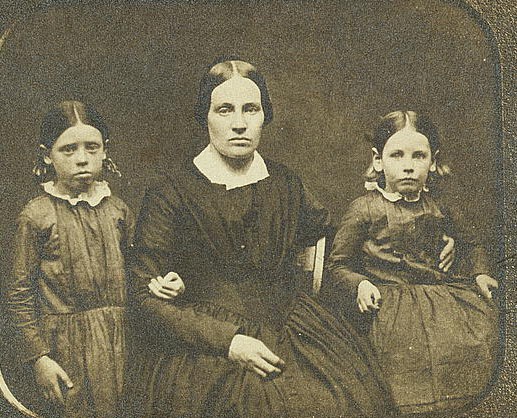
In 1831, Brown's son Frederick (I) died, at the age of 4. Brown fell ill, and his businesses began to suffer, leaving him in severe debt. In mid-1832, shortly after the death of a newborn son, his wife Dianthe also died, either in childbirth or as an immediate consequence of it. He was left with the children John Jr., Jason, Owen, Ruth and Frederick (II). On July 14, 1833, Brown married 17-year-old Mary Ann Day (1817–1884), originally from Washington County, New York;{{cite book|url=https://archive.org/details/bub_gb_o8X5krq3fP8C|title=Kansas: A Cyclopedia of State History |publisher=Standard Publishing Company|last=Blackmar |access-date=November 1, 2020 |archive-date=April 14, 2021 |archive-url=https://web.archive.org/web/20210414223932/https://www.newspapers.com/clip/62307778/anecdotes-of-john-brown/ |url-status=live
Back to Ohio
In 1836, Brown moved his family from Pennsylvania to Franklin Mills, Ohio, where he taught Sunday school. He borrowed heavily to buy land in the area, including property along canals being built, and entered into a partnership with Zenas Kent to construct a tannery along the Cuyahoga River, though Brown left the partnership before the tannery was completed.{{cite web |archive-url=https://web.archive.org/web/20071020021622/http://www.hudsonlibrary.org/hudson%20website/Archives/Archives/john%20brown/jbhome.htm|archive-date=October 20, 2007 |access-date=June 21, 2015}}{{cite news
Brown became a bank director and was estimated to be worth . Like many businessmen in Ohio, he invested too heavily in credit and state bonds and suffered great financial losses in the Panic of 1837. In one episode of property loss, Brown was jailed when he attempted to retain ownership of a farm by occupying it against the claims of the new owner.
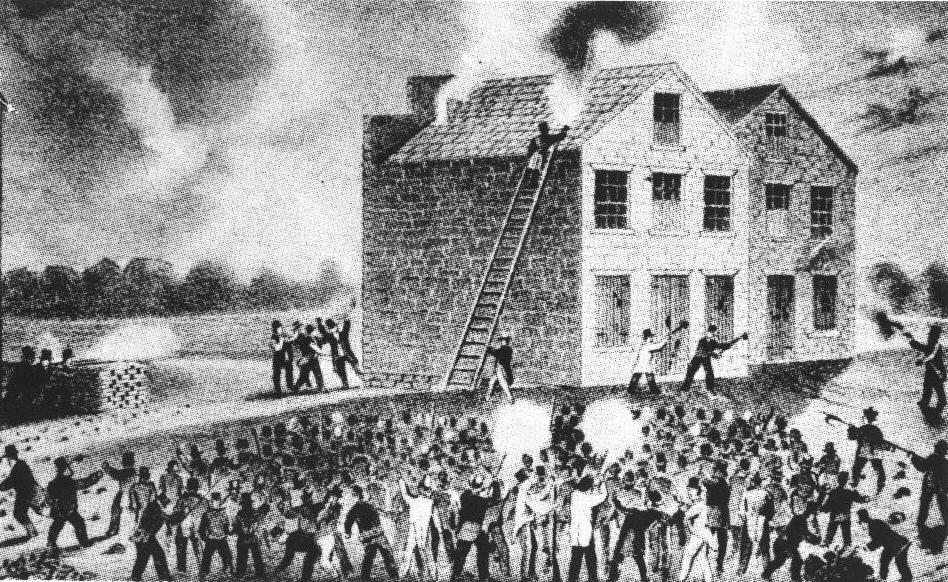
In November 1837, Elijah Parish Lovejoy was murdered in Alton, Illinois, for printing an abolitionist newspaper. Brown, deeply upset about the incident, became more militant in his behavior, comparable with Reverend Henry Highland Garnet. Brown publicly vowed after the incident: "Here, before God, in the presence of these witnesses, from this time, I consecrate my life to the destruction of slavery!"{{cite web |access-date=December 12, 2016 |archive-url=https://web.archive.org/web/20161220103009/http://law.missouri.edu/bowman/hatts/john_brown/biography.html|archive-date=December 20, 2016 |url-status=dead}} Brown objected to Black congregants being relegated to the balcony at his church in Franklin Mills. According to daughter Ruth Brown's husband Henry Thompson, whose brother was killed at Harpers Ferry:
|access-date=May 3, 2021 |archive-date=May 25, 2021 |archive-url=https://web.archive.org/web/20210525051006/https://www.newspapers.com/clip/76818707/the-brown-family-in-pasadena/ |url-status=live
For three or four years he seemed to flounder hopelessly, moving from one activity to another without plan. He tried many different business efforts attempting to get out of debt. He bred horses briefly, but gave it up when he learned that buyers were using them as race horses.{{cite journal |access-date=August 4, 2021 |archive-date=August 4, 2021 |archive-url=https://web.archive.org/web/20210804202949/https://babel.hathitrust.org/cgi/pt?id=mdp.39015038078906&view=1up&seq=63&skin=2021 |url-status=live
From the mid-1840s, Brown had built a reputation as an expert in fine sheep and wool. For about one year, he ran Captain Oviatt's farm,{{efn|Later, in 1852, Brown received five first prizes for his sheep and cattle at the Ohio State Fair.
Springfield, Massachusetts

In 1846, Brown moved to Springfield, Massachusetts, as an agent for Ohio wool growers in their relations with New England manufacturers of woolen goods, but "also as a means of developing his scheme of emancipation". The white leadership there, including "the publisher of The Republican, one of the nation's most influential newspapers, were deeply involved and emotionally invested in the anti-slavery movement".
Brown made connections in Springfield that later yielded financial support he received from New England's great merchants, allowed him to hear and meet nationally famous abolitionists like Frederick Douglass and Sojourner Truth, and included, after passage of the Fugitive Slave Act of 1850, the foundation of the League of Gileadites. Brown's personal attitudes evolved in Springfield, as he observed the success of the city's Underground Railroad and made his first venture into militant, anti-slavery community organizing. In speeches, he pointed to the martyrs Elijah Lovejoy and Charles Turner Torrey as white people "ready to help blacks challenge slave-catchers". In Springfield, Brown found a city that shared his own anti-slavery passions, and each seemed to educate the other. Certainly, with both successes and failures, Brown's Springfield years were a transformative period of his life that catalyzed many of his later actions.
Two years before Brown's arrival in Springfield, in 1844, the city's African-American abolitionists had founded the Sanford Street Free Church, now known as St. John's Congregational Church, which became one of the most prominent abolitionist platforms in the United States. From 1846 until he left Springfield in 1850, Brown was a member of the Free Church, where he witnessed abolitionist lectures by the likes of Frederick Douglass and Sojourner Truth. In 1847, after speaking at the Free Church, Douglass spent a night speaking with Brown, after which Douglass wrote, "From this night spent with John Brown in Springfield, Mass. [in] 1847, while I continued to write and speak against slavery, I became all the same less hopeful for its peaceful abolition."
During Brown's time in Springfield, he became deeply involved in transforming the city into a major center of abolitionism, and one of the safest and most significant stops on the Underground Railroad. Brown contributed to the 1848 republication, by his friend Henry Highland Garnet, of David Walker's An Appeal to the Colored Citizens of the World (1829), which he helped publicize.
Before Brown left Springfield in 1850, the United States passed the Fugitive Slave Act, a law mandating that authorities in free states aid in the return of escaped slaves and imposing penalties on those who aid in their escape. In response, Brown founded a militant group to prevent the recapture of fugitives, the League of Gileadites, operated by free Blacks—like the "strong-minded, brave, and dedicated" Eli Baptist, William Montague, and Thomas Thomas—who risked being caught by slave catchers and sold into slavery. Upon leaving Springfield in 1850, he instructed the League to act "quickly, quietly, and efficiently" to protect slaves that escaped to Springfieldwords that would foreshadow Brown's later actions preceding Harpers Ferry. From Brown's founding of the League of Gileadites onward, not one person was ever taken back into slavery from Springfield.
His daughter Amelia died in 1846, followed by Emma in 1849.
New York
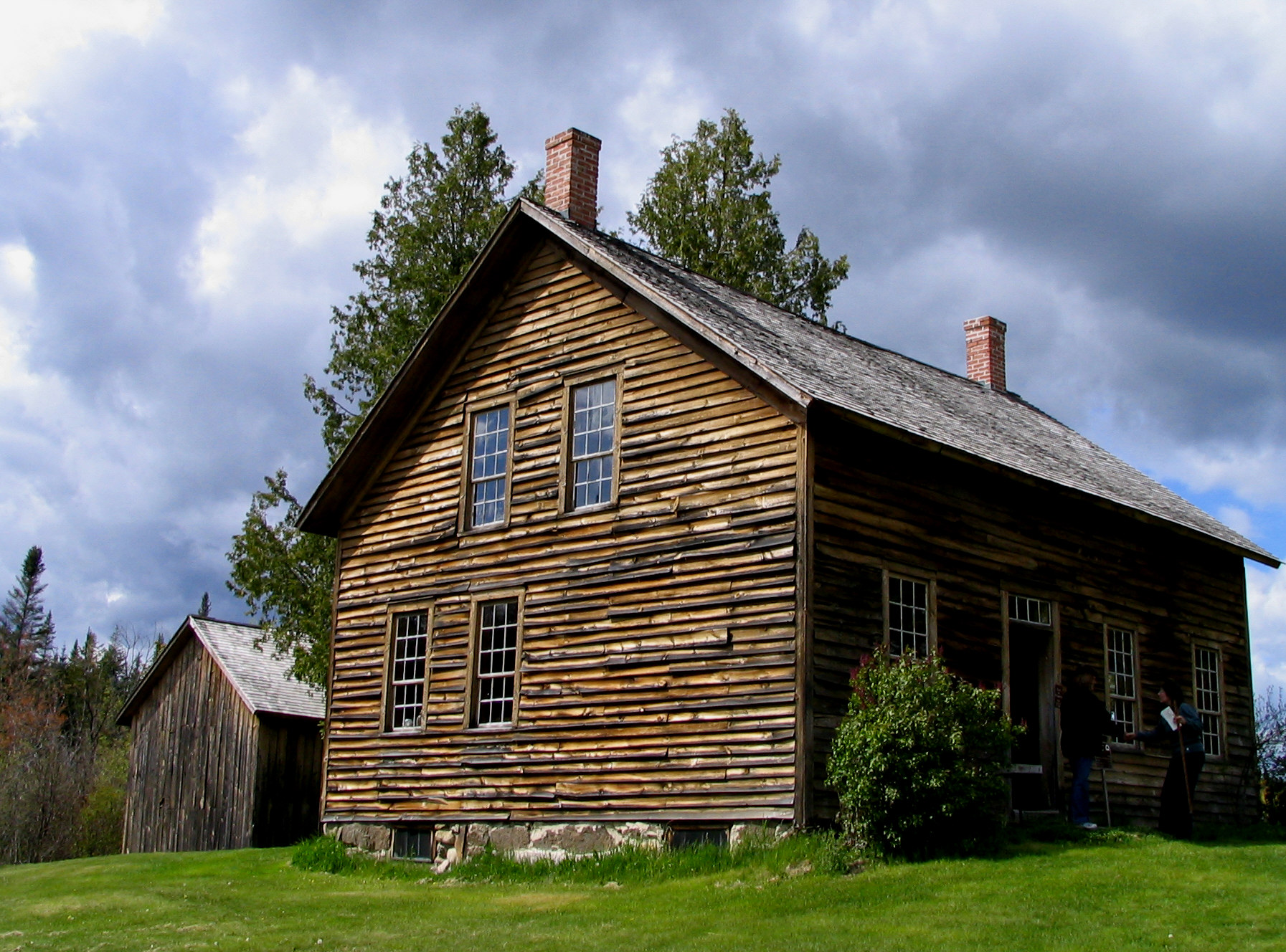
In 1848, bankrupt and having lost the family's house, Brown heard of Gerrit Smith's Adirondack land grants to poor black men, in so remote a location that Brown later called it Timbuctoo, and decided to move his family there to establish a farm where he could provide guidance and assistance to the blacks who were attempting to establish farms in the area.{{cite web |access-date=December 15, 2018 |archive-date=October 20, 2018 |archive-url=https://web.archive.org/web/20181020074541/http://www.nyhistory.com/gerritsmith/nelba.htm |url-status=dead |access-date=November 8, 2020 |archive-date=November 16, 2020 |archive-url=https://web.archive.org/web/20201116025051/https://newspaperarchive.com/indianapolis-journal-oct-18-1882-p-2/ |url-status=live |access-date=November 11, 2020 |archive-date=April 12, 2021 |archive-url=https://web.archive.org/web/20210412104910/https://www.newspapers.com/clip/63000537/burial-of-john-brown-in-north-elba/ |url-status=live
After he was executed on December 2, 1859, his widow took his body there for burial; the trip took five days, and he was buried on December 8. Watson's body was located and buried there in 1882. In 1899 the remains of 12 of Brown's other collaborators, including his son Oliver, were located and brought to North Elba. They could not be identified well enough for separate burials, so they are buried together in a single casket donated by the town of North Elba; there is a collective plaque there now. Since 1895, the John Brown Farm State Historic Site has been owned by New York State and is now a National Historic Landmark.
Actions in Kansas
Kansas Territory was in the midst of a state-level civil war from 1854 to 1860, referred to as the Bleeding Kansas period, between pro- and anti-slavery forces. From 1854 to 1856, there had been eight killings in Kansas Territory attributable to slavery politics. There had been no organized action by abolitionists against pro-slavery forces by 1856. The issue was to be decided by the voters of Kansas, but who these voters were was not clear; there was widespread voting fraud in favor of the pro-slavery forces, as a Congressional investigation confirmed.{{Cite report |author-link=34th United States Congress |archive-url=https://web.archive.org/web/20110811023716/http://quod.lib.umich.edu/cgi/t/text/text-idx?type=simple;c=moa;cc=moa;sid=1f5114455ee8820b080a95813f091487;rgn=title;q1=troubles%20in%20kansas;firstpubl1=1800;firstpubl2=1925;view=toc;subview=detail;sort=occur;start=1;size=25;idno=AFK4445.0001.001 |archive-date=August 11, 2011 |url-status=live |access-date=March 16, 2022
Move to Kansas
Five of Brown's sons—John Jr., Jason, Owen, Frederick, and Salmon—moved to Kansas Territory in the spring of 1855. Brown, his son Oliver, and his son-in-law Henry Thompson followed later that year with a wagon loaded with weapons and ammunition. Brown stayed with Florella (Brown) Adair and the Reverend Samuel Adair, his half-sister and her husband, who lived near Osawatomie. During that time, he rallied support to fight proslavery forces, and became the leader of the antislavery forces in Kansas.
Pottawatomie
Main article: Pottawatomie massacre, Bleeding Kansas

Brown and the free-state settlers intended to bring Kansas into the union as a slavery-free state. After the winter snows thawed in 1856, the pro-slavery activists began a campaign to seize Kansas on their own terms. Brown was particularly affected by the sacking of Lawrence, the center of anti-slavery activity in Kansas, on May 21, 1856. A sheriff-led posse from Lecompton, the center of pro-slavery activity in Kansas, destroyed two abolitionist newspapers and the Free State Hotel. Only one man, a border ruffian, was killed.
Preston Brooks's May 22 caning of anti-slavery Senator Charles Sumner in the United States Senate, news of which arrived by newswire (telegraph), also fueled Brown's anger. A pro-slavery writer, Benjamin Franklin Stringfellow, of the Squatter Sovereign, wrote that "[pro-slavery forces] are determined to repel this Northern invasion, and make Kansas a slave state; though our rivers should be covered with the blood of their victims, and the carcasses of the abolitionists should be so numerous in the territory as to breed disease and sickness, we will not be deterred from our purpose". Brown was outraged by both the violence of the pro-slavery forces and what he saw as a weak and cowardly response by the antislavery partisans and the Free State settlers, whom he described as "cowards, or worse".
The Pottawatomie massacre occurred during the night of May 24 and the morning of May 25, 1856. Under Brown's supervision, his sons and other abolitionist settlers took from their residences and killed five "professional slave hunters and militant pro-slavery" settlers.{{cite web |access-date=February 10, 2019 |archive-date=March 24, 2016 |archive-url=https://web.archive.org/web/20160324204848/http://thelibertarianrepublic.com/defense-john-brown/ |url-status=live}} The massacre was the match in the powderkeg that precipitated the bloodiest period in "Bleeding Kansas" history, a three-month period of retaliatory raids and battles in which 29 people died.{{cite journal |archive-url=https://web.archive.org/web/20171019165328/http://www.kshs.org/publicat/history/1995summer_watts.pdf |archive-date=October 19, 2017 |url-status=live
Henry Clay Pate, who was part of the sacking of Lawrence, was, either during or shortly before, commissioned as a Deputy United States Marshal. On hearing news of John Brown's actions at the Pottawatomie Massacre, Pate set out with a band of thirty men to hunt Brown down.{{cite book
Palmyra and Osawatomie
In the Battle of Black Jack of June 2, 1856, John Brown, nine of his followers, and 20 local men successfully defended a Free State settlement at Palmyra, Kansas, against an attack by Henry Clay Pate. Pate and 22 of his men were taken prisoner.
In August, a company of over 300 Missourians under the command of General John W. Reid crossed into Kansas and headed toward Osawatomie, intending to destroy the Free State settlements there and then march on Topeka and Lawrence. On the morning of August 30, 1856, they shot and killed Brown's son Frederick and his neighbor David Garrison on the outskirts of Osawatomie. Brown, outnumbered more than seven to one, arranged his 38 men behind natural defenses along the road. Firing from cover, they managed to kill at least 20 of Reid's men and wounded 40 more. Reid regrouped, ordering his men to dismount and charge into the woods. Brown's small group scattered and fled across the Marais des Cygnes River. One of Brown's men was killed during the retreat and four were captured. While Brown and his surviving men hid in the woods nearby, the Missourians plundered and burned Osawatomie. Though defeated, Brown's bravery and military shrewdness in the face of overwhelming odds brought him national attention and made him a hero to many Northern abolitionists.
On September 7, Brown entered Lawrence to meet with Free State leaders and help fortify against a feared assault. At least 2,700 pro-slavery Missourians were once again invading Kansas. On September 14, they skirmished near Lawrence. Brown prepared for battle, but serious violence was averted when the new governor of Kansas, John W. Geary, ordered the warring parties to disarm and disband, and offered clemency to former fighters on both sides.
Brown had become infamous and federal warrants were issued for his arrest due to his actions in Kansas. He became careful of how he travelled and whom he stayed with across the country.
Raid at Harpers Ferry
Main article: John Brown's raid on Harpers Ferry
Brown's plans
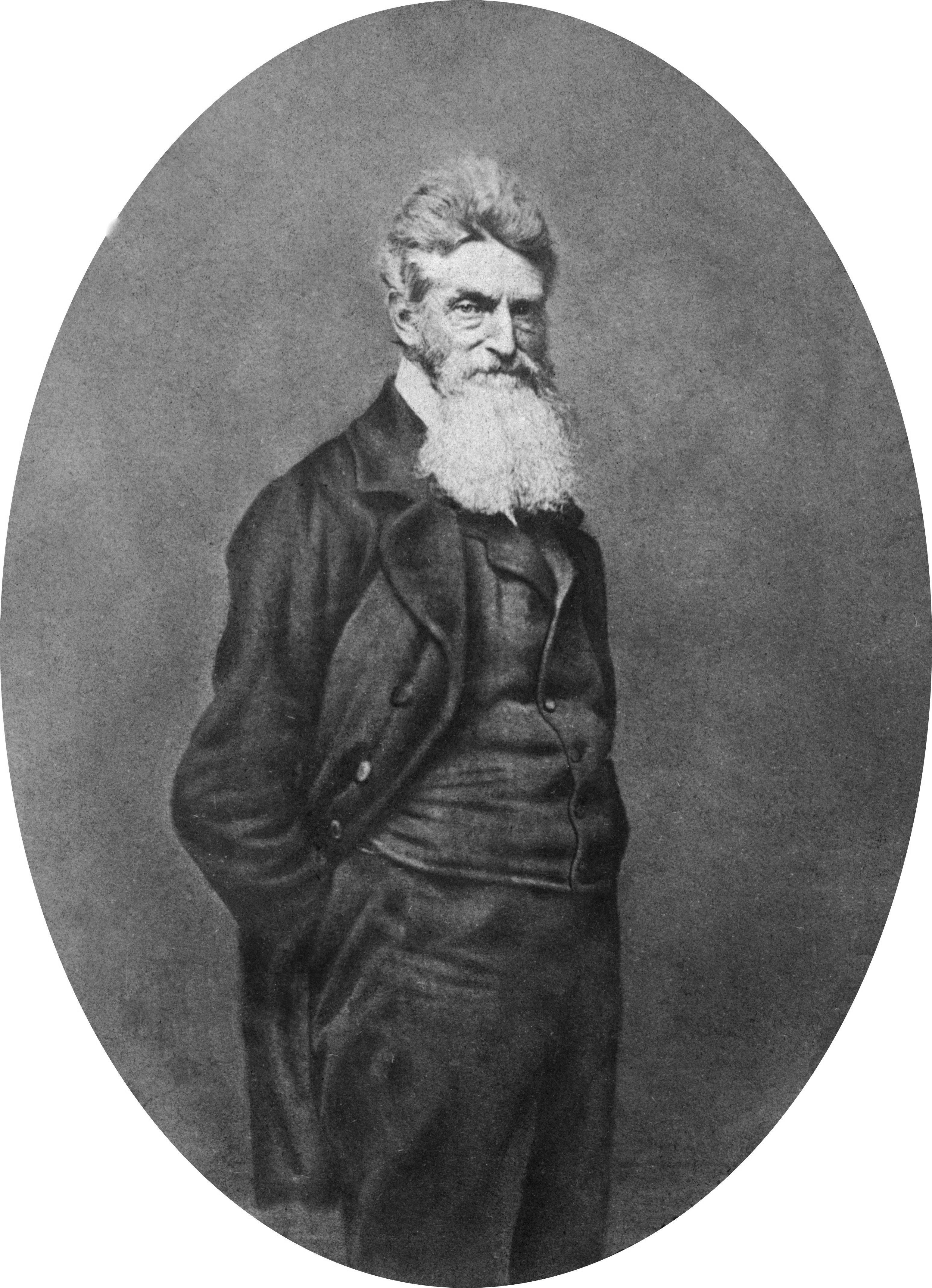
Brown's plans for a major attack on American slavery began long before the raid. According to his wife Mary, interviewed while her husband was awaiting his execution, Brown had been planning the attack for 20 years.{{cite news |access-date=February 16, 2022 |archive-date=February 16, 2022 |archive-url=https://web.archive.org/web/20220216124626/https://cdnc.ucr.edu/?a=d&d=SDU18591219.2.3 |url-status=live |author-link=Frederick Douglass |access-date=July 21, 2021 |archive-date=February 2, 2021 |archive-url=https://web.archive.org/web/20210202032535/https://www.accessible.com/accessible/docButton?AAWhat=builtPage&AAWhere=DOUGLASSMONTHLY.18591100_001.image&AABeanName=toc3&AANextPage=%2FprintBrowseBuiltImagePage.jsp |url-status=live
According to his first biographer James Redpath, "for thirty years, he secretly cherished the idea of being the leader of a servile insurrection: the American Moses, predestined by Omnipotence to lead the servile nations in our Southern States to freedom."{{cite news |access-date=November 11, 2020 |archive-date=July 21, 2021 |archive-url=https://web.archive.org/web/20210721121810/https://www.newspapers.com/clip/63027513/various-things-connected-with-john/ |url-status=live |author-link=William Frederick Milton Arny
Brown said that,
Brown kept his plans a secret, including the care he took not to share the plans with his men, according to Jeremiah Anderson, one of the participants in the raid. His son Owen, the only one who survived of Brown's three participating sons, said in 1873 that he did not think his father wrote down the entire plan.{{cite magazine |access-date=May 25, 2021 |archive-date=November 7, 2020 |archive-url=https://web.archive.org/web/20201107072844/https://babel.hathitrust.org/cgi/pt?id=chi.25763588&view=2up&seq=352 |url-status=live
Preparations
Financial and political backing
To attain financial backing and political support for the raid on Harpers Ferry, Brown spent most of 1857 meeting with abolitionists in Massachusetts, New York, and Connecticut. Initially Brown returned to Springfield, where he received contributions, and also a letter of recommendation from a prominent and wealthy merchant, George Walker. Walker was the brother-in-law of Franklin Benjamin Sanborn, the secretary for the Massachusetts State Kansas Committee, who introduced Brown to several influential abolitionists in the Boston area in January 1857. Amos Adams Lawrence, a prominent Boston merchant, secretly gave Brown a large amount of cash. William Lloyd Garrison, Thomas Wentworth Higginson, Theodore Parker and George Luther Stearns, and Samuel Gridley Howe also supported Brown, although Garrison, a pacifist, disagreed about the need to use violence to end slavery.
Most of the money for the raid came from the "Secret Six", Franklin B. Sanborn, Samuel G. Howe M.D., businessman George L. Stearns, real estate tycoon Gerrit Smith, transcendentalist and reforming minister of the Unitarian church Theodore Parker, and Unitarian minister Thomas Wentworth Higginson. Recent research has also highlighted the substantial contribution of Mary Ellen Pleasant, an African American entrepreneur and abolitionist, who donated $30,000 () toward the cause.
In Boston, he met Henry David Thoreau and Ralph Waldo Emerson. Even with the Secret Six and other contributors, Brown had not collected all money needed to fund the raid. He wrote an appeal, Old Browns Farewell, to abolitionists in the east with some success.
In December 1857, an anti-slavery Mock Legislature, organized by Brown, met in Springdale, Iowa. On several of Brown's trips across Iowa he preached at Hitchcock House, an Underground Railroad stop in Lewis, Iowa.
"Virginia scheme"

With a free-state victory in the October elections, Kansas was quiet. Brown made his men return to Iowa, where he told them tidbits of his Virginia scheme. In January 1858, Brown left his men in Springdale, Iowa, and set off to visit Frederick Douglass in Rochester, New York. There he discussed his plans with Douglass, and reconsidered Forbes' criticisms. Brown wrote a Provisional Constitution that would create a government for a new state in the region of his invasion. He then traveled to Peterboro, New York, and Boston to discuss matters with the Secret Six. In letters to them, he indicated that, along with recruits, he would go into the South equipped with weapons to do "Kansas work". While in Boston making secret preparations for his operation on Harper's Ferry, he was raising money for weapons that were manufactured in Connecticut. Abolitionist Chaplain Photius Fisk gave him a sizable donation and obtained his autograph which he later gave to the Kansas Historical Society.
Brown started to wear a beard, "to change his usual appearance".{{cite news |orig-date=April 21, 1895 |archive-url=https://web.archive.org/web/20210723164803/https://www.newspapers.com/clip/82029197/with-john-brown-in-kansas-what/ |archive-date=July 23, 2021 |url-status=live |access-date=March 16, 2022 First published in the Brooklyn Daily Eagle
Weapons
The Massachusetts Committee pledged to provide 200 Sharps Rifles and ammunition, which were being stored at Tabor, Iowa. The rifles were originally intended for use by free-staters in Kansas. After negotiation between the officers of the Massachusetts Kansas Committee and the National Committee, the rifles were transferred to the Massachusetts Committee for use in the Harpers Ferry raid. Horatio N. Rust, a friend of Brown's, helped acquire for 1,000 pikes for the intended slave rebellion.
Weapons were purchased and sent to Kennedy Farmhouse in Sharpsburg, Maryland, where they were stored. Brown's plan was to make use of weapons, ammunition, and other military equipment stored at the armory, arsenal, and the rifle factory in Harpers Ferry. There were an estimated 100,000 muskets and rifles at the armory and arsenal complex at the time.
The more sophisticated weapons, like Sharps rifles and pistols, were to be used by Black and White officers. The remaining fighters would use spear-like pikes, shotguns, and muskets.
Constitutional convention in Ontario

Brown and 12 of his followers, including his son Owen, traveled to Chatham, Ontario, where he convened on May 10 a Constitutional Convention.{{cite journal |access-date=February 5, 2021 |archive-date=February 13, 2021 |archive-url=https://web.archive.org/web/20210213020758/https://slate.com/human-interest/2013/12/john-brown-the-abolitionist-s-declaration-of-liberty-written-by-owen-brown-in-scroll-form.html |url-status=live |author-link=John Brown (abolitionist) |access-date=February 5, 2021 |archive-date=April 13, 2021 |archive-url=https://web.archive.org/web/20210413200515/http://digitalhistory.hsp.org/pafrm/doc/declaration-liberty-representatives-slave-population-united-states-america-july-4-1859 |url-status=live
Crisis
While in New York City, Brown was introduced to Hugh Forbes, an English mercenary, who had experience as a military tactician fighting with Giuseppe Garibaldi. Concerned about Brown's strategy, Forbes undermined and delayed the plans for the raid.
Although nearly all of the delegates signed the constitution, few volunteered to join Brown's forces, although it will never be clear how many Canadian expatriates actually intended to join Brown because of a subsequent "security leak" that threw off plans for the raid, creating a hiatus in which Brown lost contact with many of the Canadian leaders. This crisis occurred when Hugh Forbes, Brown's mercenary, tried to expose the plans to Massachusetts Senator Henry Wilson and others. The Secret Six feared their names would be made public. Howe and Higginson wanted no delays in Brown's progress, while Parker, Stearns, Smith and Sanborn insisted on postponement. Stearns and Smith were the major sources of funds, and their words carried more weight. To throw Forbes off the trail and invalidate his assertions, Brown returned to Kansas in June, and remained in that vicinity for six months. There he joined forces with James Montgomery, who was leading raids into Missouri.
Continue to organize funds and forces

On December 20, Brown led his own raid, in which he liberated 11 slaves, took captive two white men, and looted horses and wagons. The Governor of Missouri announced a reward of $3,000 () for his capture. On January 20, 1859, he embarked on a lengthy journey to take the liberated slaves to Detroit and then on a ferry to Canada. While passing through Chicago, Brown met with abolitionists Allan Pinkerton, John Jones, and Henry O. Wagoner who arranged and raised the fare for the passage to Detroit and purchased supplies for Brown. Jones's wife and fellow abolitionist, Mary Jane Richardson Jones, provided new clothes for Brown and his men, including the garb Brown was hanged in six months later. On March 12, 1859, Brown met with Frederick Douglass and Detroit abolitionists George DeBaptiste, William Lambert, and others at William Webb's house in Detroit to discuss emancipation. DeBaptiste proposed that conspirators blow up some of the South's largest churches. The suggestion was opposed by Brown, who felt humanity precluded such unnecessary bloodshed.
Over the course of the next few months, he traveled again through Ohio, New York, Connecticut, and Massachusetts to drum up more support for the cause. On May 9, he delivered a lecture in Concord, Massachusetts, that Amos Bronson Alcott, Emerson, and Thoreau attended. Brown reconnoitered with the Secret Six.

As he began recruiting supporters for an attack on slaveholders, Brown was joined by Harriet Tubman, "General Tubman", as he called her. Her knowledge of support networks and resources in the border states of Pennsylvania, Maryland, and Delaware was invaluable to Brown and his planners. She also raised funds for Brown.
Some abolitionists, including Frederick Douglass and William Lloyd Garrison, opposed his tactics, but Brown dreamed of fighting to create a new state for freed slaves and made preparations for military action. After he began the first battle, he believed, slaves would rise up and carry out a rebellion across the South.
Brown's forces
Main article: John Brown's raiders
The men that fought with Brown in Kansas gathered at Springdale, Iowa, a Quaker settlement, about January 1858, to prepare to execute Brown's Virginia scheme.
In June, Brown paid his last visit to his family in North Elba before departing for Harpers Ferry. He stayed one night en route in Hagerstown, Maryland, at the Washington House, on West Washington Street. On June 30, 1859, the hotel had at least 25 guests, including I. Smith and Sons, Oliver Smith and Owen Smith, and Jeremiah Anderson, all from New York. From papers found in the Kennedy Farmhouse after the raid, it is known that Brown wrote to Kagi that he would sign into a hotel as I. Smith and Sons.
The men who prepared for the raid at Kennedy Farmhouse and participated in the raid with Brown included two groups of men:
:A group that fought with him in Kansas and gathered at Springdale, Iowa, to prepare and drill for the raid, :* Jeremiah Goldsmith Anderson, 26, born in Indiana, served with Brown in Kansas, killed in the raid. :* Oliver Brown, 20, John Brown's son, served in Kansas. He was mortally wounded during the raid. :* Owen Brown, about 35, John Brown's son, fought in Kansas. He escaped the raid. :* John E. Cook, 29, reformer and former soldier, attended Oberlin College, he initially escaped capture, but was found and hanged. :* Albert Hazlett, 23, fought in Kansas, escaped following the raid, but was captured and hanged. :* John Henry Kagi, about 24, a teacher, became Brown's second in command. Before the raid he printed copies of Brown's constitution in a printing shop he established in Hamilton, Ontario. He was mortally wounded during the raid. :* William H. Leeman, 20, fought with the free-staters in Kansas for three years, beginning at the age of 17. He died during the raid. :* Aaron Dwight Stevens, about 28, was a former soldier and fighter in Kansas, who gave the men military training and drills. He was wounded during the raid, after which he was executed. :* Charles Plummer Tidd, 25, fought in Kansas. He escaped the raid and later served during the Civil War.
:Men he met when rounding up recruits for the raid: :* Watson Brown, son of John Brown, mortally wounded during the raid. :* John Anthony Copeland Jr. was a free black man who joined John Brown's raid on Harpers Ferry. He was captured during the raid and was executed. :* Barclay Coppoc, 19, escaped capture following the raid. He fought in the Civil War. :* Edwin Coppoc, 24, captured and hanged. :* Shields Green, about 23, escaped slavery, captured and hanged. :* Lewis Sheridan Leary, a harness maker freed by his white father, mortally wounded during the raid. :* Francis Jackson Meriam, 22, grandson of Francis Jackson who was a leader of Antislavery Societies. Meriam was an aristocrat. He escaped during the raid. Meriam led an African American infantry group during the Civil War. :* Dangerfield Newby, 44, born a slave, escaped slavery, returned to Virginia to fight in the raid, where he was killed. :* Stewart Taylor, 23, a wagonmaker from Canada, mortally wounded during the raid. :* Dauphin Thompson, 21, married to Ruth Brown, John Brown's daughter, mortally wounded during the raid. :* William Thompson, 26, mortally wounded during the raid.

They were at Kennedy Farmhouse, four to five miles away from Harpers Ferry. Brown's daughter Annie Brown or Anne in some writings, and daughter-in-law Martha, Oliver's wife. The two prepared food and kept the house for the men from August and throughout the month of September. Annie also acted as a lookout for her father and sometimes intercepted curious neighbors.
Raid
Main article: John Brown's raid on Harpers Ferry#Timeline of the raid
Brown led his forces for Harper Ferry on the night of October 16, 1859. The objective was to take the armory, the arsenal, the town, and then the rifle factory. Then, they wanted to free all the slaves in Harpers Ferry. After that, they would move south with those newly freed people who wanted to join the fight to free other enslaved people. Brown told his men to take prisoners who disobeyed them and to fight only in self-defense.
Initially, they met no resistance entering the town. John Brown's raiders cut the telegraph wires and easily captured the armory, which was being defended by a single watchman. They next rounded up hostages from nearby farms, including Colonel Lewis Washington, great-grandnephew of George Washington. They also spread the news to the local slaves that their liberation was at hand.{{cite web | access-date = January 11, 2008 | archive-date = January 11, 2008 | archive-url = https://web.archive.org/web/20080111050237/http://www.wvculture.org/History/jnobrown.html | url-status = dead}}, wvculture.org; accessed August 29, 2015.
When an eastbound Baltimore and Ohio Railroad train approached the town, Brown held it and then inexplicably allowed it to continue on its way. At the next station where the telegraph still worked, the conductor sent a telegram to B&O headquarters in Baltimore. The railroad sent telegrams to President Buchanan and Virginia Governor Henry A. Wise.{{cite book
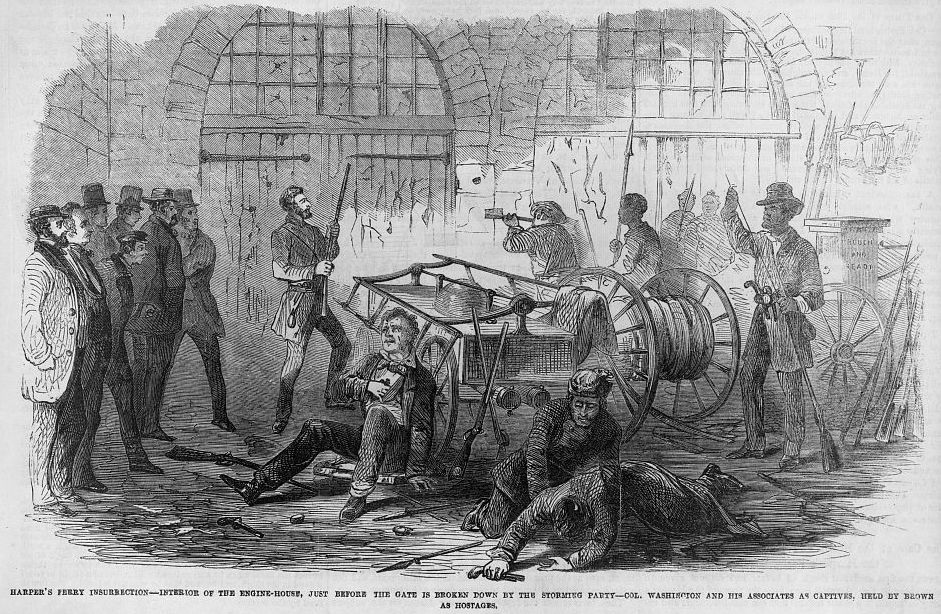
By the morning of October 18 the engine house, later known as John Brown's Fort, was surrounded by a company of U.S. Marines under the command of First Lieutenant Israel Greene, USMC, with Colonel Robert E. Lee of the United States Army in overall command.
Army First Lieutenant J. E. B. Stuart approached the engine-house to apprehend Brown and told the raiders their lives would be spared if they surrendered. Brown refused, saying, "No, I prefer to die here." Stuart then gave a signal and the Marines used sledgehammers and a makeshift battering ram to break down the engine room door. Lieutenant Israel Greene cornered Brown and struck him several times, wounding his head. In three minutes, Brown and the survivors were captives.
Altogether, Brown's men killed four townspeople and one Marine. Ten people were wounded, one of whom was a Marine. Four of Brown's men were not captured, the rest died during the raid or were captured and executed. Among the raiders killed were John Henry Kagi, Lewis Sheridan Leary, and Dangerfield Newby; those hanged besides Brown included John Copeland, Edwin Coppock, Aaron Stevens, and Shields Green.{{cite web |url= http://www2.iath.virginia.edu/jbrown/people.html |access-date= October 16, 2012 |archive-date= November 1, 2012 |archive-url= https://web.archive.org/web/20121101062954/http://www2.iath.virginia.edu/jbrown/people.html |url-status= dead }}{{cite news |access-date=February 18, 2020 |language=en |archive-date=February 17, 2020 |archive-url=https://web.archive.org/web/20200217211217/https://www.washingtonpost.com/history/2019/10/13/five-black-men-raided-harpers-ferry-with-john-brown-theyve-been-forgotten/ |url-status=live }} Most of the enslaved people were returned to their slaveholders, while some were able to escape capture. A man named Phil was captured with Brown, and a man named Jim drowned in the Shenandoah.
Brown and the others captured were held in the office of the armory. On October 18, 1859, Virginia Governor Henry A. Wise, Virginia Senator James M. Mason, and Representative Clement Vallandigham of Ohio arrived in Harpers Ferry. Brown conceded that he did not receive the support he expected from White and Black people. The questioning lasted several hours.
Trial
Main article: Virginia v. John Brown

.jpg)

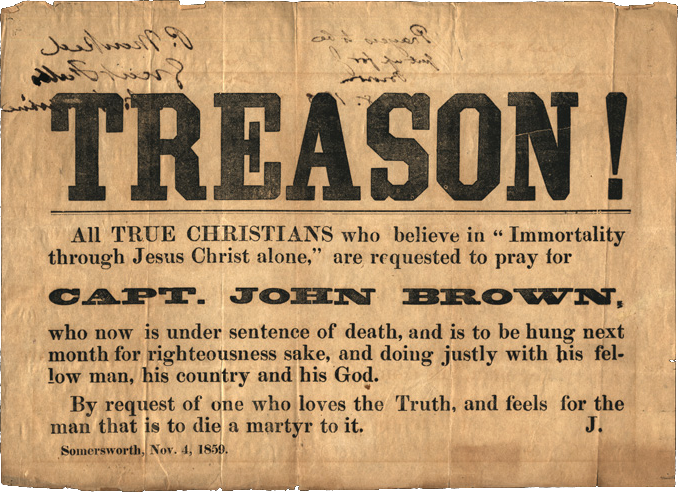
Brown was charged with treason and tried in a Virginia state court at Governor Wise's request. Accordingly, the charge was treason against Virginia. President Buchanan did not object.
Brown was tried with his men who had lived through the raid and had not escaped—Copeland, Coppoc, Green, and Stevens—on charges of murder, "conspiracy to foment a slave insurrection", and treason, as of October 26.
On November 2, after a week-long trial in Charles Town, the county seat of Jefferson County, and 45 minutes of deliberation, the jury found Brown guilty on all three counts. He was sentenced to be hanged in public on December 2. He was the first person executed for treason in the history of the United States.{{cite news |access-date=March 18, 2022 |archive-date=April 13, 2022 |archive-url=https://web.archive.org/web/20220413135927/https://nyshistoricnewspapers.org/lccn/sn83030973/1859-12-03/ed-1/seq-2/ |url-status=live
The trial attracted reporters who were able to send their articles via the new telegraph. They were reprinted in numerous papers. It was the first trial in the U.S. to be nationally reported.
November 2 to December 2, 1859
Before his conviction, reporters were not allowed access to Brown, as the judge and Andrew Hunter feared that his statements, if quickly published, would exacerbate tensions, especially among the enslaved. This was much to Brown's frustration, as he stated that he wanted to make a full statement of his motives and intentions through the press. Once he had been convicted, the restriction was lifted, and, glad for the publicity, he talked with reporters and anyone else who wanted to see him, except pro-slavery clergy.{{cite news |orig-date=November 25, 1859 |access-date=June 3, 2021 |archive-date=June 3, 2021 |archive-url=https://web.archive.org/web/20210603101550/https://www.newspapers.com/clip/78853788/a-visit-to-john-brown-by-an-old-friend/ |url-status=live
Rescue and Victor Hugo's pardon plans
There were well-documented and specific plans to rescue Brown, as Virginia Governor Henry A. Wise wrote to President Buchanan. Throughout the weeks Brown and six of his collaborators were in the Jefferson County Jail in Charles Town, the town was filled with various types of troops and militia, hundreds and sometimes thousands of them. Brown's trips from the jail to the courthouse and back, and especially the short trip from the jail to the gallows, were heavily guarded. Wise halted all non-military transportation on the Winchester and Potomac Railroad (from Maryland south through Harpers Ferry to Charles Town and Winchester), from the day before through the day after the execution. Jefferson County was under martial law,{{cite news |access-date=November 16, 2020 |archive-date=December 9, 2020 |archive-url=https://web.archive.org/web/20201209093235/https://www.newspapers.com/clip/63369403/john-browns-execution/ |url-status=live
However, Brown said several times that he did not want to be rescued. He refused the assistance of Silas Soule, a friend from Kansas who infiltrated the Jefferson County Jail one day by getting himself arrested for drunken brawling and offered to break him out during the night and flee northward to New York State and possibly Canada. Brown told Silas that, aged 59, he was too old to live a life on the run from the federal authorities as a fugitive and wanted to accept his execution as a martyr for the abolitionist cause. As Brown wrote his wife and children from jail, he believed that his "blood will do vastly more towards advancing the cause I have earnestly endeavoured to promote, than all I have done in my life before."{{cite news |author-link=John Brown (abolitionist) |orig-date=November 8, 1859 |author-link=Gamaliel Bradford (biographer) |access-date=December 8, 2020 |archive-date=November 23, 2020 |archive-url=https://web.archive.org/web/20201123225513/https://www.theatlantic.com/past/docs/issues/22nov/bradford.htm |url-status=live
Victor Hugo, from exile on Guernsey, tried to obtain a pardon for John Brown: he sent an open letter that was published by the press on both sides of the Atlantic. This text warned of a possible civil war:
The letter was initially published in the London News and was widely reprinted. After Brown's execution, Hugo wrote a number of additional letters about Brown and the abolitionist cause.
Abolitionists in the United States saw Hugo's writings as evidence of international support for the anti-slavery cause. The most widely publicized commentary on Brown to reach America from Europe was an 1861 pamphlet, John Brown par Victor Hugo, that included a brief biography and reprinted two letters by Hugo, including that of December 9, 1859. The pamphlet's frontispiece was an engraving of a hanged man by Hugo that became widely associated with the execution.
Last words, death and aftermath
On December 1, 1859, Mary Ann Brown, who had stayed away from the prison due to Brown's concern for her safety, visited her husband for several hours with permission from Governor Wise.
On the day of his execution, December 2, Brown read his Bible and wrote a final letter to his wife, which included the will he had written the previous day,{{cite news |access-date=July 3, 2021 |archive-date=July 9, 2021 |archive-url=https://web.archive.org/web/20210709183129/https://www.newspapers.com/clip/80724453/john-browns-will/ |url-status=live

Brown was well read and knew that the last words of prominent people are valued. That morning, Brown wrote and gave to his jailor Avis the words he wanted to be remembered by:
I, John Brown, am now quite certain that the crimes of this guilty land will never be purged away but with blood. I had, as I now think, vainly flattered myself that without very much bloodshed it might be done.

At 11:00 a.m. Brown rode, sitting on his coffin in a furniture wagon, from the county jail through a crowd of 2,000 soldiers to a small field a few blocks away, where the gallows were. The military, prepared for an attack, lined the square where Brown was to be hanged, with "the greatest array of disciplined forces ever seen in Virginia", according to Major Preston. Among the soldiers in the crowd were Robert E Lee (cite source), future Confederate general Stonewall Jackson, and John Wilkes Booth (the latter borrowing a militia uniform to gain admission to the execution). Also present was the pro-slavery activist Edmund Ruffin, who later purchased some of the blades from John Brown's pikes and sent one to the governor of each slave state, as a reminder of Northern enmity against their cause. Ruffin was also credited for firing one of the first cannons against Fort Sumter, which initiated the Civil War in 1861.
Brown, who did not want to have a minister with him, displayed "the most complete fearlessness of & insensibility to danger & death" as he walked to the gallows. Brown was hanged at 11:15 a.m. and was pronounced dead 35 minutes later.
The poet Walt Whitman, in Year of Meteors, described viewing the execution.
Funeral and burial
Main article: John Brown's body


Due to people's certainty of Brown's execution, there was debate over what to do with his body even whilst his trial was still ongoing. Professor of anatomy Arthur E. Peticolas petitioned prosecutor Andrew Hunter and Virginia governor Henry Wise for possession of Brown's body for anatomical dissection. However, national attention towards the case resulted in Brown's body being given to his wife.
Brown's desire, as told to the jailor in Charles Town, was that his body be burned, "the ashes urned", and his dead sons disinterred and treated likewise.{{cite news |access-date=November 16, 2020 |archive-date=December 9, 2020 |archive-url=https://web.archive.org/web/20201209093235/https://www.newspapers.com/clip/63369403/john-browns-execution/ |url-status=live |access-date=November 16, 2020 |archive-date=December 9, 2020 |archive-url=https://web.archive.org/web/20201209093226/https://timesmachine.nytimes.com/timesmachine/1859/12/05/issue.html |url-status=live |access-date=November 16, 2020 |archive-date=December 9, 2020 |archive-url=https://web.archive.org/web/20201209093226/https://timesmachine.nytimes.com/timesmachine/1859/12/05/issue.html |url-status=live
His body needed to be prepared for burial; this was supposed to take place in Philadelphia. There were many Southern pro-slavery medical students and faculty in Philadelphia, and as a direct result, they left the city en masse on December 21, 1859, for Southern medical schools, never to return. When Mary and her husband's body arrived on December 3, Philadelphia Mayor Alexander Henry met the train, with many policemen, and said public order could not be maintained if the casket remained in Philadelphia. In fact he "made a fake casket, covered with flowers and flags[,] which was carefully lifted from the coach"; the crowd followed the sham casket. The genuine casket was immediately sent onwards.{{cite web |access-date=November 1, 2018 |archive-date=November 13, 2018 |archive-url=https://web.archive.org/web/20181113165912/https://hsp.org/blogs/hidden-histories/john-browns-body-1859-philadelphias-medical-schools-rebellion-against-its-presence-in-the-city |url-status=live |access-date=May 28, 2021 |archive-date=April 27, 2021 |archive-url=https://web.archive.org/web/20210427175252/http://www.wvculture.org/history/jbexhibit/bbsms12-0054.html |url-status=dead
In the North, large memorial meetings took place, church bells rang, minute guns were fired, and famous writers such as Emerson and Thoreau joined many Northerners in praising Brown.
On July 4, 1860, family and admirers of Brown gathered at his farm for a memorial. This was the last time that the surviving members of Brown's family gathered together. The farm was sold, except for the burial plot. By 1882, John Jr., Owen, Jason, and Ruth, widow of Henry Thompson, lived in Ohio; his wife and their two unmarried daughters in California.{{cite news |access-date=April 17, 2021 |archive-date=April 17, 2021 |archive-url=https://web.archive.org/web/20210417100827/https://www.newspapers.com/clip/69324628/topeka-daily-capital-10aug1882p2-jb/ |url-status=live |access-date=May 28, 2021 |archive-date=July 21, 2021 |archive-url=https://web.archive.org/web/20210721121811/https://www.newspapers.com/clip/78449953/the-browns-honored-in-parade-of-grand/ |url-status=live
Senate investigation
On December 14, 1859, the U.S. Senate appointed a bipartisan committee to investigate the Harpers Ferry raid and to determine whether any citizens contributed arms, ammunition or money to John Brown's men. The Democrats attempted to implicate the Republicans in the raid; the Republicans tried to disassociate themselves from Brown and his acts.
The Senate committee heard testimony from 32 witnesses, including Liam Dodson, one of the surviving abolitionists. The report, authored by chairman James Murray Mason, a pro-slavery Democrat from Virginia, was published in June 1860. It found no direct evidence of a conspiracy, but implied that the raid was a result of Republican doctrines. The two committee Republicans published a minority report, but were apparently more concerned about denying Northern culpability than clarifying the nature of Brown's efforts. Republicans such as Abraham Lincoln rejected any connection with the raid, calling Brown "insane".
The investigation was performed in a tense environment in both houses of Congress. One senator wrote to his wife that "The members on both sides are mostly armed with deadly weapons and it is said that the friends of each are armed in the galleries." After a heated exchange of insults, a Mississippian attacked Thaddeus Stevens of Pennsylvania with a Bowie knife in the House of Representatives. Stevens' friends prevented a fight.
The Senate committee was very cautious in its questions of two of Brown's backers, Samuel Howe and George Stearns, out of fear of stoking violence. Howe and Stearns later said that the questions were asked in a manner that permitted them to give honest answers without implicating themselves. Civil War historian James M. McPherson stated that "A historian reading their testimony, however, will be convinced that they told several falsehoods."
Aftermath of the raid

John Brown's raid on Harpers Ferry was among the last in a series of events that led to the American Civil War. Southern slaveowners, hearing initial reports that hundreds of abolitionists were involved, were relieved the effort was so small, but feared other abolitionists would emulate Brown and attempt to lead slave rebellions. Future Confederate President Jefferson Davis feared "thousands of John Browns".{{cite journal |author-link=Tony Horwitz
Southern Democrats charged that Brown's raid was an inevitable consequence of the political platform of what they invariably called "the Black Republican Party". In light of the upcoming elections in November 1860, the Republicans tried to distance themselves as much as possible from Brown, condemning the raid and dismissing its leader as an insane fanatic. As one historian explains, "Brown's raid succeeded brilliantly. It drove a wedge through the already tentative and fragile Opposition–Republican coalition and helped to intensify the sectional polarization that soon tore the Democratic party and the Union apart."
Many abolitionists in the North viewed Brown as a martyr, sacrificed for the sins of the nation. Immediately after the raid, William Lloyd Garrison published a column in The Liberator, judging Brown's raid "well-intended but sadly misguided" and "wild and futile".{{cite news |author-link=William Lloyd Garrison |access-date=March 9, 2022 |archive-date=February 18, 2006 |archive-url=https://web.archive.org/web/20060218064443/http://fair-use.org/the-liberator/1859/10/28/the-tragedy-at-harpers-ferry |url-status=live |author-link=William Lloyd Garrison |access-date=November 10, 2020 |archive-date=November 10, 2020 |archive-url=https://web.archive.org/web/20201110122119/https://www.newspapers.com/clip/62929987/william-lloyd-garrison-on-john-browns/ |url-status=live
Frederick Douglass believed that Brown's "zeal in the cause of my race was far greater than mineit was as the burning sun to my taper lightmine was bounded by time, his stretched away to the boundless shores of eternity. I could live for the slave, but he could die for him."{{cite book |author-link=Frederick Douglass |access-date=March 9, 2022 Or: {{cite web |access-date=March 9, 2022
Viewpoints
Contemporaries
Between 1859 and Lincoln's assassination in 1865, Brown was the most famous American: emblem to the North, as Wendell Phillips put it,{{cite book |author-link=Wendell Phillips |access-date=August 22, 2021 |archive-date=August 27, 2021 |archive-url=https://web.archive.org/web/20210827091233/https://www.google.com/books/edition/_/XUUIAAAAQAAJ |url-status=live |access-date=January 21, 2021 |archive-date=January 29, 2021 |archive-url=https://web.archive.org/web/20210129152433/https://www.newspapers.com/clip/22594248/democrat/ |url-status=live
Other black leaders of the timeMartin Delany, Henry Highland Garnet, Harriet Tubmanalso knew and respected Brown. "Tubman thought Brown was the greatest white man who ever lived", and she said later he did more for American blacks than Lincoln did.
Black businesses across the North closed on the day of his execution. Church bells tolled across the North. In response to the death sentence, Ralph Waldo Emerson remarked that "[John Brown] will make the gallows glorious like the Cross."{{cite news |author-link=David W. Blight |access-date=June 2, 2021 |archive-date=June 3, 2021 |archive-url=https://web.archive.org/web/20210603010320/https://historynewsnetwork.org/article/120730 |url-status=live
Lincoln thought Brown had "shown great courage, rare unselfishness"; but said that he could not support Brown's use of violence.
According to W. E. B. Du Bois in his 1909 biography, John Brown, Brown's raid stood as "a great white lightan unwavering, unflickering brightness, blinding by its all-seeing brilliance, making the whole world simply a light and a darknessa right and a wrong."
According to his friend and financier, the rich abolitionist Gerrit Smith, "If I were asked to point out the man in all this world I think most truly a Christian, I would point to John Brown."{{cite journal|last=Harlow
Historians and other writers
Writers continue to vigorously debate Brown's personality, sanity, motivations, morality, and relation to abolitionism. Once the Reconstruction era had ended, with the country distancing itself from the anti-slavery cause, and martial law imposed in the South, the historical view of Brown changed. Historian James Loewen surveyed American history textbooks prior to 1995 and noted that until about 1890, historians considered Brown perfectly sane, but from about 1890 until 1970, he was generally portrayed as insane. Oswald Garrison Villard, the grandson of abolitionist William Lloyd Garrison, wrote a favorable 1910 biography of Brown, though it also added fuel to the anti-Brown fire by criticizing him as a muddled, pugnacious, bumbling, and homicidal madman. Villard himself was a pacifist and admired Brown in many respects, but his interpretation of the facts provided a paradigm for later anti-Brown writers. Similarly, a 1923 textbook stated, "The farther we getaway from the excitement of 1859 the more we are disposed to consider this extraordinary man the victim of mental delusions." In 1978, NYU historian Albert Fried concluded that historians who portrayed Brown as a dysfunctional figure are "really informing me of their predilections, their judgment of the historical event, their identification with the moderates and opposition to the 'extremists.'" This view of Brown has come to prevail in academic writing and in journalism. Biographer Louis DeCaro Jr. wrote in 2007, "there is no consensus of fairness with respect to Brown in either the academy or the media." Biographer Stephen B. Oates has described Brown as "maligned as a demented dreamer ... (but) in fact one of the most perceptive human beings of his generation".
In 1931, the United Daughters of the Confederacy and Sons of Confederate Veterans erected a counter-monument, to Heyward Shepherd, a free black man who was the first fatality of the Harpers Ferry raid, claiming without evidence that he was a "representative of Negroes of the neighborhood, who would not take part". By the mid-20th century, some scholars were fairly convinced that Brown was a fanatic and killer, while some African Americans sustained a positive view of him. According to Stephen Oates, "unlike most Americans at his time, he had no racism. He treated blacks equally. ...He was a success, a tremendous success because he was a catalyst of the Civil War. He didn't cause it but he set fire to the fuse that led to the blow up."{{citation |author-link=Stephen B. Oates |archive-url=https://web.archive.org/web/20090510102805/http://www.nps.gov/archive/hafe/jbrown/oates-text.htm |archive-date=May 10, 2009 }} Journalist Richard Owen Boyer considered Brown "an American who gave his life that millions of other Americans might be free", and others held similarly positive views.{{cite journal
Some historians, such as Paul Finkelman, compare Brown to contemporary terrorists such as Osama bin Laden and Timothy McVeigh, Finkelman calling him "simply part of a very violent world" and further stating that Brown "is a bad tactician, a bad strategist, he's a bad planner, he's not a very good generalbut he's not crazy". Historian James Gilbert labels Brown a terrorist by 21st-century criteria.{{cite book |author-link2=Paul A. Shackel |access-date=November 22, 2015 |archive-date=May 3, 2016 |archive-url=https://web.archive.org/web/20160503154049/https://books.google.com/books?id=j4kkQAA0jqMC&pg=PA101 |url-status=live|page=101}} Gilbert writes: "Brown's deeds conform to contemporary definitions of terrorism, and his psychological predispositions are consistent with the terrorist model."{{cite book |editor-first1=Peggy A. |editor-last1=Russo |editor-first2=Paul |editor-last2=Finkelman |editor-link2=Paul Finkelman
In his posthumous The Impending Crisis, 1848–1861 (1976), David Potter argued that the emotional effect of Brown's raid exceeded the philosophical effect of the Lincoln–Douglas debates, and reaffirmed a deep division between North and South. Biographer Louis A. DeCaro Jr., who has debunked many historical allegations about Brown's early life and public career, concludes that although he "was hardly the only abolitionist to equate slavery with sin, his struggle against slavery was far more personal and religious than it was for many abolitionists, just as his respect and affection for black people was far more personal and religious than it was for most enemies of slavery". Historian and Brown documentary scholar Louis Ruchames wrote: "Brown's action was one of great idealism and placed him in the company of the great liberators of mankind."
Several 21st-century works about Brown are notable for the absence of hostility that characterized similar works a century earlier (when Lincoln's anti-slavery views were de-emphasized). Journalist and documentary writer Ken Chowder considers Brown "stubborn ... egoistical, self-righteous, and sometimes deceitful; yet ... at certain times, a great man" and argues that Brown has been adopted by both the left and right, and his actions "spun" to fit the world view of the spinner at various times in American history.
Influences
Brown was born during the period of the Haitian Revolution, which saw Haitian slaves revolting against the French. The role the revolution played in helping formulate Brown's abolitionist views directly is not clear; however, the revolution had an obvious effect on the general view toward slavery in the northern United States, and in the Southern states, it was a warning of horror (as they viewed it) possibly to come. As W. E. B. Du Bois notes, the involvement of slaves in the American Revolutions, and the "upheaval in Hayti, and the new enthusiasm for human rights, led to a wave of emancipation which started in Vermont during the Revolution and swept through New England and Pennsylvania, ending finally in New York and New Jersey".
The 1839 slave insurrection aboard the Spanish ship La Amistad, off the coast of Cuba, provides a poignant example of John Brown's support and appeal toward Caribbean slave revolts. On La Amistad, Joseph Cinqué and approximately 50 other slaves captured the ship, slated to transport them from Havana to Puerto Príncipe, Cuba, in July 1839, and attempted to return to Africa. However, through trickery, the ship ended up in the United States, where Cinque and his men stood trial. Ultimately, the courts acquitted the men because at the time, the international slave trade was illegal in the United States. In 1850, Brown would refer affectionately to the revolt, in saying "Nothing so charms the American people as personal bravery. Witness the case of Cinques, of everlasting memory, on board the Amistad."
The specific knowledge John Brown gained from the tactics employed in the Haitian Revolution, and other Caribbean revolts, was of paramount importance when Brown turned his sights to the federal arsenal at Harpers Ferry, Virginia. As Brown's cohort Richard Realf explained to a committee of the 36th Congress, "he had posted himself in relation to the wars of Toussaint L'Ouverture;{{cite journal |access-date=December 11, 2020 |archive-date=July 21, 2021 |archive-url=https://web.archive.org/web/20210721121813/https://go.gale.com/ps/i.do?p=AONE&u=wikipedia&id=GALE%7CA180861432&v=2.1&it=r&sid=AONE&asid=e4ef98b1 |url-status=live |url-access=subscription
The idea of creating maroon communities was the impetus for the creation of John Brown's "Provisional Constitution and Ordinances for the People of the United States", which helped to detail how such communities would be governed. However, the idea of maroon colonies of slaves is not an idea exclusive to the Caribbean region. In fact, maroon communities riddled the southern United States between the mid-1600s and 1864, especially in the Great Dismal Swamp region of Virginia and North Carolina. Similar to the Haitian Revolution, the Seminole Wars, fought in modern-day Florida, saw the involvement of maroon communities, which although outnumbered by native allies were more effective fighters.
Although the maroon colonies of North America undoubtedly had an effect on John Brown's plan, their impact paled in comparison to that of the maroon communities in places like Haiti, Jamaica, and Surinam. Accounts by Brown's friends and cohorts prove this idea. Richard Realf, a cohort of Brown in Kansas, noted that Brown not only studied the slave revolts in the Caribbean, but focused more specifically on the maroons of Jamaica and those involved in Haiti's liberation. Brown's friend Richard Hinton similarly noted that Brown knew "by heart" the occurrences in Jamaica and Haiti. Thomas Wentworth Higginson, a cohort of Brown's and a member of the Secret Six, stated that Brown's plan involved getting "together bands and families of fugitive slaves" and "establish them permanently in those [mountain] fastnesses, like the Maroons of Jamaica and Surinam".
Legacy
Of all the major figures associated with the American Civil War, Brown is one of the most studied and pondered.{{cite journal |access-date=July 21, 2021 |archive-date=July 21, 2021 |archive-url=https://web.archive.org/web/20210721121813/https://babel.hathitrust.org/cgi/pt?id=nc01.ark%3A%2F13960%2Ft50g5xn6g&view=1up&seq=206 |url-status=live |access-date=October 2, 2020 |archive-date=July 21, 2021 |archive-url=https://web.archive.org/web/20210721121815/https://babel.hathitrust.org/cgi/pt?id=uva.x001175616&view=1up&seq=310&q1=Winchester |url-status=live |author-link=Kate Field |access-date=May 16, 2021 |archive-date=July 21, 2021 |archive-url=https://web.archive.org/web/20210721121814/https://www.google.com/books/edition/Kate_Field_s_Washington/3PYVAAAAIAAJ?hl=en&gbpv=1 |url-status=live

In 2007 Brown was inducted into the National Abolition Hall of Fame, in Peterboro, New York.
John Brown Day
- May 1: In 1999, John Brown Day was celebrated on May 1.{{cite news |access-date=February 16, 2022 |archive-date=February 16, 2022 |archive-url=https://web.archive.org/web/20220216021434/https://nyshistoricnewspapers.org/lccn/sn86033360/1999-04-15/ed-1/seq-3/ |url-status=live
- May 7: In 2016, John Brown Lives! Friends of Freedom celebrated May 7 as John Brown Day.{{cite web |access-date=December 3, 2020 |archive-date=October 23, 2020 |archive-url=https://web.archive.org/web/20201023195441/https://www.ptny.org/newsandmedia/e-news-1/2016/06/celebrating-juneteenth-and-history-timbuctoo |url-status=live |access-date=March 16, 2022 |archive-date=April 13, 2022 |archive-url=https://web.archive.org/web/20220413135952/https://www.adirondackexplorer.org/stories/john-brown-celebration-at-the-farmstead |url-status=live |access-date=March 2, 2022 |archive-date=March 4, 2022 |archive-url=https://web.archive.org/web/20220304213131/https://johnbrownlives.org/about-jbl-events/johnbrownday/ |url-status=live
- May 9: The John Brown Farm, Tannery & Museum, in Guys Mills, Pennsylvania, holds community celebrations on John Brown's birthday, May 9.{{cite web |access-date=April 25, 2021 |archive-date=May 2, 2021 |archive-url=https://web.archive.org/web/20210502092027/https://www.visitpa.com/region/john-brown-farm-tannery-museum |url-status=live
- August 17: In 1906, the Niagara Movement, predecessor of the NAACP, celebrated John Brown Day on August 17.
- October 16: In 2017, the Vermont Legislature designated October 16, the date of the raid, as John Brown Day.{{cite news |access-date=December 3, 2020 |archive-date=July 21, 2021 |archive-url=https://web.archive.org/web/20210721121813/https://www.newspapers.com/clip/64512897/john-brown-day-in-vermont/ |url-status=live |access-date=December 3, 2020 |archive-date=July 21, 2021 |archive-url=https://web.archive.org/web/20210721121816/https://www.newspapers.com/clip/64513319/john-brown-day-in-vermont/ |url-status=live
Meetings in honor of John Brown
In 1946, the John Brown Memorial Association held its 24th annual pilgrimage to the grave in North Elba, where there were memorial services.{{cite news |access-date=April 12, 2021 |archive-date=April 12, 2021 |archive-url=https://web.archive.org/web/20210412075545/https://newspaperarchive.com/crime-clipping-may-07-1946-2297525/ |url-status=live
At the 150th anniversary of the raid In 2009, a two-day symposium, "John Brown Comes Home", was held, on the influence of Brown's raid. Speakers included Bernadine Dohrn and a great-great-great-granddaughter of Brown.{{cite news |access-date=April 12, 2021 |archive-date=April 12, 2021 |archive-url=https://web.archive.org/web/20210412075542/https://www.newspapers.com/clip/74239183/john-bbrown-program-in-north-elba/ |url-status=live |access-date=April 12, 2021 |archive-date=April 12, 2021 |archive-url=https://web.archive.org/web/20210412075554/https://www.newspapers.com/clip/74250450/john-brown-program-lake-placid/ |url-status=live
Museums
.jpg)
- John Brown Museum, Harpers Ferry National Historical Park, Harpers Ferry, West Virginia
- John Brown Farm State Historic Site, North Elba, New York
- John Brown Farm, Tannery, and Museum, Guys Mills, Pennsylvania
- John Brown House (Chambersburg, Pennsylvania)
- John Brown Museum, Osawatomie, Kansas
- John Brown Raid Headquarters (Kennedy Farm), Samples Manor, Maryland
All of these museums except the one in Harpers Ferry are places Brown lived or stayed.
- Barnum's American Museum in New York, destroyed by fire in 1868, contained according to a November 7, 1859, advertisement "a full-length Wax Figure of OSAWATOMIE BROWN, taken from life, and a KNIFE found on the body of his son, at Harper's Ferry".{{cite news|date=November 7, 1859|title=Barnum's American Museum|page=2 |access-date=February 8, 2022 |archive-date=February 8, 2022 |archive-url=https://web.archive.org/web/20220208155325/https://www.newspapers.com/clip/94503332/barnum-in-charlestown-buying-john-brown/ |url-status=live |archive-date=May 16, 2021|archive-url=https://web.archive.org/web/20210516154759/https://www.newspapers.com/clip/71754699/barnum-american-museum/|url-status=live}} On December 16 the Museum added, with document vouching for its authenticity, "the link of the shackles that Cook and Coppock cut in two...that consequently permitted them to escape."{{cite news |access-date=May 31, 2022 |archive-date=May 31, 2022 |archive-url=https://web.archive.org/web/20220531105210/https://www.newspapers.com/clip/102889545/barnums-museum/ |url-status=live |author-link=Benjamin Arthur Quarles
Statues
- Nothing came of the proposal that Kansas send a statue of Brown as one of its two representatives honored in the U.S. Capitol.
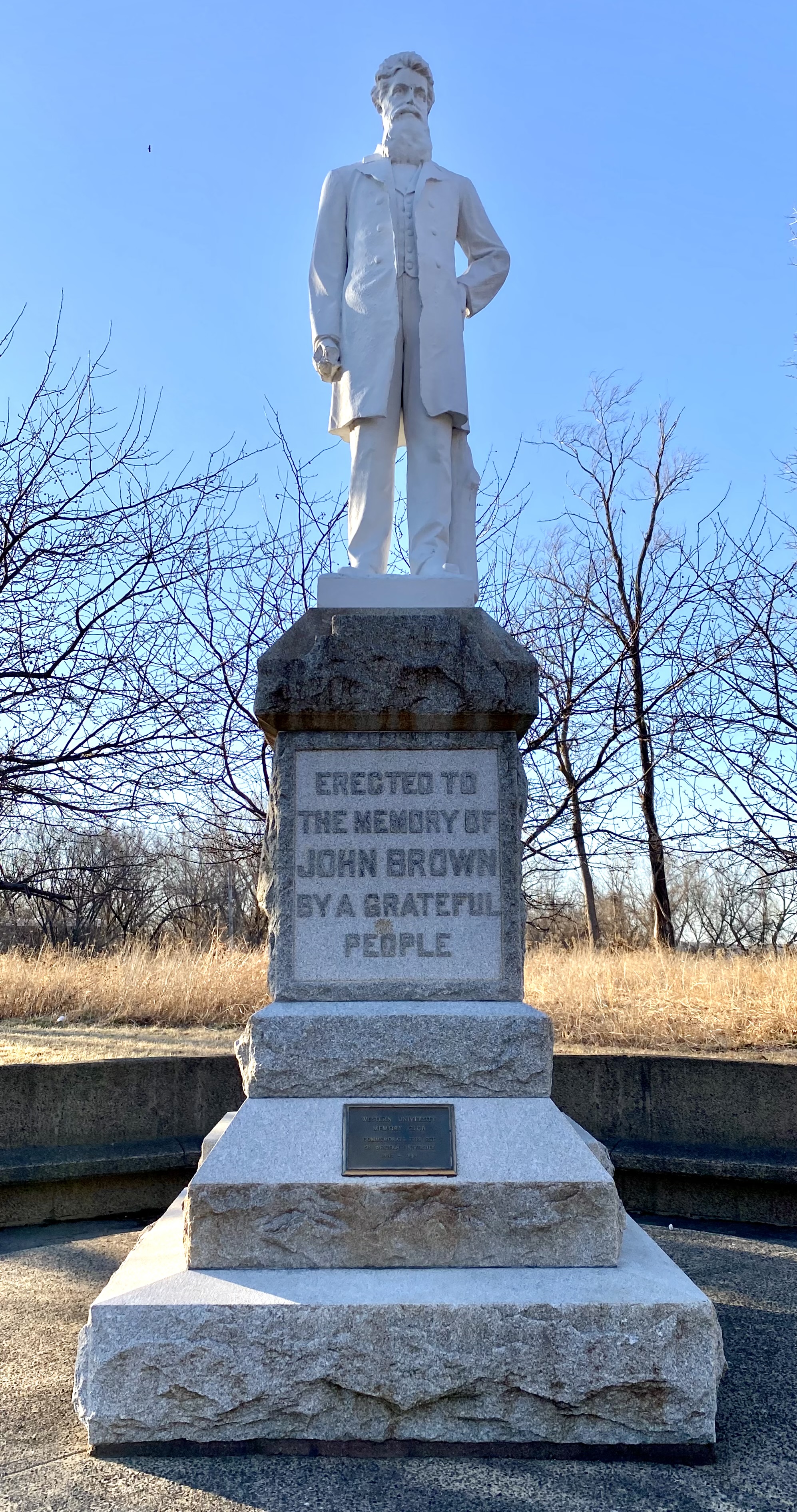
- The first statue of Brown, and the only one not at one of his residences, is that located on the (new) John Brown Memorial Plaza, on the former campus of the closed black Western University, site of a freedmen's school founded in 1865, the first black school west of the Mississippi River. The statue is the one surviving structure of the entire Quindaro Townsite, a ghost town today part of Kansas City, Kansas (27th Street and Sewell Avenue), a major Underground Railroad station, a key port on the Missouri River for fugitive slaves and contrabands escaping from the slave state of Missouri. The pillar and the life-sized statue of Brown were erected by descendants of slaves in 1911, at a cost of $2,000 (). Lettering reads: "Erected to the Memory of John Brown by a Grateful People". There is a bronze plaque. In March 2018, the statue was defaced with swastikas and "Hail Satan".
- At the John Brown Farm State Historic Site, near Lake Placid, New York, there is a 1935 statue of Brown escorting a black child to freedom. The artist was Joseph Pollia. The cost of the statue and pedestal "was contributed in small sums by Negroes of the United States".
- A statue (1933) is at the John Brown Museum, Brown's home in Osawatomie, Kansas. It was sponsored by the Women's Relief Corps, Department of Kansas.
- The only other sculptures of Brown are two busts: the first by black sculptor Edmonia Lewis, which she presented to Henry Highland Garnet; and the other, at Tufts University, by Edward Brackett.{{cite news |author-link=Lydia Maria Child}}
Streets
- Only one major street in the world honors Brown, the Avenue John Brown in Port-au-Prince, Haiti, near an avenue honoring abolitionist Senator Charles Sumner.
- A rural John Brown Road is near Torrington, Connecticut, his birthplace. Small roads near museums in North Elba, New York, and Guys Mills, Pennsylvania, are named for Brown. There is a Harpers Ferry Street in Davie, Florida, and in Ellwood City and Beaver Falls, Pennsylvania, in Northwest Pennsylvania near the Ohio border, near the route Owen Brown took seeking refuge after the raid in his brother John Jr.'s house in Ashtabula County, Ohio, there is a Harpers Ferry Road, and intersecting with it, a smaller John Brown Road. In Osawatomie, Kansas is John Brown Highway.
Storer College
- Storer College began as the first graded school for blacks in West Virginia. Its location in Harpers Ferry was because of the importance of Brown and his raid. The Arsenal engine house, renamed John Brown's Fort, was moved to the Storer campus in 1909. It was used as the college museum.
- A plaque honoring Brown was attached to the Fort in 1918, while it was on the Storer campus.

Other John Brown sites
- John Brown's Fort, Harpers Ferry National Historical Park.
- The John Brown House, where he lived from 1844 to 1854, and John Brown Memorial,{{cite news |access-date=January 24, 2021 |archive-date=May 25, 2021 |archive-url=https://web.archive.org/web/20210525051003/https://www.msn.com/en-us/news/world/hikers-call-secluded-memorial-to-abolitionist-john-brown-hidden-treasure/ar-BB18Kd8m |url-status=live |access-date=January 15, 2021 |archive-date=January 31, 2021 |archive-url=https://web.archive.org/web/20210131063513/https://www.akronzoo.org/zoo-rules-faqs |url-status=live |access-date=January 23, 2021 |archive-date=May 25, 2021 |archive-url=https://web.archive.org/web/20210525050956/https://www.newspapers.com/clip/68328250/complete-on-john-brown-monument-dont/ |url-status=live |access-date=October 30, 2020 |archive-date=January 26, 2021 |archive-url=https://web.archive.org/web/20210126120416/https://www.waymarking.com/waymarks/WMAEEP_John_Brown_Memorial_Akron_Ohio |url-status=live |access-date=August 7, 2021 |archive-date=August 7, 2021 |archive-url=https://web.archive.org/web/20210807205412/https://www.newspapers.com/clip/82990771/monument-to-john-brown/ |url-status=live
- The wagon that carried Brown from jail to his execution is preserved by the Jefferson County, West Virginia, Museum in Charles Town.{{cite web |access-date=November 20, 2018 |archive-date=November 21, 2018 |archive-url=https://web.archive.org/web/20181121021838/https://www.hmdb.org/marker.asp?marker=41671 |url-status=live
- A wagon used by Brown when transporting freed slaves from Missouri across Iowa is preserved at the Iowa Historical Society{{cite news |access-date=September 25, 2021 |archive-date=September 25, 2021 |archive-url=https://web.archive.org/web/20210925182112/https://www.newspapers.com/clip/5369067/james-townsend-john-brown/ |url-status=live
- An approximate replica of the firehouse was built in 2012 at the Discovery Park of America museum park in Union City, Tennessee. There is a marker explaining the link with John Brown's raid.{{cite web |access-date=November 15, 2018 |archive-date=November 21, 2018 |archive-url=https://web.archive.org/web/20181121115948/https://www.dreamstime.com/editorial-photography-fire-station-house-discovery-park-america-people-visit-discfire-union-city-tennessee-image42677402 |url-status=live |access-date=November 20, 2018 |archive-date=November 21, 2018 |archive-url=https://web.archive.org/web/20181121021948/http://discoveryparkofamerica.com/wp-content/uploads/2014/03/NWTN_march29.pdf |url-status=live |access-date=November 20, 2018 |archive-date=November 21, 2018 |archive-url=https://web.archive.org/web/20181121022019/https://www.hmdb.org/marker.asp?marker=106065 |url-status=live
- Iowa has set up the John Brown Freedom Trail, marking his journey across Iowa leaving Kansas, en route to Chatham, Ontario.{{cite web
|access-date=November 15, 2018
|archive-date=November 19, 2018
|archive-url=https://web.archive.org/web/20181119173628/https://iowaculture.gov/sites/default/files/History%20-%20Education%20-%20Lifelong%20Learning%20-%20Iowa%20Underground%20Railroad%20%28PDF%29.pdf
|url-status=live
- Lewis, Iowa: "Fighting Slavery – Aiding Runaways. John Brown Freedom Trail – December 20, 1858 – March 12, 1859."
- Jordan House, West Des Moines, Iowa.
- "Because of the impossibility of colored boys entering work shops where useful trades are taught", a John Brown Industrial College was planned at Bonner Springs, Kansas, a suburb of Kansas City, and 80 acres purchased.{{cite news |access-date=March 20, 2022 |archive-date=March 20, 2022 |archive-url=https://web.archive.org/web/20220320172407/https://www.newspapers.com/clip/98010968/john-brown-industrial-college/ |url-status=live |access-date=March 20, 2022 |archive-date=March 20, 2022 |archive-url=https://web.archive.org/web/20220320174320/https://www.newspapers.com/clip/98011985/john-brown-industrial-college/ |url-status=live |author-link=Kate Field |access-date=March 20, 2022 |archive-date=March 20, 2022 |archive-url=https://web.archive.org/web/20220320175106/https://babel.hathitrust.org/cgi/pt?id=uc1.c2605441&view=1up&seq=29 |url-status=live
Media
Two notable screen portrayals of Brown were given by actor Raymond Massey. The 1940 film Santa Fe Trail, starring Errol Flynn and Olivia de Havilland, depicted Brown completely unsympathetically as a villainous madman and Massey plays him with a constant, wild-eyed stare. The film gave the impression that he did not oppose slavery, even to the point of having a black "mammy" character say, after an especially fierce battle, "Mr. Brown done promised us freedom, but ... if this is freedom, I don't want no part of it". Massey portrayed Brown again in the little-known, low-budget Seven Angry Men, in which he was not only the main character, but depicted in a much more restrained, sympathetic way. Massey, along with Tyrone Power and Judith Anderson, starred in the acclaimed 1953 dramatic reading of Stephen Vincent Benét's epic Pulitzer Prize-winning poem John Brown's Body (1928).{{cite book
The play Gallows Glorious, by Ronald Gow, was produced on stage in 1933. Published in 1933, it was the first three-act play to be presented on television, the BBC, in 1938. It was released as a film the same year, according to IMDb. Reprinted in 1937, it was published by Penguin in 1958 and this edition is available in the Internet Archive.
Numerous American poets have written poems about him, including John Greenleaf Whittier, Louisa May Alcott, and Walt Whitman. The Polish poet Cyprian Kamil Norwid wrote two poems praising Brown: "John Brown" and the better known "Do obywatela Johna Brown" ("To Citizen John Brown"). Marching Song (1932) is an unpublished play about the legend of John Brown by Orson Welles. Russell Banks's 1998 biographical novel about Brown, Cloudsplitter, was a Pulitzer Prize finalist. It is narrated by Brown's surviving son Owen. James McBride's 2013 novel The Good Lord Bird tells Brown's story through the eyes of a young slave, Henry Shackleford, who accompanies Brown to Harpers Ferry. The novel won the 2013 National Book Award for Fiction. A limited episode series based on the book was released starring Ethan Hawke as John Brown.
Paintings

A well-known image of Brown in the later 19th century is a Currier and Ives print, based on a lost painting by Louis Ransom.{{cite journal |access-date=April 3, 2021 |archive-date=May 25, 2021 |archive-url=https://web.archive.org/web/20210525051000/https://www.kshs.org/p/ransom-s-john-brown-painting/12845 |url-status=live |access-date=April 13, 2022 |archive-date=December 20, 2021 |archive-url=https://web.archive.org/web/20211220222754/https://www.hudsonrivervalley.org/documents/401021/1608258/HRVR+29.1+full+text/50b5b141-990f-4163-b206-814be15204a7 |url-status=live |access-date=April 15, 2022 |archive-date=April 15, 2022 |archive-url=https://web.archive.org/web/20220415132757/https://www.loc.gov/resource/sn84026365/1850-09-05/ed-1/?sp=3 |url-status=live
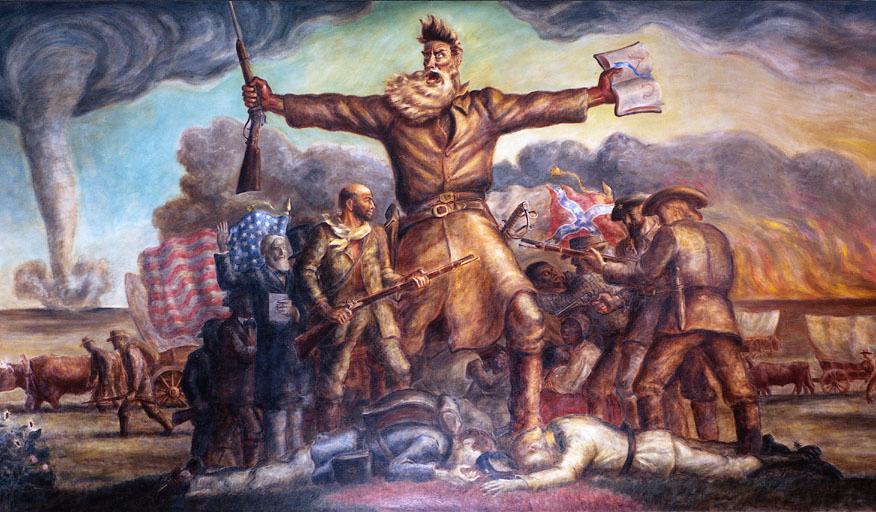
In 1938, Kansas painter John Steuart Curry was commissioned to prepare murals for the Kansas State Capitol in Topeka, Kansas. He chose as his subject the Kansan John Brown, seen by many as the most important man in Kansas history. In the resulting mural, Tragic Prelude, Brown holds a Bible in one hand and a Beecher's Bible rifle in the other. Behind him are Union and Confederate troops, with dead soldiers, a reference to the Bleeding Kansas period.{{cite news |access-date=May 23, 2019 |archive-date=September 1, 2020 |archive-url=https://web.archive.org/web/20200901103342/https://www.newspapers.com/clip/31834623/criticism-of-curry-portrait-of-john/ |url-status=live
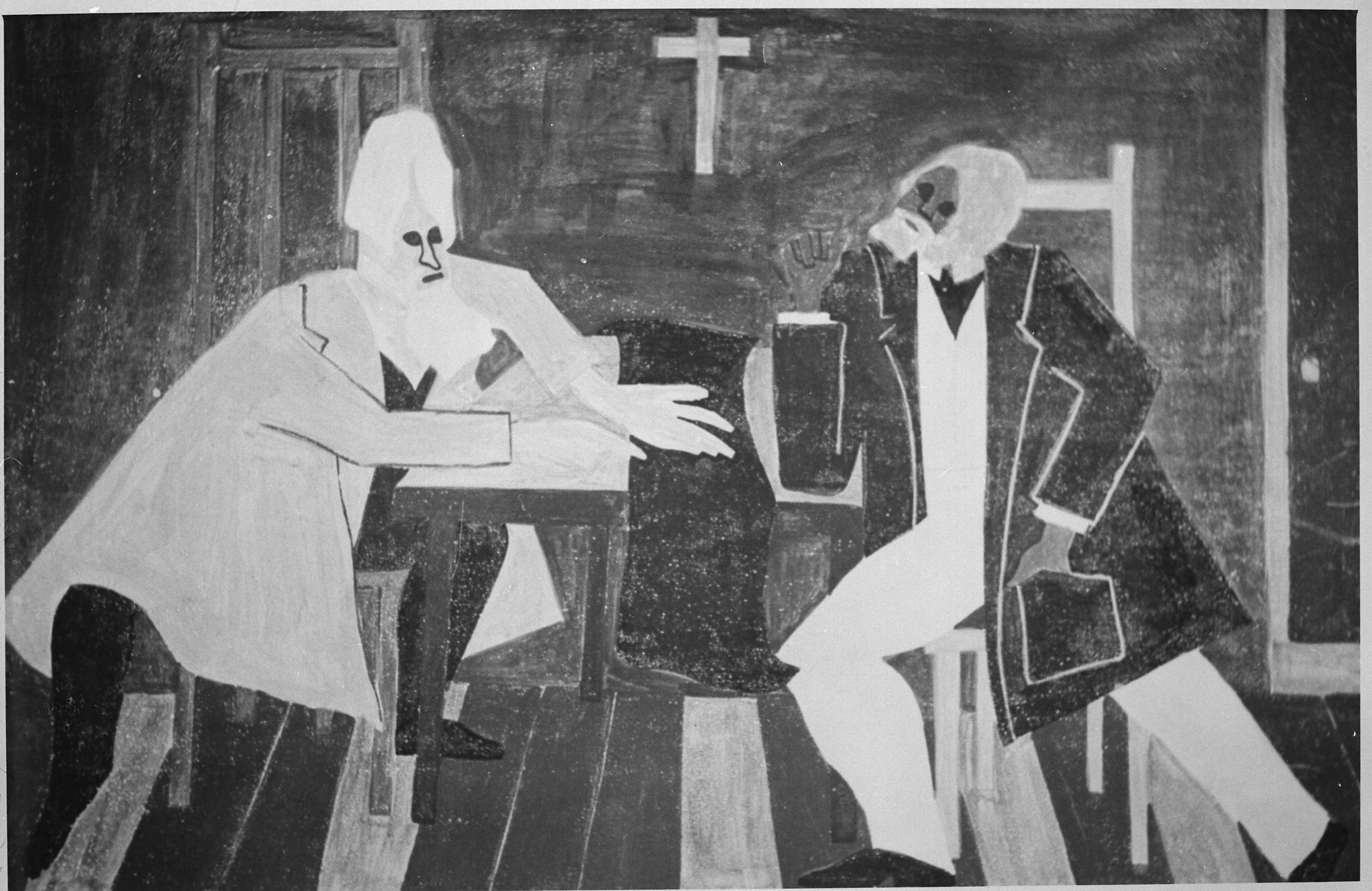
In 1941, Jacob Lawrence illustrated Brown's life in The Legend of John Brown, a series of 22 gouache paintings. By 1977, these were in such fragile condition that they could not be displayed, and the Detroit Institute of Arts had to commission Lawrence to recreate the series as silkscreen prints. The result was a limited-edition portfolio of 22 hand-screened prints, published with a poem, John Brown, by Robert Hayden, commissioned specifically for the project. The Legend of John Brown was the first series to explore his legacy from an African-American perspective.
Paintings such as Thomas Hovenden's The Last Moments of John Brown immortalize an apocryphal story in which a black woman offers the condemned Brown her baby to kiss on his way to the gallows. The tale was probably invented by journalist James Redpath.
Historical markers
- According to the Historical Marker Database, Brown is mentioned on the following historical markers:
- At his birthplace in Torrington, Connecticut, on John Brown Road.
- Baldwin City, Kansas: "Battle of Black Jack"
- Franklin County, Kansas: At the site of the Pottawatomie massacre.
- Lawrence, Kansas: "John Brown and the Siege of Lawrence, September 14–15, 1856"
- Near Netawaka, Kansas: Battle of the Spurs
- Osawatomie, Kansas:
- At the site of the Battle of Osawatomie, in John Brown Memorial Park.
- "Soldiers' Monument". Commemorating the 5 persons killed, including one of Brown's sons. "This inscription is also in commemoration of the heroism of Capt. John Brown who commanded at the Battle of Osawatomie August 30, 1856; who died and conquered American slavery on the scaffold at Charlestown Va. Dec. 2, 1859."
- 1935 plaque by The Woman's Relief Corps, Department of Kansas
- Old Stone Church Marker. "Built by Rev. Samuel Adair brother-in-law of John Brown" (1861).
- Topeka, Kansas: "Capital of Kansas" ("In the late 1850s negroes bound north on the 'underground railway' were hidden here by John Brown.")
- Near Trading Post, Kansas:
- "Marais des Cygnes Massacre" – site of a "fort" built by Brown after the massacre
- "Murder on the Marais des Cygnes"
- Hagerstown, Maryland: at the site of the Washington House Hotel, where Brown stayed on his way to Harpers Ferry.
- Hyattsville, Maryland: Osborne Perry Anderson, who fought with Brown.
- Sharpsburg, Maryland: at the site of the Kennedy Farm.
- Marlborough, Massachusetts: at the John Brown Bell, once in Harpers Ferry, since 1892 on display in Marlborough. The second-most-famous American bell, after the Liberty Bell.
- Detroit, Michigan: at the house of William Webb, site of the "Frederick Douglass – John Brown meeting".
- Hudson, Ohio:
- At his boyhood home.{{citation |access-date=October 23, 2020 |archive-date=October 18, 2020 |archive-url=https://web.archive.org/web/20201018230220/https://www.hmdb.org/m.asp?m=41270 |url-status=live
- First Congregational Church in Hudson: "At a November 1837 prayer meeting, church member and anti-slavery leader John Brown made his first public vow to destroy slavery." Another marker mentions Brown at the former site of the church.
- Chambersburg, Pennsylvania: "Abolitionist John Brown Boards in Chambersburg"
- In rural Crawford County, Pennsylvania, there is a John Brown Road, and on it two historical markers at the site of Brown's house and tannery.
- Indiana, Pennsylvania: marker for Albert Hazlett, a member of Brown's party who was also hanged at Charles Town (in 1860)
- King of Prussia, Pennsylvania (Valley Forge National Historic Park): "Knox's Quarters – John Brown Farm".
- Kent, Ohio: marker for Underground Railroad stops mentions John Brown's residence in Kent (then called Franklin Mills) during the 1830s.
- Mont Alto, Pennsylvania: "John Brown Raid", where John Cooke, one of Brown's followers, was captured. (Two markers.)
- Near Amissville, Virginia: Dangerfield Newby marker.
- Winchester, Virginia: "A 'Malicious Design' – Burning the Winchester Medical College". The body of John Brown's son Watson was brought there for dissection by medical students.
- Charles Town, West Virginia:
- "Jefferson County Courthouse – Where John Brown Was Tried"
- "Two Treason Trials". (The other had nothing to do with Brown.)
- "Hanging Site of John Brown. Creation of a Martyr. Prelude to War."
- "Site of the execution of John Brown"
- "Edge Hill Cemetery – John Brown Raid Victims"
- Beallair, home of Colonel Lewis Washington, held hostage by Brown.
- Focus of Action – Jefferson County in the Civil War
- Harpers Ferry, West Virginia:
- "Pilgrimage." Marks the site of an 1896 visit by the National League of Colored Women.
- "Holy Ground". Marks 1906 visit by members of the Niagara Movement, predecessor of the NAACP, on what they called John Brown Day, August 17.
- "John Brown", plaque erected in 1918 by the alumni of Storer College.
- "John Brown", plaque erected in 1932 by the NAACP.
- "John Brown Fort."
- "A Nation's Armory"
- "Arsenal Square"
- "'for the deposit of arms
- "John Brown Monument", on the site of the original location of "John Brown's Fort"
- "John Brown's Last Stand", at the same location.
- "Allstadt House – John Brown's Hostages – Prelude to War"
- "The John Brown Raiders", all those who participated in the raid.
- "In Honor of Private Luke Quinn" – killed during the capture of John Brown
- "The Murphy Farm", location of John Brown's Fort between 1895 and 1910.
- "Hayward Shepard – Another Perspective"
- "Heyward Shepherd"
- Chatham, Ontario: "John Brown's Convention 1858".
Archival material
Court material and related documents
The indictments, summons, sentences, bills of exception, and similar documents for Brown and his raiders are held by the Jefferson County Circuit Clerk, and have been digitized by West Virginia Archives and History.{{cite web |access-date=May 15, 2022 |archive-date=May 18, 2022 |archive-url=https://web.archive.org/web/20220518183743/https://archive.wvculture.org/history/johnbrown/jbjeffcc.html |url-status=live |author-link=Henry A. Wise |access-date=July 21, 2021 |archive-date=July 9, 2021 |archive-url=https://web.archive.org/web/20210709190408/https://babel.hathitrust.org/cgi/pt?id=loc.ark%3A%2F13960%2Ft4cn76w33&view=thumb&seq=1 |url-status=live
Much material is missing. The order book, which had the minutes of John Brown's trial,{{cite news |author-link=Richard Parker (congressman) |access-date=April 7, 2021 |archive-date=May 25, 2021 |archive-url=https://web.archive.org/web/20210525050953/https://www.newspapers.com/clip/73986239/richard-parrker-john-browns-judge/ |url-status=live
According to Prosecutor Andrew Hunter,
|access-date=April 7, 2021 |archive-date=May 16, 2021 |archive-url=https://web.archive.org/web/20210516224722/https://www.newspapers.com/clip/66365784/andrew-hunter-interview/ |url-status=live
There was correspondence from Frederick Douglass and Gerrit Smith, among many others. Hugh Forbes said that the carpet-bag may have contained "an abundant supply of my correspondence".{{cite news |orig-date=October 29, 1859 |access-date=April 7, 2021 |archive-date=July 21, 2021 |archive-url=https://web.archive.org/web/20210721121907/https://timesmachine.nytimes.com/timesmachine/1859/11/01/issue.html |url-status=live |access-date=April 7, 2021 |archive-date=April 13, 2021 |archive-url=https://web.archive.org/web/20210413200632/https://www.newspapers.com/clip/75277822/news-from-harpers-ferry-john-brown/ |url-status=live |author-link2=Franklin Benjamin Sanborn |access-date=September 9, 2021 |archive-date=September 9, 2021 |archive-url=https://web.archive.org/web/20210909104041/https://www.jstor.org/stable/24718206 |url-status=live |url-access=subscription |author-link=Franklin Benjamin Sanborn
The carpet-bag also contained maps of Kentucky, North Carolina, and Virginia that showed the locations of State arsenals with proposed routes for attacks and retreats.{{cite news |access-date=May 6, 2021 |archive-date=May 25, 2021 |archive-url=https://web.archive.org/web/20210525051008/https://www.newspapers.com/clip/77150798/more-on-harpers-ferry/ |url-status=live
Hunter personally took the carpet-bag to Richmond, because he thought it would be safer there. In 1865, when Lee advised that he could no longer defend Richmond, Hunter did not want the "Yankees" to find the carpetbag. He thought that the Capitol was as safe a place as any in Richmond, and he asked Commonwealth Secretary George Wythe Munford if he could hide it in the Capitol. "Munford told me that he has taken the carpet-bag up to the cock-loft of the Capitol and had let down the bag between the wall and the plastering, and I believe those papers are there yet."
Wise sent attorney Henry Hudnall to Charles Town to put in order Hunter's documents. In a letter to Wise of November 17, he refers to "a large quantity of matter", including "nearly a half bushel of letters" just of Tidd alone.{{cite book |orig-date=November 17, 1859 |access-date=May 4, 2021 |archive-date=May 4, 2021 |archive-url=https://web.archive.org/web/20210504151214/https://www.forgottenbooks.com/en/books/AppendixtoMessageI_10551253 |url-status=live
In 1907–1908, there appeared in print a varied collection of letters and other documents a Union soldier from Massachusetts took from Hunter's office in the Charles Town courthouse in 1862, when it was being used as a Union barracks.{{cite journal |access-date=August 24, 2021 |archive-date=October 13, 2020 |archive-url=https://web.archive.org/web/20201013173504/https://www.jstor.org/stable/25079946 |url-status=live |author-link=Henry A. Wise |access-date=April 29, 2021 |archive-date=April 30, 2021 |archive-url=https://web.archive.org/web/20210430224056/https://www.jstor.org/stable/25079848 |url-status=live
Correspondence and other archival material
The West Virginia Archives and History owns the largest single collection on Brown, the Boyd B. Stutler Collection. A negative microfilm of the material is held by the Ohio Historical Society.{{cite book |access-date=July 20, 2021 |archive-date=July 21, 2021 |archive-url=https://web.archive.org/web/20210721121906/https://www.ancestry.com/imageviewer/collections/28302/images/dvm_LocHist012264-00032-0?ssrc=&backlabel=Return |url-status=live
The Hudson Library and Historical Society of Hudson, Ohio, Brown's home town, prepared annotated listings of Brown's many ancestors, siblings, and children.{{cite web |access-date=February 4, 2021 |archive-date=March 4, 2021 |archive-url=https://web.archive.org/web/20210304213039/https://www.hudsonlibrary.org/historical-society/john-brown-resources/ |url-status=live |editor-last=DeCaro |editor-first=Louis A. Jr. |editor-link=Louis DeCaro Jr. |author-link=John Brown (abolitionist) |access-date=May 7, 2021 |archive-date=July 21, 2021 |archive-url=https://web.archive.org/web/20210721121910/https://timesmachine.nytimes.com/timesmachine/1929/02/13/91754747.html?pageNumber=15 |url-status=live |access-date=May 8, 2021 |archive-date=July 21, 2021 |archive-url=https://web.archive.org/web/20210721121954/https://timesmachine.nytimes.com/timesmachine/1929/03/17/91763301.html?zoom=14.58 |url-status=live |author-link=Charles Burleigh Galbreath |access-date=September 15, 2021 |archive-date=September 25, 2021 |archive-url=https://web.archive.org/web/20210925182029/https://resources.ohiohistory.org/ohj/search/display.php?page=50&searchterm=shakers&vol=30&pages=184-289 |url-status=live
Brown biographer Oswald Garrison Villard surveys the manuscript collections in his 1910 biography. The archive of Villard is in the Columbia University Library. Kansas Memory has a collection of materials regarding Brown's activities in Kansas.
Notes
References
Sources
- {{cite book |author-link=Frederick Douglass
- {{Cite book |orig-date=1909
- {{cite book |editor-first=Paul |editor-last=Finkelman |editor-link=Paul Finkelman |author-link=Paul Finkelman
- {{cite book|first=James W.|last=Loewen|author-link=James Loewen|title=Lies My Teacher Told Me: Everything Your American History Textbook Got Wrong|location=New York|publisher=The New Press|year=2008
- {{cite book
- {{cite journal |access-date=May 25, 2022 |url-access=subscription
- {{cite book
- {{cite book
- {{cite book|first=David S.|last=Reynolds |author-link= David S. Reynolds
- {{cite book |author-link=Franklin Benjamin Sanborn |author-link2=John Brown (abolitionist) |access-date=March 26, 2021 |archive-date=May 25, 2021 |archive-url=https://web.archive.org/web/20210525050953/https://catalog.hathitrust.org/Record/009833098 |url-status=live
- {{cite journal
- {{cite journal |access-date=March 20, 2021 |archive-date=May 25, 2021 |archive-url=https://web.archive.org/web/20210525051011/https://lawdigitalcommons.bc.edu/cgi/viewcontent.cgi?article=3106&context=bclr |url-status=live
- {{cite book |author-link=Oswald Garrison Villard
- {{cite journal |access-date=September 14, 2021 |archive-date=September 14, 2021 |archive-url=https://web.archive.org/web/20210914130149/https://www.jstor.org/stable/41177972 |url-status=live
References
- (1864). "The martyrdom of John Brown : the proceedings of a public meeting held in London, on the 2nd December, 1863, to commemorate the fourth anniversary of John Brown's death". Emancipation Society.
- Anderson, Osborne Perry. (1861). "A Voice from Harper's Ferry". Published by the author.
- "The Father of American Terrorism".
- Turzillo, Jane Ann. (2002). "Hudson, Ohio". Arcadia Publishing.
- (2021-12-20). "The Hudson Underground Railroad".
- "New Richmond Township, Pennsylvania to Jamestown, New York".
- "[John Brown, Abolitionist]".
- Weber, Sandra. (February 2005). "John Brown's Family: A Living Legacy".
- (Fall 2016). "John Brown Speaks: Letters and Statements from Charlestown (review)". Ohio History.
- "American Experience: Timeline of John Brown's Life".
- "The Wives and Children of John Brown".
- "Perkins & Brown Partnership".
- Cowan, Wes. (December 6, 2007). "Cowan's Auctions".
- Sanborn, Franklin. (April 1872). "John Brown in Massachusetts".
- Carvalho III. (April 6, 2010). "Abolitionist John Brown's years in Springfield Ma. transform his anti-slavery thoughts and actions". MassLive Media.
- "Resisting Slavery: St. John's Congregational Church". Springfield, MA – Our Plural History.
- (June 22, 2010). "History | St. John's Congregational Church | Springfield, MA". Sjkb.org.
- Trodd, Zoe. (2007). "Writ In Blood: John Brown's Charter of Humanity, The Tribunal of History, and the Thick Link of American Political Protest (summary)". Journal for the Study of Radicalism.
- (1998–1999). "Africans in America – Abolitionism". GHS IB History of the Americas.
- "John Brown: In His Own Words – Prelude". Zikibay.com.
- "John Brown Biography, Harpers Ferry, & Pottawatomie Massacre".
- "John Brown".
- Rhodes, James Fork. (1892). "History of the United States from the Compromise of 1850". Harper & Brothers.
- (1976). "History of the State of Kansas". Atchison County Historical Society.
- (2012). "Battle of Black Jack, National Register of Historic Places Registration Form".
- "Jason Emerson".
- (1973). "John Brown". Prentice-Hall.
- Carter Jackson, Kellie. (2019). "Force and Freedom: Black Abolitionists and the Politics of Violence.". University of Pennsylvania Press.
- "Hitchcock House".
- Jones, Louis Thomas (1914). ''The Quakers of Iowa''. Iowa City: The State Historical Society of Iowa. p. 193:
"A little over a year after his first visit to the Springdale neighborhood, Brown reappeared late in December, 1857{{sndthis time with some ten companions and for purposes which he seemed not anxious to have known. The men were lodged with a Quaker, William Maxon, about three miles northeast of the village of Springdale, Brown agreeing to give in exchange for their keep such of his teams or wagons as might seem just and fair. Brown was taken into the home of John H. Painter, about a half-mile away; and all were welcomed with that unfeigned hospitality for which the Friends have always been known." - "In Pursuit of Freedom".
- Hodge, Lyman F.. (1891). "Photius Fisk A Biography". Lyman F. Hodge.
- Isely, W. H.. (1907). "The Sharps Rifle Episode in Kansas History". The American Historical Review.
- Scharff, Virginia. (2015-04-09). "Empire and Liberty: The Civil War and the West". University of California Press.
- "The Harpers Ferry Raid". pbs.org.
- "John Brown's Convention 1858".
- "Chatham Convention Delegates".
- ''The History of Johnson County, Iowa'', 1883, pp. 475–77
- Junger, Richard, "Thinking Men and Women who Desire to Improve our Condition": Henry O. Wagoner, ''Civil Rights, and Black Economic Opportunity in Frontier Chicago and Denver, 1846–1887''. in Alexander, William H., Cassandra L. Newby-Alexander, and Charles H. Ford, eds. ''Voices from within the Veil: African Americans and the Experience of Democracy''. Cambridge Scholars Publishing, 2009. p. 154
- Junger, Richard. (2008). "'God and man helped those who helped themselves': John and Mary Jones and the Culture of African American Self-Sufficiency in Mid-Nineteenth-Century Chicago". Journal of Illinois History.
- Underground Railroad, US Department of Interior, National Park Service, Denver Service Center. Duane Publishing, February 1, 1995, p. 168
- Toledo, Gregory. The Hanging of Old Brown: A Story of Slaves, Statesmen, and Redemption. Greenwood Publishing Group, 2002. p. 75
- "John Brown meets with Harriet Tubman in Canada".
- "John Brown in Washington County".
- Hoffman, Colonel Jon T., ''USMC: A Complete History'', Marine Corps Association, Quantico, VA, (2002), p. 84.
- "Territorial Kansas Online: ''John Brown (1800–1859)''".
- Evan Carton, ''Patriotic Treason: John Brown and the Soul of America'' (2006), pp. 332–33.
- Korda, 2014, p. xxxviii.
- Mackey, Thomas C.. (2014-01-05). "A Documentary History of the American Civil War Era: Volume 3, Judicial Decisions, 1857-1866". University of Tennessee Press.
- (1859–1860). "Year of Meteors". The Walt Whitman Archive.
- Theerman, Paul. (2011). "John Brown's Body". West Virginia History.
- (1859-12-15). "The Funeral of John Brown at North Elba". Chicago Tribune.
- (1859-12-16). "Burial of John Brown in North Elba". The Liberator.
- Beck, Janet Kemper. (2009-04-07). "Creating the John Brown Legend: Emerson, Thoreau, Douglass, Child and Higginson in Defense of the Raid on Harpers Ferry". McFarland.
- (December 22, 1859). "The National Era".
- (June 15, 1860). "Senate Select Committee Report on the Harper's Ferry Invasion".
- Donald, David Herbert. (1995). "Lincoln". Simon and Schuster.
- (1984). "[[To Purge This Land with Blood: A Biography of John Brown]]". University of Massachusetts Press.
- [[James M. McPherson]]. ''[[Battle Cry of Freedom (book). Battle Cry of Freedom]]''. New York: Oxford University Press (1988), p. 207.
- (1976). "The Impending Crisis, 1848–1861". Harper & Row.
- Daniel W. Crofts, ''Reluctant Confederates: Upper South Unionists in the Secession Crisis'' (1989), pp. 70 ff
- Bordewich, Fergus M.. (October 2009). "John Brown's Day of Reckoning". [[Smithsonian Magazine]].
- (22 April 2009). "Lincoln for President: An Underdog's Path to the 1860 Republican Nomination". McFarland.
- Crothers, A. Glenn. (Fall 2011). "'To Bear our Righteous Testimonies against All Evil': Virginia Quakers' Response to John Brown". Quaker History.
- (April 2006). "No Taint of Compromise: Crusaders in Antislavery Politics". Louisiana State University Press.
- Bassett, John Spencer. (1923). "A Short History of the United States". [[Macmillan Publishers.
- (1978). "John Brown's Journey: Notes & Reflections on His America & Mine". Anchor/Doubleday.
- Louis A. DeCaro Jr., ''John Brown – The Cost of Freedom: Selections from His Life & Letters'' (New York: International Publishers, 2007), pp. 16–17,
- (June 2, 2005). "Dr. Stephen B. Oates on John Brown (transcript)". [[National Park Service]].
- "An "Ever Present Bone of Contention": The Heyward Shepherd Memorial".
- (2005b). "The Afterlife of John Brown". Palgrave Macmillan.
- (2012). "Prophets Of Protest: Reconsidering The History Of American Abolitionism". New Press.
- Lori McManus. (2008). "Frederick Douglass American Hero: and International Icon of The Nineteenth Century". Xlibris.
- R. Blakeslee Gilpin. (2011). "John Brown Still Lives!: America's Long Reckoning With Violence, Equality, & Change". U. of North Carolina Press.
- For historiography see Merrill D. Peterson, ''John Brown: The Legend Revisited'' (2002) and review by Aimee Lee Cheek, ''Journal of Southern History'' 70:2 (2004) pp. 435–436.
- Massaquoi, Hans J.. (1964). "Mystery of Malcolm X".
- Louis Ruchames, ''A John Brown Reader'' (New York: Abelard & Schuman, 1959), p. 12
- Realf, Richard. (1860). "Report of the Select Committee of the Senate Appointed to Inquire in the Late Invasion and Seizure of the Public Property at Harper's Ferry". Select Committee of the Senate.
- Meyer, Howard N.. (2000). "The Magnificent Activist: The Writings of Thomas Wentworth Higginson (1823–1911)". Da Capo Press.
- "John Brown Museum". National Park Service.
- "Search: John Brown Tannery Site".
- Gordon, Elana. (August 14, 2011). "Abolitionist's Monument Central To Town's Pride". NPR ([[National Public Radio]]). Weekend Edition.
- Kansas City Star Editorial Board. (March 19, 2018). "Vandals may have defaced John Brown statue, but they can't scar Quindaro's significance". [[Kansas City Star]].
- Flick, Alexander C.. (July 1935). "John Brown Memorial Statue". [[New York History]].
- (May 10, 1935). "In John Brown's Honor". [[Kansas City Times]] ([[Kansas City, Missouri]]).
- Hall, Stephen G.. (February 2, 2017). "History as a Communal Act. History of Black History Month".
- Burke, Dawne Raines. (2015). "An American Phoenix: A History of Storer College from Slavery to Desegregation, 1865–1955". Storer College Books, an imprint of [[West Virginia University Press]].
- (2005). "The Afterlife of John Brown". Palgrave Macmillan.
- (November 18, 1938). "Gallows Glorious".
- (May 4, 1933). "Gallows Glorious". Penguin Books Harmondsworth Middlesex.
- (1963). "A Polish poet on John Brown". The Polish Review.
- McGilligan, Patrick. (2015). "Young Orson". [[Harper (publisher).
- Banks, Russell. ''Cloudsplitter''. New York: Harper Flamingo, 1998.
- Minzesheimer, Bob. (November 21, 2013). "James McBride wins National Book Award for fiction". USA Today.
- Garth Franklin. (August 3, 2019). "Diggs, Russell Join Hawke's "Good Lord Bird"".
- (2005). "The Afterlife of John Brown". Palgrave Macmillan.
- (1959). "The Road to Harpers Ferry". William Sloane Associates.
- "The Historical Marker Database".
- "John Brown".
- "John Brown collection". Archives Research Center.
- "Kansas Memory".
This article was imported from Wikipedia and is available under the Creative Commons Attribution-ShareAlike 4.0 License. Content has been adapted to SurfDoc format. Original contributors can be found on the article history page.
Ask Mako anything about John Brown (abolitionist) — get instant answers, deeper analysis, and related topics.
Research with MakoFree with your Surf account
Create a free account to save articles, ask Mako questions, and organize your research.
Sign up freeThis content may have been generated or modified by AI. CloudSurf Software LLC is not responsible for the accuracy, completeness, or reliability of AI-generated content. Always verify important information from primary sources.
Report