From Surf Wiki (app.surf) — the open knowledge base
John 9
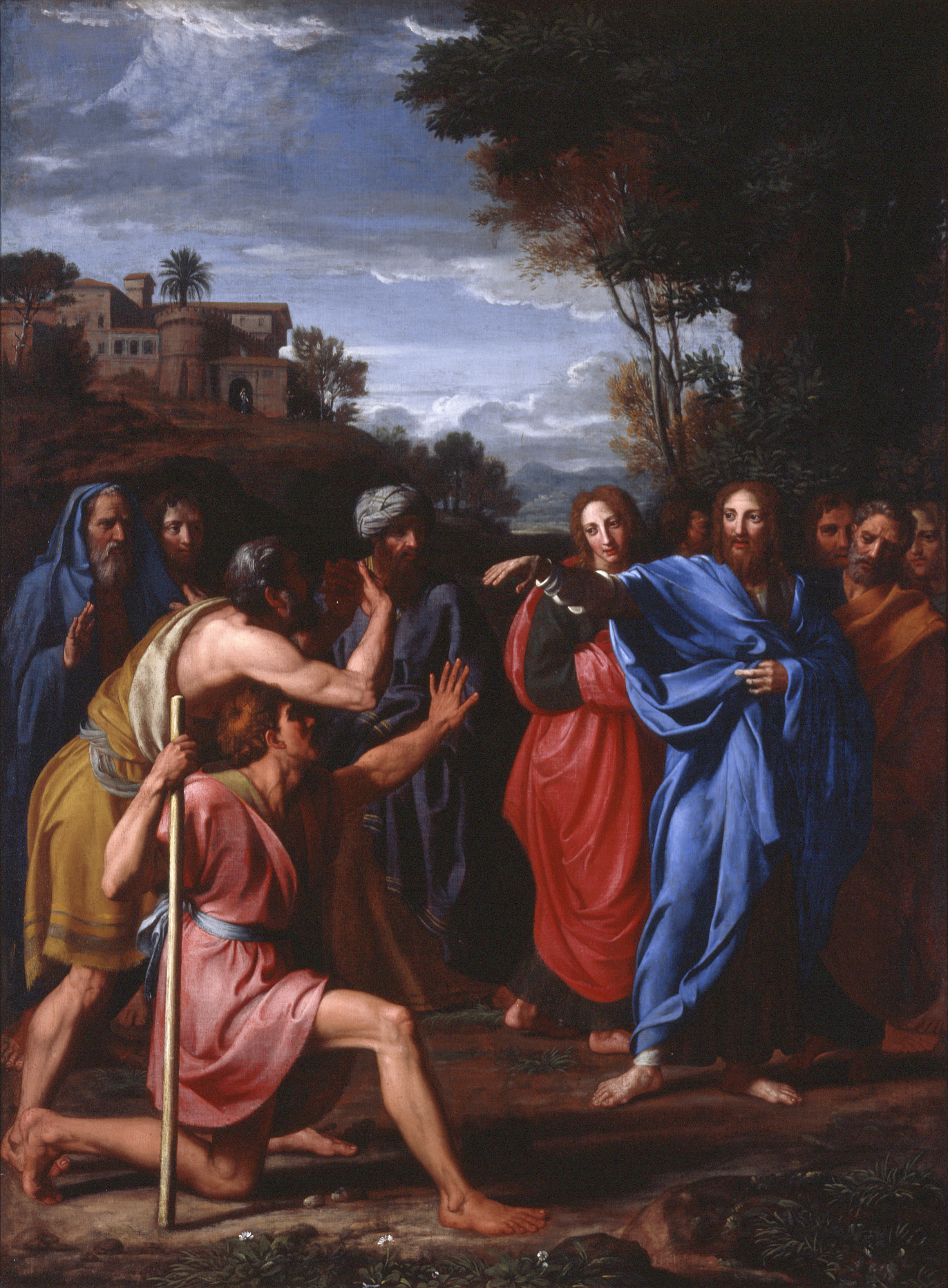
John 9 is the ninth chapter of the Gospel of John in the New Testament of the Christian Bible. It maintains the previous chapter's theme "Jesus is light", recording the healing of an unnamed man who had been blind from birth, a miracle performed by Jesus, and their subsequent dealings with the Pharisees. The man born blind comes to complete faith in Jesus, while some of the Pharisees remain in their sin. The author of the book containing this chapter is anonymous, but early Christian tradition uniformly affirmed that John composed this Gospel.
Text
The original text was written in Koine Greek. This chapter is divided into 41 verses. Some early manuscripts containing the text of this chapter are:
- Papyrus 75 (AD 175–225)
- Papyrus 66 ( 200)
- Codex Vaticanus (325–350)
- Codex Sinaiticus (330–360)
- Codex Bezae ( 400)
- Codex Alexandrinus (400–440)
- Codex Ephraemi Rescriptus ( 450; extant verses 1–10)
- Papyrus 128 (6th/7th century; extant verses 3–4)
Themes in this chapter
René Kieffer notes the similarity between this chapter and chapter 5, where another healing at a pool on the sabbath day is recounted. In chapter 9, the "progressive insight" of the man born blind is a central motif in the narrative. The progress of the narrative can be seen in the sub-headings used by the New King James Version:
- = A Man Born Blind Receives Sight
- = The Pharisees Excommunicate the Healed Man
- = True Vision and True Blindness
Location
Jesus and His disciples are said to be "passing by" or "going along", and there is no indication yet that they have left Jerusalem, the scene of the narrative in chapters 7 and 8. Jesus sends the man he heals to the Pool of Siloam, a rock-cut pool on the southern slope of Jerusalem, located outside the walls of the Old City to the southeast. However, there are also references to a Jewish ruling that anyone who believed Jesus to be the Messiah would be excluded from the synagogue (John 9:22). There is no other New Testament reference to Jerusalem having a synagogue, but rabbinical tradition states that there were 480 synagogues in Jerusalem at the time of the Jewish rebellion.
Chronology
The initial events of this chapter occur on a Sabbath (), not necessarily connected with the Feast of Tabernacles or the days immediately afterwards when the events of John 7-8 took place. H. W. Watkins suggests that this was the last day, the "great day" of the Feast of Tabernacles referred to in because "nothing has taken place which makes it necessary to suppose any interval, and though the discourses seem long, they would have occupied but a short time in delivery",
Verses 1-4
A discussion about suffering takes place between Jesus (here called "Rabbi") and his disciples. This leads to Jesus' announcement that:
:I must work the works of Him who sent Me while it is day; the night is coming when no one can work. This verse begins with "we must" (, hēmas dei) in the Westcott-Hort version and in the New International Version. The Textus Receptus and the Vulgate both use the singular, "I must" (). The plural is "probably right". The reference to "Him who sent me" anticipates the evangelist's note that "Siloam means 'Sent' (verse 6), meaning that Jesus, who has been sent by his Father, "is also present in this water".
Verse 14
:Now it was a Sabbath when Jesus made the clay and opened his eyes. The circumstances are similar to the healing at Bethesda in John 5.
Verse 22
:The Jews had agreed already that if anyone confessed that He (Jesus) was Christ, he would be put out of the synagogue. "The word for ‘out of the synagogue’ () is peculiar to John, occurring [in] , , and nowhere else". The decision has been linked to the possible Council of Jamnia which was once thought to have decided the content of the Jewish canon sometime in the late 1st century (c. 70–90 AD).
Verse 34 confirms that "they cast him out", the Amplified Bible and the New Living Translation adding text to refer to his exclusion from the synagogue.
Verse 38
:Then he said, "Lord, I believe!" And he worshiped Him. Pope Paul VI describes the faith evidenced in this verse as "firm and resolute, ... though always humble and diffident". A few manuscripts, such as Papyrus 75 and Codex Sinaiticus, omit the whole of verse 38 and the beginning of verse 39. :And Jesus said, "For judgment I have come into this world, that those who do not see may see, and that those who see may be made blind."
Verses 40-41
:"Surely, we are not blind, are we?" Jesus said to them, "If you were blind, you would not have sin. But now that you say, 'We see', your sin remains."
Old Testament references==-->
Notes
References
References
- Watkins, H. W., [https://biblehub.com/commentaries/ellicott/john/8.htm Ellicott's Commentary for Modern Readers] on John 8, accessed 16 May 2016
- Halley, Henry H., ''Halley's Bible Handbook'': an Abbreviated Bible Commentary. 23rd edition. Zondervan Publishing House. 1962.
- [[:sv:René Kieffer. Kieffer, R.]], ''60. John'' in Barton, J. and Muddiman, J. (2001), [https://b-ok.org/dl/946961/8f5f43 The Oxford Bible Commentary] {{Webarchive. link. (2017-11-22 , p. 978)
- Holman Illustrated Bible Handbook. Holman Bible Publishers, Nashville, Tennessee. 2012.
- The [[messianic]] significance of the story is noted in the [[New English Translation]].Biblical Studies Press LLC, [https://www.biblegateway.com/passage/?search=John%209&version=NET#fen-NET-26431a Footnote a at John 9:1] in the New English Translation, accessed 22 January 2024
- {{bibleverse. John. 9:1. NET: [[New English Translation]]
- JewishEncyclopedia.com, [https://jewishencyclopedia.com/articles/8604-jerusalem#anchor26 Jerusalem: Synagogues and Schools], accessed 26 May 2016
- and the [[Pulpit Commentary]] agrees that "the day may have been a festival sabbath".[https://biblehub.com/commentaries/pulpit/john/9.htm Pulpit Commentary] on John 9, accessed 16 May 2016
- {{bibleverse. John. 9:4. NKJV: NKJV
- {{bibleverse. John. 9:4. WHNU: Westcott-Hort
- {{bibleverse. John. 9:4. NIV: NIV
- {{bibleverse. John. 9:4. VULGATE: Vulgate
- {{bibleverse. John. 9:14. NKJV: NKJV
- {{bibleverse. John. 9:22. NKJV: NKJV
- [https://biblehub.com/commentaries/cambridge/john/9.htm Cambridge Bible for Schools and Colleges] on {{bibleverse. John. 9. NKJV, accessed 19 May 2016
- Graetz, Heinrich (1871). "Der alttestamentliche Kanon und sein Abschluss (The Old Testament Canon and its finalisation)". Kohélet, oder der Salomonische Prediger (Kohélet, or Ecclesiastes) (in German). Leipzig: Carl Winters Universitätsbuchhandlung. pp. 147–173
- {{bibleverse. John. 9:34. NKJV
- [[BibleGateway.com]], [https://www.biblegateway.com/verse/en/John%209:34 Versions of John 9:34]
- {{bibleverse. John. 9:38. NKJV: NKJV
- Pope Paul VI, [https://www.vatican.va/content/paul-vi/en/encyclicals/documents/hf_p-vi_enc_06081964_ecclesiam.html Ecclesiam Suam], paragraph 23, published on 6 August 1964, accessed on 16 July 2024
- Kieffer, R., ''60. John'' in Barton, J. and Muddiman, J. (2001), [https://b-ok.org/dl/946961/8f5f43 The Oxford Bible Commentary] {{Webarchive. link. (2017-11-22 , p. 979)
- {{bibleverse. John. 9:39. NKJV: NKJV
This article was imported from Wikipedia and is available under the Creative Commons Attribution-ShareAlike 4.0 License. Content has been adapted to SurfDoc format. Original contributors can be found on the article history page.
Ask Mako anything about John 9 — get instant answers, deeper analysis, and related topics.
Research with MakoFree with your Surf account
Create a free account to save articles, ask Mako questions, and organize your research.
Sign up freeThis content may have been generated or modified by AI. CloudSurf Software LLC is not responsible for the accuracy, completeness, or reliability of AI-generated content. Always verify important information from primary sources.
Report