From Surf Wiki (app.surf) — the open knowledge base
John 19

John 19 is the nineteenth chapter of the Gospel of John in the New Testament of the Christian Bible. The book containing this chapter is anonymous, but early Christian tradition uniformly affirmed that John composed this Gospel. This chapter records the events on the day of the crucifixion of Jesus, until his burial.
Text
The original text was written in Koine Greek. This chapter is divided into 42 verses.
Textual witnesses
Some early manuscripts containing the text of this chapter are:
- Papyrus 90 (AD 150–175; extant verses 1–7)
- Papyrus 66 ( 200; complete)
- Papyrus 121 (3rd century; extant verses 17–18,25-26)
- Codex Vaticanus (325–350)
- Codex Sinaiticus (330–360)
- Codex Bezae ( 400)
- Codex Alexandrinus (400–440)
- Papyrus 60 ( 700; extant verses 1–26)
Old Testament references
- : Psalm
- : Psalm
- : ; ; Psalm ;
- : Zechariah 12:10
New Testament references
- : ,; ; ,
- : ;
- : ; ; ,
- : ; ;
- : ; ;
Places
The events recorded in this chapter took place in Jerusalem.
Structure
Swedish-based commentator René Kieffer divides this chapter into two sections:
- Verses 1-16a deal with Jesus' trial before Pilate, and are continuous with the events reported in the latter part of chapter 18
- Verses 16b-42 deal with his crucifixion, death and burial. He further divides the first section into four parts: verses 1-3 (humiliation before Pilate), verses 4-7 (Pilate coming out of his headquarters with the mocked royal Jesus), verses 8-11 (Jesus' dialogue with Pilate) and verses 12-16a (the "decisive scene" determining Jesus' fate). Kieffer goes on to divide the second section into three parts: a narrative in verses 16b-30 leading to the death of Jesus, a theological commentary in verses 31-37, and a narrative concerning Jesus' burial in verses 38-42.
Verses 1-3: Jesus' humiliation before Pilate
Verse 1
:So then Pilate took Jesus and scourged [Him]. Heinrich Meyer notes that Pilate "caused the scourging to be carried out", but this would have been done by his soldiers. Pilate stated three times (in John 18:39, 19:4 and 19:6) that he found no fault in Jesus.
Verse 2
:And the soldiers twisted a crown of thorns and put it on His head, and they put on Him a purple robe. Henry Alford describes the soldiers' action as "mock-reverential", rendered "as to a crowned king: coming probably with obeisances and pretended homage". Meyer also notes that this "contumelious" action of the soldiers was undertaken under Pilate's watch.
Verse 3
:Then they said, "Hail, King of the Jews!" And they struck Him with their hands. In the New Century Version, "they came to him many times and said ...". This additional wording reflects the insertion ἤρχοντο πρὸς αὐτὸν (ērchonto pros auton) in many early texts, but which was missing in the Textus Receptus. Karl Lachmann, Constantin von Tischendorf, Meyer and Westcott and Hort all adopt the additional wording.
Cross references: , ; ; .
Verses 4-8: Jesus' delivery to the Jewish religious leaders
Verse 5
:Then Jesus came out, wearing the crown of thorns and the purple robe. And Pilate said to them, "Behold the Man!" "Behold the Man": Ecce homo in Vulgate Latin; in the original , (Ide ho anthrōpos). Meyer reflects that the words are "short [but] significant". To Alford, these words reflect the "accurate and graphic delineation of an eye-witness".
Verse 6
:Therefore, when the chief priests and officers saw Him, they cried out, saying, "Crucify Him, crucify Him!" Pilate said to them, "You take Him and crucify Him, for I find no fault in Him".
- "Crucify Him, crucify Him!": The words of the chief priests and officers in the Received Text are , staurōson, staurōson, meaning "crucify! crucify!", with the word "him" being implied or added in English texts. The Jews did not possess the right of execution, nor was crucifixion a Jewish form of capital punishment.
- "No fault": or no crime (Revised Standard Version).
Verse 7
:The Jews answered him, "We have a law, and according to our law He ought to die, because He made Himself the Son of God." The reference to "the Jews" probably means "the Jewish religious leaders, and others under their influence".
Critical texts refer to "the law", κατὰ τὸν νόμον (kata ton nomon), but the Textus Receptus reads "according to our law". Alfred Plummer, in the Cambridge Bible for Schools and Colleges, argues that "our" is not original.
("the law") states: :And whoever blasphemes the name of the Lord shall surely be put to death. All the congregation shall certainly stone him, the stranger as well as him who is born in the land. When he blasphemes the name of the Lord, he shall be put to death. Pilate was bound by Roman precedent to pay respect to the law of subject nationalities.
Verse 9
:[Pilate] went again into the Praetorium, and said to Jesus, "Where are You from?" But Jesus gave him no answer. A second private examination by Pilate.
Verse 19
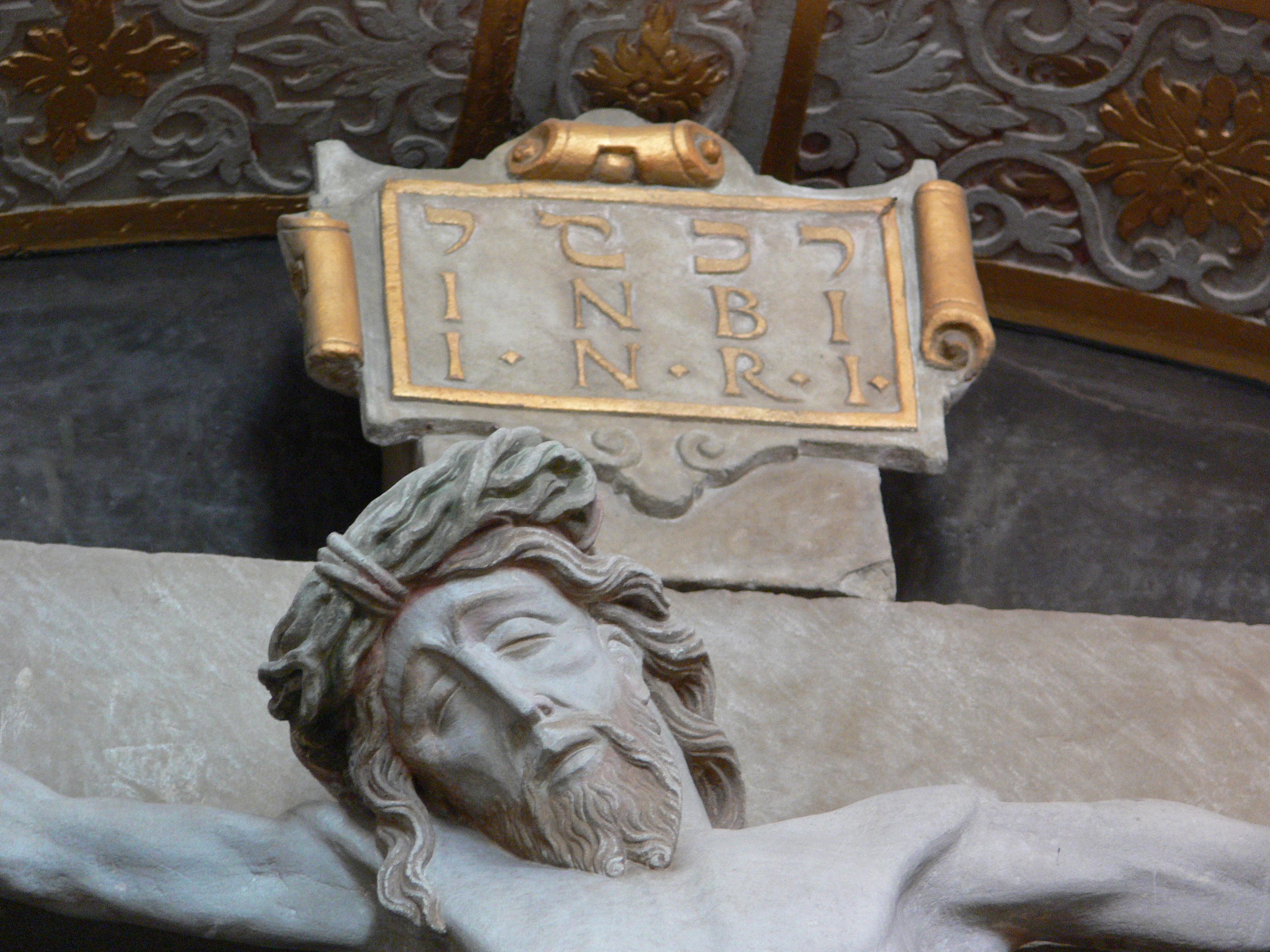
Main article: Jesus, King of the Jews
: Now Pilate wrote a title and put it on the cross. And the writing was: :: JESUS OF NAZARETH, THE KING OF THE JEWS.
Verse 19 in Greek
Textus Receptus/Majority Text: : ἔγραψεν δὲ καὶ τίτλον ὁ Πιλάτος, καὶ ἔθηκεν ἐπὶ τοῦ σταυροῦ· ἦν δὲ γεγραμμένον, :: Ἰησοῦς ὁ Ναζωραῖος ὁ βασιλεὺς τῶν Ἰουδαίων. Transliteration: : egrapsen de kai titlon ho Pilatos, kai ethēken epi tou staurou; ēn de gegrammenon, :: IĒSOUS O NAZŌRAIOS O BASILEUS TŌN IOUDAIŌN.
Verse 19 in Latin
Biblia Sacra Vulgata: : scripsit autem et titulum Pilatus et posuit super crucem erat autem scriptum :: Iesus Nazarenus rex Iudaeorum
Verse 20
: Then many of the Jews read this title, for the place where Jesus was crucified was near the city; and it was written in Hebrew, Greek, and Latin.
Verse 21
: Therefore the chief priests of the Jews said to Pilate, "Do not write, 'The King of the Jews,' but, 'He said, "I am the King of the Jews."'"
Verse 22
Main article: Quod scripsi, scripsi
: Pilate answered, "What I have written, I have written."
Verse 22 in Greek
Textus Receptus/Majority Text: : ἀπεκρίθη ὁ Πιλάτος, Ὃ γέγραφα, γέγραφα Transliteration: : apekrithē o Pilatos o gegrapha gegrapha
Verse 22 in Latin
Biblia Sacra Vulgata: : respondit Pilatus quod scripsi scripsi
Verse 23
: Then the soldiers, when they had crucified Jesus, took His garments and made four parts, to each soldier a part, and also the tunic. : Now the tunic was without seam, woven from the top in one piece.
Verse 24
: They said therefore among themselves, "Let us not tear it, but cast lots for it, whose it shall be," : that the Scripture might be fulfilled which says: :: "They divided My garments among them, :: And for My clothing they cast lots." : Therefore the soldiers did these things. The Greek λαγχάνειν (lagchanein) is properly translated not as "to cast lots", but "to obtain by lot". In this action, John sees a fulfilment of Psalm 22:18, the Septuagint version of which is quoted here.
Verse 25
: Now there stood by the cross of Jesus :: His mother, :: and His mother’s sister, Mary the wife of Clopas, and :: Mary Magdalene.
Verse 26
: When Jesus therefore saw His mother, and the disciple whom He loved standing by, : He said to His mother, ::"Woman, behold your son!"
Verse 27
: Then He said to the disciple, :: "Behold your mother!" : And from that hour that disciple took her to his own home. "That hour" may indicate that "they did not wait at the cross to see the end and the disciple took her to his own home"; εἰς τὰ ἴδια, see , . Mary would live with John and his natural mother, Salome, who is also Mary's sister.
Verse 28
: After this, Jesus, knowing that all things were now accomplished, that the Scripture might be fulfilled, said, "I thirst!" Referring to : They also gave me gall for my food, and for my thirst they gave me vinegar to drink.
Verse 29
: Now a vessel full of sour wine was sitting there; and they filled a sponge with sour wine, : put it on hyssop, and put it to His mouth.
- Referring to:
- Cross reference: ; ;
Verse 30
Main article: Sayings of Jesus on the cross#John 19:30
: So when Jesus had received the sour wine, He said, ::"It is finished!" : And bowing His head, He gave up His spirit.
Verse 30 in Greek
Textus Receptus/Majority Text: : ὅτε οὖν ἔλαβε τὸ ὄξος ὁ Ἰησοῦς, εἶπε, :: Τετέλεσται· : καὶ κλίνας τὴν κεφαλήν, παρέδωκε τὸ πνεῦμα. Transliteration: : ote oun elaben to oxos o Iēsous eipen :: tetelestai : kai klinas tēn kephalēn paredōken to pneuma
Verse 30 in Latin
Biblia Sacra Vulgata: : cum ergo accepisset Iesus acetum dixit :: consummatum est : et inclinato capite tradidit spiritum
Verse 31
:Therefore, because it was the Preparation Day, that the bodies should not remain on the cross on the Sabbath (for that Sabbath was a high day), the Jews asked Pilate that their legs might be broken, and that they might be taken away. Preparation Day was the day before the Passover. Verse 42 refers to this day as "the Jews' Preparation Day". Plummer suggests that "the addition of 'the Jews' may point to the time when there was already a Christian ‘preparation-day'".
Verse 34
:But one of the soldiers pierced His side with a spear, and immediately blood and water came out. For discussion of the physiological aspects of how water and blood might apparently flow out together from Jesus' body, see Crucifixion of Jesus#Medical aspects. Pope Francis draws together several themes which he says the early Christians would have recognised in this single observation: "one who is pierced" (see Verse 37), an open or flowing fountain, "the outpouring of a spirit of compassion and supplication", and "the water of the Spirit" pouring forth.
Verse 37
:And again another Scripture says, "They shall look on Him whom they pierced". This is the last of a series of texts, commencing from John 13:18: "that the Scripture may be fulfilled, 'He who eats bread with Me has lifted up his heel against Me', in which the evangelist confirms that the events of the passion fulfill the Old Testament scriptures. The quoted passage is b, "then they will look on Me whom they pierced", with the word "me" changed to "him". Lutheran commentator Johann Bengel argues that John quotes this passage "for the sake of its allusion to the piercing [not for that to the looking]".
Verse 39
:And Nicodemus, who at first came to Jesus by night, also came, bringing a mixture of myrrh and aloes, about a hundred pounds. Bengel notes that Nicodemus, who had shown his faith in dialogue with Jesus in chapter 3, here "manifested [it] by an altogether distinguished work of love".
Verse 40
Main article: Descent from the Cross
:Then took they the body of Jesus, and wound it in linen clothes with the spices, as the manner of the Jews is to bury.
References
Bibliography
References
- Holman Illustrated Bible Handbook. Holman Bible Publishers, Nashville, Tennessee. 2012.
- Halley, Henry H. ''Halley's Bible Handbook'': an Abbreviated Bible Commentary. 23rd edition. Zondervan Publishing House. 1962.
- "Biblical concordances of John 19 in the 1611 King James Bible".
- Kieffer, R., ''60. John'', in Barton, J. and Muddiman, J. (2001), [https://b-ok.org/dl/946961/8f5f43 The Oxford Bible Commentary] {{Webarchive. link. (2017-11-22 , pp. 994-996)
- {{bibleverse. John. 19:1. NKJV: [[New King James Version. NKJV]]
- The action was "inflicted without [[Sentence (law). Scottish Free Church]] minister [[William Robertson Nicoll
- {{bibleverse. John. 19:2. NKJV: [[New King James Version. NKJV]]
- Alford, H. (1868), [https://biblehub.com/commentaries/alford/john/19.htm Greek Testament Critical Exegetical Commentary - Alford] on John 19, accessed on 14 October 2025
- {{bibleverse. John. 19:3. NKJV: [[NKJV]]
- {{bibleverse. John. 19:3. NCV: [[New Century Version. NCV]]
- {{bibleverse. John. 19:5. NKJV: [[NKJV]]
- {{bibleverse. John. 19:6. NKJV: [[NKJV]]
- {{bibleverse. John. 19:6. TR1550: Textus Receptus
- Meyer, H. A. W., [https://biblehub.com/commentaries/meyer/john/19.htm Meyer's NT Commentary] on John 19, accessed 15 June 2019
- {{bibleverse. John. 19:6. RSV: [[Revised Standard Version. RSV]]
- {{bibleverse. John. 19:7. NKJV}: NKJV
- [[Crossway]] (2001), [https://www.biblegateway.com/passage/?search=john%2019&version=ESV#fen-ESV-26821a Footnote a at John 19:7 in the English Standard Version], accessed on 14 October 2025
- {{bibleverse. John. 19:7. TR1550: Textus Receptus 1550
- Plummer, A. (1902), [https://biblehub.com/commentaries/cambridge/john/19.htm Cambridge Bible for Schools and Colleges] on John 19, accessed 5 September 2022
- {{bibleverse. John. 19:9. NKJV: NKJV
- {{bibleverse. John. 19:19. NKJV: NKJV
- {{bibleverse. John. 19:20. NKJV: NKJV
- {{bibleverse. John. 19:21. NKJV: NKJV
- {{bibleverse. John. 19:22. NKJV: NKJV
- {{bibleverse. John. 19:23. NKJV NKJV
- {{bibleverse. John. 19:24. NKJV: NKJV
- {{bibleverse. John. 19:25. NKJV: NKJV
- {{bibleverse. John. 19:26. NKJV: NKJV
- {{bibleverse. John. 19:27. NKJV NKJV
- Marcus Rods. II: The Gospel of St. John. In: The Expositor's Greek Testament (Volumes 1). W. Robertson Nicoll (Editor). 1956. ASIN: B002KE6V1Q
- {{bibleverse. John. 19:28. NKJV: NKJV
- {{bibleverse. Psalm. 69:21. NKJV: NKJV
- {{bibleverse. John. 19:29. NKJV: NKJV
- {{bibleverse. John. 19:30. NKJV: NKJV
- {{bibleverse. John. 19:31. NKJV: NKJV
- {{bibleverse. John. 19:42. NLT: [[New Living Translation]]
- {{bibleverse. John. 19:34. NKJV: NKJV
- Pope Francis, [https://www.vatican.va/content/francesco/en/encyclicals/documents/20241024-enciclica-dilexit-nos.pdf Dilexit nos], paragraph 96, published on 24 October 2024, accessed on 2 January 2025
- {{bibleverse. John. 19:37. NKJV
- {{bibleverse. John. 13:8. NKJV
- Bengel, J. A., [https://biblehub.com/commentaries/bengel/john/19.htm Bengel's Gnomon of the New Testament] on John 19, third edition, accessed 5 December 2020
- {{bibleverse. John. 19:39. NKJV
- {{bibleverse. John. 19:40. KJV [[King James Version. KJV]]
This article was imported from Wikipedia and is available under the Creative Commons Attribution-ShareAlike 4.0 License. Content has been adapted to SurfDoc format. Original contributors can be found on the article history page.
Ask Mako anything about John 19 — get instant answers, deeper analysis, and related topics.
Research with MakoFree with your Surf account
Create a free account to save articles, ask Mako questions, and organize your research.
Sign up freeThis content may have been generated or modified by AI. CloudSurf Software LLC is not responsible for the accuracy, completeness, or reliability of AI-generated content. Always verify important information from primary sources.
Report