From Surf Wiki (app.surf) — the open knowledge base
John 17
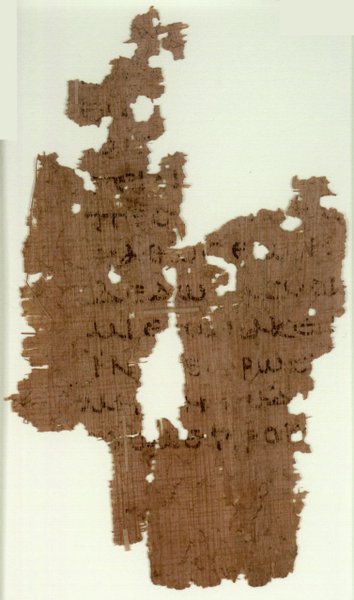
John 17 is the seventeenth chapter of the Gospel of John in the New Testament of the Christian Bible. It portrays a prayer of Jesus Christ addressed to his Father, placed in context immediately before his betrayal and crucifixion, the events which the gospel often refers to as his glorification. Lutheran writer David Chytraeus entitled Jesus' words "the prayer of the high priest". Methodist theologian Joseph Benson calls this prayer "Our Lord’s Intercessory Prayer", because "it is considered as a pattern of the intercession he is now making in heaven for his people". The New King James Version divides this chapter into three sections:
- : Jesus Prays for Himself
- : Jesus Prays for His Disciples
- : Jesus Prays for All Believers. The book containing this chapter is anonymous, but early Christian tradition uniformly affirmed that John composed this Gospel.
Text
The original text was written in Koine Greek. This chapter is divided into 26 verses.
Textual witnesses
Some early manuscripts containing the text of this chapter are:
- Papyrus 108 (2nd/3rd century; extant verses )
- Papyrus 66 (~200; complete)
- Papyrus 107 (3rd century; extant verses ,)
- Codex Vaticanus (325–350)
- Codex Sinaiticus (330–360)
- Codex Bezae (~400)
- Codex Alexandrinus (400–440)
- Codex Ephraemi Rescriptus (~450; complete)
- Papyrus 84 (6th century; extant verses , )
- Papyrus 60 (~700; complete)
- Papyrus 59 (7th century; extant verses ).
Old Testament references
- :
Jesus' Prayer
Jesus refers to his Father six times in this chapter, calling God "Father" (, pater), "Holy Father" (, pater hagie, ) and "Righteous Father" (, pater dikaie, ). These are the only occurrences in the New Testament of the vocative forms αγιε and δικαιε, used in direct address to God.
Verse 1
:Jesus spoke these words, lifted up His eyes to heaven, and said: "Father, the hour has come. Glorify Your Son, that Your Son also may glorify You".
Alternatively, "After Jesus had spoken these words ..." (to his disciples, in chapter 16), namely: :"These things I have spoken to you, that in Me you may have peace. In the world you will have tribulation; but be of good cheer, I have overcome the world." Benson suggested that "these words" refers to "the words recorded in the three preceding chapters" (chapters 14 to 16).
Verse 2
:"As You have given Him authority over all flesh, that He should give eternal life to as many as You have given Him. "Over all flesh" (σαρκός, sarkos), from the noun σὰρξ (sarx), becomes "all people" in the New International Version and the Good News Translation. Alfred Plummer argues that "fallen man, man in his frailty, is specially meant".
Verse 4
:I have glorified You on the earth. I have finished the work which You have given Me to do. This is the first of six summaries given in this chapter of the ministry of Jesus Christ on earth. The others are to be found in verses 6-8, 12, 14, 22-23, 25-26.
Verse 10
:All mine are yours, and yours are mine, and I am glorified in them. Jesus explains parenthetically, how they belong to the Father, although given by him to the Son. Irish Archbishop John McEvilly comments that
Verse 11
:Now I am no longer in the world, but these are in the world, and I come to You. Holy Father, keep through Your name those whom You have given Me, that they may be one as We are. Swedish-based commentator René Kieffer distinguishes chapter 17 from the rest of Jesus' farewell discourse, referring to "a kind of timeless aspect" denoted by the words "I am no longer in the world".
In verse 11b, the holiness of God, whom Jesus calls "Father", can be contrasted with "the unholiness of the world", The Jerusalem Bible and Richard Francis Weymouth's version of the New Testament both suggest the reading "keep [them] true to your/thy name".
Verse 12
New King James Version : While I was with them in the world, I kept them in Your name. Those whom You gave Me I have kept; and none of them is lost except the son of perdition, that the Scripture might be fulfilled. The words "in the world" are omitted by the most reliable early texts. Judas' actions fulfill the words of : :Even my close friend, someone I trusted, one who shared my bread, has turned against me.
Verse 20
:I do not pray for these alone, but also for those who will believe in Me through their word. McEvilly divides Jesus' prayer into four parts: his prayers for himself (verses 1-5), for his disciples (verses 6-19), specifically for those who will come to faith through the teaching of the apostles (verse 20) and finally for the whole church (verses 21-26).
Verse 21
Main article: That they all may be one, Ut unum sint
: [T]hat they all may be one, as You, Father, are in Me, and I in You; that they also may be one in Us, that the world may believe that You sent Me.
References
References
- [[Henry H. Halley. Halley, Henry H.]] ''Halley's Bible Handbook'': an Abbreviated Bible Commentary. 23rd edition. Zondervan Publishing House. 1962.
- Kieffer, R., ''60. John'', in Barton, J. and Muddiman, J. (2001), [https://b-ok.org/dl/946961/8f5f43 The Oxford Bible Commentary] {{Webarchive. link. (2017-11-22 , p. 990-1)
- Benson, J., [https://biblehub.com/commentaries/benson/john/17.htm Benson Commentary] on John 17, accessed 6 June 2019
- {{bibleref2. John. 17:1-26. NKJV: [[New King James Version]]
- Holman Illustrated Bible Handbook. Holman Bible Publishers, Nashville, Tennessee. 2012.
- "Biblical concordances of John 17 in the King James Bible".
- Englishman's Concordance, [http://biblehub.com/greek/agie_40.htm ἅγιε] and [http://biblehub.com/greek/dikaie_1342.htm δίκαιε]
- {{bibleref2. John. 17:1. NKJV: [[New King James Version]]
- {{bibleref2. John. 17:1. NRSV NRSV
- {{bibleverse. John. 16:33. NKJV: New King James Version
- {{bibleverse. John. 17:2. NKJV: NKJV
- Englishman's Concordance, [https://biblehub.com/greek/sarx_4561.htm σὰρξ], accessed 29 November 2020
- Plummer, A. (1902), [https://biblehub.com/commentaries/cambridge/john/17.htm Cambridge Bible for Schools and Colleges] on John 17, accessed 29 November 2020
- {{bibleverse. John. 17:4. NKJV: NKJV
- {{bibleverse. John. 17:10. ESV: [[English Standard Version]]
- Cf. [[John Nelson Darby]]'s translation at {{bibleverse. John. 17:10. DARBY
- {{bibleverse. John. 17:12. NKJV: NKJV
- or the "unholy atmosphere" in which Jesus' disciples remain.[[David Brown (Free Church of Scotland). Brown, D.]] (1882), [https://biblehub.com/commentaries/jfb/john/17.htm John 17] in the [[Jamieson-Fausset-Brown Bible Commentary]], accessed 12 May 2024
- Jerusalem Bible (1966), John 17:11
- Weymouth, R. F. (1903), [https://biblehub.com/wey/john/17.htm Weymouth New Testament: John 17], accessed 12 May 2024
- {{bibleverse. John. 17:12. NKJV: NKJV
- {{bibleverse. John. 17:20. NKJV: NKJV
- McEvilly, J. (1879), [https://www.ecatholic2000.com/macevilly2/untitled-106.shtml An Exposition Of The Gospels by The Most Rev. John Macevilly D.D.]: John 17, accessed 8 February 2024
- {{bibleverse. John. 17:21. NKJV: NKJV
This article was imported from Wikipedia and is available under the Creative Commons Attribution-ShareAlike 4.0 License. Content has been adapted to SurfDoc format. Original contributors can be found on the article history page.
Ask Mako anything about John 17 — get instant answers, deeper analysis, and related topics.
Research with MakoFree with your Surf account
Create a free account to save articles, ask Mako questions, and organize your research.
Sign up freeThis content may have been generated or modified by AI. CloudSurf Software LLC is not responsible for the accuracy, completeness, or reliability of AI-generated content. Always verify important information from primary sources.
Report