From Surf Wiki (app.surf) — the open knowledge base
Jingle Bells
1857 Christmas song by James Lord Pierpont
1857 Christmas song by James Lord Pierpont
| Field | Value |
|---|---|
| name | Jingle Bells |
| cover | One Horse Open Sleigh title page.jpg |
| caption | Title page of "The One Horse Open Sleigh" |
| type | song |
| language | English |
| published | September 16, 1857, by Oliver Ditson & Co., Boston, Massachusetts, U.S. |
| genre | Christmas |
| writer | James Lord Pierpont |
| misc | Originally titled as "The One Horse Open Sleigh" |
the song
"Jingle Bells" is an American song and one of the most commonly sung Christmas songs in the world. It was written by James Lord Pierpont. It is an unsettled question where and when Pierpont originally composed the song that would become known as "Jingle Bells". It was published under the title "The One Horse Open Sleigh" in September 1857. Although it has no original connection to Christmas, it became associated with winter and Christmas in the 1860s and 1870s, and it was featured in a variety of parlor song and college anthologies in the 1880s. It was first recorded in 1889 on an Edison cylinder; this recording, believed to be the first Christmas record, is lost, but an 1898 recording—also from Edison Records—survives.
History
Composition
James Lord Pierpont originally copyrighted the song with the name "The One Horse Open Sleigh" on September 16, 1857. The songwriting credit given was "Song and Chorus written and composed by J. Pierpont." Possibly intended as a drinking song, it did not become a Christmas song until decades after it was first performed. Pierpont dedicated the song to John P. Ordway, Esq., an organizer of a troupe called "Ordway's Aeolians".
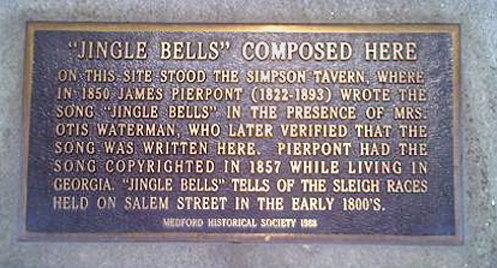
It is not known where and when Pierpont originally composed the song that would become known as "Jingle Bells". A plaque at 19 High Street in the center of Medford Square in Medford, Massachusetts, commemorates the "birthplace" of "Jingle Bells", and claims that Pierpont wrote the song there in 1850, at what was then the Simpson Tavern. Previous local history narratives claim the song was inspired by the town's popular sleigh races during the 19th century. Researcher Kyna Hamil proposes that the song was composed in Boston, before Pierpont moved to Savannah in the fall of 1857.
The song was republished in 1859 by Oliver Ditson and Company, 277 Washington Street, Boston, with the new title "Jingle Bells; or, The One Horse Open Sleigh". Its sheet music cover featured a drawing of sleigh bells around the title which was draped in snow. Sleigh bells were strapped across the horse to make the jingle, jangle sound.
"Jingle Bells" was first performed on September 15, 1857, at Ordway Hall in Boston by blackface minstrel performer Johnny Pell. The song was in the then-popular style or genre of "sleighing songs". Pierpont's lyrics are strikingly similar to lines from many other popular sleigh-riding songs of the time; researcher Kyna Hamill argued that this, along with his constant need for money, led him to compose and release the song solely as a financial enterprise: "Everything about the song is churned out and copied from other people and lines from other songs—there's nothing original about it."
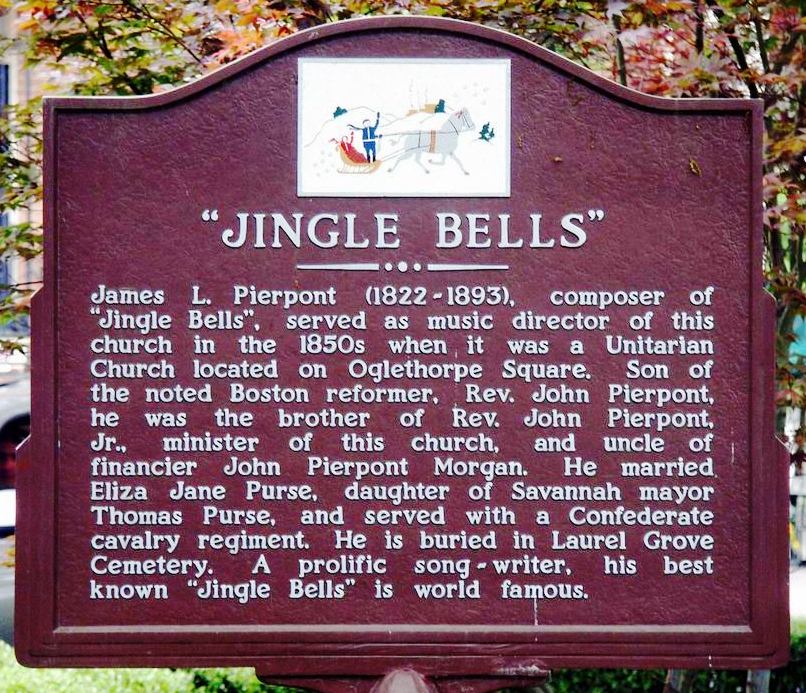
By the time the song was released and copyrighted, Pierpont had relocated to Savannah, Georgia, to serve as organist and music director of that city's Unitarian Church (now Unitarian Universalist), where his brother, Rev. John Pierpont Jr., served as minister. In August 1857, Pierpont married Eliza Jane Purse, daughter of the mayor of Savannah. Pierpont remained in Savannah and never returned north.
Recordings and performances
James Lord Pierpont's 1857 composition "Jingle Bells" became one of the most performed and most recognizable secular holiday songs ever written, not only in the United States, but around the world. In recognition of this achievement, James Lord Pierpont was voted into the Songwriters Hall of Fame.
"Jingle Bells" was first recorded by banjoist Will Lyle on October 30, 1889 (attested A T E Wangemann Logbook, p. 114), on an Edison cylinder, but no surviving copies are known to exist. The earliest surviving vocal recording was made by the Edison Male Quartette in 1898, also on an Edison cylinder (and 1898 Columbia brown wax 4090), as part of a 'Christmas' medley titled "Sleigh Ride Party". In 1902, the Hayden Quartet recorded "Jingle Bells". The song became a Christmas favorite in the early twentieth century.

In 1935, Benny Goodman and His Orchestra reached No. 18 on the charts with their Swing or big band recording of "Jingle Bells". In 1941, Glenn Miller and His Orchestra with Tex Beneke, Marion Hutton, Ernie Caceres, and the Modernaires on vocals had a No. 5 hit on the Billboard pop singles chart with a big band arrangement of "Jingle Bells" on RCA Victor as Bluebird 11353-A. In 1943, Bing Crosby and the Andrews Sisters recorded "Jingle Bells" as Decca 23281 which reached No. 19 on the charts and sold over a million copies. In 1951, Les Paul had a No. 10 hit with a multi-tracked version on guitar. In 2001, House of Mouse version, sung by Wayne Allwine, Russi Taylor, and Bill Farmer. In 2006, Kimberley Locke had a No. 1 hit on the Billboard Adult Contemporary chart with a recording of the song.
First song in space
"Jingle Bells" was one of the first songs to be broadcast from space, in a Christmas-themed prank by Gemini 6 astronauts Tom Stafford and Wally Schirra. While in space on December 16, 1965, they sent this report to Mission Control: The astronauts then produced a smuggled harmonica and sleigh bells, and with Schirra on the harmonica and Stafford on the bells, broadcast a rendition of "Jingle Bells". The harmonica, shown to the press upon their return, was a Hohner "Little Lady", a tiny harmonica approximately 1 in long, by 3/8 in wide.
Lyrics
Music historian James Fuld notes that (as opposed to an adjective), "the word jingle in the title and opening phrase is apparently an imperative verb"; however, "jingle bells" is commonly interpreted to refer to a certain kind of bell. In the winter in New England in pre-automobile days, it was common to adorn horses' harnesses with straps bearing bells as a way to avoid collisions at blind intersections, since a horse-drawn sleigh in snow produces almost no audible noise. The rhythm of the tune apparently mimics that of a trotting horse's bells.
Jingle Bells Dashing through the snow In a one-horse open sleigh O'er the fields we go Laughing all the way Bells on bob tail ring Making spirits bright What fun it is to ride and sing A sleighing song tonight!
:Oh! Jingle bells, jingle bells, :Jingle all the way. :Oh! what fun it is to ride :In a one-horse open sleigh. Hey! :Jingle bells, jingle bells, :Jingle all the way; :Oh! what fun it is to ride :In a one-horse open sleigh.
A day or two ago I thought I'd take a ride And soon, Miss Fanny Bright Was seated by my side, The horse was lean and lank Misfortune seemed his lot He got into a drifted bank And then we got up sot."Upsot" is an archaic or dialectic variant of the past tense of "upset", which allows the line to rhyme with "lot". ::|: chorus :|
A day or two ago, The story I must tell I went out on the snow, And on my back I fell; A gent was riding by In a one-horse open sleigh, He laughed as there I sprawling lie, But quickly drove away. Ah! ::|: chorus :|
Now the ground is white Go it while you're young, Take the girls tonight and sing this sleighing song; Just get a bobtailed bay Two forty as his speedTwo forty refers to a mile in two minutes and forty seconds at the trot, or 22.5 mph. This is a good speed, and suggests the desired horse of that era was a type later known as a Standardbred. Hitch him to an open sleigh And snap! You'll take the lead. ::|: chorus :|
Notes to lyrics
Original lyrics
The two first stanzas and chorus of the original 1857 lyrics differed slightly from those known today. It is unknown who replaced the words with those of the modern version. Underlined lyrics are the removed lyrics from the original version. Bold lyrics are the new lyrics in the current version. Dashing thro' the snow, In a one-horse open sleigh, O'er the (fields) we go, Laughing all the way; Bells on bob tail ring, Making spirits bright, (What fun it is) to ride and sing A sleighing song tonight.
::|: chorus :| :Jingle bells, jingle bells, :Jingle all the way; :Oh! what (fun) it is to ride :In a one-horse open sleigh.
A day or two ago I tho't I'd take a ride And soon Miss Fannie Bright Was seated by my side. The horse was mean and lank Misfortune seemed his lot He got into a drifted bank And (then) we got upsot.
Melody
The original 1857 version of "Jingle Bells" featured a substantially different chorus. The progression of descending chords in the original refrain (A–E/G–Fm–C–D–A/E–E7–A; in Roman numeral analysis, I–V6–vi–V/vi–IV–I–V7–I) bears some resemblance to that of Pachelbel's Canon. The verses, on the other hand, have mostly the same melody (with some minor simplifications) in modern renditions as they did in 1857. The origin of the simpler, modern refrain is unknown, but it dates back at least 1898, when the oldest surviving phonograph recording of the song was released through Edison Records.
The "Jingle Bells" tune is used in French and German songs, although the lyrics are unrelated to the English lyrics. Both songs celebrate winter fun, as in the English version. The French song, titled "Vive le vent" ("Long Live the Wind"), was written by Francis Blanche and contains references to Father Time, Baby New Year, and New Year's Day. There are several German versions of "Jingle Bells", including Roy Black's "Ein kleiner weißer Schneemann".
Parodies and homages
Like many simple, catchy, and popular melodies, "Jingle Bells" is often the subject of parody. "Jingle Bells, Batman Smells" has been a well-known parody since the mid-1960s, with many variations on the lyrics. It has been referenced several times in official Batman media, notably appearing in the second episode of Batman: The Animated Series, "Christmas with the Joker". It also appears in the first episode of The Simpsons, "Simpsons Roasting on an Open Fire", which led the series to be misattributed with creating the parody.
Parodies or novelty versions of "Jingle Bells" have been recorded by many artists, and include Yogi Yorgesson's "Yingle Bells", Da Yoopers' "Rusty Chevrolet", Bucko and Champs' "Aussie Jingle Bells", The Three Stooges' "Jingle Bell Drag", and Jeff Dunham's "Jingle Bombs", performed in his "Achmed the Dead Terrorist" sketch. Another popular spoof of the song is "Pumpkin Bells", a "Pumpkin Carol" which celebrates Halloween and the "Great Pumpkin". It originated in The Peanuts Book of Pumpkin Carols, a booklet based on the Peanuts comic strip and published by Hallmark Cards in the 1960s.
The Australian "Aussie Jingle Bells" written by Colin Buchanan, broadly translates the idea of the original song to the summertime Christmas of the Southern Hemisphere, making reference to a Holden ute and Kelpie.

"Jingle Bell Rock" by Bobby Helms pays homage to "Jingle Bells", directly referencing the source song's lyrics, but with a different melody. Originally recorded and released by Helms in a rockabilly style, "Jingle Bell Rock" has itself since become a Christmas standard.
"Tintinabulations" is a novelty arrangement of the song for full orchestra by American Katherine W. Punwar. It consists of 19th and 20th century stylistic variations of "Jingle Bells" and is sometimes performed by classical orchestras for their Christmas concerts.
The first notes in the chorus have become a motif that has been inserted into recordings of other Christmas songs, most notably at the beginning and end of Bing Crosby's "It's Beginning to Look a Lot Like Christmas"; a guitar passage at the end of Nat King Cole's "The Christmas Song"; and Clarence Clemons performing a saxophone solo in the middle of Bruce Springsteen's "Merry Christmas Baby". A piano is also heard playing these notes at the end of Springsteen's version of "Santa Claus Is Comin' to Town". A slow version of the chorus opening forms the conclusion of Stan Freberg's 1957 "Green Chri$tma$", interspersed with cash-register noises. Mariah Carey utilizes a bit of the melody in her song "When Christmas Comes". Joni Mitchell's 1971 song "River" begins with a melancholy version of the chorus on piano.
Charts
Frank Sinatra version
| Chart (2013–2026) | Peak | ||||
|---|---|---|---|---|---|
| position | Australia (ARIA) | France (SNEP) | Greece International (IFPI) | Lithuania (AGATA) | |
| 37 | |||||
| 28 | |||||
| 29 | |||||
| 38 |
Peter Alexander version
| Chart (1965) | Peak |
|---|---|
| position |
Judge Dread version
| Chart (1978) | Peak |
|---|---|
| position |
Moustache version
| Chart (1980) | Peak |
|---|---|
| position |
Hysterics version
| Chart (1981) | Peak |
|---|---|
| position |
Confetti's version
| Chart (1990) | Peak |
|---|---|
| position |
Yello version
| Chart (1995–2024) | Peak | |
|---|---|---|
| position | Poland (Polish Airplay Top 100) | |
| 46 |
Johann K. version
| Chart (2003) | Peak |
|---|---|
| position |
Crazy Frog version
| Chart (2005) | Peak |
|---|---|
| position |
Kimberley Locke version
| Chart (2006) | Peak | |
|---|---|---|
| position | US Adult Contemporary (Billboard) | |
| 1 |
Basshunter version
| Chart (2006, 2008) | Peak |
|---|---|
| position |
Glee Cast version
Weekly charts
| Chart (20102025) | Peak | |
|---|---|---|
| position | Holiday Digital Song Sales (Billboard) | |
| 10 |
Monthly charts
| Chart (2025) | Peak | |
|---|---|---|
| position | Moldova Airplay (TopHit) | |
| 70 |
Michael Bublé and the Puppini Sisters version
| Chart (2011–2024) | Peak | ||
|---|---|---|---|
| position | Italy (FIMI) | UK Streaming Chart (OCC) | |
| 16 | |||
| 77 |
3js version
| Chart (2014) | Peak |
|---|---|
| position |
Jim Reeves version
| Chart (2015) | Peak |
|---|---|
| position |
Lauren Daigle version
| Chart (2017) | Peak |
|---|---|
| position |
Sam Ryder version
| Chart (2022) | Peak |
|---|---|
| position |
Meghan Trainor version
| Chart (2023–2024) | Peak |
|---|---|
| position |
Certifications
Frank Sinatra version
Michael Bublé and the Puppini Sisters version
References
References
- link. (January 16, 2023 Zondervan, 2004. {{ISBN). 0310264480. p. 104.
- Wazer, Caroline. (December 23, 2024). "'Jingle Bells' Wasn't Written as a Christmas Song. Here's the Real History".
- Doyle, Steven. (September 16, 2017). "This day in history: Sept. 16, 1857". [[Greensboro News & Record]].
- Brown, Joel. (December 8, 2016). "History of Jingle Bells". [[BU Today]].
- Pierpont, J.. (September 16, 1857). "The One-Horse Open Sleigh". Oliver Ditson & Co..
- Staff (2014, updated 2022) [https://newenglandhistoricalsociety.com/james-lord-pierpont-10-unusual-facts-life/ "10 Unusual Facts About James Lord Pierpont"] {{Webarchive. link. (March 27, 2023 [[New England Historical Society]])
- Wilcox, Kris. (December 15, 2014). "James Lord Pierpont and the mystery of 'Jingle Bells'".
- "Jingle Bells. Johns Hopkins. Sheridan Libraries and University Museums. The Lester S. Levy Sheet Music Collection. Retrieved 16 December 2021.".
- Terry Keegan, Douglas Hughes, Claude A. Brock, Ran Hawthorne. ''Horse Bells''. National Horse Brass Society, Surrey, England. 2nd ed. 1988.
- (September 2017). "'The story I must tell': 'Jingle Bells' in the Minstrel Repertoire". Theatre Survey.
- [http://www.hymnsandcarolsofchristmas.com/Hymns_and_Carols/Biographies/james_lord_pierpont.htm "James Lord Pierpont (1822–1893) Author of 'Jingle Bells'"] {{Webarchive. link. (December 31, 2020 on the ''Hymns and Carols of Christmas'' website)
- [https://www.songhall.org/profiles/j-s-pierpont J.S. Pierpont. Songwriters Hall of Fame. Inducted: 1970. Retrieved 7 December 2025.]
- (December 2, 2008). "Voices of Christmas Past". dawnofsound.com.
- "Sleigh Ride Party".
- "A Bing Crosby Discography". International Club Crosby.
- Whitburn, Joel. (1986). "Joel Whitburn's Pop Memories 1890–1954". Record Research Inc.
- [https://www.billboard.com/music/music-news/chart-beat-99-56445/ Music News: 12/14/2006. Chart Beat. Fred discusses Kimberley Locke, other American Idols, Incubus and more! ''Billboard'', December 14, 2006. Retrieved 7 December 2025.]
- "Gemini VI Voice Communications". NASA.
- Edwards, Owen. (December 2005). "The Day Two Astronauts Said They Saw a UFO Wearing a Red Suit". [[Smithsonian Magazine]].
- (September 23, 2015). "The QI Third Book of General Ignorance". Faber & Faber.
- "Harmonica, Gemini 6 {{!}} National Air and Space Museum".
- Fuld, James J. (2012) ''The Book of World-Famous Music'' (Fifth Edition) New York: Dover Publications, p. 313. {{ISBN. 9780486414751
- "Vive le vent (French chorus and literal English translation)". About.com.
- "Vive le vent (with verses and augmented refrain)". Paroles.net.
- "Roy Black's version of "Jingle Bells in German" (German lyrics and literal English translation)". About.com.
- Crawford, Bill. (January 3, 1967). "bill crawford". The Lawton Constitution.
- Bronner, Simon J.. (1988). "American Children's Folklore". August House.
- (2001). "The Simpsons season 1 DVD commentary for the episode 'Simpsons Roasting on an Open Fire'". 20th Century Fox.
- Tom Berger. (December 24, 1986). "Come and say, yah hey: 'Rusty Chevrolet' rolls into holiday hit". Wausau Daily Herald.
- ''The Peanuts Book of Pumpkin Carols'', Ambassador Cards
- Lind, Stephen. (2015). "A Charlie Brown Religion". University Press of Mississippi.
- Collins, Ace. (2010). "Stories Behind the Greatest Hits of Christmas". Zondervan.
- "The Compostion" in J. S. Pierpont. ''Tintinabulations.'' Arranged by Katherine W. Punwar. San Diego: Neil A. Kjos Music Company, 1986. p. 2.
- du Lac, J. Freedom. (December 7, 2018). "How a 'thoroughly depressing' Joni Mitchell song became a blue Christmas classic". The Washington Post.
- (January 1, 2024). "ARIA Top 50 Singles Chart". [[Australian Recording Industry Association]].
- "Top Singles (Week 52, 2023)". Syndicat National de l'Édition Phonographique.
- "Official IFPI Charts – Digital Singles Chart (International) - Week 52/2023". [[IFPI Greece]].
- (December 29, 2023). "2023 52-os savaitės klausomiausi (Top 100)". [[AGATA (organization).
- "OLiS – oficjalna lista airplay". [[OLiS]].
- "Adult Contemporary".
- "Glee Cast Chart History (Holiday Digital Song Sales)".
- (December 24, 2025). "Top Radio Hits Moldova Monthly Chart: December 2025". [[TopHit]].
- "Top Singoli – Classifica settimanale WK 52". [[Federazione Industria Musicale Italiana]].
- "Official Streaming Chart". [[Official Charts Company]].
This article was imported from Wikipedia and is available under the Creative Commons Attribution-ShareAlike 4.0 License. Content has been adapted to SurfDoc format. Original contributors can be found on the article history page.
Ask Mako anything about Jingle Bells — get instant answers, deeper analysis, and related topics.
Research with MakoFree with your Surf account
Create a free account to save articles, ask Mako questions, and organize your research.
Sign up freeThis content may have been generated or modified by AI. CloudSurf Software LLC is not responsible for the accuracy, completeness, or reliability of AI-generated content. Always verify important information from primary sources.
Report