From Surf Wiki (app.surf) — the open knowledge base
Jilin
Province in Manchuria

Province in Manchuria
| Field | Value | |
|---|---|---|
| name | Jilin | |
| native_name | 吉林 | |
| other_name | Chi-lin, Kirin | |
| settlement_type | Province | |
| translit_lang1 | Name | |
| translit_lang1_type | Chinese | |
| translit_lang1_info | 吉林省 (zh) | |
| translit_lang1_type1 | Abbreviation | |
| translit_lang1_info1 | JL / () | |
| image_skyline | Changbaishan Tianchi from western rim.jpg | |
| image_caption | View of Heaven Lake | |
| image_map | Jilin in China (+all claims hatched).svg | |
| mapsize | 275px | |
| map_alt | Map showing the location of Jilin Province | |
| map_caption | Map showing the location of Jilin Province | |
| coordinates | ||
| subdivision_type | Country | |
| subdivision_name | China | |
| named_for | from girin ula, a Manchu phrase meaning "along the river" | |
| seat_type | Capital | |
| (and largest city) | ||
| seat | ||
| parts_type | Divisions | |
| parts_style | para | |
| p1 | 9 prefectures | |
| p2 | 60 counties | |
| p3 | 1006 townships | |
| government_type | Province | |
| governing_body | Jilin Provincial People's Congress | |
| leader_title | Party Secretary | |
| leader_name | Huang Qiang | |
| leader_title1 | Congress chairman | |
| leader_name1 | vacant | |
| leader_title2 | Governor | |
| leader_name2 | Hu Yuting | |
| leader_title3 | CPPCC chairman | |
| leader_name3 | Zhu Guoxian | |
| leader_title4 | National People's Congress Representation | |
| leader_name4 | 60 deputies | |
| area_footnotes | ||
| area_total_km2 | 191126 | |
| area_rank | 14th | |
| elevation_max_m | 2744 | |
| elevation_max_point | Mount Paektu | |
| population_footnotes | ||
| population_total | 24,073,453 | |
| population_as_of | 2020 | |
| population_rank | 24th | |
| population_density_km2 | auto | |
| population_density_rank | 23rd | |
| demographics_type1 | Demographics | |
| demographics1_footnotes | tags -- | |
| demographics1_title1 | Ethnic composition | |
| demographics1_info1 | {{plainlist | |
| demographics1_title2 | Languages and dialects | |
| demographics1_info2 | Northeastern Mandarin, Hamgyŏng Korean | |
| demographics_type2 | GDP | |
| demographics2_title1 | Total | |
| demographics2_info1 | CN¥ 1,588 billion (26th) | |
| demographics2_title2 | Per capita | |
| demographics2_info2 | CN¥ 54,695 (27th) | |
| iso_code | CN-JL | |
| blank4_name_sec2 | HDI (2022) | |
| blank4_info_sec2 | 0.777 (17th) – | |
| website |
the province
(and largest city)
- Han: 91%
- Korean: 4%
- Manchu: 4%
- Mongol: 0.6%
- Hui: 0.5%}}
US$ 192 billion
US$ 7,762
a Manchu phrase meaning "along the river" ᡤᠣᠯᠣ
Jilin is one of the three provinces of Northeast China. Its capital and largest city is Changchun. Jilin borders North Korea (Rasŏn, North Hamgyong, Ryanggang and Chagang) and Russia (Primorsky Krai) to the east, Heilongjiang to the north, Liaoning to the south, and Inner Mongolia to the west.
Along with the rest of Northeast China, Jilin underwent an early period of industrialization. However, Jilin's economy, characterized by heavy industry, has been facing economic difficulties with privatization. This prompted the central government to undertake a campaign called "Revitalize the Northeast". The region contains large deposits of oil shale.
Name
etymology The name "Jilin" originates from girin ula, a Manchu phrase meaning "along the river", shortened to Kirin in English. This Manchu term was transcribed into jilin wula (t 吉林烏拉, s 吉林乌拉) in Chinese characters and shortened the first two characters, which are transcribed in English as Chi-lin (Wade-Giles) and later "Jilin" (Hanyu Pinyin).
History
Main article: History of Jilin
In ancient times, Jilin was inhabited by the Xianbei, Sushen, the Mohe, Jurchens, and the Wùjí (勿吉). The kingdoms of Buyeo and Goguryeo ruled parts of this area.
The region then fell successively under the domination of the Xiongnu, Xianbei state, Goguryeo, Balhae, Khitan Liao Dynasty, the Jurchen Jin Dynasty, and the Mongol Yuan dynasty. During the Qing Dynasty, much of the area was under the control of the General of Jilin (Girin i Jiyanggiyūn), whose area of control extended to encompass much of what is Russia's Primorsky Krai today.
After the Primorsky Krai area was ceded to Russia in 1860, the government began to open the area up to Han Chinese migrants, most of whom came from Shandong. By the beginning of the 20th century, Han Chinese had become the dominant ethnic group of the region. In 1932, the area was incorporated into Manchukuo, a puppet state set up by Japan. Changchun (then called Xinjing), capital of Jilin today, was made the capital of Manchukuo. After the defeat of Japan in 1945, the Red Army captured Jilin after Operation August Storm. The region, with the rest of northeastern China, was ceded to the Communists by the Soviet Union. Manchuria was the staging ground from which the communists eventually conquered the rest of China in the Chinese Civil War.
In 1949, Jilin province was smaller, encompassing only the environs of Changchun and Jilin City, and the capital was at Jilin City, while Changchun was a municipality independent from the province. In the 1950s, Jilin was expanded to its present borders. During the Cultural Revolution, Jilin was expanded again to include a part of Inner Mongolia, giving it a border with the independent state of Mongolia, though this was later reversed.
In recent times Jilin has, with the rest of heavy industry-based Northeast China, been facing economic difficulties with privatization. This prompted the central government to undertake a campaign called "Revitalize the Northeast".
Geography
Jilin lies in the central part of northeastern China, bordering Russia and North Korea in the east and southeast respectively. Jilin has an area of 190,000 km2 and a population of 24 million. Its capital is Changchun, which lies 113 km west of Jilin City. Jilin is rich in natural mineral deposits with 136 types of minerals, of which 70 have been extracted. Jilin has an abundance of Traditional Chinese medicine resources, with approximately 27,000 kinds of wild plants and 9,000 kinds of medicinal herbs.
The province is rich in large reserves of oil, gas, coal, iron, nickel, molybdenum, talc, graphite, gypsum, cement rock, gold and silver; its reserves of oil shale are the largest in the country.
Jilin is highest in altitude in the southeast and drops gently towards the northwest. The Changbai Mountains run through its southeastern regions and contains the highest peak of the province, Paektu Mountain at 2744 m. Other ranges include the Jilinhada Mountains, Zhang Guangcai Mountains, and Longgang Mountains.
Jilin is drained by the Yalu and Tumen rivers in the extreme southeast (which together form parts of the border between the People's Republic of China and North Korea), by tributaries of the Liao River in the southwest, and by the Songhua and Nen rivers in the north, both eventually flowing into the Amur.
Jilin has a northerly continental monsoon climate, with long, cold winters and short, warm summers. Average January temperatures range from −20 to. Rainfall averages at 350. to.
Major cities in this province include Changchun, Jilin City, Baishan, Baicheng, Siping, Yanji, Songyuan, Tonghua and Liaoyuan.
Administrative divisions
Main article: List of administrative divisions of Jilin, List of township-level divisions of Jilin
Jilin consists of nine prefecture-level divisions: eight prefecture-level cities (including a sub-provincial city) and one autonomous prefecture:
| Division code | Division | Area in km2 | Population 2010 | Seat | Divisions | Districts | Counties | Aut. counties | CL cities | 220000 | Jilin Province | 220100 | Changchun city | 220200 | Jilin city | 220300 | Siping city | 220400 | Liaoyuan city | 220500 | Tonghua city | 220600 | Baishan city | 220700 | Songyuan city | 220800 | Baicheng city | 222400 | Yanbian Autonomous Prefecture |
|---|---|---|---|---|---|---|---|---|---|---|---|---|---|---|---|---|---|---|---|---|---|---|---|---|---|---|---|---|---|
| 187,400.00 | 27,462,297 | Changchun city | 21 | 16 | 3 | 20 | |||||||||||||||||||||||
| 24,734.13 | 7,677,089 | Nanguan District | 7 | 1 | 3 | ||||||||||||||||||||||||
| 27,659.79 | 4,414,681 | Chuanying District | 4 | 1 | 4 | ||||||||||||||||||||||||
| 10,241.73 | 3,386,325 | Tiexi District | 2 | 1 | 1 | 1 | |||||||||||||||||||||||
| 5,140.45 | 1,176,645 | Longshan District | 2 | 2 | |||||||||||||||||||||||||
| 15,607.80 | 2,325,242 | Dongchang District | 2 | 3 | 2 | ||||||||||||||||||||||||
| 17,473.73 | 1,295,750 | Hunjiang District | 2 | 2 | 1 | 1 | |||||||||||||||||||||||
| 21,089.38 | 2,881,082 | Ningjiang District | 1 | 2 | 1 | 1 | |||||||||||||||||||||||
| 25,692.29 | 2,033,058 | Taobei District | 1 | 2 | 2 | ||||||||||||||||||||||||
| 43,509.10 | 2,271,600 | Yanji city | 2 | 6 |
| Administrative divisions in Chinese and varieties of romanizations | English | Chinese | Pinyin |
|---|---|---|---|
| Jilin Province | 吉林省 | zh | |
| Changchun city | 长春市 | zh | |
| Jilin city | 吉林市 | zh | |
| Siping city | 四平市 | zh | |
| Liaoyuan city | 辽源市 | zh | |
| Tonghua city | 通化市 | zh | |
| Baishan city | 白山市 | zh | |
| Songyuan city | 松原市 | zh | |
| Baicheng city | 白城市 | zh | |
| Yanbian Korean Autonomous Prefecture | 延边朝鲜族自治州 | zh |
These nine prefecture-level divisions are in turn subdivided into 60 county-level divisions (21 districts, 20 county-level cities, 16 counties, and three autonomous counties). (See List of administrative divisions of Jilin.) These administrative divisions are explained in greater detail at Administrative divisions of the People's Republic of China. At the end of the year 2017, the total population is 27.17 million.http://www.stats.gov.cn/tjsj/ndsj/2018/indexch.htm
| # | Cities | 2020 Urban area | 2010 Urban area | 2020 City proper |
|---|---|---|---|---|
| 1 | Changchun | 3,531,661 | 3,411,209 | 9,066,906 |
| 2 | Jilin | 1,326,640 | 1,469,722 | 3,623,713 |
| 3 | Yanji | 630,612 | 505,516 | part of Yanbian Prefecture |
| 4 | Siping | 485,710 | 509,107 | 1,814,733 |
| 5 | Songyuan | 480,769 | 464,999 | 2,252,994 |
| 6 | Tonghua | 408,403 | 476,792 | 1,812,114 |
| 7 | Liaoyuan | 407,296 | 385,049 | 996,903 |
| 8 | Baishan | 391,234 | 503,287 | 1,551,378 |
| 9 | Gongzhuling | 384,715 | 337,851 | see Changchun |
| 10 | Meihekou | 291,138 | 268,259 | see Tonghua |
| 11 | Baicheng | 263,667 | 359,492 | 968,373 |
| 12 | Yushu | 253,344 | 280,961 | see Changchun |
| 13 | Dunhua | 241,929 | 293,396 | part of Yanbian Prefecture |
| 14 | Dehui | 202,988 | 187,956 | see Changchun |
| 15 | Hunchun | 189,760 | 174,355 | part of Yanbian Prefecture |
| 16 | Huadian | 184,810 | 193,537 | see Jilin |
| 17 | Shulan | 176,692 | 254,850 | see Jilin |
| 18 | Jiaohe | 168,313 | 201,712 | see Jilin |
| 19 | Panshi | 163,592 | 228,004 | see Jilin |
| 20 | Shuangliao | 146,716 | 180,700 | see Siping |
| 21 | Da'an | 136,823 | 202,322 | see Baicheng |
| 22 | Fuyu | 124,874 | see Songyuan | |
| 23 | Taonan | 115,946 | 164,976 | see Baicheng |
| 24 | Longjing | 96,972 | 122,065 | part of Yanbian Prefecture |
| 25 | Linjiang | 87,555 | 133,435 | see Baishan |
| 26 | Ji'an | 81,982 | 95,971 | see Tonghua |
| 27 | Helong | 80,419 | 112,337 | part of Yanbian Prefecture |
| 28 | Tumen | 71,023 | 109,342 | part of Yanbian Prefecture |
| — | Jiutai | see Changchun | 198,851 | see Changchun |
Politics
Main article: Politics of Jilin, List of provincial leaders of the People's Republic of China

The politics of Jilin is structured in a dual party-government system like all other governing institutions in mainland China.
The Governor of Jilin is the highest-ranking official in the People's Government of Jilin. However, in the province's dual party-government governing system, the Governor has less power than the Jilin Chinese Communist Party Provincial Committee Secretary.
Economy
In 2011, the nominal GDP of Jilin province totaled RMB 1053.1 billion (US$167.1 billion). Its GDP has been rising at a double-digit rate since 2003, growing 51 percent from 2003 to 2007. Per capita nominal GDP increased to RMB 26,289 (US$3,848) in 2009. Meanwhile, the incremental value and profit of large enterprises witnessed an increase of 19 percent and 30 percent respectively, compared with 2005 figures.
Jilin's agricultural production is centered upon rice, wheat, maize, and sorghum. Rice is mostly cultivated in the eastern parts, such as Yanbian Prefecture. The Changbai Mountains are an important source of lumber. Sheep herding is an important activity in the western parts, such as Baicheng.
Among its natural resources, Jilin has the largest reserves of shale oil and one of the top five largest mineral reserves in China. Compared to other provinces of China, Jilin has extensive deposits of Kieselguhr, wollastonite, floatstone, and molybdenum.
Industry in Jilin is concentrated on automobiles, train carriages, and iron alloy.
Jilin is one of the most important commodity grain bases in China and ranks 6th in timber production.
Traditionally, Jilin has been known as a major pharmaceutical center, with yields of ginseng and deer antlers among the largest in China, being used extensively in the field of Chinese medicine.
Economic and technological development zones
Jilin New and Hi-tech Industry Development Zone
The zone was founded in 1992 and is in Jilin city, covering 818 km2 of planned area with 242 km2 established. The leading industries in the zone are new materials, refined chemical products, integration of photoelectron and mechanism, electronics, medicine and bioengineering. A mere 14 km from Songhua Lake, the nearest bus and train stations are within 3 km.
The Jilin Economic and Technological Development Zone was founded in May 1998 and is in the northeast of Jilin city. The zone has a total planned area of 28 km2. It is 90 km from Changchun, 5 km from Jilin Airport, and 8 kmfrom Jilin Railway Station.
Major industries include refined chemicals, bioengineering, fine processing of chemical fiber, and farm products. It is divided into four parts: the Chemical Industrial Park, the Food Industrial Park, the Textile Industrial Park, and the Medical Industrial Park. The latter specializes in the development of traditional Chinese pharmaceuticals, mini molecule medicine, bio-pharmaceuticals and health products.
State-level ETDZs [[Changchun]] Economic and Technological Development Zone
In 1993, with the approval of the state, Changchun Economic & Technological Development Zone (CETDZ) became a state-level economic and technological development zone. The total area of CETDZ is 112.72 km2, of which 30 km2 has been set aside for development and use. By the end of 2006, the total fixed assets investment of the Changchun Economic and Technological Development Zone reached 38.4 billion yuan. There were 1656 registered enterprises in this zone including 179 foreign-funded enterprises. The regional gross product of the zone reached 101.8 billion yuan; industrial output value reached 233.0 billion Yuan; overall financial revenue reached 15.7 billion yuan.
Changchun is also the location of one of the largest factories where CRRC manufactures bullet trains. In November 2016, CRCC Changchun unveiled the first bullet train carriages in the world that would have sleeper berths, and would be capable of running in ultra low temperature environments. Nicknamed Panda, they are capable of running at 250 kmph, operate at −40 degrees Celsius, have Wi-Fi hubs and contain sleeper berths that fold into seats during the day.
;State-level HIDZs Changchun High-Tech Industrial Development Area Changchun High-Tech Industrial Development Area is connected by four roads and one light-rail line to the downtown area. The nearest train station, Changchun Station, is twenty minutes away by light rail. In 2002, Changchun HDA became the first area in Northeast China to qualify for the environmental certification of ISO14001. Its landscaping ratio reaches 38%.
;Hunchun Border Economic Cooperation Zone Hunchun Border Economic Cooperation Zone was approved to be national-level border economic cooperation zone in 1992, with a planning area of 24 km2. In 2002 and 2001, the Hunchun Export Processing Zone and Hunchun Sino-Russia Trade Zone were set up in it. It has a strategic location at the junction of the borders of China, Russia and Korea. It focuses on the development of sea food processing, electronic product manufacture, bio-pharmaceuticals, textile industry and other industries.
;Hunchun Export Processing Zone The Hunchun Export Processing Zone is in 5 km2 area is in the Hunchun Border Economic Cooperation Zone. Its planned area is 2.44 km2. It relies on the same infrastructure and policies as its parent zone.
Infrastructure
There are 35216 km of highways, including over 500 km of expressways.
The province has a rail network, begun by the Japanese, with Changchun as its main hub. There are four major new railway projects which started construction in 2007. One of these, the Harbin–Dalian High-Speed Railway connecting Harbin with Dalian via Changchun was completed in 2012. Trains on the line can travel at up to 350 km/h. The four railway projects were estimated to cost RMB13 billion, and the province urged foreign investors to invest in them. A line from Changchun to Jilin City, expected to be completed in 2015, was expected to cut the journey times between the cities from 96 minutes to 30. The railway network in Jilin can be divided into two directions in the northwest–southeast and southwest–northeast. The main trunk line Beijing-Harbin railway runs through the north and south of Jilin. From Jilin Province, it can go directly to Harbin, Shenyang, Dalian, Beijing, Tianjin, Xi'an, Shijiazhuang, Wuhan, Jinan, and so on. By the end of 2015, the railway business mileage of Jilin province reached 4877.4 km.
The main commercial airport is Changchun Longjia International Airport; other commercial airports include Yanji Chaoyangchuan International Airport, Tonghua Sanyuanpu Airport, Baicheng Chang'an Airport, Songyuan Chaganhu Airport and Changbaishan Airport.
Jilin is landlocked. River navigation is possible from April to November. The major river ports are at Da'an, Jilin city and Fuyu. In 2007, Jilin started construction on a two-phase RMB60 million comprehensive river port; the first phase is finished. The port is on the Songhua River, has an annual throughput of two million tons, and will connect to the waterways of Northeast China. Aviation takes Changchun as the center, supplemented by Yanji and Baishan. It can go directly to Beijing, Shanghai, Guangzhou, Haikou, Ningbo, Dalian, Kunming, Hong Kong, South Korea, Japan and so on. Changchun Longjia Airport, Yanji Airport, Tonghua Sanyuanpu Airport and Changbaishan Airport, etc.
Demographics
|1912 |5,580,000 |1928 |7,635,000 |1936–37 |7,354,000 |1947 |6,465,000 |1954 |11,290,073 |1964 |15,668,663 |1982 |22,560,053 |1990 |24,658,721 |2000 |26,802,191 |2010 |27,462,297 |2020 |24,073,453 Jilin is inhabited by Han Chinese, Manchus, Hui, Mongols and Xibe. Most ethnic Koreans live in the Yanbian Korean Autonomous Prefecture. The Manchu people were once the majority in the area of Jilin, making it part of their historical region. With the adoption of Han culture and the Chinese languages by the Manchu people, the Manchu language is considered a critically endangered language. Koreans comprise about 4% of the population, owing to its proximity to the Korean Peninsula. The majority of the province speaks Mandarin.
| Ethnic groups in Jilin (2000 census) | Ethnic Groups | Population | Percentage |
|---|---|---|---|
| Han Chinese | 24,348,815 | 90.85% | Koreans |
Excludes members of the People's Liberation Army in active service.
Culture
Jilin is part of Northeast China and shares many similarities in culture to neighbouring regions, such as Errenzhuan and Yangge. Among its music, Jiju, or Jilin Opera, is a form of traditional entertainment that Jilin has innovated over its short migrant history.
The ethnic Koreans of Jilin have a distinct culture, closely tied to Korea.
Languages
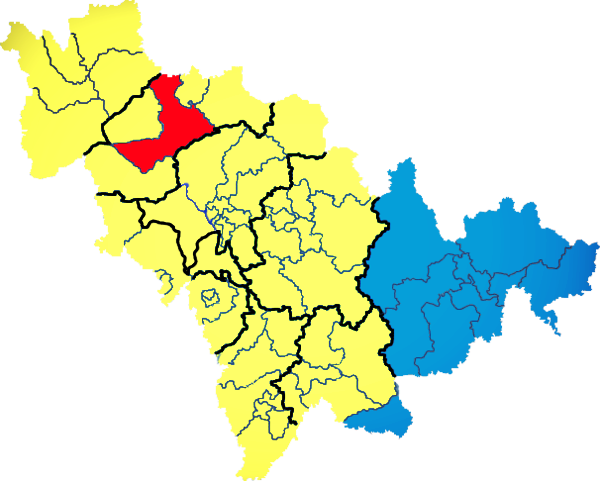
The majority of the province speaks Mandarin, the official language of China. Closer to the east, many people speak Korean. Some people of Qian Gorlos autonomous county speak Mongolian.
Cuisine
Main article: Jilin cuisine
Tourism
The Goguryeo sites and tombs found in Ji'an, Jilin, including Hwando Mountain City, Gungnae City, and the pyramidal Tomb of the General, have been listed as part of the Capital Cities and Tombs of the Ancient Koguryo Kingdom, a World Heritage Site.
Paektu Mountain, especially Heaven Lake on the border with North Korea, are popular tourist destinations due to their natural scenery.
The Ancient Tombs at Longtou Mountain, including the Mausoleum of Princess Jeonghyo, are royal tombs of Balhae found in Yanbian Korean Autonomous Prefecture.
Education
Universities and colleges
- Jilin University (吉林大学)
- Jilin Medical College (吉林医药学院)
- Northeast Normal University (东北师范大学)
- Jilin Agricultural University (吉林农业大学)
- Jilin Normal University (吉林师范大学)
- Changchun University of Science and Technology (长春理工大学)
- Changchun University of Technology (长春工业大学)
- Changchun Normal University (长春师范大学)
- Changchun University (长春大学)
- Changchun Taxation College (长春税务学院)
- Yanbian University of Science and Technology (延边科技大学)
- Yanbian University (延边大学)
- Northeast China Institute of Electric Power Engineering (东北电力学院)
- Jilin College of Electrification
- Changchun Institute of Post & Telecommunications (长春邮政学院)
- Changchun Institute of Optics and Fine Mechanics
- Beihua University
- Jilin Agricultural Science and Technology University
- Changchun Institute of Technology (长春工程学院)
Sports

Professional teams
- Chinese Basketball Association
- Jilin Northeast Tigers
- Chinese Super League
- Changchun Yatai
- China League One
- Yanbian Longding
Notable individuals
- O Kuk-ryol, Chinese-born North Korean general and politician
- Choe Hyon, Chinese-born North Korean general and politician
- Ri Tu-ik, Chinese-born North Korean vice-marshal and politician
- Li Hongbo, sculptor
- Guo Junchen, actor
- Wei Daxun, actor
- Huang Renjun, main vocalist and lead dancer of K-pop boyband NCT and NCT Dream
- Dong Yanping, Taiwanese general and politician
Notes
References
References
- "Doing Business in China – Survey". [[Ministry of Commerce of the People's Republic of China]].
- (11 May 2021). "Communiqué of the Seventh National Population Census (No. 3)". [[National Bureau of Statistics of China]].
- (March 2024). "National Data". [[National Bureau of Statistics of China.
- "Human Development Indices (8.0)- China".
- "Jilin". [[Oxford University Press]].
- {{in lang. zh [http://www.people.com.cn/GB/shenghuo/1090/2435218.html "Origin of the Names of China's Provinces"] {{Webarchive. link. (27 April 2016 , ''[[People's Daily Online]]''.)
- link. Jilin Province Library. (2009-11-24). (December 2017)
- ''History of Mongolia'', Volume II, 2003
- LTC David M. Glantz, [http://usacac.army.mil/cac2/cgsc/carl/download/csipubs/LP7_AugustStormTheSoviet1945StrategicOffensiveInManchuria.pdf "August Storm: The Soviet 1945 Strategic Offensive in Manchuria"] {{Webarchive. link. (3 March 2016 . Leavenworth Papers No. 7, Combat Studies Institute, February 1983, [[Fort Leavenworth]] [[Kansas]].)
- (2008). "China Expat city Guide Jilin". China Expat.
- (2007). "China Briefing Business Reports". Asia Briefing.
- (2008). "China Briefing Business Reports". Asia Briefing.
- link. [[Ministry of Civil Affairs]]
- Shenzhen Bureau of Statistics. [[:zh:中国统计出版社. China Statistics Print]]. link
- (2012). [[:zh:中国统计出版社. China Statistics Print]]
- Ministry of Civil Affairs. (August 2014). [[:zh:中国统计出版社. China Statistics Print]]
- 国务院人口普查办公室、国家统计局人口和社会科技统计司编. (2022). [[:zh:中国统计出版社. China Statistics Print]]
- 国务院人口普查办公室、国家统计局人口和社会科技统计司编. (2012). [[:zh:中国统计出版社. China Statistics Print]]
- (April 2018). "China Briefing Business Reports". Asia Briefing.
- "Jilin Province @ the China Perspective".
- [http://rightsite.asia/en/industrial-zone/jilin-hi-tech-development-zone/ RightSite.asia. Jilin Hi-Tech Development Zone]
- [http://rightsite.asia/en/industrial-zone/changchun-economic-technology-development-zone/ RightSite.asia. Changchun Economic and Technology Development Zone]
- (14 November 2016). "China develops bullet train with fold-up beds". China Daily.
- [http://rightsite.asia/en/industrial-zone/changchun-hi-tech-industrial-development-zone/ RightSite.asia. Changchun High-Tech Industrial Development Area]
- [http://rightsite.asia/en/industrial-zone/huichun-border-economic-cooperation-zone/ RightSite.asia. Hunchun Border Economic Cooperation Zone] {{webarchive. link. (2010-02-05)
- [http://rightsite.asia/en/industrial-zone/huichun-export-processing-zone/ RightSite.asia. Hunchun Export Processing Zone] {{webarchive. link. (2010-02-05)
- link
- link
- link
- link
- link. [[National Bureau of Statistics of China]]
- link. [[National Bureau of Statistics of China]]
- link. [[National Bureau of Statistics of China]]
- link. [[National Bureau of Statistics of China]]
- link. [[National Bureau of Statistics of China]]
- "Communiqué of the National Bureau of Statistics of People's Republic of China on Major Figures of the 2010 Population Census". [[National Bureau of Statistics of China]].
- link. [[Ta Kung Pao]]. (2017-11-08)
- National Bureau of Population and Social Science and Technology Statistics Division of China ({{lang. zh-Hans. 国家统计局人口和社会科技统计司). zh-Hans. 国家民族事务委员会经济发展司). [[Publishing House of Minority Nationalities]]. (2003)
- "Changchun Institute of Technology Homepage".
This article was imported from Wikipedia and is available under the Creative Commons Attribution-ShareAlike 4.0 License. Content has been adapted to SurfDoc format. Original contributors can be found on the article history page.
Ask Mako anything about Jilin — get instant answers, deeper analysis, and related topics.
Research with MakoFree with your Surf account
Create a free account to save articles, ask Mako questions, and organize your research.
Sign up freeThis content may have been generated or modified by AI. CloudSurf Software LLC is not responsible for the accuracy, completeness, or reliability of AI-generated content. Always verify important information from primary sources.
Report