From Surf Wiki (app.surf) — the open knowledge base
Jhansi district
| Field | Value |
|---|---|
| name | Jhansi district |
| settlement_type | District of Uttar Pradesh |
| total_type | Total |
| image_skyline | {{Photomontage |
| size | 250 |
| photo1a | Rani Mahal Jhansi.jpg |
| photo2a | Dance of the Aqua - Flickr - Dr. Santulan Mahanta.jpg |
| image_caption | Top: Rani Mahal in Jhansi |
| Bottom: Barua Sagar Tal | |
| image_map | India Uttar Pradesh districts 2012 Jhansi.svg |
| map_caption | Location of Jhansi district in Uttar Pradesh |
| coor_pinpoint | Jhansi |
| subdivision_type | Country |
| subdivision_name | India |
| subdivision_type1 | State |
| subdivision_name1 | Uttar Pradesh |
| subdivision_type2 | Division |
| subdivision_name2 | Jhansi |
| established_title | Established |
| seat_type | Headquarters |
| seat | Jhansi |
| parts_type | Tehsils |
| parts_style | para |
| p1 | 1. Jhansi, 2. Mauranipur, 3. Moth, 4.Tehroli, 5.Garautha |
| area_total_km2 | 5024 |
| population_as_of | 2011 |
| population_total | 1,998,603 |
| population_urban | 833,484 |
| population_density_km2 | auto |
| demographics_type1 | Demographics |
| demographics1_title1 | Literacy |
| demographics1_info1 | 75.05% |
| demographics1_title2 | Sex ratio |
| demographics1_info2 | 890 |
| leader_title1 | Lok Sabha constituencies |
| leader_name1 | Jhansi |
| timezone1 | IST |
| utc_offset1 | +05:30 |
| website |
the district
Bottom: Barua Sagar Tal
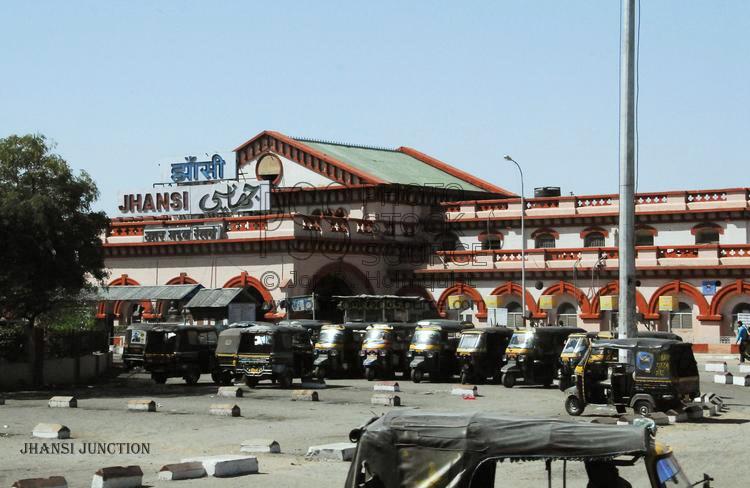
Jhansi district is one of the districts of Uttar Pradesh state in northern India. The city of Jhansi is the district headquarters. The district is bordered on the north by Jalaun District, to the east by Hamirpur and Mahoba districts, to the south by Tikamgarh District of Madhya Pradesh state, to the southwest by Lalitpur District, which is joined to Jhansi District by a narrow corridor, and on the east by the Datia and Bhind districts of Madhya Pradesh. Population 19,98,603 (2011 census). Lalitpur District, which extends into the hill country to the south, was added to Jhansi District in 1891, and made a separate district again in 1974.
History
Under the Mughal Empire at the time of Akbar, the area of today's Jhansi district was part of the sarkar of Erachh in Agra Subah. The area was part of the mahals of Erachh, Bhander, Bijpur, Jhansi, "Pandor" (i.e. Pandwaha), and Jhatra. Jhatra consisted of 4 mahals grouped together.
Geography
Several railway lines serve the district. South of Jhansi District lies the hill country of Bundelkhand, which slopes down from the Vindhya Range. The district consists of the level plain of Bundelkhand, distinguished for its deep black soil, known as mar, and admirably adapted for the cultivation of cotton. The district is intersected or bounded by three principal rivers, the Pahuj, Betwa and Dhasan.
The main city in Jhansi district is Jhansi. Other towns are Mauranipur, Garautha, Moth, Babina, Chirgaon, Samthar, Gursarai, Erich, etc.
Demographics
According to the 2011 census Jhansi district has a population of 1,998,603, roughly equal to the nation of Slovenia or the US state of New Mexico. This gives it a ranking of 231st in India (out of a total of 640). The district has a population density of 398 PD/sqkm . Its population growth rate over the decade 2001-2011 was 14.54%. Jhansi has a sex ratio of 890 females for every 1000 males, and a literacy rate of 69.68%. 41.70% of the population lives in urban areas. Scheduled Castes and Scheduled Tribes make up 28.14% and 0.19% of the population respectively.
At the time of the 2011 Census of India, 95.35% of the population in the district spoke Hindi and 3.36% Bundeli as their first language.
District at a Glance
Tehsil
There are 5 tehsil in district Jhansi:
- Jhansi
- Mauranipur
- Garautha
- Tehroli
- Moth
Development Blocks
There are 8 Development Blocks:
- Babina
- Badagaon
- Bamaur
- Bangra
- Chirgaon
- Gursarai
- Mauranipur
- Moth
Constituencies
There are 4 constituencies in Jhansi District:
- 222 – Babina
- 223 – Jhansi Nagar
- 224 – Mauranipur
- 225 – Garautha
Villages
- Ambabai
- Gadiya Gaon
- Gonti
- Khatikyana
- Palra
References
References
- (September 1905). "Dschansi". Meyers Grosses Konversations-Lexikon.
- (1929). "Jhansi: A Gazetteer, Being Volume XXIV Of The District Gazetteers Of The United Provinces Of Agra And Oudh". Government Press.
- {{EB1911
- [http://www.censusindia.gov.in/2011census/PCA/A2_Data_Table.html Decadal Variation In Population Since 1901]
- (2011). "Table C-01 Population by Religion: Uttar Pradesh". [[Registrar General and Census Commissioner of India]].
- (2011). "District Census Handbook: Jhansi". [[Registrar General and Census Commissioner of India]].
- US Directorate of Intelligence. "Country Comparison:Population".
- "2010 Resident Population Data". U. S. Census Bureau.
- "Table C-16 Population by Mother Tongue: Uttar Pradesh". [[Registrar General and Census Commissioner of India]].
- [https://jhansi.nic.in/, Jhansi]
This article was imported from Wikipedia and is available under the Creative Commons Attribution-ShareAlike 4.0 License. Content has been adapted to SurfDoc format. Original contributors can be found on the article history page.
Ask Mako anything about Jhansi district — get instant answers, deeper analysis, and related topics.
Research with MakoFree with your Surf account
Create a free account to save articles, ask Mako questions, and organize your research.
Sign up freeThis content may have been generated or modified by AI. CloudSurf Software LLC is not responsible for the accuracy, completeness, or reliability of AI-generated content. Always verify important information from primary sources.
Report