From Surf Wiki (app.surf) — the open knowledge base
Jewish question
Debate about the status of Jews in Europe
Debate about the status of Jews in Europe
The Jewish question was a wide-ranging debate in 19th- and 20th-century Europe that pertained to the appropriate status and treatment of Jews. The debate, which was similar to other "national questions", dealt with the civil, legal, national, and political status of Jews as a minority within society, particularly in Europe during the 18th, 19th, and 20th centuries.
The debate began with Jewish emancipation in western and central European societies during the Age of Enlightenment and after the French Revolution. The debate's issues included legal and economic Jewish disabilities (such as Jewish quotas and segregation), Jewish assimilation, and Jewish Enlightenment.
The expression has been used by antisemitic movements from the 1880s onwards, culminating in the Holocaust (1941–45), specifically a Nazi plan called the "Final Solution to the Jewish Question". Similarly, the expression was used by proponents for, and opponents of, the establishment of an autonomous Jewish homeland or a sovereign Jewish state, leading to the state of Israel in 1948.
History of "the Jewish question"
The term "Jewish question" was first used in Great Britain around 1750 when the expression was used during the debates related to the Jewish Naturalisation Act 1753.{{Cite book |editor-last= Auerbach |editor-first=Rena R. |url-status = dead |archive-url = https://web.archive.org/web/20051125164845/http://sicsa.huji.ac.il/bibkulka.html |archive-date = 25 November 2005 Cite book | publication-place=New York
The question was next discussed in France (la question juive) after the French Revolution in 1789. It was discussed in Germany in 1843 via Bruno Bauer's treatise Die Judenfrage (). He argued that Jews could achieve political emancipation only if they let go their religious consciousness, as he proposed that political emancipation required a secular state. Bauer's conclusions were disputed by Karl Marx in his essay Zur Judenfrage, in which he argued that Jewish political emancipation was possible because a secular state presupposes and sustains the private religious life of its citizens. Yet he still maintained that the abolition of capitalism would bring about the end of Judaism: "The existence of religion is not in contradiction to the perfection of the state... [However] once society has succeeded in abolishing the empirical essence of Judaism – huckstering and its preconditions – the Jew will have become impossible, because his consciousness no longer has an object."
According to Otto Dov Kulka of Hebrew University, the term became widespread in the 19th century when it was used in discussions about Jewish emancipation in Germany (Judenfrage). In the 19th century hundreds of tractates, pamphlets, newspaper articles and books were written on the subject, with many offering such solutions as resettlement, deportation, or assimilation of the Jewish population. Similarly, hundreds of works were written opposing these solutions and offering instead solutions such as re-integration and education. This debate however, could not decide whether the problem of the Jewish question had more to do with the problems posed by the German Jews' opponents or vice versa: the problem posed by the existence of the German Jews to their opponents.
From around 1860, the term was used with an increasingly antisemitic tendency: Jews were described under this term as a stumbling block to the identity and cohesion of the German nation and as enemies within the Germans' own country. Antisemites such as Wilhelm Marr, Karl Eugen Dühring, Theodor Fritsch, Houston Stewart Chamberlain, Paul de Lagarde and others declared it a racial problem insoluble through integration. They stressed this in order to strengthen their demands to "de-jewify" the press, education, culture, state and economy. They also proposed to condemn inter-marriage between Jews and non-Jews. They used this term to oust the Jews from their supposedly socially dominant positions.
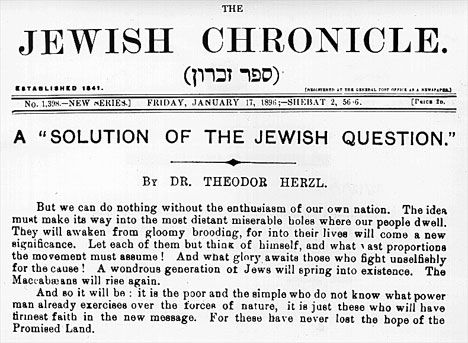
The topic was also taken up by Jews themselves. Theodor Herzl's 1896 treatise Der Judenstaat advocates Zionism as a "modern solution for the Jewish question" by creating an independent Jewish state, preferably in Ottoman-controlled Palestine. The 1934 science fiction novel {{Ill|Zwei im andern Land|de}} by the German rabbi Martin Salomonski imagines a refuge for Jews on the moon.
The most infamous use of this expression was by the Nazis in the early- and mid-twentieth century. They implemented what they called their "Final Solution to the Jewish question" through the Holocaust during World War II, when they attempted to exterminate Jews in Europe.{{Cite web |access-date=25 March 2008 |url-status=dead |archive-url=https://web.archive.org/web/20080314131150/http://holocaust-history.org/der-ewige-jude/hitler-19390130.shtml |archive-date=14 March 2008
Bruno Bauer – ''The Jewish Question''
In his book The Jewish Question (1843), Bauer argued that Jews could only achieve political emancipation if they relinquished their particular religious consciousness. He believed that political emancipation required a secular state, and such a state did not leave any "space" for social identities such as religion. According to Bauer, such religious demands were incompatible with the idea of the "Rights of Man". True political emancipation, for Bauer, required the abolition of religion.
Karl Marx – ''On the Jewish Question''
Karl Marx replied to Bauer in his 1844 essay On the Jewish Question. Marx repudiated Bauer's view that the nature of the Jewish religion prevented assimilation by Jews. Instead, Marx attacked Bauer's very formulation of the question from "can the Jews become politically emancipated?" as fundamentally masking the nature of political emancipation itself.
Marx used Bauer's essay as an occasion for his own analysis of liberal rights. Marx argued that Bauer was mistaken in his assumption that in a "secular state", religion would no longer play a prominent role in social life. As an example, he referred to the pervasiveness of religion in the United States, which, unlike Prussia, had no state religion. In Marx's analysis, the "secular state" was not opposed to religion, but rather assumed it. The removal of religious or property qualifications for citizenship did not mean the abolition of religion or property, but rather naturalized both and introduced a way of regarding individuals in abstraction from them. On this note Marx moved beyond the question of religious freedom to his real concern with Bauer's analysis of "political emancipation." Marx concluded that while individuals can be 'politically' free in a secular state, they were still bound to material constraints on freedom by economic inequality, an assumption that would later form the basis of his critiques of capitalism.
After Marx
Werner Sombart praised Jews for their capitalism and presented the seventeenth–eighteenth century court Jews as integrated and a model for integration.{{Cite book |access-date=25 March 2008 |author-link=Werner Sombart |orig-year= translated in 2001 |access-date=25 March 2008 |author-link=Theodor Herzl
The Nazi "Final Solution"
In Nazi Germany, the term Jewish Question (in ) referred to the belief that the existence of Jews in Germany posed a problem for the state. In 1933 two Nazi theorists, Johann von Leers and Achim Gercke, both proposed the idea that the Jewish Question could be solved by resettling Jews in Madagascar, or somewhere else in Africa or South America. They also discussed the pros and cons of supporting the German Zionists. Von Leers asserted that establishing a Jewish homeland in Mandatory Palestine would create humanitarian and political problems for the region.
Upon achieving power in 1933, Adolf Hitler and the Nazi state began to implement increasingly severe legislation that was aimed at segregating and ultimately removing Jews from Germany and (eventually) all of Europe. The next stage was the persecution of the Jews and the stripping of their citizenship through the 1935 Nuremberg Laws.{{Cite web |access-date=25 March 2008 |author-link=Adolf Hitler |author2-link=Wilhelm Frick |author3-link=Franz Gürtner |author4-link=Rudolf Hess |url-status=dead |archive-url=https://web.archive.org/web/20080319040258/http://www.ess.uwe.ac.uk/documents/gerblood.htm |archive-date=19 March 2008 |access-date=25 March 2008 |url-status=dead |archive-url=https://web.archive.org/web/20080321001525/http://www.ess.uwe.ac.uk/documents/citizen.htm |archive-date=21 March 2008 |access-date=25 March 2008 |access-date=25 March 2008 |url-status=dead |archive-url=https://web.archive.org/web/20150602232947/http://www.holocaust-history.org/hitler-final-solution/ |archive-date=2 June 2015
Nazi propaganda was produced in order to manipulate the public, the most notable examples of which were based on the writings of people such as Eugen Fischer, Fritz Lenz and Erwin Baur in Foundations of Human Heredity Teaching and Racial Hygiene. The work Die Freigabe der Vernichtung lebensunwerten Lebens (Allowing the Destruction of Life Unworthy of Living) by Karl Binding and Alfred Hoche and the pseudo-scholarship that was promoted by Gerhard Kittel also played a role. In occupied France, the collaborationist regime established its own Institute for studying the Jewish Questions.
In the United States
Main article: History of antisemitism in the United States
According to historians Ronald J. Jensen and Stuart Knee, by the 1870s Russian-American relations were strained by the mistreatment of American Jewish visitors in Russia. President Ulysses S. Grant responded to American Jewish requests for action to protect visitors. By the 1880s, the outbreak of anti-Semitic pogroms in Russia and consequent mass emigration of Jews to New York made relations worse. After 1880, escalating pogroms alienated both elite opinion and public opinion in the U.S. In 1903, the Kishinev pogrom killed 47 Jews, injured 400, and left 10,000 homeless and dependent on relief. American Jews began large-scale organized financial help and assisted in emigration from Russia. More violence in Russia led in 1911 to the United States repealing an 1832 commercial treaty.
In the 1920s, according to historian Leo Ribuffo, auto magnate Henry Ford sponsored a major outburst of attacks on Jews in his magazine, the Dearborn Independent, bundles of which he sent to all Ford dealerships every week. It especially promoted The Protocols of the Elders of Zion, and also published new articles that blamed Jews for America's problems. In 1927, following a lawsuit by Aaron Sapiro, Ford publicly apologized for his anti-Semitism, retracted his earlier views, and closed his magazine.
A "Jewish problem" was discussed in majority-European countries outside Europe, even as the Holocaust was in progress. American aviator and celebrity Charles A. Lindbergh used the phrase repeatedly in public speeches and writing. For example in his diary entry of September 18, 1941, published in 1970 as part of The Wartime Journals of Charles A. Lindbergh, he wrote
Contemporary use
A dominant anti-Semitic conspiracy theory is the belief that Jewish people have undue influence over the media, banking, and politics. Based on this conspiracy theory, certain groups and activists discuss the "Jewish Question" and offer different proposals to address it. In the early 21st century, white nationalists, alt-righters, and neo-Nazis have used the initialism JQ in order to refer to the Jewish question.
Notes
References
References
- Karl Marx. (February 1844). "On the Jewish Question". Deutsch-Französische Jahrbücher.
- As of 2008 Otto Dov Kulka's works are out of print, but the following may be useful and is available on microfilm: ''Reminiscences of Otto Dov Kulka'' (Glen Rock, New Jersey: Microfilming Corp. of America, 1975), {{ISBN. 978-0-88455-598-8, {{OCLC. 5326379.
- (1988). "Der Judenstaat". [[Dover Publications.
- (11 September 2022). "Jews in Space. Six questions for Lena Kugler".
- [[François Furet. 978-0-8052-4051-1
- Peled, Yoav. (1992). "From Theology to Sociology: Bruno Bauer and Karl Marx on the Question of Jewish Emancipation". History of Political Thought.
- Marx 1844:{{Blockquote. [T]he political annulment of private property not only fails to abolish private property but even presupposes it. The state abolishes, in its own way, distinctions of birth, social rank, education, occupation, when it declares that birth, social rank, education, occupation, are non-political distinctions, when it proclaims, without regard to these distinctions, that every member of the nation is an equal participant in national sovereignty, when it treats all elements of the real life of the nation from the standpoint of the state. Nevertheless, the state allows private property, education, occupation, to act in their way – i.e., as private property, as education, as occupation, and to exert the influence of their special nature. Far from abolishing these real distinctions, the state only exists on the presupposition of their existence; it feels itself to be a political state and asserts its universality only in opposition to these elements of its being.
- Dr. Achim Gercke. "Solving the Jewish Question".
- (March 2023)
- Niewyk, Donald L. ''The Columbia Guide to the Holocaust'', [[Columbia University Press]], 2000, p. 45: "The Holocaust is commonly defined as the murder of more than 5,000,000 Jews by the Germans in World War II." Also see "The Holocaust", ''Encyclopædia Britannica'', 2007: "the systematic state-sponsored killing of six million Jewish men, women and children, and millions of others, by Nazi Germany and its collaborators during World War II. The Germans called this "the final solution to the Jewish question."
- Ronald J. Jensen, "The Politics of Discrimination: America, Russia and the Jewish Question 1869–1872." ''American Jewish History'' 75.3 (1986): 280–295 [https://www.jstor.org/stable/23883266 online].
- Stuart Knee, "Tensions in nineteenth century Russo‐American diplomacy: The 'Jewish question'." ''East European Jewish Affairs'' 23#1 (1993): 79–90.
- Philip Ernest Schoenberg, "The American Reaction to the Kishinev Pogrom of 1903." ''American Jewish Historical Quarterly'' 63.3 (1974): 262–283 [https://www.jstor.org/stable/23877915 online].
- Stuart E. Knee, "The Diplomacy of Neutrality: Theodore Roosevelt and the Russian Pogroms of 1903–1906." ''Presidential Studies Quarterly'' 19#1 (1989): 71–78 [https://www.jstor.org/stable/40574565 online]
- Leo P. Ribuffo, "Henry Ford and 'The International Jew{{'" ''American Jewish History'' 69.4 (1980): 437–477. [https://www.jstor.org/stable/23881872 online]
- (1970). "The Wartime Journals of Charles A. Lindbergh". Harcourt Brace Jovanovich.
- [https://www.pbs.org/wgbh/amex/lindbergh/filmmore/reference/primary/desmoinesspeech.html "Des Moines Speech"] {{Webarchive. link. (January 30, 2017 . PBS. Retrieved: January 19, 2011.)
- (21 December 2016). "White Nationalists Create New Shorthand for the 'Jewish Question'".
- "JQ stands for the 'Jewish Question,' an anti-Semitic conspiracy theory that Jewish people have undue influence over the media, banking and politics that must somehow be addressed" (Christopher Mathias, Jenna Amatulli, Rebecca Klein, 2018, ''The HuffPost'', 3 March 2018, https://www.huffingtonpost.com/entry/florida-public-school-teacher-white-nationalist-podcast_us_5a99ae32e4b089ec353a1fba)
This article was imported from Wikipedia and is available under the Creative Commons Attribution-ShareAlike 4.0 License. Content has been adapted to SurfDoc format. Original contributors can be found on the article history page.
Ask Mako anything about Jewish question — get instant answers, deeper analysis, and related topics.
Research with MakoFree with your Surf account
Create a free account to save articles, ask Mako questions, and organize your research.
Sign up freeThis content may have been generated or modified by AI. CloudSurf Software LLC is not responsible for the accuracy, completeness, or reliability of AI-generated content. Always verify important information from primary sources.
Report