From Surf Wiki (app.surf) — the open knowledge base
Jewel bearing
Jewel-lined bearing used in precision instruments, particularly mechanical watches
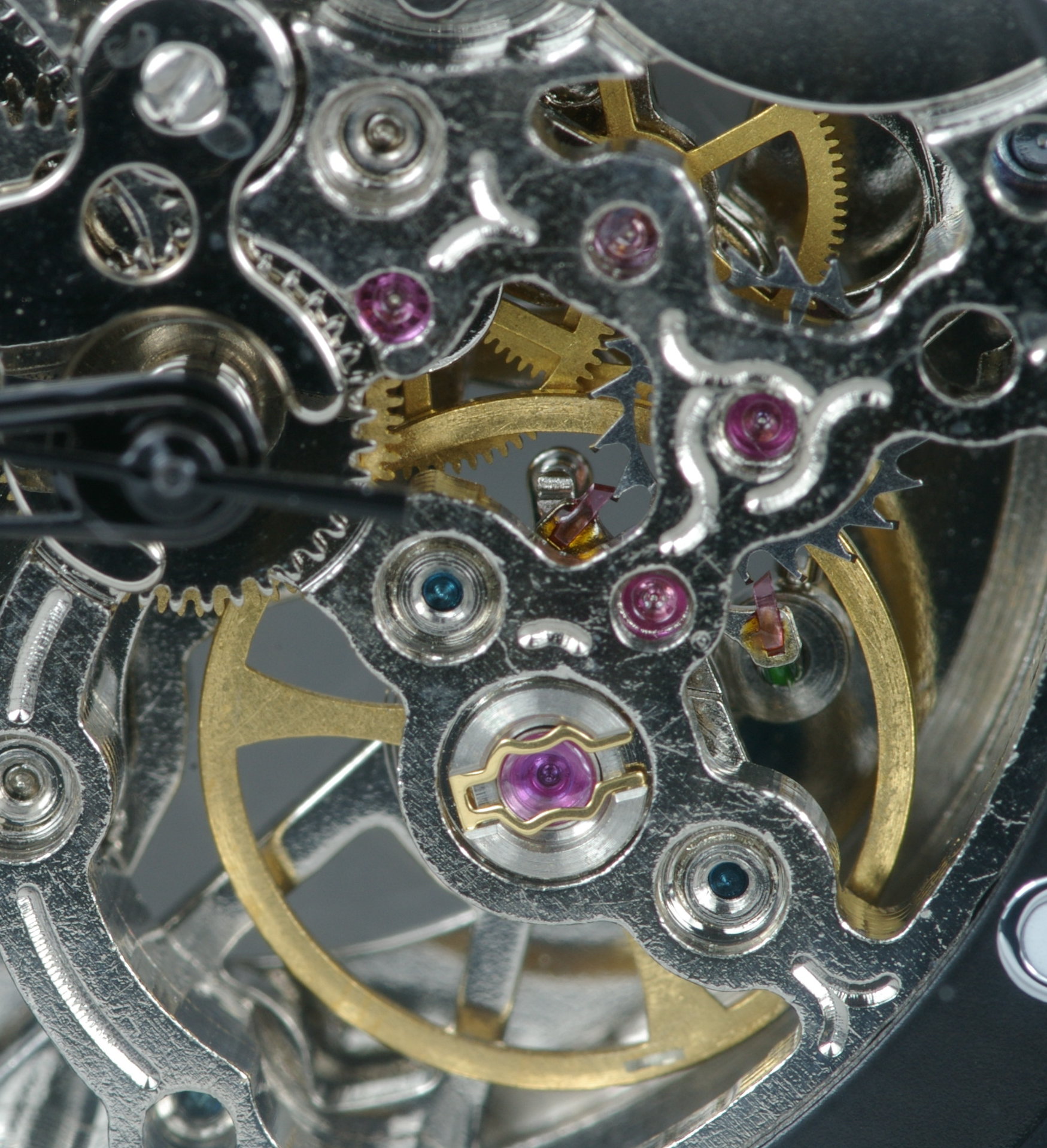
Jewel-lined bearing used in precision instruments, particularly mechanical watches


A jewel bearing is a plain bearing in which a metal spindle turns in a jewel-lined pivot hole. The hole is typically shaped like a torus and is slightly larger than the shaft diameter. The jewels are typically made from the mineral corundum, usually either synthetic sapphire or synthetic ruby. Jewel bearings are used in precision instruments where low friction, long life, and dimensional accuracy are important. Their main use is in mechanical watches.
History
Jewel bearings were invented in 1704 for use in watches by Nicolas Fatio de Duillier, Peter Debaufre, and Jacob Debaufre, who received an English patent (no. 371) for the idea. Originally natural jewels were used, such as diamond, sapphire, ruby, and garnet. In 1902, a process to make synthetic sapphire and ruby (crystalline aluminium oxide, also known as corundum) was invented by Auguste Verneuil, making jewelled bearings much cheaper. Today most jewelled bearings are synthetic ruby or sapphire.
Historically, jewel pivots were made by grinding using diamond abrasive.{{cite web | author-link = | archive-date = 2019-01-11 | archive-url = https://web.archive.org/web/20190111071911/https://elginnationalwatches.com/elgin-jewel-bearings/ | url-status = dead
During World War II jewel bearings were one of the products restricted by the United States government War Production Board as critical to the war effort.{{cite web | author-link = | archive-date = 2019-01-11 | archive-url = https://web.archive.org/web/20190111070409/https://elginnationalwatches.com/jewel-bearings-preparage/ | url-status = dead
Characteristics
The advantages of jewel bearings include high accuracy, very small size and weight, low and predictable friction, good temperature stability, and the ability to operate without lubrication and in corrosive environments. They are known for their low kinetic friction and highly consistent static friction.{{cite web | author-link = | archive-date = 2007-09-28 | archive-url = https://web.archive.org/web/20070928035751/http://www.birdprecision.com/PDFs/jewelbearings.pdf | url-status = dead | author-link = | author-link = | archive-date = 2013-05-26 | archive-url = https://web.archive.org/web/20130526022242/http://www.oringsusa.com/html/synthetic_ruby.html | url-status = dead
Uses
The predominant use of jewel bearings is in mechanical watches, where their low and predictable friction improves watch accuracy as well as improving bearing life. Manufacturers traditionally listed the number of jewels prominently on the watch face or back, as an advertising point. A typical fully jeweled time-only watch has 17 jewels: two cap jewels, two pivot jewels and an impulse jewel for the balance wheel, two pivot jewels and two pallet jewels for the pallet fork, and two pivot jewels each for the escape, fourth, third, and center wheels. In modern quartz watches, the timekeeper is a quartz crystal in an electronic circuit, powering a small stepper motor. Because of the small amount of torque needed to move the hands, there is almost no pressure on the bearings and no real gain by using a jewel bearing, hence they are not used in a large proportion of quartz movements.
The other major use of jeweled bearings is in sensitive mechanical measuring instruments. They are typically used for delicate linkages that must carry very small forces, in instruments such as galvanometers, compasses, gyroscopes, gimbals, dial indicators, dial calipers, and turbine flow meters. In such instruments, jewel bearings are often used as pivots for their needles which need to move reliably and with low variability even when measuring small changes. Bearing bores are typically smaller than 1 mm and support loads weighing less than 1 gram, although they are made as large as 10 mm and may support loads up to about 500 g. Their use has diminished with the popularization of digital measuring instruments.
References
- {{cite book
Footnotes
References
- Thompson, David. (2022). "A General History of Horology". Oxford University Press.
- BHI
This article was imported from Wikipedia and is available under the Creative Commons Attribution-ShareAlike 4.0 License. Content has been adapted to SurfDoc format. Original contributors can be found on the article history page.
Ask Mako anything about Jewel bearing — get instant answers, deeper analysis, and related topics.
Research with MakoFree with your Surf account
Create a free account to save articles, ask Mako questions, and organize your research.
Sign up freeThis content may have been generated or modified by AI. CloudSurf Software LLC is not responsible for the accuracy, completeness, or reliability of AI-generated content. Always verify important information from primary sources.
Report