From Surf Wiki (app.surf) — the open knowledge base
Jet blast deflector
Safety device that redirects exhaust from a jet engine

Safety device that redirects exhaust from a jet engine
_before_flight_operations_on_the_flight_deck_of_USS_John_C._Stennis_(CVN_74).jpg)
A jet blast deflector (JBD) or blast fence is a safety device that redirects the high energy exhaust from a jet engine to prevent damage and injury. The structure must be strong enough to withstand heat and high speed air streams as well as dust and debris carried by the turbulent air.
Jet blast deflectors range in complexity from stationary concrete, metal or fiberglass fences to heavy panels that are raised and lowered by hydraulic arms and actively cooled. Blast deflectors can be used as protection from helicopter and fixed-wing aircraft propwash. At airports and jet engine service centers, jet blast deflectors can be combined with sound-deadening walls to form a ground run-up enclosure within which a jet aircraft engine can safely and more quietly be tested at full thrust.
Purpose
High energy jet engine exhaust can cause injury and damage. Jet blast has been known to uproot trees, shatter windows, overturn automobiles and trucks, flatten poorly made structures and injure people. a level of force which is high enough to kill people. To prevent these problems, jet blast deflectors redirect the air stream in a non-dangerous direction, frequently upward.
Airports

Jet blast deflectors began to appear at airports in the 1950s. Airports in the 1960s used jet blast deflectors with a height of 6 to, but airports in the 1990s needed deflectors that were twice as high, and even up to 35 ft high for jet airliners such as the McDonnell Douglas DC-10 and MD-11, which have engines mounted in the tail above the fuselage. However, a low-pressure zone can form behind the blast fence, causing ambient air and debris to be drawn upward with the jet exhaust, and hot, toxic gases to circulate behind the blast fence. Jet blast deflectors have been designed to counteract this problem by using multiple panels and various angles, and by using slotted panel surfaces.
Ground run-up enclosure
After a jet engine has been overhauled or has undergone the replacement of parts, it is normal to run the engine up to full thrust to test it. Rural airports rarely provide more than a distant portion of the airfield within which to test engines at full thrust, but urban airports surrounded by residential areas often specify that engine tests be conducted within a ground run-up enclosure ("hush house"), so that the engine noise can be reduced for residents.
Aircraft carriers
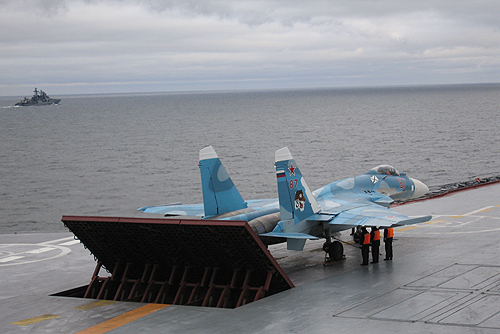

Aircraft carriers use jet blast deflectors at the rear of aircraft catapults, positioned to protect other aircraft from exhaust blast damage. Jet blast deflectors are made of heavy duty material that is raised and lowered by hydraulic cylinders or linear actuators. The jet blast deflector lies flush with and serves as a portion of the flight deck until the aircraft to be launched rolls over it on the way to the catapult. When the aircraft is clear of the deflector, the heavy panel is raised into position to redirect the hot jet blast.
Jet blast deflectors aboard aircraft carriers are placed in very close proximity to the 2300 F However, the water cooling system adds more complexity and failure points, and requires additional maintenance. The most recent method tried by the United States Navy for solving the heat problem was introduced in 2008 with USS George H.W. Bush which uses heavy-duty metal panels covered in heat-dissipating ceramic tiles similar to those used on the Space Shuttle.
Blast deflector

A jet blast deflector is often called simply a "blast deflector", however, this term has other uses. In gunnery, the term "blast deflector" refers to a device which protects the gun crew from the muzzle blast of a gun. In small arms, a "blast deflector" is another name for a muzzle brake which directs muzzle blast to the sides and upward to prevent the muzzle from climbing during automatic fire.
References
References
- Without a deflector, [[jet blast]] can be dangerous to people, equipment, vehicles and other aircraft.Morrison, Rowena. ''ASRS Directline'', Issue Number 6, August 1993. [http://asrs.arc.nasa.gov/publications/directline/dl6_blast.htm "Ground Jet Blast Hazard."] Retrieved on November 13, 2009.
-
- kn have been measured behind the largest jet-powered aircraft at distances of over {{convert. 200. ft. 200000. lbf. 5429324, issued July 4, 1995.
- Brown, Edward L. ''Blast fence for jet engines''. {{US patent. 2726830, issued December 13, 1955.
- Hayden, Harold J. ''Jet engine exhaust deflector''. {{US patent. 2826382, issued March 11, 1958.
- Stanley, Lynn B. ''Jet blast deflector fence''. {{US patent. 5127609, issued July 7, 1992.
- Stanley, Lynn B. ''Blast deflecting fence''. {{US patent. 4471924, issued September 18, 1984.
- As soon as the deflector is raised, another aircraft can be brought into position behind it, and flight deck personnel can perform final readiness duties without the danger of hot, violent exhaust gases. Such systems were installed on aircraft carriers in the late 1940s and early 1950s, as jet-powered aircraft began to appear in navies.Federation of American Scientists. [http://www.fas.org/programs/ssp/man/uswpns/navy/aircraftcarriers/cv9essex.html "CV-9 Essex Class: Overview."] {{Webarchive. link. (2011-03-10 USS Oriskany (CV-34) began a major refit in October 1947 and was returned to service in August 1951 with a number of modernizations including jet blast deflectors.)
- temperatures of [[Fourth-generation jet fighter. 6575113, issued June 10, 2003.
- The tiled panels can be changed quickly and easily – the ship carries a large replacement supply. Without active water lines, the passively-tiled deflector is expected to require much less maintenance.GlobalSecurity.org. [http://www.globalsecurity.org/military/systems/ship/cvn-77.htm "CVN-77 - George H.W. Bush."] July 10, 2006. Retrieved on November 14, 2009.
- Carlucci, Donald E. and Sidney S. Jacobson. ''Ballistics: Theory and Design of Guns and Ammunition'', pp. 158–159. CRC Press, 2007. {{ISBN. 1-4200-6618-8
This article was imported from Wikipedia and is available under the Creative Commons Attribution-ShareAlike 4.0 License. Content has been adapted to SurfDoc format. Original contributors can be found on the article history page.
Ask Mako anything about Jet blast deflector — get instant answers, deeper analysis, and related topics.
Research with MakoFree with your Surf account
Create a free account to save articles, ask Mako questions, and organize your research.
Sign up freeThis content may have been generated or modified by AI. CloudSurf Software LLC is not responsible for the accuracy, completeness, or reliability of AI-generated content. Always verify important information from primary sources.
Report