From Surf Wiki (app.surf) — the open knowledge base
Jesus and the rich young man
Episode in the New Testament
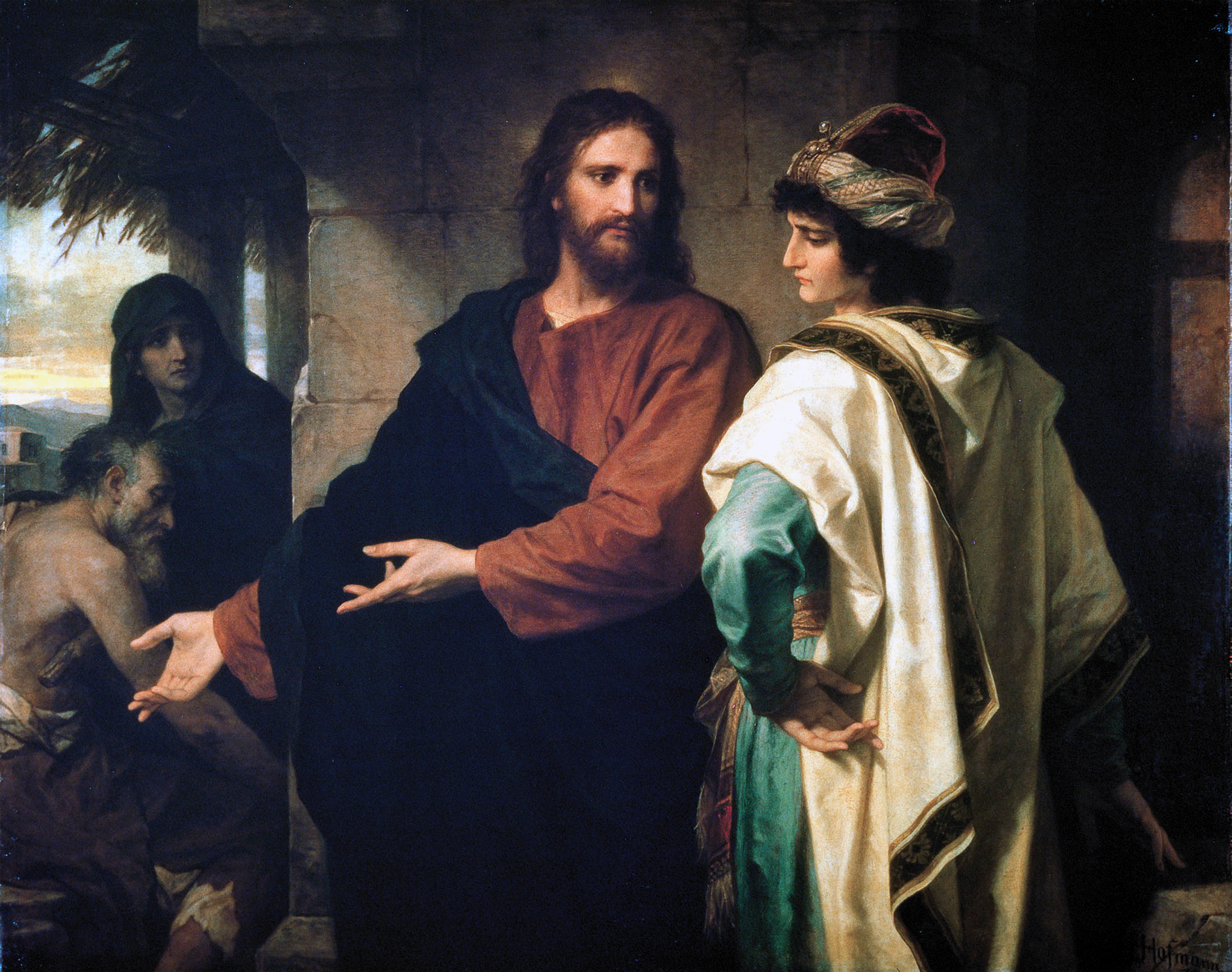
Episode in the New Testament
Jesus and the rich young man (also called Jesus and the rich ruler) is an episode in the life of Jesus recounted in the Gospel of Matthew , the Gospel of Mark and the Gospel of Luke in the New Testament. It deals with eternal life and the world to come.
Narratives
In Matthew, Mark, and Luke, the discussion is set within the period when Jesus ministered in Perea, east of the River Jordan. In Matthew, a rich young man asks Jesus what actions bring eternal life. First, Jesus advises the man to obey the commandments. When the man responds that he already observes them, and asks what else he can do, Jesus adds:
Luke has a similar episode and states that:
The non-canonical Gospel of the Nazarenes is mostly identical to the Gospel of Matthew, but one of the differences is an elaboration of this account. It reads:
Interpretation
This event relates the term "eternal life" to entry into the Kingdom of God. The account starts with a question to Jesus about eternal life, and Jesus then refers to entry into the Kingdom of God in the same context. The rich young man was the context in which Pope John Paul II brought out the Christian moral law in chapter 1 of his 1993 encyclical letter Veritatis splendor.
While Jesus's instructions to the rich young ruler are often interpreted to be supererogatory for Christians, Dietrich Bonhoeffer argues that this interpretation acquiesces in what he calls "cheap grace", lowering the standard of Christian teaching:
Separately, dispensational theologians distinguish between the Gospel of the Kingdom and the Gospel of Grace that is taught in dispensational churches today to avoid conflict with the doctrine which states that salvation is "by grace through faith" articulated in .
Justus Knecht reflects on this passage, writing: "The young man had kept the commandments from his youth up; and yet he did not feel satisfied. He wished to do even more than was commanded, or was absolutely necessary; in other words, he wished to reach a higher state of perfection. Our Lord, seeing this, gave him this counsel: 'If thou wishest to be perfect, become voluntarily poor, and follow Me.' There is no desire more noble, or more pleasing to God than the desire for perfection; and as our Lord looked at the young man, He loved him for this yearning of his soul." Knecht goes to say that unfortunately the young man "resisted our Lord’s gracious invitation, because of his too great attachment to the things of this world."
Camel and the eye of a needle
Some interpreters take the image of the camel and the eye of a needle as deliberate hyperbole, contrasting the largest familiar animal with the smallest familiar opening in order to stress that the entry of the rich into God's kingdom lies beyond human power.
The imagery of the "camel" and the "eye of a needle" has been interpreted variously. One study notes that "camel" and "eye of the needle" correspond to the names of two letters in the Phoenician alphabet, and proposes that the letter "camel" can be turned into an "eye of the needle" very quickly. Jesus was likely to have been familiar with Phoenician letter names, as he travels to Lebanon many times in the New Testament.
Other explanations have associated the phrase with a supposed small postern gate popularly called the "needle's eye", through which a loaded camel could pass only with difficulty, although this is generally regarded as a later homiletic development rather than a description of an actual gate.
In the Church Fathers
In his Latin work entitled Quis dives salvetur ("Who is the Rich Man That Shall Be Saved?"), St Clement of Alexandria stated that wealth in itself is neither good nor bad, it is a tool to be used and in itself it is not wrong. He does not espouse the pauperism typical of the Middle Ages; on the contrary, he declares that it is lawful for Christians to possess private property, without prejudice to the duty of charity, to share and redistribute their wealth to the poor. He said:
The problem of property and the relationship between rich and poor is also dealt with in De Nabùthaeit by St Ambrose of Milan.
References
## References
1. [[N. T. Wright. Wright, T.]] (2004), ''Matthew for Everyone: Chapters 16-28'', {{ISBN. 0-664-22787-2 page 47
2. ''The Bible Exposition Commentary: New Testament: Volume 1'' by Warren W. Wiersbe 2003 {{ISBN. 1-56476-030-8 page 251
3. {{bibleverse. Mark. 10:30. KJV
4. ["Bible gateway"](http://www.biblegateway.com/passage/?search=matthew%2019:16-19:30&version=NIV). *Bible gateway*.
5. ["Bible gateway"](http://www.biblegateway.com/passage/?search=luke%2018:18-18:30&version=NIV). *Bible gateway*.
6. James, M. R.. (1924). "The Apocryphal New Testament". *Clarendon Press*.
7. (2015-04-22). ["Gospel of the Nazaraeans: Variant/Addition to Mt 19:14-24 (Wikisource)"](https://en.wikisource.org/wiki/Gospel_of_the_Nazaraeans#Variant.2FAddition_to_Mt_19:14-24). *En.wikisource.org*.
8. ''Matthew'' by David L. Turner 2008 {{ISBN. 0-8010-2684-9 page 473
9. <ref>''The Westminster theological wordbook of the Bible'' by Donald E. Gowan 2003 {{ISBN. 0-664-22394-X pages 296–298
10. Green, Joel B.. (1997). "The Gospel of Luke". *Wm. B. Eerdmans Publishing*.
11. ["Veritatis Splendor, Official English Text"](https://www.vatican.va/content/john-paul-ii/en/encyclicals/documents/hf_jp-ii_enc_06081993_veritatis-splendor.html). *W2.vatican.va*.
12. [[Dietrich Bonhoeffer]], ''[[The Cost of Discipleship]]'' (1937), p. 80
13. ["A Contrast of Character | Zacchaeus and the Rich Young Ruler"](http://www.randywhiteministries.org/2013/11/26/a-contrast-of-character-a-rich-ruler-a-rich-publican/). *Randywhiteministries.org*.
14. Friedrich Justus Knecht. (1910). "A Practical Commentary on Holy Scripture". *B. Herder*.
15. Went, K. J.. ["The camel and the eye of the needle"](https://www.studylight.org/language-studies/difficult-sayings.html?article=514).
16. (1 February 2019). ["Origins of the Hebrew Aleph-Bet (Part 3, Gimel)"](https://ivrianochi.home.blog/2019/02/01/origins-of-the-hebrew-aleph-bet-part-3-gimel/).
17. Max Freedom Pollard (2024). "Revisiting the 'Camel and the Needle': A Philological Recontextualization of Phoenician Letter Nomenclature". ''Journal of Historical Linguistics''. doi:10.5281/zenodo.14848051.
18. Ziemińska, Agnieszka. (9 June 2022). "The Origin of the 'Needle's Eye Gate' Myth: Theophylact or Anselm?". *New Testament Studies*.
19. ["Who is the Rich Man That Shall Be Saved?"](https://www.newadvent.org/fathers/0207.htm).
20. Roberto Cutaia. (December 1, 2021). ["Come usare la ricchezza e la fede"](https://www.osservatoreromano.va/it/news/2021-12/quo-274/come-usare-la-ricchezza-e-la-fede.html).This article was imported from Wikipedia and is available under the Creative Commons Attribution-ShareAlike 4.0 License. Content has been adapted to SurfDoc format. Original contributors can be found on the article history page.
Ask Mako anything about Jesus and the rich young man — get instant answers, deeper analysis, and related topics.
Research with MakoFree with your Surf account
Create a free account to save articles, ask Mako questions, and organize your research.
Sign up freeThis content may have been generated or modified by AI. CloudSurf Software LLC is not responsible for the accuracy, completeness, or reliability of AI-generated content. Always verify important information from primary sources.
Report