From Surf Wiki (app.surf) — the open knowledge base
Jean-Michel Basquiat
American artist (1960–1988)
American artist (1960–1988)
| Field | Value | |
|---|---|---|
| name | Jean-Michel Basquiat | |
| image | Jean-Michel Basquiat passport (cropped).jpg | |
| image_upright | 0.9 | |
| image_size | 250 | |
| caption | Basquiat, | |
| birth_date | ||
| birth_place | New York City, U.S. | |
| death_date | ||
| death_place | New York City, U.S. | |
| resting_place | Green-Wood Cemetery, New York City, U.S. | |
| years_active | 1978–1988 | |
| known_for | Painting, drawing | |
| notable_works | {{plainlist | |
| style | {{flatlist | |
| movement | Neo-expressionism | |
| website |
- Irony of Negro Policeman (1981)
- Untitled (1981)
- Untitled (1982)
- Boy and Dog in a Johnnypump (1982)
- Defacement (1983)
- Hollywood Africans (1983)}}
- Neo-expressionism
- graffiti
- street art}}
Jean-Michel Basquiat ( , ; December 22, 1960 – August 12, 1988) was an American artist who rose to success during the 1980s as part of the neo-expressionism movement.
Basquiat first achieved notoriety in the late 1970s as part of the graffiti duo SAMO, alongside Al Diaz, writing enigmatic epigrams all over Manhattan, particularly in the cultural hotbed of the Lower East Side where disco, punk, and street art coalesced into early hip-hop culture. By the early 1980s, his paintings were being exhibited in galleries and museums internationally. At 21, Basquiat became the youngest artist to ever take part in Documenta in Kassel, Germany. At 22, he became one of the youngest to exhibit at the Whitney Biennial in New York. The Whitney Museum of American Art held a retrospective of his artwork in 1992.
Basquiat's art focused on dichotomies such as wealth versus poverty, integration versus segregation, and inner versus outer experience. He appropriated poetry, drawing, and painting, and married text and image, abstraction, figuration, and historical information mixed with contemporary critique. He used social commentary in his paintings as a tool for introspection and for identifying with his experiences in the black community, as well as attacks on power structures and systems of racism.
Basquiat died at the age of 27 in 1988 of a heroin overdose. Since then, his work has steadily increased in value. In 2017, Untitled, a 1982 painting depicting a black skull with red-and-yellow rivulets, sold for a record-breaking $110.5 million, becoming one of the most expensive paintings ever purchased.
Biography
Early life: 1960–1977
Basquiat was born on December 22, 1960, in Park Slope, Brooklyn, New York City, the second of four children to Matilde Basquiat (née Andrades, 1934–2008) and Gérard Basquiat (1930–2013). He had an older brother, Max, who died shortly before Jean-Michel's birth, and two younger sisters, Lisane (b. 1964) and Jeanine (b. 1967). His father was born in Port-au-Prince, Haiti, and his mother was born in Brooklyn to Puerto Rican parents. He was raised Catholic.
Matilde instilled a love for art in her young son by taking him to local art museums and enrolling him as a junior member of the Brooklyn Museum of Art. Basquiat was a precocious child who learned to read and write by the age of four. His mother encouraged her son's artistic talent and he often tried to draw his favorite cartoons. In 1967, he started attending Saint Ann's School, a private school. There he met his friend Marc Prozzo and together they created a children's book, written by Basquiat at the age of seven and illustrated by Prozzo.
In 1968, at the age of seven, Basquiat was hit by a car while playing in the street. His arm was broken and he suffered several internal injuries, which required a splenectomy. While he was hospitalized, his mother brought him a copy of Gray's Anatomy to keep him occupied. After his parents separated that year, Basquiat and his sisters were raised by their father. His mother was admitted to a psychiatric hospital when he was ten and thereafter spent her life in and out of institutions. By the age of eleven, Basquiat was fluent in French, Spanish and English, and an avid reader of all three languages.
Basquiat's family resided in the Brooklyn neighborhood of Boerum Hill and then in 1974, moved to Miramar, Puerto Rico. When they returned to Brooklyn in 1976, Basquiat attended Edward R. Murrow High School. He struggled to deal with his mother's instability and rebelled as a teenager. He ran away from home at 15 when his father caught him smoking cannabis in his room. He slept on park benches at Washington Square Park and took LSD. Eventually, his father spotted him with a shaved head and called the police to bring him home.
In the 10th grade, he enrolled at City-As-School, an alternative high school in Manhattan, home to many artistic students who found conventional schooling difficult. He would skip school with his friends, but still received encouragement from his teachers, and began to write and illustrate for the school newspaper. He developed the character SAMO to endorse a faux religion. The saying "SAMO" had started as a private joke between Basquiat and his schoolmate Al Diaz, as an abbreviation for the phrase "Same old shit." They drew a series of cartoons for their school paper before and after using SAMO©.
Street art and Gray: 1978–1980
commodity structures]] with the [Social environment
social milieu]] he wished to enter: the predominantly white art world.
In 1979, Basquiat appeared on the live [public-access television show TV Party hosted by Glenn O'Brien. Basquiat and O'Brien formed a friendship and he made regular appearances on the show over the next few years. Eventually, he began spending time writing graffiti around the School of Visual Arts, where he befriended students John Sex, Kenny Scharf, and Keith Haring.
In April 1979, Basquiat met Michael Holman at the Canal Zone Party and they founded the noise rock band Test Pattern, which was later renamed Gray. Other members of Gray included Shannon Dawson, Nick Taylor, Wayne Clifford and Vincent Gallo. They performed at nightclubs such as Max's Kansas City, CBGB, Hurrah and the Mudd Club.
Around this time, Basquiat lived in the East Village with his girlfriend Alexis Adler, a Barnard biology graduate. He often copied diagrams of chemical compounds borrowed from Adler's science textbooks. She documented Basquiat's creative explorations as he transformed the floors, walls, doors and furniture into his artworks. He also made postcards with his friend Jennifer Stein. While selling postcards in SoHo, Basquiat spotted Andy Warhol at W.P.A. restaurant with art critic Henry Geldzahler. He sold Warhol a postcard titled Stupid Games, Bad Ideas.
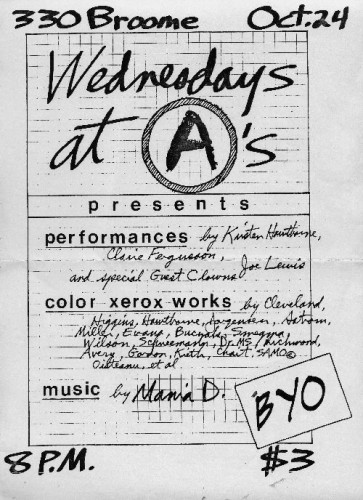
In October 1979, at Arleen Schloss's open space called A's, Basquiat showed his SAMO montages using color Xerox copies of his works. Schloss allowed Basquiat to use the space to create his "MAN MADE" clothing, which were painted upcycled garments. In November 1979, costume designer Patricia Field carried his clothing line in her upscale boutique on 8th Street in Greenwich Village. Field also displayed his sculptures in the store window.
When Basquiat and Diaz had a falling out, he inscribed "SAMO IS DEAD" on the walls of SoHo buildings in 1980. In June 1980, he appeared in High Times magazine, his first national publication, as part of an article titled "Graffiti '80: The State of the Outlaw Art" by Glenn O'Brien. Later that year, he began filming O'Brien's independent film Downtown 81 (2000), originally titled New York Beat, which featured some of Gray's recordings on its soundtrack.
Rise to fame and success: 1980–1986
In June 1980, Basquiat participated in The Times Square Show, a multi-artist exhibition sponsored by Collaborative Projects Incorporated (Colab) and Fashion Moda. He was noticed by various critics and curators, including Jeffrey Deitch, who mentioned him in an article titled "Report from Times Square" in the September 1980 issue of Art in America. In February 1981, Basquiat participated in the New York/New Wave exhibition, curated by Diego Cortez at New York's P.S.1. Italian artist Sandro Chia recommended Basquiat's work to Italian dealer Emilio Mazzoli, who promptly bought 10 paintings for Basquiat to have a show at his gallery in Modena, Italy in May 1981. In December 1981, art critic Rene Ricard published "The Radiant Child" in Artforum magazine, the first extensive article on Basquiat. During this period, Basquiat painted many pieces on objects he found in the streets, such as discarded doors.
Basquiat sold his first painting, Cadillac Moon (1981), to Debbie Harry, lead singer of the punk rock band Blondie, for $200 after they had filmed Downtown 81 together. He also appeared as a disc jockey in the 1981 Blondie music video "Rapture", a role originally intended for Grandmaster Flash. At the time, Basquiat was living with his girlfriend, Suzanne Mallouk, who financially supported him as a waitress.
In September 1981, art dealer Annina Nosei invited Basquiat to join her gallery at the suggestion of Sandro Chia. Soon after, he participated in her group show Public Address. She provided him with materials and a space to work in the basement of her gallery. In 1982, Nosei arranged for him to move into a loft, which also served as a studio at 101 Crosby Street in SoHo. He had his first American one-man show at the Annina Nosei Gallery in March 1982. He also painted in Modena for his second Italian exhibition in March 1982. With Basquiat saying he felt exploited, that show was canceled because he was expected to make eight paintings in one week.
By the summer of 1982, Basquiat had left the Annina Nosei Gallery, and gallerist Bruno Bischofberger became his worldwide art dealer. In June 1982, at 21, Basquiat became the youngest artist to ever take part in Documenta in Kassel, Germany. His works were exhibited alongside Joseph Beuys, Anselm Kiefer, Gerhard Richter, Cy Twombly, and Andy Warhol. Bischofberger gave Basquiat a one-man show at his Zurich gallery in September 1982, and arranged for him to meet Warhol for lunch on October 4, 1982. Warhol recalled, "I took a Polaroid and he went home and within two hours a painting was back, still wet, of him and me together." The painting, Dos Cabezas (1982), ignited a friendship between them. Basquiat was photographed by James Van Der Zee for an interview with Henry Geldzahler published in the January 1983 issue of Warhol's Interview magazine.[[File:Jean-Michel Basquiat (1960-1988) home on 57 Great Jones Street.jpg|thumb|From 1983 to 1988 Basquiat lived at 57 [[Great Jones Street]] in [[NoHo, Manhattan|NoHo]], where he died. A plaque commemorating his life was placed outside the building in 2016; the block was named "Jean-Michel Basquiat Way" in 2025.]]
In November 1982, Basquiat's solo exhibition opened at the Fun Gallery in the East Village. Among the works exhibited were A Panel of Experts (1982) and Equals Pi (1982). In early December 1982, Basquiat began working at the Market Street studio space art dealer Larry Gagosian had built below his Venice Beach, California home. In Los Angeles, he frequented the Whisky a Go Go and Tail o' the Pup with his friend artist George Condo. There, he commenced a series of paintings for a March 1983 show, his second at the Gagosian Gallery in West Hollywood. He was accompanied by his girlfriend, then-unknown singer Madonna. Gagosian recalled: "Everything was going along fine. Jean-Michel was making paintings, I was selling them, and we were having a lot of fun. But then one day Jean-Michel said, 'My girlfriend is coming to stay with me.' ... So I said, 'Well, what's she like?' And he said, 'Her name is Madonna and she's going to be huge.' I'll never forget that he said that."
Basquiat took considerable interest in the work that artist Robert Rauschenberg was producing at Gemini G.E.L. in West Hollywood. He visited him on several occasions and found inspiration in his accomplishments. While in Los Angeles, Basquiat painted Hollywood Africans (1983), which portrays him with graffiti artists Toxic and Rammellzee. He often painted portraits of other graffiti artists—and sometimes collaborators—in works such as Portrait of A-One A.K.A. King (1982), Toxic (1984), and ERO (1984). In 1983, he produced the hip-hop record "Beat Bop" featuring Rammellzee and rapper K-Rob. It was pressed in limited quantities on his Tartown Inc. imprint. He created the cover art for the single, making it highly desirable among both record and art collectors.[[File:Andy Warhol, Jean-Michel Basquiat, Bruno Bischofberger and Fransesco Clemente, New York, 1984.tif|left|thumb|[[Andy Warhol]], Jean-Michel Basquiat, [[Bruno Bischofberger]], and [[Francesco Clemente]] in 1984]] In March 1983, at 22 years old, Basquiat became one of the youngest artists to participate in the Whitney Biennial exhibition of contemporary art. Paige Powell, an associate publisher for Interview magazine, organized a show of his work at her friend's New York apartment in April 1983. Shortly after, he began a relationship with Powell, who was instrumental in fostering his friendship with Warhol. In August 1983, Basquiat moved into a loft owned by Warhol at 57 Great Jones Street in NoHo, which also served as a studio.
In the summer of 1983, Basquiat invited Lee Jaffe, a former musician in Bob Marley's band, to join him on a trip throughout Asia and Europe. On his return to New York, he was deeply affected by the death of Michael Stewart, an aspiring black artist in the downtown club scene who was killed by transit police in September 1983. He painted Defacement (The Death of Michael Stewart) (1983) in response to the incident. He also participated in a Christmas benefit with various New York artists for the family of Michael Stewart in 1983.
Having joined the Mary Boone's SoHo gallery in 1983, Basquiat had his first show there in May 1984. A large number of photographs depict a collaboration between Warhol and Basquiat in 1984 and 1985. When they collaborated, Warhol would start with something very concrete or a recognizable image and then Basquiat defaced it in his animated style. They made an homage to the 1984 Summer Olympics with Olympics (1984). Other collaborations include Taxi, 45th/Broadway (1984–85) and Zenith (1985). Their joint exhibition, Paintings, at the Tony Shafrazi Gallery, caused a rift in their friendship after it was panned by critics, and Basquiat was called Warhol's "mascot".
Basquiat often painted in expensive Armani suits and would appear in public in the same paint-splattered clothes. He was a regular at the Area nightclub, where he sometimes worked the turntables as a DJ for fun. He also painted murals for the Palladium nightclub in New York City. His swift rise to fame was covered in the media. He appeared on the cover of the February 10, 1985, issue of The New York Times Magazine in a feature titled "New Art, New Money: The Marketing of an American Artist". His work appeared in GQ and Esquire, and he was interviewed for MTV's "Art Break" segment. In 1985, he walked the runway for the Comme des Garçons Spring fashion show in New York.
In the mid-1980s, Basquiat was earning $1.4 million a year and he was receiving lump sums of $40,000 from art dealers. Despite his success, his emotional instability continued to haunt him. "The more money Basquiat made, the more paranoid and deeply involved with drugs he became", wrote journalist Michael Shnayerson. Basquiat's cocaine use became so excessive that he blew a hole in his nasal septum. A friend claimed that Basquiat confessed he was on heroin in late 1980. Many of his peers speculated that his drug use was a means of coping with the demands of his newfound fame, the exploitative nature of the art industry, and the pressures of being a black man in the white-dominated art world.
For what would be his last exhibition on the West Coast, Basquiat returned to Los Angeles for his show at the Gagosian Gallery in January 1986. In February 1986, Basquiat traveled to Atlanta, Georgia for an exhibition of his drawings at Fay Gold Gallery. That month, he participated in Limelight's Art Against Apartheid benefit. In the summer, he had a solo exhibition at Galerie Thaddaeus Ropac in Salzburg. He was also invited to walk the runway for Rei Kawakubo again, this time at the Comme des Garçons Homme Plus fashion show in Paris. In October 1986, Basquiat flew to Ivory Coast for an exhibition of his work organized by Bruno Bischofberger at the French Cultural Institute in Abidjan. He was accompanied by his girlfriend Jennifer Goode, who worked at his frequent hangout, Area nightclub. In November 1986, at 25 years old, Basquiat became the youngest artist given an exhibition at Kestner-Gesellschaft in Hanover, Germany.
Final years and death: 1986–1988
During their relationship, Goode began snorting heroin with Basquiat, since drugs were at her disposal. She said: "He didn't push it on me, but it was just there and I was so naïve." In late 1986, she successfully got herself and Basquiat into a methadone program in Manhattan, but he quit after three weeks. According to Goode, he did not start injecting heroin until after she ended their relationship. In the last 18 months of his life, Basquiat became something of a recluse. His continued drug use is thought to have been a way of coping after the death of his friend Andy Warhol in February 1987.
In 1987, Basquiat had exhibitions at Galerie Daniel Templon in Paris, the Akira Ikeda Gallery in Tokyo, and the Tony Shafrazi Gallery in New York. Allen Ginsberg photographed Basquiat at the Shafrazi gallery attending William Burroughs' "Shotgun Artshow" on December 17, 1987. He designed a Ferris wheel for André Heller's Luna Luna, an ephemeral amusement park in Hamburg from June to August 1987 with rides designed by renowned contemporary artists.
In January 1988, Basquiat traveled to Paris for his exhibition at the Yvon Lambert Gallery and to Düsseldorf for an exhibition at the Hans Mayer Gallery. While in Paris, he befriended Ivorian artist Ouattara Watts. They made plans to travel together to Watts' birthplace, Korhogo, that summer. Following his exhibition at the Vrej Baghoomian Gallery in New York in April 1988, Basquiat traveled to Maui in June to withdraw from drug use. After returning to New York in July, Basquiat ran into Keith Haring on Broadway, who stated that this last encounter was the only time Basquiat ever discussed his drug problem with him. Glenn O'Brien also recalled Basquiat calling him and telling him he was "feeling really good."
Despite attempts at sobriety, Basquiat died at the age of 27 of a heroin overdose at his home on Great Jones Street in Manhattan on August 12, 1988. He had been found unresponsive in his bedroom by his girlfriend Kelle Inman and was taken to Cabrini Medical Center, where he was pronounced dead on arrival.
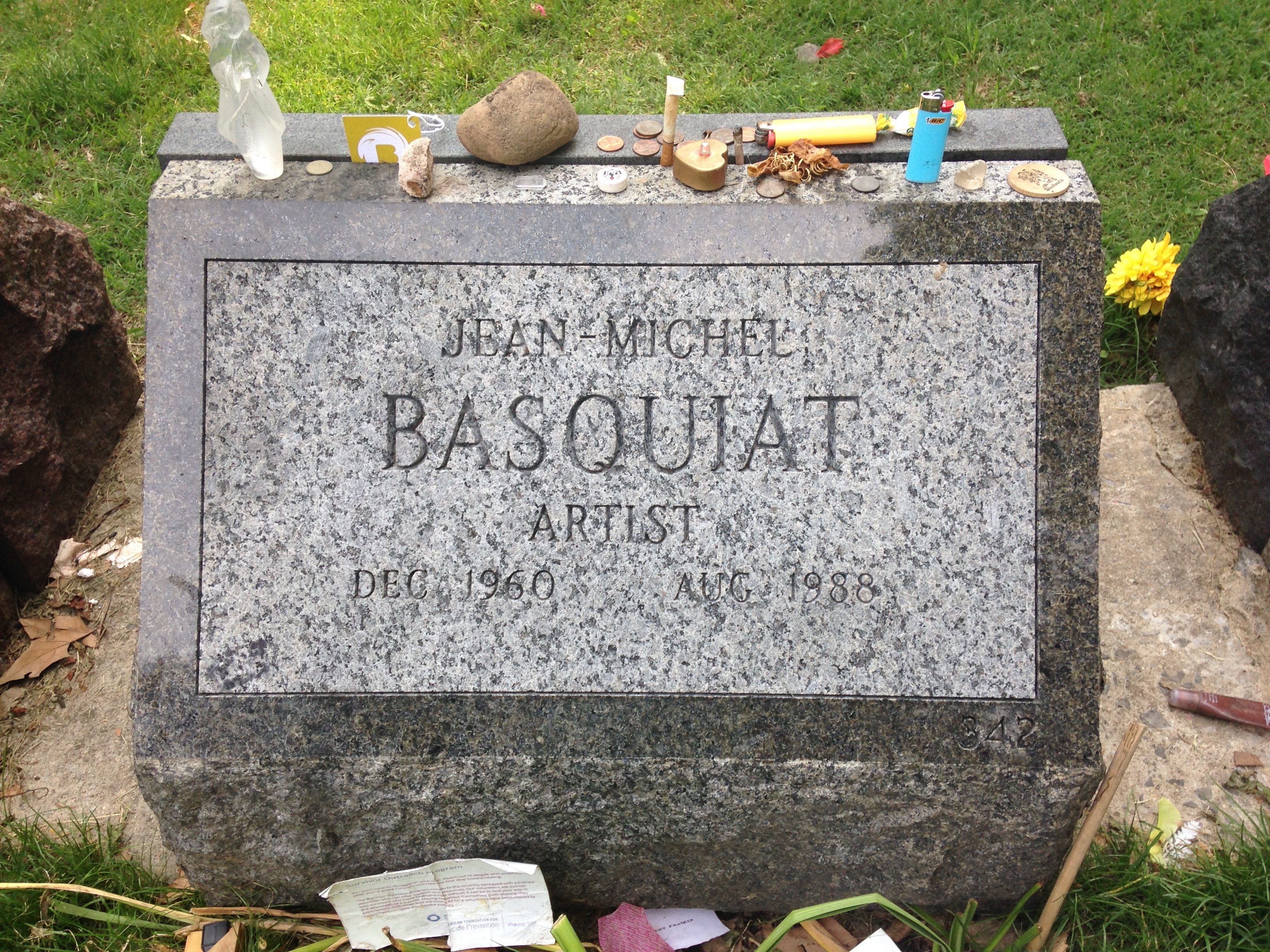
Basquiat is buried at Brooklyn's Green-Wood Cemetery. A private funeral was held at Frank E. Campbell Funeral Chapel on August 17, 1988. The funeral was attended by immediate family and close friends, including Keith Haring, Francesco Clemente, Glenn O'Brien, and Basquiat's former girlfriend Paige Powell. Art dealer Jeffrey Deitch delivered a eulogy.
A public memorial was held at Saint Peter's Church on November 3, 1988. Among the speakers was Ingrid Sischy, who as the editor of Artforum got to know Basquiat well and commissioned a number of articles that introduced his work to the wider world. Basquiat's former girlfriend Suzanne Mallouk recited sections of A. R. Penck's "Poem for Basquiat" and his friend Fab 5 Freddy read a poem by Langston Hughes. The 300 guests included musicians John Lurie and Arto Lindsay, Keith Haring, poet David Shapiro, Glenn O'Brien, and members of Basquiat's former band Gray.
In memory of the late artist, Keith Haring created the painting A Pile of Crowns for Jean-Michel Basquiat. In the obituary Haring wrote for Vogue, he stated: "He truly created a lifetime of works in ten years. Greedily, we wonder what else he might have created, what masterpieces we have been cheated out of by his death, but the fact is that he has created enough work to intrigue generations to come. Only now will people begin to understand the magnitude of his contribution."
Artistry
Before his career as a painter began, Basquiat produced punk-inspired postcards for sale on the street, and became known for his political–poetical graffiti under the name of SAMO. He often drew on random objects and surfaces, including other people's clothing. The conjunction of various media is an integral element of his art. His paintings are typically covered with codes of all kinds: words, letters, numerals, pictograms, logos, map symbols, and diagrams.
Basquiat primarily used texts as reference sources. A few of the books he used were Gray's Anatomy, Henry Dreyfuss' Symbol Sourcebook, Leonardo da Vinci published by Reynal & Company, and Burchard Brentjes' African Rock Art, Flash of the Spirit by Robert Farris Thompson.
A middle period from late 1982 to 1985 featured multi-panel paintings and individual canvases with exposed stretcher bars, the surface dense with writing, collage and imagery. The years 1984 to 1985 were also the period of the Basquiat–Warhol collaborations.
Drawings
_1982.jpeg)
In his short but prolific career, Basquiat produced around 1,500 drawings, around 600 paintings, and many sculpture and mixed media works. He drew constantly and often used objects around him as surfaces when paper was not immediately at hand. Since childhood, he produced cartoon-inspired drawings when encouraged by his mother's interest in art, and drawing became a part of his expression as an artist. He drew in many different media, most commonly ink, pencil, felt-tip or marker, and oil-stick. He sometimes used Xerox copies of fragments of his drawings to paste onto the canvases of larger paintings.
The first public showing of Basquiat's paintings and drawings was in 1981 at the MoMA PS1 New York/New Wave exhibition. Rene Ricard's article "Radiant Child" in Artforum magazine brought Basquiat to the attention of the art world. Basquiat immortalized Ricard in two drawings, Untitled (Axe/Rene) (1984) and René Ricard (1984).
A poet as well as an artist, words featured heavily in his drawings and paintings, with direct references to racism, slavery, the people and street scene of 1980s New York, black historical figures, famous musicians, and athletes, as his notebooks and many important drawings demonstrate. Often Basquiat's drawings were untitled, and as such, to differentiate works, a word written within the drawing is commonly in parentheses after Untitled. After Basquiat died, his estate was controlled by his father Gérard Basquiat, who also oversaw the committee that authenticated artworks, and operated from 1994 to 2012 to review over 2000 works, the majority of which were drawings.
Heroes and saints
A prominent theme in Basquiat's work is the portrayal of historically prominent black figures, who were identified as heroes and saints. His early works often featured the iconographic depiction of crowns and halos to distinguish heroes and saints in his specially chosen pantheon. "Jean-Michel's crown has three peaks, for his three royal lineages: the poet, the musician, the great boxing champion. Jean measured his skill against all he deemed strong, without prejudice as to their taste or age", said his friend and artist Francesco Clemente. Reviewing Basquiat's show at the Bilbao Guggenheim, Art Daily noted that "Basquiat's crown is a changeable symbol: at times a halo and at others a crown of thorns, emphasizing the martyrdom that often goes hand in hand with sainthood. For Basquiat, these heroes and saints are warriors, occasionally rendered triumphant with arms raised in victory."
Basquiat was particularly a fan of bebop and cited saxophonist Charlie Parker as a hero. He frequently referenced Parker and other jazz musicians in paintings such as Charles the First (1982) and Horn Players (1983), and King Zulu (1986). "Basquiat looked to jazz music for inspiration and for instruction, much in the same way that he looked to the modern masters of painting", said art historian Jordana Moore Saggese.
Death and marginalization

A major reference source used by Basquiat throughout his career was the book Gray's Anatomy, which his mother had given him while he was in the hospital when he was seven. It remained influential in his depictions of human anatomy, and in its mixture of image and text as seen in Flesh and Spirit (1982–83). Art historian Olivier Berggruen situates in Basquiat's anatomical screen prints Anatomy (1982) an assertion of vulnerability, one which "creates an aesthetic of the body as damaged, scarred, fragmented, incomplete, or torn apart, once the organic whole has disappeared. Paradoxically, it is the very act of creating these representations that conjures a positive corporeal valence between the artist and his sense of self or identity."
Heads and skulls are significant focal points of many of Basquiat's most seminal works. Heads in works like Untitled (Two Heads on Gold) (1982) and Philistines (1982) are reminiscent of African masks, suggesting a cultural reclamation. The skulls allude to Haitian Vodou, which is filled with skull symbolism; the paintings Red Skull (1982) and Untitled (1982) can be seen as primary examples. In reference to the potent image depicted in Untitled (Skull) (1981), art historian Fred Hoffman writes that Basquiat was likely "caught off guard, possibly even frightened, by the power and energy emanating from this unexpected image." Further investigation by Hoffman in his book The Art of Jean-Michel Basquiat reveals a deeper interest in the artist's fascination with heads that proves an evolution in the artist's oeuvre from one of raw power to one of more refined cognizance.
Heritage
Basquiat's diverse cultural heritage was one of his many sources of inspiration. He often incorporated Spanish words into his artworks like Untitled (Pollo Frito) (1982) and Sabado por la Noche (1984). Basquiat's La Hara (1981), a menacing portrait of a white police officer, combines the Nuyorican slang term for police (la jara) and the Irish surname O'Hara. The black-hatted figure that appears in his paintings The Guilt of Gold Teeth (1982) and Despues De Un Pun (1987) is believed to represent Baron Samedi, the spirit of death and resurrection in Haitian Vodou.
Basquiat has various works deriving from African-American history, namely Slave Auction (1982), Undiscovered Genius of the Mississippi Delta (1983), El Gran Espectaculo (The Nile) (1983), and Jim Crow (1986). Another painting, Irony of Negro Policeman (1981), illustrates how African-Americans have been controlled by a predominantly white society. Basquiat sought to portray that African-Americans have become complicit with the "institutionalized forms of whiteness and corrupt white regimes of power" years after the Jim Crow era had ended. This concept has been reiterated in additional Basquiat works, including Created Equal (1984).
In the essay "Lost in Translation: Jean-Michel in the (Re)Mix", Kellie Jones posits that Basquiat's "mischievous, complex, and neologistic side, with regard to the fashioning of modernity and the influence and effluence of black culture" are often elided by critics and viewers, and thus "lost in translation."
Blackness, identity, and aesthetics
Basquiat's artwork stands at the intersection of blackness, identity, and aesthetics, grappling with complex questions of representation and self-reflexivity. His work disrupts the boundaries of high art, redefining the aesthetics of black identity through distinctive use of symbols, language, and visual style. Basquiat's engagement with black identity is inseparable from his exploration of a commodified American Africanism. His oeuvre, which includes graffiti under the moniker "SAMO©", critiques mainstream racial representations and constructs a fluid African American identity. Through his "economies of accumulation", Basquiat challenges the simplified constructions of blackness, rejecting the essentialist narratives imposed by the art world. His art incorporates motifs that signify historical and modern racial struggles, rendering the African American experience as both a subject of critique and aesthetic innovation.
Basquiat's artwork serves as a method of identity formation, navigating the ontological and aesthetic challenges posed by blackness. His depictions of the black body resist reductive racial representations, instead offering a vibrant, complex subjectivity that reclaims blackness from its "aesthetic colonization". Basquiat's use of graffiti and street art, often marginalized within the traditional art world, communicates stories of resistance and identity that resonate with the broader African diaspora.
Moreover, Basquiat's artworks evoke a historical and political consciousness, often referencing figures from both the African American cultural pantheon and Western scientific history. His 1983 piece Untitled (Charles Darwin) juxtaposes the legacy of evolutionary science with broader themes of marginality, connecting the legacies of Darwin, Huxley, and Mendel to the commodification of blackness and the manipulation of scientific discourse for socio-political ends. This interplay between science and art highlights how Basquiat critiques both racial and intellectual histories, revealing their entanglement in narratives of oppression and commodification.
Finally, Basquiat's relationship with hip-hop culture further enriches his aesthetic of blackness. His collaborations with artists from the hip-hop generation, such as Fab 5 Freddy and Lady Pink, emphasize the fusion of neo-expressionism with the rhythmic, improvisational qualities of hip-hop. This synthesis of art and music positions Basquiat as a figure who not only represented blackness but actively participated in shaping its cultural expression during the 1980s. His works, much like the art of graffiti, blur the lines between high art and street culture, reinforcing the legitimacy of non-traditional forms of black expression.
Reception
Traditionally, the interpretation of Basquiat's works at the visual level comes from the subdued emotional tone of what they represent compared to what is actually depicted. For example, the figures in his paintings, as stated by writer Stephen Metcalf, "are shown frontally, with little or no depth of field, and nerves and organs are exposed, as in an anatomy textbook. Are these creatures dead and being clinically dissected, one wonders, or alive and in immense pain?" Writer Olivia Laing noted that "words jumped out at him, from the back of cereal boxes or subway ads, and he stayed alert to their subversive properties, their double and hidden meaning."
A second recurrent reference to Basquiat's aesthetics comes from the artist's intention to share, in the words of gallerist Niru Ratnam, a "highly individualistic, expressive view of the world". Art historian Luis Alberto Mejia Clavijo believes Basquiat's work inspires people to "paint like a child, don't paint what is in the surface but what you are re-creating inside. Musician David Bowie, who was a collector of Basquiat's works, stated that "he seemed to digest the frenetic flow of passing image and experience, put them through some kind of internal reorganization and dress the canvas with this resultant network of chance."
Art critics have also compared Basquiat's work to the emergence of hip-hop during the same era. "Basquiat's art—like the best hip-hop—takes apart and reassembles the work that came before it", said art critic Franklin Sirmans in a 2005 essay, "In the Cipher: Basquiat and the Hip-Hop Culture".
Art critic Rene Ricard wrote in his 1981 article "The Radiant Child":I'm always amazed at how people come up with things. Like Jean-Michel. How did he come up with the words he puts all over everything, his way of making a point without overstating the case, using one or two words he reveals a political acuity, gets the viewer going in the direction he wants, the illusion of the bombed-over wall. One or two words containing a full body. One or two words on a Jean-Michel contain the entire history of graffiti. What he incorporates into his pictures, whether found or made, is specific and selective. He has a perfect idea of what he's getting across, using everything that collates to his vision.Curator Marc Mayer wrote in the 2005 essay "Basquiat in History":Basquiat speaks articulately while dodging the full impact of clarity like a matador. We can read his pictures without strenuous effort—the words, the images, the colors and the construction—but we cannot quite fathom the point they belabor. Keeping us in this state of half-knowing, of mystery-within-familiarity, had been the core technique of his brand of communication since his adolescent days as the graffiti poet SAMO. To enjoy them, we are not meant to analyze the pictures too carefully. Quantifying the encyclopedic breadth of his research certainly results in an interesting inventory, but the sum cannot adequately explain his pictures, which requires an effort outside the purview of iconography ... he painted a calculated incoherence, calibrating the mystery of what such apparently meaning-laden pictures might ultimately mean.
In the 1980s, art critic Robert Hughes dismissed Basquiat's work as absurd. He attributed the Basquiat phenomenon to be a mixture of hype, overproduction, and a greedy art market.
In a 1997 review for The Daily Telegraph, art critic Hilton Kramer begins by stating that Basquiat had no idea what the word "quality" meant. He relentlessly criticized Basquiat as a "talentless hustler" and "street-smart but otherwise invincibly ignorant", arguing that he "used his youth, his looks, his skin colour and his abundant sex appeal to win an overnight fame that proved to be his undoing" and that art dealers of the time were "as ignorant about art as Basquiat himself." In saying that Basquiat's work never rose above "that lowly artistic station" of graffiti "even when his paintings were fetching enormous prices", Kramer argued that graffiti art "acquired a cult status in certain New York art circles." He further opined, "As a result of the campaign waged by these art-world entrepreneurs on Basquiat's behalf—and their own, of course—there was never any doubt that the museums, the collectors and the media would fall into line" when talking about the marketing of Basquiat's name.
Exhibitions
Basquiat's first public exhibition was at The Times Square Show in New York in June 1980. In May 1981, he had his first solo exhibition at Galleria d'Arte Emilio Mazzoli in Modena. In late 1981, he joined the Annina Nosei Gallery in New York, where he had his first American one-man show from March 6 to April 1, 1982. In 1982, he also had shows at the Gagosian Gallery in West Hollywood, Galerie Bruno Bischofberger in Zurich, and the Fun Gallery in the East Village. Major exhibitions of his work have included Jean-Michel Basquiat: Paintings 1981–1984 at the Fruitmarket Gallery, Edinburgh in 1984, which traveled to the Institute of Contemporary Arts in London; Museum Boijmans Van Beuningen, Rotterdam in 1985. In 1985, the University Art Museum, Berkeley hosted Basquiat's first solo American museum exhibition. His work was showcased at Kestner-Gesellschaft, Hannover in 1987 and 1989.
The first retrospective of his work was held by the Baghoomian Gallery in New York from October to November 1989. His first museum retrospective, Jean-Michel Basquiat, was at the Whitney Museum of American Art in New York from October 1992 to February 1993. The show was sponsored by AT&T, MTV and Basquiat's former girlfriend Madonna. It subsequently traveled to the Menil Collection in Texas; the Des Moines Art Center in Iowa; and the Montgomery Museum of Fine Arts in Alabama, from 1993 to 1994. The exhibition's catalog was edited by Richard Marshall and included several essays from different perspectives. In 1996, Madonna sponsored an exhibition of his work at the Serpentine Gallery in London.
In March 2005, the retrospective Basquiat was mounted by the Brooklyn Museum in New York. It traveled to the Museum of Contemporary Art, Los Angeles, and the Museum of Fine Arts, Houston. From October 2006 to January 2007, the first Basquiat exhibition in Puerto Rico was held at the Museo de Arte de Puerto Rico, produced by ArtPremium, Corinne Timsit and Eric Bonici. In 2016, the Brooklyn Museum organized and presented Basquiat: The Unknown Notebooks, the first major viewing of Basquiat's sketches, poetry, notetaking, and overall artist's book practice. The show traveled to the Pérez Art Museum Miami later on. A monograph featuring essays by Pérez Art Museum Miami executive director, the art historian Franklin Sirmans and Henry Louis Gates, was published in the occasion of this exhibition
Basquiat remains an important source of inspiration for a younger generation of contemporary artists all over the world, such as Rita Ackermann and Kader Attia—as shown, for example, at the exhibition Street and Studio: From Basquiat to Séripop co-curated by Cathérine Hug and Thomas Mießgang and previously exhibited at Kunsthalle Wien, Austria, in 2010. Basquiat and the Bayou, a 2014 show presented by the Ogden Museum of Southern Art in New Orleans, focused on the artist's works with themes of the American South. The Brooklyn Museum exhibited Basquiat: The Unknown Notebooks in 2015. In 2017, Basquiat Before Basquiat: East 12th Street, 1979–1980 exhibited as Museum of Contemporary Art Denver, which displayed works created during the year Basquiat lived with his friend Alexis Adler. Later that year, the Barbican Centre in London exhibited Basquiat: Boom for Real.
In 2019, the Brant Foundation in New York, hosted an extensive exhibition of Basquiat's works with free admission. All 50,000 tickets were claimed before the exhibition opened, so additional tickets were released. In June 2019, the Solomon R. Guggenheim Museum in New York presented Basquiat's "Defacement": The Untold Story. Later that year, the National Gallery of Victoria in Melbourne opened the exhibition Keith Haring and Jean-Michel Basquiat: Crossing Lines. In 2020, the Lotte Museum of Art mounted the first major exhibition of Jean-Michel Basquiat in Seoul. The Museum of Fine Arts, Boston exhibited Writing the Future: Basquiat and the Hip-Hop Generation from October 2020 to July 2021.
Basquiat's family curated Jean-Michel Basquiat: King Pleasure, an immersive exhibition with over 200 never-before-seen and rarely shown works. King Pleasure debuted at the Starrett-Lehigh Building in Chelsea, New York in April 2022. In March 2023, the exhibition traveled to the Grand LA in Los Angeles.
In 2022, the Albertina presented the first museum retrospective of Basquiat's work in Austria. The exhibition Seeing Loud: Basquiat and Music was mounted at the Montreal Museum of Fine Arts in 2022. In 2023, the show traveled to Paris as Basquiat Soundtracks at the Philharmonie de Paris. Later that year, the Brant Foundation held the exhibition Basquiat X Warhol at their East Village location.
In 2024, the gallery Hauser & Wirth presented "Jean-Michel Basquiat. Engadin", Jean-Michel Basquiat's first solo exhibition dedicated to the paintings he created in and inspired by his visits to Switzerland at Hauser & Wirth's St. Moritz gallery.
Art market
Basquiat sold his first painting to singer Debbie Harry for $200 in 1981. Advised by Italian artist Sandro Chia, gallerist Emilio Mazzoli purchased ten of Basquiat's works for $10,000 and held an exhibition at his gallery in Modena in May 1981. Spurred by the Neo-expressionism art boom, his work was in great demand by 1982, which is considered his most valuable year. A majority of his highest-selling paintings at auction date to 1982. Recalling that year, Basquiat said, "I had some money; I made the best paintings ever." His paintings were priced at $5,000 to $10,000 in 1983—lowered from the range of $10,000 to $15,000 when he joined Mary Boone's gallery to reflect what she felt was consistent with those of other artists in her gallery. In 1984, it was reported that in two years his work appreciated in value by 500%. In the mid-1980s, Basquiat was earning $1.4 million a year as an artist. By 1985, his paintings were selling for $10,000 to $25,000 each. Basquiat's rise to fame in the international art market landed him on the cover of The New York Times Magazine in 1985, which was unprecedented for a young black artist.
Since Basquiat's death in 1988, the market for his work has developed steadily—in line with overall art market trends—with a dramatic peak in 2007 when, at the height of the art market boom, the global auction volume for his work was over $115 million. Brett Gorvy, deputy chairman of Christie's, described Basquiat's market as "two-tiered ... The most coveted material is rare, generally dating from the best period, 1981–83." Until 2002, the highest amount paid for an original work of Basquiat's was $3.3 million for Self-Portrait (1982), which was sold at Christie's in 1998. In 2002, Profit I (1982) was sold at Christie's by drummer Lars Ulrich of the heavy metal band Metallica for $5.5 million. The proceedings of the auction were documented in the 2004 film Metallica: Some Kind of Monster.
Between 2007 and 2012, the price of Basquiat's work continued to steadily increase up to $16.3 million. The sale of Untitled (1981) for $20.1 million in 2012 elevated his market to a new stratosphere and soon other works in his oeuvre outpaced that record. His painting, Untitled (1981), depicting a fisherman, sold for $26.4 million in 2012. In 2013, Dustheads (1982) sold for $48.8 million at Christie's. In 2016, Air Power, part of David Bowie's art collection, was sold at auction for nearly $9 million.
Japanese billionaire Yusaku Maezawa purchased Untitled (1982), depicting a devil-like figure, for $57.3 million at Christie's in 2017. He later sold the painting for $85 million at Phillips in 2022. Maezawa also purchased Basquiat's Untitled (1982), a powerful depiction of a black skull with red and yellow rivulets, for a record-setting $110.5 million in May 2017. It is the second-highest price ever paid at an auction for artwork by an American artist.
In 2018, Flexible (1984) sold for $45.3 million, becoming Basquiat's first post-1983 painting to surpass the $20 million mark. In June 2020, Untitled (Head) (1982), sold for $15.2 million; a record for a Sotheby's online sale and a record for a Basquiat work on paper. In July 2020, Loïc Gouzer's Fair Warning app announced that an untitled drawing on paper sold for $10.8 million, which is a record high for an in-app purchase. Earlier that year, American businessman Ken Griffin purchased Boy and Dog in a Johnnypump (1982) for upwards of $100 million from art collector Peter Brant. In March 2021, Warrior (1982) sold for $41.8 million at Christie's in Hong Kong, which is the most expensive Western work of art sold at auction in Asia. In May 2021, In This Case (1983) sold for $93.1 million at Christie's in New York. Later that year, Donut Revenge (1982) sold for $20.9 million at Christie's in Hong Kong.
After reaching a record high of $439.6 million in 2021, Basquiat's annual auction sales fell 50% in 2022. Nevertheless, his art is still in high demand. In 2022, Sugar Ray Robinson (1982) sold for $32.6 million at Christie's. In 2023, El Gran Espectaculo (The Nile) (1983) sold for $67.1 million at Christie's, and Self-Portrait as a Heel (Part Two) (1982) sold for $42 million at Sotheby's. In 2024, Untitled (ELMAR) sold for $46.5 million at Phillips.
Authentication committee
The authentication committee of the estate of Jean-Michel Basquiat was formed by the Robert Miller Gallery, the gallery that was assigned to handle Basquiat's estate after his death, in part to wage battle against the growing number of fakes and forgeries in the Basquiat market. The cost of the committee's opinion was $100. The committee was headed by Basquiat's father Gérard Basquiat. Members varied depending on who was available at the time when a piece was being authenticated, but they have included the curators and gallerists Diego Cortez, Jeffrey Deitch, Annina Nosei, John Cheim, Richard Marshall, Fred Hoffman, and publisher Larry Warsh.
In 2008, the authentication committee was sued by collector Gerard De Geer, who claimed the committee breached its contract by refusing to offer an opinion on the authenticity of the painting Fuego Flores (1983). After the lawsuit was dismissed, the committee ruled the work genuine. In January 2012, the committee announced that after eighteen years it would dissolve in September of that year and no longer consider applications.
Forgeries and financial crimes
In 1994, three paintings displayed as Basquiats at the FIAC were revealed to be fakes.
In June 2002, New York artist Alfredo Martinez was charged by the Federal Bureau of Investigation with attempting to deceive two art dealers by selling them $185,000 worth of fake Basquiat drawings. The charges against Martinez, which landed him in prison for 21 months, involved a scheme to sell drawings he copied from authentic artworks, accompanied by forged certificates of authenticity. Martinez claimed he had been selling fake Basquiat drawings for 18 years.
In 2007, Christie's was sued by art collector Guido Orsi and art dealer Tony Shafrazi, for allegedly selling Shafrazi a fake Basquiat, which Orsi later purchased. Christie's rejected the charge, and the case was dismissed in November 2011.
In 2007, Basquiat's painting Hannibal (1982) was seized by federal authorities as part of an embezzlement scheme by convicted Brazilian money launderer and former banker Edemar Cid Ferreira. Ferreira had purchased the painting with illegally acquired funds while he controlled Banco Santos in Brazil. It was shipped to a Manhattan warehouse, via the Netherlands, with a false shipping invoice stating it was worth $100. The painting was later sold at Sotheby's for $13.1 million in 2016.
In March 2014, Basquiat's sisters filed a $1 million lawsuit against Christie's, claiming the auction house tried to sell fake Basquiat artworks and falsely suggested they were approved by the artist's estate.
In 2020, a Los Angeles man, Philip Bennet Righter, pled guilty to art fraud after trying to sell forged paintings by Andy Warhol and Jean-Michel Basquiat. Also in 2020, in France, an exhibition of drawings attributed to Basquiat at the Volcano gallery in Nuits-Saint-Georges was disputed.
In February 2022, the Orlando Museum of Art mounted the controversial exhibition Heroes & Monsters, which consisted of 25 cardboard works that were claimed to have been sold by Basquiat directly to screenwriter Thad Mumford in 1982, and then placed in storage, where they remained until being rediscovered in 2012. The paintings were seized in a raid by the Federal Bureau of Investigation in June 2022. The New York Times obtained an affidavit that revealed Mumford signed a declaration in the presence of federal agents stating that "at no time in the 1980s or any other time did I meet with Jean-Michel Basquiat, and at no time did I acquire or purchase any paintings from him." Los Angeles auctioneer Michael Barzman confessed to creating a suite of 25 Basquiat forgeries that wound up at the Orlando Museum of Art and was sentenced to community service and probation.
In 2023, Florida art dealer Daniel Elie Bouaziz was sentenced to 27 months in federal prison for a money laundering scheme to sell counterfeit contemporary artworks, including pieces purportedly by Jean-Michel Basquiat, Andy Warhol, and Banksy.
Sexuality
Basquiat had romantic relationships with many women, including singer Madonna. Although he never publicly identified as bisexual, a few of his friends have stated that he had sexual relationships with men. Joey Arias said he saw Basquiat naked with Klaus Nomi in Nomi's New York City apartment. Basquiat's former girlfriend Suzanne Mallouk described his sexual interest as "not monochromatic. It did not rely on visual stimulation, such as a pretty girl. It was a very rich multichromatic sexuality. He was attracted to people for all different reasons. They could be boys, girls, thin, fat, pretty, ugly ... He was attracted to intelligence more than anything and to pain."
Biographer Phoebe Hoban wrote on Basquiat's first sexual experiences, which were with men. When Basquiat was a minor in Puerto Rico he was orally raped by a barber dressed in drag, then he got involved with a deejay. Art critic Rene Ricard, who helped launch Basquiat's career, said that Basquiat was into everything and had "turned tricks" in Condado when he lived in Puerto Rico. As a teenager, Basquiat told a friend that he worked as a prostitute on 42nd Street in Manhattan when he ran away from home. Andy Warhol said Basquiat had refused to go with him and Keith Haring to Rounds, a gay hustler bar, because it brought back bad memories of when he was hustling.
Legacy

Basquiat's estate was administered by his father, Gerard Basquiat, until his passing in 2013. It is now run by his sisters, Jeanine Heriveaux and Lisane Basquiat. His work had a significant impact on the street art and hip hop scene, and has been noted as an influence on a range of contemporary artists including Banksy, Shepard Fairey, and Halim Flowers.
In 2015, Basquiat was featured on the cover of Vanity Fairs Art and Artists Special Edition.
In 2016, the Greenwich Village Society for Historic Preservation placed a plaque commemorating Basquiat's life outside his former residence at 57 Great Jones Street in Manhattan. On October 21, 2025, the block of 57 Great Jones Street (between Bowery and Lafayette) was named "Jean-Michel Basquiat Way."
In 2017, Basquiat was posthumously awarded the key to the city of Brooklyn by Borough President Eric Adams and honored on the Celebrity Path at the Brooklyn Botanic Garden.
Before the exhibition Basquiat: Boom for Real at London's Barbican Centre in 2017, graffiti artist Banksy created two murals inspired by Basquiat on the walls of the Barbican. The first mural depicts Basquiat's painting Boy and Dog in a Johnnypump (1982) being searched by two police officers. The second mural depicts a carousel with the carriages replaced with Basquiat's signature crown motif. In 2018, a public square in the 13th arrondissement of Paris was named Place Jean-Michel Basquiat in his memory. For the 2020–21 NBA season, the Brooklyn Nets honored Basquiat with their City Edition uniform and a court design inspired by his art. In 2021, the Joe and Clara Tsai Foundation funded a Basquiat educational arts program developed in partnership between the Brooklyn Nets, the New York City Department of Education and the Fund for Public Schools. The Nets used a white version of the Basquiat City Edition uniform for the 2022–23 NBA season.
In 2022, cosmetics based on Basquiat's works were added to Fortnite.
Fashion
In 2007, Basquiat was listed among GQs 50 Most Stylish Men of the Past 50 Years. Basquiat often painted in expensive Armani suits and he did a photo shoot for Issey Miyake. Comme des Garçons was one of his favorite brands; he was a model for the Spring 1986 fashion show in New York and the Homme Plus Spring/Summer 1987 fashion show in Paris. To commemorate Basquiat's runway appearances, Comme des Garçons featured his prints in the brand's Fall/Winter 2018 collection. In 2015, Basquiat was featured on the cover of T: The New York Times Style Magazine Men's Style issue.
Valentino's Fall/Winter 2006 collection paid homage to Basquiat. Sean John created a capsule collection for the 30th anniversary of Basquiat's death in 2018. Apparel and accessories companies that have featured Basquiat's work include Uniqlo, Urban Outfitters, Supreme, Herschel Supply Co., Alice + Olivia, Olympia Le-Tan, DAEM, Coach New York, and Saint Laurent. Footwear companies such as Dr. Martens, Reebok, and Vivobarefoot have also collaborated with Basquiat's estate.
In 2021, luxury jewelry company Tiffany & Co. partnered with American singer Beyoncé and rapper Jay-Z to promote the company's "About Love" campaign. The campaign incorporated Tiffany's recently acquired painting, Equals Pi (1982), by Basquiat. The painting heavily features a color close to the company's signature robin egg blue. The campaign was met with criticism from the artist's friends and colleagues.
In 2022, Basquiat's estate partnered with Black Fashion Fair for a limited-run capsule collection, which was on view at the exhibition Jean-Michel Basquiat: King Pleasure in New York City.
His hair has been imitated by Canadian pop singer The Weeknd and American rapper and businessman Jay-Z.
Film, television, and theater
Basquiat starred in Downtown 81, a vérité movie written by Glenn O'Brien and shot by Edo Bertoglio in 1980–81, but not released until 2000.
Without Walls: Shooting Star, a British documentary by Geoff Dunlop on Basquiat's life, aired on Channel 4 in 1990. In 1996, painter Julian Schnabel made his filmmaking debut with the biopic Basquiat. It stars Jeffrey Wright as Basquiat and David Bowie as Andy Warhol.
Jean-Michel Basquiat: The Radiant Child, a documentary film directed by Tamra Davis, premiered at the 2010 Sundance Film Festival and was shown on the PBS series Independent Lens in 2011. Sara Driver directed the documentary film Boom for Real: The Late Teenage Years of Jean-Michel Basquiat, which premiered at the 2017 Toronto International Film Festival. In 2018, PBS aired the documentary Basquiat: Rage to Riches as part of the American Masters series.
In 2022, it was reported that actor Kelvin Harrison Jr. will star as Basquiat in an upcoming biopic titled Samo Lives, which will be written, directed and produced by Julius Onah. It was also announced that actor Stephan James will star and co-produce a limited series about Basquiat.
In 2022, The Collaboration, a play by Anthony McCarten about Basquiat and Warhol debuted at London's Young Vic Theatre with Jeremy Pope portraying Basquiat, and Paul Bettany as Warhol. The play then moved to Broadway, for a limited run from December 2022 through March 2023, again starring Bettany and Pope, produced by the Manhattan Theatre Club. The pair have also reprised their roles in a film version.
Roger Guenveur Smith wrote, directed, and performed the solo show In Honor of Jean-Michel Basquiat, a tribute to Basquiat, whom he was friends with.
Literature

In 1991, poet Kevin Young published the book To Repel Ghosts, a compendium of 117 poems relating to Basquiat's life, individual paintings, and social themes found in the artist's work. He published a "remix" of the book in 2005. In 1993, a children's book was released titled Life Doesn't Frighten Me, which combines a poem written by Maya Angelou with art made by Basquiat.
In 1998, journalist Phoebe Hoban published the unauthorized biography Basquiat: A Quick Killing in Art. In 2000, author Jennifer Clement wrote the memoir Widow Basquiat: A Love Story, based on the narratives told to her by Basquiat's former girlfriend Suzanne Mallouk.
In 2005, poet M. K. Asante published the poem "SAMO", dedicated to Basquiat, in his book Beautiful. And Ugly Too. The children's book Radiant Child: The Story of Young Artist Jean-Michel Basquiat, written and illustrated by Javaka Steptoe, was released in 2016. The picture book won the Caldecott Medal in 2017. In 2019, illustrator Paolo Parisi wrote the graphic novel Basquiat: A Graphic Novel, following Basquiat's journey from street-art legend SAMO to international art-scene darling, up until his death.
Music
Guitarist Vernon Reid of the funk metal band Living Colour wrote a song called "Desperate People", released on their album Vivid, which addresses the drug scene of New York during the mid-1980s. Reid was inspired to write the song after receiving a phone call from Greg Tate informing him that Basquiat had overdosed.
In August 2014, Revelation 13:18 released the single "Old School", featuring Jean-Michel Basquiat, along with the self-titled album Revelation 13:18 x Basquiat. The release date of "Old School" coincided with the anniversary of Basquiat's death. In 2020, New York rock band the Strokes used Basquiat's painting Bird on Money (1981) as the cover art for their album The New Abnormal.
References
References
- (July 2002). "Say How? A Pronunciation Guide to Names of Public Figures". [[National Library Service for the Blind and Physically Handicapped]].
- Ominira-Bluejack, 'Shèun. (August 27, 2024). "Look To Her, Moor".
- Dwyer, Colin. (May 19, 2017). "At $110.5 Million, Basquiat Painting Becomes Priciest Work Ever Sold By A U.S. Artist".
- (February 27, 2019). "Jean-Michel Basquiat's sisters talk growing up with the Brooklyn-born art icon".
- Braziel, Jana Evans. (2008). "Artists, Performers, and Black Masculinity in the Haitian Diaspora". [[Indiana University Press]].
- Guerrero, Naiomy. (June 16, 2017). "Basquiat's Record Sale Highlights the Invisibility of the Latinx Market".
- (March 3, 2021). "Art, Friendship, and An Awakening". Carnegie Museums of Pittsburgh.
- Bosworth, Patricia. (August 9, 1998). "Hyped to Death". [[The New York Times]].
- Pogrebin, Robin. (January 11, 2018). "Basquiat Skull Painting Is Coming to the Brooklyn Museum". [[The New York Times]].
- (December 15, 2016). "The Ultimate Guide To Jean-Michel Basquiat".
- Jegede, Dele. (2009). "Encyclopedia of African American Artists". [[ABC-CLIO]].
- Curtis, Lisa J.. (April 15, 2005). "Homecoming".
- (2008). "Basquiat. Fantasmi da scacciare. Ediz. bilingue". Skira.
- Emmerling, Leonard. (2003). "Jean-Michel Basquiat: 1960–1988". Taschen.
- Hoban, Phoebe. (September 26, 1988). "SAMO Is Dead: The Fall of Jean Michel Basquiat". [[New York (magazine).
- {{Harvnb. Fretz. 2010
- Wilson, Jamia. (February 1, 2018). "Young Gifted and Black: Meet 52 Black Heroes from Past and Present". Wide Eyed Editions.
- "One Basquiat".
- Manatakis, Lexi. (November 21, 2017). "Jean-Michel Basquiat in his own words".
- Gotthardt, Alexxa. (December 1, 2017). "Basquiat Left School at 17—and Made New York Museums His Classroom".
- Goldstein, Caroline. (June 1, 2017). "Basquiat, the Teenage Years? A Trove of Unpublished Photos and Prints Is Released".
- Haden-Guest, Anthony. (November 1988). "Burning Out".
- Lim, Robert. (October 15, 2015). "From Unique to Uniqlo: The Malling of Soho NYC".
- Beyer, Gregory. (September 30, 2007). "$12,000 Postcards by Some Guy Named Basquiat". The New York Times.
- Faflick, Philip. (March 20, 2019). "Jean-Michel Basquiat and the Birth of SAMO".
- Harris, Kelly. (April 24, 2018). "The Enduring Style of an Underground '80s TV Show". The New York Times.
- (October 7, 2016). "Jean-Michel Basquiat's prolific artwork extended well past the canvas as noise-rock band Gray".
- van Straaten, Laura. (February 13, 2017). "The Jean-Michel Basquiat You Haven't Seen". The New York Times.
- "Basquiat Before Basquiat: East 12th Street, 1979–1980".
- Dowd, Vincent. (September 25, 2017). "Jean-Michel Basquiat: The neglected genius". BBC News.
- Brumfitt, Stuart. (September 19, 2017). "New York Inspiration {{!}} Tales from Teen Basquiat's Best Friend".
- de la Haba, Gregory. "December 2012: In Conversation with Arlene Schloss".
- Mugrabi, Colby. (May 21, 2019). "Exploring Jean-Michel Basquiat's 1970's Clothing Collection, 'Man Made.'".
- {{Harvnb. Fretz. 2010
- (October 25, 2023). "Patricia Field's Village Shops – Village Preservation".
- "Man Made by Basquiat".
- Haden-Guest, Anthony. (1998). "True Colors: The Real Life of the Art World". Atlantic Monthly Press.
- O'Brien, Glenn. (June 1980). "Graffiti '80: The State of the Outlaw Art". High Times.
- [{{AllMusic
- Brown, Emma. (August 30, 2012). "Times Square: The Underbelly of New York Culture".
- Deitch, Jeffrey. (September 1980). "Report from Times Square". Art in America.
- Kane, Ashleigh. (January 26, 2018). "The New York curator who helped launch Basquiat's career".
- (December 1981). "The Radiant Child".
- "Jean-Michel Basquiat: Street As Studio".
- Eshun, Ekow. (September 22, 2017). "Bowie, Bach and Bebop: How Music Powered Basquiat". The New York Times.
- Laneri, Raquel. (July 7, 2021). "Blondie looks back on iconic music video 'Rapture' on its 40th anniversary".
- Sawyer, Miranda. (September 3, 2017). "The Jean-Michel Basquiat I knew...". [[The Guardian]].
- (March 4, 2014). "'IT'S CULTURE OR IT'S NOT CULTURE': An Interview with Annina Nosei".
- Maitland, Hayley. (September 20, 2017). "American Graffiti: Memories of Jean-Michel Basquiat".
- Metcalf, Stephen. (July–August 2018). "The Enigma of the Man Behind the $110 Million Painting". The Atlantic.
- Emmerling, Leonhard. (2003). "Jean-Michel Basquiat: 1960–1988". Taschen.
- "History".
- "documenta 7 – Retrospective – documenta".
- (July 13, 2020). "Warhol and Basquiat".
- Geldzahler, Henry. (March 25, 2011). "From the Subways to Soho".
- Friedman, Vanessa. (September 1, 2021). "The Mystery of That Basquiat Painting – and Its Tiffany Blue". The New York Times.
- Hoffman, Fred. (March 13, 2005). "Basquiat's L.A.". Los Angeles Times.
- Amadour. (February 15, 2023). "15 Minutes with George Condo".
- Jones, Alice. (January 10, 2013). "Larry Gagosian reminisces about the days Madonna was his driver". The Independent.
- Brant, Peter M.. (November 27, 2012). "Larry Gagosian".
- "Jean-Michel Basquiat, Hollywood Africans, 1983".
- McGreevy, Nora. "How Jean-Michel Basquiat and His Peers Made Graffiti Mainstream".
- Nosnitsky, Andrew. (November 14, 2013). "Basquiat's 'Beat Bop': An Oral History of One of the Most Valuable Hip-Hop Records of All Time".
- Nosnitsky, Andrew. (November 14, 2013). "Basquiat's 'Beat Bop': An Oral History of One of the Most Valuable Hip-Hop Records of All Time".
- (September 23, 2019). "Jean-Michel Basquiat: 'Painter to the core'".
- "Paige Powell on documenting '80s New York".
- Dazed. (January 30, 2014). "Jean-Michel Basquiat, Reclining Nude".
- (July 15, 2019). "The Artist Who Travelled the World with Basquiat".
- Scheinfeld, Jillian. (June 27, 2019). "The Intimate, Marijuana-Laced Portraiture of Lee Jaffe".
- Schjeldahl, Peter. (July 8, 2019). "Basquiat's Memorial to a Young Artist Killed by Police".
- America, Haoyan of. (December 30, 2020). "North Store, Michael Stewart Benefit, Haring, Basquiat, Futura, Warhol, Xerox, 1983".
- Raynor, Vivien. (May 11, 1984). "Art: Paintings by Jean Michel Basquiat at Boone". The New York Times.
- Vanderhoof, Erin. (July 31, 2019). "Andy Warhol, Jean-Michel Basquiat, and the Friendship That Defined the Art World in 1980s New York City".
- Gotthardt, Alexxa. (June 6, 2019). "Jean-Michel Basquiat on How to Be an Artist".
- (May 28, 2019). "The best, worst, and weirdest parts of Warhol and Basquiat's friendship".
- (February 16, 2017). "The meaning and magic of Basquiat's clothes".
- Cork, Richard. (2003). "New Spirit, New Sculpture, New Money: Art in the 1980s". Yale University Press.
- O'Brien, Glenn. (August 27, 2006). "Culture Club". The New York Times.
- Kaplan, Isaac. (October 14, 2016). "6 Iconic New York Artworks That Were Destroyed".
- McGuigan, Cathleen. (February 10, 1985). "NEW ART, NEW MONEY". The New York Times.
- "Art Breaks: Jean Michel Basquiat -".
- (1989). "The Andy Warhol Diaries". Warner Books.
- Bierut, Michael. (1986). "IDCNY 19: News from the International Design Center Fashionable!".
- Tarmy, James. (May 16, 2019). "How Contemporary Art Became a Fiat Currency for the World's Richest". Bloomberg.
- Wines, Michael. (August 27, 1988). "Jean Michel Basquiat: Hazards Of Sudden Success and Fame". The New York Times.
- {{Harvnb. Hoban. 1998
- (April 17, 2018). "Limelight, Basquiat, Afrika Bambaataa, Dondi, Art Against Apartheid, Benefit Poster, February 1986".
- (2022). "Jean-Michel Basquiat: King Pleasure". Rizzoli.
- (August 2, 2019). "Comme des Garçons Muses Throughout History".
- Jacobs, Sean. "When Basquiat went to Africa".
- (February 13, 2017). "Jennifer Goode and Area's Heydey".
- {{Harvnb. Hoban. 1998
- "Jean Michel Basquiat – Artists – Leila Heller Gallery".
- Mugrabi, Colby. (October 30, 2018). "Luna Luna".
- O'Leary, Hannah. (March 22, 2018). "Ouattara Watts – From Côte d'Ivoire to Basquiat's New York".
- Emmerling, Leonhard. (2003). "Jean-Michel Basquiat: 1960–1988". Taschen.
- Michals, Susan. (November 17, 2010). "Rare Polaroids and Snapshots of Jean-Michel Basquiat".
- Basquiat, Jean-Michel. (June 4, 2019). "Basquiat-isms". Princeton University Press.
- Tomkins, Calvin. (November 5, 2007). "A Fool for Art".
- Sischy, Ingrid. (May 2014). "For The Love of Basquiat".
- Hoban, Phoebe. (1988). "Basquiat: A Quick Killing in Art". Viking.
- (November 3, 1988). "Basquiat Memorial". The New York Times.
- Hays, Constance L.. (November 6, 1988). "Friends Recall Young Artist With Music and Verse". The New York Times.
- Muir, Robin. (May 7, 1999). "Keith Haring". [[The Independent]].
- Haring, Keith. (September 29, 2020). "Haring-isms". Princeton University Press.
- Lindy, Percival. (November 22, 2019). "Keith Haring and Jean-Michel Basquiat: art stars who shone too briefly". The Sydney Morning Herald.
- Sirmans, Franklin. (2005) ''In the Cipher: Basquiat and Hip Hop Culture'' from the book ''Basquiat''. Mayer, Marc (ed.). Merrell Publishers in association with the Brooklyn Museum, {{ISBN. 1-85894-287-X, pp. 91–105.
- Connolly, Serena. (January 2018). "Jean-Michel Basquiat and Antiquity". Article Navigation Jean-Michel Basquiat and Antiquity Get Access Arrow Serena Connolly Classical Receptions Journal.
- Hoffman, Fred. (December 22, 2013). "Notes on Five Key Jean-Michel Basquiat Works".
- Berger, John. (2011). "Seeing Through Lies: Jean-Michael Basquiat". Harper's Foundation.
- (December 8, 2017). "Basquiat and Books".
- (June 15, 2020). "Dr. Robert Farris Thompson Remembers the Spirit of Basquiat".
- Scott, Chadd. "Judge Jean-Michel Basquiat-Andy Warhol Collaborations For Yourself At Jack Shainman Gallery's The School".
- Gregory, Alice. (August 2015). "New Art".
- Cumming, Laura. (September 24, 2017). "Basquiat: Boom for Real review – restless energy".
- "Jean-Michel Basquiat facts, information, pictures {{!}} Encyclopedia.com articles about Jean-Michel Basquiat".
- Steel, Rebecca. "The Art of Jean-Michel Basquiat: Legacy of a Cultural Icon". Culture Trip.
- Haden-Guest, Anthony. (April 2, 2014). "Jean-Michel Basquiat".
- Holzwarth, Hans W.. (2009). "100 Contemporary Artists A-Z". Taschen.
- "Jean-Michel Basquiat: René Ricard".
- (April 2015). "Glenn O'Brien on the notebooks and drawings of Jean-Michel Basquiat".
- (April 7, 2015). "Inner workings: the notebooks of Jean-Michel Basquiat are unveiled at the Brooklyn Museum". Wallpaper*.
- "Jean-Michel Basquiat's Dad Leaves Behind Son's Art, and Tax Problem".
- "Jean-Michel Basquiat {{!}} Heroes and Saints".
- "'Jean-Michel Basquiat: Now's the Time' on view at the Guggenheim Museum Bilbao".
- Saggese, Jordana Moore. (June 30, 2015). "Basquiat, Horn Players".
- Kaushik, Rajiv. (October 1, 2011). "The Obscene and the Corpse: Reflections on the Art of Jean-Michel Basquiat". Janus Head.
- Berggruen, Olivier. (2011). "The Writing of Art". Pushkin Press.
- Lee, Shannon. (July 9, 2020). "Why Basquiat's Heads Are His Most Sought-After Works".
- (May 19, 2017). "Is this Basquiat worth $110m? Yes – his art of American violence is priceless".
- Hoffman, Fred. ''The Art of Jean-Michel Basquiat'', Gallerie Enrico Navarra / 2017
- Ben-Meir, Sam. (August 21, 2019). "Basquiat's Story We Need to Hear".
- Saggese, Jordana Moore. (May 30, 2014). "Reading Basquiat: Exploring Ambivalence in American Art". Univ of California Press.
- (July 1, 2020). "Iconic Artworks: Basquiat's Undiscovered Genius of the Mississippi Delta".
- Frohne, Andrea. (1999). "The African Diaspora: African Origins and New World Identities". Indiana University Press.
- ''Lost in Translation: Jean-Michel in the (Re)Mix'', by Kellie Jones, from the book ''Basquiat'', edited by Marc Mayer, 2005, Merrell Publishers in association with the Brooklyn Museum, {{ISBN. 978-1-85894-287-2, pp. 163–179.
- Rodrigues, Laurie A.. (2011). ""SAMO© as an Escape Clause": Jean-Michel Basquiat's Engagement with a Commodified American Africanism". Journal of American Studies.
- Pinn, Anthony B.. (2013). ""Why Can't I Be Both?": Jean-Michel Basquiat and Aesthetics of Black Bodies Reconstituted". Journal of Africana Religions.
- (2018). "Jean-Michel Basquiat, Charles Darwin, T. H. Huxley, the Origin of Cotton and Gregor Mendel (Inventor of X-rays)". Leonardo.
- (2022). "Writing the Future: Basquiat and the Hip-Hop Generation". Panorama.
- "Jean-Michel Basquiat Biography, Art, and Analysis of Works". The Art Story.
- Laing, Olivia. (September 8, 2017). "Race, power, money – the art of Jean-Michel Basquiat".
- Niru Ratnam (November 16, 2013), [https://www.spectator.co.uk/2013/11/collectors-love-him-critics-hate-him-what-do-you-think-of-jean-michel-basquiat/ Do you think this painting is worth $48.4 million?] ''[[The Spectator]]''.
- Mejia Clavijo, Luis Alberto. (July 10, 2012). "Voodoo Child: Ernok of Jean Michel Basquiat".
- ''Basquiat'', edited by Marc Mayer, 2005, Merrell Publishers in association with the Brooklyn Museum, {{ISBN. 978-1-85894-287-2, p. 50.
- Graham Thompson, ''American Culture in the 1980s'', Edinburgh University Press, 2007, p. 68
- D'Arcy, David. (November 1992). "BASQUIAT CASE".
- (March 22, 1997). "He had everything but talent". The Daily Telegraph.
- (June 8, 2018). "Sotheby's Brings Basquiat Held in Italy for 35 Years to London".
- "Jean-Michel Basquiat | MoMA".
- Gotthardt, Alexxa. (April 1, 2018). "What Makes 1982 Basquiat's Most Valuable Year".
- (December 22, 2014). "Jean Michel Basquiat / MATRIX 80 {{!}} BAMPFA".
- "Basquiat biography {{!}} Galerie Bruno Bischofberger".
- Glueck, Grace. (July 22, 1991). "The Basquiat Touch Survives the Artist In Shows and Courts". The New York Times.
- Lipson, Karin. (January 23, 1993). "Basquiat Retrospective: Well-Earned or Hype? : Art: Four years after his death, a Whitney show raises questions: Is this a look at a productive career? Or a new spin on a dubious phenomenon?". Los Angeles Times.
- Smith, Roberta. (October 23, 1992). "Review/Art; Basquiat: Man For His Decade". The New York Times.
- D'Arcy, David. (October 31, 1992). "Whitney compares Basquiat to Leonardo da Vinci in new retrospective".
- (September 30, 1992). "First American Basquiat retrospective to be held at the Whitney".
- Marshall, Richard. ''Jean-Michel Basquiat'', Abrams / Whitney Museum of American Art, 1992 (out of print).
- Bevan, Roger. (March 1, 1996). "The Serpentine asks how good was Jean-Michel Basquiat, really?".
- (February 17, 1996). "Madonna Sponsors Show". The Guardian.
- (April 8, 1996). "Requiescat in Spago". New York Magazine.
- "Basquiat".
- Mayer, Marc, Hoffman Fred, et al. ''Basquiat'', Merrell Publishers / Brooklyn Museum, 2005.
- "Basquiat: An anthology for Puerto Rico".
- "Basquiat at PAMM Pérez Art Museum Miami - Artmap.com".
- (2015). "Basquiat: the unknown notebooks. [on the occasion of the Exhibition Basquiat: The Unknown Notebooks, held at the Brooklyn Museum, April 3 – August 23, 2015]". Skira Rizzoli [u.a.].
- "Street and Studio". Kunsthalle Wien.
- MacCash, Doug. (November 11, 2014). "'Basquiat and the Bayou,' the No. 1 Prospect.3 art festival stop in New Orleans". NOLA.com.
- "Basquiat: The Unknown Notebooks". [[Brooklyn Museum]].
- (September 21, 2017). "Basquiat: Boom for Real exhibition, 21 Sep 2017–28 Jan 2018 {{!}} Barbican".
- Cascone, Sarah. (April 8, 2019). "The Basquiat Show at the Brant Foundation Is Such a Big Hit That Organizers Are Releasing More Free Tickets".
- (May 6, 2019). "Interview by Jeffrey Brown on Basquiat Brant Foundation exhibit. May 6, 2019.". [[PBS NewsHour]].
- (October 15, 2018). "Basquiat's "Defacement": The Untold Story".
- "Keith Haring {{!}} Jean-Michel Basquiat {{!}} NGV".
- Park, Yuna. (July 20, 2020). "Lotte Museum of Art to host first major exhibition of Jean-Michel Basquiat in Seoul".
- "Writing the Future".
- "Jean-Michel Basquiat: King Pleasure ©".
- Weaver, Shaye. (February 28, 2022). "EXCLUSIVE: Tickets to the immersive Basquiat exhibition are on sale right now".
- (April 13, 2023). "Jean-Michel Basquiat: King Pleasure©".
- Batycka, Dorian. (September 25, 2022). "In Pictures: See Inside the Albertina's Legacy-Defining Basquiat Retrospective".
- Gural, Natasha. (January 24, 2023). "'Seeing Loud: Basquiat And Music' Amplifies The Neo-Expressionist Master's Undeniable Bond With Sound And Vision".
- (April 19, 2023). "'Basquiat Soundtracks' at the Philharmonie de Paris: Painting with the sound turned up". Le Monde.fr.
- "Warhol x Basquiat {{!}} Brant Foundation {{!}} Review".
- "Jean-Michel Basquiat: «Engadin» – Hauser & Wirth St. Moritz zeigt Werke aus der Schweiz".
- Glueck, Grace. (June 12, 1983). "When Money Talks, What Does It Say About Art". The New York Times.
- (April 12, 2018). "Jean-Michel Basquiat, 555 West 24th Street, New York, February 7 – April 6, 2013".
- Georgina Adam and Gareth Harris (June 17, 2010), [http://theartnewspaper.com/articles/Basquiat-comes-of-age/21078 Basquiat comes of age] ''[[The Art Newspaper]]''. {{webarchive. link. (August 22, 2010)
- Vogel, Carol. (November 13, 1998). "Graffiti Artist Makes Good: A Basquiat Sells for a Record $3.3 Million". The New York Times.
- Horsley, Carter. "Art/Auctions: Post-War & Contemporary Art evening auction, May 14, 2002 at Christie's".
- Gleiberman, Owen. (July 8, 2004). "Metallica: Some Kind of Monster".
- (May 16, 2007). "Huge bids smash modern art record". BBC.
- Vogel, Carol. (May 11, 2012). "Basquiat Painting Brings $16.3 Million at Phillips Sale". The New York Times.
- Melikian, Souren. (June 29, 2012). "Wary Buyers Still Pour Money Into Contemporary Art". The New York Times.
- Harris, Gareth. (August 31, 2012). "Basquiat leaps into different league: A market analysis".
- (November 15, 2012). "Records set for Jean-Michel Basquiat, Jeff Koons". CBC News.
- (May 16, 2016). "Basquiat's Most Expensive Works at Auction". Artnet.com.
- "Sotheby's: David Bowie's Art Captivates Collectors".
- Pogrebin, Robin. (May 15, 2016). "A Collector's-Eye View of the Auctions". The New York Times.
- Porterfield, Carlie. (May 18, 2022). "Billionaire Yusaku Maezawa Sells Basquiat Painting For $85 Million As Market For Artist's Work Heats Up".
- (May 18, 2017). "A Basquiat Sells for 'Mind-Blowing' $110.5 Million at Auction". The New York Times.
- Pogrebin, Robin. (May 10, 2022). "Warhol's 'Marilyn,' at $195 Million, Shatters Auction Record for an American Artist". The New York Times.
- Armstrong, Annie. (May 18, 2018). "$45.3 M. Basquiat Is Top Lot in Robust $131.6 M. Phillips Sale of 20th-Century and Contemporary Art".
- Villa, Angelica. (July 3, 2020). "Mitchell, Basquiat Top $41 M. Phillips Contemporary Evening Sale, Thirst for Young Artists Brings New Records".
- (July 31, 2020). "Art Industry News: Loïc Gouzer's Fair Warning Sold a Basquiat for $10.8 Million, a Record for an In-App Purchase of Anything + Other Stories".
- Johnson, Steve. (July 25, 2020). "Now hanging at the Art Institute: Chicago billionaire Ken Griffin's new, $100 million Basquiat canvas". Chicago Tribune.
- Kazakina, Katya. (June 4, 2020). "Ken Griffin Buys Basquiat Painting for More Than $100 Million".
- Rea, Naomi. (March 23, 2021). "A Basquiat Painting of a Warrior Just Fetched $41.8 Million at Christie's Hong Kong, Setting a Record for Western Art in Asia".
- "Basquiat's Warrior becomes most expensive Western artwork ever sold in Asia at HK$323,600,000 / $41,857,351".
- Kazakina, Katya. (May 11, 2021). "A Prized Basquiat Skull Painting Fetched $93.1 Million at Christie's, the Second-Highest Price Ever Paid for a Work by the Artist at Auction".
- Raybaud, Sebastien. (December 2, 2021). "Basquiat's painting garners US$20 million at Christie's Evening Sale".
- (January 5, 2023). "The High-Flying Basquiat Market Fell Off a Cliff Last Year. Why?".
- (November 17, 2022). "Basquiat, Rothko and Modigliani lead Christie's 20th and 21st Century Evening Sales".
- Schultz, Abby. "Jean-Michel Basquiat Triptych Achieves $67 Million at Christie's".
- Rabb, Maxwell. (November 16, 2023). "Julie Mehretu breaks auction record at Sotheby's evening sales.".
- Greenberger, Alex. (May 15, 2024). "$46.5 M. Basquiat Leads Phillips's Tepid $86.3 M. New York Auction".
- Grant, Daniel. (September 29, 1996). "The tricky art of authentication Truth: Sometimes, only the artist or his or her family knows for sure whether a work is the real thing.". Baltimore Sun.
- Ghorbani, Liza. (September 16, 2011). "The Devil on the Door".
- Kinsella, Eileen. (January 24, 2012). "Basquiat Committee to Cease Authenticating Works".
- Taylor, Kate. (May 1, 2008). "Lawsuits Challenge Basquiat, Boetti Authentication Committees". The New York Sun.
- Georgina Adam and Riah Pryor (December 11, 2008), [http://www.theartnewspaper.com/articles/The-law-vs-scholarship/25155 The law vs scholarship] ''[[The Art Newspaper]]''. {{webarchive. link. (May 15, 2013)
- (October 8, 2020). "Basquiat drawings found in French village 'a scam', experts say".
- Artdaily. "Basquiat Forger Arrested By FBI".
- Lehmann, John. (February 27, 2003). "Fraud Artist Finds Prison Less Filling".
- Spies, Michael. (February 13, 2007). "Trigger Happy".
- Nelson, Joe Heaps. "July 2013: In Conversation with Alfredo Martinez".
- Carlson, Jen. (September 19, 2007). "Christie's and the Bogus Basquiat".
- Grant, Daniel. (October 2, 2007). "Gallerist Accuses Christie's of Selling Him a Fake Basquiat".
- (March 1, 2008). "Christie's hits back over disputed Basquiat".
- Miller, Michael H.. (January 17, 2012). "Basquiat's Authentication Committee to Disband in September 2012".
- Cohen, Patricia. (May 13, 2013). "Valuable as Art, but Priceless as a Tool to Launder Money". The New York Times.
- Kinsella, Eileen. (June 19, 2015). "Bad Banker's $8 Million Basquiat Smuggled With Shipping Invoice for $100 Returns Home".
- Freeman, Nate. (October 7, 2016). "Sotheby's Contemporary Sale Nets $59.6 M., Beating High Estimate, With $13.1 M. Basquiat Leading the Way".
- Cascone, Sarah. (March 5, 2014). "Jean-Michel Basquiat's Sisters Claim Christie's Auction Full of Fakes".
- Flanagin, Jake. (March 11, 2020). "US man pleads guilty to duping art buyers with fake Basquiats and Warhols". The Guardian.
- (September 30, 2020). "Une galerie est soupçonnée d'exposer 35 faux dessins de Basquiat – Arts in the City".
- Sokol, Brett. (February 16, 2022). "In Orlando, 25 Mysterious Basquiats Come Under the Magnifying Glass". The New York Times.
- Galbraith, Alex. (February 18, 2022). "Orlando Museum of Art fires back at claims they are showing fake Basquiat paintings".
- Dafoe, Taylor. (February 17, 2022). "A Florida Museum Is Showing What It Claims Is a Trove of Previously Unknown Basquiats, But Experts Remain Unconvinced".
- Fischer, David. (June 24, 2022). "FBI seizes disputed Basquiat artwork from Florida museum".
- (June 24, 2022). "F.B.I. Raids Orlando Museum and Removes Basquiat Paintings". The New York Times.
- Stevens, Matt. (August 18, 2023). "Auctioneer Who Helped Create Fake Basquiats Gets Probation". The New York Times.
- Luscombe, Richard. (April 13, 2023). "Man admits to Basquiat forgery scheme which saw fakes displayed in museum". The Guardian.
- (June 1, 2022). "FBI Investigates Whether These 25 Works by Jean-Micheal Basquiat Are Fake".
- Solomon, Tessa. (May 31, 2023). "Disgraced Florida Dealer Gets Prison Time for Peddling Fake Basquiats, Warhols".
- Madonna. (March 5, 1996). "Me, Jean-Michel, love and money". The Guardian.
- (June 30, 2022). "Overlooked No More: Klaus Nomi, Singer With an Otherworldly Persona (Published 2022)". The New York Times.
- Clement, Jennifer. (December 15, 2014). "What It Was Like to Be Basquiat's Lover".
- Lambert, Bruce. (September 4, 1994). "NEIGHBORHOOD REPORT: MIDTOWN; Gay Bar Shut in 'Loop'". The New York Times.
- (1989). "The Andy Warhol Diaries". Warner Books.
- "The Basquiat Sisters on Managing One of Art's Hottest Brands – The Journal. – WSJ Podcasts".
- McShane, Julianne. (June 24, 2021). "How Basquiat and Street Artists Left Their Mark on Hip-Hop Culture".
- Helander, Bruce. (May 26, 2021). "A Blossoming Bouquet of Flowers". WBP Magazine.
- (September 14, 2023). "The Influence of Jean-Michel Basquiat in Popular Culture".
- Sischy, Ingrid. (November 2015). "For the Love of Basquiat".
- Meier, Allison. (July 14, 2016). "Basquiat's Former Home and Studio Gets a Permanent Plaque".
- Akers, Torey. (October 21, 2025). "Manhattan block where Basquiat lived and worked is renamed in his honour".
- McGoldrick, Meaghan. (June 22, 2017). "Fabolous, Jean-Michel Basquiat awarded "keys to Brooklyn" during arts weekend".
- (September 20, 2017). "Banksy artworks appear on Barbican walls ahead of Basquiat exhibition".
- "Banksy Collaborates with Jean-Michel Basquiat".
- "The Avery Review {{!}} Banksy Does Basquiat".
- Sulcas, Roslyn. (September 18, 2017). "Banksy Strikes Again, With Nod to Basquiat". The New York Times.
- Thiessen, Tamara. (December 7, 2019). "American Street Art Pioneer, Jean-Michel Basquiat, Immortalized In Paris".
- Stewert, Nan. (October 29, 2020). "Anyone for Basquiatball? The Brooklyn Nets Will Adopt Jerseys Inspired by Jean-Michel Basquiat for Its Upcoming Season".
- Lewis, Brian. (October 29, 2020). "Nets honor Basquiat, a Kevin Durant favorite, with new alternate threads".
- (July 26, 2021). "Basquiat-inspired art show hosted by Barclays Center".
- (November 10, 2022). "Brooklyn Nets 22/23 City Edition Uniform: Brooklyn Graffiti".
- (September 13, 2007). "The 50 Most Stylish Men of the Past 50 Years".
- Marain, Alexandre. (December 10, 2018). "Never-before-seen photos of Basquiat from the 1980s are on display in Paris".
- Manatakis, Lexi. (November 27, 2018). "Unseen photos of Jean-Michel Basquiat wearing Issey Miyake in the 80s".
- Bobb, Brooke. (November 2, 2018). "If You've Got $20,000 to Spare, You Can Own Jean-Michel Basquiat's Favorite Comme des Garçons Coat".
- Balster, Trisha. (February 22, 2018). "Know your Icons: Tracing the Basquiat Fashion Influence".
- Tesema, Feleg. (October 2, 2018). "These CdG SHIRT x Basquiat Pieces Are an Art Lover's Dream".
- (March 8, 2015). "T Magazine – Men's Fashion Issue – Spring 2015 – The New York Times".
- Phelps, Nicole. (March 5, 2006). "Valentino Fall 2006 Ready-to-Wear Collection".
- (February 23, 2018). "This Sean John Capsule Collection Celebrates Basquiat on the 30th Anniversary of His Death".
- Pauly, Alexandra. (September 1, 2020). "UNIQLO UT to Launch Jean-Michel Basquiat x Warner Bros. Collection".
- Li, Maverick. (December 22, 2020). "Is Jean-Michael Basquiat the Original Father of Streetwear?".
- Tesema, Feleg. (June 21, 2019). "These New Herschel Supply Bags Are Perfect for Basquiat Lovers".
- Cheng, Andrea. (November 4, 2016). "Alice + Olivia Launches a Jean-Michel Basquiat Fashion Collection".
- Mira, Nicola. (October 15, 2018). "Olympia Le-Tan launches Jean-Michel Basquiat-inspired handbag line".
- Carmichael, Maiya. (December 10, 2020). "The DAEM x Basquiat Collaboration Tells More Than Time".
- (October 11, 2020). "Coach meets Jean-Michel Basquiat in this year's coolest collaboration".
- Nair, Shatricia. (July 28, 2021). "Saint Laurent Rive Droite honours Basquiat with capsule collection".
- Solomon, Tessa. (July 10, 2020). "Dr. Martens Unveils New Collaboration with Jean-Michel Basquiat Estate".
- Solomon, Tessa. (October 8, 2020). "Vivobarefoot to Sell Shoes Hand-Painted with Basquiat's Most Iconic Designs".
- Baker, Sinéad. "Basquiat's friends and collaborators say they are 'horrified' by Beyoncé and Jay-Z's Tiffany campaign with his art".
- Friedman, Vanessa. (September 1, 2021). "The Mystery of That Basquiat Painting — and Its Tiffany Blue". The New York Times.
- Benzine, Vittoria. (December 14, 2022). "A Basquiat You Can Wear: The Late Artist's Sisters Have Tapped 9 New York City Designers to Reimagine His Art as High Fashion".
- Stutz, Colin. (November 2, 2016). "The Weeknd Talks Cutting Off His Trademark Dreadlocks: 'It Didn't Feel Right Anymore'".
- Cassell, Dessane Lopez. (November 6, 2019). "The Bittersweet Nostalgia of Watching Basquiat in Downtown 81".
- Hurst, Andrew. (November 28, 1990). "The writing on the wall". Huddersfield Daily Examiner.
- Weinreich, Regina. (August 11, 1996). "Schnabel Becomes a Director To Film the Life of Basquiat". The New York Times.
- (January 21, 2010). "Sundance '10 {{!}} Tamra Davis Revisits the Life of Jean-Michel Basquiat".
- Davis, Tamra. "Jean-Michel Basquiat: The Radiant Child". PBS.
- R, Cindy. (August 2, 2018). "Basquiat: Rage to Riches ~ About the Film | American Masters". Public Broadcasting Service.
- Jackson, Angelique. (January 5, 2022). "Kelvin Harrison Jr. to Star in Jean-Michel Basquiat Biopic 'Samo Lives' (EXCLUSIVE)".
- White, Peter. (February 24, 2022). "Stephan James Set To Star As Jean-Michel Basquiat In Limited Series In The Works With Boat Rocker Studios".
- Curtis, Nick. (February 24, 2022). "The Collaboration review: Basquiat and Warhol play brings fireworks".
- Collins-Hughes, Laura. (December 21, 2022). "'The Collaboration' Review: A Basquiat-Warhol Bromance in Bloom". The New York Times.
- Lenker, Maureen Lee. (December 20, 2022). "Paul Bettany and Jeremy Pope go deep on playing Warhol and Basquiat".
- Preston, Rohan. (October 18, 2024). "Review: Penumbra's 'Basquiat' channels painter whose piece fetched $110 million". [[The Minnesota Star Tribune]].
- (May 1, 2023). "Inspiration: Basquiat".
- Kevin Young, ''To Repel Ghosts'' (1st edition), Zoland Books, 2001.
- (January 10, 2018). "Maya Angelou and Basquiat made a book to help make life less frightening".
- Walker, Rebecca. (February 9, 2014). "From Muse To Outcast, A Woman Comes Of Age In 'Widow Basquiat'".
- (October 25, 2016). "Radiant Child: The Story of Young Artist Jean-Michel Basquiat".
- LSCHULTE. (December 21, 2017). "2017 Caldecott Medal and Honor Books".
- "Basquiat".
- GuitarManiaEU. (March 30, 2013). "Living Colour – Interview with Vernon Reid".
- "Jean-Michel Basquiat {{!}} Album Discography".
- Horton, Ross. (April 12, 2020). "The Strokes – The New Abnormal".
This article was imported from Wikipedia and is available under the Creative Commons Attribution-ShareAlike 4.0 License. Content has been adapted to SurfDoc format. Original contributors can be found on the article history page.
Ask Mako anything about Jean-Michel Basquiat — get instant answers, deeper analysis, and related topics.
Research with MakoFree with your Surf account
Create a free account to save articles, ask Mako questions, and organize your research.
Sign up freeThis content may have been generated or modified by AI. CloudSurf Software LLC is not responsible for the accuracy, completeness, or reliability of AI-generated content. Always verify important information from primary sources.
Report