From Surf Wiki (app.surf) — the open knowledge base
Javelin throw
Track and field athletics event
.jpg)
Track and field athletics event
| Field | Value | ||
|---|---|---|---|
| event | Javelin throw | ||
| image | [[File:Thomas Röhler 2011.jpg | 260px]] | |
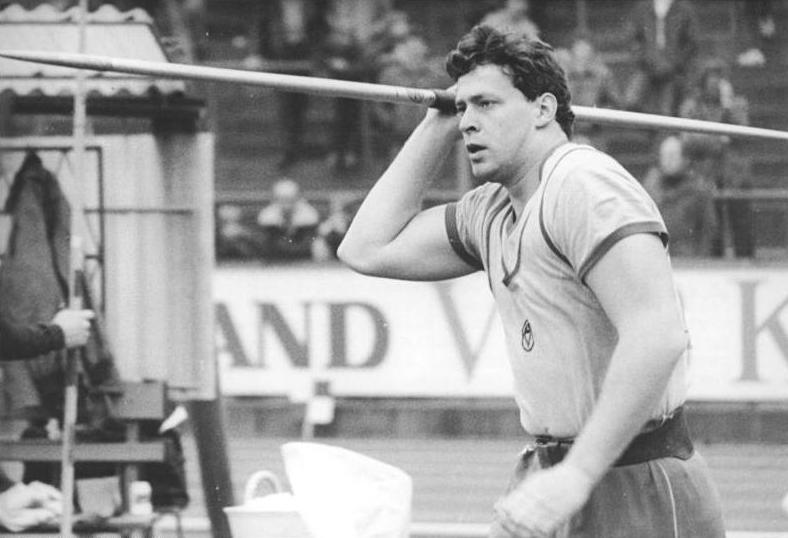
| caption | German javelin thrower Thomas Röhler in 2011 | ||
| WRmen | CZ Jan Železný (1996) | ||
| ORmen | Pakistan Arshad Nadeem (2024) | ||
| CRmen | CZE Jan Železný (2001) | ||
| WRwomen | CZE Barbora Špotáková (2008) | ||
| ORwomen | CUB Osleidys Menéndez (2004) | ||
| CRwomen | CUB Osleidys Menéndez (2005) | WU20Rmen=IND Neeraj Chopra (2016) | WU20Rwomen=CHN Ziyi Yan (2025) |
The javelin throw is a track and field event where the javelin, a spear about 2.5 m in length, is thrown as far as possible. The javelin thrower gains momentum by running within a predetermined area. Javelin throwing is an event of both the men's decathlon and the women's heptathlon.
History
The javelin throw was added to the Ancient Olympic Games as part of the pentathlon in 708 BC. It included two events, one for distance and the other for accuracy in hitting a target. The javelin was thrown with the aid of a thong (ankyle in Greek) that was wound around the middle of the shaft. Athletes held the javelin by the ankyle, a leather strap around the shaft, so when they released the javelin, the unwinding of the thong gave the javelin a spiral trajectory.
Throwing javelin-like poles into targets was revived in Germany and Sweden in the early 1870s. In Sweden, these poles developed into the modern javelin, and throwing them for distance became a common event there and in Finland in the 1880s. The rules continued to evolve over the next decades; originally, javelins were thrown with no run-up, and holding them by the grip at the center of gravity was not always mandatory. Limited run-ups were introduced in the late 1890s, and soon developed into the modern unlimited run-up.
Sweden's Eric Lemming, who threw his first world best (49.32 metres) in 1899 and ruled the event from 1902 to 1912, was the first dominant javelin thrower. When the men's javelin was introduced as an Olympic discipline at the 1906 Intercalated Games, Lemming won by almost nine metres and broke his own world record; Sweden swept the first four places, as Finland's best throwers were absent and the event had yet to become popular in any other country. Though challenged by younger talents, Lemming repeated as Olympic champion in 1908 and 1912; his eventual best mark (62.32 m, thrown after the 1912 Olympics) was the first javelin world record to be officially ratified by the International Association of Athletics Federations. |access-date = 5 August 2009 |archive-url = https://web.archive.org/web/20110629134819/http://www.iaaf.org/mm/document/competitions/competition/05/15/63/20090706014834_httppostedfile_p345-688_11303.pdf |archive-date=29 June 2011 }}

In the late 19th and early 20th century, most javelin competitions were two-handed; the implement was thrown with the right hand and separately with the left hand, and the best marks for each hand were added together. Competitions for the better hand only were less common, though not unknown. At the Olympics, a both-hands contest was held only once, in 1912; Finland swept the medals, ahead of Lemming. After that, this version of the javelin rapidly faded into obscurity, together with similar variations of the shot and the discus; Sweden's Yngve Häckner, with his total of 114.28 m from 1917, was the last official both-hands world record holder.
Another early variant was the freestyle javelin, in which holding the javelin by the grip at the center of gravity was not mandatory; such a freestyle competition was held at the 1908 Olympics, but it was dropped from the program after that. Hungary's Mór Kóczán used a freestyle end grip to break the 60-metre barrier in 1911, a year before Lemming and Julius Saaristo first did so with a regular grip.
The first known women's javelin marks were recorded in Finland in 1909. Originally, women threw the same implement as men; a lighter, shorter javelin for women was introduced in the 1920s. Women's javelin throw was added to the Olympic program in 1932; Mildred "Babe" Didrikson of the United States became the first champion.
For a long time, javelins were made of solid wood, typically birch, with a steel tip. The hollow, highly aerodynamic Held javelin, invented by American thrower Bud Held and developed and manufactured by his brother Dick, was introduced in the 1950s; the first Held javelins were also wooden with steel tips, but later models were made entirely of metal. These new javelins flew further, but were also less likely to land neatly point first; as a response to the increasingly frequent flat or ambiguously flat landings, experiments with modified javelins started in the early 1980s. The resulting designs, which made flat landings much less common and reduced the distances thrown, became official for men starting in April 1986 and for women in April 1999, and the world records (then 104.80 m by Uwe Hohn, and 80.00 m by Petra Felke) were reset. The current () men's world record is held by Jan Železný at 98.48 m (1996); Barbora Špotáková holds the women's world record at 72.28 m (2008).
Of the 69 Olympic medals that have been awarded in the men's javelin, 32 have gone to competitors from Norway, Sweden or Finland. Finland is the only nation to have swept the medals at a currently recognized official Olympics, and has done so twice, in 1920 and 1932, in addition to its 1912 sweep in the two-handed javelin; in 1920 Finland swept the first four places, which is no longer possible as only three entrants per country are allowed. Finland has, however, never been nearly as successful in the women's javelin.
The javelin throw has been part of the decathlon since the decathlon was introduced in the early 1910s; the all-around, an earlier ten-event contest of American origin, did not include the javelin throw. The javelin was also part of some (though not all) of the many early forms of women's pentathlon and has always been included in the heptathlon after it replaced the pentathlon in 1981.
Rules and competitions
The size, shape, minimum weight, and center of gravity of the javelin are all defined by World Athletics rules. In international competition, men throw a javelin between 2.6 and in length and 800 g in weight, and women throw a javelin between 2.2 and in length and 600 g in weight. The javelin has a grip, about 150 mm wide, made of cord and located at the javelin's center of gravity (0.9 to) from the javelin tip for the men's javelin and 0.8 to from the javelin tip for the women's javelin.

Unlike the other throwing events (shot put, discus, and hammer), the technique used to throw the javelin is dictated by World Athletics rules and "non-orthodox" techniques are not permitted. The javelin must be held at its grip and thrown overhand, over the athlete's shoulder or upper arm. Further, the athlete is prohibited from turning completely around or starting with their back facing the direction of the throw. This prevents athletes from attempting to spin and hurl the javelin sidearm in the style of a discus throw. This rule was put in place when a group of athletes began experimenting with a spin technique referred to as "free style". On 24 October 1956, Pentti Saarikoski threw using the technique holding the end of the javelin. Officials were so afraid of the out of control nature of the technique that the practice was banned through these rule specifications.
Instead of being confined to a circle, javelin throwers have a runway 4 m wide and at least 30 m in length, ending in an 8 m radius throwing arc from which their throw is measured; athletes typically use this distance to gain momentum in a "run-up" to their throw. Like the other throwing events, the competitor may not leave the throwing area (the runway) until after the implement lands. The need to come to a stop behind the throwing arc limits both how close the athlete can come to the line before the release as well as the maximum speed achieved at the time of release.
The javelin is thrown towards a 28.96º circular sector that is centered on the center point of the throwing arc. The angle of the throwing sector (28.96º) provides sector boundaries that are easy to construct and lay out on a field. A throw is only legal if the tip of the javelin lands within this sector, and is the first part of the javelin to strike the ground. The distance of the throw is measured from the throwing arc to the point where the tip of the javelin landed, rounded down to the nearest centimetre.
Competition rules are similar to other throwing events: a round consists of one attempt by each competitor in turn, and competitions typically consist of three to six rounds. The competitor with the longest single legal throw (over all rounds) is the winner; in case of a tie, the competitors' second-longest throws are also considered. Competitions involving large numbers of athletes sometimes use a cut whereby all competitors compete in the first three rounds but only those who are currently among the top eight or have achieved some minimum distances are permitted to attempt to improve on their distance in additional rounds (typically three).
The javelin is almost always thrown outdoors, though it is rarely thrown indoors. The world record for men's indoor javelin throw is 85.78 m by Matti Närhi in 1996.
Javelin redesigns
On 1 April 1986, the men's javelin (800 g) was redesigned by the governing body (the IAAF Technical Committee). They decided to change the rules for javelin design because of the increasingly frequent flat landings and the resulting discussions and protests when these attempts were declared valid or invalid by competition judges. The world record had also crept up to a potentially dangerous level, 104.80 m by Uwe Hohn. With throws exceeding 100 metres, it was becoming difficult to safely stage the competition within the confines of a stadium infield. The javelin was redesigned so that the centre of gravity was moved 4 cm forward. In addition, the surface area in front of centre of gravity was reduced, while the surface area behind the centre of gravity was increased. This had an effect similar to that produced by the feathers on an arrow. The javelin turns into the relative wind. This relative wind appears to originate from the ground as the javelin descends, thus the javelin turns to face the ground. As the javelin turns into the wind less lift is generated, reducing the flight distance by around 10% but also causing the javelin to stick in the ground more consistently. In 1999, the women's javelin (600 g) was similarly redesigned.
Modifications that manufacturers made to recover some of the lost distance, by increasing tail drag (using holes, rough paint or dimples), were forbidden at the end of 1991 and performances made using implements with such modifications removed from the record books. Seppo Räty had achieved a world record of 96.96 m in 1991 with such a design, but this record was nullified.
Weight rules by age group
The weight of the javelin in the Under-20 category is the same as the senior level.
| 80+ | 400 g |
|---|
Technique and training
Unlike other throwing events, javelin allows the competitor to build speed over a considerable distance. In addition, the core and upper body strength is necessary to deliver the implement, javelin throwers benefit from the agility and athleticism typically associated with running and jumping events. Thus, the athletes share more physical characteristics with sprinters than with others, although they still need the skill of heavier throwing athletes.
Traditional free-weight training is often used by javelin throwers. Metal-rod exercises and resistance band exercises can be used to train a similar action to the javelin throw to increase power and intensity. Without proper strength and flexibility, throwers can become extremely injury prone, especially in the shoulder and elbow. Core stability can help in the transference of physical power and force from the ground through the body to the javelin. Stretching and sprint training are used to enhance the speed of the athlete at the point of release, and subsequently, the speed of the javelin. At release, a javelin must reach speeds approaching 113 km/h (70 mph).
The javelin throw consists of three separate phases: the run-up, the transition, and the delivery. During each phase, the position of the javelin changes while the thrower changes his or her muscle recruitment. In the run-up phase as Luann Voza said, "your arm is bent and kept close to your head, keeping the javelin in alignment with little to no arm movement". This allows the thrower's bicep to contract, flexing the elbow. In order for the javelin to stay up high, the thrower's deltoid flexes. In the transition phase, the thrower's "back muscles contract" as "the javelin is brought back in alignment with the shoulder with the thrower's palm up". This, according to Voza, "stretches your pectoral, or chest, muscles. From there, a stretch reflex, an involuntary contraction of your chest, helps bring your throwing arm forward with increased force". During the final phase, the rotation of the shoulders initiates the release, which then "transfers movement through the triceps muscles, wrists and fingers to extend the throwing arm forward to release the javelin".
Culture

In 1994, Michael Torke composed Javelin, commissioned by the Atlanta Committee for the Olympic Games in celebration of the Atlanta Symphony Orchestra's 50th anniversary season, in conjunction with the 1996 Summer Olympics.
Javelin throwers have been selected as a main motif in numerous collectors' coins. One of the recent samples is the €5 Finnish 10th IAAF World Championships in Athletics commemorative coin, minted in 2005 to commemorate the 2005 World Championships in Athletics. On the obverse of the coin, a javelin thrower is depicted. On the reverse, legs of hurdle runners with the Helsinki Olympic Stadium tower in the background can be seen.
All-time top 25 (current models)
| *- denotes top performance (only) for other top 25 athletes who fall outside the top 25 javelin throw marks* |
|---|
Men
- Correct as of August 2025.
| Ath.# | Perf.# | Mark | Athlete | Nation | Date | Place | |||||||
|---|---|---|---|---|---|---|---|---|---|---|---|---|---|
| 1 | 1 | Jan Železný | 25 May 1996 | Jena | |||||||||
| 2 | 2 | Johannes Vetter | 6 September 2020 | Chorzów | |||||||||
| 3 | Vetter #2 | 29 May 2021 | Chorzów | ||||||||||
| 4 | Železný #2 | 29 August 1993 | Sheffield | ||||||||||
| 5 | Železný #3 | 6 April 1993 | Pietersburg | ||||||||||
| 6 | Železný #4 | 31 May 1996 | Ostrava | ||||||||||
| 7 | Vetter #3 | 11 July 2017 | Luzern | ||||||||||
| 8 | Vetter #4 | 19 May 2021 | Ostrava | ||||||||||
| 9 | Železný #5 | 26 March 1997 | Stellenbosch | ||||||||||
| 3 | 10 | Thomas Röhler | 5 May 2017 | Doha | |||||||||
| 11 | Vetter #5 | 18 August 2017 | Thum | ||||||||||
| 12 | Vetter #6 | 26 June 2021 | Kuortane | ||||||||||
| 13 | Vetter #7 | 21 May 2021 | Dessau | ||||||||||
| 4 | 14 | Aki Parviainen | 26 June 1999 | Kuortane | |||||||||
| 5 | 15 | Anderson Peters | 13 May 2022 | Doha | |||||||||
| 6 | 16 | Arshad Nadeem | 8 August 2024 | Saint-Denis | |||||||||
| 17 | Železný #6 | 12 August 2001 | Edmonton | ||||||||||
| 7 | 18 | Julius Yego | 26 August 2015 | Beijing | |||||||||
| 19 | Vetter #8 | 11 March 2018 | Leiria | ||||||||||
| 8 | 20 | Sergey Makarov | 30 June 2002 | Sheffield | |||||||||
| 9 | 21 | Raymond Hecht | 14 August 1996 | Zurich | |||||||||
| 22 | Železný #7 | 28 May 1997 | Ostrava | ||||||||||
| 23 | Parviainen #2 | 24 June 2001 | Vaasa | ||||||||||
| 24 | Železný #8 | 9 September 1995 | Monaco | ||||||||||
| Hecht #2 | 14 August 1996 | Zurich | |||||||||||
| 10 | Andreas Hofmann | 2 June 2018 | Offenburg | ||||||||||
| 11 | Konstadinós Gatsioúdis | 24 June 2000 | Kuortane | ||||||||||
| 12 | Andreas Thorkildsen | 2 June 2006 | Oslo | ||||||||||
| 13 | Tero Pitkämäki | 26 June 2005 | Kuortane | ||||||||||
| 14 | Julian Weber | 28 August 2025 | Zurich | ||||||||||
| 15 | Steve Backley | 25 January 1992 | Auckland | ||||||||||
| 16 | Cheng Chao-tsun | 26 August 2017 | Taipei | title=UNIVERSIADE: Taiwan's Cheng wins record-breaking gold in javelin | url=http://focustaiwan.tw/news/aeas/201708260019.aspx | website=focustaiwan.tw | date=26 August 2017 | access-date=26 August 2017 | archive-url=https://web.archive.org/web/20170826234427/http://focustaiwan.tw/news/aeas/201708260019.aspx | archive-date=26 August 2017 | url-status=dead}} | ||
| 17 | Breaux Greer | 21 June 2007 | Indianapolis | ||||||||||
| 18 | Luiz Maurício da Silva | 3 August 2025 | São Paulo | ||||||||||
| 19 | Jakub Vadlejch | 13 May 2022 | Doha | ||||||||||
| 20 | Kimmo Kinnunen | 26 August 1991 | Tokyo | ||||||||||
| 21 | Vadims Vasiļevskis | 22 July 2007 | Tallinn | ||||||||||
| 22 | Magnus Kirt | 22 June 2019 | Kuortane | ||||||||||
| 23 | Seppo Räty | 20 July 1992 | Nurmijärvi | ||||||||||
| 24 | Boris Henry | 9 July 1997 | Linz | ||||||||||
| 25 | Neeraj Chopra | 16 May 2025 | Doha |
Women
- Correct as of September 2025.
| Ath.# | Perf.# | Mark | Athlete | Nation | Date | Place |
|---|---|---|---|---|---|---|
| 1 | 1 | Barbora Špotáková | 13 September 2008 | Stuttgart | ||
| 2 | 2 | Osleidys Menéndez | 14 August 2005 | Helsinki | ||
| 3 | Špotáková #2 | 2 September 2011 | Daegu | |||
| 4 | Menéndez #2 | 1 July 2001 | Rethymno | |||
| 5 | Menéndez #3 | 27 August 2004 | Athens | |||
| 6 | Špotáková #3 | 21 August 2008 | Beijing | |||
| 3 | 7 | Maria Andrejczyk | 9 May 2021 | Split | ||
| 4 | 8 | Mariya Abakumova | 1 September 2013 | Berlin | ||
| 5 | 9 | Christina Obergföll | 23 June 2007 | Munich | ||
| 10 | Obergföll #2 | 14 August 2005 | Helsinki | |||
| 11 | Menéndez #4 | 29 August 2001 | Beijing | |||
| 12 | Obergföll #3 | 31 August 2008 | Elstal | |||
| 13 | Abakumova #2 | 25 August 2013 | Elstal | |||
| 14 | Obergföll #4 | 8 September 2011 | Zurich | |||
| 15 | Špotáková #4 | 9 August 2012 | London | |||
| 16 | Menéndez #5 | 6 August 2001 | Edmonton | |||
| 6 | 17 | Trine Hattestad | 28 July 2000 | Oslo | ||
| 18 | Špotáková #5 | 22 July 2011 | Monaco | |||
| 7 | 19 | Sunette Viljoen | 9 June 2012 | New York City | ||
| 20 | Abakumova #3 | 16 March 2013 | Castellón | |||
| 8 | 21 | Christin Hussong | 30 May 2021 | Chorzów | ||
| 22 | Špotáková #6 | 31 May 2008 | Zaragoza | |||
| 23 | Abakumova #4 | 16 August 2013 | Moscow | |||
| 24 | Obergföll #5 | 18 August 2013 | Moscow | |||
| 25 | Abakumova #5 | 29 August 2013 | Zurich | |||
| 9 | Kathryn Mitchell | 11 April 2018 | Gold Coast | |||
| 10 | Sara Kolak | 6 July 2017 | Lausanne | |||
| 11 | Steffi Nerius | 31 August 2008 | Elstal | |||
| 12 | Kara Winger | 2 September 2022 | Brussels | |||
| 13 | Lü Huihui | 2 August 2019 | Shenyang | |||
| 14 | Victoria Hudson | 28 June 2025 | Maribor | |||
| 15 | Kelsey-Lee Barber | 9 July 2019 | Lucerne | |||
| 16 | Katharina Molitor | 30 August 2015 | Beijing | |||
| 17 | Sonia Bisset | 6 July 2005 | Salamanca | |||
| 18 | Mirela Manjani | 30 September 2000 | Sydney | |||
| 19 | Tatsiana Khaladovich | 7 June 2018 | Oslo | |||
| 20 | Nikola Ogrodníková | 26 May 2019 | Offenburg | |||
| Maggie Malone | 17 July 2021 | East Stroudsburg | ||||
| 22 | Haruka Kitaguchi | 8 September 2023 | Brussels | |||
| 23 | Linda Stahl | 14 June 2014 | New York City | |||
| 24 | Vera Rebrik | 19 February 2016 | Sochi | |||
| 25 | Hanna Hatsko-Fedusova | 26 July 2014 | Kirovohrad | |||
| Liu Shiying | 15 September 2020 | Shaoxing |
Annulled marks
- In 2011, Mariya Abakumova threw 71.99 metres. This performance was annulled due to doping offences.
All-time top 5 (dimpled models 1990–1991)
Marks set using dimpled rough-tailed javelins manufactured by several companies were nullified effective 20 September 1991.
| Rank | Mark | Athlete | Date | Place | Ref | 1 | 2 | 3 | 4 | 5 |
|---|---|---|---|---|---|---|---|---|---|---|
| 96.96 | Seppo Räty | 2 June 1991 | Punkalaidun | |||||||
| 91.36 | Steve Backley | 15 September 1991 | Sheffield | |||||||
| 90.84 | Raymond Hecht | 8 September 1991 | Gengenbach | |||||||
| 90.82 | Kimmo Kinnunen | 26 August 1991 | Tokyo | |||||||
| 90.72 | Jan Železný | 10 July 1991 | Lausanne |
All-time top 15 (old models)
Men
| Rank | Mark | Athlete | Date | Place | Ref | 1 | 2 | 3 | 5 | 6 | 7 | 8 | 9 | 10 | 11 | 12 | 13 | 14 | 15 |
|---|---|---|---|---|---|---|---|---|---|---|---|---|---|---|---|---|---|---|---|
| 104.80 | Uwe Hohn | 21 July 1984 | Berlin | ||||||||||||||||
| 99.72 | Tom Petranoff | 15 May 1983 | Westwood | ||||||||||||||||
| 96.72 | Ferenc Paragi | 23 April 1980 | Tata | ||||||||||||||||
| Detlef Michel | 9 June 1983 | Berlin | |||||||||||||||||
| 95.80 | Bob Roggy | 29 August 1982 | Stuttgart | ||||||||||||||||
| 95.10 | Brian Crouser | 5 August 1985 | Eugene | ||||||||||||||||
| 94.58 | Miklós Németh | 26 July 1976 | Montreal | ||||||||||||||||
| 94.22 | Michael Wessing | 3 August 1978 | Oslo | ||||||||||||||||
| 94.20 | Heino Puuste | 5 June 1983 | Birmingham | ||||||||||||||||
| 94.08 | Klaus Wolfermann | 5 May 1973 | Leverkusen | ||||||||||||||||
| 94.06 | Duncan Atwood | 26 July 1985 | Eugene | ||||||||||||||||
| 93.90 | Hannu Siitonen | 6 June 1973 | Helsinki | ||||||||||||||||
| 93.84 | Pentti Sinersaari | 27 January 1979 | Auckland | ||||||||||||||||
| 93.80 | Jānis Lūsis | 6 July 1972 | Stockholm | ||||||||||||||||
| 93.70 | Viktor Yevsyukov | 17 July 1985 | Kyiv |
Women

| Rank | Mark | Athlete | Date | Place | Ref | 1 | 2 | 3 | 4 | 5 | 6 | 7 | 8 | 9 | 10 | 11 | 12 | 13 | 14 | 15 |
|---|---|---|---|---|---|---|---|---|---|---|---|---|---|---|---|---|---|---|---|---|
| 80.00 | Petra Felke | 8 September 1988 | Potsdam | |||||||||||||||||
| 77.44 | Fatima Whitbread | 28 August 1986 | Stuttgart | |||||||||||||||||
| 74.76 | Tiina Lillak | 13 June 1983 | Tampere | |||||||||||||||||
| 74.20 | Sofia Sakorafa | 26 September 1982 | Hania | |||||||||||||||||
| 73.58 | Tessa Sanderson | 26 June 1983 | Edinburgh | |||||||||||||||||
| 72.70 | Anna Verouli | 20 May 1984 | Hania | |||||||||||||||||
| 72.16 | Antje Kempe | 5 May 1984 | Celje | |||||||||||||||||
| 72.12 | Trine Hattestad | 10 July 1993 | Oslo | |||||||||||||||||
| 71.88 | Antoaneta Todorova | 15 August 1981 | Zagreb | |||||||||||||||||
| 71.82 | Ivonne Leal | 30 August 1985 | Leverkusen | |||||||||||||||||
| 71.40 | Natalya Shikolenko | 5 June 1994 | Sevilla | |||||||||||||||||
| 71.00 | Silke Renk | 25 June 1988 | Rostock | |||||||||||||||||
| 70.76 | Beate Koch | 22 June 1989 | Rostock | |||||||||||||||||
| 70.42 | Zhang Li | 6 August 1990 | Tianjin | |||||||||||||||||
| 70.20 | Karen Forkel | 9 May 1991 | Halle |
Olympic medalists
Men
Women
World Championships medalists
Men
Women
Season's bests
Men
| Year | Mark | Athlete | Place |
|---|---|---|---|
| 1967 | 90.98 | Jānis Lūsis | Odesa |
| 1968 | 91.98 | Jānis Lūsis | Saarijärvi |
| 1969 | 92.70 | Jorma Kinnunen | Tampere |
| 1970 | 92.64 | Pauli Nevala | Helsinki |
| 1971 | 90.68 | Jānis Lūsis | Helsinki |
| 1972 | 93.80 | Jānis Lūsis | Stockholm |
| 1973 | 94.08 | Klaus Wolfermann | Leverkusen |
| 1974 | 89.58 | Hannu Siitonen | Rome |
| 1975 | 91.38 | Miklós Németh | Budapest |
| 1976 | 94.58 | Miklós Németh | Montreal |
| 1977 | 94.10 | Miklós Németh | Stockholm |
| 1978 | 94.22 | Michael Wessing | Oslo |
| 1979 | 93.84 | Pentti Sinersaari | Auckland |
| 1980 | 96.72 | Ferenc Paragi | Tata |
| 1981 | 92.48 | Detlef Michel | Berlin |
| 1982 | 95.80 | Bob Roggy | Stuttgart |
| 1983 | 99.72 | Tom Petranoff | Westwood |
| 1984 | 104.80 | Uwe Hohn | Berlin |
| 1985 | 96.96 | Uwe Hohn | Canberra |
A new model was introduced in 1986, and all records started fresh.
| Year | Mark | Athlete | Place |
|---|---|---|---|
| 1986 | 85.74 | Klaus Tafelmeier | Como |
| 1987 | 87.66 | Jan Železný | Nitra |
| 1988 | 86.88 | Jan Železný | Leverkusen |
| 1989 | 87.60 | Kazuhiro Mizoguchi | San José |
| 1990 | 89.58 | Steve Backley | Stockholm |
| 1991 | 90.82 | Kimmo Kinnunen | Tokyo |
| 1992 | 91.46 | Steve Backley | Auckland |
| 1993 | 95.66 | Jan Železný | Sheffield |
| 1994 | 91.82 | Jan Železný | Sheffield |
| 1995 | 92.60 | Raymond Hecht | Oslo |
| 1996 | 98.48 | Jan Železný | Jena |
| 1997 | 94.02 | Jan Železný | Stellenbosch |
| 1998 | 90.88 | Aki Parviainen | Tartu |
| 1999 | 93.09 | Aki Parviainen | Kuortane |
| 2000 | 91.69 | Konstadinós Gatsioúdis | Kuortane |
| 2001 | 92.80 | Jan Železný | Edmonton |
| 2002 | 92.61 | Sergey Makarov | Sheffield |
| 2003 | 90.11 | Sergey Makarov | Dessau |
| 2004 | 87.73 | Aleksandr Ivanov | Ostrava |
| 2005 | 91.53 | Tero Pitkämäki | Kuortane |
| 2006 | 91.59 | Andreas Thorkildsen | Oslo |
| 2007 | 91.29 | Breaux Greer | Indianapolis |
| 2008 | 90.57 | Andreas Thorkildsen | Beijing |
| 2009 | 91.28 | Andreas Thorkildsen | Zurich |
| 2010 | 90.37 | Andreas Thorkildsen | Florø |
| 2011 | 90.61 | Andreas Thorkildsen | Byrkjelo |
| 2012 | 88.34 | Vítězslav Veselý | London |
| 2013 | 89.03 | Tero Pitkämäki | Bad Köstritz |
| 2014 | 89.21 | Ihab Abdelrahman | Shanghai |
| 2015 | 92.72 | Julius Yego | Beijing |
| 2016 | 91.28 | Thomas Röhler | Turku |
| 2017 | 94.44 | Johannes Vetter | Lucerne |
| 2018 | 92.70 | Johannes Vetter | Leiria |
| 2019 | 90.61 | Magnus Kirt | Kuortane |
| 2020 | 97.76 | Johannes Vetter | Chorzów |
| 2021 | 96.29 | Johannes Vetter | Chorzów |
| 2022 | 93.07 | Anderson Peters | Doha |
| 2023 | 89.51 | Jakub Vadlejch | Turku |
| 2024 | 92.97 | Arshad Nadeem | Paris |
| 2025 | 91.51 | Julian Weber | Zurich |
Women
| Year | Mark | Athlete | Place |
|---|---|---|---|
| 1973 | 66.10 | Ruth Fuchs | Edinburgh |
| 1974 | 67.22 | Ruth Fuchs | Rome |
| 1975 | 66.46 | Ruth Fuchs | Sudbury |
| 1976 | 69.12 | Ruth Fuchs | Berlin |
| 1977 | 69.32 | Kate Schmidt | Fürth |
| 1978 | 69.16 | Ruth Fuchs | Prague |
| 1979 | 69.52 | Ruth Fuchs | Dresden |
| 1980 | 70.08 | Tatyana Biryulina | Podolsk |
| 1981 | 71.88 | Antoaneta Todorova | Zagreb |
| 1982 | 74.20 | Sofia Sakorafa | Hania |
| 1983 | 74.76 | Tiina Lillak | Tampere |
| 1984 | 74.72 | Petra Felke | Celje |
| 1985 | 75.40 | Petra Felke | Schwerin |
| 1986 | 77.44 | Fatima Whitbread | Stuttgart |
| 1987 | 78.90 | Petra Felke | Leipzig |
| 1988 | 80.00 | Petra Felke | Potsdam |
| 1989 | 76.88 | Petra Felke | Macerata |
| 1990 | 73.08 | Petra Felke | Manaus |
| 1991 | 71.44 | Trine Hattestad | Fana |
| 1992 | 70.36 | Natalya Shikolenko | Moscow |
| 1993 | 72.12 | Trine Hattestad | Oslo |
| 1994 | 71.40 | Natalya Shikolenko | Seville |
| 1995 | 71.18 | Natalya Shikolenko | Zurich |
| 1996 | 69.42 | Steffi Nerius | Monaco |
| 1997 | 69.66 | Trine Hattestad | Helsinki |
| 1998 | 70.10 | Tanja Damaske | Berlin |
A new model was introduced in 1999 and all records started fresh.
| Year | Mark | Athlete | Place |
|---|---|---|---|
| 1999 | 68.19 | Trine Hattestad | Fana |
| 2000 | 69.48 | Trine Hattestad | Oslo |
| 2001 | 71.54 | Osleidys Menéndez | Rethymno |
| 2002 | 67.47 | Miréla Manjani | Munich |
| 2003 | 66.52 | Miréla Manjani | Paris |
| 2004 | 71.53 | Osleidys Menéndez | Athens |
| 2005 | 71.70 | Osleidys Menéndez | Helsinki |
| 2006 | 66.91 | Christina Obergföll | Athens |
| 2007 | 70.20 | Christina Obergföll | Munich |
| 2008 | 72.28 | Barbora Špotáková | Stuttgart |
| 2009 | 68.59 | Christina Obergföll | Leiria |
| 2010 | 68.66 | Barbora Špotáková | Rome |
| 2011 | 71.58 | Barbora Špotáková | Daegu |
| 2012 | 69.55 | Barbora Špotáková | London |
| 2013 | 70.53 | Mariya Abakumova | Berlin |
| 2014 | 67.99 | Barbora Špotáková | Brussels |
| 2015 | 67.69 | Katharina Molitor | Beijing |
| 2016 | 67.30 | Vera Rebrik | Sochi |
| 2017 | 68.43 | Sara Kolak | Lausanne |
| 2018 | 68.92 | Kathryn Mitchell | Gold Coast |
| 2019 | 67.98 | Lü Huihui | Shenyang |
| 2020 | 67.61 | Lü Huihui | Beijing |
| 2021 | 71.40 | Maria Andrejczyk | Split |
| 2022 | 68.11 | Kara Winger | Brussels |
| 2023 | 67.38 | Haruka Kitaguchi | Brussels |
| 2024 | 66.70 | Flor Ruiz | Cuiaba |
| 2025 | 67.76 | Victoria Hudson | Maribor |

References
References
- (July 11, 2022). "From weapon of war to Olympic sport: A glance at javelin throw's history".
- "Greek Javelin".
- Jukola, Martti. (1935). "Huippu-urheilun historia". [[Werner Söderström Osakeyhtiö]].
- "Urheilulajien synty". Teos.
- Vélez Blasco, Miguel. "Part III: Llançaments – Tema 12 Javelina". Institut Nacional d'Educació Física de Catalunya / Federació Catalana d'Atletisme.
- "IAAF World Records Progression". [[International Association of Athletics Federations]].
- "Javelin Throw – Introduction". IAAF.
- (6 June 1955). "Track: A Salute to the Javelin And Its Practitioners—One of Whom, Bud Held, Is Showing Those Finns A Thing Or Two".
- Bremicher, Erick. "Why did the senior javelin specification have to be changed?".
- IAAF Scoring Tables for Combined Events, pp. 7–10.
- Pentti Saarikosk
- . ["Laying Out Sector Angles for the Track and Field Throwing Events"](http://www.pntf.org/officials/ivars/Throwing_Event_Sector_Angles_Rev_F1.pdf).
- "Javelin Throw".
- (29 Jan 2015). "Undercover javelin". World Athletics.
- (March 28, 2009). "Physics: Javelin Designs, what's the significance?". World of Javelin.
- "Throwing Weight Rules per Age Group". Athletics Direct.
- Luann Voza. (February 21, 2019). "Describe the Sequence of Arm Muscle Movements in Throwing a Javelin".
- "Javelin Throw – men – senior – outdoor".
- "Men's javelin".
- Bob Ramsak. (6 September 2020). "Vetter threatens javelin world record with 97.76m throw in Silesia". World Athletics.
- (5 May 2017). "Javelin Throw Results".
- Jon Mulkeen. (14 May 2022). "Peters prevails in javelin thriller at windy Diamond League debut in Doha". World Athletics.
- (8 August 2024). "Olympics 2024 - Men's Javelin Throw Final Results".
- (26 August 2015). "Javelin Throw Results". IAAF.
- (3 June 2018). "Hofmann improves to 92.06m in Offenburg". European Athletics.
- (28 August 2025). "Javelin Throw Results".
- British Athletics. "British Athletics Official WebsiteSteve Backley". britishathletics.org.uk.
- (26 August 2017). "UNIVERSIADE: Taiwan's Cheng wins record-breaking gold in javelin".
- Gabriel Gentile. (3 August 2025). "Luiz Maurício da Silva destrói recorde brasileiro e faz marca que seria prata em Paris". OlimpiadadTodoDia.
- (22 June 2019). "Kirt extends world lead in the javelin to 90.61m in Kuortane". European Athletics.
- (2025-05-16). "Doha Diamond League Live Updates: Julian Weber stuns Neeraj Chopra, beats his 90.23m mark with final throw".
- "All-time women's best Javelin throw". alltime-athletics.com.
- Jess Whittington. (9 May 2021). "Rojas opens with 15.14m, Andrejczyk throws 71.40m". World Athletics.
- Jess Whittington. (29 May 2021). "Vetter throws 96.29m in Silesia for third best javelin mark in history". World Athletics.
- (11 April 2018). "Javelin Throw Results". gc2018.com.
- (6 July 2017). "Javelin Throw Results". sportresult.com.
- Jon Mulkeen. (2 September 2022). "Krop, Mahuchikh and Winger bounce back in Brussels with world-leading marks". World Athletics.
- Jon Mulkeen. (4 August 2019). "National championships round-up: Mihambo leaps world-leading 7.16m in Berlin". IAAF.
- "Javelin Throw Results".
- Diego Sampaolo. (9 July 2019). "Barber and Röhler in the spotlight in Lucerne". IAAF.
- (30 August 2015). "Women's Javelin Throw Results". IAAF.
- (7 June 2018). "Javelin Throw Results". sportresult.com.
- (26 May 2019). "Javelin Throw Results". laportal.net.
- (8 September 2023). "Javelin Throw Result". sportresult.com.
- Jon Mulkeen. (18 September 2020). "Wang and Liu impress at Chinese Championships". World Athletics.
- Larsson, Peter. "Track & Field all-time performances: Men's non-legal javelin".
This article was imported from Wikipedia and is available under the Creative Commons Attribution-ShareAlike 4.0 License. Content has been adapted to SurfDoc format. Original contributors can be found on the article history page.
Ask Mako anything about Javelin throw — get instant answers, deeper analysis, and related topics.
Research with MakoFree with your Surf account
Create a free account to save articles, ask Mako questions, and organize your research.
Sign up freeThis content may have been generated or modified by AI. CloudSurf Software LLC is not responsible for the accuracy, completeness, or reliability of AI-generated content. Always verify important information from primary sources.
Report