From Surf Wiki (app.surf) — the open knowledge base
Jaunting car
Irish horse-drawn vehicle for hire
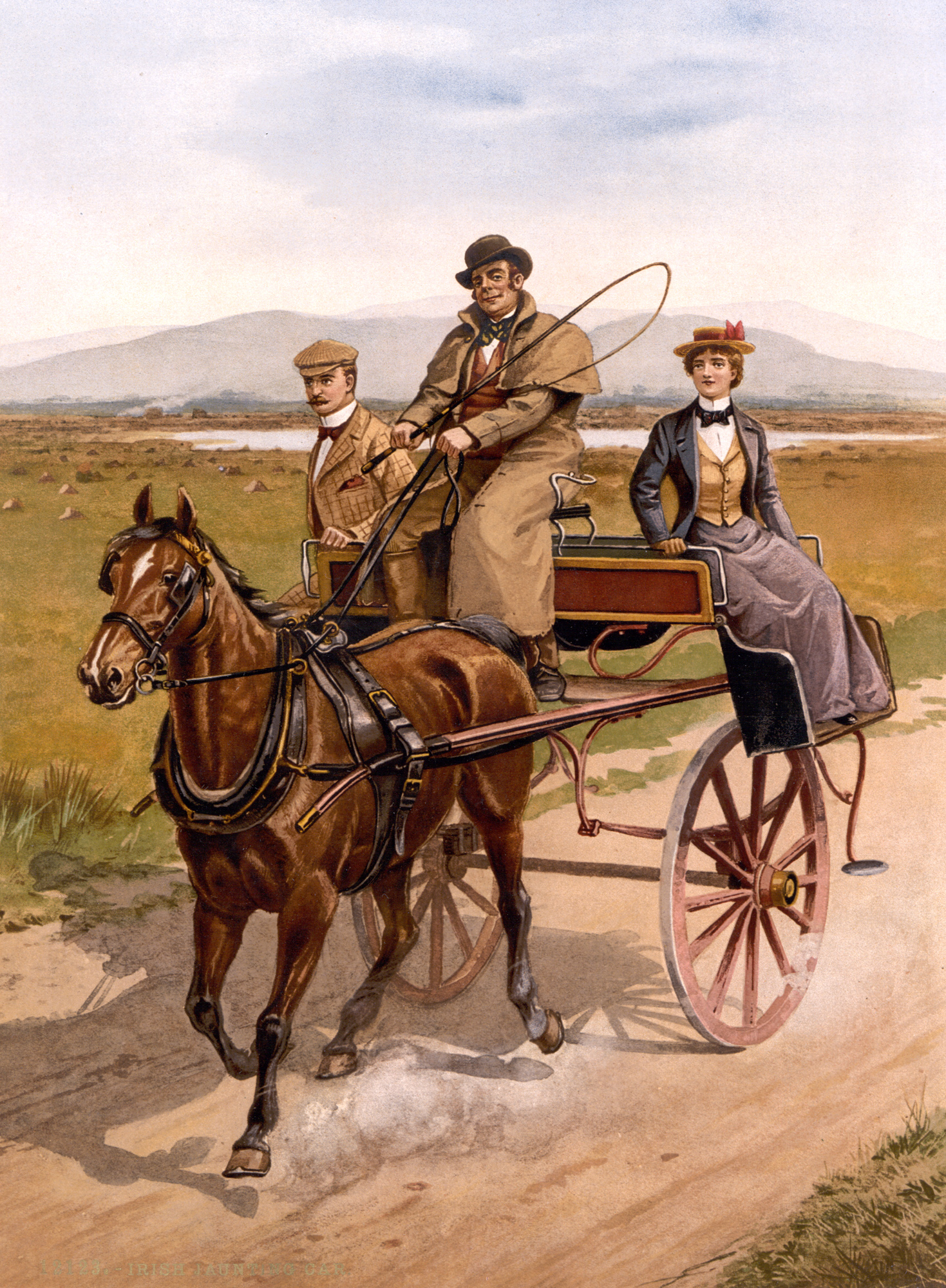
Irish horse-drawn vehicle for hire
A jaunting car, also known as a jaunty car or side car, is a light two-wheeled carriage for a single horse, with a seat in front for the driver. The outside jaunting car commonly holds up to four passengers seated back to back, with the foot-boards projecting over the wheels. It was a typical public conveyance for people in Ireland in the 1800s, and continues in use today as a tourist attraction. Variations have passengers seating facing each other (inside jaunting car), having a cover, and an elongated version. The driver of a jaunting car is called a jarvey.
Design and variations
Outside of Ireland, jaunting car usually refers to the "outside car"; within Ireland it mostly means a horse-drawn vehicle for hire for passengers, especially tourists, and is driven by a jarvey who is usually the proprietor.
The outside car is a high light carriage for a single horse. There are two seats placed lengthwise with the passengers sitting back-to-back and facing outward (left or right of the car). Sizes have varied, but the typical outside car holds four adult passengers. The foot boards are outside of the wheels, and are hinged so they can be folded up over the seats to make the carriage narrower, protect empty seats from bad weather, or to grease the wheels. The driver has a separate center-front seat, but may drive from the right or left side passenger seat to balance the load if there is only one other passenger.
The inside car is an enclosed carriage where up to six passengers sit face-to-face with their backs to the sides of the car. It enters from the rear and is much like the tub cart, but differs in that there is a small seat up front for the driver outside the tub. Anthony Trollope described the "inside jaunting-car" as "perhaps the most uncomfortable kind of vehicle yet invented."
A simple distinction is that an outside car has passengers facing out with their feet outside the wheels, and an inside car has passengers facing inside with their feet inside (between) the wheels.
The covered inside car or jingle, is an inside car with an oiled canvas cover and sides to protect passengers from the weather; the driver sits outside. It is used mainly as an in-town hackney cab since the passengers have no view.
Long carThe Bian or long car is a four-wheeled variation of the outside car which can hold 6-10 passengers per side. It was invented by Charles Bianconi to carry more passengers as demand for his transport business grew. A long car with six passengers on each side would weigh 1,800 lb.
The jaunting wagon was similar to the Bian long car and popular in the US from the 1890s, especially for sight-seeing.
File:Irish Jaunting car (29536513210) (cropped).jpg|Outside car File:Edwin W. Cooper of Beccles - A Gentleman Driving Tandem to a Jaunting Car - Google Art ProjectFXD.jpg|Inside car File:Long Cars, Gorey, Co. Wexford (17049250847) (cropped).jpg|Long car
Historical context

Predecessors to the jaunting car are the cart-car (mid-18th century northern Ireland), and the trottle cart made from rough carved timbers and lacking springs. According to D. J. Smith, the jaunting car "first appeared in the streets of Dublin, as a means of public transport, about 1813".
In 1815, Charles Bianconi, an Italian-Irish entrepreneur, established a transport business in southern Ireland areas not served by stagecoaches. In the early 1800s, the British government levied a tax on every "jaunting car or pleasure car", providing an opportunity for Bianconi to cheaply purchase family outside cars to start his car-for-hire business. At one point he had 140 agents across Ireland running parts of his horse and car business.
Modern usage
Jaunting cars remain in use for tourists in some parts of the country, notably Killarney in County Kerry where tours of the lakes and national park are popular. Many types of modern carriages are used including outside cars, tub carts, wagonettes, and others.
File:Sign-1170134,_Killarney,_Co._Kerry,_Ireland.jpg|A traffic sign warning of jaunting cars in Killarney File:Killarney - Kenmare Place - Two-wheel jaunting car - geograph.org.uk - 1624592.jpg|An outside car File:Jaunting Car in Killarney - panoramio.jpg|A tub cart File:Jaunting cars near Ross Castle - geograph.org.uk - 5241811.jpg|Covered wagonettes
In literature and popular culture
Valentine Vousden wrote the song The Irish Jaunting Car in the 1850s, and Percy French wrote his own version of the song for his comic opera The Knight of the Road (1891). French edited a weekly comic magazine called The Jarvey from January 1889-January 1891 based on the adventures of a jaunting car driver and published by Richard J. Mecredy. The Jarvey was a highly literary and lavishly illustrated weekly comic paper, considered to have been the best comic paper of the 19th and 20th century in Ireland.
The outside car was featured in the 1952 movie The Quiet Man starring John Wayne, with Barry Fitzgerald as the jarvey. Val Doonican recorded the song The Jarvey Was a Leprechaun in the 1960s. In Disney's 1967 film The Gnome-Mobile, DJ Mulroony tells his grandchildren about the jaunting car he owned in his youth, and sings a song about it.
Notes
References
References
- "[[Can You Forgive Her?]]" by [[Anthony Trollope]], Chapter XXXI.
- 1813 Act of Parliament, [[53 Geo. 3]]. c. 59)
- "Ireland - Jaunting Cars" by [[Clive Akerman]] in ''[[Revenue Society. The Revenue Journal]]'', Vol. XXII, No. 4, Whole No. 88, March 2012, p. 175.
- Berkebile, Donald H.. (1978). "Carriage Terminology: An Historical Dictionary". Smithsonian Institution Scholarly Press.
- O'Connell, Morgan John. (1878). "Charles Bianconi: A Biography, 1786-1875". Chapman and Hall.
- {{EB1911
- Gilbey, Walter. (1905). "Modern carriages". Vinton & Co..
- "Hand-books for Ireland", by Samuel Carter Hall, 1853, pp. 83 ff.
- Mansfield, M. F.. (1905). "Romantic Ireland". L. C. Page & company.
- Smith, D.J.M.. (1988). "A Dictionary of Horse Drawn Vehicles". J. A. Allen & Co. Ltd..
- Stratton, Ezra M.. (1878). "The World on Wheels; or, Carriages, with their Historical Associations from the Earliest to the Present Time, Including a Selection from the American Centennial Exhibition". The author.
- Walrond, Sallie. (1979). "The Encyclopaedia of Driving". Country Life Books.
- Ware, John. (1880). "Memoir of the Life of Henry Ware, Jr.".
This article was imported from Wikipedia and is available under the Creative Commons Attribution-ShareAlike 4.0 License. Content has been adapted to SurfDoc format. Original contributors can be found on the article history page.
Ask Mako anything about Jaunting car — get instant answers, deeper analysis, and related topics.
Research with MakoFree with your Surf account
Create a free account to save articles, ask Mako questions, and organize your research.
Sign up freeThis content may have been generated or modified by AI. CloudSurf Software LLC is not responsible for the accuracy, completeness, or reliability of AI-generated content. Always verify important information from primary sources.
Report