From Surf Wiki (app.surf) — the open knowledge base
Japanese traditional dance
Traditional styles of Japanese dance

Traditional styles of Japanese dance
Japanese traditional dance describes a number of Japanese dance styles with a long history and prescribed method of performance. Some of the oldest forms of traditional Japanese dance may be among those transmitted through the ja tradition, or folk dances relating to food producing activities such as planting rice (ja) and fishing, including rain dances. There are large number of these traditional dances, which are often suffixed ja, ja, and ja, and may be specific to a region or village. ja and ja are the two main groups of Japanese dances, and the term was coined in modern times as a general term for dance, by combining (which can also be read as ja) and (which can also be read as ja).
ja is a more reserved genre of dance that often has circling movements, and dances of the Noh theatre are of this tradition. A variation of the ja style of Japanese dance is ja, or Kyoto-style dance. ja developed in the 17th century Tokugawa cultural period. It is heavily influenced by the elegance and sophistication of the manners often associated with the Imperial Court in Kyoto. ja has more vigorous stepping movements and is more energetic, and dances of the kabuki theatre belong to this category.
Classification
There are several types of traditional Japanese dance. The most basic classification is into two forms, ja and ja, which can be further classified into genres such as Noh ja or ja, the latter style having its origins in the pleasure districts of Kyoto and Osaka.
The ja style is reserved and typified by circling movements where the body is kept low to the ground. The ja style includes folk dances performed at annual ja festival events and dances that were part of traditional kabuki performances. The ja style features larger movements and is typically more energetic.
Traditional dance forms in the present day have also been influenced by Western dance forms like ballet, which were introduced to Japan during the Meiji Restoration. In ja ('The Heron Maiden') the dancer's role is the spirit of the heron. In classical versions, the spirit assumes a handsome, strong pose at the end of the dance. However, this classical ending was altered in later versions (which borrowed heavily from Anna Pavlova's performances of The Dying Swan) so the spirit gradually became lifeless, ultimately sinking to the floor.
Kabuki
Main article: Kabuki

Kabuki is a classical Japanese dance-drama. Kabuki theatre is known for the stylization of its drama and for the elaborate make-up worn by some of its performers.
The individual kanji characters, from left to right, mean 'sing', 'dance', and 'skill'. Kabuki is therefore sometimes translated as 'the art of singing and dancing'. These are, however, ja characters which do not reflect actual etymology. The kanji of 'skill' generally refers to a performer in kabuki theatre. Since the word 'kabuki' is believed to derive from the verb ja, meaning 'to lean' or 'to be out of the ordinary', kabuki can be interpreted as 'avant-garde' or 'bizarre' theatre. The expression referred originally to those who were bizarrely dressed and swaggered on a street.
The history of kabuki began in 1603, when Izumo no Okuni, possibly a shrine maiden of Izumo Taisha Temple, began performing a new style of dance drama in the dry riverbeds of Kyoto, and they were then called "strange" or "unusual" (kabuki). This new form of dance drama is thought to have been derived from folk-dances performed only by women, ja and ja. Kabuki became a common form of entertainment in Yoshiwara, the registered red-light district in Edo. During the Genroku era, kabuki thrived. The structure of a kabuki play was formalized during this period, as were many elements of style. Conventional character types were established, as were many of the most popular and still-performed plays.
Noh {{transliteration|ja|mai}}
Main article: Noh
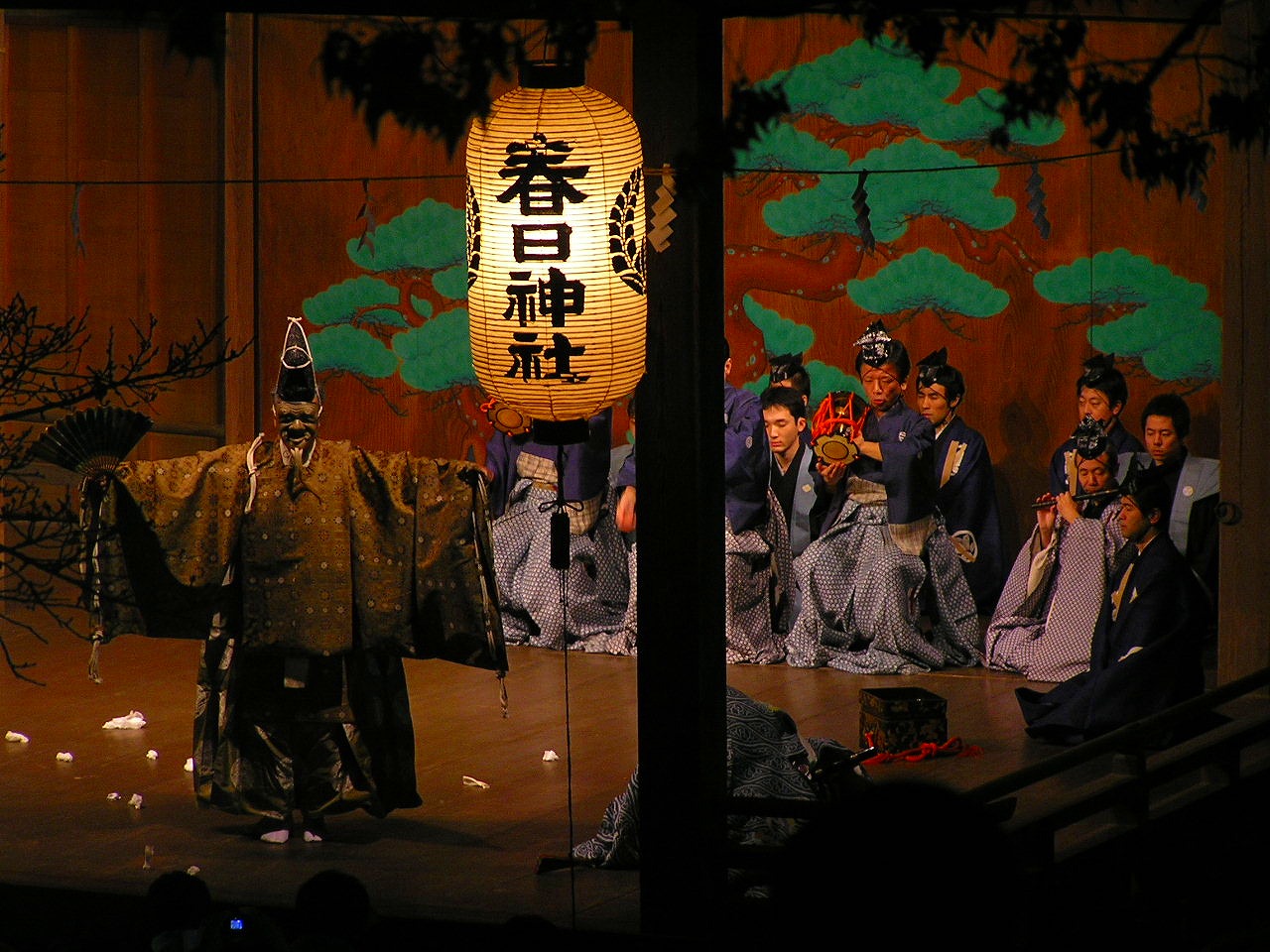
The origin of Noh ja can be traced back to as far as the fourteenth century. Noh ja is a dance that is done to music that is made by flutes and small hand drums called ja. At various points the performers dance to vocal and percussion music; these points are called ja or ja. Noh ja dances are put together by a series of forms. Forms are patterns of body movements that are done elegantly and with beauty.
There are several types of Noh ja dances. A type that is neither slow nor fast is called ja, and is usually performed by a female dancer. A slower type of dance is the ja, which is also done by a female, sometimes dressed up as a ghost of a noble woman, a spirit, or a deity. A male's dance is ja. In ja the performer does not wear a mask and is portraying the character as being heroic. Another male dance is ja, where the dancer acts as though he is a deity. This is a very fast dance. The female version of this is called ja and can be performed in various ways. ja is a dance that imitates music played at the imperial court and is usually done by the main character in a Noh drama. These are the six varieties that make up the Noh ja dance types.
Costumes are a major part of Noh theatre, including the Noh ja. Dances and play may start out slowly, so actors create flamboyant, colourful costumes to keep the audience engaged. They also dress to fit the aspects the characters represent, for example a bamboo hat worn by a character represents country life. The most important part of the Noh costumes are the masks. The Noh ja masks are thought to be the most artistic masks in Japan. The masks are only worn by the main characters. The masks have neutral expressions so it is the job of the actor to bring the character to life.
{{transliteration|ja|Nihon buyō}}
Main article: Nihon-buyō{{!}}''Buyō''

ja is different from most other traditional dances. It is intended for entertainment on stage. ja is a refined dance that has been improved throughout four centuries.
There are four parts to ja, the most significant part being kabuki ja. Most of the repertoire has been borrowed from 18th and 19th century kabuki theatre and even from the ja (pleasure quarters) of Edo Japan.
ja was created directly from kabuki ja before it became theater. The second part of ja is Noh. ja takes a few key elements from Noh such as the circular movements and the tools used in its dances. The third part of these dances comes from the folk dances; the spinning and jumping used in folk dances was incorporated into ja. The last part came from a mixture of European and American culture that is found in Japan today.
ja did not reach its present form until the Meiji Restoration of 1868 during a time when Western dance forms were being introduced to Japan. Thus, the present day form of ja was influenced by dance forms like ballet.
Folk dances

thumb|ja contestants at Aoba ja festival with a flutist
There are a wide variety of folk dances in Japan. Folk dances are often the basis from which other dance forms developed. An example of a Japanese folk dance is the sparrow dance, a dance based upon the fluttering movements of the Eurasian tree sparrow. It was first performed and improvised by stonemasons who were constructing Sendai Castle for the ja Date Masamune. The emblem of the Date clan incorporates two tree sparrows. The sparrow dance is now performed yearly in Sendai, Miyagi Prefecture at the Aoba festival in mid-May. School children in Miyagi prefecture learn and perform the sparrow dance, especially during the Obon Festival.
.jpg)
{{transliteration|ja|Bon odori}}
Main article: Bon Festival#Bon Odori
ja is a type of folk dance performed during the Obon Festival. It was originally a dance to welcome the spirits of the dead. These dances and the music that accompanies them are different for every region of Japan. Usually, the ja dance involves people dancing around a ja, a high wooden scaffold. The people move either counter clockwise or clockwise, away and towards the ja. Sometimes they switch direction.
The movement and gestures in a ja dance often depict the history, work or geography of the region. For example, ja is a coal mining work song that originates from Miike Mine in Kyushu, and the movements in the dance depict digging, cart pushing and lantern hanging. ja is a sea shanty, and the movements in the dance depict net dragging and luggage hoisting. ja dances may employ the use of different utensils, such as fans, small towels and wooden hand clappers. For the ja, the dancers use straw hats with flowers on them.
{{transliteration|ja|Jiuta mai}}
(or ja) is a refined dance form that comes from the pleasure quarters in Osaka and Kyoto. The dance style is represented by classical elements of ja style such as fan movements, pantomime and circular movements. This form of dance is intended to be performed only by women.
References
References
- Frederic, Louis. (6 May 2005). "Japan Encyclopedia". Harvard University Press.
- Oshima, Mark. (29 June 2009). "The Encyclopedia of Contemporary Japanese Culture". Routledge.
- Buckley, Sandra. (2002). "Encyclopedia of Contemporary Japanese Culture". Routledge.
- Frederic, Louis. (6 May 2005). "Japan Encyclopedia". Harvard University Press.
- [http://www.the-noh.com/en/world/dance.html Introducing the world of Noh : Noh Dance]. The-noh.com. Retrieved on 2012-03-13.
- [http://www-staff.it.uts.edu.au/~don/pubs/noh.html Noh Dancing]. Don Herbison-Evans (2009-05-07). [https://web.archive.org/web/20090702002320/http://www-staff.it.uts.edu.au/~don/pubs/noh.html archived] at the [[Wayback Machine]], 2009-07-02.
- Malm, William P.. (1959). "Japanese Music and Musical Instruments". Tuttle.
- "the-noh.com : Introducing the world of Noh : Noh Dance".
- Ishii, 1994, pg. 43
- Pitt Rivers Museum
- [http://www.nihonbuyou.or.jp/english/nihonbuyo.htm The Japanese Classical Dance Association Inc.|What is nihon buyo?]. Nihonbuyou.or.jp. Retrieved on 2012-03-13. {{webarchive. link. (July 7, 2006)
- "Sendai Suzume Odori (Sendai Sparrow Dance )".
- [http://www.japan-101.com/art/art_bon_odori.htm Bon Odori – Japanese Traditional Dance]. Japan-101.com (2007-01-27). Retrieved on 2012-03-13. {{webarchive. link. (December 7, 2003)
- [http://www.bonodori.net/E/ Invitation to Bon Dancing]. Bonodori.net. Retrieved on 2012-03-13.
- [http://www.japanese-city.com/calendar/events/japanese-city-events-locations-summer-obon-odori-taiko-line-dancing-dango-drums-games-food.php 2012 Japanese Obon Festival & Bon Odori Schedule]. Japanese-City.com (2012-02-29). Retrieved on 2012-03-13.
- [http://www.bonodori.net/E/sekai/framework/framework10.htm The Framework of Bon Dancing10] {{Webarchive. link. (2011-09-11 . Bonodori.net (2002-08-31). Retrieved on 2012-03-13.)
- [http://www.lyricstime.com/mawaca-soran-bushi-lyrics.html Mawaca – Soran Bushi Lyrics] {{Webarchive. link. (2011-09-27 . Lyricstime.com. Retrieved on 2012-03-13.)
- [http://www.ikechang.com/summer/sum9602e.htm Hanagasa Odori (Flower Hat Dance)]. Ikechang.com. Retrieved on 2012-03-13.
This article was imported from Wikipedia and is available under the Creative Commons Attribution-ShareAlike 4.0 License. Content has been adapted to SurfDoc format. Original contributors can be found on the article history page.
Ask Mako anything about Japanese traditional dance — get instant answers, deeper analysis, and related topics.
Research with MakoFree with your Surf account
Create a free account to save articles, ask Mako questions, and organize your research.
Sign up freeThis content may have been generated or modified by AI. CloudSurf Software LLC is not responsible for the accuracy, completeness, or reliability of AI-generated content. Always verify important information from primary sources.
Report