From Surf Wiki (app.surf) — the open knowledge base
Japan Rugby League One
Japanese rugby union competition

Japanese rugby union competition
| Field | Value | |
|---|---|---|
| name | Japan Rugby League One | |
| seasontag | Current season | |
| logo | File:Japan Rugby League One logo.png | |
| pixels | 250px | |
| sport | Rugby union | |
| formerly | Top League (2003–2021) | |
| founded | ||
| inaugural | 2003–04 | |
| teams | {{plainlist | |
| country | ||
| championtag | Champions | |
| champion | Brave Lupus Tokyo (2024–25) | |
| season | ||
| most_champs | Brave Lupus Tokyo (7 titles) | |
| count | ||
| website | league-one.en | |
| TV | {{plainlist | |
| related_comps |
- 12 (Division 1)
- 8 (Division 2)
- 6 (Division 3)
- J Sports
- DAZN
- RugbyPass TV Japan Rugby League One (), formerly known as the Top League (), is a rugby union competition in Japan. It is the highest level of industrial-professional rugby competition in the country. The Japan Rugby Football Union created the competition in 2003, by absorbing the Japan Company Rugby Football Championship. The chief architect of the league was Hiroaki Shukuzawa who strongly felt the urgency of improving Japanese domestic company rugby to a professional level which would allow Japan to compete more convincingly at Rugby World Cups.
It is an industrial league, where many players are employees of their company and the teams were all owned by major companies. While the competition was known for paying high salaries, only world-class foreign players and a small number of Japanese players played fully professionally, which meant most of the players still played in an amateur capacity. The delayed 2021 season was the final season of the Top League, with the JRFU adopting a new fully-professional three-tier system from 2022. Despite this measure,the league still remains as a mix of professional and employee players and it has not yet transitioned to a fully professional competition. More details about the new structure was announced to the media in January 2021. Featuring 25 teams, the 12 top-tier clubs would be split into two conferences, with seven teams competing in division two and six in division three. The new competition was formally announced as Japan Rugby League One in July 2021.
The first season in 2003–04 featured 12 teams. The league was expanded to 14 teams in 2006–07 and 16 teams in 2013–14. While Japan Rugby League One's season overlaps with the start of Super Rugby's season, the Top League played during the off-season of the Super Rugby. Therefore, many full-time foreign professionals from Southern Hemisphere countries played in the Top League, notably Tony Brown, George Gregan and Dan Carter. In the 2010s, salaries in the Top League rose to become some of the highest in the rugby world; in 2012, South Africa's Jaque Fourie, now with Kobelco Steelers, was widely reported to be the world's highest-paid player.
Japan Rugby League One structure
Since 2022, the Japan Rugby League One (JRLO) had three divisions with Division 1 being the top-flight division and holding the most teams.
| Total clubs (26) |
|---|
Developments
- 2006–07: The league was expanded from 12 to 14 teams.
- 2007–08: A timekeeping system independent of the referee was introduced.
- 2008–09: Video referee (TMO) decisions were introduced for the Microsoft Cup play-off tournament.
- 2008–09: Three foreign players per team are allowed on the field at one time, one more than previously. Additionally, one member of an Asian union (such as South Korean Kim Kwang Mo for Sanyo Wild Knights) is permitted to take the field for each team.
- 2009–10: One of the three foreign players allowed on the field must have played, or be eligible, for Japan.
- 2013–14: The league was expanded from 14 to 16 teams.
- 2014–15: Video referee (TMO) decisions introduced for all league games.
- 2014–15: Playoff tournament sponsored as the Lixil Cup.
- 2021: Japan Rugby League One announced as the new league name, starting from the 2022 season.
Seasons
Twelve teams 2003–2006
First season (2003–2004)
Main article: 2003–04 Top League
The first season began with 12 teams:
- Fukuoka Sanix Blues
- Kintetsu Liners
- Kobelco Steelers
- Kubota Spears
- NEC Green Rockets
- Ricoh Black Rams
- Sanyo Wild Knights
- Secom Rugguts
- Suntory Sungoliath
- Toshiba Brave Lupus
- World Fighting Bull
- Yamaha Jubilo
Toshiba won the inaugural Top League title by finishing on top of the round-robin competition. The top eight teams qualified for the inaugural Microsoft Cup. Toshiba went on to lose the final of Microsoft Cup to NEC, but the cup was considered a separate competition to the Top League prior to 2007. Secom and Sanix were relegated at the end of the season. IBM and Toyota were promoted.
Second season (2004–2005)
Main article: 2004–05 Top League
Following the 2004 Challenge series with IBM and Toyota being promoted, the following 12 teams competed in the second season:
- Kintetsu Liners
- Kobelco Steelers
- Kubota Spears
- NEC Green Rockets
- Nihon IBM Big Blue
- Ricoh Black Rams
- Sanyo Wild Knights
- Suntory Sungoliath
- Toshiba Brave Lupus
- Toyota Verblitz
- World Fighting Bull
- Yamaha Jubilo
Toshiba won both the league round-robin and the Microsoft Cup knockout competition contested by the top 8 teams after the regular season. The eleventh and twelfth teams (Kintetsu and IBM) were automatically relegated, and the ninth and tenth placed teams (World and Ricoh) had to win their 2005 promotion and relegation play-offs (Irekaesen) to stay in the Top League, which they did.
Third season (2005–2006)
Main article: 2005–06 Top League
After the pre-season 2005 Challenge series, Secom and Sanix returned after a year out of the league, replacing Kintetsu and IBM. The following 12 teams competed in the third season:
- Fukuoka Sanix Blues
- Kobelco Steelers
- Kubota Spears
- NEC Green Rockets
- Ricoh Black Rams
- Sanyo Wild Knights
- Secom Rugguts
- Suntory Sungoliath
- Toshiba Brave Lupus
- Toyota Verblitz
- World Fighting Bull
- Yamaha Jubilo
Toshiba again won both the league round-robin and the Microsoft Cup knockout competition contested by the top 8 teams after the regular season. Coca-Cola West Japan (now Coca-Cola West Red Sparks) gained promotion to the League at the end of the season. IBM also gained promotion to return to the league.
Fourteen teams: 2006–2012
Fourth season (2006–2007)
Main article: 2006–07 Top League
The number of teams was increased from 12 to 14. Coca-Cola West Red Sparks became the second Kyushu-based team in the Top League. IBM returned to the league.
- Coca-Cola West Red Sparks
- Fukuoka Sanix Blues
- IBM Big Blue
- Kobelco Steelers
- Kubota Spears
- NEC Green Rockets
- Ricoh Black Rams
- Sanyo Wild Knights
- Secom Rugguts
- Suntory Sungoliath
- Toshiba Brave Lupus
- Toyota Verblitz
- World Fighting Bull
- Yamaha Jubilo
The top four teams in the league played in the Microsoft Cup which was officially integrated into the league from this season as the "Top League Play-off Tournament Microsoft Cup". Toshiba won the cup and also won the All-Japan Championship. Secom and World (13th and 14th) were automatically relegated, to be replaced by Kyuden Voltex, the third team from Kyushu to enter the league, and Mitsubishi Sagamihara DynaBoars from Kanto.
Fifth season (2007–2008)
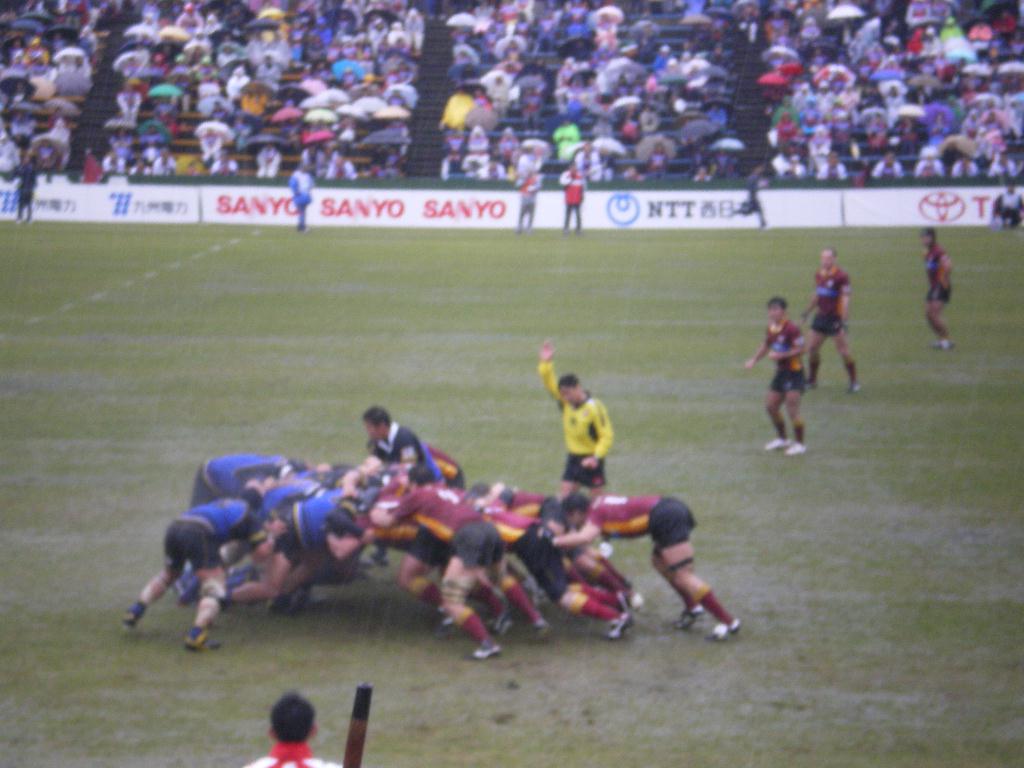
Main article: 2007–08 Top League
Kyuden Voltex and Mitsubishi Sagamihara DynaBoars joined the league for the first time. The following 14 teams were in the Top League in the 2007–08 season:
- Coca-Cola West Red Sparks
- Fukuoka Sanix Blues
- IBM Big Blue
- Kobelco Steelers
- Kubota Spears
- Kyuden Voltex
- Mitsubishi Sagamihara DynaBoars
- NEC Green Rockets
- Ricoh Black Rams
- Sanyo Wild Knights
- Suntory Sungoliath
- Toshiba Brave Lupus
- Toyota Verblitz
- Yamaha Jubilo
The top four teams (Sanyo, Suntory, Toyota and Toshiba) played in the fifth Microsoft Cup to decide the league champion. Suntory beat Sanyo 14–10 in the final to become the 2007–08 champions. Mitsubishi (14th) and Ricoh (13th) were automatically relegated.
Sixth season (2008–2009)
Main article: 2008–09 Top League
Kintetsu Liners returned to the league, and Yokogawa Denki were promoted for the first time (and renamed Yokogawa Musashino Atlastars in the off season). They replaced Ricoh Black Rams and Mitsubishi Sagamihara DynaBoars. The following teams were in the league:
- Coca-Cola West Red Sparks
- Fukuoka Sanix Blues
- IBM Big Blue
- Kintetsu Liners
- Kobelco Steelers
- Kubota Spears
- Kyuden Voltex
- NEC Green Rockets
- Sanyo Wild Knights
- Suntory Sungoliath
- Toshiba Brave Lupus
- Toyota Verblitz
- Yamaha Jubilo
- Yokogawa Musashino Atlastars
Seventh season (2009–2010)
Main article: 2009–10 Top League
IBM Big Blue and Yokogawa Atlastars were automatically relegated at the completion of the 2008–9 season for finishing 13th and 14th. Ricoh and Honda won promotion through the Top Challenge series. Kyuden and Sanix retained their places in Top League when they won their respective promotion and relegation play-offs. The following teams were in the league:
- Coca-Cola West Red Sparks
- Fukuoka Sanix Blues
- Honda Heat
- Kintetsu Liners
- Kobelco Steelers
- Kubota Spears
- Kyuden Voltex
- NEC Green Rockets
- Ricoh Black Rams
- Sanyo Wild Knights
- Suntory Sungoliath
- Toshiba Brave Lupus
- Toyota Verblitz
- Yamaha Jubilo
Eighth season (2010–2011)
Main article: 2010–11 Top League
Honda Heat and Kyuden Voltex were automatically relegated at the completion of the 2009–10 season for finishing 13th and 14th. Toyota Industries Shuttles and NTT Communications Shining Arcs won promotion through the Top Challenge series. The following teams were in the league:
- Coca-Cola West Red Sparks
- Fukuoka Sanix Blues
- Kintetsu Liners
- Kobelco Steelers
- Kubota Spears
- NEC Green Rockets
- NTT Communications Shining Arcs
- Ricoh Black Rams
- Sanyo Wild Knights
- Suntory Sungoliath
- Toshiba Brave Lupus
- Toyota Verblitz
- Toyota Industries Shuttles
- Yamaha Jubilo
The top 4 sides (Toshiba, Sanyo, Toyota and Suntory) from the regular season competed in a knock out tournament to fight for the Top League title. In the final, Sanyo defeated Suntory 28–23.
Ninth season (2011–2012)
Main article: 2011–12 Top League
NTT Shining Arcs and Yamaha Jubilo which won their 2005 promotion/relegation play-offs (Irekaesen) against Canon Eagles and Kyuden Voltex to retain their places for the 2011–12 season. The following teams were in the league:
- Coca-Cola West Red Sparks
- Fukuoka Sanix Blues
- Kintetsu Liners
- Kobelco Steelers
- NTT DoCoMo Red Hurricanes
- NEC Green Rockets
- NTT Communications Shining Arcs
- Ricoh Black Rams
- Sanyo Wild Knights
- Suntory Sungoliath
- Toshiba Brave Lupus
- Toyota Verblitz
- Honda Heat
- Yamaha Jubilo
The top 4 sides of the regular season (Suntory, Toshiba, Sanyo, and NEC) competed in the 2012 Top League Champions Cup knock-out tournament for the Top League title at Chichibu, Tokyo. Suntory defeated Sanyo 47–28 in the final to win the title. Both teams met again a few weeks later in the final of the 49th All-Japan Rugby Football Championship.
Additionally, in the Wildcard play-offs, the Top League teams ranked 5th and 8th (Kintetsu Liners and Yamaha Jubilo) played each other at Hanazono, Osaka, as did the teams ranked 6th and 7th (Kobe Steelers and Ricoh Black Rams), with the winners (Kobe and Yamaha) also qualifying for the All-Japan Rugby Football Championship.
Sixteen teams: 2012 onwards
- Kintetsu Liners
- Kobelco Steelers
- Munakata Sanix Blues
- NTT DoCoMo Red Hurricanes
- NEC Green Rockets
- NTT Communications Shining Arcs
- Ricoh Black Rams
- Sanyo Wild Knights
- Suntory Sungoliath
- Toshiba Brave Lupus
- Toyota Verblitz
- Toyota Industries Shuttles
- Honda Heat
- Yamaha Jubilo
- Hino Red Dolphins
- Mitsubishi Dynaboars
Statistics
Finals
| Season | Winners | Score | Runners-up | Venue | Top League | 2003–04 | 2004–05 | 2005–06 | 2006–07 | 2007–08 | 2008–09 | 2009–10 | 2010–11 | 2011–12 | 2012–13 | 2013–14 | 2014–15 | 2015–16 | 2016–17 | 2017–18 | 2018–19 | 2020 | 2021 | Japan Rugby League One (D1) | 2022 | 2022–23 | 2023–24 | 2024–25 | 2025–26 |
|---|---|---|---|---|---|---|---|---|---|---|---|---|---|---|---|---|---|---|---|---|---|---|---|---|---|---|---|---|---|
| Chiba NEC Green Rockets | 24–19 | Tokyo Toshiba Brave Lupus | National Stadium, Kasumigaoka, Tokyo | ||||||||||||||||||||||||||
| Tokyo Toshiba Brave Lupus | 20–6 | Shizuoka Yamaha Júbilo | Chichibunomiya Rugby Stadium, Aoyama, Tokyo | ||||||||||||||||||||||||||
| Tokyo Toshiba Brave Lupus | 33–18 | Tokyo Suntory Sungoliath | Chichibunomiya Rugby Stadium, Aoyama, Tokyo | ||||||||||||||||||||||||||
| Tokyo Toshiba Brave Lupus | 14–13 | Tokyo Suntory Sungoliath | Chichibunomiya Rugby Stadium, Aoyama, Tokyo | ||||||||||||||||||||||||||
| Tokyo Suntory Sungoliath | 14–10 | Gunma Sanyo Wild Knights | Chichibunomiya Rugby Stadium, Aoyama, Tokyo | ||||||||||||||||||||||||||
| Tokyo Toshiba Brave Lupus | 17–6 | Gunma Sanyo Wild Knights | Chichibunomiya Rugby Stadium, Aoyama, Tokyo | ||||||||||||||||||||||||||
| Tokyo Toshiba Brave Lupus | 6–0 | Gunma Sanyo Wild Knights | Chichibunomiya Rugby Stadium, Aoyama, Tokyo | ||||||||||||||||||||||||||
| Gunma Sanyo Wild Knights | 28–23 | Tokyo Suntory Sungoliath | Chichibunomiya Rugby Stadium, Aoyama, Tokyo | ||||||||||||||||||||||||||
| Tokyo Suntory Sungoliath | 47–28 | Gunma Sanyo Wild Knights | Chichibunomiya Rugby Stadium, Aoyama, Tokyo | ||||||||||||||||||||||||||
| Tokyo Suntory Sungoliath | 19–3 | Tokyo Toshiba Brave Lupus | Chichibunomiya Rugby Stadium, Aoyama, Tokyo | ||||||||||||||||||||||||||
| Gunma Panasonic Wild Knights | 45–22 | Tokyo Suntory Sungoliath | Chichibunomiya Rugby Stadium, Aoyama, Tokyo | ||||||||||||||||||||||||||
| Gunma Panasonic Wild Knights | 30–12 | Shizuoka Yamaha Júbilo | Chichibunomiya Rugby Stadium, Aoyama, Tokyo | ||||||||||||||||||||||||||
| Gunma Panasonic Wild Knights | 27–26 | Tokyo Toshiba Brave Lupus | Chichibunomiya Rugby Stadium, Aoyama, Tokyo | ||||||||||||||||||||||||||
| Tokyo Suntory Sungoliath | 15–10 | Gunma Panasonic Wild Knights | Chichibunomiya Rugby Stadium, Aoyama, Tokyo | ||||||||||||||||||||||||||
| Tokyo Suntory Sungoliath | 12–8 | Gunma Panasonic Wild Knights | Chichibunomiya Rugby Stadium, Aoyama, Tokyo | ||||||||||||||||||||||||||
| Hyogo Kobelco Steelers | 55–5 | Tokyo Suntory Sungoliath | Chichibunomiya Rugby Stadium, Aoyama, Tokyo | ||||||||||||||||||||||||||
| Season cancelled due to the COVID-19 pandemic.}} | |||||||||||||||||||||||||||||
| Gunma Panasonic Wild Knights | 31–26 | Tokyo Suntory Sungoliath | Chichibunomiya Rugby Stadium, Aoyama, Tokyo | ||||||||||||||||||||||||||
| Saitama Saitama Wild Knights | 18–12 | Tokyo Tokyo Sungoliath | National Stadium, Shinjuku, Tokyo | ||||||||||||||||||||||||||
| Chiba Spears Tokyo Bay | 17–15 | Saitama Saitama Wild Knights | National Stadium, Shinjuku, Tokyo | ||||||||||||||||||||||||||
| Tokyo Brave Lupus Tokyo | 24–20 | Saitama Saitama Wild Knights | National Stadium, Shinjuku, Tokyo | ||||||||||||||||||||||||||
| Tokyo Brave Lupus Tokyo | 18–13 | Chiba Spears Tokyo Bay | National Stadium, Shinjuku, Tokyo | ||||||||||||||||||||||||||
| — | National Stadium, Shinjuku, Tokyo |
Performance by club
| Club | Title(s) | Runners-up | Seasons won | Seasons runner-up | Tokyo Brave Lupus Tokyo | GunmaSaitama Saitama Wild Knights | Tokyo Tokyo Sungoliath | Chiba Spears Tokyo Bay | Chiba Green Rockets Tokatsu | Hyogo Kobe Steelers | Shizuoka Shizuoka Blue Revs |
|---|---|---|---|---|---|---|---|---|---|---|---|
| 7 | 3 | 2004–05, 2005–06, 2006–07, 2008–09, 2009–10, 2023–24, 2024–25 | 2003–04, 2012–13, 2015–16 | ||||||||
| 6 | 8 | 2010–11, 2013–14, 2014–15, 2015–16, 2021, 2022 | 2007–08, 2008–09, 2009–10, 2011–12, 2016–17, 2017–18, 2022–23, 2023–24 | ||||||||
| 5 | 7 | 2007–08, 2011–12, 2012–13, 2016–17, 2017–18 | 2005–06, 2006–07, 2010–11, 2013–14, 2018–19, 2021, 2022 | ||||||||
| 1 | 1 | 2022–23 | 2024–25 | ||||||||
| 1 | 0 | 2003–04 | — | ||||||||
| 1 | 0 | 2018–19 | — | ||||||||
| 0 | 2 | — | 2004–05, 2014–15 |
Performance by prefecture
| Prefecture | Clubs | Title(s) | Runners-up | Seasons won | Seasons runner-up | Tokyo Tokyo Prefecture | Gunma Prefecture | Chiba Prefecture | Saitama Prefecture | Hyogo Hyogo Prefecture | Shizuoka Prefecture |
|---|---|---|---|---|---|---|---|---|---|---|---|
| 12 | 10 | 2004–05, 2005–06, 2006–07, 2007–08, 2008–09, 2009–10, 2011–12, 2012–13, 2016–17, 2017–18, 2023–24, 2024–25 | 2003–04, 2005–06, 2006–07, 2010–11, 2012–13, 2013–14, 2015–16, 2018–19, 2021, 2022 | ||||||||
| Saitama Wild Knights | 5 | 6 | 2010–11, 2013–14, 2014–15, 2015–16, 2021 | 2007–08, 2008–09, 2009–10, 2011–12, 2016–17, 2017–18 | |||||||
| 2 | 1 | 2003–04, 2022–23 | 2024–25 | ||||||||
| Saitama Wild Knights | 1 | 2 | 2022 | 2022–23, 2023–24 | |||||||
| Kobe Steelers | 1 | 0 | 2018–19 | — | |||||||
| Shizuoka Blue Revs | 0 | 2 | — | 2004–05, 2014–15 |
Notable foreign players
The following foreign players that have played in the Top League have either won or been nominated for a major IRB award, played in a Rugby World Cup, played for a combined-nations touring side, or captained their national team.
| Wales Shane Williams | – 2003, 2007 and 2011 World Cups; 2005, 2009 and 2013 British and Irish Lions |
|---|
Notes
References
References
- (2020-07-01). "Framework of Entry Conditions to New League". JRFU.
- (2021-01-18). "Japan's new rugby union league to launch in 2022". Sports Pro Media.
- (16 July 2021). "La nouvelle ligue japonaise s'appelle la Japan Rugby League One". Asie Rugby.
- 一般社団法人ジャパンラグビーリーグワン. "JAPAN RUGBY LEAGUE ONE OFFICIAL SITE FIXTURES & RESULTS(2022)".
- "2022 Super Rugby Pacific".
- (2012-05-24). "The 4.25 million pound question". ESPN Scrum.
- [http://www.yomiuri.co.jp/dy/sports/20080228TDY18309.htm Daily Yomiuri, 28 February 2008]
- (19 August 2016). "Japan to add second-tier rugby league in 2017". The Japan Times.
This article was imported from Wikipedia and is available under the Creative Commons Attribution-ShareAlike 4.0 License. Content has been adapted to SurfDoc format. Original contributors can be found on the article history page.
Ask Mako anything about Japan Rugby League One — get instant answers, deeper analysis, and related topics.
Research with MakoFree with your Surf account
Create a free account to save articles, ask Mako questions, and organize your research.
Sign up freeThis content may have been generated or modified by AI. CloudSurf Software LLC is not responsible for the accuracy, completeness, or reliability of AI-generated content. Always verify important information from primary sources.
Report