From Surf Wiki (app.surf) — the open knowledge base
Jan Matejko
Polish painter (1838–1893)
Polish painter (1838–1893)
| Field | Value | |
|---|---|---|
| name | Jan Matejko | |
| image | Jan Matejko 1901 (612306) (cropped).jpg | |
| caption | Matejko, before 1883 | |
| birth_name | Jan Alojzy Matejko | |
| birth_date | 24 June 1838 | |
| birth_place | Free City of Kraków | |
| death_date | ||
| death_place | Kraków, Grand Duchy of Kraków, Austria-Hungary | |
| resting_place | Rakowicki Cemetery, Kraków, Poland | |
| other_names | Jan Mateyko | |
| known_for | Painting, drawing, teaching | |
| training | {{Plainlist | |
| movement | History painting, academic art | |
| notable_works | {{Plainlist | |
| spouse | Teodora Giebułtowska | |
| awards | {{Plainlist |
- School of Fine Arts, Kraków
- Academy of Fine Arts, Munich
- The Battle of Grunwald
- Stańczyk
- The Prussian Homage
- The Hanging of the Sigismund Bell
- Légion d'honneur
- Knight Commander with Star of the Order of Pius IX
- Doctor Honoris Causa
Jan Alojzy Matejko (; also known as Jan Mateyko; 24 June 1838 – 1 November 1893) was a Polish painter, a leading 19th-century exponent of history painting, known for depicting nodal events from Polish history. His works include large scale oil paintings such as Stańczyk (1862), Rejtan (1866), Union of Lublin (1869),* Astronomer Copernicus, or Conversations with God* (1873), or Battle of Grunwald (1878). He was the author of numerous portraits, a gallery of Polish monarchs in book form, and murals in St. Mary's Basilica, Kraków. He is considered by many as the most celebrated Polish painter, and sometimes as the "national painter" of Poland.
Matejko spent most of his life in Kraków. He enrolled at the Kraków Academy of Fine Arts at age fourteen, where he studied under notable artists such as Wojciech Korneli Stattler and Władysław Łuszczkiewicz and completed his first major historical painting in 1853. His early exposure to revolutions in Kraków and the military service of his brothers influenced his artistic themes. After studying art in Munich and Vienna, he returned to Kraków and set up a studio. He gradually gained recognition, selling key paintings that settled his debts and created some of his most famous works, including Stańczyk and Skarga's Sermon. Matejko's art played a key role in promoting Polish history and national identity at a time when Poland was partitioned and lacked political autonomy.
At the same time, Matejko's painting style has been criticised as old-fashioned and overly theatrical, labeled as "antiquarian realism". His works often lost their nuanced historical significance when displayed abroad due to the audience's unfamiliarity with Polish history. Matejko's support for the Polish cause was not just through his art; he also contributed financially and materially to the January Uprising of 1863. Later, he became director of the art academy in Kraków, which was eventually renamed the Jan Matejko Academy of Fine Arts. A number of his students became prominent artists in their own right, including Maurycy Gottlieb, Jacek Malczewski, Józef Mehoffer and Stanisław Wyspiański. He received several honors during his lifetime, including the French Légion d'honneur. Matejko was among the notable people to receive an unsolicited letter from the German philosopher Friedrich Nietzsche, as the latter tipped, in January 1889, into his psychotic breakdown while in Turin.
Biography
Youth
Matejko was born on 24 June 1838, in the Free City of Kraków. His father, Franciszek Ksawery Matejko () (born 1789 or 13 January 1793, died 26 October 1860), a Czech from the village of Roudnice, was a graduate of the Hradec Králové school who later became a tutor and music teacher. He first worked for the Wodzicki family in Kościelniki, Poland, then moved to Kraków, where he married the half-German, half-Polish Joanna Karolina Rossberg (Rozberg). Jan was the ninth of eleven children. His mother died when he was very young and his older brother, Franciszek had a hand in the manner of his upbringing. He grew up in a kamienica building on Floriańska Street. After the death of his mother in 1845, Jan and his siblings were cared for by his maternal aunt, Anna Zamojska.

At a young age he witnessed the Kraków revolution of 1846 and the 1848 siege of Kraków by the Austrians, two events which put an end to the Free City of Kraków. Two of his older brothers served in both armed conflicts, under General Józef Bem. One of them, Edmund, fell in battle and the other was forced into exile. Matejko attended St. Anne's High School, but he dropped out in 1851 because of poor grades. Matejko showed an early artistic talent, but had great difficulty with other academic subjects. He never fully mastered a foreign language. Despite that, and because of his exceptional skill, at the age of fourteen he entered the School of Fine Arts in Kraków, where he was a contemporary of Artur Grottger from 1852 to 1858. His teachers included Wojciech Korneli Stattler and Władysław Łuszczkiewicz. He opted for historical painting as his specialism, and finished his first major work, The Shuyski Tsars before Zygmunt III (Carowie Szujscy przed Zygmuntem III), in 1853 (he would return to this theme a year before his death, in 1892. His graduation project in 1858 was Sigismund I the Old ennobles professors of the Jagiellonian University (Zygmunt I nadaje szlachectwo profesorom Uniwersytetu Jagiellońskiego) and proved to be seminal.
After graduation in 1859, Matejko received a scholarship to study with Hermann Anschütz at the Academy of Fine Arts, Munich. The following year he received a further scholarship to study at the Academy of Fine Arts Vienna, but after only a few days and a major quarrel with Christian Ruben, Matejko returned to Kraków. He set up a studio at his family home in Floriańska Street. It took years before he met with commercial success. He struggled as the proverbial "starving artist", who finally celebrated when he managed to sell the Shuyski Tsars... canvas for five florins.
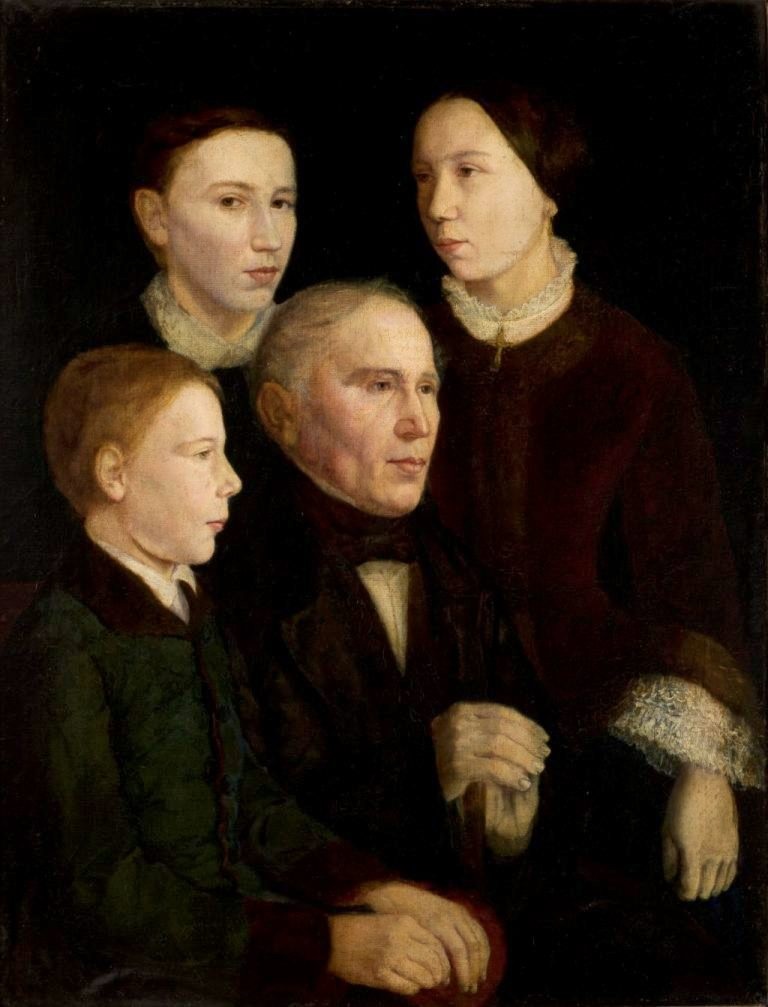
In 1860, against a background of cultural erosion in partitioned Poland Matejko published an illustrated album, Clothing in Poland (Ubiory w Polsce), a project reflecting his intense interest in the historical record of his nation and his desire to promote it among Polish people and incidentally stir their patriotism. 1862 saw the completion of his Stańczyk, initially received without much acclaim, but in due course becoming one of Matejko's best known works. It marks a manifest departure in Matejko's art, from mere illustrator of history to commentator upon its moral content.

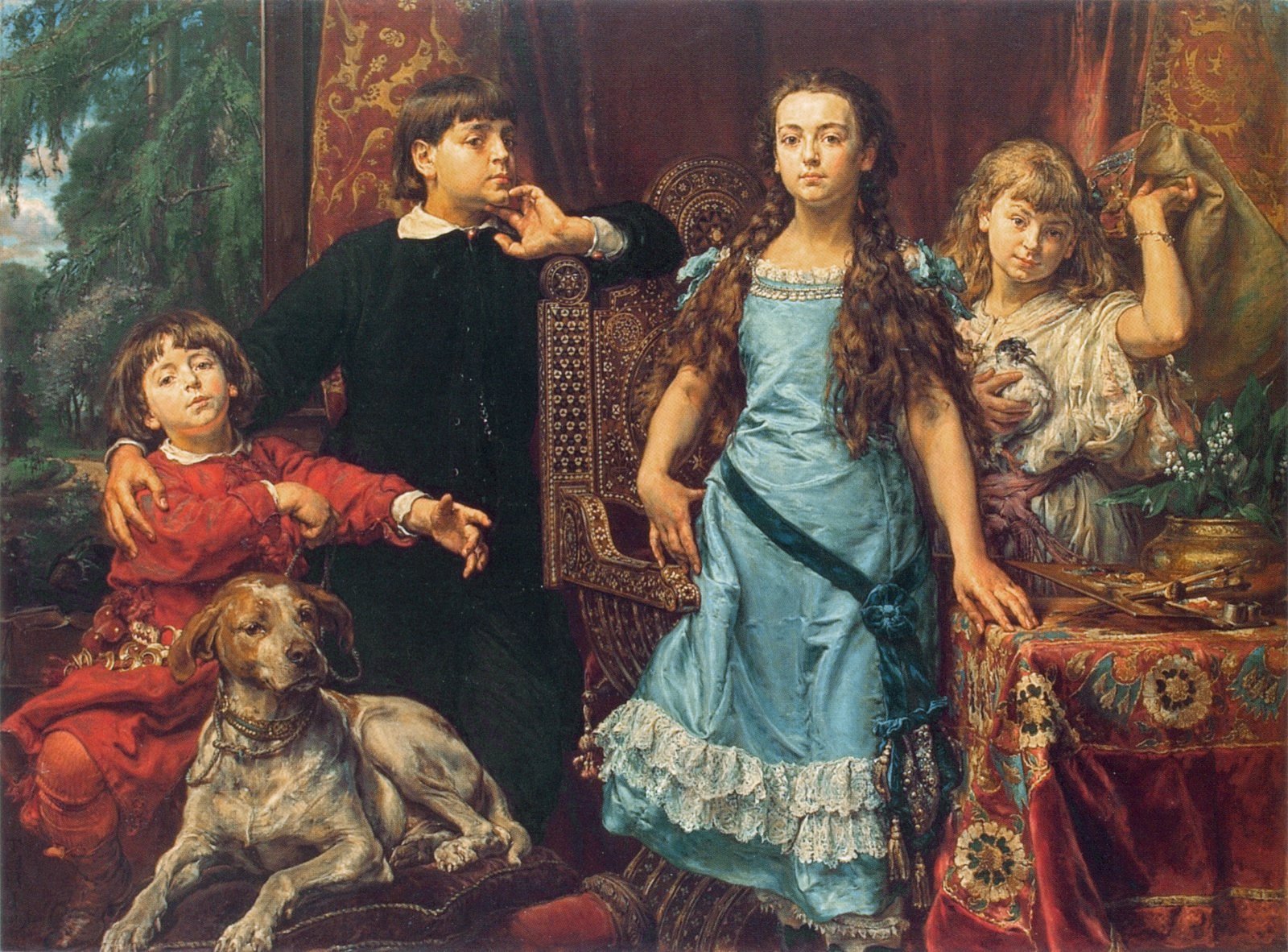
During the January Uprising of 1863, in which he did not directly take part on account of his poor health, Matejko supported it financially, donating most of his savings to the cause, and personally transporting arms to an insurgents' camp. Subsequently, his Skarga's Sermon (Kazanie Skargi), May 1864, was exhibited in the gallery of the Kraków Society of Friends of Fine Arts, which gained him much publicity. On 21 November he married Teodora Giebułtowska, with whom he went on to have five children: Beata, Helena, Tadeusz, Jerzy and Regina. His daughter, Helena, also an artist, later helped World War I victims and was awarded the Cross of Independence by President Stanisław Wojciechowski.
Rise to fame

_(cropped).jpg)
In 1872, during an exhibition in Prague he was offered the directorship of the Prague Academy of Fine Arts, quickly followed by a similar offer from the Kraków School of Fine Arts. That year he received an "honorary grand gold" medal in Paris, while Kraków city council presented him with a ceremonial scepter, as a symbol of his "royal status in fine art".
1880-1882 were taken up with another large work, The Prussian Tribute (Hołd Pruski) which Matejko gifted to "the Polish nation". It earned him the honorary citizenship of Kraków. The painting is on permanent exhibition in the Sobieski Room at the Vatican Museums. Around that time he also became vocal on a number of political issues, publishing letters on topics such as Polish-Russian relations.
In 1887 Matejko received an honorary doctorate from the Jagiellonian University, and recognition from the Austrian Society, Litteris et Artibus. 1891 marked his Constitution of the 3 May (Konstytucja 3 Maja). He went on to compose another large scale work, The Oaths of Jan Kazimierz (Śluby Jana Kazimierza), but death intervened. In 1892, a year before his death, he completed his Self-portrait (Autoportret).
Portraits and other work


In addition to the history paintings Matejko was a prolific portraitist. He also designed the monumental polychrome murals for the Brick Gothic St. Mary's Basilica, Kraków (1889–1891), which in 1978 became a UNESCO World Heritage Site alongside the Historic Centre of Kraków.
Death

Matejko suffered from a peptic ulcer, and died in Kraków on 1 November of internal bleeding. He was buried in Kraków's Rakowicki Cemetery.
Significance, style and themes
He is counted among the most significant of Polish painters, and considered by many as "Poland's greatest history painter" or as "a cult figure for the nation at large... [already] by the time of his death.".
He succeeded in propagating Polish history, and fostering the memory of an erstwhile historic state lost to the world, while his country remained carved up between three European powers which afforded its Polish natives no prospect of political self-determination. His works, disseminated through thousands of reproductions, have become standard illustrations of the many key events in Polish history. His 1860 illustrated album, Ubiory w Polsce (Costume in Poland), is seen as a valuable historical reference.
Criticism and controversy
Critics of his work have pointed to his use of traditional, outdated or bombastic painting style, discrediting him for "antiquarian realism" and "theatrical effects". At exhibitions abroad, the nuanced historical context of his works was often lost on foreign audiences.
Awards
- Chevalier de la Legion d'honneur, 1870 for his Union of Lublin 1869
- Médaille d'or at the Salon de Paris in 1867 for *Rejtan *
- Kunst-medaille 1873, Vienna
- Membre de l'Académie des Beaux-Arts (1873)
- Médaille d'honneur at the Exposition Universelle (1878)
- Commander's Cross of the Order of Franz Joseph
- Commander's Cross of the Order of the Iron Crown
- Commander's Cross with Star of the Order of Pius IX
- Gold Medal of the Munich Academy of Art
- Papal Gold Medal of Leo XIII
- Medal "Pro litteris et artibus", Vienna
- Odznaka Honorowa za Dzieła Sztuki i Umiejętności, Poland (1887)
- Honorary citizenship of the cities of Kraków, Lwów, Przemyśl, Ivano-Frankivsk, Stryj and Brzezany
- Doctor honoris causa of the Jagiellonian University (1887)
- Member of the Institut de France (1874), the Berlin Academy of Arts (1874), the Accademia Raffaello in Urbino (1878), and the Wiener Kunstlergenossenschaft (1888)
Legacy

Matejko's aim was to focus on major themes in Polish history using historical sources to paint events in minute historical detail. His earliest paintings are purely historical depictions without didactic content. Stańczyk focuses on the court jester, portrayed as a symbol of his country's conscience, sitting in a chair, against the background of a party - a lonely figure reflecting on war, ignored by the joyful crowd.
His paintings are on display in numerous Polish museums, including: the National Museum in Warsaw, National Museum in Kraków, National Museum in Poznań and National Museum in Wrocław. Another museum dedicated to Matejko is the Jan Matejko Manor House (Dworek Jana Matejki w Krzesławicach), in the village of Krzesławice, where Matejko had bought a small estate in 1865.
As teacher and influencer
Over 80 painters were Matejko's students, many influenced during his tenure as director of the Kraków School of Fine Arts, and are called members of the "Matejko School". Some went on to become members of the brief flowering of the Young Poland (Młoda Polska) movement, which encompassed literature, music, theatre as well as visual arts and was dissipated by World War I. Matejko has been dubbed "Father of Young Poland". Prominent among his students were:
- Maurycy Gottlieb
- Ephraim Moses Lilien
- Jacek Malczewski
- Helena Matejko, Matejko's daughter
- Józef Mehoffer
- Jozef Pankiewicz
- Antoni Piotrowski
- Witold Pruszkowski
- Jan Styka
- Włodzimierz Tetmajer
- Józef Unierzyski, Matejko's son-in-law
- Leon Wyczółkowski
- Stanisław Wyspiański
File:Treny normal.jpg|Jan Kochanowski over his dead daughter's body, 1862 File:Samuel Zborowski śmierć.jpg|Samuel Zborowski on his way to his execution File:Wladyslaw I Lokietek (76841156) (cropped).jpg|Wladyslaw I Lokietek from the Gallery of Polish Monarchs File:Konstytucja 3 Maja Sejm Czteroletni Komisja edukacyjna Rozbior.jpg|The Constitution of May 3. Four-Year Sejm. Educational Commission Partition. A.D. 1795 Royal Castle File:Jan Matejko-Astronomer Copernicus-Conversation with God.jpg|Astronomer Copernicus, or Conversations with God, 1873. In the background: Frombork Cathedral File:Jan Matejko, ritratto di donna.jpg|Pen and ink drawing possibly of Bona Sforza, 1861 File:Jan Matejko - Ociemniały Wit Stwosz z wnuczką.jpg|Blind Veit Stoss with His Granddaughter (1865), National Museum in Warsaw
Selected work
The following is a selected list of Matejko's works, in chronological order.
| 27. | Wyjście żaków z Krakowa w roku 1549 (Students leaving Krakow in 1549) | 1892 | oil | National Museum in Kraków | [[File:Kleparz w XVIw Wyjscie zakow z Krakowa.jpg | 140x140px]] |
|---|
Notes
References
Bibliography
References
- Maria Szypowska. (2016). "Jan Matejko wszystkim znany". Fundacja Artibus-Wurlitzer oraz Wydawn. Domu Słowa Polskiego.
- (2021). "Conversations with God: Jan Matejko's Copernicus, Exhibition, 21 May-22 August 2021". [[National Gallery London]].
- William Fiddian Reddaway. (1971). "The Cambridge History of Poland". CUP Archive.
- Matejko Adressat des Briefes ''Den erlauchten Polen'' vom 4. Januar 1889 (in German)
- [http://www.thenietzschechannel.com/correspondence/ger/nlett1889g.htm Nietzsches Briefe, Ausgewählte Korrespondenz, Wahnzettel 1889]
- Maria Szypowska. (2016). "Jan Matejko wszystkim znany". Fundacja Artibus-Wurlitzer oraz Wydawn. Domu Słowa Polskiego.
- Maria Szypowska. (2016). "Jan Matejko wszystkim znany". Fundacja Artibus-Wurlitzer oraz Wydawn. Domu Słowa Polskiego.
- Maria Szypowska. (2016). "Jan Matejko wszystkim znany". Fundacja Artibus-Wurlitzer oraz Wydawn. Domu Słowa Polskiego.
- Maria Szypowska. (2016). "Jan Matejko wszystkim znany". Fundacja Artibus-Wurlitzer oraz Wydawn. Domu Słowa Polskiego.
- Maria Szypowska. (2016). "Jan Matejko wszystkim znany". Fundacja Artibus-Wurlitzer oraz Wydawn. Domu Słowa Polskiego.
- (1993). "Matejko: Album". Arkady.
- During this time, he began exhibiting historical paintings at the [[Kraków Society of Friends of Fine Arts]] from 1855.Bochnak (1975), p. 185
- Maria Szypowska. (2016). "Jan Matejko wszystkim znany". Fundacja Artibus-Wurlitzer oraz Wydawn. Domu Słowa Polskiego.
- Maria Szypowska. (2016). "Jan Matejko wszystkim znany". Fundacja Artibus-Wurlitzer oraz Wydawn. Domu Słowa Polskiego.
- Maria Szypowska. (2016). "Jan Matejko wszystkim znany". Fundacja Artibus-Wurlitzer oraz Wydawn. Domu Słowa Polskiego.
- Bochnak (1975), p. 186
- (1992). "Projekt". Prasa-Książka-Ruch.
- Jan Matejko. (1993). "Matejko: obrazy olejne : katalog". Arkady.
- Bochnak (1975), p. 187
- (1994). "Listy Stanisława Wyspiańskiego do Józefa Mehoffera, Henryka Opieńskiego i Tadeusza Stryjeńskiego". Wydawnictwo Literackie.
- He accepted the Kraków position, and was for many years its principal ([[Rector (academia)
- Mieczysław Treter. (1939). "Matejko: osobowosc artysty, tworczosc, forma i styl". Książnica-Atlas.
- "The Immaculate Conception and Sobieski Rooms".
- (1 December 2010). "Lasers in the Conservation of Artworks VIII". CRC Press.
- Stanisława Serafińska. (1958). "Jan Matejko: wspomnienia rodzinne". Wydawnictwo Literackie.
- Griffin, Julia. (2021). "Matejko, Father of 'Young Poland', a talk by Julia Griffin". [[National Gallery London]].
- Maria Szypowska. (2016). "Jan Matejko wszystkim znany". Fundacja Artibus-Wurlitzer oraz Wydawn. Domu Słowa Polskiego.
- Bochnak (1975), p. 190
- Ciciora, Barbara. (2006). "Jan Matejko in München". zeitenblicke.
- (2012). "WYSTAWA: Wielka rekwizytornia artysty. Stroje i kostiumy z kolekcji Jana Matejki". Muzeum Narodowe w Krakowie.
- Jerzy Jan Lerski. (1996). "Historical Dictionary of Poland, 966-1945". Greenwood Publishing Group.
- Ciciora-Czwórnóg, Barbara. ''Jan Matejko''. p. 56.
- Krzysztofowicz-Kozakowska, Stefania.''Malarstwo polskie w zbiorach za granicą''. publisher, Kluszczyński. 2001, p. 12.
- (21 August 1887). "Telegramy biura koresp.". Czas.
- "Doktorzy honoris causa".
- (2 December 1888). "Kronika". Kurjer Lwowski.
- Ian Chilvers. (10 June 2004). "The Oxford Dictionary of Art". Oxford University Press.
- Wanda Małaszewska. "Matejko, Jan." Grove Art Online. Oxford Art Online. Oxford University Press. Retrieved 28 May 2014, http://www.oxfordartonline.com/subscriber/article/grove/art/T055919
- Jarmuł, Katarzyna. (2004). "Artyści ze Szkoły Jana Matejki". Muzeum Śląskie.
- Griffin, Julia. (2021). "Matejko, Father of 'Young Poland'". [[National Gallery London]].
- Glenda Abramson. (1 March 2004). "Encyclopedia of Modern Jewish Culture". Routledge.
- "Considered Poland's greatest panorama painter, Jan Styka died 95 years ago today".
- AB. (5 December 2002). "Helena z Matejków Unierzyska". Miasta.gazeta.pl.
- "History's Impact on Polish Art". Info-poland.buffalo.edu.
- "Jan Matejko: The Painter and Patriot Fostering Polish Nationalism". Info-poland.buffalo.edu.
This article was imported from Wikipedia and is available under the Creative Commons Attribution-ShareAlike 4.0 License. Content has been adapted to SurfDoc format. Original contributors can be found on the article history page.
Ask Mako anything about Jan Matejko — get instant answers, deeper analysis, and related topics.
Research with MakoFree with your Surf account
Create a free account to save articles, ask Mako questions, and organize your research.
Sign up freeThis content may have been generated or modified by AI. CloudSurf Software LLC is not responsible for the accuracy, completeness, or reliability of AI-generated content. Always verify important information from primary sources.
Report