From Surf Wiki (app.surf) — the open knowledge base
Jammu and Kashmir (state)
State administered by India (1952–2019)

State administered by India (1952–2019)
| Field | Value | ||
|---|---|---|---|
| common_name | Jammu and Kashmir | ||
| subdivision | Indian-administered | ||
| conventional_long_name | State of Jammu and Kashmir | ||
| capital | Srinagar (May–October) | ||
| Jammu (November–April) | |||
| year_start | 1952 | ||
| date_start | 17 November | ||
| event_start | Abolition of monarchy | ||
| event1 | Presidential order of 1954 | ||
| date_event1 | 14 May 1954 | ||
| year_end | 2019 | ||
| date_end | 31 October | ||
| event_end | Reorganized into Jammu and Kashmir and Ladakh | ||
| p1 | Jammu and Kashmir (princely state) | ||
| s1 | Jammu and Kashmir (union territory) | ||
| s2 | Ladakh | ||
| symbol_type | Emblem | ||
| image_coat | Emblem of Jammu & Kashmir.svg | ||
| image_map | Kashmir_region_2004.jpg | ||
| image_map_caption | Map of Jammu and Kashmir | ||
| image_flag | Flag of Jammu and Kashmir (1952-2019).svg | ||
| legislature | Jammu and Kashmir Legislature | ||
| house1 | Jammu and Kashmir Legislative Council (36 seats) | ||
| house2 | Jammu and Kashmir Legislative Assembly (89 seats) | ||
| political_subdiv | 22 districts | ||
| title_leader | Governor | ||
| leader1 | Karan Singh (first) | ||
| year_leader1 | 1952–1965 as Sadr-e-Riyasat; 1965–1967 | ||
| leader2 | Satya Pal Malik (last) | ||
| year_leader2 | 2018–2019 | ||
| title_deputy | Chief Minister | ||
| deputy1 | Sheikh Abdullah (first) | ||
| year_deputy1 | 1952–1953 as Prime Minister | ||
| deputy2 | Mehbooba Mufti (last) | ||
| year_deputy2 | 2016–2018 | ||
| native_name | demonym= | today= |
the former state
Jammu (November–April)
Jammu and Kashmir was a region formerly administered by India as a state from 1952 to 2019, constituting the southern and southeastern portion of the larger Kashmir region, which has been the subject of a dispute between India, Pakistan and China since the mid-20th century. The underlying region of this state were parts of the former princely state of Jammu and Kashmir, whose western districts, now known as Azad Kashmir, and northern territories, now known as Gilgit-Baltistan, are administered by Pakistan. The Aksai Chin region in the east, bordering Tibet, has been under Chinese control since 1962.
After the Government of India repealed the special status accorded to Jammu and Kashmir under Article 370 of the Indian constitution in 2019, the Parliament of India passed the Jammu and Kashmir Reorganisation Act, which contained provisions to split the state into two union territories – Ladakh in the east and the residuary Jammu and Kashmir in the west, with effect from 31 October 2019. Jammu and Kashmir was the only state in India with a Muslim-majority population.
Establishment
After the Indo-Pakistani War of 1947–1948, the princely state of Jammu and Kashmir was divided between India (which controlled the regions of Jammu, Kashmir Valley, and Ladakh) and Pakistan (which controlled Gilgit–Baltistan and Azad Kashmir). Maharaja Hari Singh signed the Instrument of Accession on 26 October 1947 after an invasion by Pakistani tribesmen. Sheikh Abdullah was appointed as the prime minister of Jammu and Kashmir as part of an interim government by Maharaja Hari Singh in March 1948. In order to integrate the provisions of the instrument of accession relating to the powers of the state and Indian government, the Constituent Assembly of India drew up the draft provision named Article 306-A, which would later become Article 370.
A constituent assembly for Jammu and Kashmir was convened to frame a new constitution for the state in October 1951, after an election in which all the seats were won by the Jammu & Kashmir National Conference party of Abdullah.
Abdullah reached an agreement termed as the "Delhi Agreement" with Jawaharlal Nehru, the Prime Minister of India, on 24 July 1952. It extended provisions of the Constitution of India regarding citizenship and fundamental rights to the state, in addition to the jurisdiction of the Supreme Court of India. Agreements were also reached on issues of abolishing the monarchy, as well as the state being allowed a separate flag and official language. The Delhi Agreement spelt out the relationship between the central government and the state through recognizing the autonomy of Jammu and Kashmir, while also declaring it as an integral part of India and granting the central government control of several subjects that were not a part of the instrument of accession.
The government of Jammu and Kashmir quickly moved to adopt the provisions of the agreement. The recommendations of the Drafting Committee on the Constitution of Jammu and Kashmir regarding the monarchy were accepted by the Constituent Assembly of Jammu and Kashmir on 21 August 1952. The Jammu and Kashmir Constitution Act 1939 was amended in November 1952 to adopt the resolutions and the monarchy was officially abolished on 12 November. The regent Karan Singh was formally elected as the Sadar-i-Riyasat or head of state by the Constituent Assembly and was later recognized by the President of India. The amendments incorporating the provisions into the state constitution entered into force on 17 November.
Integration with India
Abdullah however sought to make Article 370 permanent and began calling for the secession of the state from India, which led to his arrest in 1953. Bakshi Ghulam Mohammad then became the Prime Minister of Jammu and Kashmir. The Constituent Assembly of the state passed a resolution in February 1954, extending some provisions of the Constitution of India and formally ratifying the accession of the state to India per the Instrument of Accession. A Presidential Order was passed on 14 May 1954 to implement the Delhi Agreement, drawing its validity from the resolution of the Constituent Assembly.
The new Constitution of Jammu and Kashmir was adopted on 17 November 1956 and came into force on 26 January 1957. Following this, the state constituent assembly dissolved itself and elections were held for the legislative assembly in 1957, with the National Conference winning 68 out of 75 seats.
In 1956–57, China constructed a road through the disputed Aksai Chin area of Ladakh. India's belated discovery of this road culminated in the Sino-Indian War of 1962; China has since administered Aksai Chin. Following the Indo-Pakistani War of 1971, India and Pakistan signed the Simla Agreement, recognising a Line of Control in Kashmir, and committing to a peaceful resolution of the dispute through bilateral negotiations.
In December 1964, the Indian government extended provisions of Articles 356 and 357 of the Constitution of India, which allowed for President's rule in the state. In April 1965, the legislative assembly approved renaming the positions of Sadar-i-Riyasat to Governor and Wazir-i-Azam (Prime Minister) to Chief Minister of Jammu and Kashmir. Though the change had no actual effect on the legal structure of the state, it conveyed that the government of Jammu and Kashmir was equal to that of any other Indian state.
Despite Nehru releasing the imprisoned Abdullah in April 1964 to initiate dialogue with Pakistan, it viewed these developments as leading to the inseparability of Jammu and Kashmir from India and launched an armed conflict, infiltrating Kashmir during Operation Gibraltar in August 1965. However, it ultimately failed in its objective and both countries returned to the status quo after the Tashkent Declaration of 1966. The government of Ghulam Mohammed Sadiq meanwhile rapidly extended many provisions of the Indian Constitution to further integrate the state into India.
The failure of Pakistan in the 1971 Indo-Pakistani war weakened the Kashmiri nationalist movement and Abdullah dropped demands of secession. Under the Indira–Sheikh Accord of 1975, he recognised the region as a part of India, the state legislature requiring the approval of the President to make laws, and the Parliament of India being able to promulgate laws against secessionism. In return, Article 370 was left untouched and Abdullah became the Chief Minister of the state. The region remained mostly peaceful until his death in 1982.
Kashmir insurgency
In the late 1980s, discontent over the high-handed policies of the union government and allegations of the rigging of the 1987 Jammu and Kashmir Legislative Assembly election provoked separatist sentiments in the region, culminating in a violent uprising and prolonged armed insurgency backed by Pakistan, who claimed to have given its "moral and diplomatic" support to the movement. Several new militant groups with radical Islamic views emerged and changed the ideological emphasis of the movement to Islamic. This was facilitated by a large influx of Islamic "Jihadi" fighters (mujahideen) who had entered the Kashmir valley following the end of the Soviet–Afghan War in the 1980s. The Inter-Services Intelligence of Pakistan has been accused by India and the international community of supporting, supplying arms and training mujahideen, to fight in Jammu and Kashmir. In 2015, former President of Pakistan Pervez Musharraf admitted that Pakistan had supported and trained insurgent groups in the 1990s. A prolonged, bloody conflict between the Islamic militant separatists and the Indian Army took place, both of whom have been accused of widespread human rights abuses, including abductions, massacres, rapes and armed robbery.
The violence emerged as a setback to industries in the Valley. Doda district, rich in high-grade sapphire, had active mines until 1989 that were abandoned owing to their turbulent location. In 1998, the government discovered that smugglers had occupied these mines and stolen much of the resource. Following the 2008 Kashmir unrest, secessionist movements in the region were boosted. The 2016–17 Kashmir unrest resulted in the death of over 90 civilians and the injury of over 15,000. Six policemen, including a sub-inspector were killed in an ambush in Anantnag in June 2017, by trespassing militants of the Pakistan-based Lashkar-e-Toiba. An attack on an Indian police convoy in Pulwama, in February 2019, resulted in the deaths of 40 police officers. Responsibility for the attack was claimed by a Pakistan-backed militant group Jaish-e-Mohammed.
Revocation of special status and reorganisation
In August 2019, the Parliament of India passed resolutions to amend Article 370, ending Jammu and Kashmir’s special constitutional status and bringing it entirely under the Constitution of India. Alongside this, the Jammu and Kashmir Reorganisation Act, 2019 was passed, splitting the state of Jammu and Kashmir into two union territories: Ladakh and the residuary Jammu and Kashmir.
Ahead of these actions, the union government locked down the Kashmir Valley, increased security forces, restricted public movement under Section 144, and detained several political leaders, including former chief ministers Omar Abdullah and Mehbooba Mufti. Internet and phone services were also suspended. The new administrative structure came into effect on 31 October 2019.
Administrative divisions
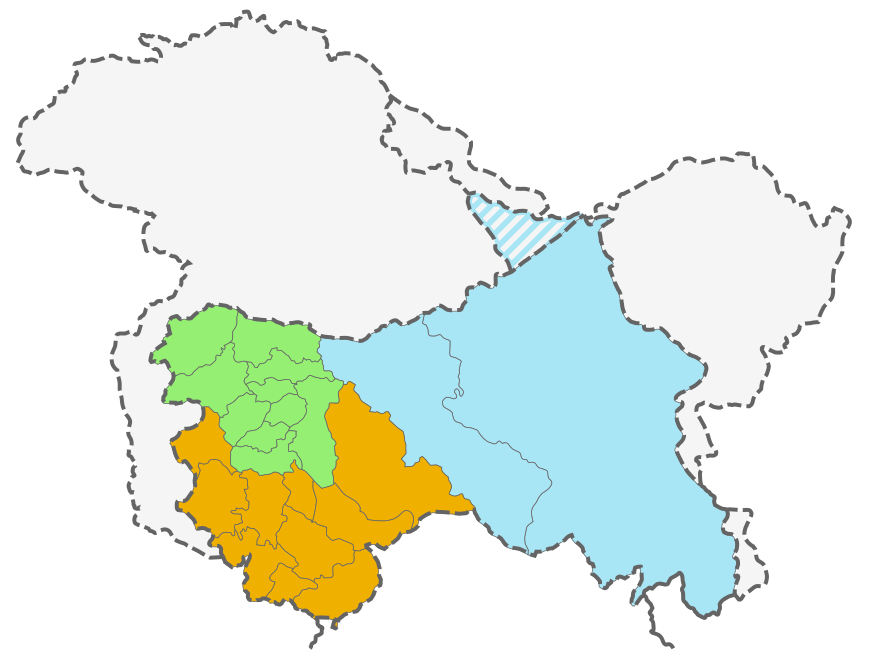
The state of Jammu and Kashmir consisted of three divisions: the Jammu Division, the Kashmir Division and Ladakh which were further divided into 22 districts. The Siachen Glacier, while under Indian military control, did not lie under the administration of the state of Jammu and Kashmir. Kishtwar, Ramban, Reasi, Samba, Bandipora, Ganderbal, Kulgam and Shopian were districts formed in 2008.
Districts
| Division | Name | Headquarters | Before 2007 | After 2007 | Area | ||||||||
|---|---|---|---|---|---|---|---|---|---|---|---|---|---|
| (km2) | Area | ||||||||||||
| (km2) | Area | ||||||||||||
| (sq miles) | Rural Area | ||||||||||||
| (km2) | Urban Area | ||||||||||||
| (km2) | Ref. | ||||||||||||
| Jammu | Kathua district | Kathua | 2502 km2 | ||||||||||
| Jammu district | Jammu | 2342 km2 | 2) Part B page 24 says 2,089.87 km2-- | ||||||||||
| Samba district | Samba | new district | 904 km2 | ||||||||||
| Udhampur district | Udhampur | 2637.00 km2 | |||||||||||
| Reasi district | Reasi | new district | 1719 km2 | ||||||||||
| Rajouri district | Rajouri | 2630 km2 | |||||||||||
| Poonch district | Poonch | 1674 km2 | |||||||||||
| Doda district | Doda | 8912.00 km2 | |||||||||||
| Ramban district | Ramban | new district | 1329.00 km2 | ||||||||||
| Kishtwar district | Kishtwar | new district | 1644.00 km2 | ||||||||||
| Total for division | Jammu | 26293 km2 | |||||||||||
| Kashmir | Anantnag district | Anantnag | 3574 km2 | ||||||||||
| Kulgam district | Kulgam | new district | 410 km2 | ||||||||||
| Pulwama district | Pulwama | 1086.00 km2 | |||||||||||
| Shopian district | Shopian | new district | 312.00 km2 2, Part A page 10 says 307.42 km2. -- | ||||||||||
| Budgam district | Budgam | 1361 km2 | |||||||||||
| Srinagar district | Srinagar | 1978.95 km2 2 in 2001 and 1978.95 km2 in 2011 -- | |||||||||||
| Ganderbal district | Ganderbal | new district | 259 km2 2, pages 12 and 22 say 259.00 km2 -- | ||||||||||
| Bandipora district | Bandipora | new district | 345 km2 | ||||||||||
| Baramulla district | Baramulla | 4243 km2 | |||||||||||
| Kupwara district | Kupwara | 2379 km2 | |||||||||||
| Total for division | Srinagar | 15,948.00 km2 | |||||||||||
| Ladakh | Kargil district | Kargil | 14036 km2 | ||||||||||
| Leh district | Leh | 45110.0 km2 | |||||||||||
| Total for division | Leh and Kargil | 59,146.00 km2 | |||||||||||
| Total | 101387.00 km2 |
Demographics
| 1961 | 3560976 | 1971 | 4616632 | 1981 | 5987389 | 1991 | 7837051 | 2001 | 10143700 | 2011 | 12541302
Jammu and Kashmir was the only state in India with a Muslim-majority population. In the Census of India held in 1961, the first to be conducted after the formation of the state, Islam was practised by 68.31% of the population, while 28.45% followed Hinduism. The proportion of population that practised Islam fell to 64.19% by 1981 but recovered afterward. According to the 2011 census, the last to be conducted in the state, Islam was practised by about 68.3% of the state population, while 28.4% followed Hinduism and small minorities followed Sikhism (1.9%), Buddhism (0.9%) and Christianity (0.3%).
Government
Jammu and Kashmir was the only Indian state that had special autonomy under Article 370 of the Constitution of India, which stipulated that no law enacted by the Parliament of India, except for those in the field of defence, communication and foreign policy, would be extendable to Jammu and Kashmir unless it was ratified by the state legislature of Jammu and Kashmir. The state was able to define the permanent residents of the state who alone had the privilege to vote in state elections, the right to seek government jobs and the ability to own land or property in the state. By virtue of this autonomy, Jammu and Kashmir was the only state to have an official state flag, hoisted alongside India's national flag, and had a separate constitution. Designed by the then-ruling National Conference, the flag of Jammu and Kashmir featured a plough on a red background symbolising labour; it replaced the Maharaja's state flag. The three stripes on the flag represented the three distinct administrative divisions of the state. By 1999, 94 out of the 97 subjects in the Union List and 260 out of 395 articles of the Constitution of India had become applicable in the state, though it retained some of its autonomy.{{cite book|url=https://books.google.com/books?id=PgdGEAAAQBAJ&pg=PA211|title= Kashmir After 2019: Completing the Partition|editor1=Werner Menski|editor2=Muneeb Yousuf
Like all the states of India, Jammu and Kashmir had a multi-party democratic system of governance and had a bicameral legislature. At the time of drafting the Constitution of Jammu and Kashmir, 100 seats were earmarked for direct elections from territorial constituencies. Of these, 25 seats were reserved for the areas of Jammu and Kashmir state that came under Pakistani control; this was reduced to 24 after the 12th amendment of the Constitution of Jammu and Kashmir. After a delimitation in 1988, the total number of seats increased to 111, of which 87 were within Indian-administered territory. The Jammu and Kashmir Assembly had a 6-year term, in contrast to the norm of a 5-year term followed in other state assemblies. This anomaly arose because Jammu and Kashmir accepted the provision in the Forty-second Amendment of the Constitution of India but did not accept its repeal in the Forty-fourth Amendment.
The state's official language was Urdu, which occupied a central space in media, education, religious and political discourses and the legislature of Jammu and Kashmir; the language functioned as a symbol of identity among Muslims of South Asia. The first language of less than 1% of the population, it was regarded as a "neutral" and non-native language of the multilingual region, and broadly accepted by Kashmiri Muslims. The dominant position of Urdu has been criticised for rendering Kashmiri into a functional "minority language", effectively restricting its use to households and family.
Central provisions
In 1990, an Armed Forces (Special Powers) Act of India, which gave special powers to the Indian security forces, including the detaining of individuals for up to two years without presenting charges, was enforced in Jammu and Kashmir, a decision which drew criticism from Human Rights Watch and Amnesty International for violating human rights. Security forces claimed that many missing people were not detained, but had crossed into Pakistan-administered Kashmir to engage in militancy.
Notes
References
Citations
Sources
- {{citation
References
- The Hindu Net Desk. (8 May 2017). "What is the Darbar Move in J&K all about?". The Hindu.
- (23 August 2018). "Satya Pal Malik sworn in as Jammu and Kashmir governor". The Economic Times.
- (19 June 2018). "BJP-PDP alliance ends in Jammu and Kashmir LIVE updates: Mehbooba Mufti resigns as chief minister; Governor's Rule in state". [[Firstpost]].
- Jones, Daniel. (2003). "English Pronouncing Dictionary". Cambridge University Press.
- "Jammu and Kashmir, State, India". Encyclopaedia Britannica.
- (2003). "Encyclopedia of the United Nations and International Agreements: G to M". Taylor & Francis.
- (5 August 2019). "Jammu Kashmir Article 370: Govt revokes Article 370 from Jammu and Kashmir, bifurcates state into two Union Territories". The Times of India.
- Jyoti Bhushan Daz Gupta. (6 December 2012). "Jammu and Kashmir". [[Springer Publishing]].
- Waseem Ahmad Sofi. (18 June 2021). "Autonomy of a State in a Federation: A Special Case Study of Jammu and Kashmir". [[Springer Nature]].
- (28 March 2022). "The Power of the Ballot: Travail and Triumph in the Elections". [[Bloomsbury Publishing]].
- Waseem Ahmad Sofi. (17 June 2021). "Autonomy of a State in a Federation: A Special Case Study of Jammu and Kashmir". [[Springer Publishing]].
- Jyoti Bhusan Das Gupta. (6 December 2012). "Jammu and Kashmir". [[Springer Publishing]].
- Waseem Ahmad Sofi. (17 June 2021). "Autonomy of a State in a Federation: A Special Case Study of Jammu and Kashmir". [[Springer Publishing]].
- (15 June 2020). "Jammu & Kashmir: A Victim". [[Prabhat Prakashan]].
- Bibhu Prasad Routray. (2012). "Autonomy and Armed Separatism in South and Southeast Asia". Institute of Southeast Asian Studies.
- [[A. G. Noorani]]. (5 December 2005). "Constitutional Questions and Citizens' Rights: An Omnibus Comprising Constitutional Questions in India: The President, Parliament and the States and Citizens' Rights, Judges and State Accountability". [[Oxford University Press]].
- {{Harvnb. Schofield. 2003
- Fozia Nazir Lone. (17 May 2018). "Historical Title, Self-Determination and the Kashmir Question". [[Brill Publishers]].
- [[Sumantra Bose]]. (2021). "Kashmir at the Crossroads: Inside a 21st-Century Conflict". [[Yale University Press]].
- "Kashmir – region, Indian subcontinent".
- (8 November 2013). "Kashmir Fast Facts".
- [[Hafeez Malik]]. (27 July 2016). "India, Pakistan and the Secret Jihad: The Covert War in Kashmir, 1947-2004". [[Palgrave Macmillan]].
- [[Praveen Swami]]. (19 October 2006). "India, Pakistan and the Secret Jihad: The Covert War in Kashmir, 1947-2004". [[Routledge]].
- Matthew J. Webb. (13 February 2012). "Kashmir's Right to Secede: A Critical Examination of Contemporary Theories of Secession". [[Routledge]].
- Waseem Ahmed Sofi. (17 June 2021). "Autonomy of a State in a Federation: A Special Case Study of Jammu and Kashmir". [[Springer Nature]].
- Kaushik Roy. (2 March 2017). "Autonomy of a State in a Federation: A Special Case Study of Jammu and Kashmir". [[Routledge]].
- {{Harvnb. Schofield. 2003
- "1989 Insurgency". Kashmirlibrary.org.
- "Contours of militancy".
- {{Harvnb. Schofield. 2003
- "India Pakistan – Timeline". BBC News.
- (9 October 2006). "Pakistan's shadowy secret service". [[BBC News]].
- (6 October 2006). "Nato's top brass accuse Pakistan over Taliban aid". [[The Daily Telegraph]].
- (21 January 2007). "At Border, Signs of Pakistani Role in Taliban Surge". [[The New York Times]].
- (25 February 2002). "Death of Reporter Puts Focus On Pakistan Intelligence Unit". [[The New York Times]].
- (28 October 2015). "Pakistan supported, trained terror groups: Pervez Musharraf". [[Business Standard]].
- "India: "Everyone Lives in Fear": Patterns of Impunity in Jammu and Kashmir: I. Summary". [[Human Rights Watch]].
- "India and Human Rights in Kashmir – The Myth – India Together".
- {{Harvnb. Schofield. 2003
- "India: "Everyone Lives in Fear": Patterns of Impunity in Jammu and Kashmir: VI. Militant Abuses".
- (19 April 2002). "Kashmir troops held after rape". BBC News.
- (24 March 2010). "219 Kashmiri Pandits killed by militants since 1989". [[The Hindu]].
- "Not myth, but the truth of migration".
- "Pregnant woman in Doda accuses Lashkar militants of gang raping her repeatedly". The Indian News.
- "19/01/90: When Kashmiri Pandits fled Islamic terror". [[Rediff]].
- Haroon Mirani. (20 June 2008). "Sapphire-rich Kashmir". The Hindu Business Line.
- Avijit Ghosh. (17 August 2008). "In Kashmir, there's azadi in air". Online edition of The Times of India, dated 17 August 2008.
- Thottam, Jyoti. (4 September 2008). "Valley of Tears".
- (2 January 2017). "Kashmir unrest: What was the real death toll in the state in 2016?". [[Firstpost]].
- (23 January 2017). "After 15000 injuries, Govt to train forces in pellet guns". [[Greater Kashmir]].
- Express Web Desk. (16 June 2017). "Six policemen, including sub-inspector, killed in militant ambush in Anantnag, Jammu and Kashmir". Online edition of The Indian Express, dated June 16, 2017.
- [https://www.indiatoday.in/india/story/pulwama-attack-2019-everything-about-jammu-and-kashmir-terror-attack-on-crpf-by-terrorist-adil-ahmed-dar-jaish-e-mohammad-1457530-2019-02-16 Pulwama Attack 2019, everything about J&K terror attack on CRPF by terrorist Adil Ahmed Dar, Jaish-eMohammad] {{Webarchive. link. (18 February 2019 , India Today, 16 February 2019.)
- K. Venkataramanan. (5 August 2019). "How the status of Jammu and Kashmir is being changed". The Hindu.
- (5 August 2019). "Gazette of India, Extraordinary, Part II, Section 3". Government of India.
- [https://indianexpress.com/article/india/jammu-kashmir-bifurcation-ladakh-union-territory-key-takeaways-from-reorganisation-bill-article-370-amit-shah-5880177/ Jammu & Kashmir Reorganisation Bill passed by Rajya Sabha: Key takeaways] {{Webarchive. link. (5 August 2019 , The Indian Express, 5 August 2019.)
- [https://www.ndtv.com/india-news/article-370-jammu-and-kashmir-live-updates-resolution-to-revoke-article-370-in-lok-sabha-today-2080833 Article 370 Jammu And Kashmir LIVE Updates: "Abuse Of Executive Power," Rahul Gandhi Tweets On Article 370 Removal] {{Webarchive. link. (6 August 2019 , NDTV, 6 August 2019.)
- (6 August 2019). "Kashmir: Pakistan will 'go to any extent' to protect Kashmiris". The Guardian.
- [https://www.bbc.co.uk/news/world-asia-india-49294301 Inside Kashmir's lockdown: 'Even I will pick up a gun'] {{Webarchive. link. (13 August 2019 , BBC News, 10 August 2019.)
- "India revokes Kashmir's special status: All the latest updates".
- Ministry of Home Affairs. (9 August 2019). "In exercise of the powers conferred by clause a of section 2 of the Jammu and Kashmir Reorganisation Act.". [[The Gazette of India]].
- "Ministry of Home Affairs:: Department of Jammu & Kashmir Affairs".
- (2012). "Divisions & Districts". Jamu & Kashmir Official Portal.
- (18 June 2014). "District Census Handbook Kathua". Census of India 2011, Part A.
- (18 June 2014). "District Census Handbook Jammu, Part A". Census of India 2011.
- (18 June 2014). "District Census Handbook Samba, Part A". Census of India 2011.
- (16 June 2014). "District Census Handbook Udhampur". Census of India 2011.
- (18 June 2014). "District Census Handbook Reasi, Part A". Census of India 2011.
- (18 June 2014). "District Census Handbook Rajouri, Part A". Census of India 2011.
- (18 June 2014). "District Census Handbook Punch, Part A". Census of India 2011.
- (18 June 2014). "District Census Handbook Doda, Part B". Census of India 2011.
- (18 June 2014). "District Census Handbook Ramban, Part B". Census of India 2011.
- (18 June 2014). "District Census Handbook Kishtwar, Part B". Census of India 2011.
- (July 2016). "District Census Handbook Anantnag, Part A". Census of India 2011.
- (July 2016). "District Census Handbook Kulgam, Part A". Census of India 2011.
- (16 June 2014). "District Census Handbook Pulwama, Part B". Census of India 2011.
- (16 June 2014). "District Census Handbook Shupiyan, Part A". Census of India 2011.
- (July 2016). "District Census Handbook Badgam, Part A". Census of India 2011.
- (July 2016). "District Census Handbook Srinagar, Part A". Census of India 2011.
- (July 2016). "District Census Handbook Ganderbal, Part B". Census of India 2011.
- (July 2016). "District Census Handbook Bandipora, Part A". Census of India 2011.
- (July 2016). "District Census Handbook Baramulla, Part A". Census of India 2011.
- (July 2016). "District Census Handbook Kupwara, Part A". Census of India 2011.
- (July 2016). "District Census Handbook Kargil, Part A". Census of India 2011.
- (16 June 2014). "District Census Handbook Leh, Part B". Census of India 2011.
- "A-2 Decadal Variation In Population Since 1901". Censusindia.gov.in.
- Larson, Gerald James. "India's Agony Over Religion", 1995, page 245
- (29 December 2016). "Share of Muslims and Hindus in J&K population same in 1961, 2011 Censuses".
- (2011). "C-1 Population By Religious Community". [[Ministry of Home Affairs (India).
- "States: Jammu & Kashmir: Repeating History:By Harinder Baweja (3 July 2000)India Today".
- (June 2016). "Sorry". Indianexpress.com.
- (14 March 2015). "Under BJP pressure, J&K withdraws flag order". The Hindu.
- "The Constitution of Jammu and Kashmir".
- "Constitution of Jammu and Kashmir Section 4 Read with Section 48(a)". Kashmir-information.com.
- Luv Puri. (24 October 2002). "The vacant seats". [[The Hindu]].
- Rasheeda Bhagat. (27 October 2005). "It is introspection time for Congress in J&K". The Hindu Businessline.
- [https://www.greaterkashmir.com/news/kashmir/no-need-for-constitutional-amendment-to-bring-jk-under-one-nation-one-election-bjp/ No need for constitutional amendment to bring J&K under 'one nation, one election': BJP] {{Webarchive. link. (20 September 2019 , Greater Kashmir, 22 June 2019.)
- Meenakshi Lekhi, [https://economictimes.indiatimes.com/blogs/Chargesheet/why-isn-t-kashmir-secular-cong-ncp-must-answer/ Why isn't Kashmir 'secular', Cong & NC must answer] {{Webarchive. link. (20 September 2019 , The Economic Times blog, 9 January 2014.)
- (9 September 2011). "Emergence of the Urdu Discourses in Kashmir". LANGUAGE IN INDIA.
- (2006). "Redefining Urdu Politics in India". Oxford University Press.
- Pandharipande, Rajeshwari. (2002). "Minority Matters: Issues in Minority Languages in India". International Journal on Multicultural Societies.
- (27 March 2008). "Language in South Asia". Cambridge University Press.
- [https://web.archive.org/web/20150904052546/http://mha.nic.in/sites/upload_files/mha/files/pdf/Armedforces%20_J%26K_%20Splpowersact1990.pdf The Armed Forces (Jammu and Kashmir) Special Powers Act, 1990"] Indian Ministry of Law and Justice Published by the Authority of New Deli
- Huey, Caitlin. (28 March 2011). "Amnesty International Cites Human Rights Abuse in Kashmir". U.S. News & World Report.
- [http://hrw.org/english/docs/2008/08/18/india19628.htm "India: Repeal Armed Forces Special Powers Act] {{Webarchive. link. (11 September 2008 [[Human Rights Watch]]. Retrieved 11 September 2008.)
- (July 2015). "India: Accountability still missing for human rights violations in Jammu and Kashmir". Amnesty International.
- (25 August 2011). "Kashmir graves: Human Rights Watch calls for inquiry". BBC News.
This article was imported from Wikipedia and is available under the Creative Commons Attribution-ShareAlike 4.0 License. Content has been adapted to SurfDoc format. Original contributors can be found on the article history page.
Ask Mako anything about Jammu and Kashmir (state) — get instant answers, deeper analysis, and related topics.
Research with MakoFree with your Surf account
Create a free account to save articles, ask Mako questions, and organize your research.
Sign up freeThis content may have been generated or modified by AI. CloudSurf Software LLC is not responsible for the accuracy, completeness, or reliability of AI-generated content. Always verify important information from primary sources.
Report