From Surf Wiki (app.surf) — the open knowledge base
Jakobshavn Glacier
Glacier in Greenland
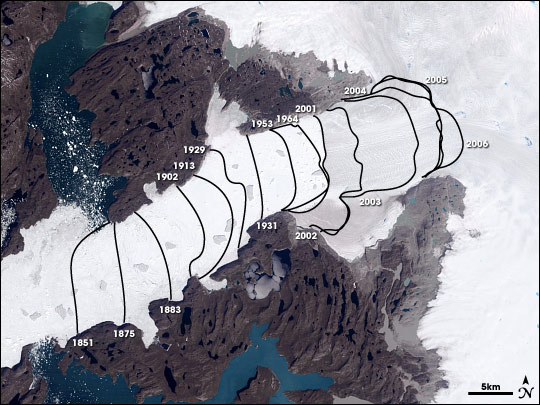
Glacier in Greenland
| Field | Value | |
|---|---|---|
| name | Jakobshavn Glacier | |
| other_name | da | |
| kl | ||
| photo | Jakobshavn Calving Front (7166014512).jpg | |
| photo_caption | The calving front of the glacier | |
| type | Ice stream | |
| location | Near Ilulissat, Greenland | |
| map | Greenland | |
| map_caption | Location within Greenland | |
| mark | Blue_pog.svg | |
| coords | ||
| area | 110 000 km2 (whole catchment) | |
| length | greater than 65 km | |
| thickness | around 2000 m | |
| terminus | Ocean (was floating now grounded) | |
| status | Advancing | |
| {{designation list | embed | yes |
| designation1 | WHS | |
| designation1_offname | Ilulissat Icefjord | |
| designation1_date | 2004 | |
| designation1_type | Natural | |
| designation1_criteria | vii, viii | |
| designation1_number | 1149 | |
| designation1_free1name | Region |
kl
Jakobshavn Glacier (), also known as Ilulissat Glacier (), is a large outlet glacier in West Greenland. It is located near the Greenlandic town of Ilulissat (colonial name in ) and ends at the sea in the Ilulissat Icefjord.
Jakobshavn Glacier drains 6.5% of the Greenland ice sheet and produces around 10% of all Greenland icebergs. Some 35 billion tonnes of icebergs calve off and pass out of the fjord every year. Icebergs breaking from the glacier are often so large (up to 1 km in height) that they are too tall to float down the fjord and lie stuck on the bottom of its shallower areas, sometimes for years, until they are broken up by the force of the glacier and icebergs further up the fjord.
Studied for over 250 years, the Jakobshavn Glacier has helped develop modern understanding of climate change and icecap glaciology. Jakobshavn is one of the fastest-declining glaciers in the world, and icebergs calving from Jakobshavn were responsible for 4 percent of the increase in global sea level in the 20th century. Ilulissat Icefjord () was declared a UNESCO World Heritage Site in 2004, in part because of the importance of the Jakobshavn Glacier in contributing to the current scientific understanding of climate change.
Name
Jakobshavn has been a name used for this glacier in scientific literature since 1853 when Danish geologist Hinrich Johannes Rink referred to it as Jakobshavn Isstrøm (Danish for Jakobshavn Ice Stream). It is sometimes referred to in the international scientific literature (by glaciologists) as Jakobshavn Isbræ glacier. Isbræ is Danish for glacier. It is also commonly known by the anglicised version, Jakobshavn Glacier.
The local name for this glacier is Sermeq Kujalleq, where "sermeq" is Greenlandic for 'glacier' and "kujalleq" means 'southern'. It lies south of the town Ilulissat (colonial name Jakobshavn). UNESCO's World Heritage Site website uses this name, in connection with mention of the Ilulissat Icefjord world heritage site, which includes the downstream end of the glacier.
There is evidence that people have inhabited the area around the glacier for up to 4000 years. The recently abandoned settlement of Sermermiut (which means 'place of the glacier people') lies just to the north of the glacier, much nearer than Ilulissat.
The glacier is sometimes referred to as Ilulissat Glacier. This form simply replaces Jakobshavn with Ilulissat because of the change in the name of the town.
Acceleration and retreat
_Photo_by_Giles_Laurent.jpg)
Jakobshavn is one of the fastest moving glaciers, flowing at its terminus at speeds that used to be around 20 m per day{{cite conference |book-title = IAPRS Volume XXXVI, Part 5 |archive-url = https://web.archive.org/web/20070605174023/http://rcswww.urz.tu-dresden.de/~isprs/proceedings/paper/MAAS_606.pdf |url-status = dead |archive-date = 5 June 2007 |access-date = 17 February 2009
_Photo_by_Giles_Laurent.jpg)
Large calving events where the glacier produces icebergs have also been found to trigger earthquakes due to ice-ice and ice-bottom of the fjord interactions. and from the longer-duration forces exerted on the solid Earth during the capsize of very large (e.g., 1 km3) calved ice volumes. Especially large calving events at Jakobshavn have produced glacial earthquakes that are detectable on seismographs worldwide with moment magnitudes in excess of 5.0. A large calving of approximately 7 km2 took place on 15 February 2015. On 16 August 2015 a calving was identified via satellite images as the largest ever recorded at Jakobshavn, with an area of 12.5 km2.
Mechanisms
The first mechanism for explaining the change in velocity is the "Zwally effect" and is not the main mechanism, this relies on meltwater reaching the glacier base and reducing the friction through a higher basal water pressure. A moulin is the conduit for the additional meltwater to reach the glacier base. This idea, proposed by Jay Zwally, was observed to be the cause of a brief seasonal acceleration of up to 20% on the Jakobshavns Glacier in 1998 and 1999 at Swiss Camp. The acceleration lasted 2–3 months and was less than 10% in 1996 and 1997 for example. They offered a conclusion that the "coupling between surface melting and ice-sheet flow provides a mechanism for rapid, large-scale, dynamic responses of ice sheets to climate warming". The acceleration of the three glaciers had not occurred at the time of this study and they were not concluding or implying that the meltwater increase was the cause of the aforementioned acceleration. Examination of rapid supra-glacial lake drainage documented short term velocity changes due to such events, but they had little significance to the annual flow of the large outlet glaciers.
The second mechanism is a "Jakobshavn effect", coined by Terry Hughes, where a small imbalance of forces caused by some perturbation can cause a substantial non-linear response. In this case an imbalance of forces at the calving front propagates up-glacier. Thinning causes the glacier to be more buoyant, even becoming afloat at the calving front, and is responsive to tidal changes. The reduced friction due to greater buoyancy allows for an increase in velocity. The reduced resistive force at the calving front is then propagated up glacier via longitudinal extension in what R. Thomas calls a backforce reduction.
This mechanism is supported by the data indicating no significant seasonal velocity changes at the calving front and the acceleration propagating upglacier from the calving front. The cause of the thinning could be a combination of increased surface ablation and basal ablation as one report presents data that show a sudden increase in subsurface ocean temperature in 1997 along the entire west coast of Greenland, and suggests that the changes in Jakobshavn Glacier are due to the arrival of relatively warm water originating from the Irminger Sea near Iceland.
Evidence also exists for a deep subglacial trench beneath the glacial outlet, identified through seismic reflection methods. There are theories that Greenland consists of three large islands under the ice sheet, separated at the coast by three narrow straits, one of them Jakobshavn Glacier.
''Chasing Ice''
In the 2012 documentary entitled Chasing Ice by cinematographer Jeff Orlowski, nature photographer James Balog and his Extreme Ice Survey (EIS) team, there is a 75-minute segment showing the Jakobshavn Glacier calving. Two EIS videographers waited several weeks in a small tent overlooking the glacier, and were finally able to witness 7.4 km3 of ice crashing off the glacier. It was the longest calving ever captured on film.
References
References
- (2004). "Large fluctuations in speed on Greenland's Jakobshavn Isbrae glacier". [[Nature (journal).
- "Plummer Jakobshavn". University of Kansas.
- Amundsen, J.M., Truffer M., Luthi M.P., Fahnestock M., West M., Motyka R.J.. (2008). "Glacier, fjord, and seismic response to recent large calving events, Jakobshavn Isbrae, Greenland". [[Geophys. Res. Lett.]].
- "Why a Growing Greenland Glacier Doesn’t Mean Good News for Global Warming".
- Bennike, Ole. (2004). "Ilulissat Icefjord". [[Geological Survey of Denmark and Greenland]].
- Weidick, Anker. (2003). "Jakobshavn Isbræ,West Greenland: the 2002-2003 collapse and nomination for the UNESCO World Heritage List. In: Review of Survey activities 2003". Geological Survey of Denmark and Greenland.
- (January 6, 2024). "Can $500 Million Save This Glacier?".
- "Ilulissat Icefjord". United Nations Educational, Scientific, and Cultural Organization.
- Rink H.. (1853). "Om den geographiske Beskaffenhed af de danske Handelsdistrikter i Nordgrønland, tilligemed en Udsigt over Nordgrønlands Geognosi". Det Kongelige Danske Videnskabernes Selskabs Skrifter, 5. Række, Naturvidenskabelige og Mathematiske Afdeling.
- (2004). "Force-perturbation analysis of recent thinning and acceleration of Jakobshavn Isbrae, Greenland". [[International Glaciological Society.
- "Explore Ilulissat Icefjord". Geological Survey of Denmark.
- "Sermermiut". Ilulissat Museum.
- "Greenland's fastest glacier sets new speed record {{!}} UW Today".
- (1998). "Jakobshavn Glacier, West Greenland: 30 years of spaceborne observations". [[Geophys. Res. Lett.]].
- (2008). "Seasonal speedup along the western flank of the Greenland Ice Sheet". [[Science (journal).
- "Cold Water Currently Slowing Fastest Greenland Glacier".
- (2019). "Interruption of two decades of Jakobshavn Isbrae acceleration and thinning as regional ocean cools". Nature Geoscience.
- (25 March 2019). "Key Greenland glacier growing again after shrinking for years, NASA study shows "That was kind of a surprise."". NBC.
- (2012). "Analysis of low-frequency seismic signals generated during a multiple-iceberg calving event at Jakobshavn Isbræ, Greenland". Journal of Geophysical Research: Earth Surface.
- (17 July 2015). "Reverse glacier motion during iceberg calving and the cause of glacial earthquakes". Science.
- (20 February 2015). "Shock News – Massive Calving of Jakobshavn Isbræ". Great White Con.
- "One of the world's fastest melting glaciers may have just lost its biggest chunk of ice on record". Washington Post.
- Zwally, J., Abdalati W., Herring,T.,Larson, K.,Saba,J., Steffen, K.. (2002). "Surface Melt-Induced Acceleration of Greenland Ice-Sheet Flow". [[Science (journal).
- Hughes, T.. (1986). "The Jakobshavn Effect". [[Geophys. Res. Lett.]].
- Pelto, M.. (2008). "Moulins, Calving Fronts and Greenland Outlet Glacier Acceleration". [[RealClimate]].
- Holland D M., Thomas R.H., Younn B .d, Ribergaard M. H., Lyberth, B.. (2008). "Acceleration of Jakobshavn Isbrae triggered by warm ocean waters". [[Nature Geoscience]].
- Clarke, Ted S.. (1996). ["Seismic-reflection evidence for a deep subglacial trough beneath Jakobshavns Isbræ, West Greenland"](https://www.cambridge.org/core/journals/journal-of-glaciology/article/seismicreflection-evidence-for-a-deep-subglacial-trough-beneath-jakobshavns-isbrae-west-greenland/BE6B0880824E72B6055607B52A737A38 ). .
- (21 June 2007). "Subglacial topography and geothermal heat flux: Potential interactions with drainage of the Greenland ice sheet". [[Geophysical Research Letters]].
- (2012). "Media reviews". Chasing Ice.
- Carrington, Damian. (12 December 2012). "Chasing Ice movie reveals largest iceberg break-up ever filmed". The Guardian.
This article was imported from Wikipedia and is available under the Creative Commons Attribution-ShareAlike 4.0 License. Content has been adapted to SurfDoc format. Original contributors can be found on the article history page.
Ask Mako anything about Jakobshavn Glacier — get instant answers, deeper analysis, and related topics.
Research with MakoFree with your Surf account
Create a free account to save articles, ask Mako questions, and organize your research.
Sign up freeThis content may have been generated or modified by AI. CloudSurf Software LLC is not responsible for the accuracy, completeness, or reliability of AI-generated content. Always verify important information from primary sources.
Report