From Surf Wiki (app.surf) — the open knowledge base
Jai Shri Ram
Indic phrase meaning "Hail Lord Rama"
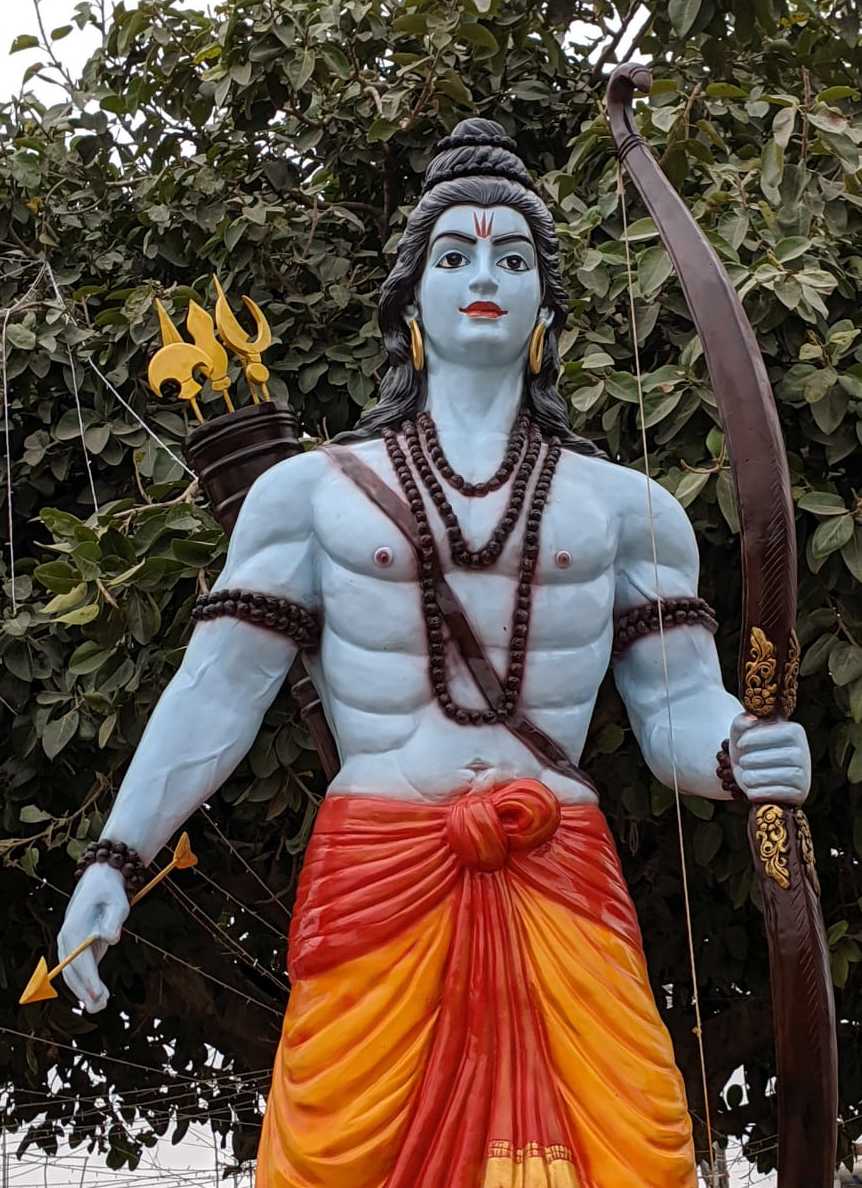
Indic phrase meaning "Hail Lord Rama"
Jai Shri Ram (IAST: ) is an expression in Indic languages, translating to "Glory to Lord Rama" or "Victory to Lord Rama". The proclamation has been used by Hindus as a symbol of adhering to the Hindu faith, or for projection of varied faith-centered emotions.
The expression has been increasingly used by Indian organisations aligning with Hindutva, a Hindu nationalist ideology, such as the Vishva Hindu Parishad (VHP), Bharatiya Janata Party (BJP) and their allies, which adopted the slogan in the late 20th century as a tool for increasing the visibility of Hinduism in public spaces, before going on to use it as a battle cry. The slogan has since been employed in connection with the perpetration of communal violence against Muslims.
Meaning
"Jai Shri Ram" means "Hail Lord Ram" or "Victory to Lord Ram". Ram (or Rama) is a major deity in Hinduism.
Antecedents
Religious and social
"Jaya Sri Ram", along with "Jaya Sita Ram", "Jaya Ram" and "Sita Ram", were used as mutual salutations by Ramanandi ascetics (called Bairagis). "Ram Ram", "Jai Ram ji ki" and "Jai Siya Ram" have been noted as common salutations in the Hindi heartland (Sita or Siya is the name of Rama's consort). The Ahmadnagar Kaikadis used to tattoo "Sri Ram", "Jai-Ram", and "Jai-Jai-Ram", on their hands and feet.
Photojournalist Prashant Panjiar wrote about how in the city Ayodhya female pilgrims always chant "Sita-Ram-Sita-Ram", while the older male pilgrims prefer not to use Rama's name at all. As per Panjiar, the traditional usage of "Jai" in a slogan was with "Siyavar Ramchandraji ki jai" ("Victory to Sita's husband Rama").
Sukhdevlal's 1884 commentary of Tulsikrit Ramayana does, however, mention the slogan "Jai Ram Jai Shri Ram" being used. Also, the phrase "Sri Ram Jai Ram Jai Jai Ram" was chanted in mantras and used in kirtan (religious stories), while "Jai Shri Ram" has been used in the bhajan (devotional song) "Jai Shri Ram nabh Ghansham".
Rama symbolism
The worship of Rama increased significantly in the 12th century, following the invasions of Muslim Turks. The Ramayana became widely popular in the 16th century. It is argued that the story of Rama offers a "very powerful imaginative formulation of the divine king as the only being capable of combating evil". The concept of Ramrajya, "the rule of Ram", was used by Gandhi to describe the ideal country free from the British.
The most widely known political use of Ram began with Baba Ram Chandra's peasant movement in Awadh in the 1920s. He encouraged the use of "Sita-Ram" as opposed to the then widely used "Salaam" as a greeting, since the latter implied social inferiority. "Sita-Ram" soon became a rallying cry.
Journalist Mrinal Pande states that slogans were often chanted for the duo of Sita and Rama, such as Bol Siyavar or Siyapat Ramchandra ki jai [victory to Ram, Sita's husband], although growing up she never heard any about Ram as an individual, let alone a warrior. But in Methodist Quarterly Review, Volume LXII.–1880., Rev. B. H. Badley has mentioned Indian soldiers cheering "Ram Rajah Ki Jai !" and "Ram Chandra Ki Jai !" ("Hurrah for King Ram Chandra— Victory to Ram !") while leaving the Bombay harbor for Malta. And J. F. Fanthome, in his book Mariam: A Story of the Indian Mutiny of 1857 (1896), mentions Hindus using the war cry of "Jai Sri Ram Lachmanji ki" ("Victory to Lord Rama and Lakshmana") against the British during the Indian Rebellion of 1857, while Muhammadans yelled "Ek nara Haidari, ya Husein".
1980s and forward
In the late 1980s, the slogan "Jai Shri Ram" was popularised by Ramanand Sagar's television series Ramayan, where it was used by Hanuman and the Vanara Sena (monkey army) as a war cry when they fought the demon army of Ravana in order to free Sita. Sagar himself acknowledged his contribution, claiming, "College boys don't say 'Hi' any more, they say 'Jai Shri Ram ki' 'Long live Shri Ram'."
The Hindu nationalist organisation Vishva Hindu Parishad (VHP) and its militant wing Bajrang Dal, carried out a campaign saying "Ram-Ram Chhodo, Jai Shri Ram Bolo" ("Stop saying Ram-Ram, Say Jai Shri Ram"). Prashant Panjiar, From Jai Siya Ram to Jai Shri Ram: How Ayodhya erased Sita, ThePrint, 19 October 2019. During L. K. Advani's ratha yatra to Ayodhya in 1989, the customary slogan Jai Siya Ram was replaced by "Jai Shri Ram". The VHP, Bharatiya Janata Party and their Sangh Parivar allies used it extensively in their Ayodhya Ram Janmabhoomi movement. Volunteers at Ayodhya at the time would write the slogan on their skin, using their own blood as ink to signify their devotion. The organizations also distributed a cassette named as Jai Shri Ram, containing songs like "Ram ji ki sena chali" () and "Aya samay jawano jago" (). All the songs in the cassette were set to the tunes of popular Bollywood songs. Kar sevaks, led by the Sangh Parivar allies, chanted the slogan of "Jai Shri Ram" when laying a foundation east of the Babri Masjid in August 1992.
Simultaneously the Rama pictography was changed to projecting a heroic, muscular, and angry Rama. A muscular Rama, clad in saffron, was shown towering over an imaginary Ram temple in Ayodhya. These images were labelled with the "Jai Shri Ram" slogan (written in the Devanagari script of Hindi).
A 1995 essay published in Manushi, a journal edited by academic Madhu Kishwar, described how the Sangh Parivar's usage of "Jai Shri Ram", as opposed to "Sita-Ram", lies in the fact that their violent ideas had "no use for a non-macho Ram." This also mobilised more people politically, since it was patriarchal. Further, the movement was exclusively associated with Ram's birth, which had occurred many years before his marriage to Sita.
Sociologist Jan Breman writes:
An Indian political analyst decried the political use of the slogan in 2019, and said that "it now seems to have official sanction." In December 2022, Congress leader Rahul Gandhi while giving a speech in Madhya Pradesh attacked BJP and RSS by raising the question "Why they always chants "Jai Shri Ram" and not "Jai Siya Ram". Reacting to his question, a minister in Madhya Pradesh and a senior BJP leader Narottam Mishra replied "I think Rahul Gandhi's knowledge is only limited to children's rhyme 'Baa Baa Black Sheep', the name of Ram is prefixed with 'Shri' which is also used for Lord Vishnu's wife Lakshmi and Sita Ji". The BJP's Amit Malviya also reacted to Rahul Gandhi's attack by posting a video in which Prime Minister Narendra Modi started his Ram Mandir ceremony speech with "Jai Siya Ram".
The Wire said in 2023 that "We are yet to see any condemnation of the 'misuse' of the sacred name Ram by any religious leader or body."
Usage
The BJP advocates using Jai Shri Ram and Jai Siya Ram as a greeting.
Numismatics
Gharib Niwaz, ruler of the Manipur Kingdom, issued bell metal coins with the phrase "Jai Shri Ram", "Shri Ram" and "Jai Shri" in 18th century.
Violent incidents
- In 1992, during riots and the demolition of the Babri Masjid, the same slogan was raised. Former BBC Bureau Chief Mark Tully, who was present at the site of the Masjid on 6 December, recalls the usage of the slogan "Jai Shri Rama!" by the Hindu crowds rushing towards the mosque.
- In January 1999, the slogan was heard again when Australian missionary doctor Graham Staines was burned alive with his two children in Manoharpur, Orissa.
- In the events leading up to the Godhra train burning of February 2002, supporters of the Gujarat VHP and its affiliated organisations like the Bajrang Dal forced Muslims to chant "Jai Shri Ram" on their journey to Ayodhya, and on their return journey, they did the same at "every other station", including at Godhra. Both journeys were taken in the Sabarmati Express for the ceremony at the Ram Janmabhoomi. During the 2002 Gujarat riots that followed, the slogan was used in a leaflet distributed by the VHP to encourage Hindus to boycott Muslim businesses.
- "Jai Shri Ram" was also chanted by the mob responsible for the Gulbarg Society Massacre. Ehsan Jafri, a former Member of Parliament from Ahmedabad, was forced to chant the slogan before he was brutally murdered during said massacre.
- The slogan was also heard from the mob during the Naroda Patiya massacre. People living in mixed-religion neighborhoods were forced to put up Jai Shri Ram posters and wear armbands to ward off the rioters.
- Tabrez Ansari was forced by a mob to chant "Jai Shree Ram" and "Jai Hanuman" during his lynching.
- All India Democratic Women's Association, the women's wing of CPI(M), alleged that the perpetrators of the 2020 Gargi College molestations were chanting the slogan.
- During the 2020 Delhi riots, rioters were reported to have kept chanting "Jai Shri Ram" while beating their victims and whenever a building went up in flames. The police were also found to join in the chant while siding with the Hindu mobs. The Muslims were told Hindustan me rehna hoga, Jai Shri Ram kehna hoga (). Indian journalist Rana Ayyub, writing in Time, commented that the slogan had become a "racist dog whistle" against Muslims during the riots.
- After the BJP's victory in the 2022 Uttar Pradesh Legislative Assembly election, a 25 year old Muslim man, Babar Ali from UP's Kushinagar district was lynched and killed by the members of his own community for supporting BJP. His family members said that Babar was returning from his shop when he chanted 'Jai Shri Ram' and was attacked by some local Muslims.
- On 15 April 2023, while Atiq Ahmed was being escorted for a court-mandated medical checkup in Prayagraj, a pistol was fired at Ahmed and his brother's head. Both Atiq and his brother Ashraf Ahmed were killed in the shootout, which was filmed and broadcast live. After shooting attackers started chanting 'Jai Shri Ram' as they were being apprehended.
- On June 24, 2023, in Pulwama, South Kashmir, Indian Army personnel stormed a mosque and allegedly forced worshippers to chant Jai Shri Ram and bharat mata ke jai. Similarly, on November 24, 2024, Kashmiri shawl sellers in Himachal Pradesh reported being harassed and forced to chant Hindutva slogans, including Jai Shri Ram.
- In October 2024, a 16-year-old Dalit boy in Uttar Pradesh was assaulted and forced to chant Jai Shri Ram by a group of students. Similarly, on December 2024, In Ratlam, Madhya Pradesh, three Muslim minors were allegedly beaten and forced to chant “Jai Shri Ram” by two men near Amrit Sagar Lake.
- On January 16, 2026, a Christian pastor in Odisha was attacked by a mob, including local villagers and members of the Hindutva militant group Bajrang Dal, who tried to force him to chant Jai Shri Ram.
Several other reports of alleged violent incidents associated with the slogan were later found to be false. In June 2019, a group of 49 artists, academics and intellectuals wrote a letter to Prime Minister Narendra Modi, requesting him to put a stop "to the name of Ram being defiled" as a war cry. They demanded that strict action be taken against using the slogan for violent purposes.
Politics
In June 2019, the slogan was used to heckle Muslim MPs as they proceeded to take their oath in the 17th Lok Sabha. In July that year, Nobel laureate Amartya Sen stated in a speech that the slogan was "not associated with the Bengali culture", leading to some unknown groups publishing his statement on billboards in Kolkata. The slogan has also been used to heckle West Bengal Chief Minister Mamata Banerjee on multiple occasions, triggering angry reactions from her.
The slogan was used by lawyers to celebrate the 2019 Supreme Court decision to allow a Ram temple to be built on the disputed Ayodhya site where a mob had demolished the Babri Masjid mosque in 1992. In August 2020, following the ground-breaking ceremony of the Ram Temple, Ayodhya, the slogan was used as a chant in celebrations in New York.
Popular culture
The slogan is painted on the walls of a mandir in a house in the 1994 film Hum Aapke Hain Koun..!.
It is used as a salutation in the 2015 film Bajrangi Bhaijaan. The director states that he grew up hearing "Jai Shri Ram" as a benevolent expression, "rooted in our culture", but that the words have become aggressive. A 2017 Bhojpuri film, Pakistan Me Jai Shri Ram depicts the hero as a devotee of Ram who enters Pakistan and kills terrorists while chanting the slogan. Stickers stating Hello nahīṃ, bolo Jaya Śrī Rāma () became popular on the vehicles and telephones of people running small businesses. A 2018 song, "Hindu Blood Hit", features psychedelic repetitions of the slogan and goes on to warn Indian Muslims that their time is up. Another song from 2017, "Jai Shree Ram DJ Vicky Mix", hopes for a time in the future in which "there will continue to be a Kashmir but no Pakistan". The song "Jai Shree Ram" is part of the film music in the 2022 action-adventure Ram Setu. The 2023 film Adipurush had a song with the same name.
In 2022, Jujaru Nagaraju, a handloom weaver in Andhra Pradesh weaved a 60 metre long silk sari with "Jai Sri Ram" written over 30 000 times in 13 Indian languages.
Notes
References
Bibliography
References
- (10 July 2019). "The Hindu chant that became a murder cry". [[BBC News]].
- Poonam, Snigdha. (13 February 2020). "The 3 Most Polarizing Words in India". Foreign Policy.
- Ramachandran, Tanisha. (1 March 2014). "A call to multiple arms! protesting the commoditization of hindu imagery in western society". Material Religion.
- (20 August 2019). "Modi's party will grow stronger in West Bengal". Emerald Expert Briefings.
- Dasgupta, Amlan. (2006). "Rhythm and Rivalry". Economic and Political Weekly.
- (22 April 2022). "In India, hate-filled songs are a weapon to target Muslims". AP News.
- Engineer, Asghar Ali. (14 November 1992). "Sitamarhi on Fire". [[Economic and Political Weekly]].
- Nussbaum, Martha C.. (18 August 2008). "The Clash Within: Democracy and the Hindu Right". [[Routledge]].
- Staples, James. (7 November 2019). "Blurring Bovine Boundaries: Cow Politics and the Everyday in South India". [[Routledge]].
- Jaffrelot, Christophe. (4 January 2003). "Communal Riots in Gujarat: The State at Risk?". [[Heidelberg University]].
- Breman, Jan. (17 April 1993). "Anti-Muslim Pogrom in Surat". [[Economic and Political Weekly]].
- Menon, Nivedita. (6–12 July 2002). "Surviving Gujarat 2002". [[Economic and Political Weekly]].
- Sarkar, Sumit. (30 January 1993). "The Fascism of the Sangh Parivar". [[Economic and Political Weekly]].
- (April 1996). "Contesting the Nation: Religion, Community, and the Politics of Democracy in India". [[University of Pennsylvania Press]].
- Rambachan, Anantanand. (20 April 2017). "The Coexistence of Violence and Nonviolence in Hinduism". [[University of Pennsylvania Press]].
- Gudipaty, Nagamallika. (2017). "Citizenship, Democracies, and Media Engagement among Emerging Economies and Marginalized Communities". [[Springer International]].
- Ghassem-Fachandi, Parvis. (1 August 2009). "Violence: Ethnographic Encounters". [[Berg Publishers.
- Salam, Ziya Us. (16 August 2019). ""Jai Shri Ram": The new battle cry". [[Frontline (magazine).
- (2 October 2022). "Tensions That Roiled English City Have Roots in India".
- (1999). "Sri Ramacaritamanasa". Motilal Banarsidass.
- Wilson, H. H.. (1958). "Religious sects of the Hindus". Susil Gupta (India) Private Ltd..
- MOLESWORTH, James T.. (1857). "A Dictionary English and Maráthí ... commenced by J. T. Molesworth ... completed by T. Candy".
- Onial, Devyani. (2020-08-06). "From assertive 'Jai Shri Ram', a reason to move to gentler 'Jai Siya Ram'". The Indian Express.
- Campbell, J. M.. (1897). "Indian Antiquary". Popular Prakashan.
- Panjiar, Prashant. (19 October 2019). "From Jai Siya Ram to Jai Shri Ram: How Ayodhya erased Sita". ThePrint.
- Tulasīdāsa. (1884). "Tulasīkrta Rāmāyaṇa saṭīkā". [[Nawal Kishore Press]].
- Carnac, Rivett. (October 1886). "Copper Chambu or Sacrificial Vase from Benares". Journal of Indian Art and Industry.
- (1900). "A Descriptive Catalogue of Sanskrit Manuscripts in the Library of the Calcutta Sanskrit College". J.N. Banerjee & son, Banerjee Press.
- Gross, Robert Lewis. (1992). "The Sādhus of India: A Study of Hindu Asceticism". Rawat Publications.
- (22 March 1937). "THE INDIAN LISTENER: Vol. II. No. 7. (22nd MARCH 1937)". All India Radio, Bombay.
- Daniyal, Shoaib. (28 June 2019). "'Jai Shri Ram' might be a new slogan – but the use of Ram as a political symbol is 800 years old". Scroll.in.
- Pollock, Sheldon. (1993). "Ramayana and Political Imagination in India". The Journal of Asian Studies.
- Menon, Dilip M.. (16 January 2018). "Not just indentured labourers: Why India needs to revisit its pre-1947 history of migration". Scroll.in.
- Lutgendorf, Philip. (1991). "The Life of a Text: Performing the Rāmcaritmānas of Tulsidas". University of California Press.
- Badley, B. H.. (January 1880). "Methodist Magazine and Quarterly Review". G. Lane & P. B. Sandford.
- Fanthome, J. F.. (1896). "Mariam: A Story of the Indian Mutiny of 1857". Chandraprabha Press, Company LD..
- Dutta, Prabash K.. (13 July 2019). "Jai Shri Ram: A slogan that changed political contours of India". India Today.
- Naqvi, Saba. (30 June 2019). "From Siya Ram to Jai Shri Ram". The Tribune.
- Mazumdar, Sucheta. (1995). "Women on the March: Right-Wing Mobilization in Contemporary India". Feminist Review.
- (15 August 1992). "Ayodhya controversy {{sic". India Today.
- Menon, Aditya. (28 June 2019). "Jai Shri Ram: How a Chant Became A War Cry for Attacking Muslims". TheQuint.
- Breman, Jan. (1999). "Institutions and Inequalities: Essays in Honour of Andre Beteille". Oxford University Press.
- (2019). "Misusing Hindu gods to lynch and spook Indian Muslims". [[TRT World]].
- (2022-12-05). "Rahul Gandhi attacks BJP over 'Jai Shri Ram', party takes dig at his 'limited knowledge'". The Times of India.
- (2022-12-03). "Rahul Gandhi says BJP's slogan is 'Jai Shri Ram' and not 'Jai Siya Ram' because...".
- (2020-08-05). "'Jai Siyaram' call resonating throughout the world: PM Narendra Modi". The Times of India.
- (22 April 2023). "Why Aren't Hindutva Leaders Irked by the Use of 'Jai Shri Ram' by Atiq's Killers?". [[The Wire (India).
- (1 January 2024). "No hello for greetings, BJP adopts New Year resolution to say Jai Shri Ram in Bihar". [[The Telegraph (India)]].
- Singh, Alok. (2021-08-12). "Purvottar Bharat : Lok Aur Samaj". Sarv Bhasha Trust.
- Dutta, Debajit. (2015). "Koch coinage: a study in historical perspective". University of North Bengal.
- (31 December 1992). "Babri Masjid demolition: When men in saffron bandanas struck screaming the name of Ram". India Today.
- (2017). "Matter of Geography". [[Mosaic Press]].
- Tully, Mark. (2017-11-22). "India In Slow Motion". Penguin Random House India Private Limited.
- Sarkar, Sumit. (26 June – 2 July 1999). "Conversions and Politics of Hindu Right". [[Economic and Political Weekly]].
- "Crime Against Humanity". Concerned Citizens Tribunal - Gujarat 2002.
- Bose, Raja. (6 March 2002). "Lord Ram has given me new lease of life". The Times of India.
- Punwani, Jyoti. (2002). "Gujarat: The Making of a Tragedy". Penguin (India).
- (2002-06-17). "The Hindu call to arms". The Telegraph.
- Bunsha, Dionne. (2006). "Scarred: Experiments with Violence in Gujarat". Penguin Books India.
- (1 March 2002). "Mob burns to death 65 at Naroda-Patia". The Times of India.
- Mukherjee, Amit. (17 March 2002). "Shops in Gujarat wear religion on their sleeve". The Times of India.
- (10 July 2019). "The Hindu chant that became a murder cry". BBC News.
- (10 February 2020). "'They shouted Jai Shri Slogans': CPI's women's association on thugs involved in Gargi College 'mass molestation' case". Free Press Journal.
- (3 March 2020). "What's Next for India's Muslims After Delhi Riots?".
- (26 February 2020). "Communal Violence Over India's Citizenship Law Leaves 20 Dead Amid Trump's Visit".
- (25 February 2020). "Death Toll Rises to 24 From Delhi Riots During Trump Trip". The New York Times.
- Shroff, Kaushal. (25 February 2020). "Delhi violence: Cops shouted "Jai Shri Ram" with armed Hindu mob, charged at Muslims".
- Ayyub, Rana. (28 February 2020). "Narendra Modi Looks the Other Way as New Delhi Burns". Time.
- Time, Pratidin. (28 March 2022). "UP: Muslim Man Killed For Chanting 'Jai Shree Ram', Celebrating BJP's Victory".
- (2022-03-28). "Muslim Man Lynched In Uttar Pradesh For Celebrating BJP's Victory, Chanting 'Jai Shri Ram'".
- (2023-04-15). "Atiq Ahmad, his brother Ashraf shot dead in Prayagraj, 3 attackers arrested".
- (2023-04-15). "'Main baat Guddu Muslim...': Atiq Ahmad, brother shot dead as they were speaking".
- (2023-06-26). "Officer Removed After Row Over Slogans In Kashmir's Pulwama Mosque".
- (2023-06-25). "Army forced Muslims at Pulwama mosque to chant 'Jai Shri Ram', claims Mehbooba Mufti".
- (2024-11-25). "'Go back': Kashmiri shawl sellers harassed, forced to raise Hindutva slogans in Himachal".
- "Dalit Teen Assaulted By Students, Forced To Say 'Jai Shri Ram' in UP: Cops".
- (2024-12-06). "3 children thrashed in MP's Ratlam, forced to chant Jai Shri Ram: Police". Hindustan Times.
- (17 January 2026). "Odisha pastor forcefully made to eat cow dung and chant 'Jai Shri Ram' by Hindutva group".
- (17 January 2026). "Hindutva group assaults Odisha Pastor, forces him to Eat cow dung and chant 'Jai Sree Ram'".
- (29 Jul 2019). "FAKE ALERT: News of Muslim boy set ablaze for not chanting 'Jai Shri Ram' is fake - Times of India". The Times of India.
- "Was a Nepali man humiliated and forced to chant Jai Shri Ram? Here's the story". Free Press Journal.
- (4 July 2019). "Was An Ice Cream Seller In UP Thrashed For Not Chanting 'Jai Shri Ram'?". www.boomlive.in.
- (28 May 2019). "Was Mamata Banerjee Greeted With Jai Shri Ram Chants Outside the West Bengal Assembly?". BOOM.
- (18 July 2019). "Aligarh, Unnao, Kanpur violence was not communal, UP DGP busts lies about Jai Shri Ram attacks". India Today.
- Joy, Shemin. (2019-07-24). "'Jai Shri Ram' has become a war-cry: Celebs write to PM". Deccan Herald.
- (18 June 2019). "'Jai Shri Ram' to 'Allahu Akbar': Frenzied slogans in LS as MPs take oath". The Week.
- Kundu, Indrajit. (6 July 2019). "Jai Shri Ram is not associated with Bengali culture: Nobel laureate Amartya Sen". India Today.
- (12 July 2019). "Posters With Amartya Sen's Remarks On "Jai Shri Ram" Slogan In Kolkata". NDTV.com.
- (30 May 2019). "People chant 'Jai Shri Ram', Mamata calls them criminals". Deccan Chronicle.
- (9 November 2019). "Watch: Supreme Court lawyers chant 'Jai Shri Ram' after Ayodhya verdict". Scroll.in.
- (2020-08-06). "Bhajans, Jai Shri Ram chants at Times Square to celebrate 'bhoomi poojan' at Ayodhya". Hindustan Times.
- Ghosh, Shohini. (2000). "Hum Aapke Hain Koun...!: Pluralizing Pleasures of Viewership". Social Scientist.
- Poonam, Snigdha. (2020-02-13). "The 3 Most Polarizing Words in India".
- (22 October 2022). "Akshay Kumar on 'Ram Setu' anthem: 'Jai Shree Ram' is our Diwali gift to the audience". [[The Hindu]].
- (22 October 2022). "Akshay Kumar releases Jai Shree Ram anthem's lyrical video. Says 'mera chhota sa Diwali gift'". [[India Today]].
- (20 May 2023). "Adipurush song 'Jai Shri Ram' shows Prabhas leading vaanar sena to Raavan's Lanka, reveals unseen footage from film". [[The Indian Express]].
- (17 April 2022). "Andhra loomsman weaves 60-metre silk sari with Jai Shri Ram written in 13 dialects".
This article was imported from Wikipedia and is available under the Creative Commons Attribution-ShareAlike 4.0 License. Content has been adapted to SurfDoc format. Original contributors can be found on the article history page.
Ask Mako anything about Jai Shri Ram — get instant answers, deeper analysis, and related topics.
Research with MakoFree with your Surf account
Create a free account to save articles, ask Mako questions, and organize your research.
Sign up freeThis content may have been generated or modified by AI. CloudSurf Software LLC is not responsible for the accuracy, completeness, or reliability of AI-generated content. Always verify important information from primary sources.
Report