From Surf Wiki (app.surf) — the open knowledge base
Jackson County, Oregon
County in Oregon, United States
County in Oregon, United States
| Field | Value |
|---|---|
| county | Jackson County |
| state | Oregon |
| seal | Jackson County (Oregon) Seal.png |
| founded date | January 12 |
| founded year | 1852 |
| seat wl | Medford |
| largest city wl | Medford |
| area_total_sq_mi | 2802 |
| area_land_sq_mi | 2784 |
| area_water_sq_mi | 18 |
| area percentage | 1% |
| population_as_of | 2020 |
| population_total | 223259 |
| pop_est_as_of | 2024 |
| population_est | 221331 |
| density_sq_mi | auto |
| district | 2nd |
| web | jacksoncountyor.gov |
| time zone | Pacific |
| ex image | {{Photomontage |
| photo1a | Jackson County Courthouse (Jackson County, Oregon scenic images) (jacDA0008).jpg |
| photo2a | Jacksonville, Oregon City Hall (former Jackson County Courthouse).jpg |
| photo2b | Templo_de_Medford_Oregon.jpg |
| photo3a | Views_from_Cascade-Siskiyou_National_Monument_(18362936785).jpg |
| photo3b | Hannon_library_sou.jpg |
| photo4a | Alexlockhart Mt Ashland 06-01-21.jpg |
| spacing | 2 |
| position | center |
| color_border | white |
| color | white |
| size | 310 |
| foot_montage | From top clockwise: Jackson County Courthouse and Office Building, Medford Mormon Temple, Southern Oregon University's Hannon Library, Cascade–Siskiyou National Monument, Mount Ashland, Old Jackson County Courthouse |
| named for | Andrew Jackson |
Jackson County is one of the 36 counties in the U.S. state of Oregon. As of the 2020 census, the population was 223,259. The county seat is Medford. The county is named for Andrew Jackson, the seventh president of the United States. Jackson County comprises the Medford, OR Metropolitan Statistical Area. There are 11 incorporated cities and 34 unincorporated communities in Jackson County; the largest is Medford, which has been the county seat since 1927.
History
Modoc, Shasta, Takelma, Latgawa, and Umpqua Indian tribes are all native to the region of present Jackson County. Prior to the 1850s, the Klickitats from the north raided the area.
The Territorial Legislature created Jackson County on January 12, 1852, from the southwestern portion of Lane County and the unorganized area south of Douglas and Umpqua Counties. It included lands which now lie in Coos, Curry, Josephine, Klamath and Lake Counties. Gold discoveries in the Illinois River valley and the Rogue River valley near Jacksonville in 1852, and the completion of a wagon road connecting the county with California to the south and Douglas County to the north led to an influx of non-native settlers.
Conflict between the miners and Native Americans led to war in 1853, which continued intermittently until the final defeat of the last band under chiefs John and George by a combined force of regular army and civilians May 29, 1856, at Big Bend on the Rogue River. The Native Americans had received the worse of the fighting throughout this conflict, and as they began to surrender, they were herded to existing reservations, beginning in January 1856 when one group was marched to the Grand Ronde Indian Reservation west of Salem. Over the following months, other groups were forced to leave until by May 1857 almost all of the Shasta, Takelma, and Latgawas tribes had been relocated to the Siletz Reservation, where they remained.
Jacksonville was designated as the first county seat in 1853. However, Jacksonville declined due to diminishing returns in the local goldfields and the construction in the 1880s of the Oregon and California Railroad. This railroad bypassed Jacksonville and instead went through Medford, located 5 mi east of Jacksonville. Medford's prospects improved because of the location of the railroad and the accompanying commerce and development as Jacksonville continued its steady decline. Jacksonville fended off suggestions to move the county seat until 1927 when Medford was finally selected as the county seat.
In March 2004, Jackson County became the first of an eventual 35 counties in Oregon to implement a voluntary plan of fireproofing homes situated on properties zoned as part of the forestland-urban interface. This requires homeowners to maintain a 30' or greater firebreak around their structures, and affects 12,000 homeowners. In 2007, this plan becomes mandatory for many landowners, under threat of liability if their property is involved in a fire.
On May 15, 2007, residents voted not to reopen the county's 15 libraries, which had been closed since April 6 due to a shortage of funds. This was the largest library closure in the history of the United States. The libraries were reopened, with reduced hours, on October 24, 2007.
Geography

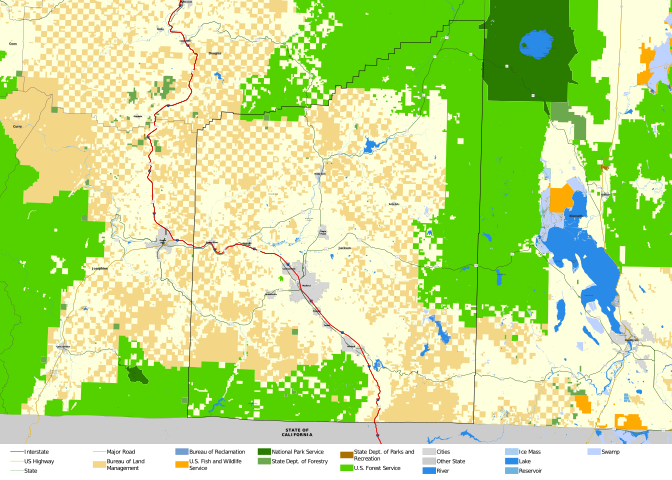
According to the United States Census Bureau, the county has a total area of 2802 sqmi, of which 2784 sqmi is land and 18 sqmi (0.6%) is water. A portion of the Umpqua National Forest is in Jackson County.
Located entirely within Jackson County is Bear Creek and its watershed, a tributary of the Rogue River. The population centers of Medford, Ashland, Phoenix, Talent, and Central Point are located along the stream. It connects with the Rogue River near the Upper and Lower Table Rock lava formations.
Summits
- Barneburg Hill
- Fredenburg Butte
- Obenchain Mountain
- Ropers Bunion
Adjacent counties
- Douglas County (north)
- Klamath County (east)
- Siskiyou County, California (south)
- Josephine County (west)
National protected areas
- Cascade–Siskiyou National Monument
- Crater Lake National Park (part)
- Klamath National Forest (part)
- Rogue River-Siskiyou National Forest (part)
- Umpqua National Forest (part)
Other landforms
- Schieffelin Gulch
Demographics
|align-fn=center 1790–1960 1900–1990 1990–2000 2010–2020
2020 census
As of the 2020 census, the county had a population of 223,259. Of the residents, 20.3% were under the age of 18 and 23.3% were 65 years of age or older, and the median age was 43.1 years. For every 100 females there were 95.2 males, and for every 100 females age 18 and over there were 92.9 males; 79.4% of residents lived in urban areas and 20.6% lived in rural areas.
The racial makeup of the county was 79.8% White, 0.8% Black or African American, 1.2% American Indian and Alaska Native, 1.5% Asian, 0.4% Native Hawaiian and Pacific Islander, 5.3% from some other race, and 11.0% from two or more races. Hispanic or Latino residents of any race comprised 13.6% of the population.
There were 90,467 households in the county, of which 26.4% had children under the age of 18 living with them and 27.2% had a female householder with no spouse or partner present. About 27.9% of all households were made up of individuals and 14.9% had someone living alone who was 65 years of age or older.
There were 96,239 housing units, of which 6.0% were vacant. Among occupied housing units, 64.1% were owner-occupied and 35.9% were renter-occupied. The homeowner vacancy rate was 1.5% and the rental vacancy rate was 5.0%.
The table below summarizes the racial and ethnic composition reported in the 2020 Decennial Census Redistricting Data (Public Law 94-171).
| Race / Ethnicity (NH = Non-Hispanic) | title=1980 Census of Population - General Population Characteristics - Oregon - Table 58 - Persons by Race and Table 59 - Total Persons and Spanish Origin Persons by Type of Spanish Origin and Race (p. 39/24-39/32) | url=https://www2.census.gov/library/publications/decennial/1980/volume-1/oregon/1980a_orabc-05.pdf | website=United States Census Bureau | page=}} | title=1990 Census of Population - General Population Characteristics - Oregon - Table 5 - Race and Hispanic Origin | url=https://www2.census.gov/library/publications/decennial/1990/cp-1/cp-1-39.pdf | website=United States Census Bureau | page=9-30}} | title=P004: Hispanic or Latino, and Not Hispanic or Latino by Race – 2000: DEC Summary File 1 – Jackson County, Oregon | url=https://data.census.gov/table?g=050XX00US41029&tid=DECENNIALSF12000.P004 | website=United States Census Bureau | access-date= }} | title=P2: Hispanic or Latino, and Not Hispanic or Latino by Race – 2010: DEC Redistricting Data (PL 94-171) – Jackson County, Oregon | url=https://data.census.gov/cedsci/table?q=p2&g=050XX00US41029&tid=DECENNIALPL2010.P2 | website=United States Census Bureau | access-date= }} | Pop 2020 | % 1980 | % 1990 | % 2000 | % 2010 | % 2020 |
|---|---|---|---|---|---|---|---|---|---|---|---|---|---|---|---|---|---|---|---|---|---|---|
| White alone (NH) | 126,089 | 136,957 | 160,795 | 170,023 | 170,232 | 95.19% | 93.56% | 88.71% | 83.67% | 76.25% | ||||||||||||
| Black or African American alone (NH) | 163 | 319 | 674 | 1,227 | 1,574 | 0.12% | 0.22% | 0.37% | 0.60% | 0.71% | ||||||||||||
| Native American or Alaska Native alone (NH) | 1,189 | 1,722 | 1,782 | 1,874 | 1,775 | 0.90% | 1.18% | 0.98% | 0.92% | 0.80% | ||||||||||||
| Asian alone (NH) | 798 | 1,386 | 1,583 | 2,304 | 3,293 | 0.60% | 0.95% | 0.87% | 1.13% | 1.47% | ||||||||||||
| Native Hawaiian or Pacific Islander alone (NH) | x | x | 291 | 562 | 808 | x | x | 0.16% | 0.28% | 0.36% | ||||||||||||
| Other race alone (NH) | 263 | 56 | 198 | 229 | 1,496 | 0.20% | 0.04% | 0.11% | 0.11% | 0.67% | ||||||||||||
| Mixed race or Multiracial (NH) | x | x | 3,820 | 5,242 | 13,682 | x | x | 2.11% | 2.58% | 6.13% | ||||||||||||
| Hispanic or Latino (any race) | 3,954 | 5,949 | 12,126 | 21,745 | 30,399 | 2.99% | 4.06% | 6.69% | 10.70% | 13.62% | ||||||||||||
| Total | 132,456 | 146,389 | 181,269 | 203,206 | 223,259 | 100.00% | 100.00% | 100.00% | 100.00% | 100.00% |
2010 census
As of the 2010 census, there were 203,206 people, 83,076 households, and 53,460 families living in the county.{{cite web |access-date=February 23, 2016 |archive-url=https://archive.today/20200213030825/http://factfinder.census.gov/bkmk/table/1.0/en/DEC/10_DP/DPDP1/0500000US41029 |archive-date=February 13, 2020 |url-status=dead |access-date=February 23, 2016 |archive-url=https://archive.today/20200213192146/http://factfinder.census.gov/bkmk/table/1.0/en/DEC/10_SF1/GCTPH1.CY07/0500000US41029 |archive-date=February 13, 2020 |url-status=dead
The racial makeup of the county was 88.7% white, 1.2% Asian, 1.2% American Indian, 0.7% black or African American, 0.3% Pacific islander, 4.5% from other races, and 3.5% from two or more races. Those of Hispanic or Latino origin made up 10.7% of the population. In terms of ancestry, 19.9% were German, 14.4% were English, 14.1% were Irish, and 5.3% were American.
Of the 83,076 households, 28.7% had children under the age of 18 living with them, 48.4% were married couples living together, 11.0% had a female householder with no husband present, 35.6% were non-families, and 27.7% of all households were made up of individuals. The average household size was 2.40 and the average family size was 2.91. The median age was 42.1 years.
The median income for a household in the county was $44,142 and the median income for a family was $53,739. Males had a median income of $40,435 versus $30,632 for females. The per capita income for the county was $24,410. About 9.9% of families and 14.0% of the population were below the poverty line, including 19.0% of those under age 18 and 7.4% of those age 65 or over.
2000 census
As of the census of 2000, there were 181,269 people, 71,532 households, and 48,427 families living in the county. The population density was 65 /mi2. There were 75,737 housing units at an average density of 27 /mi2. The racial makeup of the county was 91.65% White, 0.40% Black or African American, 1.09% Native American, 0.90% Asian, 0.18% Pacific Islander, 2.88% from other races, and 2.91% from two or more races. 6.69% of the population were Hispanic or Latino of any race. 17.4% were of German, 12.9% English, 10.2% Irish and 8.8% United States or American ancestry. 92.7% spoke only English at home, while 5.6% spoke Spanish.
Of the 71,532 households, 30.30% had children under the age of 18 living with them, 53.20% were married couples living together, 10.50% had a female householder with no husband present, and 32.30% were non-families. 25.10% of all households were made up of one individual, 11.00% being a person who was 65 years of age or older. The average household size was 2.48 and the average family size was 2.95.
The age distribution of the county's population was 24.40% under the age of 18, 8.70% from 18 to 24, 25.50% from 25 to 44, 25.40% from 45 to 64, and 16.00% 65 years of age or older. The median age was 39 years. For every 100 females there were 94.60 males. For every 100 females age 18 and over, there were 91.70 males.
The median income for a household in the county was $36,461, and the median income for a family was $43,675. Males had a median income of $32,720 compared to $23,690 for females. The per capita income for the county was $19,498. 8.90% of families and 12.50% of the population were below the poverty line, including 16.30% of those under age 18 and 6.90% of those age 65 or over.
Communities
Cities
- Ashland
- Butte Falls
- Central Point
- Eagle Point
- Gold Hill
- Jacksonville
- Medford (county seat)
- Phoenix
- Rogue River
- Shady Cove
- Talent
Census-designated places
- Foots Creek
- Prospect
- Ruch
- Trail
- White City
- Wimer
Unincorporated communities
- Applegate
- Beagle
- Bitter Lick
- Brownsboro
- Buckhorn Springs
- Buncom
- Cascade Gorge
- Climax
- Colestin
- Dardanelles
- Four Corners
- Lake Creek
- Lincoln
- McKee Bridge
- McLeod
- Mountain View
- Pinehurst
- Provolt
- Rock Point
- Rogue Elk
- Sams Valley
- Seven Oaks
- Starvation Heights
- Steamboat
- Table Rock
- Tolo
- Union Creek
Former communities
- Copper
- Persist
Politics
As is typical of southwestern Oregon, Jackson County leans towards the Republican nominee in presidential elections, although the presence of a substantial student body at Ashland means Democrats get a larger proportion of the vote in statewide elections than in any other county south of the Willamette Valley. No Democratic presidential candidate has won an absolute majority in Jackson County since Lyndon Johnson's landslide in 1964, although Bill Clinton in 1992 and Barack Obama in 2008 obtained narrow pluralities in the county, in both cases by less than 500 votes. In recent elections, however, the Republican lean in Jackson County has presented some signs of waning. The four most recent instances in which Republicans have been able to win the county had them doing so only by single digit margins.
In the United States House of Representatives, Jackson County lies within Oregon's 2nd congressional district, which has a Cook Partisan Voting Index of R+11 and is represented by Republican Cliff Bentz. In the Oregon House of Representatives, Jackson County is divided between four districts, which are together represented by three Republicans and one Democrat (Pam Marsh of Ashland). In the Oregon State Senate, Jackson County is divided between three districts; the 2nd and 28th Districts, represented by Republicans Art Robinson and Dennis Linthicum, and the 3rd District, represented by Democrat Jeff Golden.
Jackson County is currently one of 11 counties in Oregon in which therapeutic psilocybin is legal.
Economy
The county's principal industries are healthcare, agriculture, lumber, manufacturing, and tourism.
Jackson County has over 10,000 acre of orchards and shares with Josephine County the Rogue Valley and Applegate wine appellations.
Soapstone, a substance used in art sculpture, is mined in Jackson County.
According to the Jackson County Board of Commissioners, by 2021 the main cash crop produced within the county was grows of illegal cannabis, with the board declaring a state of emergency.
Points of interest
Bear Creek Greenway
Main article: Bear Creek Greenway
The Bear Creek Greenway is the area on both sides of Bear Creek running from Ashland to Central Point. The Greenway's most popular feature is the bike path which runs from Ashland north towards Medford. Eventually it will be a 21 mi paved link between Ashland and Central Point. The bike path is very popular with cyclists and skaters, especially during the warmer spring and summer months.
Bigfoot trap
Main article: Bigfoot trap
What is believed to be the world's only Bigfoot trap is located in the Siskiyou National Forest in the southern part of the county. The trap was originally built in 1974 by the North American Wildlife Research Team (NAWRT), a now-defunct organization based in Eugene, Oregon to capture the legendary hominid Bigfoot (or Sasquatch) that is said to inhabit the forests of the Pacific Northwest. In recent years it has become a major tourist attraction.
Oregon Vortex
Main article: Oregon Vortex
The Oregon Vortex is a roadside attraction that opened to tourists in 1930, located on Sardine Creek in Gold Hill. It consists of a number of interesting effects, which are gravity hill optical illusions, but which the attraction's proprietors propose are the result of paranormal properties of the area.
The attraction was the inspiration for the Mystery Shack, a fictional tourist trap and the main setting for the Disney Channel (later Disney XD) original series Gravity Falls.
Pacific Crest Trail
The Pacific Crest Trail, officially designated as the Pacific Crest National Scenic Trail (PCT), passes through Jackson County.
References
References
- "State & County QuickFacts". United States Census Bureau.
- "Find a County". National Association of Counties.
- "About Jackson County". Jackson County.
- Gannett, Henry. (1905). "The Origin of Certain Place Names in the United States". Govt. Print. Off..
- "About Medford". [[Mail Tribune]].
- link. (May 19, 2007 at the ''[[Mail Tribune]]''; written May 16, 2007; retrieved February 4, 2008)
- May, Meredith; "[http://www.sfgate.com/cgi-bin/article.cgi?file=/c/a/2007/03/04/MNGC7N6Q3M1.DTL Largest library closure in U.S. looms]" at the ''[[San Francisco Chronicle]]''; written March 4, 2007; retrieved February 4, 2008
- link. (June 10, 2011 at the ''[[Mail Tribune]]''; written October 9, 2007; retrieved February 4, 2008)
- Gumprecht Bannan, Jan. (2002). "Oregon State Parks". [[The Mountaineers Books]].
- (August 22, 2012). "2010 Census Gazetteer Files". United States Census Bureau.
- (December 2001). "Bear Creek Watershed Assessment - Phase 2". Rogue Valley Council of Governments].
- "County Population Totals and Components of Change: 2020-2024". United States Census Bureau.
- "U.S. Decennial Census". United States Census Bureau.
- "Historical Census Browser". University of Virginia Library.
- (March 27, 1995). "Population of Counties by Decennial Census: 1900 to 1990". United States Census Bureau.
- (April 2, 2001). "Census 2000 PHC-T-4. Ranking Tables for Counties: 1990 and 2000". United States Census Bureau.
- (2023). "2020 Decennial Census Demographic and Housing Characteristics (DHC)".
- (2021). "2020 Decennial Census Demographic Profile (DP1)".
- (2021). "2020 Decennial Census Redistricting Data (Public Law 94-171)".
- "1980 Census of Population - General Population Characteristics - Oregon - Table 58 - Persons by Race and Table 59 - Total Persons and Spanish Origin Persons by Type of Spanish Origin and Race (p. 39/24-39/32)".
- "1990 Census of Population - General Population Characteristics - Oregon - Table 5 - Race and Hispanic Origin".
- "P004: Hispanic or Latino, and Not Hispanic or Latino by Race – 2000: DEC Summary File 1 – Jackson County, Oregon".
- "P2: Hispanic or Latino, and Not Hispanic or Latino by Race – 2010: DEC Redistricting Data (PL 94-171) – Jackson County, Oregon".
- "P2: Hispanic or Latino, and Not Hispanic or Latino by Race – 2020: DEC Redistricting Data (PL 94-171) – Jackson County, Oregon".
- included in the Asian category in the 1980 Census
- included in the Asian category in the 1990 Census
- not an option in the 1980 Census
- not an option in the 1990 Census
- "DP02 SELECTED SOCIAL CHARACTERISTICS IN THE UNITED STATES – 2006-2010 American Community Survey 5-Year Estimates". [[United States Census Bureau]].
- "DP03 SELECTED ECONOMIC CHARACTERISTICS – 2006-2010 American Community Survey 5-Year Estimates". [[United States Census Bureau]].
- "U.S. Census website". [[United States Census Bureau]].
- Menendez, Albert J.; ''The Geography of Presidential Elections in the United States, 1868–2004'', pp. 284–285 {{ISBN. 0786422173
- Leip, David. "Dave Leip's Atlas of U.S. Presidential Elections".
- "About Jackson County, Oregon".
- St. John, James; ''[http://www.newarkcampus.org/professional/osu/faculty/jstjohn/Common%20rocks/Steatite.htm Soapstone] {{webarchive. link. (June 13, 2007 '' at the [[Oregon State University]]; retrieved February 4, 2008)
- (October 13, 2021). "Overwhelmed by illegal pot, Oregon county declares emergency".
- "Bear Creek Greenway Foundation-HOME".
- "County Highpoints - Regional Lists".
This article was imported from Wikipedia and is available under the Creative Commons Attribution-ShareAlike 4.0 License. Content has been adapted to SurfDoc format. Original contributors can be found on the article history page.
Ask Mako anything about Jackson County, Oregon — get instant answers, deeper analysis, and related topics.
Research with MakoFree with your Surf account
Create a free account to save articles, ask Mako questions, and organize your research.
Sign up freeThis content may have been generated or modified by AI. CloudSurf Software LLC is not responsible for the accuracy, completeness, or reliability of AI-generated content. Always verify important information from primary sources.
Report