From Surf Wiki (app.surf) — the open knowledge base
Jabal al-Nour
Holy mountain and peak in Saudi Arabia
Holy mountain and peak in Saudi Arabia
| Field | Value |
|---|---|
| name | Jabal al-Nour |
| native_name | ar |
| photo | Jabbal An-Nour (2024).jpg |
| photo_caption | Jabal al-Nour in the vicinity of Mecca |
| elevation_m | 642 |
| location | Makkah Province, Hejaz, Saudi Arabia |
| coordinates | |
| range | Hijaz Mountains |
| map | Saudi Arabia# |
| map_alt | Map of Saudi Arabia Showing the location of Jabal al-Nour |
| map_caption | Location of Jabal al-Nour in Saudi Arabia |
| label | Jabal al-Nour |
| label_position | right |
Jabal al-Nour ( or 'Hill of the Illumination') is a mountain near Mecca in the Hejaz region of Saudi Arabia. The mountain houses the grotto or cave of Hira (), which holds tremendous significance for Muslims throughout the world, as it is here where the Islamic prophet Muhammad received his first revelation of the Quran, which consisted of the first five ayat of Surah Al-Alaq from the angel Jibra'il. It is one of the most popular tourist attractions in Mecca. The mountain itself is barely 640 m tall; nonetheless one to two hours are needed to make the strenuous hike to the cave. There are 1750 steps to the top which can take anywhere between half an hour and three hours.
Etymology
The mountain is where Muhammad is said to have had his first revelation and received five verses of the Quran, and was given the title Jabal an-Nūr ("Mountain of the Light" or "Mountain of the Enlightenment"). This experience is sometimes identified with the beginning of revelation; hence the present name. The date of the first revelation is said to have occurred on Laylat al-Qadr, one of the last 10 nights of Ramadan, suggested to have been around August of 610 A.D.
Appearance
One physical feature that differentiates Jabal al-Nour from other mountains and hills is its unusual summit, which makes it look as if two mountains are on top of each other. The top of this mountain in the mountainous desert is one of the loneliest of places. However, the cave within, which faces the direction of the Kaaba, is even more isolated. While standing in the courtyard back then, people could only look over the surrounding rocks. Nowadays, people can see the surrounding rocks as well as buildings that are hundreds of meters below and hundreds of meters to many kilometers away. Hira is both without water or vegetation other than a few thorns. Hira is higher than Thabīr (ثَبِيْر), and is crowned by a steep and slippery peak, which Muhammad with some companions once climbed.
Geology
The mountain is composed of intrusive igneous rocks, predominantly Precambrian aged coarse grained hornblende tonalite, with subordinate granodiorite.
Cave of Hira
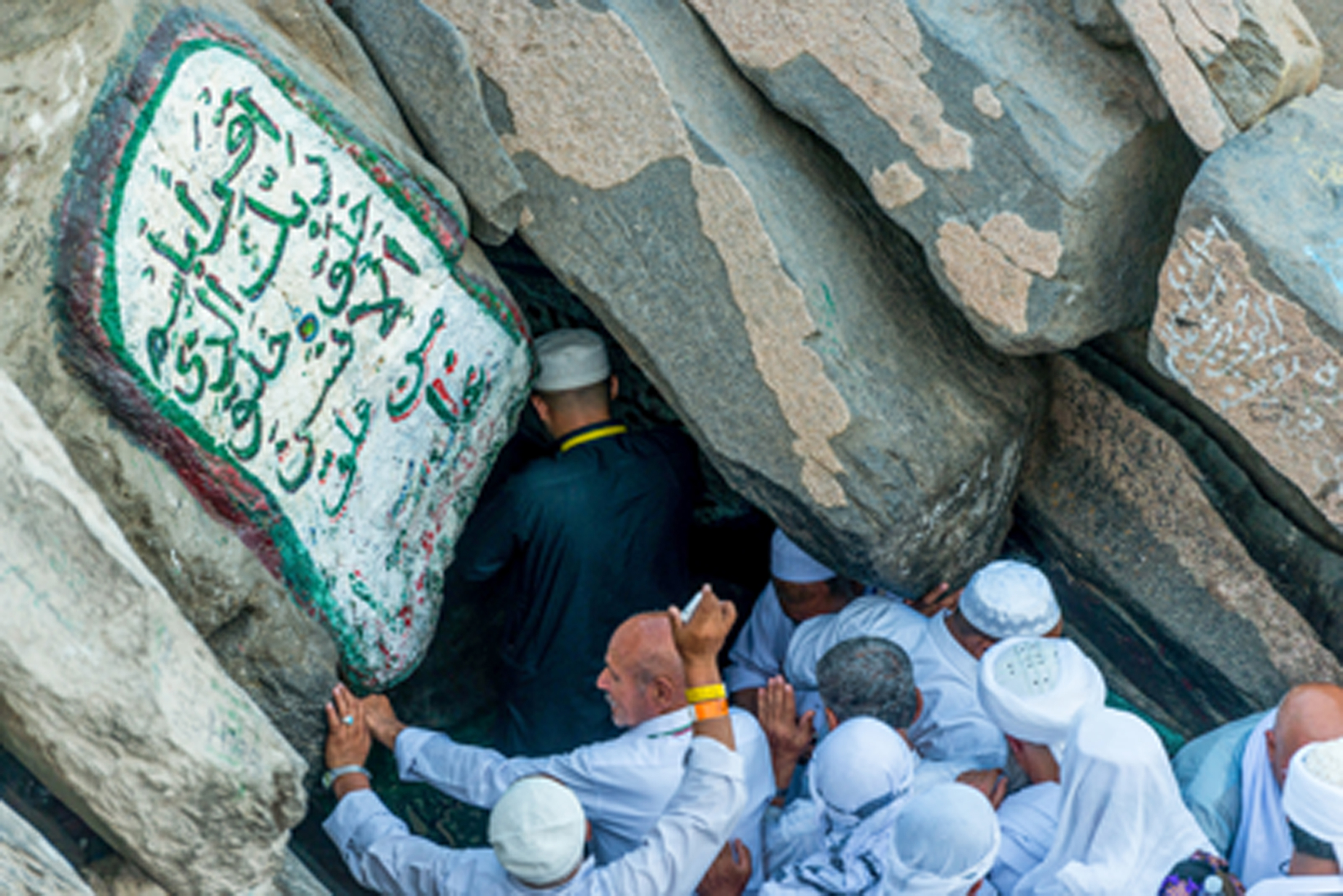
The Cave of Hira was of minor significance before Islam, its name comes from hira (jewels). Taking 1750 walking steps to reach, it is about 12 ft in length and 5 ft in width. It is at a height of 270 m. During the Hajj (pilgrimage), an estimated five thousand visitors climb to it daily to see the place where Prophet Muhammad is believed to have received the first revelation of the Quran on the Laylat al-Qadr (night of power) by the angel Jibreel (Gabriel). Most Muslims do not consider visiting the cave an integral part of the Hajj. Nonetheless many visit it for reasons of personal pleasure and spirituality, and though some consider it a place of worship, this view conflicts with Salafist interpretations of Islamic ritual. While the cave plays an important role in As-Sīrah an-Nabawiyyah (prophetic biography), it is not considered as holy as other sites in Mecca, such as the Al-Haram Mosque, and so under most interpretations of Islam, the same reward is received for praying here as any other place in Mecca.
According to Islamic tradition, before Prophet Muhammad's first revelation, he had transcendental dreams, in which were signs that his prophethood had begun and that the stones in Mecca would greet him with the salaam. These dreams lasted for six months.
An increasing need for solitude led Prophet Muhammad to seek seclusion and meditation (Muraqabah) in the rocky hills which surrounded Mecca. He retreated to the cave for one month each year, engaging in seclusion (Tahannuth). He took provisions and fed the poor who came to him. Before returning home to his family for more provisions, he would circumambulate the Kaaba seven times.
Gallery
File:Gable Noor.JPG|View of Jabal al-Nour File:Hira mağarası.jpg|People entering the Cave of Hira File:جبل النور مكة.jpg|Overview of Jabal an-Nour File:Jabl_e_Noor.jpg|Cave Hira File:Jabl_e_Noor_2.jpg|Jabal e Noor File:Great Mosque of Mecca1.jpg|A photograph of Mecca in 2019, featuring Al-Masjid Al-Haram in the foreground, and Jabal an-Nour in the background. Jabal Abu Qubays is to east of the mosque, in the right hand side of the photograph.
References
References
- (16 September 2015). "Jabal al-Nour (The Mountain Of Light) and Ghar Hira (Cave of Hira)". Mecca.
- "In the Cave of Hira'". Witness-Pioneer.
- "Jabal Al Nour".
- (24 April 2012). "Ḥirāʾ". Brill Online.
- "Surah Al-Qadr - 1-5".
- (2017). "T̲h̲abīr". [[Brill Publishers.
- Schadler, Peter. (2017). "John of Damascus and Islam: Christian Heresiology and the Intellectual Background to Earliest Christian-Muslim Relations". Brill.
- Weir, T. H.. "Ḥirāʾ." Encyclopaedia of Islam, First Edition (1913-1936). Edited by M. Th. Houtsma, [[T.W. Arnold]], R. Basset, R. Hartmann. Brill Online, 2013. Reference. Augustana College. 07 October 2013 http://referenceworks.brillonline.com/entries/encyclopaedia-of-islam-1/hira-SIM_2820
- (January 2015). "Assessment of rockfall hazard at Al-Noor Mountain, Makkah city (Saudi Arabia) using spatio-temporal remote sensing data and field investigation". Journal of African Earth Sciences.
- "Saudi Tourism". Saudi Tourism.
- "Multiplication of reward for prayer in Makkah and Madeenah - Islamweb - Fatwas".
- Mubārakpūrī, Ṣafī R.. (1998). "When the Moon Split (A Biography of the Prophet Muhammad)". Darussalam.
- Peterson, Daniel C.. (2013). "Muhammad, prophet of Allah".
- (2017). "Taḥannut̲h̲". Brill.
- Kister, M. J.. (1968). ""Al-Taḥannuth": An Inquiry into the Meaning of a Term".
- al-Tabarī, Abū Ja'far Muhammad B. Jarīr. (1988). "Ta'rīkh al-rusul wa'l-mulūk". State University of New York Press.
This article was imported from Wikipedia and is available under the Creative Commons Attribution-ShareAlike 4.0 License. Content has been adapted to SurfDoc format. Original contributors can be found on the article history page.
Ask Mako anything about Jabal al-Nour — get instant answers, deeper analysis, and related topics.
Research with MakoFree with your Surf account
Create a free account to save articles, ask Mako questions, and organize your research.
Sign up freeThis content may have been generated or modified by AI. CloudSurf Software LLC is not responsible for the accuracy, completeness, or reliability of AI-generated content. Always verify important information from primary sources.
Report