From Surf Wiki (app.surf) — the open knowledge base
Ivan Paskevich
Russian military leader (1782–1856)
Russian military leader (1782–1856)
| Field | Value | ||
|---|---|---|---|
| honorific_prefix | *Serene Prince* | ||
| name | Ivan Fyodorovich Paskevich | ||
| native_name | Иванъ Ѳедоровичъ Паскевичъ | ||
| honorific_suffix | Erevansky | ||
| image | Иван Федорович Паскевич.jpg | ||
| caption | Portrait by George Dawe (1823) | ||
| birth_date | |||
| birth_place | Poltava, Russian Empire (now Ukraine) | ||
| death_date | |||
| death_place | Warsaw, Congress Poland, Russian Empire | ||
| allegiance | Russian Empire | ||
| branch | Imperial Russian Army | ||
| serviceyears | 1800–1856 | ||
| rank | Field Marshal | ||
| battles | {{collapsible list | title = See list | |
| headerstyle | background:#dbdbdb | ||
| style | text-align:center; | ||
| awards | Order of St. Andrew | ||
| Order of St. George | |||
| Order of St. Vladimir | |||
| Order of St. Anna | |||
| Order of St. Alexander Nevsky | |||
| Order of the White Eagle (Russian Empire) | |||
| Gold Sword for Bravery | |||
| signature | Паскевич И. Ф., автограф.jpg |
- Russo-Turkish War (1806–12)
- Capture of Jassy
- Capture of Bucharest
- Battle of Izmail (1809)
- Storming of Brăila
- Battle of Brăila (1809)
- Battle of Rassowa
- Battle of Tataritsa
- Storming of Bazargic
- Battle of Varna (1810)
- Battle of Shumen
- Battle of Rusçuk (1810)
- Battle of Batin
- Napoleonic Wars
- Battle of Saltanovka
- Battle of Smolensk
- Battle of Borodino
- Battle of Maloyaroslavets
- Combat of Kolotskiy Monastery
- Battle of Vyazma
- Battle of Krasny
- Siege of Modlin
- Battle of Lützen
- Battle of Bautzen
- Battle of Gieshubl
- Battle of Leipzig
- Blockade of Magdeburg (1813)
- Siege of Hamburg
- Battle of Laon
- Battle of Arcis-sur-Aube
- Storming of Paris
- Russo-Persian War (1826–28)
- Battle of Elizabethpol
- Capture of Echmiadzin
- Capture of Erivan
- Capture of Abbasabad
- Battle of the Jevan-Bulak
- Capture of Ardabil
- Russo-Turkish War (1828–29)
- Siege of Kars
- Battle of Akhaltsikhe
- Battle of Erzerum Road
- Battle of Milli-Duze
- Battle of Khart
- Battle of Bayburt
- November Uprising
- Siege of Warsaw
- Hungarian Campaign
- Third Battle of Komárom
- Second Battle of Vác
- Battle of Tura
- Battle of Debrecen
- Crimean War
- Siege of Silistra Order of St. George Order of St. Vladimir Order of St. Anna Order of St. Alexander Nevsky Order of the White Eagle (Russian Empire) Gold Sword for Bravery Count Ivan Fyodorovich Paskevich-Erevansky, Serene Prince of Warsaw ( – ) was a Russian military leader who was the namiestnik of Poland.
Paskevich is known for leading Russian forces in Poland during the November Uprising and for a series of leadership roles throughout the early and mid-19th century, such as the Russo-Persian War of 1826–1828, and the beginning phase of the Crimean War. In Russian history, he is remembered as a prominent military commander, rated on a par with Ivan Dibich-Zabalkansky, commander of the Russian armies during the same time.
Paskevich started as an officer during the Napoleonic Wars serving in the battles of Austerlitz and Borodino. After the war, he was a leader in the Russo-Persian War. He was made count of Yerevan in 1828. Afterwards, he became the namiestnik of Poland in 1831 after he crushed the Polish rebels in the November Uprising. He then helped crush the Hungarian Revolution of 1848. His last engagement was the Crimean War. Paskevich died in Warsaw in 1856.
He attained the rank of field marshal in the Russian army, and later in the Prussian and Austrian armies.
Early life
Ivan Paskevich was born in Poltava on 19 May 1782. His father was of the Paskevich family of Zaporozhian Cossack gentry, while his mother was a Belarusian noblewoman. He was educated at the Page Corps, where his progress was rapid, and in 1800 received his commission in the Guards and was named aide-de-camp to the tsar.
Early military career
Napoleonic Wars
His first active service was in 1805, in the auxiliary army sent to the assistance of Austria against France, when he took part in the Battle of Austerlitz, 2 December 1805, where Austrian – Russian troops were defeated by the French under Napoleon.
From 1807 to 1812, Ivan Paskevich was engaged in the campaigns against the Ottomans, and distinguished himself by many brilliant and daring exploits, being made a general officer in his thirtieth year. During the war with France in 1812–1814 he was in command of the 26th division of infantry, and he won promotion to the rank of lieutenant general. During and after Napoleon's invasion of Russia Paskevich was engaged in the battles of Borodino, Dresden, Leipzig, and Paris (1814).
Ivan Paskevich wrote a memoir of some of his experiences during the Napoleonic wars.
The 1820s and the Russo-Persian War
Before the Russo-Persian War (1826–1828), then–Lieutenant General Paskevich was made commander of the 1st Guard Infantry. In the unit the brother of Tsar Alexander and future Tsar Nicholas I. This started a relationship that had the future Tsar calling Ivan Paskevich "father-Commander".
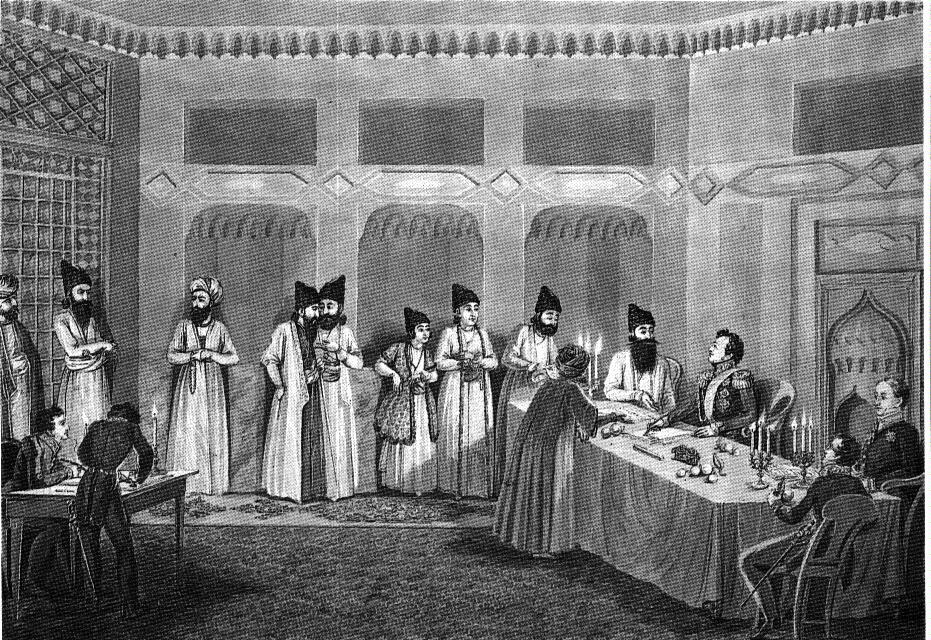
On the outbreak of Russo-Persian War in 1826 he was appointed second in command, and, in the spring of the following year he replaced Aleksey Petrovich Yermolov as chief command. Under his leadership, the Erivan and Nakhichevan Khanates were conquered from the Persians. After the Persians unsuccessfully tried to recapture Echmiadzin and its surroundings, the tsar granted Paskevich the title of "Erivanskii" (Count of Yerevan/Erevan), a million rubles and a diamond-mounted sword for his services. The Russo-Turkish War immediately followed and he successfully led the eastern or Caucasus front. For this he was made a Field Marshal at the age of forty-seven. In 1830, he was engaged in the Caucasian War on the territory of present-day Dagestan. At the same time he appointed the high-ranking Muslim cleric Mir-Fatah-Agha from Iran as head of the recently established Caucasus Committee. Paskevich hoped that by the help of Mir-Fatah's high stature in the Muslim community, he could make a very valuable contribution to the Russian consolidation of power in the Caucasus. Together with Mir-Fatah's high esteem among Muslims and his devised plans for the Caucasus, they managed to keep the entire Caucasus stable from rebellious Muslim insurrections for many years to come.
Polish uprising and the Hungarian Revolution

On the outbreak of the Hungarian Revolution of 1848 he was appointed to command the Russian troops sent to aid Austria, and finally compelled the Hungarians' surrender at Világos.
Late career
In 1854 Paskevich took command of the Army of the Danube, which was then engaging the Turks in the initial stage of the conflict which evolved into the Crimean War. Though he laid siege to Silistria, Paskevich advocated aborting the campaign due to Austria's threat to intervene in the war. On 9 June he suffered a combat injury and was compelled to return to Russia, handing command of the army to General Mikhail Dmitrievich Gorchakov. Paskevich died in Warsaw, where in 1870 a memorial was erected to him before the Koniecpolski Palace. It was demolished in October 1917 by the Poles. His remains were reburied by his son in the family mausoleum on the grounds of the Homel Palace. Both Paskevich's titles, Prince of Warsaw and Count of Erevan, went extinct with the death of his only son Lt. Gen. Fedor Paskevich in 1903.
Gallery
File:Иван Паскевич.png|Portrait by Franz Krüger in 1834, Hermitage File:Ivan Paskevich on horseback.PNG|Equestrian portrait by January Suchodolski 1841, National Museum in Warsaw File:Ivan Paskevich1.jpg|Portrait by Jan Ksawery Kaniewski in 1849 File:2022 Paskevich statue.jpg|Monument to Paskevich in Yerevan, Armenia
Notes
References
Bibliography
References
- "Сто великих полководцев – История.РФ". Russian Military Historical Society.
- Krivopalov, Alexey. (2022). "The Routledge handbook of the Crimean War". Taylor & Francis.
- [http://www.palacegomel.by/engine/print.php?newsid=92 Женский образ из Гомельского дворца.] 12 марта 2009 // «Гомельские ведомости»
- Paskevich, Ivan Fedorovich, svetleĭshiĭ kni︠a︡zʹ Varshavskiĭ. (2019). "Notes of the 1812 campaign".
- Badem, Candan. (2010). "Battles and Diplomacy During the War". Brill.
- King, Charles. (2008). "The Ghost of Freedom: A History of the Caucasus". Oxford University Press.
- King, Charles. (2008). "The Ghost of Freedom: History of the Caucasus". Oxford University Press.
This article was imported from Wikipedia and is available under the Creative Commons Attribution-ShareAlike 4.0 License. Content has been adapted to SurfDoc format. Original contributors can be found on the article history page.
Ask Mako anything about Ivan Paskevich — get instant answers, deeper analysis, and related topics.
Research with MakoFree with your Surf account
Create a free account to save articles, ask Mako questions, and organize your research.
Sign up freeThis content may have been generated or modified by AI. CloudSurf Software LLC is not responsible for the accuracy, completeness, or reliability of AI-generated content. Always verify important information from primary sources.
Report