From Surf Wiki (app.surf) — the open knowledge base
Italian Venezuelans
Venezuelan citizens of Italian descent

Venezuelan citizens of Italian descent
| Field | Value |
|---|---|
| group | Italian Venezuelans |
| native_name | it |
| es | |
| image | File:Juan Germán Roscio.jpg |
| image_caption | Juan Germán Roscio was a Venezuelan lawyer and politician of Italian ancestry who was the main editor of the Venezuelan Declaration of Independence, and the chief architect of the Venezuelan Constitution of 1811 |
| pop | (by birth) |
| 2,000,000 (Italian Embassy, 2017). | |
| 5,000,000 (Il Gazzettino, 2020) | |
| popplace | Greater Caracas, Valencia, Maracay, Barquisimeto, Maracaibo, Barcelona-Puerto La Cruz, Margarita Island, Ciudad Guayana, Acarigua-Araure and Mérida |
| langs | Venezuelan SpanishItalian and Italian dialects |
| rels | Roman Catholic |
| related | Italians, Italian Americans, Italian Argentines, Italian Bolivians, Italian Brazilians, Italian Canadians, Italian Chileans, Italian Colombian, Italian Costa Ricans, Italian Cubans, Italian Dominicans, Italian Ecuadorians, Italian Guatemalans, Italian Haitians, Italian Hondurans, Italian Mexicans, Italian Panamanians, Italian Paraguayans, Italian Peruvians, Italian Puerto Ricans, Italian Salvadorans, Italian Uruguayans |
es 2,000,000 (Italian Embassy, 2017). 5,000,000 (Il Gazzettino, 2020) Italian Venezuelans (; ) are Venezuelan-born citizens who are fully or partially of Italian descent, whose ancestors were Italians who emigrated to Venezuela during the Italian diaspora, or Italian-born people in Venezuela. Italians were among the largest groups of European immigrants to settle in the country. According to one estimate, there are 5 million Venezuelans with some degree of Italian or Venetian ancestry, corresponding to about 16% of the population, while there were around 30,000 Italian citizens in Venezuela.
Italians began arriving in Venezuela in massive numbers in the last half of the nineteenth and the first half of the twentieth centuries. Yet Italians began to transmit their cultural heritage, giving and receiving demonstrations of social empathy, which contributed to their integration and to the huge flows into Venezuela in 1947 and in 1948.
The massive presence of travelers, explorers, missionaries, and other peninsular and insular Italian immigrants over the course of almost 500 years made Venezuela acquire a Latin vocation instead of a Hispanic one. Italians also influenced the Venezuelan accent, given its slight sing-songy intonation. Similarly, beyond the ethnic contribution, Italian culture has had a significant impact in Venezuela, a country which is the second in the world with the highest consumption of pasta per capita after Italy.
History
The presence of Italians in Venezuela dates back to the Genoese sailor Christopher Columbus who landed in Macuro in 1498, followed by the explorer Amerigo Vespucci (1499) and the conquistador Giacomo Castiglione (Hispanicized as "Santiago Castellón"), creator of the first settlement of Nueva Cadiz on the Island of Cubagua in 1510 (a town created for the exploitation of pearls).
Before the discovery of large deposits of oil in Venezuela, during the first half of the 20th century, the emigration of Italians to Venezuela was limited. In colonial times, only a few hundred Italians (such as Filippo Salvatore Gilii, Juan Germán Roscio, Francisco Isnardi) arrived in Venezuela with a slight increase during the war of independence, including the privateer Giovanni Bianchi, Colonel Agostino Codazzi, Constante Ferrari, Gaetano Cestari and General Carlos Luis Castelli. The jurist and deputy Juan Germán Roscio was the author of the first republican constitution of Hispanic America promulgated in Venezuela on 21 December 1811. Roscio is considered a forerunner in the defense of civil rights and in the fight against discrimination in Venezuela and throughout the Americas, for his defense of his mestizo mother (Paula María Nieves, native of La Victoria). In the Republican era of the 19th century there was a small number of Italians and their descendants who attained high status in Venezuelan society, such as the surgeon Luis Razetti. The 1891 Venezuelan census recorded 3,030 immigrants from the Kingdom of Italy, just over 6% of the total foreign population in Venezuela. At the beginning of the 20th century, several thousand Italians immigrated to Venezuela, obtaining good working conditions, even while the community remained relatively small.
In the 1940s and 1950s, the dictatorship of the general Marcos Pérez Jiménez promoted European immigration to his depopulated country, and more than 300,000 Italians emigrated to Venezuela where they flourished under his administration because he had started many urban infrastructure projects due to the revenues of oil exportation. There were ample opportunities to work in construction developments, and as a result the economic stance increased within its cities, especially Caracas, Valencia, Barquisimeto and Maracaibo. Noteworthy is the presence of many Italians in 1952 in the creation of the agricultural colony of Turén, the most ambitious experience of this type ever carried out in a Caribbean country. The Electoral Law of 1957, which allotted to foreigners voting rights for the very first time, became a detrimental event for the Italian communities in Venezuela. The law was put into place by General Pérez Jiménez, to aid him in his reelection campaign. The loss of Perez Jimenez in the presidential referendum meant that his social programs would end, and a huge gap in leadership would follow.

Italian immigrants had notably supported the referendum of 2 December 1957 by President Perez Jimenez, as well as externalizing public support for the dictatorship in a demonstration attended by around 75,000 Italians led by the entrepreneur Filippo Gagliardi. When General Perez Jimenez fell from power on 23 January 1958, the hostile attitude of the provisional military government towards the removed president was also reflected on the groups who were supportive of him. For this reason, many migrants and their families chose to return to Italy through the following year, subsiding towards the end of February, when the Minister of Foreign Affairs recognized the potential damage of this shift and proceeded to guarantee security to the remaining Italians in Venezuela. This is a relevant factor, since acts of disdain towards the Italian populace undoubtedly affected the decisions of that ethnic group in regards to choosing to leave or enter the country.
The Italians in the 1961 Venezuelan census were the biggest European community in Venezuela (ahead of the Spanish).
In 1966, according to the Italian Embassy in Caracas, of the 170,000 Italians present in the country, 90% lived in the main cities. About 96,000 lived in Caracas, 14,000 in Maracaibo, 8,000 in Maracay, 6,000 in Valencia and 5,000 in La Guayra. Most of these Italians were born in Sicily, Campania and Puglia; only 15% were born in northern Italy (mainly in Emilia-Romagna). They initially worked in construction, in the service sector, in commercial agencies and in different businesses (like hotels, banks and restaurants), in manufacturing activities (the shoe industry in Caracas, for example, was fully in Italian hands) and a few also in the oil industry.

In 1976 the "Dirección de Estadísticas" of Venezuela registered 210,350 Italians residents and 25,858 Italians "naturalised" (who had obtained Venezuelan citizenship). In 2001, 126,553 Italians were living in Venezuela.
Marisa Vannini calculated that in the 1980s Italian-Venezuelans made up almost 400,000 of Venezuela's population, including second-generation descendants of immigrants. The Italian language in Venezuela is influencing Venezuelan Spanish with some modisms and loanwords and is experiencing a notable revival between the Italian-Venezuelans of second and third generation.
Santander Laya-Garrido estimated that the Venezuelans with at least one grandparent from Italy can be nearly one million at the beginning of the 21st century (like the former president of Venezuela, Raul Leoni, whose grandfather was an Italian mason refugee of the 19th century).
Currently, Italian citizens resident in Venezuela are reduced to less than 50,000 due mainly to demographic mortality and to their return to Italy (because of a Venezuelan political and economic crisis in the 2000s).
| Italian population in Venezuela | Census year | Venezuelan population | Italian population | % of immigrants in Venezuela | % of Venezuelan population |
|---|---|---|---|---|---|
| 1881 | 2,075,245 | 3,237 | 6.6 | 0.15 | |
| 1941 | 3,850,771 | 3,034 | 6.3 | 0.07 | |
| 1950 | 5,091,543 | 136,705 | 31.1 | 3.01 | |
| 1961 | 7,523,999 | 113,631 | 24.6 | 1.51 | |
| 1971 | 10,721,522 | 213,000 | 22.3 | 1.99 | |
| 2001 | 23,054,210 | 49,337 | 4.86 | 0.21 |
Italian community
Initially, agriculture was one of the main activities of the Italian community in Venezuela. In the 1950s, entire Italian families were moved from Italy to special agricultural areas, such as the "Colonia Turén" of the Portuguesa region.
However, most Italians concentrated in commercial, building and services activities during the second half of the 20th century. In those sectors, Italians reached top positions in the Venezuelan economy. Italian immigration has been a decisive factor for the modernization of production (industrial and agricultural) and commercial activities in the urban and rural areas of Venezuela, as well as for the improvement of living standards.
The community's main Italian newspapers are Il Corriere di Caracas and La Voce d'Italia http://www.voce.com.ve/, both published in the capital, and the main Italian school is the Agustin Codazzi of Caracas (with courses from elementary to high school). Since 2002, the Italian government has become the promoter for a provision which makes it mandatory to teach the Italian language as a second language in a consistent number of public and private schools within Venezuela.

Most of the Italian community in Caracas, but even in the rest of Venezuela, followed Deportivo Italia football club, as its own representative team. Deportivo Italia achieved worldwide fame in the Pompeo D'Ambrosio era (it was considered the best Venezuelan team of the 20th century together with Estudiantes de Mérida F.C., according to the International Federation of Football History & Statistics) winning several national championships and participating in the Copa Libertadores in the 1960s and 1970s (getting the famous Little Maracanazo).
Indeed, Italian-Venezuelans have obtained significant results in the contemporary society of Venezuela. The Italian Embassy calculates that one-third of the Venezuelan industries, not related to the oil sector, are directly or indirectly owned and/or managed by Italian-Venezuelans. For example, one of the areas of Venezuelan society most influenced by Italians is gastronomy, with the related food industry. In fact, the consumption of pasta in Venezuela is second in the world only to that of Italy itself, and spaghetti is considered a fundamental dish of the Venezuelan diet (together with pizza).
Another sector of the Venezuelan economy favored by Italians is the footwear industry, especially in the metropolitan area of Caracas. Between the 1950s and 1970s Venezuela experienced a spontaneous boom in industrialization and many of the large production laboratories founded by immigrants became, over time, factories and large-scale distribution industries. Among these was the footwear sector, a business dominated by up to 70% Italian immigrants.
Most of the Italians who arrived after World War II are concentrated in the metropolitan areas of Caracas, Valencia and Maracay. In fact, currently the main community of Italian Venezuelans is that of Caracas, which includes the Church of Pompeii in Alta Florida, the Casa de Italia with Plaza Italia as its main points of congregation (especially in the second half of the 20th century) and now the Italian Venezuelan Center at Prados del Este.
In general, Italian Venezuelans include descendants of settlers who came from various regions of the Italian-speaking area of Europe. Therefore, the descendants of Italian Croatians and Italian Swiss are also counted. Included in the Italian minority are German Italians (Italian citizens of German descent and speak German language) and Arbëreshë people, the Italian-born descendants of Albanian settlers.
In the Italian community, actually one of the most important in Venezuela, there are Presidents of Venezuela (such as Jaime Lusinchi and Raúl Leoni), entrepreneurs (such as Delfino, who with his "Constructora Delpre" made in Caracas the tallest skyscrapers of South America (Parque Central Complex), managers (such as Pompeo D'Ambrosio), sportsmen (such as Johnny Cecotto), artists (such as Franco De Vita), beauty pageants (such as Daniela di Giacomo and Viviana Gibelli), and many others personalities.
One winner of the title Miss Venezuela was born in Italy; María Antonieta Cámpoli in 1972 and later she represented Venezuela in the Miss Universe, where she was the runner-up.
Main Italo-Venezuelan Institutions and Associations

The main Italian associations in Venezuela are the following:
- Asociación Region Liguria de Venezuela in Barquisimeto, Lara
- Associazione Campana di Lara in Barquisimeto, Lara
- Associazione Emilia Romagna in Barquisimeto, Lara
- Asociación Civil Agustin Codazzi in Caracas
- Asociación Civil Abruzzesi e Molisani nel Mondo in Caracas
- Asociación Cultural Menfitani in Caracas
- Associazione Calabrese in Caracas
- Associazione Civile Campani in Venezuela in Caracas
- Associazione Civile Regionale Basilicata en Venezuela in Caracas
- Associazione Civile Regionale Assolucana in Caracas
- Associazione Emiliano Romagnola in Caracas
- Associazione Nazionale Marchigiani del Venezuela in Caracas
- Associazione Toscani in Venezuela in Caracas
- Asociación Region Emilia Romagna de Venezuela in Maracaibo, Zulia
- Associazione Civile Campani dello Stato di Aragua in Maracay, Aragua
- Associazione Molisani di Aragua in Maracay, Aragua
- Associazione Campana Táchira in San Cristóbal, Táchira
- Associazione Civile Marchiglia dell'Occidente del Venezuela in San Cristóbal, Táchira
- Asociación Civil Abruzzesi e Molisani nel Mondo in Valencia, Carabobo
- Asociación Regional Siciliana di Carabobo in Valencia, Carabobo
- Associazione Regione Emilia Romagna di Carabobo in Valencia, Carabobo
- Associazione Campana Carabobo "Centro Social Italo-Venezolano" in Valencia, Carabobo
- Associazione Emilia Romagna in Valera, Trujillo
- Camera di Commercio, Industria ed Agricoltura Venezuelana-Italiana in Caracas
- Casa D'Italia in Caracas, Maracay, Valencia, Ciudad Bolívar
- Centro Italo-Venezolano in Caracas, Barcelona, Maracaibo, Valencia
- Circolo Trentino in Caracas
- Circolo Trevisani in Caracas
- Club Social Italiano in Puerto La Cruz, Acarigua, Calabozo
- Deportivo Italia Football Club
- Famiglia Bellunese in Caracas
- Federazione Delle Associazioni Campane del Venezuela in Caracas
- Genealogía Italiana en Venezuela
- Gruppo Folklorico Italo-Venezolano in Valencia, Carabobo
- Instituto Italiano de Cultura in Caracas
- Regional Associations of Italians in Venezuela
Education
The Colegio Agustín Codazzi in Caracas is an overseas Italian school recognized by the Ministry of Foreign Affairs of Italy.
There are also multiple Italo-Venezuelan schools in the country:
Caracas:
- Colegio Agustín Codazzi
- Colegio San Francisco d'Assisi
- Colegio Nuestra Señora de Pompei
- Colegio Amerigo Vespucci
- Collegio San Marco Evangelista
- Collegio Patria
- Colegio Bolivar y Garibaldi
Eastern Venezuela:
- Collegio Maria Montessori in Ciudad Bolivar
- Collegio Angelo de Marta in Puerto La Cruz
Western Venezuela:
- Collegio R. C. Agazzi in Barquisimeto
- Collegio San Pedro in Barquisimeto
- Collegio Juan XXIII in Maracay
- Collegio Antonio Rosmini in Maracaibo
- Unidad Educativa Juan XXIII in Cabimas
Geographical distribution and origin
.png)
The Italians who migrated to Venezuela came mainly from the regions of South Italy, like Abruzzo, Campania, Sicily, and Apulia, but there were also migrants from the north, such as from Emilia-Romagna and Veneto.
The Italian Consulate in Caracas stated that in 1977, of 210,350 Italians residents in Venezuela, 39,855 were from Sicily, 35,802 from Campania, 20,808 from Abruzzi, 18,520 from Apulia, 8,953 from Veneto, 7,650 from Emilia-Romagna and 6,184 from Friuli-Venezia Giulia.
The Italians are concentrated mainly in the north-central region of Venezuela around Caracas. The Consulate stated that in the same 1977 there were 98,106 Italians in the Distrito Federal of Caracas, 39,508 in Miranda State, 14,203 in Maracaibo, 12.801 in Aragua State and 8,104 in Carabobo State, as well as 66 in the Amazonas equatorial region.
In the 2000s, it was determined that nearly 90% of the Italo-Venezuelans were concentrated in the northern coastal section of Venezuela facing the Caribbean Sea. Approximately 2/3 of them are residents of the metropolitan areas of the three main Venezuelan cities: Caracas, Maracaibo and Valencia.
There is also a considerable number of Italian residents that live in the city of San Cristóbal and in the Andes region.
Demographics
Population
States with the highest proportions of Italian-born population tend to be those of the North-central coastal area (Capital and Central Region), the Andean Region (Mérida) and the Insular Region.
At the 2011 census, this was the breakdown of Italian-born population by state, showing that the capital area was the one with the biggest concentration of native Italians.
| State | Italian-born Population | Percentage | ||
|---|---|---|---|---|
| Amazonas | 19 | 0.013 | ||
| [[File:Flag of Anzoátegui State.svg | 25px]] Anzoátegui | 1,116 | 0.0798 | |
| [[File:Flag of Apure State.svg | 25px]] Apure | 63 | 0.0137 | |
| [[File:Flag of Aragua State.svg | 25px]] Aragua | 2,492 | 0.1537 | |
| [[File:Flag of Barinas State.svg | 25px]] Barinas | 351 | 0.0434 | |
| [[File:Flag of Bolívar State.svg | 25px]] Bolívar | 885 | 0.0631 | |
| [[File:Flag of Caracas.svg | 25px]] Capital District | 5,792 | 0.3003 | |
| [[File:Flag of Carabobo State.svg | 25px]] Carabobo | 3,011 | 0.1349 | |
| [[File:Flag of Cojedes State.svg | 25px]] Cojedes | 93 | 0.0216 | |
| [[File:Flag of Delta Amacuro State.svg | 25px]] Delta Amacuro | 18 | 0.01 | |
| [[File:Flag of Falcón.svg | 25px]] Falcón | 355 | 0.0373 | |
| [[File:Federal dependencies of Venezuela's Flag.svg | 25px]] Federal Dependencies | 20 | 0.9438 | |
| [[File:Flag of Guárico.svg | 25px]] Guárico | 582 | 0.0785 | |
| [[File:Flag of Lara State.svg | 25px]] Lara | 1,449 | 0.082 | |
| [[File:Flag of Mérida State.svg | 25px]] Mérida | 558 | 0.678 | |
| [[File:Flag of Miranda state.svg | 25px]] Miranda | 8,263 | 0.3122 | |
| [[File:Flag of Monagas State.png | 25px]] Monagas | 494 | 0.0566 | |
| [[File:Flag of Nueva Esparta.svg | 25px]] Nueva Esparta | 915 | 0.1886 | |
| [[File:Flag of Portuguesa.svg | 25px]] Portuguesa | 851 | 0.0986 | |
| [[File:Flag of Sucre State.svg | 25px]] Sucre | 296 | 0.038 | |
| [[File:Flag of Táchira.svg | 25px]] Tachira | 338 | 0.0291 | |
| [[File:Flag of Trujillo State.svg | 25px]] Trujillo | 349 | 0.051 | |
| [[File:Flag of La Guaira State.svg | 25px]] Vargas | 557 | 0.1591 | |
| [[File:Flag of Yaracuy State.svg | 25px]] Yaracuy | 339 | 0.0566 | |
| [[File:Flag of Zulia State.svg | 25px]] Zulia | 1,645 | 0.0446 | |
| Total Venezuela | 30,901 | 0.1137 |
Italian Influences
Language
Main article: Italian language in Venezuela
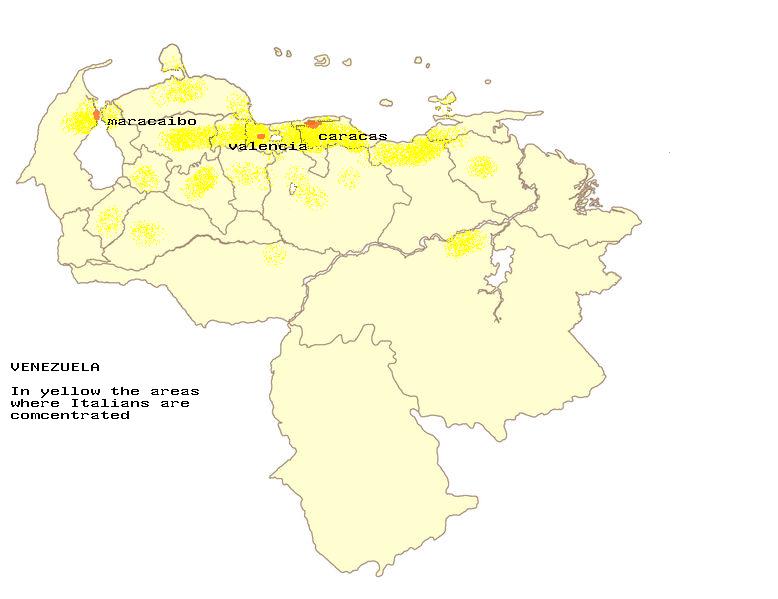
The Italian language in Venezuela has been present since colonial times in the areas around Caracas, Maracay, Valencia, Maracaibo and the Andes Mountains. The language is found in many idiomatic sentences and words of Venezuelan Spanish. There are around 200,000 Italian-speakers in the country, turning it in the second most spoken language in Venezuela, after Spanish. The name of Venezuela itself comes from the Italian Amerigo Vespucci, who called the area "Little Venice" in a typical Italian expression.
During the Venezuelan Wars of Independence some Italians helped Simón Bolivar against the Spanish Empire and they brought some Italian military words to Venezuelan Spanish. The military officer Agostino Codazzi created the first "Atlante" of Venezuela and - as a consequence - many geographical words in Venezuela are loanwords from Italian. In the second half of the 20th century, more than 300,000 Italians moved to Venezuela and left their linguistic imprint on the local vocabulary: "Ciao" is now a usual friendly salute in Caracas, for example. There are even expressions among local young people that mix Italian and Spanish words: "Muérete que chao" is an example.
Indeed after WWII came a huge emigration to Venezuela from Italy and the Italian language started to get importance in the country. The modisms of the upper class in Caracas (called "Sifrinos") are full of Italian words and expressions. Today, there are more than 5 million Venezuelans with some Italian roots: some young Italian Venezuelans in Caracas use slang mixing Italian dialect and Spanish among themselves. Italians also influenced Venezuelan accent, given its slight sing-songy intonation, like Rioplatense Spanish. Nearly all the Italians speaking the Italian language in Venezuela live in the half of the country north of the Orinoco-Apure rivers, while only a few thousands live in the Ciudad Bolivar-Ciudad Guayana and San Felipe areas of the Apure-Amazonas-Bolivar states.
Italian is also commonly spoken (mostly by the older generation) by residents of the town of La Carlota, a town in Venezuela which was one of the main settlements for Italians immigrants, regional languages of Italy were also brought to the country such as Neapolitan and Sicilian, Italian is the second language of many Venezuelans of Italian descent after Spanish, also the Italian government has become the promoter of a provision requiring the teaching of Italian as a second language in a constant number of public and private schools within Venezuela.
Cuisine

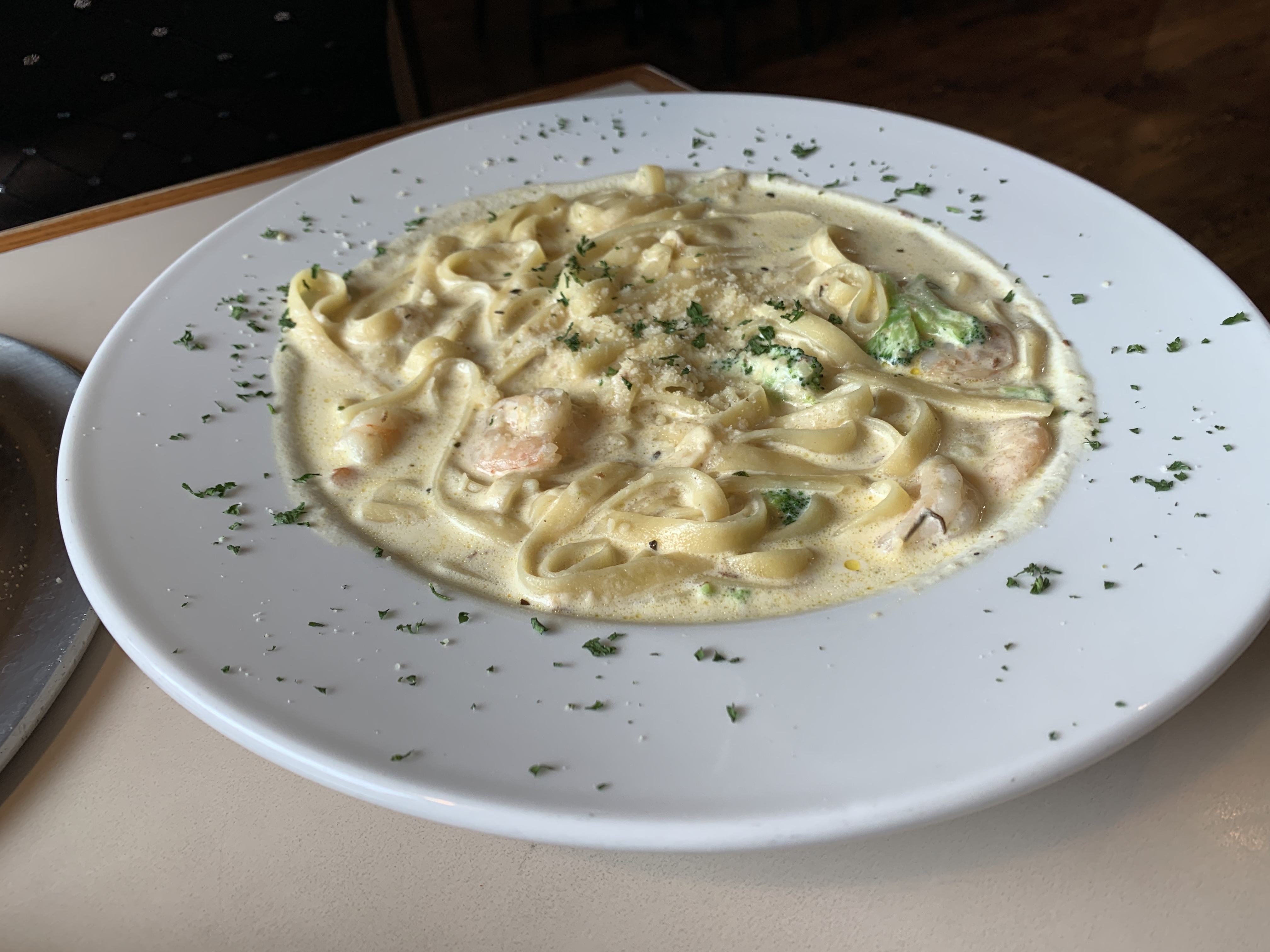
Italian cuisine is one of the most influential in the country's every day in fact, Venezuela is the second country in the world with the most consumption of pasta only after Italy itself. Pasta is the third most consumed product in Venezuela, whose per capita consumption is 12.6 kg.
Pasticho (lasagna in Italian, pl. lasagne) is extremely common dish in Venezuelan cuisine, pasticho basically lasagne is one of the traditional Venezuelan dishes being popular as hallaca, it is consumed in the original form, but also received adaptations, the variants are innumerable, for example, in some, layers of ham are added or the pasta is replaced by banana or by cachapas leafs, a version which is known as chalupa, in others it has been completely modified which involve sauce of chicken or fish, and Pasticho de berenjena which resembles greek Moussaka.
Pizza is one of the most popular dishes in Venezuelan cuisine, pizza has had completely different contrast and variations. The Associazione Verace Pizza Napoletana has approved Portarossa, a Venezuelan business, for "La margarita," which comprises mozzarella cheese, and "La Marinada," which contains tomato sauce and garlic, as the eighth Latin American pizza certified as Pizza Napolitana by this establesiment, is an example of the various variants of pizzas in the country; it serves numerous types of pizzas, including "La Pizza Parrilla," which is made with chicken, pork, chorizo, and french fries, as well as Focaccia de Lomito carpaccio.
Polenta originated in Italy originally made from boiled cornmeal. Funche as it is better known in Venezuela, has been incorporated into stews. The typical dish is made with chicken. In the East and West of the country they additionally prepare it with sardines. The typical Polenta of Venezuela is a baked cake made from a mix of precooked corn (Harina P.A.N.), water and salt, stuffed with some meat, chicken, fish or pig stew.
Cannoli is a pastry tube filled with ricotta cheese and honey or chocolate. It is an extremely common dish in Venezuelan cuisine.
Notable Italian-Venezuelans
Architecture
- Jorge Rigamonti – Designed multiple national and international award-winning buildings
- Vittorio Garatti
- Graziano Gasparini – Architect, architectural historian and painter
- Roberto Gottardi
Musicians
- Antonietta – Singer
- Benito Canónico – Composer
- – Composer, organist
- Daniel Calveti – Singer
- Gabriel Coronel – Singer
- – Singer
- Rodolfo Saglimbeni – Conductor
- Nacho – Singer
- Antonio Lauro – Guitarist and composer
- Franco De Vita – Artist, singer, composer, songwriter and pianist
- Rosario Marciano – Pianist and writer
- Pablo Manavello – Composer, guitarist, singer and songwriter
- Arnoldo Nali – Composer and band leader
- Iván Pérez Rossi – Singer and musician
- Alejandra Ghersi – Musician commonly known as Arca (musician)
- Roberto Luti – Singer and record producer
- Corrado Galzio – Piano player and founder of cultural radio
- Primo Casale – Composer, conductor and violinist
- Franco Termini – Singer
- Lele Pons – Singer and internet personality
- – double bass player and singer
- – Rock musician pioneer
- Rudy la Scala – Singer and record producer
- Migani – Songwriter and composer
- Roberto Ruscitti- Composer, pianist and accordionist
- – Composer and musician
- – Singer
- Yordano – Singer, songwriter, composer and musician
Actors and entertainers
- Gioia Arismendi – Actress
- Paula Bellini – TV entertainer
- – TV entertainer, actress and model
- Briggitte Bozzo – Actress
-
- Actor
- – Actress
- Viviana Gibelli – Actress and producer
- Maria Grazia Bianchi – Actress
- Alejandro Nones - Actor
- Jullye Giliberti – Actress
- Enrique Sapene - Actor
- Fedra López Bernini – Actress
- Carla Baratta – Actress
- – Actress
- Dora Mazzone – Actress
- Carolina Motta – Actress, sexologist TV entertainer
- Fanny Otatti – TV entertainer
- – Actress
- Sheyene Gerardi – Actress and producer
- – Actress
- Viviana Gibelli – TV show host and actress
- Renny Ottolina – Producer and TV entertainer
- Alba Roversi – Actress
- Gaetano Ruggiero de Vita- Actor
- – Actor
- Irma Palmieri – Actress
- Patricia Zavala – TV presenter
- Roberto Messuti – Actor
-
- film director
- Marisela Berti – Actress
- – Actor
- Ángel David Revilla – Personality and writer
- Andrés Mistage – Actor
- Luciano D'Alessandro – Actor
- Fernando Carrillo – Actor and singer
- Marisa Román – Actress
- Wanda D'Isidoro – Actress
- Rosanna Zanetti – Actress
- Bella La Rosa – Actress
- Julie Restifo – Actress
- – Actress
- Marjorie Magri – Actress
- Claudia La Gatta – Actress
- – Actor
- Laura Termini – Actress
- Gigi Zanchetta – Actress
- Gioia Lombardini – Actress
- Mónica Pasqualotto – Actress
- – Actress
- Ainett Stephens – Television personality
- – Actress and TV hostess
- Julie Restifo – Actress
- Doris Wells – Actress
- Carlos Guillermo Haydon – Actor
- Luigi Sciamanna – Actor
- Antonio Delli – Actor
- Gabriel Coronel – Actor
- Sandro Finoglio – Actor
- Roberto Lamarca – Actor
- – Chef host TV
- Dayana Colmenares – Television personality
Scientists
- Augusto Bonazzi - geochemist
- Nora Bustamante Luciani – Physician
- Leon Croizat – Biologist
- José Del Vecchio – Physician
- Francisco De Venanzi – Physician
- – Physician
- – Sociologist
-
- Chemistrist
- Otto Huber – Biologist
- Francisco Mago Leccia – Ichthyologist
- Mario Masciulli – Military engineer
- Alejandra Melfo – Physicist
- – Internist
- – Physician
- Luis Razetti – Physician
- Milena Sardi de Selle – Psychiatrist
Journalists
- – Journalist
- – Journalist
- – Journalist, literary critic
- Nelson Bocaranda – Journalist
- Lindsay Casinelli – Journalist
- Margarita D'Amico – Journalist
- Adriana D’Onghia – Journalist
- Roberto Giusti – Journalist
- – Journalist
- Anna Vaccarella – Journalist
- José Nucete Sardi – Journalist
- Pascual Venegas Filardo – Journalist
- Carlos Henríquez Consalvi – Journalist
- – Journalist
Economy
- – Economist
- Ernesto Armitano Amadei – Editor
- Jorge Botti – Entrepreneur
- Pompeo D'Ambrosio – Financial manager and vice-president of bank
- Giuseppe De Candido - Entrepreneur founder of Supmercados De Candido
-
- Engineer, CEO of PDVSA
- Héctor Ciavaldini- Engineer, CEO of PDVSA
- Roberto Mandini- Engineer, CEO of PDVSA
-
- Engineer, CEO of PDVSA
-
- Entrepreneur
- José Grasso Vecchio – Economist, CEO of Caracas Trade Exchange
- Jorge Giordani – Economist
- Gaetano Greco, industrialist cofounder of Venezuelan football team Deportivo Táchira F.C.
- Luigi Miglietti – Entrepreneur, racehorse owner
- Walter Pietrosemoli Rosa – Entrepreneur, co-founder of Costa Norte, S.A.
- Eddo Polesel – Entrepreneur
- Wilmer Ruperti – Entrepreneur
- Armando Scannone - Engineer, gourmet writer
- Rocco Sebastiani – Entrepreneur, racehorse owner
-
- Industrialist
Painters
- Juan Vicente Fabbiani – Painter
- Francisco Massiani – Writer and painter
- Emilio Boggio – Painter
- Emilio Jacinto Mauri – Painter
- – Painter
- Renzo Vestrini - Painter
Photographers
- Mario Migliorini
- Franco Rubartelli
- Ermanno Stradelli
Religious
- Javier Bertucci- Evangelical pastor
- Filippo Salvatore Gilii – Italian Jesuit priest and linguist who lived in the Province of Venezuela before the War of Independence
- Enzo Ceccarelli – Salesian priest, Vicar Apostolic Emeritus of Puerto Ayacucho, Venezuela
- Giovanni Battista Zantesdechi - cofounder of Colegio Rosmini of Maracaibo
Politicians
- – Journalist, first deputy elected in 2006 at the Italian Parliament representing the Italians of Latin America
- – Politician, ambassador
- Agostino Codazzi – Geographer, cartographer, military officer and governor of Barinas State
- – Italian military that fought with Simon Bolivar in the Venezuelan War of Independence
- Simón Alberto Consalvi – Politician
- Juan German Roscio – Lawyer, chief architect of the Venezuelan Constitution of 1811
-
- Politician
- – Politician
- – Politician, governor of Carabobo State
- Jaime Lusinchi – President of Venezuela (1984–1989)
- Raul Leoni – President of Venezuela (1964–1969)
- Vicencio Scarano Spisso – Politician
- – Politician
- – Politician
- – Politician
- – Politician
- Alberto Franceschi – Politician
- José Antonio Velutini – Politician
- Diego Alfredo Molero Bellavia – Politician
Sports
- Giovanni Carrara - Major League Baseball player
- Brayan Rocchio - Major League Baseball player
- Amleto Monacelli – Bowler
- Antonio Bellardi– Racehorse trainer
- Ettore Chimeri – Driver F1
- Vito Fassano– Footballer
- Roberto Cavallo– Footballer
- Daniel Canónico – Baseball player
- Miguel Mea Vitali – Footballer
- Rafael Mea Vitali – Footballer
- Francisco Limardo – épée fencer
- Johnny Cecotto – Moto driver
- Milka Duno – Motocar driver
- Jaime Moreno Ciorciari – Footballer
- Andrés Rouga – Footballer
- Jefferson Savarino - Footballer
- Sandro Notaroberto - Footballer
- Francisco La Mantía - Footballer
- Francisco Cervelli – Major League Baseball player
- Massimo Margiotta – Footballer
- Andres Galarraga – MLB player
- Marco Scutaro – MLB baseball player
- Fernando Aristeguieta di Luca - Footballer
- Gianfranco Di Julio – Soccer player
- Paola Ruggeri – Swimmer
- Jeriel De Santis - Footballer
- – Footballer
- Roberto Petagine – Major League Baseball player
- Gabriel Cichero – Football defender
- José Luis Dolgetta – Footballer
- Nahuel Ferraresi – Footballer
- Francisco Carabalí – Footballer
- – Footballer
- Matías Lacava – Footballer
- – Footballer
- Ricardo Andreutti – Footballer
- – Footballer
- Gilberto Angelucci – Footballer
- – Footballer
- – Footballer
- – Footballer
- Héctor Bidoglio – Footballer
- Mauro Cichero – Footballer
- Alejandro Cichero – Footballer
- – Footballer
- – Footballer
- Franco Signorelli – Footballer
- Humberto Scovino – Footballer
- Iván Palazzese – Sportman (moto)
- – Footballer
- – Footballer
- – Footballer
- Jorge Casanova – Footballer
- Alexander Bottini – Footballer
- – Footballer
- Daniel Saggiomo – Footballer
- Enzo Potolicchio – Racing driver
- María Elena Giusti – Swimmer
- Andrés Galarraga – Baseball player
- Enrico Forcella – Sport shooter
- Ernesto Torregrossa - Footballer
-
- Footballer
- Jefre Vargas - Footballer
- Guillermo Vento – Baseball player
- Jimy Szymanski Ottaviano – Tennis player
- Daniel Canónico – Baseball right-handed pitcher
- Giovanni Savarese –Soccer player and trainer
- José Antonio Casanova – Baseball manager
- María Vento – Tennis player
- Juan Carlos Bianchi – Tennis player
Beauty queens
- Daniela Di Giacomo – Miss International
- – Miss International
- Marzia Piazza – Miss Venezuela 1969
- Diana Croce – Miss World Venezuela 2016
- Debora Menicucci – Miss World Venezuela
- Gabriella Ferrari – Miss World Venezuela
- – Miss Venezuela 1971
- Monica Lei – Miss World Venezuela
- Fabiola Candosin – Miss World Venezuela
- Carolina Cerruti – Miss World Venezuela
- Patricia Tóffoli – Miss World Venezuela
- Olga Antonetti – Miss Venezuela 1962
- Bella La Rosa – Miss Venezuela 1970
- María Antonieta Cámpoli – Miss Venezuela 1972
- – Miss Venezuela 1973
- Paola Ruggeri – Miss Venezuela 1983
- Adriana Vasini – Miss world Venezuela
- – Miss Venezuela
- Mariam Habach – Miss Venezuela 2015
- Mariángela Bonanni - Miss Earth Venezuela 2010
- Valeria Vespoli - Miss Supranational Venezuela 2016
- Veruska Ramirez - Miss Universe Venezuela 1998
Writers
- – Writer
- Tulio Chiossone – Writer
- – Writer
- Victoria de Stefano – Writer
- Vicente Gerbasi – Poet
- Rafael Di Prisco– Writer
References
Bibliography
- Cassani Pironti, Fabio. Gli italiani in Venezuela dall’Indipendenza al Secondo Dopoguerra. Roma, 2004
- Favero L. e Sacchetti G. Un secolo di emigrazione italiana: 1876–1976. Centro Studi Emigrazioni. Roma, 1978
- Mille, Nicola. Veinte Años de "MUSIUES". Editorial Sucre. Caracas, 1965
- Santander Laya-Garrido, Alfonso. Los Italianos forjadores de la nacionalidad y del desarrollo economico en Venezuela. Editorial Vadell. Valencia, 1978.
- Vannini, Marisa. Italia y los Italianos en la Historia y en la Cultura de Venezuela. Oficina Central de Información. Caracas, 1966
- Berglund, Susan. Las Inmigraciones a Venezuela en el siglo XX, Caracas, Venezuela: Edit. Fundación Mercantil Francisco Herrera, 2004.
- Cunill Grau, Pedro. Fronteras e inmigración en Venezuela 1830–1930. Italia Altre, 1991
References
- "Juan Germán Roscio".
- Gerencia General de Estadísticas Demográficas. (2011). "Censo de Población y Vivienda 2011". Gobierno de Venezuela.
- (2017). "Por qué tantos en Venezuela están eligiendo Italia para huir de la crisis".
- (2020-02-03). "«Noi veneti del Venezuela, siamo i nuovi profughi fantasma»".
- "Los Italianos en Venezuela". Notitarde.com.
- (1994). "7: Italian Presence in Modern Venezuela: Socioeconomic Dimension and Geo-cultural Changes, 1926–1990". Center for Migration Studies Special Issues.
- Notargiovanni, Caterina. (16 August 2017). "Por qué tantos venezolanos están eligiendo Italia para huir de la crisis en su país". BBC News Mundo.
- [http://www.venezuelatuya.com/biografias/roscio.htm Biografía de Roscio] (In Spanish)
- (1908). "Emigrazione e colonie: Raccolta di rapporti dei rr. Agenti diplomatici e consolari".
- [http://www.politicamentecorretto.com/index.php?news=16433 Italiani in Venezuela dal 1870 al 1930] (In Italian)
- (1994). "8: Italian Immigration in Venezuela: A Story Still Untold". Center for Migration Studies Special Issues.
- [http://www.monografias.com/trabajos81/apuntes-historia-municipio-turen/apuntes-historia-municipio-turen5.shtml Familias italianas colonizan Turén]
- Ministerio de Fomento (Dirección General de Estadísticas y Censos nacionales). ''Décimo Censo nacional de 1971''. Caracas
- (2001). "Storia dell'emigrazione italiana". Donzelli Editore.
- Vannini, Marisa. ''Italia y los Italianos en la Historia y en la Cultura de Venezuela''. p.68
- "The Annotico Report: Italian-Venezuelans Worried By Chavez, But No Exodus".
- link. (2009-02-12 Colonia Turen (in Italian))
- P. Grau: Center for Migration Studies special issues.Volume 11, Issue 3. UCV, 2012
- http://www.ambcaracas.esteri.it/Ambasciata_Caracas/Menu/ Section:Cultural cooperation
- "Website of Deportivo Italia (in Spanish)".
- "Americas".
- [http://www.pasta.go.it/statistics.htm Estadísticas del consumo de pasta en Venezuela y en el mundo]
- [http://armandoiachini.info/armando-iachini-los-zapateros-italianos-impulsaron-la-industria-del-calzado/ Industria del calzado en Venezuela]
- D'Ambrosio, B. ''L'emigrazione italiana nel Venezuela''. Edizioni "Universitá degli Studi di Genova". Genova, 1981
- "C.I.V.".
- [http://www.telenovelawiki.com/images/e/e1/Maria_antonieta_campoli_actress_italy_venezuela.png Photo of María Antonieta Cámpoli]
- Grau, Pedro Cunill. (1994). "7: Italian Presence in Modern Venezuela: Socioeconomic Dimension and Geo-cultural Changes, 1926–1990". Center for Migration Studies Special Issues.
- [http://www.concapeligna.it/L%27ITALIAnelMONDO/allESTERO/associazioniitaliane/associazioni/venezuela.html Asscociazioni italiane in Venezuela]{{Dead link. (September 2024)
- "Home".
- "Istituto di Cultura - Caracas".
- "Concapeligna.it Emigrazione,Associazioni italiane al'estero,Venezuela".
- "[http://www.esteri.it/mae/resource/doc/2015/03/elenco_scuole_paritarie_aggiornato_marzo_2015.pdf Scuole Paritarie Italianie All'Estero]" ([https://web.archive.org/web/20150606095202/http://www.esteri.it/mae/resource/doc/2015/03/elenco_scuole_paritarie_aggiornato_marzo_2015.pdf Archive]). [[Ministry of Foreign Affairs (Italy)]]. p. 5/6. Retrieved on November 20, 2015.
- "[http://www.viaggiaresicuri.it/paesi/dettaglio/altre-informazioni/venezuela/informazioni-utili-nel-paese.html Informazioni utili nel Paese]" ([https://web.archive.org/web/20151121174506/http://www.viaggiaresicuri.it/paesi/dettaglio/altre-informazioni/venezuela/informazioni-utili-nel-paese.html Archive]). [[Ministry of Foreign Affairs (Italy). Ministry of Foreign Affairs of Italy]] (Farnesina). Retrieved on November 21, 2015.
- Consolato Generale d'Italia a Caracas.''Rapporto del Consolato per il Ministero Affari Esteri di Roma. Anno 1978''
- "Censo 2011 - INE".
- (2012). "L'ITALIANO IN VENEZUELA". Università degli Studi di Milano.
- "Ambasciata d'Italia - Caracas".
- "Consumption and production of pasta in the world".
- (14 October 2014). "Venezolanísimo pasticho".
- (2014-07-21). "La ruta de la pizza en Caracas".
- (2018-01-09). "Venezuela cuenta con su primera pizza napolitana certificada".
- (4 April 2019). "El funche: El manjar de la abuela para tiempos de crisis".
This article was imported from Wikipedia and is available under the Creative Commons Attribution-ShareAlike 4.0 License. Content has been adapted to SurfDoc format. Original contributors can be found on the article history page.
Ask Mako anything about Italian Venezuelans — get instant answers, deeper analysis, and related topics.
Research with MakoFree with your Surf account
Create a free account to save articles, ask Mako questions, and organize your research.
Sign up freeThis content may have been generated or modified by AI. CloudSurf Software LLC is not responsible for the accuracy, completeness, or reliability of AI-generated content. Always verify important information from primary sources.
Report