From Surf Wiki (app.surf) — the open knowledge base
ISSF 10 meter air pistol
Olympic shooting event governed by the International Shooting Sport Federation

Olympic shooting event governed by the International Shooting Sport Federation
The 10 metre air pistol is an Olympic shooting event governed by the International Shooting Sport Federation (ISSF). It is similar to 10 metre air rifle in that it is shot with 4.5 mm (or .177) caliber air guns at a distance of 10 m, and that the match consists of a qualification round of 60 competition shots within 75 minutes. If an electronic scoring system (EST) is not available, 15 minutes are added to the time limit. Competitors are allowed to shoot an unlimited number of shots during the 15 minutes preparation and sighting time. Along with the 50 meter pistol, it is considered a precision shooting event. Thus, numerous shooters compete in both events.
There are some restrictions on the pistol regarding its dimensions, weight and trigger pull weight. It must be operated by one hand only from a standing, unsupported position. The shooter decides their own tempo as long as the maximum time is not exceeded.
After the qualification round, the shooters with the top eight scores move on to a final round consisting of 24 competition shots. After the tenth shot, individual commands are given so that the audience may follow the progress of the standings.
The major competitions are the Olympic Games every four years and the ISSF World Shooting Championships every four years. In addition, the event is included in ISSF World Cups and in continental championships, as well as in many other international and national competitions. It is an indoor sport and, at the highest level, electronic targets are used instead of the traditional paper targets.
Range and target
The air pistol range is the same as the air rifle range, giving each shooter a table, a 1 meter wide firing point, and a 10-meter distance between the firing line and the target line.Rules 6.3.12 and 6.3.15. {{citation |access-date = 2008-06-18 |archive-url = https://web.archive.org/web/20080617170742/http://www.issf-shooting.org/rules/english/2006/23_technical_2005_2nd.html |archive-date = June 17, 2008 }} The current rules require ranges to be built indoors,Rule 6.3.6.3.4. {{citation |access-date = 2008-06-18 |archive-url = https://web.archive.org/web/20080617170742/http://www.issf-shooting.org/rules/english/2006/23_technical_2005_2nd.html |archive-date = June 17, 2008}} with specified minimum requirements for artificial lighting.Rule 6.3.15.4. {{citation |access-date = 2008-06-18 |archive-url = https://web.archive.org/web/20080617170742/http://www.issf-shooting.org/rules/english/2006/23_technical_2005_2nd.html |archive-date = June 17, 2008}} The distance from floor level to the centre of the target is 1400mm ± 50mm. Many larger and top-level competitions are held on temporary ranges installed in multi-use sporting facilities or convention centers.

The target, 17 by, is traditionally made of light-coloured cardboard upon which scoring lines and a black aiming mark consisting of the score zones 7 through 10 are printed.Rule 6.3.2.6. {{citation |access-date = 2008-06-18 |archive-url = https://web.archive.org/web/20080617170742/http://www.issf-shooting.org/rules/english/2006/23_technical_2005_2nd.html |archive-date = June 17, 2008}} There is also an inner ten ring, but the number of inner tens is used only for tie-breaking.Rule 8.12.2. {{citation |access-date = 2008-06-19 |archive-url = https://web.archive.org/web/20080617170750/http://www.issf-shooting.org/rules/english/2006/25_pistol_2005_2nd.html |archive-date = June 17, 2008 }} The changing of these traditional targets is handled by each shooter by means of electronic—or more archaically, manually operated—carrier devices.Rule 8.6.3.1.1.1 {{citation |access-date = 2008-06-19 |archive-url = https://web.archive.org/web/20080617170750/http://www.issf-shooting.org/rules/english/2006/25_pistol_2005_2nd.html |archive-date = June 17, 2008}} In major competitions, only one shot may be fired on each target,Rule 8.15.0. {{citation |access-date = 2008-06-19 |archive-url = https://web.archive.org/web/20080617170750/http://www.issf-shooting.org/rules/english/2006/25_pistol_2005_2nd.html |archive-date = June 17, 2008}} a number that can increase to two, five, or even ten with lowering level and importance of the competition. Used targets are collected by range officials to be scored in a separate office.Rule 8.6.3.1.1.2. {{citation |access-date = 2008-06-19 |archive-url = https://web.archive.org/web/20080617170750/http://www.issf-shooting.org/rules/english/2006/25_pistol_2005_2nd.html |archive-date = June 17, 2008}}
During the last few decades, these paper targets have been gradually replaced by electronic target systems, which immediately display the results on monitors. When using these systems, actual scoring lines are not printed, but the location of the impact hole (which can be determined acoustically) is automatically converted into corresponding scores by a computer. ISSF rules now require the use of these systems in top-level competitions.Rule 3.5.1.4. {{citation |access-date = 2008-06-19 |archive-url = https://web.archive.org/web/20080610044218/http://www.issf-shooting.org/rules/english/2006/06_genreg_2005_2nd.html |archive-date = June 10, 2008 }} They are generally used in other international competitions as well,{{citation |access-date = 2008-06-19 |archive-date = 2009-01-06 |archive-url = https://web.archive.org/web/20090106141218/http://www.sius.com/e_ref_anlaesse.htm |url-status = dead |access-date=2008-06-16
Equipment
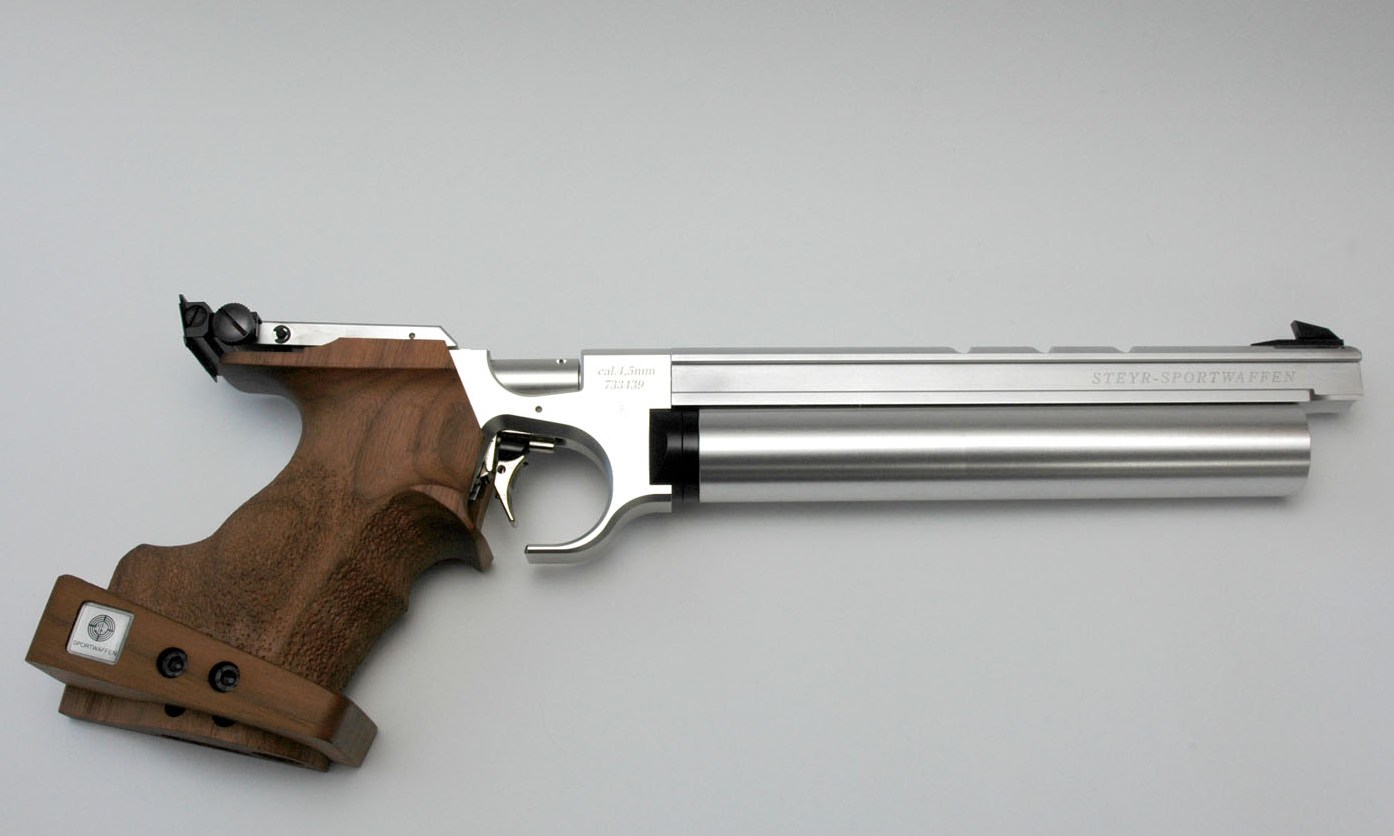
To promote comfortable and accurate shooting from a standing position, match air pistols must have fast lock times, shoot with little recoil or vibration, and exhibit minimal movement and balance shifts during discharge. The pistol must also be able to be tailored by adjustable user interfaces and various accessories to an individual shooter's personal preferences. Combined with appropriate match pellets, the pistol must produce a consistent 10-ring performance so that a non maximal result during the initial phase can be attributed to the participant.
The pistols used are gas-driven with a caliber of 4.5 mm. The minimum trigger pull weight is 500 g, half that of a sport pistol. The grip restrictions are similar to sport pistols, but the box in which an air pistol must fit is larger: 42 by.Rule 8.16.0. {{citation |access-date = 2008-06-19 |archive-url = https://web.archive.org/web/20080617170750/http://www.issf-shooting.org/rules/english/2006/25_pistol_2005_2nd.html |archive-date = June 17, 2008}} This allows for longer sight lines and also gives room for cocking arms, although with a few exceptions (such as the Baikal IZH-46M) modern match air pistols use pre-filled air, or less commonly carbon dioxide, containers.{{citation |archive-url = https://archive.today/20130131111835/http://www.pilkguns.com/aphp/comphis.htm |url-status = dead |archive-date = January 31, 2013 |access-date = 2008-06-19 |access-date = 2008-06-19 |archive-url = https://web.archive.org/web/20080617170750/http://www.issf-shooting.org/rules/english/2006/25_pistol_2005_2nd.html |archive-date = June 17, 2008}}
_match_air_gun_pellet.jpg)

For the 10 metre air pistol and air rifle disciplines match, diabolo pellets are used. These pellets have wadcutter heads, meaning the front is (nearly) flat, which leave clean round holes in paper targets for easy scoring. Match pellets are offered in tins and more elaborate packages that avoid deformation and other damage that could impair their uniformity. Air gunners are encouraged to perform shooting group tests with their gun clamped in a machine rest to establish which particular match pellet type performs best for their particular air gun. To facilitate maximum performance out of various air guns, the leading match pellet manufacturers produce pellets with graduated "head sizes", which means the pellets are offered with front diameters from 4.48 mm up to 4.51 mm.
As in other ISSF pistol events, clothing that restricts the movement of joints for support is not allowed.Rule 8.4.7. {{citation |access-date = 2008-06-19 |archive-url = https://web.archive.org/web/20080617170750/http://www.issf-shooting.org/rules/english/2006/25_pistol_2005_2nd.html |archive-date = June 17, 2008}} Optical aids such as iris diaphragms or prescription glasses are allowed as long as they are not mounted on the pistol, which may have open sights only.Rule 8.4.2.3. {{citation |access-date = 2008-06-19 |archive-url = https://web.archive.org/web/20080617170750/http://www.issf-shooting.org/rules/english/2006/25_pistol_2005_2nd.html |archive-date = June 17, 2008}} Though shooting glasses are extremely customizable, most pairs contain three basic elements: a lens, a mechanical iris, and a blinder. These components work together to help shooters focus on both the faraway target and their gun's sights at the same time. Ear protection is recommended by the ISSFRule 8.2.8. {{citation |access-date = 2008-06-19 |archive-url = https://web.archive.org/web/20080617170750/http://www.issf-shooting.org/rules/english/2006/25_pistol_2005_2nd.html |archive-date = June 17, 2008}} as well as by coaches, who sometimes stress their usefulness in shutting out distracting noise rather than their necessity for safety reasons (paramount in other shooting disciplines).{{citation | access-date = 2008-06-04 | archive-url = https://web.archive.org/web/20071021213348/http://www.nrahq.org/education/airgun_safetyguide-1.pdf | archive-date = 21 October 2007 | url-status = dead |access-date = 2008-06-04 |archive-url = https://web.archive.org/web/20090305033158/http://www.tetrathlon.ca/marksmanship.pdf |archive-date = 2009-03-05 |url-status = dead
It is each shooter's responsibility to get his or her pistol and shoes validated in a specific area (the equipment control) prior to starting the competition. To discourage shooters from lowering the trigger pull weight after passing equipment control, random controls are conducted after the match. Failure to pass such controls results in immediate disqualification.Rule 8.4.2.6.3. {{citation |access-date = 2008-06-19 |archive-url = https://web.archive.org/web/20080617170750/http://www.issf-shooting.org/rules/english/2006/25_pistol_2005_2nd.html |archive-date = June 17, 2008}}
Match air pistols in production
- Baikal IZH-46M *available in the USA under Air Venturi Import, model AV-46M.
- Benelli Kite and Benelli Kite Young
- FAS 6004
- Feinwerkbau P8X and Feinwerkbau P11
- Hämmerli AP20
- Match Guns MGH1, MGH1- Light and Match Guns MGH1- Hybrid
- Morini CM 162 EI, Morini CM 162 MI, Morin I 162 EI- Titanium, and Morini 200 EI
- Pardini K10 & K12 and Pardini K10 & K12 Junior
- Steyr Evo 10, Steyr Evo 10E, Steyr LP 2 and Steyr LP 50
- Tesro PA 10-2
- Walther LP500
- Walther LP400
- Precihole PX50
Course of fire
Shooters are generally divided into four classes: men, junior men, women and junior women. The junior classes are included in most championships, with some notable exceptions (such as the Olympic Games and the ISSF World Cups). A shooter remains a junior up to and including the calendar year in which he or she becomes 21 years of age, although a junior may opt to participate in the main class instead.Rules 3.3.6 and 3.6.8.4.1. {{citation |access-date = 2008-06-19 |archive-url = https://web.archive.org/web/20080610044218/http://www.issf-shooting.org/rules/english/2006/06_genreg_2005_2nd.html |archive-date = June 10, 2008}} There are also ISSF Junior World Cups.
In both the qualification stage and the final stage, all shooting is supervised by a Chief Range Officer, whose duties include responsibility for the correct behaviour of all personnel, dealing with technical irregularities, and cooperation with the jury.Rules 8.2.7 and 8.5.1. {{citation |access-date = 2008-06-19 |archive-url = https://web.archive.org/web/20080617170750/http://www.issf-shooting.org/rules/english/2006/25_pistol_2005_2nd.html |archive-date = June 17, 2008}}
Qualification
For the qualification stage, the shooters are divided as necessary into relays.Rule 8.7.2. {{citation |access-date = 2008-06-19 |archive-url = https://web.archive.org/web/20080617170750/http://www.issf-shooting.org/rules/english/2006/25_pistol_2005_2nd.html |archive-date = June 17, 2008}} Each relay starts with a 15-minute preparation time during which the shooter may fire an unlimited number of sighting shots.Rule 8.6.4.4.2. {{citation |access-date = 2008-06-19 |archive-url = https://web.archive.org/web/20080617170750/http://www.issf-shooting.org/rules/english/2006/25_pistol_2005_2nd.html |archive-date = June 17, 2008}} Afterwards, the Chief Range Officer gives the command "match firing, start", indicating the start of the competition time. 60 competition shots must be shot within a 75-minute period time (90 minutes if no electronic targets are available). The 60 shots are usually organized in 6 ten-shot series for display on scoreboards.
Final
.jpg)
The top eight shooters in the qualification round advance to the final.Rule 8.14.2.1. {{citation |access-date = 2008-06-19 |archive-url = https://web.archive.org/web/20080617170750/http://www.issf-shooting.org/rules/english/2006/25_pistol_2005_2nd.html |archive-date = June 17, 2008}} Often, many shooters have the same score. The higher number of inner tens is the first tiebreaker. If two or more shooters have the same number of inner tens, the shooter with the highest score in the last ten-shot series is placed higher.
During the final, the score zones are divided into tenths (by means of a special gauge, in the absence of automatic scoring devices), so that each hit can give up to 10.9 points instead of the maximum 10 during the qualification. Electronic targets are required by the ISSF for finals at the Olympic Games, ISSF World Cups and ISSF World Championships.
After a five-minute sighting shot period and the presentation of the athletes to the audience, the athletes have 250 seconds to shoot five shots after the command "for the first competition series, load, start". The same command is given again for a second five shot series. After the tenth shot, separate commands are given for each competition shot with a time limit of 50 seconds per shot. After each two shots, the athlete with the lowest score is eliminated until two shooters are left to compete for the first place in the 23rd and 24th shot.
Current rules were introduced in 2017 after the 2016 Summer Olympics.
History

The air pistol event was introduced on the World Championship level in 1970,{{citation |access-date = 2008-06-04 |archive-url = https://web.archive.org/web/20080515143657/http://www.issf-shooting.org/championships/world_championships.asp#ap10 |archive-date = May 15, 2008}} and on the Olympic programme in 1988.{{citation |access-date = 2008-06-04 |archive-url = https://web.archive.org/web/20080410153213/http://www.issf-shooting.org/_data/medallist/ALL_OG_Medallists_1896_2000.pdf |archive-date = April 10, 2008}} Before 1985, when finals began to be used, championships were decided by the results of the 40 or 60 shot match (40 for women and 60 for men). Before 1982, the men's match also consisted of 40 shots.
As in many other ISSF events, the target for air pistol was reduced in size in 1989, also lowering the scores (although not by much), and thereby resetting all records. The development after this shows a contrast to that of air rifle shooting: whereas in air rifle the winning score of the 1989 World Championships would not have reached the final 17 years later,{{citation |archive-url = https://web.archive.org/web/20071008083015/http://www.issf.tv/getresultpdf.aspx?mod=&pane=0&inst=2006&iist=571&file=C100000IA2407060900.1.AR60.0.001.PDF |url-status = dead |archive-date = October 8, 2007 |access-date = 2008-06-19
Although competitions are no longer held outdoors, the most important competitions (Olympics, World Championships, World Cups) are still scheduled for the Northern Hemisphere summer season because they are combined with outdoor events such as 50m rifle and 25m pistol events. Many lesser international events, however, are held during the European indoor season between October and March, culminating in the European Championships each year. Most of these competitions are multi-day events held together with air rifle matches.{{citation |access-date = 2008-06-04 |archive-url = https://web.archive.org/web/20080611132155/http://www.esc-shooting.org/info/calendar.htm |archive-date = 2008-06-11 |url-status = dead
World Championships, Men
| Year | Place | Gold | Silver | Bronze |
|---|---|---|---|---|
| 1970 | USA Phoenix | Kornel Marosvari | Vladimir Stolipin | Harald Vollmar |
| 1974 | SUI Thun | Grigori Kosych | Corneliu Ion | Jean Faggion |
| 1978 | KOR Seoul | Paavo Palokangas | Seppo Saarenpää | Paulo Lamego |
| 1979 | KOR Seoul | Geoffrey Robinson | Thomas Guinn | Ragnar Skanåker |
| 1981 | DOM Santo Domingo | Don Nygord | Ljubtcho Diakov | Ragnar Skanåker |
| 1982 | VEN Caracas | Vladas Turla | Alexsander Melentiev | Anatoli Egrishin |
| 1983 | AUT Innsbruck | Ragnar Skanåker | Alexsander Melentiev | Anatoli Egrishin |
| 1985 | MEX Mexico City | Rolf Beutler | Jens Potteck | Pierre Brémond |
| 1986 | GDR Suhl | Igor Basinski | Uwe Potteck | Pierre Brémond |
| 1987 | HUN Budapest | Zoltán Papanitz | Alexsander Melentiev | Ljubtcho Diakov |
| 1989 | YUG Sarajevo | Sergei Pyzhianov | Uwe Potteck | Sorin Babii |
| 1990 | URS Moscow | Bernardo Tovar | István Ágh | Boris Kokorev |
| 1991 | NOR Stavanger | Uwe Potteck | Yifu Wang | Sorin Babii |
| 1994 | ITA Milan | Franck Dumoulin | Igor Basinski | Roberto Di Donna |
| 1998 | ESP Barcelona | Yifu Wang | Igor Basinski | Kanstantsin Lukashyk |
| 2002 | FIN Lahti | Mikhail Nestruev | Andrija Zlatić | Franck Dumoulin |
| 2006 | CRO Zagreb | Pang Wei | Jakkrit Panichpatikum | Vladimir Gontcharov |
| 2010 | GER Munich | Tomoyuki Matsuda | Andrija Zlatić | Jin Jong-oh |
| 2014 | ESP Granada | Jin Jong-oh | Yusuf Dikeç | Vladimir Gontcharov |
| 2018 | KOR Changwon | Jin Jong-oh | Artem Chernousov | Lee Dae-myung |
| 2022 | EGY Cairo | Liu Jinyao | Zhang Yifan | Pavlo Korostylov |
World Championships, Men's Team
| Year | Place | Gold | Silver | Bronze |
|---|---|---|---|---|
| 1970 | USA Phoenix | URS Soviet Union | ||
| Anatoli Egrishin | ||||
| Grigori Kosych | ||||
| Evgeni Raskazov | ||||
| Vladimir Stolipin | FIN Finland | |||
| Immo Huhtinen | ||||
| Seppo Makinen | ||||
| Matti Juhani Patteri | ||||
| Seppo Saarenpää | FRG West Germany | |||
| Heinrich Fretwurst | ||||
| Heinz Mertel | ||||
| Ernst Mueller | ||||
| Manfred Moeller | ||||
| 1974 | SUI Thun | URS Soviet Union | ||
| Anatoli Egrishin | ||||
| Grigori Kosych | ||||
| Valeri Margasov | ||||
| Vladimir Stolipin | FRG West Germany | |||
| Manfred Deichmann | ||||
| Heinrich Fretwurst | ||||
| Dieter Gruetz | ||||
| Wolfgang Labenski | GDR East Germany | |||
| Helmut Artelet | ||||
| Heinz Szurlies | ||||
| Matthias Hoeflitz | ||||
| Harald Vollmar | ||||
| 1978 | KOR Seoul | FIN Finland | ||
| Teemu Anttila | ||||
| Seppo Mäkinen | ||||
| Paavo Palokangas | ||||
| Seppo Saarenpää | BRA Brazil | |||
| Paulo Lamego | ||||
| Wilson Scheidemantel | ||||
| Benevenuto Tilli | ||||
| Bertino Souza | SWE Sweden | |||
| Weith Andersson | ||||
| Ove Gunnarsson | ||||
| Staffan Oscarsson | ||||
| Ragnar Skanåker | ||||
| 1979 | KOR Seoul | SWE Sweden | ||
| Weith Andersson | ||||
| Stig Borje Nilsson | ||||
| Staffan Oscarsson | ||||
| Ragnar Skanåker | United States | |||
| Jimmie Dorsey | ||||
| Don Hamilton | ||||
| Samual Hunter | ||||
| Don Nygord | KOR South Korea | |||
| Jang Sik Kim | ||||
| Won Suk Lee | ||||
| Tae Ho Lim | ||||
| Seung Lin Park | ||||
| 1981 | DOM Santo Domingo | BUL Bulgaria | ||
| Ljubtcho Diakov | ||||
| Liubcho Dimitrov | ||||
| Ivan Mandov | ||||
| Jean Mihov | SUI Switzerland | |||
| Rolf Beutler | ||||
| Roman Burkhard | ||||
| Jacques Alain Perrin | ||||
| Rene von Gunten | URS Soviet Union | |||
| Igor Basinski | ||||
| Anatoli Egrishin | ||||
| Alexander Sniezhko | ||||
| Sergei Sumatokhin | ||||
| 1982 | VEN Caracas | URS Soviet Union | ||
| Anatoli Egrishin | ||||
| Alexsander Melentiev | ||||
| Sergei Sumatokhin | ||||
| Vladas Turla | United States | |||
| Erich Buljung | ||||
| Jimmie Mc Coy | ||||
| Don Nygord | ||||
| Darius Young | SWE Sweden | |||
| Weith Andersson | ||||
| Stig Borje Nilsson | ||||
| Benny Oestlund | ||||
| Ragnar Skanåker | ||||
| 1983 | AUT Innsbruck | URS Soviet Union | ||
| Anatoli Egrishin | ||||
| Alexsander Melentiev | ||||
| Vladas Turla | SWE Sweden | |||
| Benny Oestlund | ||||
| Staffan Oscarsson | ||||
| Ragnar Skanåker | France | |||
| Jean Bilon | ||||
| Jacky Durand | ||||
| Remy Harang | ||||
| 1985 | MEX Mexico City | URS Soviet Union | ||
| Anatoli Egrishin | ||||
| Boris Kokorev | ||||
| Vladas Turla | France | |||
| Pierre Brémond | ||||
| Philippe Cola | ||||
| Remy Harang | United States | |||
| George Ross | ||||
| Arnold Vitarbo | ||||
| Darius Young | ||||
| 1986 | GDR Suhl | URS Soviet Union | ||
| Igor Basinski | ||||
| Boris Kokorev | ||||
| Alexsander Melentiev | France | |||
| Pierre Brémond | ||||
| Philippe Cola | ||||
| Remy Harang | GDR East Germany | |||
| Gernot Eder | ||||
| Jens Potteck | ||||
| Uwe Potteck | ||||
| 1987 | HUN Budapest | URS Soviet Union | ||
| Anatoli Egrishin | ||||
| Boris Kokorev | ||||
| Alexsander Melentiev | GDR East Germany | |||
| Gernot Eder | ||||
| Jens Potteck | ||||
| Uwe Potteck | BUL Bulgaria | |||
| Ljubtcho Diakov | ||||
| Tanyu Kiryakov | ||||
| Sabi Sabev | ||||
| 1989 | YUG Sarajevo | URS Soviet Union | ||
| Sergei Barmin | ||||
| Alexsander Melentiev | ||||
| Sergei Pyzhianov | ITA Italy | |||
| Roberto Di Donna | ||||
| Dario Palazzani | ||||
| Vincenzo Spilotro | HUN Hungary | |||
| Csaba Gyorik | ||||
| Zsolt Karacs | ||||
| Zoltán Papanitz | ||||
| 1990 | URS Moscow | URS Soviet Union | ||
| Boris Kokorev | ||||
| Mikhail Nestruev | ||||
| Sergei Pyzhianov | HUN Hungary | |||
| István Ágh | ||||
| Csaba Gyorik | ||||
| Zoltán Papanitz | GDR East Germany | |||
| Gernot Eder | ||||
| Uwe Potteck | ||||
| Jens Potteck | ||||
| 1991 | NOR Stavanger | URS Soviet Union | ||
| Sergei Barmin | ||||
| Boris Kokorev | ||||
| Sergei Pyzhianov | Germany | |||
| Gernot Eder | ||||
| Hans-Juergen Bauer-Neumaier | ||||
| Uwe Potteck | China | |||
| Jinbao Li | ||||
| Yifu Wang | ||||
| Haifeng Xu | ||||
| 1994 | ITA Milan | China | ||
| Haifeng Xu | ||||
| Yifu Wang | ||||
| Shengge Zhang | ITA Italy | |||
| Vigilio Fait | ||||
| Roberto Di Donna | ||||
| Vincenzo Spilotro | HUN Hungary | |||
| Csaba Gyorik | ||||
| Zsolt Karacs | ||||
| Zoltán Papanitz | ||||
| 1998 | ESP Barcelona | China | ||
| Yifu Wang | ||||
| Dan Xu | ||||
| Hui Wu | RUS Russia | |||
| Mikhail Nestruev | ||||
| Vladimir Gontcharov | ||||
| Boris Kokorev | BLR Belarus | |||
| Igor Basinski | ||||
| Kanstantsin Lukashyk | ||||
| Siarhei Yurusau | ||||
| 2002 | FIN Lahti | RUS Russia | ||
| Mikhail Nestruev | ||||
| Vladimir Gontcharov | ||||
| Vladimir Isakov | China | |||
| Yifu Wang | ||||
| Zongliang Tan | ||||
| Huaiyu Li | UKR Ukraine | |||
| Oleg Dronov | ||||
| Victor Makarov | ||||
| Ivan Rybovalov | ||||
| 2006 | CRO Zagreb | China | ||
| Wei Pang | ||||
| Zhongzai Lin | ||||
| Zongliang Tan | RUS Russia | |||
| Mikhail Nestruev | ||||
| Vladimir Isakov | ||||
| Vladimir Gontcharov | France | |||
| Walter Lapeyre | ||||
| Manuel Alexandre-Augrand | ||||
| Franck Dumoulin | ||||
| 2010 | GER Munich | RUS Russia | ||
| Sergey Chervyakovskiy | ||||
| Leonid Ekimov | ||||
| Vladimir Isakov | SRB Serbia | |||
| Andrija Zlatić | ||||
| Damir Mikec | ||||
| Dimitrije Grgic | KOR South Korea | |||
| Jin Jong-oh | ||||
| Lee Dae-myung | ||||
| Han Seung Woo | ||||
| 2014 | ESP Granada | China | ||
| Pang Wei | ||||
| Pu Qifeng | ||||
| Wang Zhiwei | ||||
| Jin Jong-oh | ||||
| Kim Cheong-Yong | ||||
| Lee Dae-myung | Russia | |||
| Vladimir Gontcharov | ||||
| Vladimir Isakov | ||||
| Sergey Chervyakovskiy | ||||
| 2018 | KOR Changwon | |||
| Lee Dae-myung | ||||
| Jin Jong-oh | ||||
| Han Seung-woo | India | |||
| Abhishek Verma | ||||
| Om Prakash Mitharwal | ||||
| Shahzar Rizvi | Russia | |||
| Artem Chernousov | ||||
| Denis Koulakov | ||||
| Anton Gourianov | ||||
| 2022 | EGY New Administrative Capital | China | ||
| Liu Jinyao | ||||
| Zhang Bowen | ||||
| Zhang Yifan | Iran | |||
| Mohammad Rasoul Effati | ||||
| Javad Foroughi | ||||
| Sajjad Pourhosseini | Korea | |||
| Lee Woon-ho | ||||
| Lee Dae-myung | ||||
| Park Dae-hun |
World Championships, Women
| Year | Place | Gold | Silver | Bronze |
|---|---|---|---|---|
| 1970 | USA Phoenix | Sally Carroll | Nina Rasskazova | Nina Stolyarova |
| 1974 | SUI Thun | Zinaida Simonian | Anisoara Matei | Nina Stolyarova |
| 1978 | KOR Seoul | Kerstin Hansson | Gun Naesman | Yang Ja Moon |
| 1979 | KOR Seoul | Ruby Fox | Patricia Dench | Sally Carroll |
| 1981 | DOM Santo Domingo | Nonna Kalinina | Kerstin Bodin | Marina Dobrantcheva |
| 1982 | VEN Caracas | Marina Dobrantcheva | Auksne Treinite | Inna Rose |
| 1983 | AUT Innsbruck | Kerstin Bodin | Julita Macur | Yang Ja Kim |
| 1985 | MEX Mexico City | Marina Dobrantcheva | Irada Ashumova | Maritha Karlsson |
| 1986 | GDR Suhl | Anke Voelker | Marina Dobrantcheva | Haiying Liu |
| 1987 | HUN Budapest | Jasna Brajkovic | Svetlana Smirnova | Anne Goffin |
| 1989 | YUG Sarajevo | Nino Salukvadze | Jasna Šekarić | Lieselotte Breker |
| 1990 | URS Moscow | Jasna Šekarić | Marina Logvinenko | Svetlana Smirnova |
| 1991 | NOR Stavanger | Marina Logvinenko | Shuanghong Li | Margit Stein |
| 1994 | ITA Milan | FR Yugoslavia Jasna Šekarić (IOP) | Margit Stein | Galina Belyayeva |
| 1998 | ESP Barcelona | Munkhbayar Dorjsuren | Yoko Inada | Lalita Yauhleuskaya |
| 2002 | FIN Lahti | Olena Kostevych | Nino Salukvadze | Olga Kousnetsova |
| 2006 | CRO Zagreb | Natalia Paderina | Jun Hu | Viktoria Chaika |
| 2010 | GER Munich | Zorana Arunović | Lalita Yauhleuskaya | Viktoria Chaika |
| 2014 | ESP Granada | Jung Jeehae | Olena Kostevych | Chiaying Wu |
| 2018 | KOR Changwon | Anna Korakaki | Zorana Arunović | Kim Bo-mi |
| 2022 | EGY New Administrative Capital | Lu Kaiman | Anna Korakaki | Zorana Arunovic |
World Championships, Women's Team
| Year | Place | Gold | Silver | Bronze |
|---|---|---|---|---|
| 1970 | USA Phoenix | URS Soviet Union | ||
| Nina Stoliarova | ||||
| Nina Rasskazova | ||||
| Nadezda Ibragimova | FRG West Germany | |||
| Ortrud Feickert | ||||
| Karin Fitzner | ||||
| Ruth Kasten | United States | |||
| Lucile Chambliss | ||||
| Sally Carroll | ||||
| Barbara Hile | ||||
| 1974 | SUI Thun | URS Soviet Union | ||
| Zinaida Simonian | ||||
| Nina Stoliarova | ||||
| Galina Zarikova | United States | |||
| Sharon Best | ||||
| Barbara Hile | ||||
| Ruby Fox | FRG West Germany | |||
| Karin Fitzner | ||||
| Ruth Kasten | ||||
| Ortrud Feickert | ||||
| 1978 | KOR Seoul | SWE Sweden | ||
| Kerstin Hansson | ||||
| Gun Näsman | ||||
| Ingridh Strömqvist | AUS Australia | |||
| Julie Aitken | ||||
| Patricia Dench | ||||
| Maureen Hill | KOR South Korea | |||
| Kwan Seok Kang | ||||
| Yang Ja Kim | ||||
| Yang Ja Moon | ||||
| 1979 | KOR Seoul | United States | ||
| Sally Carroll | ||||
| Ruby Fox | ||||
| Patricin Olsowsky | SWE Sweden | |||
| Kerstin Hansson | ||||
| Gun Naesman | ||||
| Sally Remmert | GBR Great Britain | |||
| Carol Bartlett | ||||
| Rosemarie Edgar | ||||
| Trudy Henry | ||||
| 1981 | DOM Santo Domingo | URS Soviet Union | ||
| Marina Dobrantcheva | ||||
| Nonna Kalinina | ||||
| Zinaida Simonian | SUI Switzerland | |||
| Veronica Edelmann | ||||
| Doris Hafen | ||||
| Elisabeth Sager | United States | |||
| Carol Baker | ||||
| Ruby Fox | ||||
| Sally Carroll | ||||
| 1982 | VEN Caracas | URS Soviet Union | ||
| Marina Dobrantcheva | ||||
| Inna Rose | ||||
| Auksne Treinite | China | |||
| Jianmin Gao | ||||
| Yi Nang | ||||
| Zhifang Wen | SWE Sweden | |||
| Monica Aberg | ||||
| Chris Johansson | ||||
| Gun Naesman | ||||
| 1983 | AUT Innsbruck | SWE Sweden | ||
| Monica Aberg | ||||
| Kerstin Bodin | ||||
| Sally Remmert | AUT Austria | |||
| Corinna Hoffmann | ||||
| Christine Strahalm | ||||
| Christa Werk | United States | |||
| Sally Carroll | ||||
| Ruby Fox | ||||
| Cathy Graham | ||||
| 1985 | MEX Mexico City | URS Soviet Union | ||
| Irada Ashumova | ||||
| Marina Dobrantcheva | ||||
| Inna Rose | SWE Sweden | |||
| Kerstin Bodin | ||||
| Britt Marie Ellis | ||||
| Maritha Karlsson | FRG West Germany | |||
| Angelika Hermann | ||||
| Kirsten Steinert | ||||
| Margit Stein | ||||
| 1986 | GDR Suhl | URS Soviet Union | ||
| Marina Dobrantcheva | ||||
| Irina Kotcherova | ||||
| Lalita Tsvetkova | GDR East Germany | |||
| Diana Mueller | ||||
| Heidrun Richter | ||||
| Anke Voelker | SWE Sweden | |||
| Kerstin Bodin | ||||
| Britt Marie Ellis | ||||
| Maritha Karlsson | ||||
| 1987 | HUN Budapest | URS Soviet Union | ||
| Nino Salukvadze | ||||
| Svetlana Smirnova | ||||
| Lalita Tsvetkova | POL Poland | |||
| Dorota Bidolach | ||||
| Maria Janicka-Janda | ||||
| Julita Macur | FRG West Germany | |||
| Lieselotte Breker | ||||
| Anetta Kalinowski | ||||
| Margit Stein | ||||
| 1989 | YUG Sarajevo | FRG West Germany | ||
| Lieselotte Breker | ||||
| Anetta Kalinowski | ||||
| Margit Stein | URS Soviet Union | |||
| Olga Shilenok | ||||
| Nino Salukvadze | ||||
| Svetlana Smirnova | HUN Hungary | |||
| Agnes Ferencz | ||||
| Anna Gonczi | ||||
| Marta Kotroczo | ||||
| 1990 | URS Moscow | URS Soviet Union | ||
| Marina Logvinenko | ||||
| Nino Salukvadze | ||||
| Svetlana Smirnova | FRG Federal Republic of Germany | |||
| Lieselotte Breker | ||||
| Monika Schilleder | ||||
| Margit Stein | BUL Bulgaria | |||
| Mariya Grozdeva | ||||
| Margarita Shkodrova | ||||
| Tania Staneva | ||||
| 1991 | NOR Stavanger | URS Soviet Union | ||
| Olga Klochneva | ||||
| Marina Logvinenko | ||||
| Nino Salukvadze | Germany | |||
| Lieselotte Breker | ||||
| Margit Stein | ||||
| Anke Voelker | YUG Yugoslavia | |||
| Ksenja Macek | ||||
| Jasna Šekarić | ||||
| Mirela Skoko | ||||
| 1994 | ITA Milan | China | ||
| Xiaoping Fan | ||||
| Duihong Li | ||||
| Ge Ma | BUL Bulgaria | |||
| Diana Iorgova | ||||
| Mariya Grozdeva | ||||
| Tania Staneva | Germany | |||
| Doreen Mueller | ||||
| Margit Stein | ||||
| Anke Voelker | ||||
| 1998 | ESP Barcelona | RUS Russia | ||
| Galina Beliaeva | ||||
| Svetlana Smirnova | ||||
| Marina Logvinenko | China | |||
| Yeqing Cai | ||||
| Jie Ren | ||||
| Luna Tao | Germany | |||
| Carmen Meininger | ||||
| Margit Stein | ||||
| Anke Schumann | ||||
| 2002 | FIN Lahti | RUS Russia | ||
| Olga Kousnetsova | ||||
| Svetlana Smirnova | ||||
| Galina Beliaeva | BLR Belarus | |||
| Viktoria Chaika | ||||
| Liudmila Chabatar | ||||
| Yuliya Alipava | China | |||
| Luna Tao | ||||
| Ying Chen | ||||
| Jie Ren | ||||
| 2006 | CRO Zagreb | China | ||
| Jun Hu | ||||
| Fengji Fei | ||||
| Ying Chen | BLR Belarus | |||
| Viktoria Chaika | ||||
| Liudmila Chabatar | ||||
| Yauheniya Haluza | RUS Russia | |||
| Natalia Paderina | ||||
| Olga Kousnetsova | ||||
| Svetlana Smirnova | ||||
| 2010 | GER Munich | AUS Australia | ||
| Lalita Yauhleuskaya | ||||
| Dina Aspandiyarova | ||||
| Linda Ryan | KOR South Korea | |||
| Lee Ho-Lim | ||||
| Kim Byung-Hee | ||||
| Park Min-Jin | China | |||
| Guo Wenjun | ||||
| Su Yuling | ||||
| Zhang Jingjing | ||||
| 2014 | ESP Granada | |||
| Jasna Šekarić | ||||
| Bobana Veličković | ||||
| Zorana Arunović | China | |||
| Guo Wenjun | ||||
| Zhang Mengyuan | ||||
| Zhou Qingyuan | ||||
| Renáta Tobai-Sike | ||||
| Zsófia Csonka | ||||
| Adrienn Nemes | ||||
| 2018 | KOR Changwon | China | ||
| Jiang Ranxin | ||||
| Wang Qian | ||||
| Ji Xiaojing | ||||
| Kim Min-jung | ||||
| Kim Bo-mi | ||||
| Kwak Jung-hye | Russia | |||
| Vitalina Batsarashkina | ||||
| Margarita Lomova | ||||
| Svetlana Medvedeva | ||||
| 2022 | EGY New Administrative Capital | China | ||
| Jiang Ranxin | ||||
| Li Xue Yan | ||||
| Lu Kaiman | India | |||
| Palak Palak | ||||
| Rhythm Sangwan | ||||
| Yuvika Tomar | Iran | |||
| Mina Ghorbani | ||||
| Hanieh Rostamian | ||||
| Golnoush Sebghatollahi |
World Championships, Mixed Team
| Year | Place | Gold | Silver | Bronze |
|---|---|---|---|---|
| 2018 | KOR Changwon | Russia | ||
| Vitalina Batsarashkina | ||||
| Artem Chernousov | China | |||
| Wang Qian | ||||
| Wang Mengyi | ||||
| Olena Kostevych | ||||
| Oleh Omelchuk | ||||
| 2022 | EGY New Administrative Capital | Austria | ||
| Sylvia Steiner | ||||
| Richard Zechmeister | Korea | |||
| Yoo Hyun-young | ||||
| Park Dae-hun | Iran | |||
| Hanieh Rostamian | ||||
| Javad ForoughiChina | ||||
| Jiang Ranxin | ||||
| Zhang Bowen |
World Championships, total medals
Current world records
| Current world records in 10 metre air pistol | 246.3 | 1732 | 585 | 244.7 | 1721 | 586 | 586 |
|---|---|---|---|---|---|---|---|
| Men | |||||||
| Junior Men | |||||||
| Final | Saurabh Chaudhary | May 27, 2019 | Munich | ||||
| Teams | (Lim, Sung, Shin) | September 6, 2018 | Changwon | ||||
| Women | |||||||
| Junior Women | Individual | Julieta Mautone | May 29, 2019 | Munich | |||
| Final | Manu Bhaker | November 21, 2019 | Putian | ||||
| Teams | India (Singh, Raghav, Tomar) | November 7, 2019 | Doha | ||||
| Mixed Team | Qualification | Manu Bhaker | |||||
| Saurabh Chaudhary | May 30, 2019 | Munich | |||||
| Junior Mixed Team | Qualification | Manu Bhaker | |||||
| Saurabh Chaudhary | May 30, 2019 | Munich |
Olympic and World Champions
The ISSF publishes lists of historical champions.{{citation |access-date = 2008-06-19 |archive-url = https://web.archive.org/web/20070927023531/http://www.issf-shooting.org/_data/medallist/WCH_Medallists_1897_2005.pdf |archive-date = September 27, 2007}}
Men
A green background indicates the Olympic champion.
| Year | Venue | Individual | Team | Junior Men | Individual | Team |
|---|---|---|---|---|---|---|
| 1970 | Phoenix | Kornel Marosvari | Soviet Union | |||
| 1974 | Thun | Grigori Kosych | Soviet Union | |||
| 1978 | Seoul | Paavo Palokangas | ||||
| 1979 | Seoul | Geoffrey Robinson | Sweden | |||
| 1981 | Santo Domingo | Don Nygord | ||||
| 1982 | Caracas | Vladas Turla | ||||
| 1983 | Innsbruck | Ragnar Skanåker | ||||
| 1985 | Mexico City | Rolf Beutler | ||||
| 1986 | Suhl | Igor Basinski | ||||
| 1987 | Budapest | Zoltán Papanitz | ||||
| 1988 | Seoul | Tanyu Kiryakov | ||||
| 1989 | Sarajevo | Sergei Pyzhianov | Andrei Kandikov | |||
| 1990 | Moscow | Bernardo Tovar | ||||
| 1991 | Stavanger | Uwe Potteck | Kanstantsin Lukashyk | France | ||
| 1992 | Barcelona | Wang Yifu | ||||
| 1994 | Milan | Franck Dumoulin | China | Alexander Wiskepzev | ||
| 1996 | Atlanta | Roberto Di Donna | ||||
| 1998 | Barcelona | Wang Yifu | China | Teemu Tiainen | ||
| 2000 | Sydney | Franck Dumoulin | ||||
| 2002 | Lahti | Mikhail Nestruyev | Russia | Denis Kulakov | ||
| 2004 | Athens | Wang Yifu | ||||
| 2006 | Zagreb | Pang Wei | China | Pu Qifeng | China | |
| 2008 | Beijing | Pang Wei | ||||
| 2010 | Munich | Tomoyuki Matsuda | Russia | Zhang Bin | China | |
| 2012 | London | Jin Jong-oh | ||||
| 2014 | Granada | Jin Jong-oh | China | Alexander Kindig | ||
| 2016 | Rio de Janeiro | Hoàng Xuân Vinh | ||||
| 2018 | Changwon | Jin Jong-oh | Saurabh Chaudhary | |||
| 2020 | Tokyo | Javad Foroughi |
Women
A green background indicates the Olympic champion.
| Year | Venue | Individual | Team | Junior Women | Individual | Team |
|---|---|---|---|---|---|---|
| 1970 | Phoenix | Sally Carroll | Soviet Union | |||
| 1974 | Thun | Zinaida Simonian | ||||
| 1978 | Seoul | Kerstin Hansson | Sweden | |||
| 1979 | Seoul | Ruby Fox | United States | |||
| 1981 | Santo Domingo | Nonna Kalinina | ||||
| 1982 | Caracas | Marina Dobrantcheva | ||||
| 1983 | Innsbruck | Kerstin Bodin | Sweden | |||
| 1985 | Mexico City | Marina Dobrantcheva | ||||
| 1986 | Suhl | Anke Völker | ||||
| 1987 | Budapest | Jasna Brajković | ||||
| 1988 | Seoul | Jasna Šekarić | ||||
| 1989 | Sarajevo | Nino Salukvadze | Mirosława Sagun-Lewandowska | Poland | ||
| 1990 | Moscow | Jasna Šekarić | ||||
| 1991 | Stavanger | Marina Logvinenko | Stefanie Koch | France | ||
| 1992 | Barcelona | Marina Logvinenko | ||||
| 1994 | Milan | Jasna Šekarić | China | Karen Macary | ||
| 1996 | Atlanta | Olga Klochneva | ||||
| 1998 | Barcelona | Dorjsürengiin Mönkhbayar | Russia | Viktoria Chaika | ||
| 2000 | Sydney | Tao Luna | ||||
| 2002 | Lahti | Olena Kostevych | Russia | Katarzyna Szymanska | China | |
| 2004 | Athens | Olena Kostevych | ||||
| 2006 | Zagreb | Natalia Paderina | China | Brankica Zarić | China | |
| 2008 | Beijing | Guo Wenjun | ||||
| 2010 | Munich | Zorana Arunović | Australia | Khongorzul Tsagaandalai | ||
| 2012 | London | Guo Wenjun | ||||
| 2014 | Granada | Jung Jee-hae | Lin Yuemei | Poland | ||
| 2016 | Rio de Janeiro | Zhang Mengxue | ||||
| 2018 | Changwon | Anna Korakaki | China | Sevval Ilayda Tarhan | ||
| 2020 | Tokyo | Vitalina Batsarashkina | ||||
| 2022 | Cairo | Lu Kaiman | China | Wang Siyu |
Footnotes
References
References
- (2017). "ISSF Rulebook".
- (2017). "ISSF Rulebook".
- ISSF RuleBook 2013, Rule 6.4.6.1
- [http://www.nealjguns.com/pdfcatalog/Tgtammo.pdf Air Gun Testing Target Pellets] {{webarchive. link. (March 27, 2009)
- (January 16, 2006). "Special Technical Rules for Pistol Shooting". [[International Shooting Sport Federation]].
This article was imported from Wikipedia and is available under the Creative Commons Attribution-ShareAlike 4.0 License. Content has been adapted to SurfDoc format. Original contributors can be found on the article history page.
Ask Mako anything about ISSF 10 meter air pistol — get instant answers, deeper analysis, and related topics.
Research with MakoFree with your Surf account
Create a free account to save articles, ask Mako questions, and organize your research.
Sign up freeThis content may have been generated or modified by AI. CloudSurf Software LLC is not responsible for the accuracy, completeness, or reliability of AI-generated content. Always verify important information from primary sources.
Report