From Surf Wiki (app.surf) — the open knowledge base
Islamic world
Muslim-majority countries, states, districts, or towns
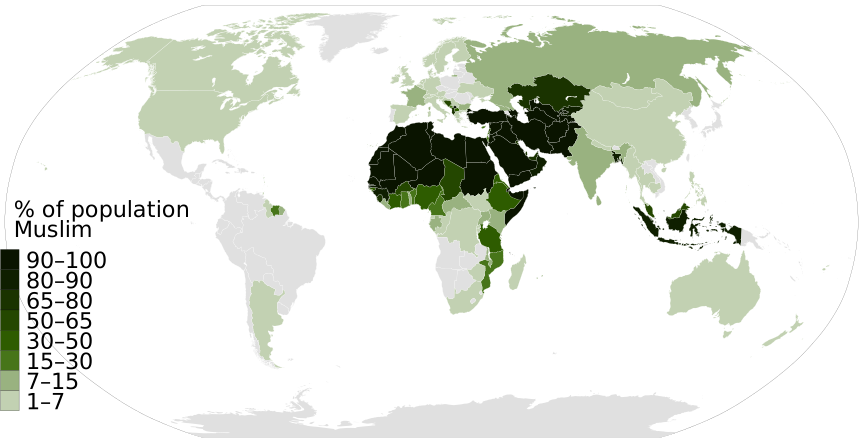
Muslim-majority countries, states, districts, or towns
The terms Islamic world and Muslim world commonly refer to the Islamic community, which is also known as the Ummah. This consists of all those who adhere to the religious beliefs, politics, and laws of Islam or to societies in which Islam is practiced. In a modern geopolitical sense, these terms refer to countries in which Islam is widespread, although there are no agreed criteria for inclusion. The term Muslim-majority countries is an alternative often used for the latter sense.
The history of the Muslim world spans about 1,400 years and includes a variety of socio-political developments, as well as advances in the arts, science, medicine, philosophy, law, economics and technology during the Islamic Golden Age. Muslims look for guidance to the Quran and believe in the prophetic mission of the Islamic prophet Muhammad, but disagreements on other matters have led to the appearance of different religious schools of thought and sects within Islam. The Islamic conquests, which culminated in the Caliphate being established across three continents (Asia, Africa, and Europe), enriched the Muslim world, achieving the economic preconditions for the emergence of this institution owing to the emphasis attached to Islamic teachings. In the modern era, most of the Muslim world came under European colonial domination. The nation states that emerged in the post-colonial era have adopted a variety of political and economic models, and they have been affected by secular as well as religious trends.
, the combined GDP (nominal) of 50 Muslim majority countries was US$5.7 trillion. , they contributed 8% of the world's total. In 2020, the Economy of the Organisation of Islamic Cooperation which consists of 57 member states had a combined GDP(PPP) of US$ 24 trillion which is equal to about 18% of world's GDP or US$ 30 trillion with 5 OIC observer states which is equal to about 22% of the world's GDP. Some OIC member countries - Ivory Coast, Guyana, Gabon, Mozambique, Nigeria, Suriname, Togo and Uganda are not Muslim-majority.
As of 2020, 1.8 billion or more than 25% of the world population are Muslims. By the percentage of the total population in a region considering themselves Muslim, 91% in the Middle East-North Africa (MENA), 89% in Central Asia, 40% in Southeast Asia, 31% in South Asia, 30% in Sub-Saharan Africa, 25% in Asia, 1.4% in Oceania, 6% in Europe, and 1% in the Americas.
Most Muslims are of one of two denominations: Sunni Islam (87–90%)*
- Sunni Islam: Oxford Bibliographies Online Research Guide "Sunni Islam is the dominant division of the global Muslim community, and throughout history it has made up a substantial majority (85 to 90 percent) of that community."
- and Shia (10–13%).See
- However, other denominations exist in pockets, such as Ibadi (primarily in Oman). Muslims who do not belong to, do not self-identify with, or cannot be readily classified under one of the identifiable Islamic schools and branches are known as non-denominational Muslims. About 13% of Muslims live in Indonesia, the largest Muslim-majority country; % of Muslims live in South Asia, the largest population of Muslims in the world; % in the Middle East–North Africa, where it is the dominant religion; and 15% in Sub-Saharan Africa and West Africa (primarily in Nigeria). Muslims are the overwhelming majority in Central Asia, make up half of the Caucasus, and widespread in Southeast Asia. India has the largest Muslim population outside Muslim-majority countries. Pakistan, Bangladesh, Iran, and Egypt are home to the world’s second, fourth, sixth and seventh largest Muslim populations respectively. Sizeable Muslim communities are also found in the Americas, Russia, India, China, and Europe. Islam is the fastest-growing major religion in the world partially due to their high birth rate, according to the same study, religious switching has no impact on Muslim population, since the number of people who embrace Islam and those who leave Islam are roughly equal. China has the third largest Muslim population outside Muslim-majority countries, while Russia has the fifth largest Muslim population. Nigeria has the largest Muslim population in Africa, while Indonesia has the largest Muslim population in Asia.
Terminology
The term has been documented as early as 1912 to encompass the influence of perceived pan-Islamic propaganda. The Times described Pan-Islamism as a movement with power, importance, and cohesion born in Paris, where Turks, Arabs and Persians congregated. The correspondent's focus was on India: it would take too long to consider the progress made in various parts of the Muslim world. The article considered the position of the Amir, the effect of the Tripoli Campaign, Anglo-Russian action in Persia, and "Afghan Ambitions".
In a modern geopolitical sense, the terms 'Muslim world' and 'Islamic world' refer to countries in which Islam is widespread, although there are no agreed criteria for inclusion. Moreover, the idea of a uniform Muslim world is imagined. Emerging in popular discourse in the nineteenth century, imperialists used the term to emphasize the civilizational differences between east and west. In opposition to colonization some Muslims started using the term in attempts at providing a unified front against western imperialism. Hence, the term 'Muslim-majority countries' is often preferred in literature.
History

The history of the Islamic faith as a religion and social institution begins with its inception around 610 CE, when the Islamic prophet Muhammad, a native of Mecca, is believed by Muslims to have received the first revelation of the Quran, and began to preach his message. In 622 CE, facing opposition in Mecca, he and his followers migrated to Yathrib (now Medina), where he was invited to establish a new constitution for the city under his leadership. This migration, called the Hijra, marks the first year of the Islamic calendar. By the time of his death, Muhammad had become the political and spiritual leader of Medina, Mecca, the surrounding region, and numerous other tribes of Arabia.
After Muhammad died in 632, his successors (the Caliphs) continued to lead the Muslim community based on his teachings and guidelines of the Quran. The majority of Muslims consider the first four successors to be 'rightly guided' or Rashidun. The conquests of the Rashidun Caliphate helped to spread Islam beyond the Arabian Peninsula, stretching from northwest India, across Central Asia, the Near East, North Africa, southern Italy, and the Iberian Peninsula, to the Pyrenees. The Arab Muslims were unable to conquer the entire Christian Byzantine Empire in Asia Minor during the Arab–Byzantine wars, however. The succeeding Umayyad Caliphate attempted two failed sieges of Constantinople in 674–678 and 717–718. Meanwhile, the Muslim community tore itself apart into the rivalling Sunni and Shia sects since the killing of caliph Uthman in 656, resulting in a succession crisis that has never been resolved. The following First, Second and Third Fitnas and finally the Abbasid Revolution (746–750) also definitively destroyed the political unity of the Muslims, who have been inhabiting multiple states ever since. Ghaznavids' rule was succeeded by the Ghurid Empire of Muhammad of Ghor and Ghiyath al-Din Muhammad, whose reigns under the leadership of Muhammad Bakhtiyar Khalji extended until the Bengal, where South Asian Islamic missionaries achieved their greatest success in terms of dawah and number of converts to Islam. Qutb ud-Din Aibak conquered Delhi in 1206 and began the reign of the Delhi Sultanate, a successive series of dynasties that synthesized Indian civilization with the wider commercial and cultural networks of Africa and Eurasia, greatly increased demographic and economic growth in India and deterred Mongol incursion into the prosperous Indo-Gangetic Plain and enthroned one of the few female Muslim rulers, Razia Sultana. Notable major empires dominated by Muslims, such as those of the Abbasids, Fatimids, Almoravids, Gao Empire, Seljukids, largest contiguous Songhai Empire (15th-16th centuries) of Sahel, West Africa, southern North Africa and western Central Africa which dominated the centers of Islamic knowledge of Timbuktu, Djenne, Oualata and Gao, Ajuran, Adal and Warsangali in Somalia, Mughals in the Indian subcontinent (India, Bangladesh, Pakistan, etc.), Safavids in Persia and Ottomans in Anatolia, Massina Empire, Sokoto Caliphate of northern Nigeria, Toucouleur Empire, were among the influential and distinguished powers in the world. 19th-century colonialism and 20th-century decolonisation have resulted in several independent Muslim-majority states around the world, with vastly differing attitudes towards and political influences granted to, or restricted for, Islam from country to country. These have revolved around the question of Islam's compatibility with other ideological concepts such as secularism, nationalism (especially Arab nationalism and Pan-Arabism, as opposed to Pan-Islamism), socialism (see also Arab socialism and socialism in Iran), democracy (see Islamic democracy), republicanism (see also Islamic republic), liberalism and progressivism, feminism, capitalism and more.
Gunpowder empires
Main article: Gunpowder empires
Scholars often use the term Age of the Islamic Gunpowders to describe period the Safavid, Ottoman and Mughal states. Each of these three empires had considerable military exploits using the newly developed firearms, especially cannon and small arms, to create their empires. They existed primarily between the fourteenth and the late seventeenth centuries. During the 17th–18th centuries, when the Indian subcontinent was ruled by Mughal Empire's sixth ruler Muhammad Auranzgeb through sharia and Islamic economics, India became the world's largest economy, valued 25% of world GDP.
File:Canonnier Persan. Auguste Wahlen. Moeurs, usages et costumes de tous les peuples du monde. 1843.jpg|Safavid Empire's Zamburak. File:Bullocks dragging siege-guns up hill during the attack on Ranthambhor Fort.jpg|Bullocks dragging siege-guns up hill during Mughal Emperor Akbar's Siege of Ranthambore Fort in 1568. File:The capture of Orchha by imperial forces (October 1635).jpg|The Mughal Army under the command of Islamist Aurangzeb recaptures Orchha in October 1635. File:OttomanJanissariesAndDefendingKnightsOfStJohnSiegeOfRhodes1522.jpg|Gun-wielding Ottoman Janissaries in combat against the Knights of Saint John at the Siege of Rhodes in 1522. File:The Dutch War in Sumatra, Guns captured at Acheen lying at Rotterdam.jpg|Cannons and guns belonging to the Aceh Sultanate (in modern Indonesia).
Great Divergence
Main article: Great Divergence
The Great Divergence was the reason why European colonial powers militarily defeated preexisting Oriental powers like the Mughal Empire, starting from the wealthy Bengal Subah, Tipu Sultan's Kingdom of Mysore, the Ottoman Empire and many smaller states in the pre-modern Greater Middle East, and initiated a period known as 'colonialism'.
File:Shah Alam II, Mughal emperor of india, reviewing the East India Companys troops.jpg|Mughal Emperor Shah Alam II negotiates with the East India Company after being defeated during the Battle of Buxar. File:Lord Clive meeting with Mir Jafar after the Battle of Plassey.jpg|East India Company's Robert Clive meeting the Nawabs of Bengal before the Battle of Plassey. File:January Suchodolski - Ochakiv siege.jpg|Siege of Ochakov (1788), an armed conflict between the Ottomans and the Russian Tsardom. File:Сражение под Елисаветполем.jpeg|Combat during the Russo-Persian Wars. File:Bataille du mont-thabor.jpg|French campaign in Egypt and Syria against the Mamluks and Ottomans.
Colonialism
Main article: Colonial empire, Colonialism

Beginning with the 15th century, colonialism by European powers profoundly affected Muslim-majority societies in Africa, Europe, the Middle East and Asia. Colonialism was often advanced by conflict with mercantile initiatives by colonial powers and caused tremendous social upheavals in Muslim-dominated societies.
A number of Muslim-majority societies reacted to Western powers with zealotry and thus initiating the rise of Pan-Islamism; or affirmed more traditionalist and inclusive cultural ideals; and in rare cases adopted modernity that was ushered by the colonial powers.
The only Muslim-majority regions not to be colonized by the Europeans were Saudi Arabia, Iran, Turkey, and Afghanistan. Turkey was one of the first colonial powers of the world with the Ottoman empire ruling several states for over 6 centuries.
File:Défense de Mazagran.jpg|The French conquest of Algeria, from 1830 to 1903 (Barcelona) La batalla de Tetuan - Marià Fortuny Marsal - MNAC.jpg|The Hispano-Moroccan War between Spain and Morocco, from 1859 to 1860 File:Libia-1911-Tripoli-conquista-bandiera-verde-del-profeta.jpg|The Italo-Turkish War between Italy and the Ottoman Empire from 1911 to 1912 File:Reprise Buda 1686.jpg|The Christian reconquest of Buda, Ottoman Hungary, 1686, painted by Frans Geffels File:Vernet-Combat de Somah.jpg|French conquest of Algeria (1830–1857) File:Battle of Omdurman.jpg|Anglo-Egyptian invasion of Sudan 1896–1899 File:1 5 Campaña Africa 1909.jpg|The Melilla War between Spain and Rif Berbers of Morocco in 1909
Postcolonial era
In the 20th century, the end of the European colonial domination has led to creation of a number of nation states with significant Muslim populations. These states drew on Islamic traditions to varying degree and in various ways in organizing their legal, educational and economic systems. The Times first documented the term "Muslim world" in 1912 when describing Pan-Islamism as a movement with power importance and cohesion born in Paris where Turks, Arabs and Persians congregated. The article considered The position of the Amir; the effect of the Tripoli Campaign; Anglo-Russian action in Persia; and "Afghan Ambitions".
A significant change in the Muslim world was the defeat and dissolution of the Ottoman Empire (1908–1922), to which the Ottoman officer and Turkish revolutionary statesman Mustafa Kemal Atatürk had an instrumental role in ending and replacing it with the Republic of Turkey, a modern, secular democracy (see Abolition of the Ottoman sultanate). The secular values of Kemalist Turkey, which separated religion from the state with the abolition of the Caliphate in 1924, have sometimes been seen as the result of Western influence.
In the 21st century, after the September 11 attacks (2001) coordinated by the Wahhabi Islamist terrorist group Al-Qaeda against the United States, scholars considered the ramifications of seeking to understand Muslim experience through the framework of secular Enlightenment principles. Muhammad Atta, one of the 11 September hijackers, reportedly quoted from the Quran to allay his fears: "Fight them, and God will chastise them at your hands/And degrade them, and He will help you/Against them, and bring healing to the breasts of a people who believe", referring to the ummah, the community of Muslim believers, and invoking the imagery of the early warriors of Islam who lead the faithful from the darkness of jahiliyyah.
By Sayyid Qutb's definition of Islam, the faith is "a complete divorce from jahiliyyah". He complained that American churches served as centers of community social life that were "very hard [to] distinguish from places of fun and amusement". For Qutb, Western society was the modern jahliliyyah. His understanding of the "Muslim world" and its "social order" was that, presented to the Western world as the result of practicing Islamic teachings, would impress "by the beauty and charm of true Islamic ideology". He argued that the values of the Enlightenment and its related precursor, the Scientific Revolution, "denies or suspends God's sovereignty on earth" and argued that strengthening "Islamic character" was needed "to abolish the negative influences of jahili life."
Islam by country
Main article: Islam by country
As the Muslim world came into contact with secular ideals, societies responded in different ways. Some Muslim-majority countries are secular. Azerbaijan became the first secular republic in the Muslim world, between 1918 and 1920, before it was incorporated into the Soviet Union.{{cite book |author-link = Tadeusz Swietochowski |access-date = 17 January 2018 |archive-url = https://web.archive.org/web/20180117131539/https://books.google.nl/books?id=cozSOSsv7ZsC&pg=129 |archive-date = 17 January 2018 |url-status = live
Some countries have declared Islam as the official state religion. In those countries, the legal code is largely secular. Only personal status matters pertaining to inheritance and marriage are governed by Sharia law. In some places, Muslims implement Islamic law, called sharia in Arabic. The Islamic law exists in a number of variations, called schools of jurisprudence. The Amman Message, which was endorsed in 2005 by prominent Islamic scholars around the world, recognized four Sunni schools (Hanafi, Maliki, Shafi'i, Hanbali), two Shia schools (Ja'fari, Zaidi), the Ibadi school, and the Zahiri school.
Government and religion (50)
Islamic states (8)
Eight Islamic states have adopted Islam as the ideological foundation of state and constitution.
- Afghanistan
- Brunei
- Iran
- Mauritania
- Oman
- Pakistan
- Saudi Arabia
- Yemen
State religion (17)
The following seventeen Muslim-majority states have endorsed Islam as their state religion, and though they may guarantee freedom of religion for citizens, do not declare a separation of state and religion:
- Algeria
- Bahrain
- Bangladesh
- Comoros
- Djibouti
- Egypt
- Iraq
- Jordan
- Kuwait
- Libya
- Malaysia
- Maldives
- Morocco
- Palestine
- Qatar
- Somalia
- United Arab Emirates
Secular states (25)
Twenty-four Secular states in the Muslim world have declared separation between civil/government affairs and religion.
- Albania
- Azerbaijan
- Bosnia and Herzegovina
- Burkina Faso
- Chad
- Gambia
- Guinea
- Guinea-Bissau
- Indonesia
- Kazakhstan
- Kosovo
- Kyrgyzstan
- Lebanon
- Mali
- Niger
- Nigeria
- Senegal
- Sierra Leone
- Sudan
- Syria
- Tajikistan
- Tunisia
- Turkey
- Turkmenistan
- Uzbekistan
Muslim-minority states (8)
According to the Pew Research Center in 2015 there were 50 Muslim-majority countries, which are shown in the Government and religion section above in the article. Apart from these, large Muslim populations exist in some countries where Muslims are a minority, and their Muslim communities are larger than many Muslim-majority nations:
- IND: 200 million Muslims (14.6%)
- ETH: 34.7 million Muslims (31.3%)
- CHN: 25–40 million Muslims (2–3%)
- TAN: 19.4 million Muslims (35.2%)
- RUS: 14–20 million Muslims (10–14%)
- CIV: 12 million Muslims (42%)
- DRC: 10 million Muslims (15%)
- PHL: 8–9 million Muslims (9–10%)
Politics

During much of the 20th century, the Islamic identity and the dominance of Islam on political issues have arguably increased during the early 21st century. The fast-growing interests of the Western world in Islamic regions, international conflicts and globalization have changed the influence of Islam on the world in contemporary history.
Islamism
Demographics
More than 24.1% of the world's population is Muslim, with an estimated total of approximately 1.9 billion. Muslims are the majority in 49 countries, they speak hundreds of languages and come from diverse ethnic backgrounds. The city of Karachi has the largest Muslim population in the world.
Geography
Main article: Islam by country

Because the terms 'Muslim world' and 'Islamic world' are disputed, since no country is homogeneously Muslim, and there is no way to determine at what point a Muslim minority in a country is to be considered 'significant' enough, there is no consensus on how to define the Muslim world geographically. The only rule of thumb for inclusion which has some support, is that countries need to have a Muslim population of more than 50%.
In 2010, 73% of the world's Muslim population lived in countries where Muslims are in the majority, while 27% of the world's Muslim population lived in countries where Muslims are in the minority. India's Muslim population is the world's largest Muslim-minority population in the world (11% of the world's Muslim population). Jones (2005) defines a "large minority" as being between 30% and 50%, which described nine countries in 2000, namely Eritrea, Ethiopia, Guinea-Bissau, Ivory Coast, Nigeria, North Macedonia, and Tanzania. As of 2024, however, Nigeria has become a Muslim-majority country.
Religion
Islam
The two main denominations of Islam are the Sunni and Shia sects. They differ primarily upon of how the life of the ummah ("faithful") should be governed, and the role of the imam. Sunnis believe that the true political successor of Muhammad according to the Sunnah should be selected based on ٍShura (consultation), as was done at the Saqifah which selected Abu Bakr, Muhammad's father-in-law, to be Muhammad's political but not his religious successor. Shia, on the other hand, believe that Muhammad designated his son-in-law Ali ibn Abi Talib as his true political as well as religious successor.
The overwhelming majority of Muslims in the world, between 87 and 90%, are Sunni. Shias and other groups make up the rest, about 10–13% of overall Muslim population. The countries with the highest concentration of Shia populations are: Iran – 89%, Azerbaijan – 65%, Iraq – 60%,{{cite book|first=John |last=Esposito |title=The Oxford Dictionary of Islam |publisher=Oxford University Press |year=2003|oclc= 52362778 |isbn=9780199891207}} Bahrain – 60%, Yemen – 35%, Turkey – 10%, Lebanon – 27%, Syria – 13%, Afghanistan – 10%, Pakistan – 10%, and India – 10%.
Non-denominational Muslims make up a majority of the Muslims in seven countries (and a plurality in three others): Albania (65%), Kyrgyzstan (64%), Kosovo (58%), Indonesia (56%), Mali (55%), Bosnia and Herzegovina (54%), Uzbekistan (54%), Azerbaijan (45%), Russia (45%), and Nigeria (42%). They are found primarily in Central Asia. Kazakhstan has the largest number of non-denominational Muslims, who constitute about 74% of the population. Southeastern Europe also has a large number of non-denominational Muslims.
The Kharijite Muslims, who are less known, have their own stronghold in the country of Oman holding about 75% of the population.
File:Muslims perform the Eid Al-Adha prayer at Eyup Sultan Mosque 2019-08-11 21.jpg|Turkish Muslims at the Eyüp Sultan Mosque on Eid al-Adha File:عزاداری شیعیان در ماه محرم 02.jpg|Shi'a Muslims in Iran commemorate Ashura File:Saying Juma Namaz (Friday prayer for Muslims), Dhaka, Bangladesh NK.JPG|Friday prayer for Sunni Muslims in Dhaka, Bangladesh
Islamic schools and branches
Main article: Islamic schools and branches

The first centuries of Islam gave rise to three major sects: Sunnis, Shi'as and Kharijites. Each sect developed distinct jurisprudence schools (madhhab) reflecting different methodologies of jurisprudence (fiqh).
The major Sunni madhhabs are Hanafi, Maliki, Shafi'i, and Hanbali.
The major Shi'a branches are Twelver (Imami), Ismaili (Sevener) and Zaidi (Fiver). Isma'ilism later split into Nizari Ismaili and Musta’li Ismaili, and then Mustaali was divided into Hafizi and Taiyabi Ismailis. It also gave rise to the Qarmatian movement and the Druze faith, although Druzes do not identify as Muslims. Twelver Shiism developed Ja'fari jurisprudence whose branches are Akhbarism and Usulism, and other movements such as Alawites, Shaykism and Alevism.
Similarly, Kharijites were initially divided into five major branches: Sufris, Azariqa, Najdat, Adjarites and Ibadis.
Among these numerous branches, only Hanafi, Maliki, Shafi'i, Hanbali, Imamiyyah-Ja'fari-Usuli, Nizārī Ismā'īlī, Alevi, Zaydi, Ibadi, Zahiri, Alawite, Druze and Taiyabi communities have survived. In addition, new schools of thought and movements like Quranist Muslims and Ahmadi Muslims later emerged independently.
File:Drummer at Hamed el-Nil Mosque (8625532075).jpg|A Sufi dervish drums up the Friday afternoon crowd in Omdurman, Sudan File:Flickr - Government Press Office (GPO) - Nebi Shueib Festival.jpg|Druze dignitaries celebrating the Nabi Shu'ayb festival at the tomb of the prophet in Hittin File:Ghardaia01.jpg|Ibadis living in the M'zab valley in Algerian Sahara File:Sanaa street.jpg|Zaydi Imams ruled in Yemen until 1962 File:Hunza Valley Karimabad.jpg|Most of the inhabitants of the Hunza Valley in Pakistan are Ismaili Muslims
File:Khataman Al-Qur'an anak-anak.jpg|Children read Qur'an in Indonesia. File:Grozny, Russia, Akhmad Kadyrov Mosque, Interiors, Praying.jpg|People pray together in the mosque in Russia. File:Muslim food street market, Xi'an, China - panoramio (2).jpg|People move close to the Muslim food corner in China. File:Rawdah by Uleke.jpg|People praying in the Prophet's Mosque (Medina, Saudi Arabia)
Other religions
There are sizeable non-Muslim minorities in many Muslim-majority countries, includes, Christians, Jews, Hindus, Buddhists, Baháʼís, Druzes, Yazidis, Mandaeans, Yarsanis and Zoroastrians.

The Muslim world is home to some of the world's most ancient Christian communities, and some of the most important cities of the Christian world—including three of its five great patriarchates (Alexandria, Antioch, and Constantinople). Scholars and intellectuals agree Christians have made significant contributions to Arab and Islamic civilization since the introduction of Islam, and they have had a significant impact contributing the culture of the Middle East and North Africa and other areas. Pew Research Center estimates indicate that in 2010, more than 64 million Christians lived in countries with Muslim majorities (excluding Nigeria). The Pew Forum study finds that Indonesia (21.1 million) has the largest Christian population in the Muslim world, followed by Egypt, Chad and Kazakhstan. While according to Adly A. Youssef and Martyn Thomas, in 2004, there were around 30 million Christians who lived in countries with Muslim majorities, with the largest Christian population number lived in Indonesia, followed by Egypt. Nigeria is divided almost evenly between Muslims and Christians, with more than 80 million Christians and Muslims.
In 2018, the Jewish Agency estimated that around 27,000 Jews live in Arab and Muslim countries. Jewish communities have existed across the Middle East and North Africa since the rise of Islam. Today, Jews residing in Muslim countries have been reduced to a small fraction of their former sizes, with the largest communities of Jews in Muslim countries exist in the non-Arab countries of Iran (9,500) and Turkey (14,500); both, however, are much smaller than they historically have been. Among Arab countries, the largest Jewish community now exists in Palestine with about 250,000 Jews, Morocco with about 2,000 Jews, and in Tunisia with about 1,000. The number of Druze worldwide is between 800,000 and one million, with the vast majority residing in the Levant (primarily in Syria and Lebanon).
In 2010, the Pew Forum study finds that Bangladesh (13.5 million), Indonesia (4 million), Pakistan (3.3 million) and Malaysia (1.7 million) has a sizeable Hindu minorities. Malaysia (5 million) has the largest Buddhist population in the Muslim world. Zoroastrians are the oldest remaining religious community in Iran.
File:The Cathedral Marina.jpg|Nigeria has the largest Christian population in the Muslim world File:Hurva Synagogue 07112018.jpg|Palestine has the largest Jewish population in the Muslim world File:4 attached Shiva temples in Dhakeshwari National Temple (Front Facing view).jpg|Bangladesh has the largest Hindu population in the Muslim world Penang Malaysia Wat-Chaiya-Mangkalaram-Temple-01.jpg|Malaysia has the largest Bhuddhist population in the Muslim world
Literacy and education
The literacy rate in the Muslim world varies. Azerbaijan is in second place in the Index of Literacy of World Countries. Some members such as Iran, Kuwait, Kazakhstan, Tajikistan and Turkmenistan have over 97% literacy rates, whereas literacy rates are the lowest in Mali, Afghanistan, Chad and other parts of Africa. Several Muslim-majority countries, such as Turkey, Iran and Egypt have a high rate of citable scientific publications.
In 2015, the International Islamic News Agency reported that nearly 37% of the population of the Muslim world is unable to read or write, basing that figure on reports from the Organisation of Islamic Cooperation and the Islamic Educational, Scientific and Cultural Organization. In Egypt, the largest Muslim-majority Arab country, the youth female literacy rate exceeds that for males. Lower literacy rates are more prevalent in South Asian countries such as in Afghanistan and Pakistan, but are rapidly increasing. In the Eastern Middle East, Iran has a high level of youth literacy at 98%, but Iraq's youth literacy rate has sharply declined from 85% to 57% during the American-led war and subsequent occupation. Indonesia, the largest Muslim-majority country in the world, has a 99% youth literacy rate.
A 2011 Pew Research Center showed that at the time about 36% of all Muslims had no formal schooling, with only 8% having graduate and post-graduate degrees. The highest of years of schooling among Muslim-majority countries found in Uzbekistan (11.5), Kuwait (11.0) and Kazakhstan (10.7). In addition, the average of years of schooling in countries in which Muslims are the majority is 6.0 years of schooling, which lag behind the global average (7.7 years of schooling). In the youngest age (25–34) group surveyed, Young Muslims have the lowest average levels of education of any major religious group, with an average of 6.7 years of schooling, which lag behind the global average (8.6 years of schooling). The study found that Muslims have a significant amount of gender inequality in educational attainment, since Muslim women have an average of 4.9 years of schooling, compared to an average of 6.4 years of schooling among Muslim men.
File:Schoolgirls in Bamozai.JPG|Young school girls in Paktia Province of Afghanistan. File:Niger_primary_school_MCC3500.jpg|A primary classroom in Niger. File:Girls lining up for class - Flickr - Al Jazeera English.jpg|Schoolgirls in Gaza lining up for class, 2009. File:Medical students before exam in saloon of moulages 1.JPG|Medical students of anatomy, before an exam in moulage, Iran
Refugees

According to the UNHCR, Muslim-majority countries hosted 18 million refugees by the end of 2010.
Since then Muslim-majority countries have absorbed refugees from recent conflicts, including the uprising in Syria. In July 2013, the UN stated that the number of Syrian refugees had exceeded 1.8 million. In Asia, an estimated 625,000 refugees from Rakhine, Myanmar, mostly Muslim, had crossed the border into Bangladesh since August 2017.
Culture
Throughout history, Muslim cultures have been diverse ethnically, linguistically and regionally. According to M. M. Knight, this diversity includes diversity in beliefs, interpretations and practices and communities and interests. Knight says perception of Muslim world among non-Muslims is usually supported through introductory literature about Islam, mostly present a version as per scriptural view which would include some prescriptive literature and abstracts of history as per authors own point of views, to which even many Muslims might agree, but that necessarily would not reflect Islam as lived on the ground, 'in the experience of real human bodies'.
Classical culture
Main article: History of Islam, Islamic Golden Age, Islamization, Spread of Islam
File:Mahmud in robe from the caliph.jpg|Sultan Mahmud of Ghazni receiving a richly decorated robe of honor from the caliph al-Qadir in 1000. Miniature from the Rashid al-Din's Jami' al-tawarikh File:1541-Battle in the war between Shah Isma'il and the King of Shirvan-Shahnama-i-Isma'il.jpg|Battle between Ismail of the Safaviyya and the ruler of Shirvan, Farrukh Yassar File:Shah Abbas I and Vali Muhammad Khan.jpg|Shah of Safavid Empire Abbas I meet with Vali Muhammad Khan File:Mir Sayyid Ali - Portrait of a Young Indian Scholar.jpg|Mir Sayyid Ali, a scholar writing a commentary on the Quran, during the reign of the Mughal Emperor Shah Jahan File:Ottoman Dynasty, Portrait of a Painter, Reign of Mehmet II (1444-1481).jpg|Portrait of a painter during the reign of Ottoman Sultan Mehmet II File:6 Dust Muhammad. Portrait of Shah Abu'l Ma‘ali. ca. 1556 Aga Khan Collection.jpg|A Persian miniature of Shah Abu'l Ma‘ali, a scholar File:DiezAlbumsStudyingTheKoran.jpg|Ilkhanate Empire ruler, Ghazan, studying the Quran File:Laila and Majnun in School, New-York.jpg|Layla and Majnun studying together, from a Persian miniature painting
The term "Islamic Golden Age" has been attributed to a period in history during which science, economic development and cultural works in most of the Muslim-dominated world flourished. The age is traditionally understood to have begun during the reign of the Abbasid caliph Harun al-Rashid (786–809) with the inauguration of the House of Wisdom in Baghdad, where scholars from various parts of the world sought to translate and gather all the known world's knowledge into Arabic, and to have ended with the collapse of the Abbasid caliphate due to Mongol invasions and the Siege of Baghdad in 1258. The Abbasids were influenced by the Quranic injunctions and hadiths, such as "the ink of a scholar is more holy than the blood of a martyr," that stressed the value of knowledge. The major Islamic capital cities of Baghdad, Cairo, and Córdoba became the main intellectual centers for science, philosophy, medicine, and education. During this period, the Muslim world was a collection of cultures; they drew together and advanced the knowledge gained from the ancient Greek, Roman, Persian, Chinese, Vedic, Egyptian, and Phoenician civilizations.
Ceramics

Between the 8th and 18th centuries, the use of ceramic glaze was prevalent in Islamic art, usually assuming the form of elaborate pottery. Tin-opacified glazing was one of the earliest new technologies developed by the Islamic potters. The first Islamic opaque glazes can be found as blue-painted ware in Basra, dating to around the 8th century. Another contribution was the development of fritware, originating from 9th-century Iraq. Other centers for innovative ceramic pottery in the Old world included Fustat (from 975 to 1075), Damascus (from 1100 to around 1600) and Tabriz (from 1470 to 1550).
Literature
Main article: Islamic literature
File:Brooklyn Museum - Manuscript of the Hadiqat al-Su`ada (Garden of the Blessed) of Fuzuli - Muhammad bin Sulayman known as Fuzuli2.jpg|Hadiqatus-suada by Oghuz Turkic poet Fuzûlî File:Princess Parizade Bringing Home the Singing Tree.jpg|The story of Princess Parizade and the Magic Tree. File:Cassim (cropped).jpg|Cassim in the Cave by Maxfield Parrish. File:Vasnetsov samolet.jpg|The Magic carpet.
The best known work of fiction from the Islamic world is One Thousand and One Nights, a compilation of folk tales from Sanskrit, Persian, and later Arabian fables. The concept had been influenced by a pre-Islamic Persian prototype Hezār Afsān (Thousand Fables) that relied on particular Indian elements. It reached its final form by the 14th century; the number and type of tales have varied from one manuscript to another. This work has been very influential in the West since it was translated in the 18th century, first by Antoine Galland. Imitations were written, especially in France. Various characters from this epic have themselves become cultural icons in Western culture, such as Aladdin, Sinbad the Sailor and Ali Baba.
An example of Arabic poetry and Persian poetry on romance is Layla and Majnun, dating back to the Umayyad era in the 7th century. It is a tragic story of undying love. Ferdowsi's Shahnameh, the national epic of Greater Iran, is a mythical and heroic retelling of Persian history. Amir Arsalan was also a popular mythical Persian story.
Ibn Tufayl (Abubacer) and Ibn al-Nafis were pioneers of the philosophical novel. Ibn Tufail wrote the first Arabic novel Hayy ibn Yaqdhan (Philosophus Autodidactus) as a response to Al-Ghazali's The Incoherence of the Philosophers, and then Ibn al-Nafis also wrote a novel Theologus Autodidactus as a response to Ibn Tufail's Philosophus Autodidactus. Both of these narratives had protagonists (Hayy in Philosophus Autodidactus and Kamil in Theologus Autodidactus) who were autodidactic feral children living in seclusion on a desert island, both being the earliest examples of a desert island story. However, while Hayy lives alone with animals on the desert island for the rest of the story in Philosophus Autodidactus, the story of Kamil extends beyond the desert island setting in Theologus Autodidactus, developing into the earliest known coming of age plot and eventually becoming the first example of a science fiction novel.
Theologus Autodidactus, written by the Arabian polymath Ibn al-Nafis (1213–1288), deals with various science fiction elements such as spontaneous generation, futurology, the end of the world and doomsday, resurrection, and the afterlife. Rather than giving supernatural or mythological explanations for these events, Ibn al-Nafis attempted to explain these plot elements using the scientific knowledge of biology, astronomy, cosmology and geology known in his time. Ibn al-Nafis' fiction explained Islamic religious teachings via science and Islamic philosophy. Translations of Ibn Tufail's Philosophus Autodidactus appeared in Latin (1671), English (1708), German, and Dutch. These European-language translations may have later inspired Daniel Defoe's Robinson Crusoe and Robert Boyle's The Aspiring Naturalist.
Philosophy
Main article: Contemporary Islamic philosophy

One of the common definitions for "Islamic philosophy" is "the style of philosophy produced within the framework of Islamic culture." Islamic philosophy, in this definition is neither necessarily concerned with religious issues, nor is exclusively produced by Muslims. The Persian scholar Ibn Sina (Avicenna) (980–1037) had more than 450 books attributed to him. His writings were concerned with various subjects, most notably philosophy and medicine. His medical textbook The Canon of Medicine was used as the standard text in European universities for centuries. He also wrote The Book of Healing, an influential scientific and philosophical encyclopedia.
Another figure from the Islamic Golden Age, Avicenna, also founded his own Avicennism school of philosophy, which was influential in both Islamic and Christian lands.
Yet another influential philosopher who had an influence on modern philosophy was Ibn Tufail. His philosophical novel, Hayy ibn Yaqdhan, translated into Latin as Philosophus Autodidactus in 1671, developed the themes of empiricism, tabula rasa, nature versus nurture, condition of possibility, materialism, and Molyneux's problem. European scholars and writers influenced by this novel include John Locke, Gottfried Leibniz, Melchisédech Thévenot, John Wallis, Christiaan Huygens, George Keith, Robert Barclay, the Quakers, and Samuel Hartlib.
Islamic philosophers continued making advances in philosophy through to the 17th century, when Mulla Sadra founded his school of Transcendent theosophy and developed the concept of existentialism.
Other influential Muslim philosophers include Ibn al-Haytham (Alhazen), a pioneer of phenomenology and the philosophy of science and a critic of Aristotelian natural philosophy and Aristotle's concept of place (topos); Al-Biruni, a critic of Aristotelian natural philosophy; Ibn al-Nafis, a pioneer of the philosophical novel; Shahab al-Din Suhrawardi, founder of Illuminationist philosophy; Fakhr al-Din al-Razi, a critic of Aristotelian logic and a pioneer of inductive logic; and Ibn Khaldun, a pioneer in the philosophy of history.
Sciences
Main article: Timeline of science and engineering in the Muslim world
Ibn al-Haytham is also regarded as the father of optics, especially for his empirical proof of the intromission theory of light. Jim Al-Khalili stated in 2009 that Ibn al-Haytham is 'often referred to as the "world's first true scientist".' al-Khwarzimi's invented the log base systems that are being used today, he also contributed theorems in trigonometry as well as limits. Recent studies show that it is very likely that the Medieval Muslim artists were aware of advanced decagonal quasicrystal geometry (discovered half a millennium later in the 1970s and 1980s in the West) and used it in intricate decorative tilework in the architecture.
Muslim physicians contributed to the field of medicine, including the subjects of anatomy and physiology: such as in the 15th-century Persian work by Mansur ibn Muhammad ibn al-Faqih Ilyas entitled Tashrih al-badan (Anatomy of the body) which contained comprehensive diagrams of the body's structural, nervous and circulatory systems; or in the work of the Egyptian physician Ibn al-Nafis, who proposed the theory of pulmonary circulation. Abu al-Qasim al-Zahrawi (also known as Abulcasis) contributed to the discipline of medical surgery with his Kitab al-Tasrif ("Book of Concessions"), a medical encyclopedia which was later translated to Latin and used in European and Muslim medical schools for centuries. Other medical advancements came in the fields of pharmacology and pharmacy.
Some most famous scientists from the medieval Islamic world include Jābir ibn Hayyān, al-Farabi, Abu al-Qasim al-Zahrawi, Ibn al-Haytham, Al-Biruni, Avicenna, Nasir al-Din al-Tusi, and Ibn Khaldun.
Technology
Main article: List of inventions in the medieval Islamic world, Arab Agricultural Revolution
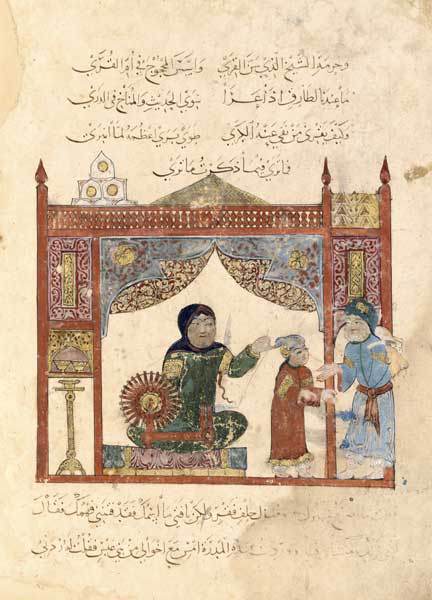
In technology, the Muslim world adopted papermaking from China.
Advances were made in irrigation and farming, using new technology such as the windmill. Crops such as almonds and citrus fruit were brought to Europe through al-Andalus, and sugar cultivation was gradually adopted by the Europeans. Arab merchants dominated trade in the Indian Ocean until the arrival of the Portuguese in the 16th century. Hormuz was an important center for this trade. There was also a dense network of trade routes in the Mediterranean, along which Muslim-majority countries traded with each other and with European powers such as Venice, Genoa and Catalonia (see also: Indo-Mediterranean). The Silk Road crossing Central Asia passed through Islamic states between China and Europe. The emergence of major economic empires with technological resources after the conquests of Timur (Tamerlane) and the resurgence of the Timurid Renaissance include the Mali Empire and the Bengal Sultanate in particular, a major global trading nation in the world, described by the Europeans to be the "richest country to trade with".
Muslim engineers in the Islamic world made a number of innovative industrial uses of hydropower, and early industrial uses of tidal power and wind power. The industrial uses of watermills in the Islamic world date back to the 7th century, while horizontal-wheeled and vertical-wheeled water mills were both in widespread use since at least the 9th century. A variety of industrial mills were being employed in the Islamic world, including early fulling mills, gristmills, paper mills, hullers, sawmills, ship mills, stamp mills, steel mills, sugar mills, tide mills and windmills. By the 11th century, every province throughout the Islamic world had these industrial mills in operation, from al-Andalus and North Africa to the Middle East and Central Asia. Muslim engineers also invented crankshafts and water turbines, employed gears in mills and water-raising machines, and pioneered the use of dams as a source of water power, used to provide additional power to watermills and water-raising machines. Such advances made it possible for industrial tasks that were previously driven by manual labour in ancient times to be mechanized and driven by machinery instead in the medieval Islamic world. The transfer of these technologies to medieval Europe had an influence on the Industrial Revolution, particularly from the proto-industrialised Mughal Bengal and Tipu Sultan's Kingdom, through the conquests of the East India Company.
Arts
The term "Islamic art and architecture" denotes the works of art and architecture produced from the 7th century onwards by people who lived within the territory that was inhabited by culturally Islamic populations.
Architecture
Aniconism
Main article: Aniconism in Islam
No Islamic visual images or depictions of God are meant to exist because it is believed that such artistic depictions may lead to idolatry. Muslims describe God by the names and attributes that, according to Islam, he revealed to his creation. All but one sura of the Quran begins with the phrase "In the name of God, the Beneficent, the Merciful". Images of Mohammed are likewise prohibited. Such aniconism and iconoclasm{{cite web |access-date = 23 February 2007 |archive-url = https://web.archive.org/web/20070314233303/http://lexicorient.com/e.o/mus_iconoclasm.htm |archive-date = 14 March 2007 |url-status = live
Arabesque
Main article: Arabesque
Islamic art frequently adopts the use of geometrical floral or vegetal designs in a repetition known as arabesque. Such designs are highly nonrepresentational, as Islam forbids representational depictions as found in pre-Islamic pagan religions. Despite this, there is a presence of depictional art in some Muslim societies, notably the miniature style made famous in Persia and under the Ottoman Empire which featured paintings of people and animals, and also depictions of Quranic stories and Islamic traditional narratives. Another reason why Islamic art is usually abstract is to symbolize the transcendence, indivisible and infinite nature of God, an objective achieved by arabesque. Islamic calligraphy is an omnipresent decoration in Islamic art, and is usually expressed in the form of Quranic verses. Two of the main scripts involved are the symbolic kufic and naskh scripts, which can be found adorning the walls and domes of mosques, the sides of minbars, and so on.
Distinguishing motifs of Islamic architecture have always been ordered repetition, radiating structures, and rhythmic, metric patterns. In this respect, fractal geometry has been a key utility, especially for mosques and palaces. Other features employed as motifs include columns, piers and arches, organized and interwoven with alternating sequences of niches and colonnettes. The role of domes in Islamic architecture has been considerable. Its usage spans centuries, first appearing in 691 with the construction of the Dome of the Rock mosque, and recurring even up until the 17th century with the Taj Mahal. And as late as the 19th century, Islamic domes had been incorporated into European architecture.
File:Interlaced-Triangles quasi-Arabesque Brunnian-link.svg|Example of an Arabesque File:Brunnian-link-12crossings-nonBorromean-quasi-Arabesque.svg|Example of an Arabesque File:Interlaced-Triangles Brunnian-link alternate.svg|Example of an Arabesque
Girih
File:Girih tiles.svg|Girih tiles File:Darbeimam subdivision rule.svg|The subdivision rule used to generate the Girih pattern on the spandrel. File:Girih compass straightedge example.svg|Girih pattern that can be drawn with compass and straight edge.
Islamic calligraphy
File:Kufic Quran, sura 7, verses 86-87.jpg|Kufic script from an early Qur'an manuscript, 7th century. (Surah 7: 86–87) File:Bismillah.svg|Bismallah calligraphy. File:Seven sleepers islam.jpg|Islamic calligraphy represented for amulet of sailors in the Ottoman Empire. File:Shiite Calligraphy symbolising Ali as Tiger of God.svg|Islamic calligraphy praising Ali. File:Planets by ibrahimabutouq.jpg|Modern Islamic calligraphy representing various planets.
Calendar
Two calendars are used all over the Muslim world. One is the lunar calendar that is most widely used among Muslims and known in the West as the "Islamic calendar". The other one is a solar calendar officially used in Iran. Both measure time in the Hijri era: the lunar calendar counts lunar years (of twelve lunar months) and the solar calendar counts solar years.
Islamic lunar calendar
Solar Hijri calendar
Women
According to Riada Asimovic Akyol, while Muslim women's experiences differ considerably by location and personal situations such as family upbringing, class and education; the difference between culture and religions is often ignored by community and state leaders in many of the Muslim majority countries. The key issue in the Muslim world regarding gender issues is that religious texts constructed in highly patriarchal environments and based on biological essentialism are still valued highly in Islam, hence views emphasizing on men's superiority in unequal gender roles are widespread among many conservative Muslims (men and women). Orthodox Muslims often believe that rights and responsibilities of women in Islam are different from that of men and sacrosanct since assigned by the God. According to Asma Barlas, patriarchal behaviour among Muslims is based in an ideology which jumbles sexual and biological differences with gender dualisms and inequality. Modernist discourse of liberal progressive movements like Islamic feminism have been revisiting hermeneutics of feminism in Islam in terms of respect for Muslim women's lives and rights. Riada Asimovic Akyol further says that equality for Muslim women needs to be achieved through self-criticism.
File:Kazakh wedding 3.jpg|A Kazakh wedding ceremony in a mosque File:COLLECTIE TROPENMUSEUM Een marabout gaat voor in het gebed tijdens een naamgevingsfeest TMnr 20018270.jpg|A group of marabouts – West African religious leaders and teachers of the Quran. File:Muslim girls at Istiqlal Mosque jakarta.png|Muslim girls at Istiqlal Mosque in Jakarta File:Chadian delegation.jpg|A tribal delegation in Chad File:Trio of Muslim Girls in Street - Srimangal - Sylhet Division - Bangladesh (12950725824).jpg|Muslim girls walking for school in Bangladesh
References
Notes
Citations
Sources
- See (PDF) The political algebra of global value change: General models and implications for the Muslim world
- {{cite book |last=Livny |first=Avital |title=Trust and the Islamic Advantage: Religious-Based Movements in Turkey and the Muslim World |location=United Kingdom| publisher=Cambridge University Press |year=2020 |oclc=1192428976 |isbn= 9781108485524}}
References
- (2009). "Islamic world".
- (2009). "Preface". Oxford University Press.
- Afsaruddin, Asma. (2016). "Islamic World". Berkshire Publishing Group.
- Scott Carpenter, Soner Cagaptay. (2 June 2009). "What Muslim World?".
- Jones, Gavin W.. (2005). "Islam, the State and Population". C. Hurst & Co. Publishers.
- (5 January 2018). "Islam".
- Hassan, M. Kabir. (30 December 2016). "Handbook of Empirical Research on Islam and Economic Life". Edward Elgar Publishing.
- Lapidus, Ira M.. (2014). "A History of Islamic Societies". Cambridge University Press (Kindle edition).
- "Economies of the ummah".
- (22 September 2016). "Muslim countries make thin contribution to global economy".
- (19 December 2017). "Who will stand up for Palestine?".
- (6 April 2017). "Why Muslims are the world's fastest-growing religious group". [[Pew Research Center]].
- "Pew-Templeton Global Religious Futures Project - Research and data from Pew Research Center".
- (27 January 2011). "Region: Middle East-North Africa". Pew Research Center.
- (December 2012). "The Global Religious Landscape".
- "Oxford Islamic Studies Online".
- (27 January 2011). "Region: Asia-Pacific".
- Burke, Daniel. (29 July 2016). "The moment American Muslims were waiting for".
- (27 January 2011). "Region: Sub-Saharan Africa". Pew Research Center.
- (27 January 2011). "Region: Asia-Pacific". Pew Research Center.
- Kettani, Houssain. (2010). "Muslim Population in Oceania: 1950-2020".
- (27 January 2011). "Region: Europe". Pew Research Center.
- (27 January 2011). "Region: Americas". Pew Research Center.
- Kington, Tom. (31 March 2008). "Number of Muslims ahead of Catholics, says Vatican".
- "Muslim Population". IslamicPopulation.com.
- "Field Listing Religions".
- Benakis, Theodoros. (13 January 2014). "Islamophoobia in Europe!". New Europe.
- (2014). "Isis Jihadist group made me wonder about non-denominational Muslims". The Sentinel.
- (2015). "Indiana Blood Center cancels 'Muslims for Life' blood drive".
- (2014). "Unthinkable: Iran, the Bomb, and American Strategy". Simon and Schuster.
- (2015-04-02). "10 Countries With the Largest Muslim Populations, 2010 and 2050".
- (2013). ["South Asian Religions: Tradition and Today"]({{google books). Routledge.
- Diplomat, Akhilesh Pillalamarri, The. "How South Asia Will Save Global Islam". The Diplomat.
- (7 October 2009). "Middle East-North Africa Overview". Pew Research Center's Religion & Public Life Project.
- (27 January 2011). "Region: Middle East-North Africa". Pew Research Center.
- (27 January 2011). "Region: Sub-Saharan Africa". Pew Research Center.
- Rowland, Richard H.. "CENTRAL ASIA ii. Demography".
- "Middle East :: Azerbaijan — The World Factbook – Central Intelligence Agency".
- "The Many Languages of Islam in the Caucasus".
- Yusuf, Imtiyaz. "The Middle East and Muslim Southeast Asia: Implications of the Arab Spring". Oxford Islamic Studies.
- (23 February 2019). "India invited as 'Guest of Honour' to OIC meet, Sushma Swaraj to attend".
- (21 April 2018). "Book review: Russia's Muslim Heartlands reveals diverse population". [[The National (Abu Dhabi).
- "Muslim Population by Country". Pew Research Center.
- "Islam in Russia".
- (25 December 2015). "A Religious Forecast For 2050: Atheism Is Down, Islam Is Rising". NPR.
- (6 April 2017). "Why Muslims are the world's fastest-growing religious group".
- (2 April 2015). "Main Factors Driving Population Growth". Pew Research Center's Religion & Public Life Project.
- (4 April 2015). "The world's fastest-growing religion is ...".
- Lippman, Thomas W.. (7 April 2008). "No God But God". U.S. News & World Report.
- (27 January 2011). "The Future of the Global Muslim Population".
- ''Pan-Islamism In India,'' FROM A CORRESPONDENT IN INDIA, Tuesday, 3 September 1912, The Times, Issue: 39994
- (2 June 2009). "What Muslim World?". Foreign Policy.
- Nawaz, Maajid. (2012). "Radical: My Journey out of Islamist Extremism". WH Allen.
- Gert Jan Geling. (12 January 2017). "Ook na 1400 jaar kan de islam heus verdwijnen". Trouw.
- Aydin, Cymil. (2012). "The Idea of the Muslim World".
- Watt, William Montgomery. (2003). "Islam and the Integration of Society". Psychology Press.
- "The 4 Caliphs".
- Encarta-encyclopedie Winkler Prins (1993–2002) s.v. "islam. §7. Sektevorming". Microsoft Corporation/Het Spectrum.
- Encarta-encyclopedie Winkler Prins (1993–2002) s.v. "Omajjaden §1. De Spaanse tak". Microsoft Corporation/Het Spectrum.
- The preaching of Islam: a history of the propagation of the Muslim faith By Sir Thomas Walker Arnold, pp. 227–228
- Majumdar, R.C., ''History of Mediaeval Bengal'', First published 1973, Reprint 2006, Tulshi Prakashani, Kolkata, {{ISBN. 81-89118-06-4
- Srivastava, Ashirvadi Lal. (1929). "The Sultanate Of Delhi 711–1526 AD". Shiva Lal Agarwala & Company.
- Evans, Charles T. "The Gunpowder Empires". Northern Virginia Community College.
- "The Islamic Gunpowder Empires, 1300–1650". Pearson Education.
- ''Islamic and European Expansion: The Forging of a Global Order'', [[Michael Adas]], Temple University Press (Philadelphia, PA), 1993.
- (2014). "Morality and Justice in Islamic Economics and Finance". Edward Elgar Publishing.
- [[Angus Maddison. 9264104143, pages 259–261
- Unknown. (1590–95). "Bullocks dragging siege-guns up hill during Akbar's attack on Ranthambhor Fort".
- Ferguson, Niall. (19 September 2011). "The 6 killer apps of prosperity". TED.com.
- "Islamic world".
- (2011). "Colonialism and Its Legacies". Rowman & Littlefield Publishers Group.
- (2016). "The Impact of Imperialism on the Region".
- {{cite encyclopedia. Cuthell. David Cameron Jr.. (2009). [[Facts On File]]
- Commins, David. (2009). "The Wahhabi Mission and Saudi Arabia". [[I.B. Tauris]].
- (2012). "Islamist Terrorism and Democracy in the Middle East". [[Cambridge University Press]].
- Wright, Lawrence. (2006). "The Looming Tower: Al-Qaeda and the Road to 9/11". [[Alfred A. Knopf.
- Moghadam, Assaf. (2008). "The Globalization of Martyrdom: Al Qaeda, Salafi Jihad, and the Diffusion of Suicide Attacks". [[Johns Hopkins University Press]].
- Livesey, Bruce. (25 January 2005). "Special Reports – The Salafist Movement: Al Qaeda's New Front". WGBH educational foundation.
- (2010). "Religion, the Enlightenment, and the New Global Order". Columbia University Press.
- "93 years pass since establishment of first democratic republic in the east – Azerbaijan Democratic Republic". Azerbaijan Press Agency.
- Ebaugh, Helen Rose. (1 December 2009). "The Gülen Movement: A Sociological Analysis of a Civic Movement Rooted in Moderate Islam". Springer Science & Business Media.
- [[Persian Constitution of 1906. 1906 Constitution of Imperial Iran]]: Article 1 – "The official religion of Persia is Islám, according to the orthodox Já'farí doctrine of the Ithna 'Ashariyya (Church of the Twelve Imáms), which faith 1 the Sháh of Persia must profess and promote."
- "Islam: Governing Under Sharia".
- "Amman Message".
- (21 February 2018). "Islamic Countries Of The World". WorldAtlas.
- "Constitution of Afghanistan 2004".
- "Brunei Darussalam's Constitution of 1959 with Amendments through 2006".
- "Islamic Republic of Iran Constitution".
- "Mauritania's Constitution of 1991 with Amendments through 2012".
- "Oman's Constitution of 1996 with Amendments through 2011".
- "The Constitution of the Islamic Republic of Pakistan".
- "Basic Law of Saudi Arabia".
- "Yemen's Constitution of 1991 with Amendments through 2001".
- "Of the People's Democratic Republic of Algeria".
- "Constitution of the Kingdom of Bahrain (2002)".
- "The Constitution of the People's Republic of Bangladesh | 2A. The state religion".
- "Comoros's Constitution of 2001 with Amendments through 2009".
- (1992). "Djibouti's Constitution of 1992 with Amendments through 2010".
- "Egypt's Constitution of 2014".
- "Constitution of Iraq".
- [https://www.cia.gov/the-world-factbook/countries/jordan/ "Jordan country report"] {{Webarchive. link. (3 June 2021 , ''The World Factbook'', U.S. Central Intelligence Agency, 24 August 2012)
- (2002). "International Religious Freedom Report".
- "Libya's Constitution of 2011 with Amendments through 2012".
- "Constitution of Malaysia".
- "Constitution of the Republic of Maldives 2008".
- "Morocco's Constitution of 2011".
- "BASIC LAW - OF THE PALESTINIAN NATIONAL AUTHORITY".
- "Qatar's Constitution of 2003".
- "Provisional Constitution of the Federal Republic of Somalia".
- "United Arab Emirates's Constitution of 1971 with Amendments through 2009".
- "Albania – Constitution". ICL.
- "Article 7.1 of Constitution".
- (12 May 2021). "United States Department of State".
- "Article 31 of Constitution".
- "Article 1 of Constitution".
- "Gambia (The) 1996(rev.2004)".
- (2022). "2022 Report on International Religious Freedom: The Gambia".
- [http://unpan1.un.org/intradoc/groups/public/documents/cafrad/unpan002994.pdf Article 1 of Constitution] {{webarchive. link. (13 September 2004)
- "Article 1 of Constitution".
- "Indonesia Risks Factors in Terrorism".
- (2022). "2022 Report on International Religious Freedom: Indonesia". U.S. Department of State.
- "The Constitution of the Republic of Kazakhstan".
- link. (21 November 2013, Republic of Kosovo constitution,)
- "Article 1 of Constitution".
- (2019). "2019 Report on International Religious Freedom: Lebanon". US Department of State.
- "Preamble of Constitution".
- (1 Dec 2020). "Niger".
- (14 September 2007). "Senegal".
- Timothy J. Demy Ph.D., Jeffrey M. Shaw Ph.D.. (2019). "Religion and Contemporary Politics: A Global Encyclopedia [2 volumes]". ABC-CLIO.
- (6 September 2020). "Sudan ends 30 years of Islamic law by separating religion, state".
- (2 June 2022). "2021 Report on International Religious Freedom: Syria".
- "Tajikistan's Constitution of 1994 with Amendments through 2003".
- oumaima-latrech. (2022-06-22). "Tunisia's New Constitution to Remove Islam as State Religion".
- "Article 2 of Constitution".
- "Constitution of Turkmenistan".
- "Uzbekistan's Constitution of 1992 with Amendments through 2011".
- (22 June 2015). "What is each country's second-largest religious group?". Pew Research Center.
- (27 January 2011). "Muslim-Majority Countries". Pew Research Center.
- "MAPPING THE GLOBAL MUSLIM POPULATION".
- "Muslim Population in India - Total Muslims in India".
- (21 February 2023). "Ethiopia".
- (11 April 2019). "China's hi-tech war on its Muslim minority". The Guardian.
- (21 February 2023). "Tanzania".
- (5 March 2019). "Russia Will be One-Third Muslim in 15 Years, Chief Mufti Predicts".
- "Technical Difficulties".
- (17 January 2022). "The Muslims of the Democratic Republic of the Congo. Victims of poverty, ignorance and Christianization".
- "Benazir Bhutto: Daughter of Tragedy" by Muhammad Najeeb, Hasan Zaidi, Saurabh Shulka and S. Prasannarajan, ''India Today'', 7 January 2008
- (17 February 2011). "A Wake-Up Call: Milestones of Islamic History – IslamOnline.net – Art & Culture".
- (27 January 2011). "Executive Summary". [[Pew Research Center]].
- "The World Factbook". CIA Factbook.
- "Muslim Population by Country". Pew Research Center.
- (27 January 2011). "Preface". [[Pew Research Center]].
- (27 January 2011). "Executive Summary". Pew Research Center.
- (27 January 2011). "Muslim-Majority Countries". [[Pew Research Center]].
- Analysis. (19 December 2011). "Global religious landscape". Pewforum.org.
- Khan, Nichola. (2016). "Cityscapes of Violence in Karachi: Publics and Counterpublics". Oxford University Press.
- Adrian Cybriwsky, Roman. (2015). "Global Happiness: A Guide to the Most Contented (and Discontented) Places around the Globe: A Guide to the Most Contented (and Discontented) Places around the Globe". ABC-CLIO.
- Hitchens, Christopher. (2007). "Hitchens '07: Danish Muhammad Cartoons".
- (22 May 2024). "Nigeria".
- "Comparison Chart of Sunni and Shia Islam". ReligionFacts.
- ANALYSIS. (7 October 2009). "Mapping the Global Muslim Population". Pew Forum on Religion & Public Life.
- "The World Factbook".
- "Administrative Department of the President of the Republic of Azerbaijan – Presidential Library – Religion".
- "The population of Shia: How many Shia are there in the world?".
- "Shi'a".
- "Pew Forum on Religious & Public life". http://www.pewforum.org/ {{Webarchive. link. (4 January 2012)
- (February 2005). "Country Profile: Pakistan". [[Library of Congress]].
- (9 August 2012). "The World's Muslims: Unity and Diversity".
- (2010). "Religions: Muslim 95% (Sunni 75%, Shia 20%), other (includes Christian and Hindu) 5%". [[The World Factbook]] on Pakistan.
- (October 2009). "Mapping the Global Muslim Population: A Report on the Size and Distribution of the World's Muslim Population". [[Pew Research Center]].
- "Pakistan, Islam in". [[Oxford University Press]].
- (19 September 2008). "Pakistan – International Religious Freedom Report 2008".
- (16 June 2015). "The Trouble With Madrassahs".
- "Early Warning Signs of Shia Genocide in Pakistan".
- (26 July 2013). "Suicide bombs kill 39 near Shi'ite mosques in Pakistan". [[Reuters]].
- "Shiite Islam". Shianumbers.com.
- (August 9, 2012). "Chapter 1: Religious Affiliation". [[Pew Research Center]]'s Religion & Public Life Project.
- (2 January 2013). "An Introduction to Islam in the 21st Century". John Wiley & Sons.
- Rabb, Intisar A.. (2009). "Fiqh". [[Oxford University Press]].
- Öz, Mustafa, ''Mezhepler Tarihi ve Terimleri Sözlüğü (The History of [[madh'hab]]s and its terminology dictionary),'' Ensar Publications, [[Istanbul]], 2011.
- J. Stewart, Dona. (2008). "The Middle East Today: Political, Geographical and Cultural Perspectives". Routledge.
- De McLaurin, Ronald. (1979). "The Political Role of Minority Groups in the Middle East". Michigan University Press.
- "Muhammad ibn Āliyy’ūl Cillī [[aqidah]]" of "Maymūn ibn [[Al-Tabarani. Abu’l-Qāsim Sulaiman ibn Ahmad ibn at-Tabarānī]] [[fiqh]]" (Sūlaiman Affandy, ''Al-Bākūrat’ūs Sūlaiman’īyyah – [[Family tree]] of the [[Nusayri]] [[Tariqat]],'' pp. 14–15, [[Beirut]], 1873.)
- "Alevi İslam Din Hizmetleri Başkanlığı".
- link. (4 March 2016, Zafer Mah. [[Ahmet Yesevi]] Cad. No: 290, Yenibosna / [[Istanbul]], Turkey.)
- Jenkins, Philip. (2020). "The Rowman & Littlefield Handbook of Christianity in the Middle East". Rowman & Littlefield.
- (2011). "The World's Christians: Who they are, Where they are, and How they got there". John Wiley & Sons.
- Hill, Donald. ''Islamic Science and Engineering''. 1993. Edinburgh Univ. Press. {{ISBN. 0-7486-0455-3, p. 4
- Brague, Rémi. (2009). "The Legend of the Middle Ages". University of Chicago Press.
- Pacini, Andrea. (1998). "Christian Communities in the Arab Middle East: The Challenge of the Future". Clarendon Press.
- C. Ellis, Kail. (2017). "Jews, Antisemitism, and the Middle East". Routledge.
- Curtis, Michael. (2018). "Secular Nationalism and Citizenship in Muslim Countries: Arab Christians in the Levant". Springer.
- "Global Christianity – A Report on the Size and Distribution of the World's Christian Population". Pew Research Center.
- (2006). "Copts in Egypt: A Christian Minority Under Siege: Papers Presented at the First International Coptic Symposium, Zurich, September 23-25, 2004". Vandenhoeck & Ruprecht.
- Ojo, Matthews A.. (July 1995). "The Charismatic Movement in Nigeria Today". International Bulletin of Missionary Research.
- Staff, Toi. (8 September 2018). "Ahead of Rosh Hashanah, figures show 14.7 million Jews around the globe". Times of Israel.
- (9 September 2018). "Global Jewish population reaches 14.7 million". The Jerusalem Post.
- "VI- November 30: Commemorating the expulsion of Jews from Arab lands".
- (15 September 2021). "Jewish Population Rises to 15.2 million Worldwide". Jewish agency.
- (2020). "Kinship and Consent: Jewish Political Tradition and Its Contemporary Uses". Routledge.
- Rosenberg, Jerry M.. (2009-09-28). "The Rebirth of the Middle East". Hamilton Books.
- C. Held, Colbert. (2008). "Middle East Patterns: Places, People, and Politics". Routledge.
- "Zoroastrianism i. History to the Arab Conquest – Encyclopaedia Iranica".
- Monshipouri, Mahmood. (2011). "Muslims in Global Politics: Identities, Interests, and Human Rights". University of Pennsylvania Press.
- (2015). "Israeli Settlement in the West Bank and Jerusalem: Demographic Specifics and Policies of Financial Support". Siyasat Arabia.
- "Scimago Journal & Country Rank".
- "Science-Matrix: 30 Years in Science – Secular Movements in Knowledge Creation". Science-matrix.com.
- "Nearly 40% of Muslim world's population unable read or write: IINA Report".
- "Egypt Literacy rate".
- "Pakistan Literacy rate".
- "Iran Literacy rate".
- "Iraq Literacy rate".
- "Indonesia Literacy rate".
- (19 December 2011). "Religion and Education Around the World". Pew Research Center.
- (24 April 2012). "OIC to hold conference on refugees in Muslim world in Turkmenistan". [[Zaman (newspaper).
- (17 July 2013). "UN Calls Syrian Refugee Crisis Worst Since Rwandan Genocide". ABC News.
- (7 December 2017). "Rohingya widows find safe haven in Bangladesh camp".
- Melikian, Souren. (4 November 2011). "'Islamic' Culture: A Groundless Myth". [[The New York Times]].
- Knight, Michael Muhammad. (24 May 2016). "Magic In Islam". Penguin.
- [[George Saliba]] (1994), ''A History of Arabic Astronomy: Planetary Theories During the Golden Age of Islam'', pp. 245, 250, 256–7. [[New York University Press]], {{ISBN. 0-8147-8023-7.
- (1983). "The Astronomy of the Mamluks". Isis.
- Medieval India, NCERT, {{ISBN. 81-7450-395-1
- Vartan Gregorian, "Islam: A Mosaic, Not a Monolith", Brookings Institution Press, 2003, pg 26–38 {{ISBN. 0-8157-3283-X
- (1 March 2011). ["Islamic Radicalism and Multicultural Politics"]({{Google books). Taylor & Francis.
- Saliba, George. (July 1995). "A History of Arabic Astronomy: Planetary Theories During the Golden Age of Islam". NYU Press.
- Vartan Gregorian, "Islam: A Mosaic, Not a Monolith", Brookings Institution Press, 2003, pp. 26–38 {{ISBN. 0-8157-3283-X
- Mason (1995) p. 1
- Mason (1995) p. 5
- Mason (1995) p. 7
- link. (17 May 2020 . Books.google.com.pk. Retrieved on 23 September 2013.)
- Marzolph. (2007). "Arabian Nights". Brill.
- Grant & Clute, p. 51
- [[L. Sprague de Camp]], ''[[Literary Swordsmen and Sorcerers]]: The Makers of Heroic Fantasy'', p. 10 {{ISBN. 0-87054-076-9
- Grant & Clute, p 52
- Abu Shadi Al-Roubi (1982), "Ibn Al-Nafis as a philosopher", ''Symposium on Ibn al-Nafis'', Second International Conference on Islamic Medicine: Islamic Medical Organization, Kuwait ([[cf.]] [http://www.islamset.com/isc/nafis/drroubi.html Ibn al-Nafis As a Philosopher] {{webarchive. link. (6 February 2008, ''Encyclopedia of Islamic World'').)
- Nahyan A. G. Fancy (2006), "[http://etd.nd.edu/ETD-db/theses/available/etd-11292006-152615 Pulmonary Transit and Bodily Resurrection: The Interaction of Medicine, Philosophy and Religion in the Works of Ibn al-Nafīs (d. 1288)] {{Webarchive. link. (4 April 2015", pp. 95–101, ''Electronic Theses and Dissertations'', [[University of Notre Dame]].)
- link. (4 October 2015 : in qua ostenditur, quomodo ex inferiorum contemplatione ad superiorum notitiam ratio humana ascendere possit. E Theatro Sheldoniano, excudebat Joannes Owens, 1700.)
- [[Ibn al-Nafis. Ala-al-din abu Al-Hassan Ali ibn Abi-Hazm al-Qarshi al-Dimashqi]]. The Theologus autodidactus of Ibn al-Nafīs. Clarendon P., 1968
- Claeys, Gregory. (5 August 2010). "The Cambridge Companion to Utopian Literature". Cambridge University Press.
- Abu Shadi Al-Roubi (1982), "Ibn Al-Nafis as a philosopher", ''Symposium on Ibn al Nafis'', Second International Conference on Islamic Medicine: Islamic Medical Organization, Kuwait ([[cf.]] [http://www.islamset.com/isc/nafis/drroubi.html Ibnul-Nafees As a Philosopher] {{webarchive. link. (6 February 2008, ''Encyclopedia of Islamic World'').)
- Cyril Glasse (2001), ''New [[Encyclopaedia of Islam]]'', p. 202, Rowman Altamira, {{ISBN. 0-7591-0190-6.
- [http://www.rep.routledge.com/article/H057 "Islamic Philosophy"] {{webarchive. link. (6 June 2022, ''Routledge Encyclopedia of Philosophy'' (1998))
- (2024). "Ibn Sina [Avicenna]".
- Saliba, George. (1994). "A History of Arabic Astronomy: Planetary Theories During the Golden Age of Islam". [[New York University Press]].
- Russell (1994), pp. 224–62,
- Dominique Urvoy, "The Rationality of Everyday Life: The Andalusian Tradition? (Aropos of Hayy's First Experiences)", in Lawrence I. Conrad (1996), ''The World of Ibn Tufayl: Interdisciplinary Perspectives on Ḥayy Ibn Yaqẓān'', pp. 38–46, [[Brill Publishers]], {{ISBN. 90-04-09300-1.
- Muhammad ibn Abd al-Malik Ibn Tufail and Léon Gauthier (1981), ''Risalat Hayy ibn Yaqzan'', p. 5, Editions de la Méditerranée.
- Russell (1994), pp. 224–39
- Martin Wainwright, [https://www.theguardian.com/books/2003/mar/22/featuresreviews.guardianreview1 Desert island scripts] , ''[[The Guardian]]'', 22 March 2003.
- Russell (1994) p. 227
- Russell (1994), p. 247
- [[G. J. Toomer]] (1996), ''Eastern Wisedome and Learning: The Study of Arabic in Seventeenth-Century England'', p. 222, [[Oxford University Press]], {{ISBN. 0-19-820291-1.
- Kamal, Muhammad. (2006). "Mulla Sadra's Transcendent Philosophy". Ashgate Publishing, Ltd..
- S.R.W. Akhtar (1997). "The Islamic Concept of Knowledge", ''Al-Tawhid: A Quarterly Journal of Islamic Thought & Culture'' '''12''' (3). https://www.al-islam.org/al-tawhid/vol-12-no3/islamic-concept-knowledge-sayyid-wahid-akhtar
- Al-Khalili, Jim. (4 January 2009). "BBC News".
- Plofker, Kim (2009), ''[[Mathematics in India (book). Mathematics in India]]: 500 BCE–1800 CE'', Princeton, NJ: Princeton University Press. {{ISBN. 0-691-12067-6.
- Peter J. Lu, [http://www.news.harvard.edu/gazette/2007/03.01/99-tiles.html Harvard's Office of News and Public Affairs] {{webarchive. link. (14 March 2007)
- Turner, H. (1997) pp. 136–38
- The knowledge of [[gunpowder]] was also transmitted from China via predominantly Islamic countries.Arming the Periphery. Emrys Chew, 2012. p. 1823.
- Nanda, J. N (2005). Bengal: the unique state. Concept Publishing Company. p. 10. 2005. {{ISBN. 978-81-8069-149-2. Bengal [...] was rich in the production and export of grain, salt, fruit, liquors and wines, precious metals and ornaments besides the output of its handlooms in silk and cotton. Europe referred to Bengal as the richest country to trade with.
- [[Ahmad Y. al-Hassan]] (1976). ''Taqi al-Din and Arabic Mechanical Engineering'', pp. 34–35. Institute for the History of Arabic Science, [[University of Aleppo]].
- Adam Robert Lucas (2005), "Industrial Milling in the Ancient and Medieval Worlds: A Survey of the Evidence for an Industrial Revolution in Medieval Europe", ''Technology and Culture'' '''46''' (1), pp. 1–30 [10].
- [[Ahmad Y. al-Hassan]], [http://www.history-science-technology.com/Articles/articles%2071.htm Transfer Of Islamic Technology To The West, Part II: Transmission Of Islamic Engineering] {{webarchive. link. (18 February 2008)
- Adam Robert Lucas (2005), "Industrial Milling in the Ancient and Medieval Worlds: A Survey of the Evidence for an Industrial Revolution in Medieval Europe", ''Technology and Culture'' '''46''' (1), pp. 1–30.
- Ettinghausen (2003), p. 3
- "Islamic Art and Architecture", ''The Columbia Encyclopedia'' (2000)
- Madden (1975), pp. 423–30
- Tonna, Jo (1990). "The Poetics of Arab-Islamic Architecture", Muqarnas BRILL, 7, pp. 182–97
- Grabar, Oleg (2006), "Islamic art and beyond". Ashgate. Vol 2, p. 87
- Akyol, Riada Asimovic. "On Erdogan and Muslim mothers".
This article was imported from Wikipedia and is available under the Creative Commons Attribution-ShareAlike 4.0 License. Content has been adapted to SurfDoc format. Original contributors can be found on the article history page.
Ask Mako anything about Islamic world — get instant answers, deeper analysis, and related topics.
Research with MakoFree with your Surf account
Create a free account to save articles, ask Mako questions, and organize your research.
Sign up freeThis content may have been generated or modified by AI. CloudSurf Software LLC is not responsible for the accuracy, completeness, or reliability of AI-generated content. Always verify important information from primary sources.
Report