From Surf Wiki (app.surf) — the open knowledge base
Islam and blasphemy
Overview of Islamic views on blasphemy

Overview of Islamic views on blasphemy
In Islam, blasphemy is impious utterance or action concerning God,{{cite journal | access-date = 22 June 2020 | archive-date = 30 September 2024 | archive-url = https://web.archive.org/web/20240930061621/https://academic.oup.com/jss/article-abstract/XLII/1/39/1629341?redirectedFrom=PDF | url-status = live | url-access = subscription
The Quran curses those who commit blasphemy and promises blasphemers humiliation in the Hereafter. However, whether any Quranic verses prescribe worldly punishments is debated: some Muslims believe that no worldly punishment is prescribed while others disagree. The interpretation of hadiths, which are another source of Sharia, is similarly debated. Some have interpreted hadith as prescribing punishments for blasphemy, which may include death, while others argue that the death penalty applies only to cases where perpetrator commits treasonous crimes, especially during times of war. Different traditional schools of jurisprudence prescribe different punishment for blasphemy, depending on whether the blasphemer is Muslim or non-Muslim, a man or a woman.
In the modern Muslim world, the laws pertaining to blasphemy vary by country, and some countries prescribe punishments consisting of fines, imprisonment, flogging, hanging, or beheading.P Smith (2003). "Speak No Evil: Apostasy, Blasphemy and Heresy in Malaysian Syariah Law". UC Davis Journal Int'l Law & Policy. 10, pp. 357–73.
- N Swazo (2014). "The Case of Hamza Kashgari: Examining Apostasy, Heresy, and Blasphemy Under Sharia". The Review of Faith & International Affairs 12(4). pp. 16–26. Capital punishment for blasphemy was rare in pre-modern Islamic societies. In the modern era some states and radical groups have used charges of blasphemy in an effort to burnish their religious credentials and gain popular support at the expense of liberal Muslim intellectuals and religious minorities. Other Muslims instead push for greater freedom of expression. Contemporary accusations of blasphemy against Islam have sparked international controversies and incited mob violence and assassinations.
Islamic scripture
In Islamic literature, blasphemy is of many types, and there are many different words for it: ar (insult) and ar (abuse, vilification), ar or ar (denial), ar (concoction), ar or ar (curse) and ar (accuse, defame).See:
- Siraj Khan. "Blasphemy against the Prophet", in Muhammad in History, Thought, and Culture (ed: Coeli Fitzpatrick Ph.D., Adam Hani Walker). , pp. 59–67.
- Hassner, R. E. (2011). "Blasphemy and Violence". International Studies Quarterly 55(1). pp. 23–24;
- Lewis, Bernard. "Behind the Rushdie affair." The American Scholar 60.2 (1991), pp. 185–96;
- Stanfield-Johnson, R. (2004). "The tabarra'iyan and the early Safavids". Iranian Studies 37(1). pp. 47–71. In Islamic literature, the term "blasphemy" sometimes also overlaps with ar ("unbelief"), ar (depravity), ar (insult), and ar (apostasy).
Quran
A number of verses in the Qur'an have been interpreted as relating to blasphemy. In these verses God admonishes those who commit blasphemy. Some verses are cited as evidence that the Qur'an does not prescribe punishments for blasphemy, while other verses are cited as evidence that it does.
The only verse that directly says blasphemy (sabb) is Q6:108. The verse calls on Muslims to not blaspheme against deities of other religions, lest people of that religion retaliate by blaspheming against Allah.
Verse 5:33 prescribes prison or mutilation or death for those "who wage war against Allah and His Messenger". Even though the verse doesn't mention blasphemy (sabb), some commentators have used to justify punishments for blasphemy.According to Abbas "waging war against Allah and His messenger" must be interpreted as "those who disbelieve in Allah and His messenger", according to the two Jalals the verse is directed towards who "fights against Muslims", according to Kathir "waging war" "includes disbelief". See {{cite web | access-date = 2020-07-31 | archive-date = 6 April 2023 | archive-url = https://web.archive.org/web/20230406234334/https://quranx.com/tafsirs/5.33 | url-status = live
33:57–61 have also been used by some commentators to justify blasphemy punishments. However, other scholars opined that verses 33:57–61 could only have been acted upon during the life of the Prophet and since the demise of Muhammad they are no longer applicable.
Other passages are not related to any earthly punishment for blasphemy, but prescribe Muslims to not "sit with" those who mock the religion – although the latter are admonishments directed towards a witness of blasphemy rather than the guilty of blasphemy:
According to Shemeem Burney Abbas, the Qur'an mentions many examples of disbelievers ridiculing and mocking Muhammad, but never commands him to punish those who mocked him. Instead, the Qur'an asks Muhammad to leave the punishment of blasphemy to God, and that there would be justice in the afterlife.
Hadith
According to several hadiths, Muhammad ordered a number of enemies executed "in the hours after Mecca's fall". One of those who was killed was Ka'b ibn al-Ashraf, because he had insulted Muhammad.
A variety of punishments, including death, have been instituted in Islamic jurisprudence that draw their sources from hadith literature. Sources in hadith literature allege that Muhammad ordered the execution of Ka'b ibn al-Ashraf. After the Battle of Badr, Ka'b had incited the Quraysh against Muhammad, and also urged them to seek vengeance against Muslims. Another person executed was Abu Rafi', who had actively propagandized against Muslims immediately before the Battle of Ahzab. Both of these men were guilty of insulting Muhammad, and both were guilty of inciting violence. While some have explained that these two men were executed for blaspheming against Muhammad, an alternative explanation is that they were executed for treason and causing disorder (fasad) in society.
Muhammad declared that there shall be no punishment for murdering anyone who disparages, abuses or insults him (ar, ar). tells of a man who killed his pregnant slave because she persisted in insulting Muhammad. Upon hearing this, Muhammad is reported to have exclaimed: "Do you not bear witness that her blood is futile!" (ar) This expression can be read as meaning that the killing was unnecessary, implying that Muhammad condemned it. However, most hadith specialists interpreted it as voiding the obligation of paying the blood money which would normally be due to the woman's next of kin. Another hadith reports Muhammad using an expression which clearly indicates the latter meaning:
Some jurists suggest that the sunnah in and provide a basis for a death sentence for the crime of blasphemy, even if someone claims not to be an apostate, but has committed the crime of blasphemy.{{cite journal
The words of Ibn Abbas, a prominent jurist and companion of Muhammad, are frequently cited to justify the death penalty as punishment blasphemy:
In Islamic jurisprudence, Kitab al Hudud and Taz'ir cover punishment for blasphemous acts.
Islamic law
Islamic jurisprudence
The Quran curses those who commit blasphemy and promises blasphemers humiliation in the Afterlife. However, whether any Quranic verses prescribe worldly punishments is debated: some Muslims believe that no worldly punishment is prescribed while others disagree. Islamic jurisprudence (fiqh) of Sunni and Shia madhabs have declared different punishments for the religious crime of blasphemy, and they vary between schools. These are as follows:
Hanafi school
In the Hanafi school, blasphemy is regarded as synonymous with apostasy, and therefore, accepts the repentance of apostates. Those who refuse to repent, their punishment is death if the blasphemer is a Muslim man, and if the blasphemer is a woman, she must be imprisoned with coercion (beating) till she repents and returns to Islam.*Abu al-Layth al-Samarqandi (983), Mukhtalaf al-Riwayah, vol. 3, pp. 1298–99
- Ahmad ibn Muhammad al-Tahawi (933), Mukhtasar Ikhtilaf al-Ulama, vol. 3, p. 504
- Ali ibn Hassan al-Sughdi (798); Kitab al-Kharaj; Quote: "أيما رجل مسلم سب رَسُوْل اللهِ صَلَّى اللهُ عَلَيْهِ وَسَلَّمَ أو كذبه أو عابه أوتنقصه فقد كفر بالله وبانت منه زوجته ، فإن تاب وإلا قتل ، وكذلك المرأة ، إلا أن أبا حنيفة قَالَ: لا تقتل المرأة وتجبر عَلَى الإسلام"; Translation: "A Muslim man who blasphemes the Messenger of Allah, denies him, reproaches him, or diminishes him, he has committed apostasy in Allah, and his wife is separated from him. He must repent, or else is killed. And this is the same for the woman, except Abu Hanifa said: Do not kill the woman, but coerce her back to Islam".
However, blasphemy is not punishable by death for non-Muslims in the Hanafi school. The school's eponym, Abu Hanifa, opined that a non-Muslim can not be killed for committing blasphemy. In his ar, Hanafi jurist al-Tahawi () argued that if a non-Muslim kept repeating the offense again and again, then they can be punished but not killed. Al-Jassas () in his exegesis of ar wrote that the non-Muslim blasphemer will not be killed, albeit would be condemned verbally. Furthermore, al-Quduri () stated that: "According to the position of Hanafi jurists, the covenant of ar (non-Muslims) shall remain intact unless they join enemy forces. Our argument is, non-Muslims also insult God and say that He has a son and the Zoroastrians say He has an “opposite.” If this does not invalidate their covenant of security, then insult of the Prophet will also not do". As such, al-Kasani () also backed this claim, asserting that insulting the Prophet only adds to the original disbelief of the non-Muslim and does not break their covenant of security under Islamic law. Some assert punishment can be a tazir (discretionary, arrest or caning).P. Smith (2003), Speak No Evil: Apostasy, Blasphemy and Heresy in Malaysian Syariah Law, UC Davis Journal Int'l Law & Policy, 10, pp. 357–73;
- N. Swazo (2014), The Case of Hamza Kashgari: Examining Apostasy, Heresy, And Blasphemy Under Sharia, The Review of Faith & International Affairs, 12(4), pp. 16–26
Maliki school
The Malikis view blasphemy as an offense distinct from, and more severe than apostasy. Death is mandatory in cases of blasphemy for Muslim men, and repentance is not accepted. For women, death is not the punishment suggested, but she is arrested and punished till she repents and returns to Islam or dies in custody. A non-Muslim who commits blasphemy against Islam must be punished; however, the blasphemer can escape punishment by converting and becoming a devout Muslim.
Shafi'i school
The Shafi'is recognize blasphemy as a separate offense from apostasy, but accepts the repentance of blasphemers. If the blasphemer does not repent, the punishment is death.P. Smith (2003), Speak No Evil: Apostasy, Blasphemy and Heresy in Malaysian Syariah Law, UC Davis Journal Int'l Law & Policy, 10, pp. 357–73;
- F. Griffel (2001), Toleration and exclusion: al-Shafi 'i and al-Ghazali on the treatment of apostates, Bulletin of the School of Oriental and African Studies, 64(3), pp. 339–54
Other schools
The Hanbalis consider blasphemy as an offense distinct from, and more severe than apostasy. Death is mandatory in cases of blasphemy, for both Muslim men and women. Zahiri view insulting God or Islamic prophets as apostasy.
Ja'fari school (Shia)
In Ja'fari jurisprudence, blasphemy against Islam, the Prophet, or any of the Imams, to be punishable with death, if the blasphemer is a Muslim.Ayatullah Abu al-Qasim al-Khoei (1992), Minhaj al-Salihin, vol. 2, pp. 43–45;
- Ali ibn Ahmad al-Amili al-Thani (1602), Sharh al-Luma al-Dimashqiya, vol. 9, pp. 194–95;
- Muhammad ibn al-Hassan al-Tusi (1067), Al-Nihaya, pp. 730–31 and Tadhib al-Ahkam, vol. 10, p. 85;
- Ali ibn al-Hussein "Sharif al-Murtada" (1044). Al-Intisar, pp. 480–81;
- Ali ibn Babawaih al-Qummi al-Saduq (991), Al-Hidaya fi al-Usul wa al-Furu, pp. 295–97 In case the blasphemer is a non-Muslim, he is given a chance to convert to Islam, or else killed.[[File:Ali Beheading Nadr ibn al-Harith in the Presence of the Prophet Muhammad. Miniature from volume 4 of a copy of Mustafa al-Darir’s Siyar-i-Nabi. Istanbul; c. 1594 The David Col..jpg|thumb|A painting from [[Siyer-i Nebi]], [[Ali]] beheading [[Nadr ibn al-Harith]] in the presence of [[Muhammad]] and his [[Sahaba|companions]]]]
Blasphemy as apostasy
Main article: Apostasy in Islam
Because blasphemy in Islam included rejection of fundamental doctrines, Not all blasphemy is apostasy, of course, as a non-Muslim who blasphemes against Islam has not committed apostasy. Blasphemy is defined as the act of speaking disrespectfully or irreverently about God and there is every other thing you can do to Cause blasphemy A specific example of blasphemy against the Holy Spirit occurs when someone attributes the good works of God (such as miracles) to Satan.
Modern state laws
The punishments for different instances of blasphemy in Islam vary by jurisdiction, but may be very severe. A convicted blasphemer may, among other penalties, lose all legal rights. The loss of rights may cause a blasphemer's marriage to be dissolved, religious acts to be rendered worthless, and claims to property—including any inheritance—to be rendered void. Repentance, in some Fiqhs, may restore lost rights except for marital rights; lost marital rights are regained only by remarriage. Women have blasphemed and repented to end a marriage. Muslim women may be permitted to repent, and may receive a lesser punishment than would befall a Muslim man who committed the same offense. Most Muslim-majority countries have some form of blasphemy law and some of them have been compared to blasphemy laws in European countries (Britain, Germany, Finland etc.). However, in several countries, such as Afghanistan, Iran, Nigeria (the northern portion), Pakistan, and Saudi Arabia, blasphemy is punishable by death. In Pakistan, more than a thousand people have been convicted of blasphemy since the 1980s; though none have been executed. In addition, blasphemy is punishable as well by varying periods in prison in multiple other countries, such as Algeria, Egypt, Indonesia, Iraq, Kazakhstan, Kuwait, Malaysia, Oman, Qatar, Russia, Sudan, Turkey and the United Arab Emirates.
In Indonesia, anyone involved in blasphemy can receive up to five years in prison. However, in Russia, the punishment is less severe, because anyone involved in blasphemy can receive up to four years in prison in the country.
History
Early and medieval Islam
According to Islamic sources Nadr ibn al-Harith, who was an Arab Pagan doctor from Taif, used to tell stories of Rustam and Isfandiyar to the Arabs and scoffed Muhammad. After the battle of Badr, al-Harith was captured and, in retaliation, Muhammad ordered his execution in hands of Ali.
According to certain hadiths, after Mecca's fall Muhammad ordered a number of enemies executed. Based on this early jurists postulated that sabb al-Nabi (abuse of the Prophet) was a crime "so heinous that repentance was disallowed and summary execution was required".
Sadakat Kadri writes that the actual prosecutions for blasphemy in the Muslim historical record "are vanishingly infrequent". One of the "few known cases" was that of a Christian accused of insulting the Islamic Prophet Muhammad. It ended in an acquittal in 1293, though it was followed by a protest against a decision led by the famed and strict jurist Ibn Taymiyya.
In the 20th and 21st century

In recent decades Islamic revivalists have called for its enforcement on the grounds that criminalizing hostility toward Islam will safeguard communal cohesion. Over 50 people accused of blasphemy have been murdered before their respective trials were over, and prominent figures who opposed blasphemy laws (Salman Taseer, the former governor of Punjab, and Shahbaz Bhatti, the Federal Minister for Minorities) have been assassinated.
As of 2011, all Islamic majority nations, worldwide, had criminal laws on blasphemy. Over 125 non-Muslim nations worldwide did not have any laws relating to blasphemy. In Islamic nations, thousands of individuals have been arrested and punished for blasphemy of Islam. Moreover, several Islamic nations have argued in the United Nations that blasphemy against Muhammad is unacceptable, and that laws should be passed worldwide to proscribe it. In September 2012, the Organisation of Islamic Conference (OIC), who has sought for a universal blasphemy law over a decade, revived these attempts. Separately, the Human Rights Commission of the OIC called for "an international code of conduct for media and social media to disallow the dissemination of incitement material". Non-Muslim nations that do not have blasphemy laws, have pointed to abuses of blasphemy laws in Islamic nations, and have disagreed.
Notwithstanding, controversies raised in the non-Muslim world, especially over depictions of Muhammad, questioning issues relating to the religious offense to minorities in secular countries. A key case was the 1989 fatwa against English author Salman Rushdie for his 1988 book entitled The Satanic Verses, the title of which refers to an account that Muhammad, in the course of revealing the Quran, received a revelation from Satan and incorporated it therein until made by Allah to retract it. Several translators of his book into foreign languages have been murdered. In the UK, many supporters of Salman Rushdie and his publishers advocated unrestricted freedom of expression and the abolition of the British blasphemy laws. As a response, Richard Webster wrote A Brief History of Blasphemy in which he discussed freedom to publish books that may cause distress to minorities.
Notable modern cases involving individuals
Assassination of Farag Foda
Main article: Farag Foda

Farag Foda (also Faraj Fawda; 1946 – 9 June 1992), was a prominent Egyptian professor, writer, columnist, and human rights activist. He was assassinated on 9 June 1992 by members of Islamist group al-Gama'a al-Islamiyya after being accused of blasphemy by a committee of clerics (ulama) at Al-Azhar University. In December 1992, his collected works were banned. In a statement claimed responsibility for the killing, Al-Gama'a al-Islamiyya accused Foda of being an apostate from Islam, advocating the separation of religion from the state, and favouring the existing legal system in Egypt rather than the application of Sharia (Islamic law). The group explicitly referred to the Al-Azhar fatwā when claiming responsibility.
Imprisonment of Arifur Rahman
Main article: Arifur Rahman
In September 2007, Bangladeshi cartoonist Arifur Rahman depicted in the daily Prothom Alo a boy holding a cat conversing with an elderly man. The man asks the boy his name, and he replies "Babu". The older man chides him for not mentioning the name of Muhammad before his name. He then points to the cat and asks the boy what it is called, and the boy replies "Muhammad the cat". Bangladesh does not have a blasphemy law but groups said the cartoon ridiculed Muhammad, torched copies of the paper and demanded that Rahman be executed for blasphemy. As a result, Bangladeshi police detained Rahman and confiscated copies of Prothom Alo in which the cartoon appeared.
Sudanese teddy bear blasphemy case
Main article: Sudanese teddy bear blasphemy case
In November 2007, British schoolteacher Gillian Gibbons, who taught middle-class Muslim and Christian children in Sudan, was convicted of insulting Islam by allowing her class of six-year-olds to name a teddy bear "Muhammad". On 30 November, thousands of protesters took to the streets in Khartoum, demanding Gibbons's execution after imams denounced her during Friday prayers. Many Muslim organizations in other countries publicly condemned the Sudanese over their reactions as Gibbons did not set out to cause offence. She was released into the care of the British embassy in Khartoum and left Sudan after two British Muslim members of the House of Lords met President Omar al-Bashir.
Asia Bibi blasphemy case
Main article: Asia Bibi blasphemy case
The Asia Bibi blasphemy case involved a Pakistani Christian woman, Aasiya Noreen (born 1971; better known as Asia Bibi convicted of blasphemy by a Pakistani court, receiving a sentence of death by hanging in 2010. In June 2009, Noreen was involved in an argument with a group of Muslim women with whom she had been harvesting berries after the other women grew angry with her for drinking the same water as them. She was subsequently accused of insulting the Islamic Prophet Muhammad, a charge she denied, and was arrested and imprisoned. In November 2010, a Sheikhupura judge sentenced her to death. If executed, Noreen would have been the first woman in Pakistan to be lawfully killed for blasphemy.
The verdict, which was reached in a district court and needed to be upheld by a superior court, received worldwide attention. Various petitions, including one that received 400,000 signatures, were organized to protest Noreen's imprisonment, and Pope Benedict XVI publicly called for the charges against her to be dismissed. She received less sympathy from her neighbors and Islamic religious leaders in the country, some of whom adamantly called for her to be executed. Christian minorities minister Shahbaz Bhatti and Muslim politician Salmaan Taseer were both assassinated for advocating on her behalf and opposing the blasphemy laws. Noreen's family went into hiding after receiving death threats, some of which threatened to kill Asia if released from prison. Governor Salmaan Taseer and Pakistan's Minority Affairs Minister Shahbaz Bhatti both publicly supported Noreen, with the latter saying, "I will go to every knock for justice on her behalf and I will take all steps for her protection." The imprisonment of Noreen left Christians and other minorities in Pakistan feeling vulnerable, and liberal Muslims were also unnerved by her sentencing.
Minority Affairs Minister Shahbaz Bhatti said that he was first threatened with death in June 2010 when he was told that he would be beheaded if he attempted to change the blasphemy laws. In response, he told reporters that he was "committed to the principle of justice for the people of Pakistan" and willing to die fighting for Noreen's release.
In January 2011, talking about the Asia Bibi blasphemy case, Pakistani politician Salmaan Taseer expressed views opposing the country's blasphemy law and supporting Asia Bibi. He was then killed by one of his bodyguards, Malik Mumtaz Qadri. After the murder, hundreds of clerics voiced support for the crime and urged a general boycott of Taseer's funeral. The Pakistani government declared three days of national mourning and thousands of people attended his funeral. Supporters of Mumtaz Qadri blocked police attempting to bring him to the courts and some showered him with rose petals.{{cite news | access-date= 18 April 2017 | archive-date= 9 January 2011 | archive-url= https://web.archive.org/web/20110109010906/http://www.voanews.com/english/news/asia/south/Disruptions-Mark-Remand-of-Alleged-Pakistani-Assassin-113016474.html | url-status= live
Imprisonment of Fatima Naoot
In 2014, an Egyptian state prosecutor pressed charges against a former candidate for parliament, writer and poet Fatima Naoot, of blaspheming Islam when she posted a Facebook message which criticized the slaughter of animals during Eid al-Adha, a major Islamic festival. Naoot was sentenced on 26 January 2016 to three years in prison for "contempt of religion." The prison sentence was effective immediately.
Murder of Farkhunda Malikzada
Main article: Murder of Farkhunda Malikzada
Farkhunda Malikzada was a 27-year-old Afghan woman who was publicly beaten and slain by a mob of hundreds of people in Kabul on 19 March 2015. Farkhunda had previously been arguing with a mullah named Zainuddin, in front of a mosque where she worked as a religious teacher, a religious shrine in Kabul. During this argument, Zainuddin reportedly falsely accused her of burning the Quran. Police investigations revealed that she had not burned anything. A number of prominent public officials turned to Facebook immediately after the death to endorse the murder. After it was revealed that she did not burn the Quran, the public reaction in Afghanistan turned to shock and anger. Her murder led to 49 arrests; three adult men received twenty-year prison sentences, eight other adult males received sixteen year sentences, a minor received a ten-year sentence, and eleven police officers received one-year prison terms for failing to protect Farkhunda. Her murder and the subsequent protests served to draw attention to women's rights in Afghanistan.
Death sentence for Ahmad Al Shamri's atheism
Main article: Ahmad Al Shamri
Ahmad Al Shamri from the town of Hafar al-Batin, Saudi Arabia, was arrested on charges of atheism and blasphemy after allegedly use social media to state that he renounced Islam and the Prophet Mohammed, he was sentenced to death in February 2015.
Death of Mashal Khan
Main article: Death of Mashal Khan
Mashal Khan was a Pakistani student at the Abdul Wali Khan University Mardan who was killed by an angry mob in the premises of the university in April 2017 over allegations of posting blasphemous content online.
Imprisonment of the governor of Jakarta
Main article: Basuki Tjahaja Purnama
In 2017 in Indonesia, Basuki Tjahaja Purnama during his tenure as the governor of Jakarta, made a controversial speech while introducing a government project at Thousand Islands in which he referenced a verse from the Quran. His opponents criticized this speech as blasphemous, and reported him to the police. He was later convicted of blasphemy against Islam by the North Jakarta District Court and sentenced to two years imprisonment. This decision barred him from serving as the governor of Jakarta, and he was replaced by his deputy, Djarot Saiful Hidayat.
Notable international controversies
Protests against depicting Muhammad
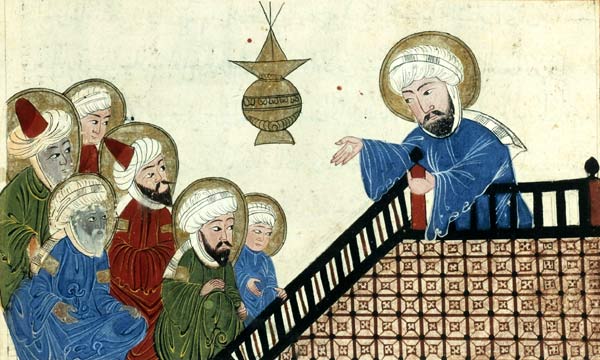
In December 1999, the German news magazine Der Spiegel printed on the same page pictures of "moral apostles" Muhammad, Jesus, Confucius, and Immanuel Kant. Few weeks later, the magazine received protests, petitions and threats against publishing depictions of Muhammad. The Turkish TV station Show TV broadcast the telephone number of an editor who then received daily calls. A picture of Muhammad had been published by the magazine once before in 1998 in a special edition on Islam, without evoking similar protests.
In 2008, several Muslims protested against the inclusion of Muhammad's depictions in the English Wikipedia's Muhammad article. An online petition opposed a reproduction of a 17th-century Ottoman copy of a 14th-century Ilkhanate manuscript image depicting Muhammad as he prohibited Nasīʾ. Jeremy Henzell-Thomas of The American Muslim deplored the petition as one of "these mechanical knee-jerk reactions [which] are gifts to those who seek every opportunity to decry Islam and ridicule Muslims and can only exacerbate a situation in which Muslims and the Western media seem to be locked in an ever-descending spiral of ignorance and mutual loathing."
The Muhammad cartoons crisis
In September 2005, in the tense aftermath of the assassination of Dutch film director Theo van Gogh, killed for his views on Islam, Danish news service Ritzau published an article discussing the difficulty encountered by the writer Kåre Bluitgen to find an illustrator to work on his children's book The Qur'an and the life of the Prophet Muhammad (Danish: Koranen og profeten Muhammeds liv). He said that three artists declined his proposal, which was interpreted as evidence of self-censorship out of fear of reprisals, which led to much debate in Denmark. Reviewing the experiment, Danish scholar Peter Hervik wrote that it disproved the idea that selfcensorship was a serious problem in Denmark, because the overwhelming majority of cartoonists had either responded positively or refused for contractual or philosophical reasons. Furthermore, the Danish newspaper Politiken stated that they asked Bluitgen to put them in touch with the artists who reportedly declined his proposal, so his claim that none of them dared to work with him could be proved, but that Bluitgen refused, making his initial claim impossible to confirm.
Flemming Rose, an editor at the Danish newspaper Jyllands-Posten, invited professional illustrators to depict Muhammad as an experiment to see how much they felt threatened. The newspaper announced that this was an attempt to contribute to the debate about criticism of Islam and self-censorship. On 30 September 2005, the Jyllands-Posten published 12 editorial cartoons, most of which depicted the Prophet Muhammad. One cartoon by Kurt Westergaard depicted Muhammad with a bomb in his turban, which resulted in the Jyllands-Posten Muhammad cartoons controversy (or Muhammad cartoons crisis) (Danish: Muhammedkrisen) i.e. complains by Muslim groups in Denmark, the withdrawal of the ambassadors of Libya, Saudi Arabia and Syria from Denmark, protests around the world including violent demonstrations and riots in some Muslim countries as well as consumer boycotts of Danish products. Carsten Juste, editor-in-chief at the Jyllands-Posten, claimed the international furor over the cartoons amounted to a victory for opponents of free expression. "Those who have won are dictatorships in the Middle East, in Saudi Arabia, where they cut criminals' hands and give women no rights," Juste told The Associated Press. "The dark dictatorships have won." Commenting the cartoon that initiated the diplomatic crisis, American scholar John Woods expressed worries about Westergaard-like association of the Prophet with terrorism, that was beyond satire and offensive to a vast majority of Muslims. Hervik also deplored that the newspaper's "desire to provoke and insult Danish Muslims exceeded the wish to test the self-censorship of Danish cartoonists."
In Sweden, an online caricature competition was announced in support of JyllandsPosten, but foreign minister Laila Freivalds pressured the provider to shut the page down (in 2006, her involvement was revealed to the public and she had to resign).

In France, satirical magazine Charlie Hebdo republished the Jyllands-Posten cartoons of Muhammad. It was taken to court by Islamic organisations under French hate speech laws; it was ultimately acquitted of charges that it incited hatred.
In July 2007, art galleries in Sweden declined to show drawings of artist Lars Vilks depicting Muhammad as a roundabout dog. While Swedish newspapers had published them already, the drawings gained international attention after the newspaper Nerikes Allehanda published one of them on 18 August to illustrate an editorial on the "right to ridicule a religion". This particular publication led to official condemnations from Iran, Pakistan, Afghanistan, Egypt and Jordan, and by the intergovernmental Organisation of the Islamic Conference.

In 2006, the American comedy program South Park, which had previously depicted Muhammad as a superhero ("Super Best Friends)" and has depicted Muhammad in the opening sequence since then, attempted to satirize the Danish newspaper incident. They intended to show Muhammad handing a salmon helmet to Family Guy character Peter Griffin ("Cartoon Wars Part II"). However, Comedy Central who airs the series rejected the scene and its creators reacted by satirizing double standard for broadcast acceptability.
In April 2010, animators Trey Parker and Matt Stone planned to make episodes satirizing controversies over previous episodes, including Comedy Central's refusal to show images of Muhammad following the 2005 Danish controversy. After they faced Internet death threats, Comedy Central modified their version of the episode, obscuring all images and bleeping all references to Muhammad. In reaction, cartoonist Molly Norris created the Everybody Draw Mohammed Day, claiming that if many people draw pictures of Muhammad, threats to murder them all would become unrealistic.
On 2 November 2011, Charlie Hebdo was firebombed right before its 3 November issue was due; the issue was called Charia Hebdo and satirically featured Muhammad as guesteditor. The editor, Stéphane Charbonnier, known as Charb, and two co-workers at Charlie Hebdo subsequently received police protection. In September 2012, the newspaper published a series of satirical cartoons of Muhammad, some of which feature nude caricatures of him. In January 2013, Charlie Hebdo announced that they would make a comic book on the life of Muhammad.
In March 2013, Al-Qaeda's branch in Yemen, commonly known as Al-Qaeda in the Arabian Peninsula (AQAP), released a hit list in an edition of their English-language magazine Inspire. The list included Kurt Westergaard, Lars Vilks, Carsten Juste, Flemming Rose, Charb and Molly Norris, and others whom AQAP accused of insulting Islam. On 7 January 2015, two masked gunmen opened fire on Charlie Hebdo staff and police officers as vengeance for its continued caricatures of Muhammad, killing 12 people, including Charb, and wounding 11others. Jyllands-Posten did not re-print the Charlie Hebdo cartoons in the wake of the attack, with the new editor-in-chief citing security concerns.
Kamlesh Tiwari case
In October 2019, Kamlesh Tiwari, an Indian politician, was killed in a planned attack in Lucknow, Uttar Pradesh, for his views on Muhammad.
On 2 December 2015, Azam Khan, a politician of the Samajwadi Party, stated that Rashtriya Swayamsevak Sangh members are homosexuals and that is why they do not get married. The next day, Kamlesh Tiwari retaliated to Azam Khan's statement and called Muhammad as the first homosexual in the world. with some demanding that he be "beheaded" for "insulting" Muhammad. He was detained under National Security Act by the Samajwadi Party–led state government in Uttar Pradesh. Tiwari spent several months in jail for his comment. He was charged under Indian Penal Code sections 153-A (promoting enmity between groups on the grounds of religion and doing acts prejudicial to maintenance of harmony) and 295-A (deliberate and malicious acts, intended to outrage religious feelings of any class by insulting its religion or religious beliefs). Protest rallies against his statement were held by several Islamic groups in other parts of India, most of them demanding the death penalty.
The protests demanding capital punishment for Tiwari triggered counter-protests by Hindu groups who accused Muslim groups of demanding enforcement of Islamic law of blasphemy in India.
On 18 October 2019, Tiwari was murdered by two Muslim assailants, Farid-ud-din Shaikh and Ashfak Shaikh, in his office-cum-residence at Lucknow. The assailants came dressed in saffron kurtas to give him a sweets box with an address of a sweet shop in Surat city in Gujarat. According to police officials, the assailants kept a revolver and knife inside the sweets box. During the attack, one assailant slit his throat while another fired at him. Tiwari's aide Saurashtrajeet Singh was sent to bring cigarettes for them and when he returned he found Tiwari lying with his throat slit and his body ruptured with wounds. He was declared dead during treatment at a hospital's trauma centre. The post-mortem report revealed that he was stabbed 15 times on the upper part of body from jaws to chest, two deep cut marks on the neck points to attempt to slit his throat and shot once.
''Innocence of Muslims''
Innocence of Muslims is an anti-Islamic short film that was written and produced by Nakoula Basseley Nakoula. Two versions of the 14minute video were uploaded to YouTube in July 2012, under the titles The Real Life of Muhammad and Muhammad Movie Trailer. Videos dubbed in Arabic were uploaded during early September 2012. Anti-Islamic content had been added in post-production by dubbing, without the actors' knowledge.
What was perceived as denigrating of the Islamic Prophet Muhammad resulted in demonstrations and violent protests against the video to break out on 11 September in Egypt and spread to other Arab and Muslim nations and to some western countries. The protests have led to hundreds of injuries and over 50 deaths. Fatwas calling for the harm of the video's participants have been issued and Pakistani government minister Bashir Ahmad Bilour offered a bounty for the killing of Nakoula, the producer. The film has sparked debates about freedom of speech and Internet censorship.
Blasphemy in Sweden during Turkish-Sweden tensions
The incident happened amid rising diplomatic tension between the two countries and Turkey's objections to Sweden joining NATO. Turkey had earlier canceled a visit by Sweden's defense minister and is seeking political concessions, including the deportation of critics and Kurds. The act was described by Sweden's Foreign Minister as "appalling" and does not imply government support for the opinion expressed.
Examples
A variety of actions, speeches or behavior can constitute blasphemy in Islam. Some examples include insulting or cursing Allah, or Muhammad; mockery or disagreeable behavior towards beliefs and customs common in Islam; criticism of Islam's holy personages. Apostasy, that is, the act of abandoning Islam, or finding faults or expressing doubts about Allah (ta'til) and Qur'an, rejection of Muhammed or any of his teachings, or leaving the Muslim community to become an atheist is a form of blasphemy. Questioning religious opinions (fatwa) and normative Islamic views can also be construed as blasphemous. Improper dress, drawing offensive cartoons, tearing or burning holy literature of Islam, creating or using music or painting or video or novels to mock or criticize Muhammad are some examples of blasphemous acts. In the context of those who are non-Muslims, the concept of blasphemy includes all aspects of infidelity (kufr).
Individuals have been accused of blasphemy or of insulting Islam for a variety of actions and words.
Blasphemy against holy personages
- speaking ill of Allah.
- finding fault with Muhammad.
- slighting a Prophet who is mentioned in the Qur'an, or slighting a member of Muhammad's family.
- claiming to be a Prophet or a messenger.
- Visual depictions of Muhammad or any other Prophet, or films about Muhammad or other Prophets (Egypt).
- writing Muhammad's name on the walls of a toilet (Pakistan).
- naming a teddy bear Muhammad (Sudan). See Sudanese teddy bear blasphemy case.
- invoking God while committing a forbidden act.
Blasphemy against beliefs and customs
- finding fault with Islam.
- saying Islam is an Arab religion; prayers five times a day are unnecessary; and the Qur'an is full of lies (Indonesia).
- believing in transmigration of the soul or reincarnation or disbelieving in the afterlife (Indonesia).
- expressing an atheist or a secular point of view or publishing or distributing such a point of view.
- using words that Muslims use because the individuals were not Muslims (Malaysia).
- praying that Muslims become something else (Indonesia).
- finding amusement in Islamic customs (Bangladesh).
- publishing an unofficial translation of the Qur'an (Afghanistan).
- practicing yoga (Malaysia).
- insulting religious scholarship.
- wearing the clothing of Jews or of Zoroastrians.
- claiming that forbidden acts are not forbidden.
- uttering "words of infidelity" (sayings that are forbidden).
- participating in non-Islamic religious festivals.
Blasphemy against mosques
References
References
- (2004). "Psychology of Early Sufi Sama: Listening and Altered States". Routledge.
- (2020). "The Qur'an: What Everyone Needs to Know". Oxford University Press.
- Lorenz Langer (2014) ''Religious Offence and Human Rights: The Implications of Defamation of Religions Cambridge University Press''{{ISBN. 978-1107039575 p. 332
- link. (30 September 2024 , in ''Muhammad in History, Thought, and Culture'' (editors: Coeli Fitzpatrick and Adam Hani Walker). {{ISBN). 978-1610691772, pp. 59–61.
- link. (30 September 2024 , in ''Muhammad in History, Thought, and Culture'' (editors: Coeli Fitzpatrick and Adam Hani Walker). {{ISBN). 978-1610691772, pp. 59–67.
- "Apostasy in Islam: A Historical and Scriptural Analysis".
- Esposito, John. (2018). "Shariah: What Everyone Needs to Know". [[Oxford University Press]].
- (2009). "Blasphemy". Infobase Publishing.
- Talal Asad, in Hent de Vries (ed.). ''Religion: Beyond a Concept''. Fordham University Press (2008). {{ISBN. 978-0823227242. pp. 589–92
- {{quran-usc. 6. 108
- Saeed, Abdullah. (2004). "Freedom of Religion, Apostasy and Islam". Ashgate Publishing Company.
- Brian Winston (2014). ''The Rushdie Fatwa and After: A Lesson to the Circumspect, Palgrave Macmillan''. {{ISBN. 978-1137388599. p. 74, Quote: "(In the case of blasphemy and Salman Rushdie) the death sentence it pronounced was grounded in a jurisprudential gloss on the Surah al-Ahzab (33:57)".
- Richard T. Antoun (2014). ''Muslim Preacher in the Modern World''. Princeton University Press. {{ISBN. 978-0691602752. p. 194, Quote: "All the negative connotations of factionalism, social dissension, '''blasphemy''', and their logical conclusions conspiracy, military confrontation and damnation – are captured in the title of this sura, al-Ahzab (The Confederates, Book 33)"
- According to Akyol, this verse indicates that "Muslims are not supposed to be part of a discourse that mocks Islam, but all they have to do is stay away from it. Even then, the withdrawal should last only until the discourse changes into something inoffensive. Once mockery ends, dialogue can restart". See Akyol, Mustafa, ''Islam Without Extremes: A Muslim Case for Liberty'', 2013 p. 285
- Burney Abbas, Shemeem. "Pakistan's Blasphemy Laws: From Islamic Empires to the Taliban". [[University of Texas Press]].
- Rubin, Uri. ''The Assassination of Kaʿb b. al-Ashraf.'' Oriens, Vol. 32. (1990), pp. 65–71.
- One hadith{{hadith-usc. Abudawud. 38. 4348
- [https://www.theguardian.com/world/2011/jan/20/islam-ghamidi-pakistan-blasphemy-laws Islamic scholar attacks Pakistan's blasphemy laws] {{Webarchive. link. (30 September 2024 Guardian 20 January 2010. Retrieved 23 January 2010)
- Peters, R. (2005). Crime and punishment in Islamic Law: Theory and practice from the Sixteenth to the Twenty-First Century (Vol. 2). Cambridge University Press.
- Schirrmacher, C.. (2008). "Defection from Islam: A Disturbing Human Rights Dilemma".
- Saeed, Abdullah. "Ambiguities of Apostasy and The Repression of Muslim Dissent." The Review of Faith & International Affairs 9.2 (2011): 31–38.
- Mazhar, Arafat. (2015-11-02). "Blasphemy and the death penalty: Misconceptions explained". [[Dawn (newspaper).
- Al-Ṭaḥāwī. "Mukhtaṣar al-Ṭaḥāwī". Dar Al-Kitab Al-Arab Printing House, Deccan, India.
- Al-Jaṣṣāṣ. "Sharḥ Mukhtaṣar al-Ṭaḥāwī". Dar al-Basha'ir al-Islamiyya Dar al-Siraj.
- Al-Qudūrī. "Kitāb al-Tajrīd". Dar al-Islam.
- Al-Kāsanī. "Badāʾiʿal-Ṣanāʾi". Dar al-Kutub al-Almiyya.
- Ahmad ibn Muhammad al-Tahawi (933), Mukhtasar Ikhtilaf al-Ulama, vol. 3, p. 504
- [[Qadi Ayyad. Qadi 'Iyad ibn Musa al-Yahsubi]] (1145), Kitab Ash-shifa (كتاب الشفاء بتعريف حقوق المصطفى), pp. 373–441 (Translated in English by AA Bewley, {{oclc. 851141256, (Review Contents in [http://data.nur.nu/Kutub/English/Qadi-Iyad_Shifa_Aisha-Bewley-Table-of-Contents.pdf Part 4] {{Webarchive. link. (8 April 2023, Read [http://www.masud.co.uk/ISLAM/misc/alshifa/pt4ch1sec4.htm Excerpts from Part 4] {{Webarchive). link. (9 November 2014, Accessed on: 10 January 2015))
- D Jordan (2003), Dark Ages of Islam: Ijtihad, Apostasy, and Human Rights in Contemporary Islamic Jurisprudence, The. Wash. & Lee Race & Ethnic Anc. Law Journal, Vol. 9, pp. 55–74
- Carl Ernst (2005), "Blasphemy: Islamic Concept", Encyclopedia of Religion (Editor: Lindsay Jones), Vol 2, Macmillan Reference, {{ISBN. 0-02-865735-7
- Abdullah Saeed and Hassan Saeed (2004), Freedom of Religion, Apostasy and Islam, Ashgate Publishing, {{ISBN. 978-0754630838
- *[[Ibn Taymiyyah]] (a [[Salafi]], related to Hanbali school), ''[[As-Sarim al-Maslul 'ala Shatim ar-Rasul. al-Sārim al-Maslūl 'ala Shātim al-Rasūl]]'' (Translation: A ready sword against those who insult the Messenger), Published in 1297 AD in Arabic, Reprinted in 1975 and 2003 by Dar-ibn Hazm (Beirut)
- "Summary of Aqida - Verbal Nullifiers in the Chapter on Prophecies".
- Ali ibn al-Hussein al-Murtada (1044), Al-Intisar, pp. 480–81
- See [[Blasphemy law]].
- (12 February 2010). "Govt warned against amending blasphemy law". The News.
- Fox, Jonathan. (2015). "Political Secularism, Religion, and the State: A Time Series Analysis of Worldwide Data". Cambridge University Press.
- (2013). "The Princeton Encyclopedia of Islamic Political Thought". Princeton University Press.
- [https://books.google.com/books?id=js30HODt2aYC&pg=PA179 Byzantium and the Arabs in the Sixth Century, Volume 2, Part 2], p. 179, Irfan Shahîd. Also see footnote
- Husayn Haykal, Muhammad. (2008). "The Life of Muhammad". Islamic Book Trust.
- The Encyclopaedia of Islam, New Edition, Vol. VII, 1993, p. 872
- "Sirat Rasul Allah" by Ibn Ishaq, pp. 135–36
- Abdul-Rahman, Muhammad Saed. (2009). "The Meaning and Explanation of the Glorious Qur'an". MSA Publication Limited.
- (2012). "Heaven on Earth: A Journey Through Shari'a Law from the Deserts of Ancient Arabia ...". Macmillan.
- Michel, ''Muslim Theologian's Response'', pp. 69–71)
- (6 November 2014). "What are Pakistan's blasphemy laws?".
- (18 August 2013). "Timeline: Accused under the Blasphemy Law".
- (17 May 2014). "Living in fear under Pakistan's blasphemy law". Al Jazeera.
- (21 November 2012). "Laws Penalizing Blasphemy, Apostasy and Defamation of Religion are Widespread". Pew Research Center's Religion & Public Life Project.
- Rehman, Javaid. "The Shari 'ah, International Human Rights Law and The Right To Hold Opinions and Free Expression: After Bilour's Fatwa." Islam and International Law: Engaging Self-Centrism from a Plurality of Perspectives (2013): 244.
- Forte, David F. "Apostasy and Blasphemy in Pakistan." Conn. J. Int'l L. 10 (1994): 27.
- Silence. How Apostasy and Blasphemy Codes Are Choking Freedom Worldwide. By Paul Marshall and Nina Shea. New York: Oxford University Press, 2011.
- "Michael Totten, Radical Islam's global reaction: the push for blasphemy laws (January/February 2013)".
- (19 September 2012). "Islamic states to reopen quest for global blasphemy law". Reuters.
- (2012). "Blasphemy Laws Exposed – The Consequences of Criminalizing Defamation of Religions".
- (2009). "Blasphemy Salman Rushdie". Constitutional Rights Foundation.
- Webster, Richard. (1990). "A Brief History of Blasphemy: Liberalism, Censorship and 'The Satanic Verses'". The Orwell Press.
- . (September 1998). ["Document – Egypt: Human Rights Abuses By Armed Groups"](https://www.amnesty.org/en/documents/mde12/022/1998/en/). *[[Amnesty International]]*.
- (19 July 2011). "God Has Ninety-Nine Names: Reporting from a Militant Middle East". Simon and Schuster.
- (2002). "Censorship of Historical Thought: A World Guide, 1945–2000". Greenwood Publishing.
- de Waal, Alex. (2004). "Islamism and Its Enemies in the Horn of Africa". C. Hurst & Co.
- Day, Elizabeth. (8 December 2007). "I was terrified that the guards would come in and teach me a lesson". The Guardian.
- Stratton, Allegra. (30 November 2007). "Jailed teddy row teacher appeals for tolerance". [[The Guardian]].
- (29 November 2007). "Muhammad & the teddy bear: a case of intercultural incompetence".
- (2 December 2007). "Sudanese Views differ in Teddy Row". BBC.
- [https://news.bbc.co.uk/2/hi/uk_news/7124447.stm Teddy row teacher freed from jail], ''BBC World Service'', 3 December 2007
- "[https://www.nbcnews.com/id/wbna22076390 Teddy bear" teacher leaves Sudan after pardon] {{Webarchive. link. (13 April 2023 ", ''MSNBC'')
- Kazim, Hasnain. (19 November 2010). "Eine Ziege, ein Streit und ein Todesurteil". [[Der Spiegel]].
- (5 December 2010). "Fear for Pakistan's death row Christian woman". [[BBC News]].
- Hussain, Waqar. (11 November 2010). "Christian Woman Sentenced to Death". [[Agence France-Presse]].
- (9 November 2010). "Christian Woman sentenced to Death in Pakistan for blasphemy". [[The Daily Telegraph]].
- (2 March 2011). "Militants say killed Pakistani minister for blasphemy". Reuters.
- Guerin, Orla. (6 December 2010). "Pakistani Christian Asia Bibi 'has price on her head'". [[BBC]].
- McCarthy, Julie. (14 December 2010). "Christian's Death Verdict Spurs Holy Row in Pakistan". [[NPR]].
- (8 January 2011). "Salmaan Taseer came here and he sacrificed his life for me". The Independent.
- R. Upadhyay, [http://www.eurasiareview.com/28012011-barelvis-and-deobandhis-%E2%80%9Cbirds-of-the-same-feather%E2%80%9D/ Barelvis and Deobandhis: "Birds of the Same Feather"] {{Webarchive. link. (4 November 2018 . Eurasia Review, courtesy of the South Asia Analysis Group. 28 January 2011.)
- Sana Saleem, [https://www.theguardian.com/commentisfree/belief/2011/jan/05/salman-taseer-murder-pakistan "Salmaan Taseer: murder in an extremist climate"] {{Webarchive. link. (18 January 2017 , ''[[The Guardian]]'', 5 January 2011. Retrieved 7 January 2011.)
- Aleem Maqbool and [[Orla Guerin]], [https://www.bbc.co.uk/news/world-south-asia-12116764 "Salman Taseer: Thousands mourn Pakistan governor"] {{Webarchive. link. (12 December 2013 : "One small religious party, the Jamaat-e-Ahl-e-Sunnat Pakistan, warned that anyone who expressed grief over the assassination could suffer the same fate. 'No Muslim should attend the funeral or even try to pray for Salman Taseer or even express any kind of regret or sympathy over the incident,' the party said in a statement. It said anyone who expressed sympathy over the death of a blasphemer was also committing blasphemy." ''BBC News South Asia'', 5 January 2011. Retrieved 7 January 2011.)
- [http://mgafrica.com/article/2014-12-28-days-after-mauritania-sentences-man-to-death-for-insulting-islam-egypt-to-try-writer-for-similar-offence Days after Mauritania sentences man to death for 'insulting Islam', Egypt to try female writer for similar offence] {{Webarchive. link. (6 January 2015 Agence France-Presse, MG Africa (28 December 2014))
- "Egyptian writer Fatima Naoot sentenced to 3 years in jail for 'contempt of religion' – Politics – Egypt – Ahram Online".
- (2 April 2015). "Family of Afghan woman lynched by mob demands justice". [[Al Jazeera Media Network.
- "The Killing of Farkhunda". New York Times.
- (29 March 2015). "Woman Killed in Kabul Transformed From Pariah to Martyr". The New York Times.
- (23 March 2015). "Afghan woman Farkhunda lynched in Kabul 'for speaking out'". BBC.
- Rasmussen, Sune Engel. (23 March 2015). "Farkhunda's family take comfort from tide of outrage in wake of her death". The Guardian.
- (20 March 2015). "Afghan cleric and others defend lynching of woman in Kabul". Reuters.
- (23 March 2015). "Afghans Protest Brutal Mob Killing of 'Innocent' Woman". Newsweek.
- (14 April 2015). "What's the Future for Women's Rights in Afghanistan?". [[Equal Times]].
- (2 May 2015). "Trial begins in case of Kabul lynching of Farkhunda".
- (2 July 2015). "Afghan court quashes Farkhunda mob killing death sentences". BBC News.
- (23 October 2015). "A Memorial To Farkhunda Appears In Kabul". [[Solidarity Party of Afghanistan]].
- (27 April 2017). "Man 'sentenced to death for atheism' in Saudi Arabia". [[The Independent]].
- (14 April 2017). "Pakistan 'blasphemy killing': murdered student 'devoted to Islam'". euronews.
- "Pakistan journalism student latest victim of blasphemy vigilantes".
- (9 May 2017). "Ahok Jailed for Two Years". metrotvnews.com.
- (9 May 2017). "Ahok Sent to 2 Years in Prison for Blasphemy". en.tempo.co.
- (9 May 2017). "Jakarta governor Ahok found guilty of blasphemy, jailed for two years". theguardian.
- "Jakarta governor Ahok found guilty of blasphemy".
- [http://www.spiegel.de/spiegel/print/d-15613871.html Terror am Telefon] {{Webarchive. link. (2 December 2013, ''Spiegel'', 7 February 2000)
- ''Spiegel Special'' 1, 1998, p.{{nbsp76
- (6 February 2008). "Muslims Protest Wikipedia Images of Muhammad". [[Fox News]].
- Cohen, Noam. (5 February 2008). "Wikipedia Islam Entry Is Criticized". New York Times.
- MS Arabe 1489. The image used by Wikipedia is hosted on [[Wikimedia Commons]] ([//upload.wikimedia.org/wikipedia/commons/0/0d/Maome.jpg upload.wikimedia.org/wikipedia/commons/0/0d/Maome.jpg]). The reproduction originates from the website of the [[Bibliothèque nationale de France]] [http://expositions.bnf.fr/livrarab/pedago/grands/0_01.htm] {{Webarchive. link. (10 October 2012)
- [http://www.theamericanmuslim.org/tam.php/features/articles/wikipedia_and_depictions_of_the_Prophet_muhammad_the_latest_inane_distracti/0015659 Wikipedia and Depictions of the Prophet Muhammad: The Latest Inane Distraction] {{Webarchive. link. (14 February 2008, 10 February 2008)
- (2006). "Provoen og Profeten: Muhammed Krisen bag kulisserne". Jyllands-Postens Forlag.
- Bluitgen, Kåre. (2006). "Koranen og profeten Muhammeds liv". Høst & Søn/Tøkk.
- (17 September 2005). "Dyb angst for kritik af islam ("Profound anxiety about criticism of Islam")". Politiken.
- Rose, Flemming. (19 February 2006). "Why I Published Those Cartoons". The Washington Post.
- Hervik, Peter. (2012). "The Danish Muhammad Cartoon Conflict". Malmö Institute for Studies of Migration, Diversity and Welfare (MIM).
- Politiken 12. Februar 2006 "''Muhammedsag: Ikke ligefrem en genistreg''"
- Henkel, Heiko. (Fall 2010). "Fundamentally Danish? The Muhammad Cartoon Crisis as Transitional Drama". Human Architecture: Journal of the Sociology of Self-knowledge.
- Jensen, Tim. (2006). ""The Muhammad Cartoon Crisis. The tip of an Iceberg", Japanese religion".
- Vries, Lloyd. (2 February 2006). "Cartoon Inflames Muslim World". CBS News.
- (8 February 2006). "Explaining the outrage". [[Chicago Tribune]].
- "Swedish foreign minister resigns over cartoons". Reuters AlertNet.
- Leveque, Thierry. (22 March 2007). "French court clears weekly in Mohammad cartoon row". Reuters.
- Leveque, Thierry. (22 March 2007). "French court clears weekly in Mohammad cartoon row". Reuters.
- Ströman, Lars. (18 August 2007). "Rätten att förlöjliga en religion". [[Nerikes Allehanda]].
- (27 August 2007). "Iran protests over Swedish Muhammad cartoon". [[Agence France-Presse]].
- (30 August 2007). "Pakistan Condemns the Publication of Offensive Sketch in Sweden". [[Pakistan Ministry of Foreign Affairs]].
- Salahuddin, Sayed. (1 September 2007). "Indignant Afghanistan slams Prophet Mohammad sketch". Reuters.
- Fouché, Gwladys. (3 September 2007). "Egypt wades into Swedish cartoons row". The Guardian.
- (3 September 2007). "Jordan condemns new Swedish Mohammed cartoon". [[Agence France-Presse]].
- (30 August 2007). "The Secretary General strongly condemned the publishing of blasphemous caricatures of Prophet Muhammad by Swedish artist". [[Organisation of the Islamic Conference]].
- "Super Best Friends".
- "Ryan j Budke. "South Park's been showing Muhammad all season!" TVSquad.com; April 15, 2006". Tvsquad.com.
- "Texas shooting: What have we learned five years after 'Draw Muhammad Day'?". Washington Post.
- Simons, Stefan. (20 September 2012). "'Charlie Hebdo' Editor in Chief: 'A Drawing Has Never Killed Anyone'". Spiegel Online.
- Anaëlle Grondin (7 January 2015) [http://www.20minutes.fr/medias/1511895-20150107-charlie-hebdo-charb-directeur-publication-journal-satirique-assassine «Charlie Hebdo»: Charb, le directeur de la publication du journal satirique, a été assassiné] {{Webarchive. link. (24 February 2021 {{in lang). fr ''[[20 minutes (France). 20 Minutes]]''.
- [http://www.liberation.fr/medias/2011/11/03/trois-charlie-sous-protection-policiere_772318 Trois «Charlie» sous protection policière] {{Webarchive. link. (19 January 2015 {{in lang). fr ''Libération''. 3 November 2011.
- (2 January 2013). "It's Charlie Hebdo's right to draw Muhammad, but they missed the opportunity to do something profound". [[The Independent]].
- (8 January 2015). "Has al-Qaeda Struck Back? Part One".
- Bennet, Dashiell. (1 March 2013). "Look Who's on Al Qaeda's Most-Wanted List". The Wire.
- Urquhart, Conal. "Paris Police Say 12 Dead After Shooting at Charlie Hebdo".
- Ward, Victoria. (7 January 2015). "Murdered Charlie Hebdo cartoonist was on al Qaeda wanted list". The Telegraph.
- (2 November 2011). "French satirical paper Charlie Hebdo attacked in Paris". BBC News.
- Cormack, Lucy. (8 January 2015). "Charlie Hebdo editor Stephane Charbonnier crossed off chilling al-Qaeda hitlist". The Age.
- (7 January 2015). "Les deux hommes criaient "Allah akbar" en tirant". L'essentiel Online.
- Kim Willsher et al. (7 January 2015) [https://www.theguardian.com/world/2015/jan/07/paris-terror-attack-huge-manhunt-under-way Paris terror attack: huge manhunt under way after gunmen kill 12] {{Webarchive. link. (7 March 2017 ''[[The Guardian]]'')
- Willsher, Kim. (7 January 2015). "Satirical French magazine Charlie Hebdo attacked by gunmen".
- (8 January 2015). "Why a Danish newspaper won't publish the Charlie Hebdo cartoons".
- Chakraborty, Pathikrit. (18 October 2019). "Kamlesh Tiwari: Hindu Mahasabha leader Kamlesh Tiwari stabbed to death in Lucknow".
- [https://www.indiatoday.in/india/story/lucknow-hindu-samaj-party-leader-kamlesh-tiwari-killed-assailants-slit-throat-1610724-2019-10-18 Lucknow: Hindu Samaj Party leader Kamlesh Tiwari killed, assailants slit his throat] {{Webarchive. link. (9 April 2023, India Today (October 18, 2019))
- [https://www.indiatoday.in/india/story/kamlesh-tiwari-murder-up-police-says-case-solved-remarks-on-Prophet-muhammad-behind-killing-1610970-2019-10-19 Kamlesh Tiwari murder: UP Police says case solved, remarks on Prophet Muhammad behind killing] {{Webarchive. link. (16 April 2023, India Today (October 19, 2019))
- (2015-12-12). "This is what Kamlesh Tiwari said about Prophet Muhammad which infuriated Muslims".
- (2019-07-27). "Azam Khan no stranger to controversies, has a history of squabbles".
- Tiwari, Mrigank. (December 1, 2015). "RSS volunteers are 'homosexuals', says Azam Khan".
- Rana, Uday. (December 11, 2015). "1 lakh Muslims gather in Muzaffarnagar, demand death for Kamlesh Tiwari".
- (2015-12-12). "Here's why 1 lakh Muslims are demanding the death penalty for Kamlesh Tiwari".
- Bhatia, Ishita. (4 December 2015). "Kamlesh Tiwari not a member, says Hindu Mahasabha".
- [https://www.indiatoday.in/india/story/kamlesh-tiwari-hindu-samaj-party-leader-death-lucknow-1610775-2019-10-18 Who was Kamlesh Tiwari, the Hindu Samaj Party leader killed in broad daylight in Lucknow?] {{Webarchive. link. (6 April 2023, India Today (October 18, 2019))
- [https://www.thehindu.com/news/national/other-states/Kamlesh-Tiwari-may-contest-U.P.-bypolls/article14008095.ece Kamlesh Tiwari may contest U.P. bypolls] {{Webarchive. link. (8 April 2023, Mohammad Ali, The Hindu (September 20, 2016), Quote: "Mr. Tiwari, who was granted bail last week by a Lucknow court, will remain in jail until the Allahabad High Court decides on his plea against the slapping of the National Security Act (NSA) on him by the State government.")
- Preeti. (2016-01-05). "All You Need To Know About Malda Violence: Explained".
- (2019-10-18). "Hindu Mahasabha leader Kamlesh Tiwari found murdered inside house in Lucknow".
- (2015-12-12). "Here's why 1 lakh Muslims are demanding the death penalty for Kamlesh Tiwari".
- [https://www.indiatoday.in/india/story/kamlesh-tiwari-murder-lucknow-police-yogi-adityanath-nia-1611125-2019-10-19 Plan to kill Kamlesh Tiwari hatched 2 months ago: Police] {{Webarchive. link. (8 April 2023, India Today (October 19, 2019))
- Shaikh, Sarfaraz. (19 October 2019). "Kamlesh Tiwari murder case: Six detained in Surat".
- [https://www.thehindu.com/news/national/other-states/kamlesh-tiwari-leader-of-saffron-fringe-group-hindu-samaj-party-killed-in-lucknow/article29737067.ece Saffron fringe group leader Kamlesh Tiwari killed in Lucknow] {{Webarchive. link. (9 April 2023, The Hindu (October 18, 2019))
- [https://www.indiatoday.in/india/story/kamlesh-tiwari-was-stabbed-15-times-shot-one-bullet-post-mortem-report-1612067-2019-10-23 Kamlesh Tiwari was stabbed 15 times, shot once. Post-mortem report] {{Webarchive. link. (13 September 2023, India Today (October 23, 2019))
- (20 September 2012). "Anti-Muslim film got LA County permit for shoot". Reading Eagle.
- (20 September 2012). "County of Los Angeles Releases Redacted Film Permit for "Desert Warriors"". FilmLA.
- (13 September 2012). "Anti-Islam Producer Wrote Script in Prison: Authorities, 'Innocence of Muslims' Linked to Violence in Egypt, Libya". ABC News.
- (13 September 2012). "Behind Video, a Web of Questions". The Wall Street Journal.
- Zahos, Zachary. (19 September 2012). "The Art of Defamation". The Cornell Daily Sun.
- Lovett, Ian. (15 September 2012). "Man Linked to Film in Protests Is Questioned". The New York Times.
- Murphy, Dan. (12 September 2012). "There-may-be-no-anti-Islamic-movie-at-all". The Christian Science Monitor.
- (21 September 2012). "Death, destruction in Pakistan amid protests tied to anti-Islam film". CNN.
- (26 September 2012). "Egypt newspaper fights cartoons with cartoons". Associated Press.
- [https://abcnews.go.com/International/wireStory/latest-protests-depictions-muhammad-17309212 Latest Protests Against Depictions of Muhammad] retrieved 1 October 2012 {{dead link. (June 2016)
- [http://communities.washingtontimes.com/neighborhood/political-potpourri/2012/sep/18/fatwa-issued-muslim-cleric-against-participants-an/ Fatwa issued by Muslim cleric against participants in an anti-Islamic film] retrieved 1 October 2012 {{webarchive. link. (4 October 2012)
- [https://www.islamtwins.com/2023/05/habib-abdul-qodir-bilfaqih-sosok-ulama.html Egypt cleric issues fatwa against 'Innocence of Muslims' cast] {{Webarchive. link. (11 December 2023 retrieved 1 October 2012)
- (23 September 2012). "Anti-Islam film: US condemns Pakistan minister's bounty". BBC News.
- Fenton, Thomas. (12 September 2012). "Should Innocence of Muslims be censored?". Global Post.
- (2023-01-21). "Turkey condemns 'vile' Sweden Quran-burning protest". BBC News.
- (6 February 2023). "Salman Rushdie on Surviving the Fatwa".
- (20 October 2007). "Lesson 13 : The Types of Blasphemy and Blasphemers".
- Lawton, D. (1993). Blasphemy. Univ of Pennsylvania Press
- CW Ernst, in Eliade (Ed), ''Blasphemy – Islamic Concept'', The encyclopedia of religion, New York (1987)
- Marshall and Shea (2011), ''Silenced'', Oxford University Press, {{ISBN. 978-0199812288
- (8 April 2009). "Egypt bans 'blasphemous' magazine". BBC.
- Ibrahim, Yusha'u A.. (20 June 2009). "Nigeria: Blasphemy – Rioters Burn Police Outpost, Injure 12". Daily Trust.
- Ibrahim, Yusha'u A.. (11 August 2008). "Nigeria: Mob Kills 50-Year-Old Man for 'Blasphemy'". Daily Trust.
- (2008). "Nigeria: International Religious Freedom Report 2008". U.S. Department of State.
- (August 2002). "Blasphemy Laws and Intellectual Freedom in Pakistan". South Asian Voice.
- (20 July 2010). "Pakistan city tense after 'blaspheming' Christians shot". BBC.
- (4 June 2006). "Pakistan bans Da Vinci Code film". BBC News / South Asia.
- (19 August 2005). "Document – Pakistan: Fear for safety/ Prisoner of Conscience (POC), Mohammed Younus Shaikh". Amnesty International.
- (12 August 2005). "Karachi: Writer of sacrilegious book gets life term". Dawn the Internet Edition.
- Soage, Ana Belén. (June 2007). "Faraj Fawda, or The Cost of Freedom of Expression". Middle East Review of International Affairs (MERIA) Journal.
- Djavadi, Abbas. (28 February 2009). "In Today's Iran, Anything Else Is "Blasphemy"". Iran & Beyond.
- MacFarquhar, Neil. (24 June 2007). "Iran Cracks Down on Dissent". The New York Times.
- Fathi, Nazila. (29 June 2004). "Iran Drops Death Penalty for Professor Guilty of Blasphemy". The New York Times.
- (1 August 2004). "Iran Frees Professor Set to Die for Speech". The New York Times.
- (27 July 1994). "Pakistan: Use and abuse of blasphemy laws". Amnesty International.
- Cowasjee, Ardeshir. (10 February 2002). "The Man in the Moon".
- "Indonesian 'Prophet' jailed for blasphemy".
- (19 February 2006). "16 die in cartoon protests in Nigeria". CNN.com.
- (13 February 2008). "Nigeria Christian Killed in Riot Over Blasphemy; Dozens Injured". BosNewsLife.
- Samson, Elizabeth. (10 September 2008). "Criminalizing Criticism of Islam". Wall Street Journal Europe.
- (1 July 2008). "Jordan charges Dutch politician with blasphemy". Reuters.
- (19 September 2008). "Malaysia". U.S. State Department.
- Khouri, Malek. (Spring 2006). "Anxieties of fundamentalism and the dynamics of modernist resistance: Youssef Chahine's Al Maseer". BNET.
- Walsh, Declan. (31 May 2010). "Pakistan lifts Facebook ban but 'blasphemous' pages stay hidden". guardian.
- (May 2009). "Annual Report of the United States Commission on International Religious Freedom May 2009". [[United States Commission on International Religious Freedom]].
- (26 November 2007). "Reports: Sudan arrests UK teacher for teddy bear blasphemy". CNN.com.
- Bearak, Barry. (12 May 2001). "Death to Blasphemers: Islam's Grip on Pakistan". [[The New York Times]].
- Hussain, Zahid. (September 2001). "Lethal Law". [[Newsline (magazine).
- (16 August 2002). "Blasphemy Prisoner Acquitted After Six Years in Prison". International Christian Concern.
- Adams, Brad. (19 November 2007). "Pakistan: Dubai Should End Shutdown of Pakistani Channels". Human Rights Watch.
- (19 September 2008). "Bangladesh". U.S. State Department.
- Patung. (11 April 2007). "Islam is for Arabs". Indonesia Matters.
- Patung. (27 February 2006). "Abdul Rahman, Blasphemer". Indonesia Matters.
- Doran, Michael Scott. (January–February 2004). "The Saudi Paradox". Foreign Affairs.
- Boyle, Kevin. (1997). "Freedom of Religion and Belief". Routledge.
- "FileRoom.org - In Egypt, writer, Salaheddin Mohsen is sentenced to three years in prison for atheism and blasphemy against Islam".
- Murphy, Kim. (7 May 1990). "A Matter of Censorship". Los Angeles Times.
- Zenati, Hassen. (5 June 2004). "Al-Azhar confiscates publications". Middle East Online.
- "Censorship and Persecution in the Name of Islam: A Tunisian Weekly Counts the Ways".
- Abdoun, Safaa. (11 December 2008). "Late Publishing Mogul Madbouli leaves behind a Literary Legacy". Daily News Egypt.
- (25 October 2008). "Jordanian poet accused of 'atheism and blasphemy'". The Daily Star Lebanon.
- Alrawi, Karim. (31 January 1992). "Egypt's Rushdie". New Statesman & Society.
- (12 September 2008). "Egypt: Internet writer Kareem Amer ill treated". English PEN.
- (11 July 2006). "Independent weekly hit by two bombs after threats from radical movement". Reporters Without Borders.
- (n.d.). "To: Government of Bangladesh". Scholars for Peace in the Middle East.
- Mineeia, Zainab. (21 October 2008). "Afghanistan: Journalist Serving 20 Years for "Blasphemy"". IPS (Inter Press Service).
- Wiseman, Paul. (31 January 2008). "Afghan student's death sentence hits nerve". USA Today.
- (19 September 2008). "2008 Report on International Religious Freedom – Afghanistan". United States Department of State.
- (6 August 2003). "Supreme court confirms death sentence for two journalists for "blasphemy"". Reporters sans frontières.
- (5 March 2009). "'Allah' cannot be used by non-Muslims: Malaysia". expressindia.com.
- (May 2009). "Annual Report of the United States Commission on International Religious Freedom May 2009". United States Commission on International Religious Freedom.
- (19 September 2007). "Cartoonist arrested over harmless play on name Mohammed". Reporters Without Borders.
- (15 January 2007). "Journalists fined over Islam joke". BBC News.
- (19 September 2007). "BANGLADESH: Cartoon incident, ''Prothom Alo'' takes action against persons responsible". The Daily Star.
- Dummett, Mark. (19 September 2007). "Cartoonist jailed in Bangladesh". BBC News.
- Wafa, Abdul Waheed. (11 March 2009). "Afghan Court Backs Prison Term for Blasphemy". The New York Times.
- (22 November 2008). "Malaysia: Muslims warned to avoid blasphemous yoga". Welt Online.
- (22 November 2008). "Malaysia: Muslims warned to avoid blasphemous yoga". Die Welt.
- Holike, C. (2011), in Andrea Fleschenberg, Claudia Derich (Eds), The State of Islam{{nbsp– Negotiating Democracy, Muslim Women's Rights and Morality in Indonesia and Malaysia, ''Women and Politics in Asia: A Springboard for Democracy?'', LIT Verlag (Zurich), 15, pp.{{nbsp71–80
- Nir, Sarah Maslin. (8 April 2012). "In Queens, Seeking to Clear a Path Between Yoga and Islam". The New York Times.
This article was imported from Wikipedia and is available under the Creative Commons Attribution-ShareAlike 4.0 License. Content has been adapted to SurfDoc format. Original contributors can be found on the article history page.
Ask Mako anything about Islam and blasphemy — get instant answers, deeper analysis, and related topics.
Research with MakoFree with your Surf account
Create a free account to save articles, ask Mako questions, and organize your research.
Sign up freeThis content may have been generated or modified by AI. CloudSurf Software LLC is not responsible for the accuracy, completeness, or reliability of AI-generated content. Always verify important information from primary sources.
Report