From Surf Wiki (app.surf) — the open knowledge base
Ise Shrine
Shinto shrine in Japan

Shinto shrine in Japan
| Field | Value | |
|---|---|---|
| name | Ise Shrine | |
| native_name | 伊勢神宮 | |
| image | [[File:Naiku 04.jpg | 250px]] |
| caption | Naikū, Ise Shrine | |
| mapframe | yes | |
| mapframe-zoom | 14 | |
| mapframe-wikidata | yes | |
| map_type | Japan | |
| coordinates | ||
| religious_affiliation | Shinto | |
| deity | Amaterasu | |
| established | 4 BCE (according to legend) | |
| location | Ise, Mie Prefecture, Japan | |
| architecture_style | Shinmei zukuri |
| mapframe-zoom = 14 | mapframe-wikidata = yes The Ise Shrine, located in Ise, Mie Prefecture of Japan, is a Shinto shrine dedicated to the solar goddess Amaterasu Ōmikami and the grain goddess Toyouke-hime (Toyouke Omikami). Also known simply as , Ise Shrine is a shrine complex composed of many Shinto shrines centered on two main shrines, and .
The Inner Shrine, Naikū (also officially known as "Kōtai Jingū"), is dedicated to the worship of Amaterasu and is located in the town of Uji-tachi, south of central Ise, where she is believed to dwell. The shrine buildings are made of solid cypress wood and use no nails but instead joined wood. The Outer Shrine, Gekū (also officially known as "Toyouke Daijingū"), is located about six kilometers from Naikū and dedicated to Toyouke-Ōmikami, the god of agriculture, rice harvest and industry. Besides Naikū and Gekū, there are an additional 123 Shinto shrines in Ise City and the surrounding areas, 91 of them connected to Naikū and 32 to Gekū.
Purportedly the home of the Sacred Mirror, the shrine is the Shinto's holiest and most important site. Access to both sites is strictly limited, with the general public not allowed beyond sight of the thatched roofs of the central structures, hidden behind four tall wooden fences. However, visitors are free to roam the forest, including its ornamental walkways which date back to the Meiji period.
During the Edo period, it is estimated that one out of ten Japanese conducted an Okage Mairi pilgrimage to the shrine. Accordingly, pilgrimage to the shrine flourished in both commercial and religious frequency. According to historical documents, 3.62 million people visited the shrine in 50 days in 1625, and 1.18 million people visited the shrine in three days in 1829 when the grand festival held every 20 years was held. Because the shrine is considered sanctuary, no security checkpoints were conducted, as it was considered sacrilege by the faithful. The two main shrines of Ise are joined by a pilgrimage road that passes through the old entertainment district of Furuichi.
The chief priest or priestess of Ise Shrine must be related to the Imperial House of Japan and is responsible for watching over the Shrine. The current High Priestess of the shrine is the daughter of Emperor Emeritus Akihito, former Princess Sayako Kuroda.
Establishment of the Shrine
According to the Nihon Shoki, around 2000 years ago the divine Yamatohime-no-mikoto, daughter of the Emperor Suinin, set out from Mt. Miwa in modern Nara Prefecture in search of a permanent location to worship the goddess Amaterasu, wandering for 20 years through the regions of Omi and Mino. Her search eventually brought her to Ise, in modern Mie Prefecture, where she is said to have established Naikū after hearing the voice of Amaterasu saying "(Ise) is a secluded and pleasant land. In this land I wish to dwell." Before Yamatohime-no-mikoto's journey, Amaterasu had been worshiped at the imperial residence in Yamato, then briefly at Kasanui in the eastern Nara basin. When Princess Yamatohime-no-mikoto arrived at the village of Uji-tachi, she set up fifty bells to designate the area as enshrined for the goddess Amaterasu, which is why the river is called the Isuzu, or "fifty bells".
Geku was founded after Emperor Yuryaku dreamt that he saw Amaterasu. She said she was unable to get food and asked him to bring Toyouke-hime from Tanba help her with food.
_01.JPG)
Besides the traditional establishment date of 4 BC, other dates of the 3rd and 5th centuries have been put forward for the establishment of Naikū and Gekū respectively. The first shrine building at Naikū was erected by Emperor Tenmu (678–686), with the first ceremonial rebuilding being carried out by his wife, Empress Jitō, in 692.
The shrine was foremost among a group of shrines which became objects of imperial patronage in the early Heian period. In 965, Emperor Murakami ordered imperial messengers to be sent to report important events to the guardian kami of Japan. These heihaku were initially presented to 16 shrines including the Ise Shrine.
Chief priestess / chief priest
From the late 7th century until the 14th century, the role of chief priestess of Ise Shrine was carried out by a female member of the Imperial House of Japan known as a Saiō. According to the Man'yōshū, the first saiō to serve at the shrine was Princess Ōku, daughter of Emperor Tenmu, during the Asuka period. Mention of Ise Shrine's saiō is also made in the Aoi, Sakaki and Yugao chapters of The Tale of Genji as well as in the 69th chapter of The Tales of Ise. The saiō system ended during the turmoil of the Nanboku-chō period.
During the Empire of Japan and the establishment of State Shinto, the position of chief priest of the Ise Shrine was fulfilled by the reigning emperor and the Meiji, Taisho and Shōwa Emperors all played the role of chief priest during their reigns.
Since the disestablishment of State Shinto during the Occupation of Japan, the offices of chief priest and most sacred priestess have been held by former members of the imperial family or their descendants. The current chief priest of the shrine is , adoptive son of Takatsukasa Kazuko. He succeeded Kitashirakawa Michihisa, a great-grandson of Emperor Meiji, in 2007. Kitashirakawa Fusako, the daughter of Emperor Meiji, served as the chief priestess until 1974, when she was succeeded by her niece, Takatsukasa Kazuko. Takatsukasa was succeeded by her younger sister, Ikeda Atsuko, in 1988. In 2012, Ikeda was joined by her niece Sayako Kuroda, sole daughter of Emperor Akihito, to serve as a high priestess under her. On 19 June 2017, Kuroda officially replaced her aunt as supreme priestess.
Shrine architecture

The architectural style of the Ise shrine is known as shinmei-zukuri, characterized by extreme simplicity and antiquity; its basic principles date back to the Kofun period (250–538 C.E.). The shrine buildings use a special variant of this style called yuitsu-shinmei-zukuri, which may not be used in the construction of any other shrine. Yuitsu-shinmei-zukuri style replicates the architectural features of early rice granaries. The old shrines are dismantled and new ones built on an adjacent site to exacting specifications every 20 years at exorbitant expense, so that the buildings will be forever new and forever ancient and original. The present buildings, dating from 2013, are the 62nd iteration to date and are scheduled for rebuilding in 2033.
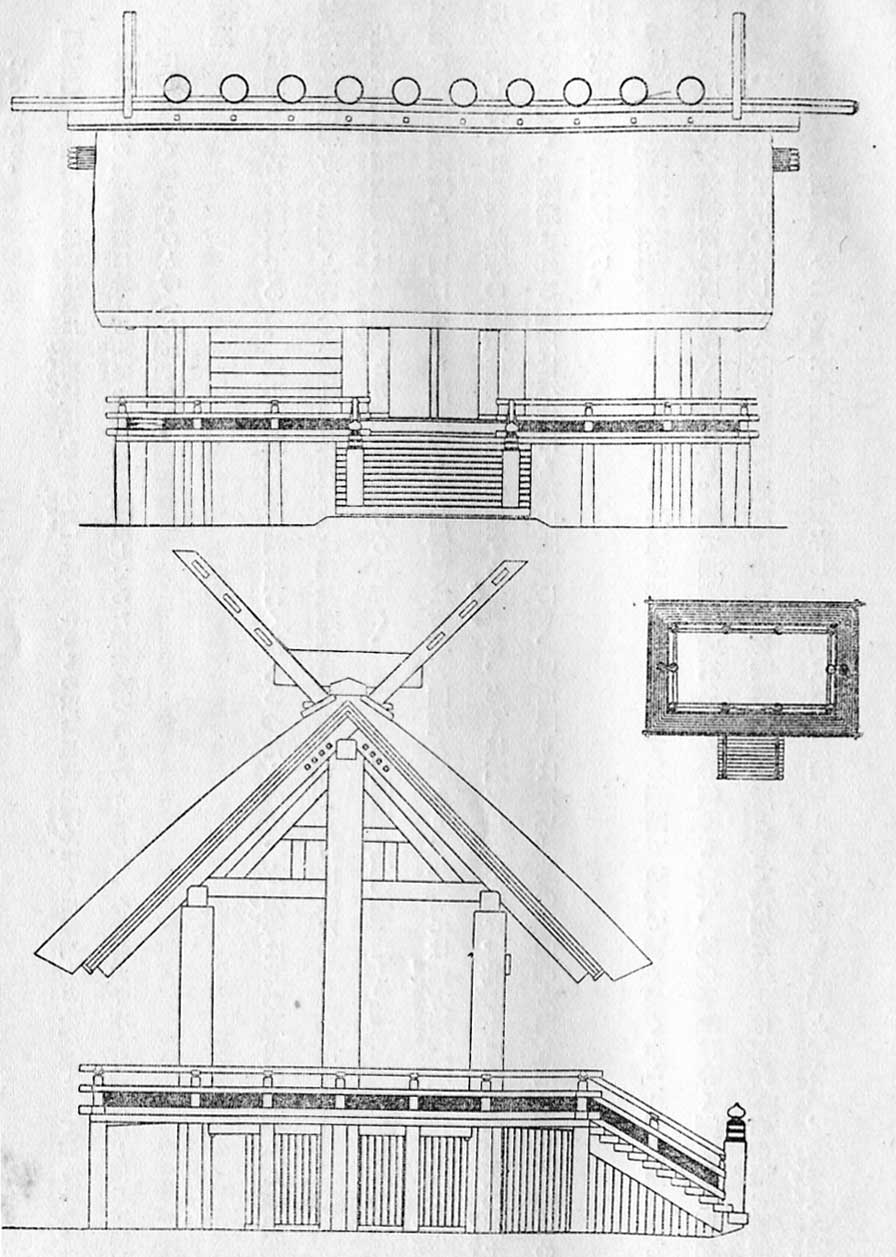
The shrine at Naikū is constructed of Japanese cypress. Built on pillars set directly in the ground, the shrine building measures 10.9 by 5.5 meters and includes a raised floor, verandas all the way around the building and a staircase leading to a single central doorway. The Naikū does not have any windows. The roof is made of thatched reed with ten billets (katsuogi) located on the ridge of the roof, the bargeboards of which project beyond the roof to form the distinctive forked finials (chigi) at the ends of the ridge. The chigi on the roof of the Naikū are flat on top, rather than pointed, which serves as a distinction for the gender of the deity being represented. In the case of Ise, Amaterasu, a female deity, is represented at the shrine, which is why the chigi are flat. The roof ridge is supported by two free-standing columns called the munamochi-bashira. The katsuogi, chigi and munamochi-bashira are stylised forms of older storehouse building techniques that pre-date the introduction of Buddhist architecture in Japan.
The empty site beside the shrine building, the site where the previous shrine once stood and where the next will be built, is called the kodenchi. This area is strewn with large white pebbles and is left totally empty apart from the oi-ya, a small wooden hut containing a wooden pole a little over 2 metres in height called the shin-no-mihashira (new sacred central pole). When a new shrine is built, it is built around the sacred central pole before the removal of the oi-ya, so that the central pole is never seen. The central pole of the old shrine will then have a new oi-ya erected so that the shin-no-mihashira also remains unseen.
Rebuilding the Shrine
_(BM_2008,3037.21409).jpg)

The shrine buildings at Naikū and Gekū, as well as the Uji Bridge, are rebuilt every 20 years as a part of the Shinto belief in tokowaka (常若), which means renewing objects to maintain a strong sense of divine prestige in pursuit of eternity, and as a way of passing building techniques from one generation to the next. The twenty-year renewal process is called the Shikinen Sengū. Although the goal of Sengū is to get the shrine built within the 20-year period, there have been some instances, especially because of war, where the shrine building process is postponed or delayed. The original physical purpose of the Sengu process is unknown. However, it is believed that it serves to maintain the longevity of the shrine, or possibly as a gesture to the deity enclosed within the shrine. Historically, this cyclical reconstruction has been practiced for many years in various shrines throughout Japan, meaning that it is not a process exclusive to Ise. The entire reconstruction process takes more or less 17 years, with the initial years focusing on project organization and general planning, and the last 8 years focusing on the physical construction of the shrine.
The shrine has evolved throughout the years in its reconstruction, while maintaining some of its key features. The shrine was not originally constructed with gold copper adornments; however, because of advancements in technology as well as Buddhist influence, it gained them over the years. Another example of Buddhist influence on the shrine is the use of Suedama, which are Buddhist orbs seen on various religious structures. It symbolizes a sacred jewel, and is comparable to nyoi-shu, orbs which many Buddhist figures are displayed holding. Initially, the shrine was constructed of locally sourced Hinoki wood, which served as an ideal building material due to its physical properties. The abundance of local Hinoki wood was short lived, and the shrine currently obtains the wood through other domestic producers, who ensure that only the best wood is being used for the construction. Before the wood is usable in building the shrine, it must be put through a lengthy seasoning and drying process where it is in a pond for several years and then dried.
The team which builds the shrine is typically formed around a few factors. Since many of the building techniques haven't changed since the creation of the Ise Shrine, the workers who are hired to build the shrine must be skilled in specific techniques. Power tools are not allowed within the area of the shrine, which means that skilled artisans and carpenters known as miyadaiku are necessary in the construction process. The unit of workers is also organized around relative skill levels, and less experienced workers will work on smaller tasks than more experienced workers. The importance of hiring specifically local artisans has decreased throughout time, for the pool of available miyadaiku has thinned out. Specialized work and the specific materials come with a cost; in 2013, the shrine was built from private donations alone, totaling 57 billion Japanese Yen (US$550 million).

In August, in a long-standing tradition, the people who live in Ise are allowed to enter the area around the Inner Sanctum of the Naiku as well as the Geku. Some villages drag a wooden carriage laden with white stones up the Isuzu River onto the grounds of the Naiku. Each participant gets two white stones in a white handkerchief and these allow them to place the stones in the area around the Inner Sanctum. Other villages drag a huge wooden cart or Noburi Kuruma laden with white stones to the Uji bridge at the entrance of the grounds of the Naiku. Participants receive two white stones which are also placed in the sacred space around the Inner Sanctum. The entire tradition is called Shiraisshiki and it is very colourful with every participant wearing a happi coat representing a particular village. The rebuilding of the main shrine takes place on a site adjacent to the old, and each rebuilding alternates between the two sites. The next scheduled rebuilding of Naikū is due in 2033 on the lower, northern site. Various other religious ceremonies are held with the completion of the shrine, each serving different purposes.
In the lead-up to the rebuilding of the shrines, a number of festivals are held to mark special events. The Okihiki Festival is held in the spring over two consecutive years and involves people from surrounding towns dragging huge wooden logs through the streets of Ise to Naikū and Gekū. In the lead-up to the 2013 rebuilding, the Okihiki festival was held in 2006 and 2007. A year after the completion of the Okihiki festival, carpenters begin preparing the wood for its eventual use in the Shrine.
Annual festivals

From the late seventh century, when the festivals and offerings of Ise Shrine became more formalised, a number of annual events have been performed at both Naikū and Gekū. The Tsukinamisai, which was held in June and December, as well as the Kannamesai Festival in September, were the only three offerings performed by the Saiō, an imperial princess who served as high priestess of the shrine until the 14th century. These offerings are based on the cycle of the agricultural year and are still performed today.
The first important ceremony of the modern calendar year is the Kinen-sai, where prayers are offered for a bountiful harvest. Kazahinomisai, where prayers for fair weather and sufficient rains are made, is held twice a year in May and August at both Naikū and Gekū.
_03.JPG)
The most important annual festival held at Ise Shrine is the Kannamesai Festival. Held in October each year, this ritual makes offerings of the first harvest of crops for the season to Amaterasu. An imperial envoy carries the offering of rice harvested by the Emperor himself to Ise, as well as five-coloured silk cloth and other materials, called heihaku.
Besides the agricultural ceremonies already mentioned, ceremonies and festivals are held throughout the year at both Naikū and Gekū to celebrate things such as the new year, the foundation of Japan, the past emperors, purification rituals for priests and court musicians, good sake fermentation and the Emperor's birthday. There are also daily food offerings to the shrine kami held both in the mornings and evenings.
Gekū – the outer shrine{{Anchor|Geku}}
is a shrine to Toyoukebime, the food goddess, located in Ise Grand Shrine. it is also colloquially known as . In pilgrimage customs people traditionally visit this shrine first and then Kotai jingu which is located 4 km to the south
The shrine was founded after Emperor Yuryaku dreamt that he saw Amaterasu. She said she was unable to get food and asked him to bring Toyouke-hime from Tanba help her with food.
Daiichi-torii-guchi Sando
Daiichi-torii-guchi Sando is the primary route into the shrine. It is a Sandō that starts at the Hiyokebashi bridge entrance, and beyond this bridge, the Temizusha (ablution font) is visible on the left side.
Temizusha
A Temizusha is present at the shrine for worshippers to purify .
Kitamikado-guchi Sando
An alternative entrance path for the shrine.
Saikan and Anzaisho
Saikan and Anzaisho are the Purification Hall and Hall for Imperial Household Visitors respectively. They are on the right side of the pilgrimage path. The Saikan, which is surrounded by fences, is used by Shinto priests to purify themselves. They stay here for one or two nights to cleanse their minds from worldly concerns before performing rituals, as they bathe and eat meals prepared with sacred fire to achieve spiritual serenity; adjacent to Saikan, there is a building called Anzaisho, which serves as the Hall for the Emperor and Empress.
Kaguraden
There is a large Kaguraden at Geku.
Honden
Toyouke Omikami is enshrined at the Honden. It lies in the most sacred area enclosed by four rows of fences, and the structure remains unchanged from 1500 years ago. Worshippers can only approach the first gate.
History
In Japanese mythology Toyouke-hime was either killed by Tsukuyomi-no-Mikoto or by Susanoo-no-Mikoto. Amaterasu mourned the death of her and in the Nihon Shoki the reason the sun and the moon are on opposite sides of the sky is that Amaterasu was unwilling to go near Tsukuyomi-no-Mikoto the moon god after he committed the murder. Amaterasu is linked with Toyouke-hime as the sun is necessary for food to grow. This was prior to the Tenson Korin and the establishment of Ise Jingu. Emperor Suinin is said to have established the shrine to worship Amaterasu at a permanent location after many temporary locations. In contrast with , this shrine is not explicitly mentioned in the Kojiki or the Nihon Shoki.
Besides the traditional establishment date of 4 BC, it has also been proposed as having been made in the 5th century. The shrine officially states it was created 1500 years ago in response to a revelation from Amaterasu that the shrine was needed.
The shrine has been traditionally rebuilt every 20 years.
There is a separate shrine dedicated to Toyouke's Ara-mitama, or called (Takamiya) inside this shrine.
Naikū – the inner shrine{{Anchor|Naiku}}
The official name of the main shrine of Naikū is Kotaijingu and is the place of worship of the goddess Amaterasu. The grounds of Naikū contain a number of structures, including the following:
The Uji Bridge

This 100 meter wooden bridge, built in a traditional Japanese style, stretches across the Isuzu River at the entrance of Naikū. Like the shrine buildings of Naikū, it is rebuilt every 20 years as a part of the Shikinen Sengū ceremony. The bridge is typically built by carpenters with less experience to gain more skills before moving on to take on the task of working on the main shrine. On crossing the bridge, the path turns to the right along the banks of the Isuzu river and passes through large landscaped gardens.
Temizusha
After crossing a short, wide bridge, pilgrims to the shrine encounter the Temizusha, a small, roofed structure containing a pool of water for use in ritual purification. Visitors are encouraged to wash their hands and rinse their mouths at Temizusha as a symbolic act to clean the mind and body of impurity. The first of two large torii gates stands just beyond the Temizusha.
Saikan and Anzaisho
After passing the first large torii gate, the Purification Hall (Saikan), and the hall for visitors from the imperial household (Anzaisho) is located to the left. The Saikan is used by shrine priests to purify themselves before performing ceremonies at the shrine. They are required to spend one or two nights to free their minds of worldly issues, partaking in baths and eating meals cooked with the sacred fire.
Kaguraden
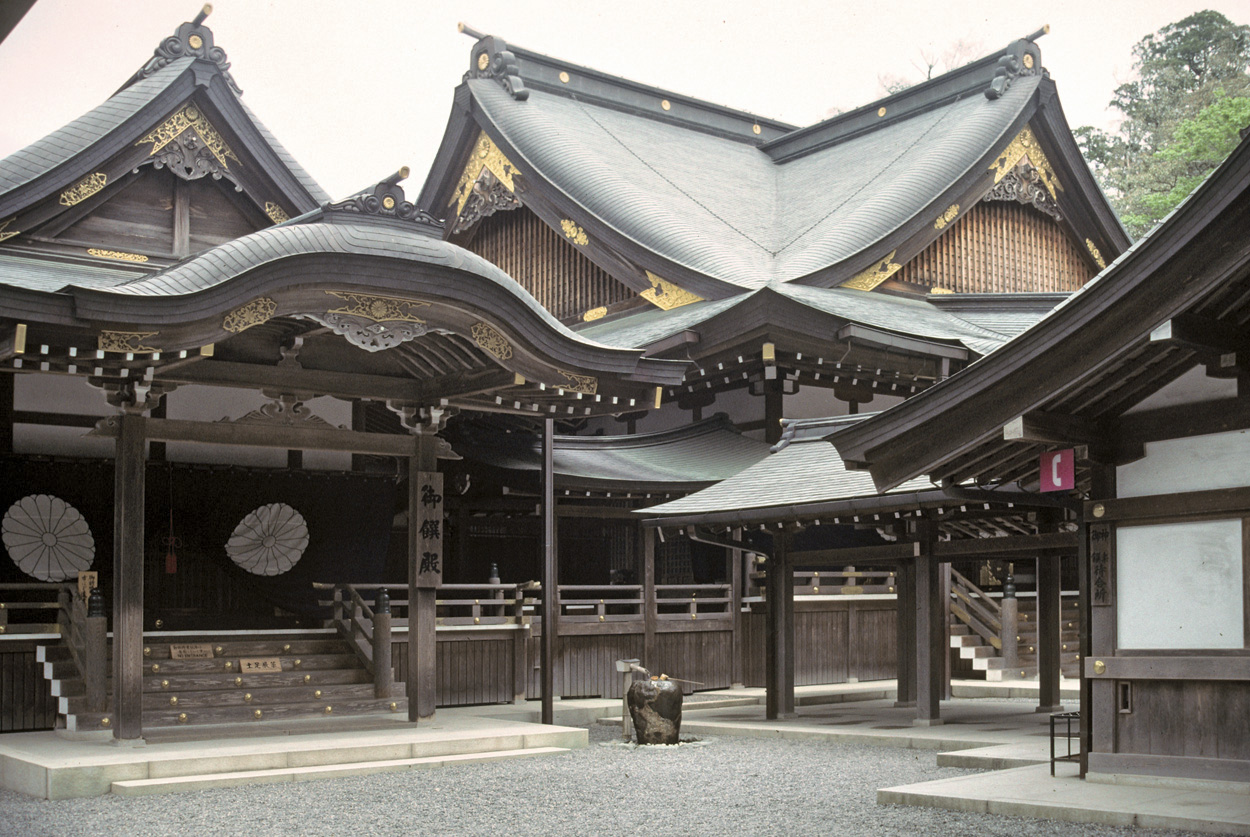
This hall for special prayer, located just after the second large torii gate, is open to the public for the offering of individual prayers to the kami, the giving of donations and the purchase of special talisman of protection, amulets and hanging scrolls of Amaterasu Omikami.

Imibiyaden

This hall contains the sacred fire used to cook all of the food offerings to the kami of Ise Shrine. Rice and other offerings cooked on the sacred fire are stored in a box made of Japanese cypress, then purified at the Haraedo immediately in front of the Imibiyaden before being offered to the kami.
Kōtai Jingū – the main shrine
The pilgrimage path then approaches the fence of the inner sanctum (昇殿, shōden) of Naikū by a set of large stone steps. Within another set of fencing inside the gate is the main shrine (正宮, seigū) itself. Visitors are supposed to keep to the sides of the path as the middle is set aside for the goddess Amaterasu. Etiquette is the same as for most Shinto shrines. Though the actual shrine is hidden behind a large fence, pilgrims can approach the gate to offer their prayers. Photographs in this area are prohibited and this restriction is strictly policed.
Kotai Jingū is said to hold the Sacred Mirror, one of three Imperial Regalia of Japan said to have been given to the first Emperor by the gods. From a path that follows the line of the outer wall, the distinctive roof of the shrine building can be seen through the trees. In front of the walled shrine compound can be seen an open area which was the location of the rebuilding of the shrine in 2013.
Pilgrimage at Ise

The pilgrimage to the Ise shrine, also known as Sangū, gained immense popularity during the Edo Period, where hundreds of thousands of pilgrims would travel there every year. The growth was exponential, 5 million pilgrims visiting the shrine in the year 1830 alone. By the late 19th century, tourists from abroad began to visit and document Ise. The popularity of making a trip to Ise resulted in vast networks and groups of travelers, which ultimately led to businesses working to benefit from this influx of interest for the shrine. Travel guidebooks were made to aid travelers in their navigation, as well to let them know of specific important places to visit while at Ise. They also included woodblock prints of the shrine that were very appealing to those who had made the long trek to the shrine. Additionally, people wanted souvenirs, which resulted in a variety of vendors at Ise selling general goods and specialty items. There were also various post stations which had specific gifts, many of which were woodblock prints. The pilgrimage had multiple purposes and appeals. It was seen as a purification process, and by visiting Ise, pilgrims were purified and aided in receiving a good afterlife. It also was seen as a vacation, the journey to the shrine itself being almost as important as actually getting there. In the 21st century, Ise is still an important destination both to foreign tourists and especially to the Japanese community; 9 million Japanese tourists visited the shrine in 2013.
Shrines and facilities
Shrines
There are 125 shrines within Ise Shrine:
| name | kanji | enshrined | kanji | location |
|---|---|---|---|---|
| Kōtai Jingū (Naikū) | 皇大神宮 | Amaterasu Ōmikami | ||
| Ameno Tajikarao no kami | ||||
| Yorozuhata-Toyoakitsuhime no mikoto | 天照大御神 | |||
| 天手力男神 | ||||
| 万幡豊秋津姫命 | Ujitachi, Ise city | |||
| Toyouke Daijingū (Gekū) | 豊受大神宮 | Toyouke no Ōmikami | ||
| 3 Mitomo no kami | 豊受大御神 | |||
| 御伴神3座 | Toyokawa, Ise city |
| name | kanji | enshrined | kanji | location |
|---|---|---|---|---|
| 1 | Aramatsuri no miya | 荒祭宮 | Amaterasu Ōmikami no Aramitama | 天照大御神荒御魂 |
| 2 | Tsukiyomi no miya | 月讀宮 | Tsukiyomi no mikoto | 月讀尊 |
| 3 | Tsukiyomi no Aramitama no miya | 月讀荒御魂宮 | Tsukiyomi no mikoto no Aramitama | 月讀尊荒御魂 |
| 4 | Izanagi no miya | 伊佐奈岐宮 | Izanagi no mikoto | 伊佐奈岐尊 |
| 5 | Izanami no miya | 伊佐奈弥宮 | Izanami no mikoto | 伊佐奈弥尊 |
| 6 | Takihara no miya | 瀧原宮 | Amaterasu Ōmikami no Mitama | 天照大御神御魂 |
| 7 | Takihara no narabi no miya | 瀧原竝宮 | Amaterasu Ōmikami no Mitama | 天照大御神御魂 |
| 8 | Izawa no miya | 伊雑宮 | Amaterasu Ōmikami no Mitama | 天照大御神御魂 |
| 9 | Yamatohime no miya | 倭姫宮 | Yamatohime no mikoto | 倭姫命 |
| 10 | Kazahinomi no miya | 風日祈宮 | Shinatsuhiko no mikoto | |
| Shinatobe no mikoto | 級長津彦命 | |||
| 級長戸辺命 |
| name | kanji | enshrined | kanji | location |
|---|---|---|---|---|
| 1 | Taka no miya | 多賀宮 | Toyouke no Ōmikami no Aramitama | 豊受大御神荒御魂 |
| 2 | Tsuchi no miya | 土宮 | Ōtsuchi no mioya no kami | 大土御祖神 |
| 3 | Tsukiyomi no miya | 月夜見宮 | Tsukiyomi no mikoto | |
| Tsukiyomi no mikoto no Aramitama | 月夜見尊 | |||
| 月夜見尊荒御魂 | ||||
| 4 | Kaze no miya | 風宮 | Shinatsuhiko no mikoto | |
| Shinatobe no mikoto | 級長津彦命 | |||
| 級長戸辺命 |
| name | kanji | enshrined | kanji | location |
|---|---|---|---|---|
| 1 | Asakuma jinja | 朝熊神社 | Ōtoshi no kami | |
| Kokemushi no kami | ||||
| Asakuma no mizu no kami | 大歳神 | |||
| 苔虫神 | ||||
| 朝熊水神 | ||||
| 2 | Asakuma mimae jinja | 朝熊御前神社 | Asakuma no mimae no kami | 朝熊御前神 |
| 3 | Sonai (Sonō) jinja | 園相神社 | Sonahihiko no mikoto | |
| Mimae no kami | 曾奈比比古命 | |||
| 御前神 | ||||
| 4 | Kamo jinja | 鴨神社 | Ishikorowake no mikoto | |
| Mimae no kami | 石己呂和居命 | |||
| 御前神 | ||||
| 5 | Tanoe jinja | 田乃家神社 | Ōkami no Misamukawa no kami | 大神御滄川神 |
| 6 | Tanoe mimae jinja | 田乃家御前神社 | Mimae no kami | 御前神 |
| 7 | Kano jinja | 蚊野神社 | Ōkami no mikage no- | |
| kawa no kami | 大神御蔭川神 | |||
| 8 | Kano mimae jinja | 蚊野御前神社 | Mimae no kami | 御前神 |
| 9 | Yuta jinja | 湯田神社 | Ōtoshi no mioya no mikoto | |
| Mimae no kami | 大歳御祖命 | |||
| 御前神 | ||||
| 10 | Ōtsuchi mioya jinja | 大土御祖神社 | Ōkunitama no mikoto | |
| Mizusasarahiko no mikoto | ||||
| Mizusasarahime no mikoto | 大国玉命 | |||
| 水佐佐良比古命 | ||||
| 水佐佐良比賣命 | ||||
| 11 | Kunitsu mioya jinja | 国津御祖神社 | Ujihime no mikoto | |
| Tamurahime no mikoto | 宇治比賣命 | |||
| 田村比賣命 | ||||
| 12 | Kuchira jinja | 朽羅神社 | Chiyorihime no mikoto | |
| Chiyorihiko no mikoto | 千依比賣命 | |||
| 千依比古命 | ||||
| 13 | Ujiyōda jinja | 宇治山田神社 | Yamatahime no mikoto"Jingū sessha massha junhai", The second volume (下巻) p. 31, No Hiragana in "Oise mairi" . | 山田姫命 |
| 14 | Tsunaga jinja | 津長神社 | Sunagahime no mikoto | 栖長比賣命 |
| 15 | Katada jinja | 堅田神社 | Samitsuhime no mikoto | 佐見都比女命 |
| 16 | Ōmizu jinja | 大水神社 | Ōyamazumi no mioya no mikoto | 大山祇御祖命 |
| 17 | E jinja | 江神社 | Nagakuchime no mikoto | |
| Ōtoshi no mioya no mikoto | ||||
| Ukano mitama no mikoto | 長口女命 | |||
| 大歳御祖命 | ||||
| 宇加乃御玉命 | ||||
| 18 | Kōzaki jinja | 神前神社 | Arasakihime no mikoto | 荒崎比賣命 |
| 19 | Awamiko jinja | 粟皇子神社 | Susanō no mikoto no Mitama no- | |
| michinushi no mikoto | 須佐乃乎命御玉道主命 | |||
| 20 | Kawara jinja | 川原神社 | Tsukiyomi no mikoto no Mitama | 月讀尊御魂 |
| 21 | Kugutsuhime jinja | 久具都比賣神社 | kugutsuhime no mikoto | |
| kugutsuhiko no mikoto | ||||
| MImae no kami | 久具都比賣命 | |||
| 久具都比古命 | ||||
| 御前神 | ||||
| 22 | Narahara jinja | 奈良波良神社 | Naraharahime no mikoto | 那良原比女命 |
| 23 | Sugihara jinja | 棒原神社 | Ama no subarume no mikoto- | |
| no Mitama | ||||
| Mimae no kami | 天須婆留女命御魂 | |||
| 御前神 | ||||
| 24 | Mifune jinja | 御船神社 | Ōkami no mikage no- | |
| kawa no mikoto | 大神御蔭川神 | |||
| 25 | Sakatekunari jinja | 坂手国生神社 | Takaminakami no mikoto | |
| (Takaminakami no kami) | 高水上命 (高水上神) | |||
| 26 | Satakunari jinja | 狭田國生神社 | Hayakawahiko no mikoto | |
| Hayakawahime no mikoto | ||||
| Yamazue no Mitama | 速川比古命 | |||
| 速川比女命 | ||||
| 山末御魂 | ||||
| 27 | Takihara jinja | 多岐原神社 | Manako no Kami | 真奈胡の神 |
| name | kanji | enshrined | kanji | location |
|---|---|---|---|---|
| 1 | Kusanagi jinja | 草奈伎神社 | Mishirushi no tsurugi no kami | 御剣仗神 (標劔仗神) |
| 2 | Ōmakunari jinja | 大間国生神社 | Ōwakako no mikoto | |
| Otowakako no mikoto | 大若子命 | |||
| 乙若子命 | ||||
| 3 | Watarai kuimii jinja | 度会国御神社 | Hikokunimigakitakeyotsuka no mikoto | 彦国見賀岐建與束命 |
| 4 | Watarai ōkunitamahime jinja | 度会大国玉比賣神社 | Ōkunitama no mikoto | |
| Mizusasarahime no mikoto | 大国玉姫命 | |||
| 弥豆佐佐良比賣命 | ||||
| 5 | Tanoe ōmizu jinja | 田上大水神社 | Ogoto kan-nushi | 小事神主 |
| 6 | Tanoe ōmizu mimae jinja | 田上大水御前神社 | Miyako | 宮子 |
| 7 | Shitomi jinja | 志等美神社 | Kukunochi no kami | 久久能智神 |
| 8 | Ōkōchi jinja | 大河内神社 | Ōyamazumi no kami | 大山祇神 |
| 9 | Kiyonoiba jinja | 清野井庭神社 | Kayanohime no mikoto | 草野姫命 |
| 10 | Takagawara jinja | 高河原神社 | Tsukiyomi no mikoto no Mitama | 月夜見尊御魂 |
| 11 | Kawara jinja | 河原神社 | Kawa no kami | 川神 |
| 12 | Kawarabuchi jinja | 河原淵神社 | Sawahime no mikoto | 澤姫命 |
| 13 | Yamazue jinja | 山末神社 | Ōyamatsuhime no mikoto | 大山津姫命 |
| 14 | Usunono jinja | 宇須乃野神社 | Usunome no mikoto | 宇須乃女命 |
| 15 | Mike jinja | 御食神社 | Minato no miketsu kami | 水戸御饗都 |
| 16 | Obata jinja | 小俣神社 | Uka no Mitama no kami | 宇賀御魂神 |
| name | kanji | enshrined | kanji | location |
|---|---|---|---|---|
| 1 | Kamoshimo jinja | 鴨下神社 | Ishikorowake no mikoto | |
| Kamohiko no mikoto | ||||
| Kamohime no mikoto | 石己呂和居命 | |||
| 鴨比古命 | ||||
| 鴨比賣命 | ||||
| 2 | Tsubura jinja | 津布良神社 | Tsuburahiko no mikoto | |
| Tsuburahime no mikoto | 津布良比古命 | |||
| 津布良比賣命 | ||||
| 3 | Ashihara jinja | 葦原神社 | Sasatsuhiko no mikoto | |
| Ukano Mitama no mioya no mikoto | ||||
| Ikarihime no mikoto | 佐佐津比古命 | |||
| 宇加乃御魂御祖命 | ||||
| 伊加利比売命 | ||||
| 4 | Ogoso jinja | 小社神社 | Takaminakami no mikoto | |
| ( | Takaminakami mikoto) | 高水上命 | ||
| 5 | Komori jinja | 許母利神社 | Awashima no kami no mitama | 粟嶋神御魂 |
| 6 | Niikawa jinja | 新川神社 | Niikawahime no mikoto | 新川比賣命 |
| 7 | Iwai jinja | 石井神社 | Takaminakami no mikoto | 高水上命 |
| 8 | Uji no nuki jinja | 宇治乃奴鬼 | Takaminakami no mikoto | 高水上命 |
| 9 | Kanumi jinja | 加努弥神社 | Inayorihime no mikoto | 稲依比女命 |
| 10 | Kawaai jinja | 川相神社 | Hosokawa no mizu no kami | 細川水神 |
| 11 | Kumabuchi jinja | 熊淵神社 | Takiōtoji no kami | 多支大刀自神 |
| 12 | Arasaki jinja | 荒前神社 | Arasakihime no mikoto | 荒前比賣命 |
| 13 | Najime jinja | 那自売神社 | Ōminakami no mioya no mikoto | |
| Mimonosusohime no mikoto | 大水上御祖命 | |||
| 御裳乃須蘇比賣命 | ||||
| 14 | Ashidate jinja | 葦立弖神社 | Tamayarahime no mikoto | 玉移良比女命 |
| 15 | Mumino jinja | 牟弥乃神社 | Samukawahiko no mikoto | |
| Samukawahime no mikoto | 寒川比古命 | |||
| 寒川比女命 | ||||
| 16 | Kagaminomiya jinja | 鏡宮神社 | Iwanoue no futatsu no mikagami no mitama | 岩上二面神鏡霊 |
| name | kanji | enshrined | kanji | location |
|---|---|---|---|---|
| 1 | Igari jinja | 伊我理神社 | Igarihime no mikoto | 伊我理比女命 |
| 2 | Agata jinja | 縣神社 | Agata no kami | 縣神 |
| 3 | Inaka jinja | 井中神社 | Inaka no kami | 井中神 |
| 4 | Uchikake jinja | 打縣神社 | Uchikake myōjin | 打縣名神 |
| 5 | Akasaki jinja | 赤崎神社 | Arasakihime no mikoto | 荒崎姫命 |
| 6 | Mori jinja | 毛理神社 | Ki no kami | 木神 |
| 7 | Ōtsu jinja | 大津神社 | Ashihara kami | |
| (Ashihara no kami) | 葦原神 | |||
| 8 | Shioya jinja | 志宝屋神社 | Shiotsuchi no oji | 塩土老翁 |
| name | kanji | enshrined | kanji | location |
|---|---|---|---|---|
| 1 | Takimatsuri no kami | 滝祭神 | Takimatsuri no Ōkami | 瀧祭大神 |
| 2 | Okitama no Kami | 興玉神 | Okitama no Kami | 興玉神 |
| 3 | Miyabi no kami | 宮比神 | Miyabi no kami | 宮比神 |
| 4 | Yanohahiki no kami | 屋乃波比伎神 | Yanohahiki no kami | 屋乃波比伎神 |
| 5 | Misakadono | 御酒殿 | Misakadono no kami | 御酒殿神 |
| 6 | Mishine no mikura | 御稲御倉 | Mishine no mikura no kami | 御稲御倉神 |
| 7 | Yuki no mikura | 由貴御倉 | Yuki no mikura no kami | 由貴御倉神 |
| 8 | Miya no meguri no kami | 四至神 | Miya no meguri no kami | 四至神 |
| 9 | Kan-Hatori hatadono jinja | 神服織機殿神社 | Kan-hatori hatadono no- | |
| mamori no kami | 神服織機殿神社鎮守神 | |||
| 10 | Massha of Kan-Hatori hatadono jinja; 8 shrines | 神服織機殿神社末社8所 | Kan-hatori hatadono no- | |
| mamori no mimae no kami | 神服織機殿神社鎮守御前神 | |||
| 11 | Kan-Omi hatadono jinja | 神麻績機殿神社 | Kan-Omi hatadono no- | |
| mamori no kami | 神麻績機殿神社鎮守神 | |||
| 12 | Massha of Kan-Omi hatadono jinja; 8 shrines | 神麻績機殿神社末社8所 | Kan-Omi hatadono no mamori no- | |
| mimae no kami | 神麻績機殿神社鎮守御前神 | |||
| 13 | Mishiodono jinja | 御塩殿神社 | Mishiodono no mamori no kami | 御塩殿神社鎮守神 |
| 14 | Aedohashihime jinja | 饗土橋姫神社 | Ujibashi no mamori no kami | 宇治橋鎮守神 |
| 15 | Ōyamatsumi jinja | 大山祇神社 | Ōyamazumi no kami | 大山祇神 |
| 16 | Koyasu jinja | 子安神社 | Konohanasakuyahime no mikoto | 木華開耶姫命 |
| name | kanji | enshrined | kanji | location |
|---|---|---|---|---|
| 1 | Misakadono | 御酒殿 | Misakadono no kami | 御酒殿神 |
| 2 | Miya no meguri no kami | 四至神 | Miya no meguri no kami | 四至神 |
| 3 | Kami no mii no jinja | 上御井神社 | Kami no mii no mamori no kami | 上御井鎮守神 |
| 4 | Shimo no mii no jinja | 下御井神社 | Shimo no mii no mamori no kami | 下御井鎮守神 |
| name | kanji | enshrined | kanji | location |
|---|---|---|---|---|
| 1 | Wakamiya jinja | 若宮神社 | Wakamiya no kami | 若宮神 |
| 2 | Nagayuke jinja | 長由介神社 | Nagayuke no kami | 長由介神 |
| 3 | Kawashima jinja | 川島神社 | Kawashima no kami | 川島神 |
| 4 | Saminaga jinja | 佐美長神社 | Shimonomii no mamori no kami | 大歳神 |
| 5 | Saminaga mimae jinja; 4 shrines | 佐美長御前神社 | Saminaga mimae no kami | 佐美長御前神 |
Facilities
| name | kanji | articles | kanji | location |
|---|---|---|---|---|
| 1 | Yahiroden of Kan-Hatori hatadono jinja | 神服織機殿神社八尋殿 | Nigitae (silk) | 和妙 |
| 2 | Yahiroden of Kan-Omi hatadono jinja | 神麻績機殿神社八尋殿 | Aratae (hemp) | 荒妙 |
| 3 | Jingu shinden | |||
| (30,000 m2) | 神宮神田 | Goryō-mai (rice) | 御料米 | |
| 4 | Izawa no miya no omita | |||
| (1,646 m2) | 伊雑宮の御神田 | Goryō-mai (rice) | 御料米 | |
| 5 | Mishiohama | |||
| (6,609 m2) | 御塩浜 | brine | 御塩 | |
| 6 | Mishiodono | |||
| Mishio kumiiresho | ||||
| Mishio yakisho | ||||
| (27,785 m2) | 御塩殿 | |||
| 御塩汲入所 | ||||
| 御塩焼所 | Mishio (salt) | 御塩 | ||
| 7 | Jingū misono | |||
| (19,751 m2) | 神宮御園 | vegetables and fruits | 野菜・果物 | |
| 8 | Awabi chōseisho | |||
| (5,946 m2) | 鰒調製所 | noshi awabi (dried abalone) | 熨斗鰒 | |
| 9 | Hidai chōseisho | |||
| (11,242 m2) | 干鯛調製所 | Hidai (dried sea bream) | 干鯛 | |
| 10 | Doki chōseisho | |||
| (2,878 m2) | 土器調製所 | earthenwares | 土器 |
Notes
Japanese cruiser Isuzu·Japanese battleship Ise - It was a shrine on board the ship.
References
References
- Hvass, Svend M. (1998). Ise Japan's Ise Shrines Ancient yet New. Copenhagen. Aristo Publishing.
- Ponsonby-Fane, Richard. (1962). Studies in Shinto and Shrines. Kyoto: Ponsonby Memorial Society. OCLC 399449
References
- "Isejingu".
- "Ise Jingu official homepage".
- (1985). "Japanese Religion: A Cultural Perspective". Prentice-Hall.
- [https://web.archive.org/web/20161013220353/http://cleanup.jp/life/edo/86.shtml お伊勢さま、一度は行きたい庶民の夢] Cleanup Corporation
- (June 21, 2017). "Emperor's daughter becomes supreme priestess at Ise Shrine". [[Japan Times]].
- ''Encyclopædia Britannica{{Snd Ise Shrine'' https://www.britannica.com/ebc/article-9368233
- ''Sacred Places{{Snd Ise Shrine'' http://witcombe.sbc.edu/sacredplaces/ise.html {{Webarchive. link. (2021-01-26)
- Ponsonby-Fane, Richard. (1962). ''Studies in Shinto and Shrines,'' pp. 116–117.
- Cali, Joseph. (2013). "Shinto Shrines: A Guide to the Sacred Sites of Japan's Ancient Religion". University of Hawai'i Press.
- Mayer, Adrian. (March 1992). "On the Gender of Shrines and the Daijōsai". Japanese Journal of Religious Studies.
- Sir Banister Fletcher, ''A History of Architecture'' (p. 724), Architectural Press (1996), {{ISBN. 0-7506-2267-9
- Kenzo Tange and Noboru Kawazoe, ''Ise: Prototype of Japanese Architecture'' (p. 167), Cambridge, Massachusetts: M.I.T. Press, 1965.
- link. Daiwa Institute of Research Ltd.. (6 April 2016)
- Shinnyo Kawai (2013) ''常若の思想 伊勢神宮と日本人''. [[Shodensha]]. {{ISBN. 978-4396614669
- Reynolds, Jonathan. (June 2001). "Ise Shrine and a Modernist Construction of Japanese Tradition". The Art Bulletin.
- Adams, Cassandra. (Sep 1998). "Japan's Ise Shrine and Its Thirteen-Hundred-Year-Old Reconstruction Tradition". Journal of Architectural Education.
- Breen, John. (2017). "Carmen Blacker: Scholar of Japanese Religion, Myth and Folklore". Renaissance Books.
- Saikū Historical Museum information booklet, "A Town of Bamboo Illumined Once Again".
- "Isejingu".
- "Isejingu".
- "Outer Shrine (Geku)".
- "Outline of Geku".
- Roberts, Jeremy. (2010). "Japanese Mythology A To Z". Chelsea House Publishers.
- "About Ise Jingu".
- "Ise Jingu – Geku (Toyouke Daijingu) {{!}} Sightseeing Spots MIE(Ise-Shima) {{!}} Kintetsu Railway Co., Ltd.".
- "Isejingu".
- Kaempfer, Engelbert. (1999). "Kaempfer's Japan: Tokugawa Culture Observed". University of Hawai'i Press.
- Vaporis, Constantine. (1994). "Breaking Barriers: Travel and the State in Early Modern Japan". Harvard University.
- "Oise mairi" (「お伊勢まいり」, Jingū-shichō, Ise-Jingū-sūkei-kai, July 1, 2006) pp. 105-118
- "Oise mairi" p. 72
- "Oise mairi" p. 9
- "Jingū sessha massha junhai" (「神宮摂社末社順拝」, [[:ja:猿田彦神社. Sarutahiko jinja]], March 31, 1989) The second volume (下巻) p. 87
- "Jingū sessha massha junhai", The second volume (下巻) p. 69
- "Jingū sessha massha junhai", The first volume (上巻) p. 65
- "Oisesan wo arukō (「お伊勢さんを歩こう」, Ise-Jingū-sūkei-kai, April 1, 2005) p. 15, No Hiragana in "Oise mairi" and "Jingū sessha massha junhai".
- "Oisesan wo arukō" p. 21
- "Jingū sessha massha junhai", The second volume (下巻) p. 15
- "Jingū sessha massha junhai", The second volume (下巻) p. 4
- "Jingū sessha massha junhai", The second volume (下巻) p. 37
- "Oisesan wo arukō" p. 16
- "Oisesan wo arukō" p. 17
- "Oisesan wo arukō" p. 15
- "Oisesan wo arukō" p. 8
- "Oisesan wo arukō" p. 4
- "Oisesan wo arukō" p. 5
- "Oisesan wo arukō" p. 24
- "Oisesan wo arukō" p. 24
- "Oisesan wo arukō" p. 27
- "Oisesan wo arukō" p. 31
- "Oisesan wo arukō" p. 29
- "Oise mairi" pp. 98-103
This article was imported from Wikipedia and is available under the Creative Commons Attribution-ShareAlike 4.0 License. Content has been adapted to SurfDoc format. Original contributors can be found on the article history page.
Ask Mako anything about Ise Shrine — get instant answers, deeper analysis, and related topics.
Research with MakoFree with your Surf account
Create a free account to save articles, ask Mako questions, and organize your research.
Sign up freeThis content may have been generated or modified by AI. CloudSurf Software LLC is not responsible for the accuracy, completeness, or reliability of AI-generated content. Always verify important information from primary sources.
Report