From Surf Wiki (app.surf) — the open knowledge base
Irn-Bru
Scottish carbonated soft drink

Scottish carbonated soft drink
| Field | Value | |
|---|---|---|
| name | Irn-Bru | |
| logo | Irn-Bru logo.png | |
| image | Barr IRN-BRU Sugar Free (3 of 3).jpg | |
| caption | Sugar free Irn-Bru in a glass, with the associated silver sugar free variant can | |
| type | Carbonated soft drink | |
| manufacturer | A.G. Barr | |
| origin | Falkirk and Glasgow, Scotland | |
| introduced | 1889 (as Iron Brew) | |
| 1899 (test launch) | ||
| 1901 (officially) | ||
| 2018 (new recipe) | ||
| discontinued | {{plainlist | |
| colour | Orange | |
| ingredients | {{plainlist | |
| variants | {{plainlist |
1899 (test launch) 1901 (officially) 2018 (new recipe)
- Irn-Bru XS
- Irn-Bru 32
- Fiery Irn-Bru}}
- carbonated water
- sugar
- citric acid
- flavourings (incl. caffeine, ammonium ferric citrate, quinine)
- sodium benzoate
- Sunset yellow FCF
- Ponceau 4R
- Acesulfame K
- Aspartame}}
- Irn-Bru
- Irn-Bru Sugar Free
- Irn-Bru Xtra
- Irn-Bru 1901}}
Irn-Bru ( "iron brew", ) is a Scottish carbonated soft drink, often described as "Scotland's other national drink" after Scotch whisky. Introduced in 1901, the drink is produced in Westfield, Cumbernauld, North Lanarkshire, by A.G. Barr of Glasgow. As well as being sold throughout the United Kingdom, Irn-Bru is available throughout the world and can usually be bought where there is a significant community of people from Scotland. The brand also has its own tartan. It has been the top-selling soft drink in Scotland for over a century, competing directly with global brands such as Coca-Cola.
The flavour of Irn-Bru is known to be difficult to describe, a fact that has even been used in the manufacturers' advertising. Public surveys have turned up words such as Tutti Frutti, bubble gum, cream soda, and even an undertone of iron or rust that has been referred to as 'girders'.
Originally selling it as Iron Brew, the drink's makers, A.G. Barr, were forced to change the name of the drink in 1946 following a change in the law that stipulated that the marketing of products be "literally true". As the drink did not contain much iron, nor was it brewed, the passage of this legislation led the company to change the product's name to the presently used Irn-Bru. Irn-Bru has long been the most popularly consumed soft drink in Scotland, consistently beating rivals such as Coca-Cola, Pepsi and Fanta, and reportedly sells 20 cans every second throughout Scotland. Irn-Bru is sold in a number of international food and drink markets, including countries such as the Netherlands, Spain, Belgium, Malta, certain countries of the African continent, the Middle East, and North America.
Overview and history
Appearance and overview
Irn-Bru is known for its bright orange colour and unique flavour. As of 1999, it contained 0.002% of ammonium ferric citrate, sugar, 32 flavouring agents including caffeine and quinine (but not in Australia), and two controversial colourings (Sunset Yellow FCF E110 and Ponceau 4R E124). On 27 January 2010, soft-drink manufacturer A.G. Barr agreed to a Food Standards Agency voluntary ban on these two colourings although no date was set for their replacement.
After lobbying by First Minister of Scotland Alex Salmond, a proposed restriction of Sunset Yellow to 10 mg/litre was eased to 20 mg/litre in 2011 – the same amount present in Irn-Bru. As of August 2024, Irn-Bru still contains these colourings.
Origins
The first Iron Brew drink was produced by the Maas & Waldstein chemicals company of New York in 1889 under the name IRONBREW. The drink was popular across North America and was widely copied. A similar beverage was launched in 1898 by London essence firm Stevenson & Howell that supplied soft drinks manufacturers in the UK and colonies. Many local bottlers around the UK began selling their own version of the beverage.
Despite the official launch date for Barr's Iron Brew being given as 1901, the firms AG Barr & Co (Glasgow) and Robert Barr (Falkirk) jointly launched their own Iron Brew drink at least two years earlier, according to a document in the firm's archives which indicates that the drink was already enjoying strong sales by May 1899. The strongman image which Barr's adopted for their bottle labels and advertising had been trademarked by the firm Stevenson & Howell in 1898. Barr's ordered their labels directly from Stevenson & Howell, which also sold Barr's many of the individual flavours with which they mixed their own drinks. An advertisement for Barr's Iron Brew dated 1900 featuring the original strongman label can be found in Falkirk's Local History Archives.
Trademark
Barr's trademark application for the brand name Irn-Bru dates from July 1946 when the drink was still off sale because of wartime regulations. The firm first commercialised their drink using this new name in 1948 once government SDI consolidation of the soft drinks industry had ended. The name change followed the introduction of new labelling restrictions which cracked down on spurious health claims and introduced minimum standards for drinks claiming to contain minerals such as iron. However, according to Robert Barr OBE (chairman 1947–1978), there was also a commercial rationale behind the unusual spelling. "Iron Brew" had come to be understood as a generic product category in the UK, whereas adopting the name "Irn-Bru" allowed the firm to have a legally protected brand identity that would enable the firm to benefit from the popularity of their wartime "Adventures of Ba-Bru" comic strip advertising. (The "Iron Brew" name has continued to be used for many versions of the drink sold by rival manufacturers.)
Popularity and new variants
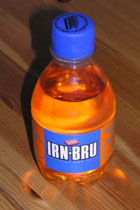
1980 saw the introduction of Low Calorie Irn-Bru: this was re-launched in 1991 as Diet Irn-Bru and again in 2011 as Irn-Bru Sugar Free. The Irn-Bru 32 energy drink variant was launched in 2006, but was discontinued shortly after.
Irn-Bru has long been the most popular soft drink in Scotland, with Coca-Cola second, but competition between the two brands brought their sales to roughly equal levels by 2003. It is also the third best selling soft drink in the UK, after Coca-Cola and Pepsi, outselling high-profile brands such as Fanta, Dr Pepper, Sprite and 7 Up. This success in defending its home market (a feat claimed only by Irn-Bru, Inca Kola and Thums Up; Thums Up sold out to Coca-Cola in 1993, and Inka Kola owners Corporación Lindley S.A. entered into a joint venture with Coca-Cola in 1999, giving up all rights to the name outside Peru) led to ongoing speculation that Coca-Cola, PepsiCo, Inc. or its UK brand franchisee Britvic would attempt to buy A.G. Barr. In November 2012 AG Barr and Britvic announced a merger proposal, but in July 2013 the merger collapsed when terms could not be agreed.
Irn-Bru's advertising slogans used to be 'Scotland's other National Drink', referring to whisky, and 'Made in Scotland from girders', a reference to the rusty colour of the drink; though the closest one can come to substantiating this claim is the 0.002% ammonium ferric citrate listed in the ingredients.
Fiery Irn-Bru, a limited edition variant, was released in autumn 2011. It was packaged with a black and orange design, and with the signature man icon with an added image of a fire. It featured the traditional Irn-Bru flavour with an aftertaste similar to ginger.
Irn-Bru was also sold in reusable 750 ml glass bottles which, like other Barr's drinks, were able to be returned to the manufacturer in exchange for a 30 pence (previously 20p) deposit paid on purchase. This scheme was widely available in shops across Scotland and led to the colloquial term for an empty: a "glass cheque". As a result of a 40% drop in returned bottles since the 1990s Barr deemed the washing and re-filling process uneconomical, and on 1 January 2016 ceased the scheme.
New logo
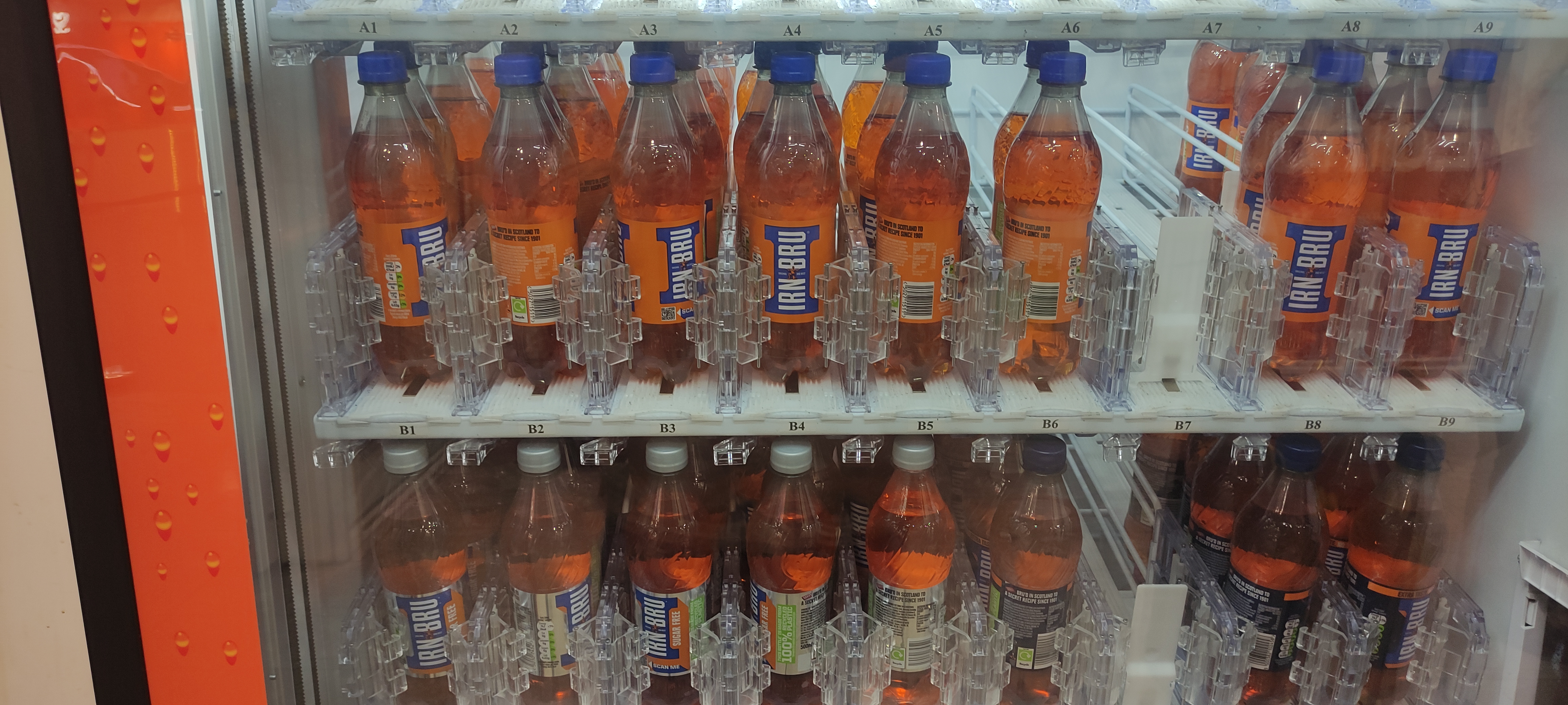
2016 saw the introduction of the current logo, conveying "strength" and an "industrial feel", and a new diet variant called Irn-Bru Xtra in different branding to the existing sugar free variety in a similar fashion to Coca-Cola Zero and Pepsi Max.
Barr changed the formula of Irn-Bru in January 2018 in response to a sugar tax implemented in the UK in April 2018, intended to combat obesity. By reducing the sugar content to less than 5g per 100ml, Barr has made Irn-Bru exempt from the tax. The manufacturer asserted that "most people will not be able to tell the difference in flavour between the old and new formulas", but fans of the drink launched an unsuccessful 'Save Real Irn-Bru' campaign to stop or reverse the change, and began stocking up on the more sugary formula.
In May 2019, Barr announced a new energy drink variant of Irn-Bru called Irn-Bru Energy, which was released on 1 July 2019.
In October 2019, Barr announced the launch of the "Irn-Bru 1901". The drink would be available for a limited time and use the original recipe from 1901. In March 2021, Barr announced the relaunch of "Irn-Bru 1901" as a permanent addition to the Irn-Bru lineup.
Irn-Bru was the only soft drink on sale at the 2021 United Nations Climate Change Conference (COP26) in Glasgow, Scotland, due to a sponsorship arrangement. Member of the US House of Representatives Alexandria Ocasio-Cortez tried Irn-Bru at COP26 and said she loved it, and that it tasted just like the Latino soda Kola Champagne. The response from others at the conference ranged from strong dislike to strong liking. The volume of editorial and opinion publicity the drink gained on social and print media was described as "the summit's surprise", coverage worth millions. However, AG Barr's share price remained relatively flat at the time.
Production
It is produced in Westfield, Cumbernauld, North Lanarkshire, since Barr's moved out of their Parkhead, Glasgow factory in the mid-2000s. In 2011, Irn-Bru closed their factory in Mansfield, making the Westfield plant in Cumbernauld the main location for production. Other manufacturing locations include the English city of Sheffield.
Marketing
_092.jpg)


Barr's actively promoted their Irn-Bru from the outset, with some of their earliest ads featuring world champion wrestlers and Highland Games athletes Donald Dinnie and Alex Munro who endorsed the drink by means of personal testimonials. In the 1930s, the firm began a long-running series of comic strip ads entitled "The Adventures of Ba-Bru" which ran in various local papers from April 1939 until October 1970. The last traces of this campaign, a large neon sign featuring Ba-Bru which stood in Union St above Glasgow Central railway station, was removed in 1983 and replaced with an illuminated display featuring the tagline "Your Other National Drink".
Barr has a long-established gimmick associating Irn-Bru with Scottishness, stemming from the claim of its being Scotland's most popular soft drink. A tagline, "Made in Scotland from girders", was used for several years from the 1980s, usually featuring Irn-Bru drinkers becoming unusually strong, durable or magnetic.
An advertising campaign launched in Spring 2000 aimed to "dramatise the extraordinary appeal of Irn-Bru in a likeably maverick style". David Amers, Planning Director, said: "Irn-Bru is the likeable maverick of the soft drinks market and these ads perfectly capture the brand's spirit." One involved a grandfather (played by actor Robert Wilson) who removed his false teeth to spoil his grandson's interest in his can of Irn-Bru. A further TV advertisement featured a senior citizen in a mobility scooter robbing a local shopping market of a supply of Irn-Bru.
In 2004 the company created a new concept "Phenomenal". In 2006 the company launched its first Christmas adverts. This campaign consisted of a parody commercial of a popular Christmas Cartoon, The Snowman, and was effective in interesting American audiences in the Irn-Bru brand. A sequel to the commercial would later be released in December 2018. Further advertising campaigns for Irn-Bru appeared in conjunction with the release of Irn-Bru 32 in 2006.
A 2009 advertisement for the product featured a group of high school pupils performing a musical number, with the refrain "It's fizzy, it's ginger, it's phenomenal!" It was a parody of High School Musical, and starred Jack Lowden. In 2012 the company changed its slogan to "gets you through", which see a number of people drinking Irn-Bru to get through tough situations. In response to the Coca-Cola 'Share a Coke' campaign, Barr decided to produce thousands of limited edition 750 ml bottles of Irn-Bru with the names 'Fanny', 'Senga', 'Rab' and 'Tam' on the label, mimicking that by Coca-Cola. The use of the name 'Fanny' ties in with one of ''Irn-Bru'''s controversial marketing advertisements.
One of the most controversial Irn-Bru television adverts evoked 1950s entertainment. A mother plays the piano, while the father and two children deliver a song which ends with the mother singing: "...even though I used to be a man". This advertisement was broadcast in 2000, but when it was repeated in 2003, it led to seventeen complaints about it being offensive to members of the transgender community. Issue A14 of the Ofcom Advertising Complaints bulletin reports that the children's response to their mother's claim was not offensive. According to the advertising agency Leith, the advertisement was meant to "create a sense of humour while confirming the maverick nature of the brand". However, the scene involving the mother shaving at the end of the advertisement was deemed by Ofcom to be "capable of causing offence by strongly reinforcing negative stereotypes", and so it was taken off the air.
In 2003, an Irn-Bru commercial which showed a midwife trying to entice a baby from its mother's womb during a difficult delivery sparked fifty complaints. Some saw it as upsetting to women who had suffered miscarriages. One billboard that drew criticism featured a young woman in a bikini along with the slogan "Diet Irn-Bru. I never knew four-and-a-half inches could give so much pleasure". Another featured a picture of a cow with the slogan "When I'm a burger, I want to be washed down with Irn-Bru". This billboard resulted in over 700 complaints but was cleared by advertisement watchdogs. According to a 2003 BBC report, a billboard which featured a depressed goth and the slogan "Cheer up Goth. Have an Irn-Bru." was also criticised for inciting bullying.
Brand portfolio
| Name | Launched |
|---|---|
| Irn-Bru | 1901 |
| Irn-Bru Sugar Free | |
| formerly Diet Irn-Bru (1991–2011) | 1991 |
| Irn-Bru XS | 1995 |
| Irn-Bru 32 | 2006 |
| Fiery Irn-Bru | 2011 |
| Irn-Bru Zero | |
| formerly Irn-Bru Xtra (2016–2026) | 2016 |
| Irn-Bru Energy | |
| Irn-Bru Energy Sugar Free | 2019 |
| Irn-Bru Crimbo Juice | 2019 |
| Irn-Bru 1901 | 2019 |
| Irn-Bru Xtra Tropical | |
| Irn-Bru Xtra Ice Cream | 2023 |
| Pwr-Bru Origin (Original) | |
| Pwr-Bru Diablo (Cherry) | |
| Pwr-Bru Dropkick (Tropical) | |
| Pwr-Bru Maverick (Berry) | 2023 |
| Irn-Bru Xtra Raspberry Ripple | |
| Irn-Bru Xtra Wild Berry Slush | 2024 |
| Pwr-Bru Dynamo (Fruit Punch) | 2025 |
| Irn-Bru Xtra Nessie Nectar | |
| Irn-Bru Xtra Unicorn Tears | 2025 |
| Irn-Bru Winter Bru (Spiced Cinnamon & Ginger) | 2025 |
McCowan's also produced Irn-Bru Bars, chewy, fizzy, bright orange confectionery bars which taste strongly of Irn-Bru, though production ended in late 2005. Irn-Bru sorbet is available in some speciality ice cream shops in Scotland.
The drink can be used as a mixer with alcoholic beverages, mainly vodka and whisky. Barr launched an alcopop drink combining Irn-Bru and Bell's whisky, although this proved to be unpopular and was discontinued.
Exports and foreign markets
_(crop).jpg)
Australia
In Australia, Irn-Bru was manufactured and distributed under licence by Occasio Australia until 2009. It was available in 500 ml and 1.25-litre in both standard and diet. The drink enjoyed growing success in the country, with its first advertising campaign launched in Queensland in September 2007. It was initially available in major chains such as Coles and Woolworths, Caltex service stations and in many independent grocers and convenience stores. It was then delisted at Coles Supermarkets. Because of manufacturing and bottling issues, Occasio ceased local production in late 2009. It is now imported direct from the UK and distributed by British Provender, and can again be found in the international sections of major supermarket chains and some convenience stores.
Canada
Irn-Bru sold in Canada contained no caffeine until 2011, following the decision by Health Canada to repeal the ban on caffeine on non cola soft drinks in March 2010. Non-cola soft drinks can now contain up to 150ppm of caffeine. Now bottles of Irn-Bru have the label 'Now Contains caffeine' on the packaging. Irn-Bru in Canada is distributed by TFB & Associates Ltd from Markham, Ontario but is packaged by A.G. Barr in Glasgow, Scotland. Irn-Bru can be found at Sobeys, Co-op and Walmart supermarkets. The now-defunct McKinlay soft-drink company in Glace Bay, Cape Breton, Nova Scotia, Canada, offered its own non-licensed beverage called Irn-Bru and later "Cape Breton's Irn-Bru". It was a brown carbonated soft-drink with a fruity cola taste.
The standard Irn-Bru distributed in Canada also contains the "Not a source of iron" disclaimer on the label. The UK version of the drink (with caffeine) was imported by speciality retailers to Canada, given the large Scottish populations in Canada, with the country accounting for the largest number of Scottish expats in the world.
In 2014, Irn-Bru was incorrectly reported to have been one of a number of imported products, including Marmite, banned in Canada as a result of its additives in its ingredients due to a shipment being confiscated; however, a statement released by the Government of Canada in October 2020 reiterated that "Irn-Bru and Marmite are not banned for sale in Canada. These products have been available on Canadian store shelves for more than a decade and will continue to be sold in stores across Canada. ...Imported products, including Irn Bru and Marmite, that meet Canadian requirements under Canada's Food and Drug Regulations are and will continue to be available for sale in Canada."
Middle East
Irn-Bru is available throughout the Middle East. It is found mostly in LuLu supermarkets.
Europe
Irn-Bru entered the Norwegian market in May 2008. They had to withdraw from the market again in 2009 as a result of problems with production agreements and lack of funding for marketing. They were believed to be sponsoring the Norwegian First Division club Mjøndalen IF in 2009. This later turned out to be fraud carried out by a third-party company, and Mjøndalen IF never received any sponsorship from Irn-Bru, even though the team played the 2009 season with the Irn-Bru logo on their shirts. It is available in the Republic of Ireland, increasingly being stocked in BWG and ADM Londis supplied stores, as well as in supermarkets owned by Dunnes Stores and Tesco Ireland. In Ireland generally, the drink mainly sells in County Donegal.
Other European territories where Irn Bru is sold include Spain, the Netherlands, Germany, Gibraltar, Belgium, Poland, Malta, Greece and Cyprus. In September 2010, profits in England and Wales had increased, with half year pre-tax profits rising 18.8% to £16 million. By July 2024, A.G. Barr, the manufacturers of the drink, were estimated to make £221 million in sales in England alone for the first six months (January–June) of 2024, a 7% increase in sales from the previous year.
Russia
Irn-Bru began being sold in Russia in 1997, and by 2002, it had become their third best selling soft drink. After its original bottler went out of business, a new deal was signed for the drink to be manufactured and distributed in larger quantities by the Pepsi Bottling Group of Russia in 2002. Its popularity has been attributed to the drink's apparent similarity to discontinued Soviet-era soft drinks. As of 2011, Irn-Bru sales in Russia were still growing.
On 4 March 2022, due to the ongoing 2022 Russian invasion of Ukraine, A.G. Barr cut ties with the Russian market.
United States
Irn-Bru and Diet Irn-Bru have been formulated since 2002 by A.G. Barr to meet the regulations for food colouring of the Food & Drug Administration (FDA). Ponceau 4R, used in the UK formulation, is prohibited by the FDA. Barr uses alternative food and drink colourants manufactured by a US company approved by the FDA. The product labelling also meets US labelling standards on nutritional information and bar code.
Competitor and generic Iron Brews
- Rivets was an iron brew drink launched in 1994 by Meri-Mate Ltd of Dundee.
- Highland Brew was launched in 2000 by the Natural Fruit and Beverage Company.
- Several supermarkets including Aldi, Asda and Lidl sell own brand Iron Brews, alongside the original product made by Barr's.
- Foxon Park Beverages in Connecticut, US, makes its own "Iron Brew" soda, available throughout the New Haven area
References
References
- Brooks, Libby. (30 May 2007). "Alongside penicillin, tarmacadam and the bicycle, there is another Scottish invention that has genuinely rocked the world: Irn Bru.". [[The Guardian]].
- (5 November 2021). "'The first sip was rather shocking': Cop26 delegates try Irn-Bru for the first time". The Guardian.
- "Tartan Details - Irn Bru".
- "How this brand has outsold Coke in Scotland for over a century". [[Canadian Broadcasting Corporation]].
- (31 May 2022). "What does Irn-Bru taste like? Scots can't agree, research finds". [[The National (Scotland).
- (1 November 2024). "So THAT's What Flavour Irn-Bru Is". [[HuffPost]].
- (March 9, 2023). "Ad of the Day: Irn-Bru ignites fiery debate about its true taste". The Drum.
- (10 July 2019). "Irn-Bru: the surprising and secretive history of Scotland's 'other national drink' {{!}} Scotsman Food and Drink".
- (11 January 2024). "IRN-BRU 16 things you didn't know about Scotland's 'other' national drink".
- (11 January 2024). "IRN-BRU 16 things you didn't know about Scotland's 'other' national drink".
- (9 June 2016). "Is Irn-Bru Really Made From Girders?". [[The Scotsman]].
- (28 January 2010). "AG Barr to replace colourings in Irn-Bru". just-drinks.
- Bolger, Andrew. (9 September 2011). "EU reprieve for Scottish soft drink Irn-Bru". [[Financial Times]].
- "The Guilty Suspects". [[A.G. Barr]].
- Leishman, David. (2017). ""Original and Best"? How Barr's Irn-Bru Became a Scottish Icon". Études écossaises.
- (1898). "Iron Brew Showcard registered in 1898 by Stevenson & Howell (Reference: 1 143 002)". [[The National Archives (United Kingdom).
- (1900). "The Falkirk Cookery Book". [[John Callander]].
- Trademark number [https://trademarks.ipo.gov.uk/ipo-tmcase/page/Results/1/UK00000649974 UK00000649974] {{Webarchive. link. (1 September 2019)
- (21 May 1948). "The Adventures of Ba-Bru: The new way Mr Barr spells Irn-Bru". Motherwell Times.
- (1949). "The Advertising, Labelling and Composition of Food". [[Ministry of Agriculture, Fisheries and Food (United Kingdom).
- (19 August 2015). "Irn Bru bottles reach point of no return". [[BBC News]].
- (30 September 2003). "Coke takes sparkle from Irn-Bru". [[The Scotsman]].
- Hosie, Rachel. (5 January 2018). "Irn-Bru: 15 things you didn't know about Scotland's national drink". [[The Independent]].
- Flanagan, Martin. "AG Barr-Britvic merger could see 500 jobs axed – Management". [[The Scotsman]].
- (11 July 2013). "Britvic, A.G. Barr merger deal collapses". [[Reuters]].
- (9 June 2016). "Is Irn-Bru really made from girders?". The Scotsman.
- (18 October 2018). "Remembering Fiery Irn-Bru and one of our favourite banned ads".
- "Irn-Bru launches 'fiery' limited edition drink".
- (19 August 2015). "Irn-Bru maker ends glass bottle returns".
- (30 December 2015). "The end of the 'glass cheque': Irn-Bru stops bottle return scheme | Scotland". [[STV News]].
- Gillan, Audrey. "Cash in your 'glass cheques': the end of the Irn Bru buy-back scheme is nigh | Life and style". The Guardian.
- (19 August 2015). "Irn Bru maker AG Barr signals end to bottle returns". [[BBC News]].
- (3 May 2016). "Fizzy drink Irn-Bru gets sparkling new branding and packaging design". [[Design Week]].
- Connelly, Tony. (24 July 2016). "AG Barr reveals Irn-Bru Xtra as part of its new marketing strategy following sugar tax". The Drum.
- (19 August 2016). "Irn-Bru XTRA is finally here and this is where you can buy it". The Scotsman.
- "AG Barr: Response to new Irn Bru recipe 'encouraging'". BBC News.
- Wood, Zoe. (5 January 2018). "Coca-Cola to sell smaller bottles at higher prices in response to sugar tax". [[The Guardian]].
- Karasz, Palko. (5 January 2018). "Irn Bru, a Scottish Favorite, Loses Some Sugar". [[The New York Times]].
- (5 January 2018). "Irn-Bru drinkers won't notice halved sugar content, claims AG Barr". The Guardian.
- "Irn-Bru set to launch brand new high-caffeine energy drink this summer". The Scotsman.
- (23 October 2019). "'Yassssss, empty the shelves!': Irn-Bru fans react to return of original recipe". Scotsman Food and Drink.
- IRN-BRU. (22 March 2021). "IRN-BRU 1901. BRU'd to the original 1901 recipe, old-school label, traditional glass bottle... truly timeless. And now BACK FOR GOOD!".
- Murray, Jessica. (10 November 2021). "'Love it': Alexandria Ocasio-Cortez gives verdict on Scottish favourite Irn-Bru". The Guardian.
- Sweney, Mark. (12 November 2021). "'An emblem of Scotland': how Irn-Bru stole the show at Cop26". The Guardian.
- (1 December 2009). "Sales increase for Irn Bru maker". BBC News.
- Burke, Darren. (February 2020). "Sheffield Irn-Bru factory to go green after striking wind power deal". [[Sheffield Star]].
- (1 January 2001). "Robert Barr 1875 to 2001". [[A.G. Barr]].
- (19 October 1970). "The Adventures of Ba-Bru: Three-legged race". [[Glasgow Times.
- (13 July 1983). "It's time for a change in city's landmark". [[The Herald (Glasgow).
- Leishman, David. (2020). "Consumer nationalism and Barr's Irn-Bru in Scotland".
- Brabbs, Cordelia. (20 April 2000). "Irn-Bru to air first TV ads in England". [[Campaign (magazine).
- (19 November 2021). "8 of the best and funniest Irn Bru adverts throughout the years".
- (19 November 2011). "Irn Bru Advert Granny".
- "Irn-bru unveils biggest ever marketing drive in Scotland". The Drum.
- (1 December 2006). "Irn-Bru Snowman Advert". [[YouTube]].
- Leishman, David. (2020). "Consumer nationalism and Barr's Irn-Bru in Scotland".
- (2 December 2018). "IRN-BRU Snowman - The Sequel". IRN-BRU.
- Stewart, Rebecca. (2 December 2018). "The Irn-Bru Snowman returns as boy tries to swipe his can back in long-awaited sequel". The Drum.
- (25 March 2006). "Irn-Bru 32 campaign leaves a sour taste". [[The Herald (Glasgow).
- "Irn-Bru bows to police pressure on 'cuckoo' ad". The Scotsman.
- (30 April 2009). "IRN-BRU Musical ad". Youtube.com.
- "Irn-Bru 'gets you through' by the Leith Agency". Campaign.
- Leishman, David. (2020). "Consumer nationalism and Barr's Irn-Bru in Scotland".
- "IRN-BRU launches a long line of Fannies for fans as personalised bottles go on sale". The Drum.
- (July 2004). "Ofcom response to complaints about Leith Agency advert for Irn-Bru". [[Ofcom]].
- Cozens, Claire. (19 July 2004). "Ofcom bans discriminatory Irn-Bru ad". The Guardian.
- (15 June 2003). "Irn-Bru Foetus Campaign Leaves TV Viewers Fizzing". The Scotsman.
- (30 July 2003). "Irn-Bru ad leaves bad taste". BBC News.
- "Statistics: 1998 Complaints Resolved (Public and industry)". [[Advertising Standards Authority (United Kingdom).
- (30 July 2003). "Irn-Bru ad leaves bad taste". BBC News.
- Eleftheriou-Smith, Loulla-Mae. (20 September 2011). "Irn-Bru launches 'fiery' limited edition drink". [[Strategy (magazine).
- (16 May 2019). "Irn-Bru maker to launch energy drink".
- (31 October 2019). "Limited Edition Crimbo Juice".
- (29 April 2023). "Barr releases Irn-Bru Xtra Tropical and Ice Cream flavour drinks".
- Hart, Jasper. (9 August 2023). "Barr unveils Scotland-exclusive Pwr-Bru energy drink range".
- Hart, Jasper. (1 March 2024). "Irn-Bru Xtra launches limited Raspberry Ripple and Wild Berry Slush varieties".
- (24 March 2025). "Irn-Bru introduces new flavour for Pwr-Bru".
- (15 April 2025). "Two limited editions added to the IRN-BRU XTRA range".
- (11 September 2024). "IRN-Bru unveils spiced cinnamon & ginger Winter Bru".
- "Desserts".
- Boyle, Catherine. (22 March 2010). "Irn Bru: girders, sugar and curing hangovers". [[The Times]].
- "Welcome to British Provender". British Provender Pty Ltd.
- "Caffeine use extended despite health warnings".
- (27 July 2010). "Food and Nutrition {{!}} Caffeine and Carbonated Soft Drinks". [[Health Canada]].
- "Cape Breton's strange brew".
- (24 January 2014). "Scotland's other national drink runs dry in Canada as officials ban sale of Irn-Bru".
- (11 January 2024). "IRN-BRU 16 things you didn't know about Scotland's 'other' national drink".
- (27 March 2015). "CFIA Statement on Rejected Shipment of Products from the UK".
- (25 July 2016). "AG Barr's Irn Bru Xtra - Product Launch".
- Nilsen, Magne J.. (2 June 2010). "MIF utsatt for sponsorbløff". [[Drammens Tidende]].
- "IRN-BRU Soft Drink Cans 6 x 330ml".
- (1 June 2024). "17 things you (probably) didn't know about Irn-Bru".
- (28 September 2010). "Irn Bru sales increase in England and Wales".
- (30 July 2024). "Irn-Bru sales rise in England as profits soar for owners of iconic drink".
- (29 January 2002). "Irn-Bru signs Russian deal". BBC News.
- Hall, James. (28 March 2011). "AG Barr profits rise as Russia gets a taste for Irn-Bru". [[The Daily Telegraph]].
- (4 March 2022). "Irn-Bru maker AG Barr cuts ties with Russian market". BBC News.
- (9 November 2008). "Food and Drug Administration Compliance Program Guidance Manual". [[Food & Drug Administration]].
- (14 May 1994). "A 'riveting' new brew". The Herald.
- (13 July 1994). "Battle brews in the soft drinks market". The Herald.
- (13 July 1994). "Iron challenge to drinks giant". Aberdeen Press and Journal.
- (3 August 1994). "Ginger Boost for Firm". [[Daily Record (Scotland).
- (20 June 2000). "Soft drinks battle is brewing". The Herald.
- (9 July 2022). "Are Irn-Bru supermarket budget-friendly dupes just as good as the real thing? giant". [[The Press and Journal.
This article was imported from Wikipedia and is available under the Creative Commons Attribution-ShareAlike 4.0 License. Content has been adapted to SurfDoc format. Original contributors can be found on the article history page.
Ask Mako anything about Irn-Bru — get instant answers, deeper analysis, and related topics.
Research with MakoFree with your Surf account
Create a free account to save articles, ask Mako questions, and organize your research.
Sign up freeThis content may have been generated or modified by AI. CloudSurf Software LLC is not responsible for the accuracy, completeness, or reliability of AI-generated content. Always verify important information from primary sources.
Report