From Surf Wiki (app.surf) — the open knowledge base
IRAS
Infrared space observatory
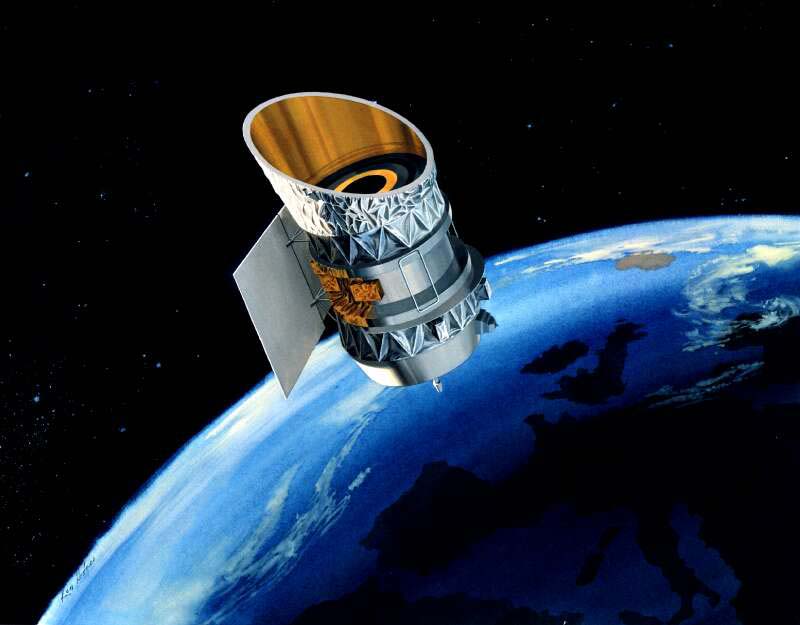
Infrared space observatory
| Field | Value | |
|---|---|---|
| name | Infrared Astronomical Satellite / Infrarood Astronomische Satelliet | |
| image | File:IRAS testing.jpg | |
| image_caption | Infrared Astronomical Satellite in space simulator at JPL, 1982 | |
| mission_type | Infrared space observatory | |
| operator | {{plainlist | |
| COSPAR_ID | 1983-004A | |
| SATCAT | 13777 | |
| website | ||
| mission_duration | Final: | |
| manufacturer | {{plainlist | |
| launch_mass | 1083 kg | |
| dimensions | 3.60 xx | |
| power | ||
| launch_date | UTC | |
| launch_rocket | Delta 3910 | |
| launch_site | Vandenberg SLC-2W | |
| entered_service | 9 February 1983 | |
| disposal_type | Decommissioned | |
| deactivated | ||
| decay_date | ||
| orbit_reference | Geocentric | |
| orbit_regime | Sun-synchronous | |
| orbit_semimajor | 7270.69 km | |
| orbit_eccentricity | 0.001857 | |
| orbit_periapsis | 879.05 km | |
| orbit_apoapsis | 906.05 km | |
| orbit_inclination | 98.95 deg | |
| orbit_period | 102.8 min | |
| orbit_mean_motion | 14.00 rev/day | |
| orbit_epoch | 19 November 2016, 04:15:30 UTC | |
| apsis | gee | |
| telescope_type | Ritchey–Chrétien | |
| telescope_diameter | 57 cm | |
| telescope_focal_length | 545 cm, | |
| telescope_area | 2019 cm2 | |
| telescope_wavelength | Long-wavelength to far-infrared | |
| instruments_list | {{Infobox spaceflight/Instruments | |
| acronym1 | SA | name1 = Survey Array |
| acronym2 | LRS | name2 = Low Resolution Spectrometer |
| acronym3 | CPC | name3 = Chopped Photometric Channel |
the space telescope
-
NASA
-
NIVR
-
SERC
-
Ball Aerospace
-
Fokker Space
-
Hollandse Signaal
The Infrared Astronomical Satellite (Dutch: Infrarood Astronomische Satelliet) (IRAS) was the first space telescope to perform a survey of the entire night sky at infrared wavelengths. Launched on 25 January 1983, its mission lasted ten months. The telescope was a joint project of the United States (NASA), the Netherlands (NIVR), and the United Kingdom (SERC). Over 250,000 infrared sources were observed at 12, 25, 60, and 100 micrometer wavelengths.
Support for the processing and analysis of data from IRAS was contributed from the Infrared Processing and Analysis Center at the California Institute of Technology. Currently, the Infrared Science Archive at IPAC holds the IRAS archive.
The success of IRAS led to interest in the 1985 Infrared Telescope (IRT) mission on the Space Shuttle, and the planned Shuttle Infrared Telescope Facility which eventually transformed into the Space Infrared Telescope Facility, SIRTF, which in turn was developed into the Spitzer Space Telescope, launched in 2003. The success of early infrared space astronomy led to further missions, such as the Infrared Space Observatory (1990s) and the Hubble Space Telescope NICMOS instrument.
Mission
IRAS was the first observatory to perform an all-sky survey at infrared wavelengths. It mapped 96% of the sky four times, at 12, 25, 60 and 100 micrometers, with resolutions ranging from 30 arcseconds at 12 micrometers to 2 arcminutes at 100 micrometers. It discovered about 350,000 sources, many of which are still awaiting identification. About 75,000 of those are believed to be starburst galaxies, still enduring their star-formation stage. Many other sources are normal stars with disks of dust around them, possibly the early stage of planetary system formation. New discoveries included a dust disk around Vega and the first images of the Milky Way core.
IRAS's life, like that of most infrared satellites that followed, was limited by its cooling system. To effectively work in the infrared domain, a telescope must be cooled to cryogenic temperatures. In IRAS's case, 73 kg of superfluid helium kept the telescope at a temperature of 2 K, keeping the satellite cool by evaporation. IRAS was the first use of superfluids in space.{{cite book | author-link = Michael Rowan-Robinson
IRAS was designed to catalog fixed sources, so it scanned the same region of sky several times. Jack Meadows led a team at Leicester University, including John K. Davies and Simon F. Green, which searched the rejected sources for moving objects. This led to the discovery of three asteroids, including 3200 Phaethon (an Apollo asteroid and the parent body of the Geminid meteor shower), six comets, and a huge dust trail associated with comet 10P/Tempel. The comets included 126P/IRAS, 161P/Hartley–IRAS, and comet IRAS–Araki–Alcock (C/1983 H1), which made a close approach to the Earth in 1983. Out of the six comets IRAS found, four were long period and two were short period comets.
The Supplemental IRAS Minor Planet Survey (SIMPS) would also later use the archived data to search for more minor planets, asteroids. {{cite web |display-authors= etal |access-date= 29 December 2008 |archive-url= https://web.archive.org/web/20090817051318/http://www.psi.edu/pds/resource/imps.html |archive-date= 17 August 2009
Discoveries
Overall, over a quarter million discrete targets were observed during its operations, both inside and beyond the Solar System. In addition, new objects were discovered including asteroids and comets. The observatory made headlines briefly with the announcement on 10 December 1983 of the discovery of an "unknown object" at first described as "possibly as large as the giant planet Jupiter and possibly so close to Earth that it would be part of this solar system". Further analysis revealed that, of several unidentified objects, nine were distant galaxies and the tenth was "intergalactic cirrus". None were found to be Solar System bodies.
During its mission, IRAS (and later the Spitzer Space Telescope) detected odd infrared signatures around several stars. This led to the systems being targeted by the Hubble Space Telescope's NICMOS instrument between 1999 and 2006, but nothing was detected. In 2014, using new image processing techniques on the Hubble data, researchers discovered planetary disks around these stars.
IRAS discovered six comets, out of total of 22 discoveries and recoveries of all comets that year. This was a lot for this period, before the launch of SOHO in 1995, which would allow the discovery of many more comets in the next decade (it would detect 1000 comets in ten years).
Asteroid discoveries
| 1 November 1983 |
|---|
Comet discoveries
| 161P/Hartley–IRAS | 4 November 1983 |
|---|
Later surveys
Several infrared space telescopes have continued and greatly expanded the study of the infrared Universe, such as the Infrared Space Observatory launched in 1995, the Spitzer Space Telescope launched in 2003, and the Akari Space Telescope launched in 2006.
A next generation of infrared space telescopes began when NASA's Wide-field Infrared Survey Explorer launched on 14 December 2009 aboard a Delta II rocket from Vandenberg Air Force Base. Known as WISE, the telescope provided results hundreds of times more sensitive than IRAS at the shorter wavelengths; it also had an extended mission dubbed NEOWISE beginning in October 2010 after its coolant supply ran out.
A planned mission is NASA's Near-Earth Object Surveillance Mission (NEOSM), which is a successor to the NEOWISE mission.
2020 near-miss
On , IRAS was expected to pass as closely as 12 meters from the U.S. Air Force's Gravity Gradient Stabilization Experiment (GGSE-4) of 1967, another un-deorbited satellite left aloft; the 14.7-kilometer per second pass had an estimated risk of collision of 5%. Further complications arose from the fact that GGSE-4 was outfitted with an 18 meter long stabilization boom that was in an unknown orientation and may have struck the satellite even if the spacecraft's main body did not. Initial observations from amateur astronomers seemed to indicate that both satellites had survived the pass, with the California-based debris tracking organization LeoLabs later confirming that they had detected no new tracked debris following the incident.
References
Bibliography
References
- "Infrared Astronomical Satellite". [[NASA]].
- (March 1984). "The Infrared Astronomical Satellite (IRAS) mission". Astrophysical Journal.
- (19 November 2016). "IRAS - Orbit". [[Heavens-Above]].
- "Infrared Astronomical Satellite". [[Caltech]].
- "Infrared Astronomical Satellite (IRAS)". Caltech.
- "Early History". NASA.
- O'Toole, Thomas. (30 December 1983). "Mystery Heavenly Body Discovered". [[The Washington Post]].
- (30 December 1983). "Mystery heavenly body found close to Earth". [[Montreal Gazette.
- Chester, Thomas J.. (5 May 1998). "No Tenth Planet Yet From IRAS". Caltech.
- Plait, Phil. (17 November 2010). "The Planet X Saga: Science". Bad Astronomy.
- (24 April 2014). "Astronomical Forensics Uncover Planetary Disks in NASA's Hubble Archive". NASA.
- (1986). "1986QJRAS..27..102M Page 102". Quarterly Journal of the Royal Astronomical Society.
- "NASA - History's Greatest Comet Hunter Discovers 1,000th Comet".
- (29 January 2020). "Our latest data on the IRAS / GGSE 4 event".
- (29 January 2020). "Our latest update this morning for IRAS / GGSE 4".
- (28 January 2020). "2 satellites will narrowly avoid colliding at 32,800 MPH over Pittsburgh on Wednesday".
- (29 January 2020). "Adjusted calculations for larger object size".
- (29 January 2020). "Trails of both IRAS and GGSE4 continue unimpeded after intersection".
- (29 January 2020). "Latest data following the event shows no evidence of new debris".
- Schmadel, Lutz D.. (2007). "Dictionary of Minor Planet Names". [[Springer Berlin Heidelberg]].
- (4 September 2016). "Minor Planet Discoverers". Minor Planet Center.
This article was imported from Wikipedia and is available under the Creative Commons Attribution-ShareAlike 4.0 License. Content has been adapted to SurfDoc format. Original contributors can be found on the article history page.
Ask Mako anything about IRAS — get instant answers, deeper analysis, and related topics.
Research with MakoFree with your Surf account
Create a free account to save articles, ask Mako questions, and organize your research.
Sign up freeThis content may have been generated or modified by AI. CloudSurf Software LLC is not responsible for the accuracy, completeness, or reliability of AI-generated content. Always verify important information from primary sources.
Report