From Surf Wiki (app.surf) — the open knowledge base
IRAK1
Protein-coding gene in humans
Protein-coding gene in humans
Interleukin-1 receptor-associated kinase 1 (IRAK-1) is an enzyme in humans encoded by the IRAK1 gene. IRAK-1 plays an important role in the regulation of the expression of inflammatory genes by immune cells, such as monocytes and macrophages, which in turn help the immune system in eliminating bacteria, viruses, and other pathogens. IRAK-1 is part of the IRAK family consisting of IRAK-1, IRAK-2, IRAK-3, and IRAK-4, and is activated by inflammatory molecules released by signaling pathways during pathogenic attack. IRAK-1 is classified as a kinase enzyme, which regulates pathways in both innate and adaptive immune systems.
Structure
IRAK-1 contains an N-terminal death domain (DD), a ProST domain, a centrally located kinase domain, and a C-terminal domain. The DD on IRAK-1 acts as an interaction platform for other DD-containing protein, most notably the adaptor protein myeloid differentiation factor 88, MyD88.
The proST domain contains serine, proline, and threonine amino acid residues and is used to facilitate IRAK-1 interaction with other IRAK family members or proteins. For example, auto-phosphorylation may occur multiple times in the ProST domain, which allows IRAK-1 to dissociate from the MyD88 bound to the DD while maintaining interactions with downstream proteins such as TNF receptor-associated factor 6 (TRAF-6) to initiate further pathway signaling.
Moreover, IRAK-1 contains an invariant lysine within the centrally located kinase domain. The invariant lysine acts as a binding site for ATP and a mediator for catalytic function and kinase activity.
IRAK-1 also contains a tyrosine residue (Tyr262) that conformationally changes the active site of the IRAK-1 by inhibiting the hydrophilic pocket behind the binding site and thereby allows the IRAK-1 to remain in an active state. For example, ATP binding to the IRAK-1 binding site can readily occur in the presence of Tyr266, because Tyr266 will occupy the hydrophilic pocket where ATP competitive inhibitors may bind and disrupt catalytic function.
Activation
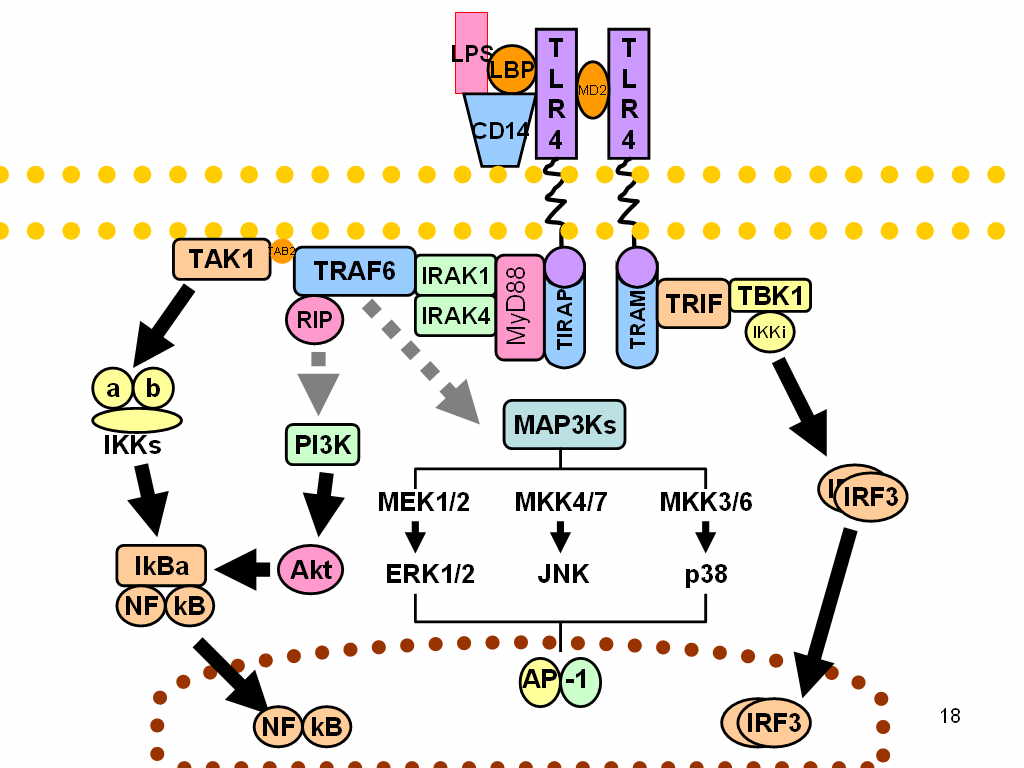
In the presence of foreign pathogens, IRAK-1 induced signaling pathways can be activated by Toll-like receptors (TLRs) or by interleukin-1 family receptors (IL-1R) in response. TLRs recognize pathogen-associated molecular patterns (PAMPs) expressed on bacteria and IL-1Rs recognize and bind pro-inflammatory cytokines of the IL-1 family. Both the TLR and IL-1R mediate a signaling cascade that involves MyD88 binding to the receptor, oligomerization of the MyD88, recruitment of IRAK-1 via the DD, multimerization of IRAK-1, and ultimately kinase activation and further downstream signaling.
IRAK-1 can also be activated upon interaction with other IRAK family members. IRAK-1 and IRAK-4 can activate each other by using the DD as a platform for MyD88. IRAK-4 first phosphorylates IRAK-1 which catalyzes an IRAK-1 auto-phosphorylation cascade, occurring in three steps. IRAK-1 is first phosphorylated at Thr209, causing a conformational change. Then, IRAK-1 is phosphorylated at Thr387 rendering IRAK-1 fully active. Finally, auto-phosphorylation at several residues in the proST region stimulates IRAK-1 release from the receptor complex.
Function
The IRAK-1 encodes the interleukin-1 receptor-associated kinase 1, which is a serine-threonine protein kinase that is associated with the interleukin-1 receptor (IL1R) upon stimulation. IRAK-1 is required for pro-inflammatory cytokine production downstream of TLR and IL-1R signaling pathways. Moreover, IRAK-1 is responsible for IL1-induced up-regulation of the transcriptional factor NF-kappa B. Upon binding with its receptor, IRAK-1 becomes activated, as described in Activation, and then dissociates from its receptor complex. IRAK-1 dissociates from the receptor alongside of TRAF6 - a ubiquitin E3 ligase that intermediates between various types of receptors for exogenous or endogenous mediators and activation of transcriptional responses via NF-kappa B and MAPK pathways. IRAK-1 and TRAF-6 then bind to TAK-1 binding protein-1 (TAB-1), followed by binding to transforming growth factor-β-activated kinase (TAK-1) and TAB-2, forming a new complex. This complex then translocates into the cytoplasm wherein it associates with ubiquitin ligases such as ubiquitin conjugating enzyme-13 UBC-13 and ubiquitin conjugating enzyme E2 variant-1(UEV-1a), leading to the ubiquitination and degradation of TRAF-6. TAK-1 is then activated and phosphorylation of the inhibitor of κB kinase (IKK) complex, consisting of IKKα, IKKβ, and IKKγ, occurs. MAPKs are also activated in the process. Finally, NF-κB is activated to regulate the transcription of pro-inflammatory genes. Alternatively, IRAK-1 activation of the NF-κB pathway can be regulated by the ubiquitination of Lys134 and Lys180.
Alternatively spliced transcript variants encoding different isoforms have been found for the IRAK1 gene. Currently, there are three differentially spliced variants of IRAK1 - IRAK1, IRAK1b, and IRAK1c. IRAK1 was observed to undergo sumoylation, promoting its translocation to the nucleus instead of the cytoplasm upon pathogenic attack. IRAK1c, notably, remains stable upon sumoylation, does not undergo modification under the same circumstances and localizes only to the cytoplasm.
IRAK-1 kinase activity is not the sole protein involved in pro-inflammatory immune responses, however, it serves as an adaptor protein that effectively binds MyD88, IRAK-4, the toll-interacting proteins (TOLLIP) together to form a complex that induces IL-1R-mediated NF-κB activation.
Regulation
IRAK-1 activity is regulated during its activation and function. Auto-phosphorylation plays a role in IRAK-1 activation (see Activation), and also mediates proteasome-mediated degradation which results in the loss of the IRAK1 protein. Alternatively, IRAK-1 may be regulated on the transcriptional level. The IRAK-1b splice variant lacks kinase activity and is resistant to proteasome-mediated degradation. Moreover, IRAK-1c splice variant has a truncated and thus mutated sequence at the C-terminus of its kinase domain and acts a negative regulator of the TLR and IL-1R signaling pathways.
Interactions
IRAK1 has been shown to interact with the following proteins:
- CHUK
- IKBKG
- IKK2,
- Myd88
- NEMO
- SOCS1
- STAT3
- TRAF6
- UBC,
- TOLLIP
- TLR4
Clinical significance
IRAK-1 signaling is involved in rheumatoid arthritis. Moreover, IRAK-1 plays a significant role in cancer.
References
References
- (November 1997). "IRAK (Pelle) family member IRAK-2 and MyD88 as proximal mediators of IL-1 signaling". Science.
- (February 1996). "IRAK: a kinase associated with the interleukin-1 receptor". Science.
- (2014). "IL-1 Receptor-Associated Kinase Signaling and Its Role in Inflammation, Cancer Progression, and Therapy Resistance". Frontiers in Immunology.
- (2013). "Systemic Lupus Erythematosus". Emery and Rimoin's Principles and Practice of Medical Genetics.
- (May 2009). "IRAK-4 inhibitors for inflammation". Current Topics in Medicinal Chemistry.
- (December 2017). "Crystal structure of human IRAK1". Proceedings of the National Academy of Sciences of the United States of America.
- (2019). "Immune Control by TRAF6-Mediated Pathways of Epithelial Cells in the EIME (Epithelial Immune Microenvironment)". Frontiers in Immunology.
- (November 2017). "Inhibition of IRAK1 Ubiquitination Determines Glucocorticoid Sensitivity for TLR9-Induced Inflammation in Macrophages". Journal of Immunology.
- "Entrez Gene: IRAK1 interleukin-1 receptor-associated kinase 1".
- (February 2007). "Differential regulation of interleukin-1 receptor associated kinase 1 (IRAK1) splice variants". Molecular Immunology.
- "TOLLIP toll interacting protein [Homo sapiens (human)] - Gene - NCBI".
- (February 2008). "IRAK1: a critical signaling mediator of innate immunity". Cellular Signalling.
- (March 2008). "Interleukin-1 (IL-1) induces the Lys63-linked polyubiquitination of IL-1 receptor-associated kinase 1 to facilitate NEMO binding and the activation of IkappaBalpha kinase". Molecular and Cellular Biology.
- (May 2008). "Lys63-linked polyubiquitination of IRAK-1 is required for interleukin-1 receptor- and toll-like receptor-mediated NF-kappaB activation". Molecular and Cellular Biology.
- (March 2001). "SIMPL is a tumor necrosis factor-specific regulator of nuclear factor-kappaB activity". The Journal of Biological Chemistry.
- (July 2002). "Inhibition of interleukin-1beta -induced NF-kappa B activation by calcium/calmodulin-dependent protein kinase kinase occurs through Akt activation associated with interleukin-1 receptor-associated kinase phosphorylation and uncoupling of MyD88". The Journal of Biological Chemistry.
- (July 1999). "IRAK-M is a novel member of the Pelle/interleukin-1 receptor-associated kinase (IRAK) family". The Journal of Biological Chemistry.
- (April 2002). "IRAK-4: a novel member of the IRAK family with the properties of an IRAK-kinase". Proceedings of the National Academy of Sciences of the United States of America.
- (September 2001). "Mal (MyD88-adapter-like) is required for Toll-like receptor-4 signal transduction". Nature.
- "IRAK1 Gene {{!}} IRAK1 Protein {{!}} IRAK1 Antibody". GeneCards Human Gene Database.
- (November 2001). "IRAK-mediated translocation of TRAF6 and TAB2 in the interleukin-1-induced activation of NFkappa B". The Journal of Biological Chemistry.
- (October 1996). "TRAF6 is a signal transducer for interleukin-1". Nature.
- (April 2003). "Identification of TIFA as an adapter protein that links tumor necrosis factor receptor-associated factor 6 (TRAF6) to interleukin-1 (IL-1) receptor-associated kinase-1 (IRAK-1) in IL-1 receptor signaling". The Journal of Biological Chemistry.
- (August 2000). "T6BP, a TRAF6-interacting protein involved in IL-1 signaling". Proceedings of the National Academy of Sciences of the United States of America.
- (April 2001). "Interleukin-1 (IL-1) receptor-associated kinase leads to activation of TAK1 by inducing TAB2 translocation in the IL-1 signaling pathway". Molecular and Cellular Biology.
- (April 2008). "Syntenin negatively regulates TRAF6-mediated IL-1R/TLR4 signaling". Cellular Signalling.
- (May 2008). "Pellino 3b negatively regulates interleukin-1-induced TAK1-dependent NF kappaB activation". The Journal of Biological Chemistry.
- (June 2000). "Tollip, a new component of the IL-1RI pathway, links IRAK to the IL-1 receptor". Nature Cell Biology.
- (2014). "MicroRNAs: new regulators of Toll-like receptor signalling pathways". BioMed Research International.
- "IRAK1 gene". U.S. National Library of Medicine.
- (September 2018). "Inhibition of interleukin-1 receptor-associated kinase 1 (IRAK1) as a therapeutic strategy". Oncotarget.
This article was imported from Wikipedia and is available under the Creative Commons Attribution-ShareAlike 4.0 License. Content has been adapted to SurfDoc format. Original contributors can be found on the article history page.
Ask Mako anything about IRAK1 — get instant answers, deeper analysis, and related topics.
Research with MakoFree with your Surf account
Create a free account to save articles, ask Mako questions, and organize your research.
Sign up freeThis content may have been generated or modified by AI. CloudSurf Software LLC is not responsible for the accuracy, completeness, or reliability of AI-generated content. Always verify important information from primary sources.
Report