From Surf Wiki (app.surf) — the open knowledge base
Io (mythology)
Mortal woman seduced by Zeus in Greek mythology
Mortal woman seduced by Zeus in Greek mythology
| Field | Value |
|---|---|
| type | Greek |
| name | Io |
| image | Io Argos MAN Napoli Inv9556.jpg |
| caption | Io wearing bovine horns watched over by Argos on Hera's orders, antique fresco from Pompeii |
| abode | |
| consort | |
| children | |
| parents | Inachus |
In Greek mythology, Io (; ) was one of the mortal lovers of Zeus. An Argive princess, she was an ancestor of many kings and heroes, such as Perseus, Cadmus, Heracles, Minos, Lynceus, Cepheus, and Danaus. The astronomer Simon Marius named a moon of Jupiter after Io in 1614.
Phoronis Because her brother was Phoroneus, Io is also known as Phoronis (an adjective form of Phoroneus: "Phoronean"). She was sometimes compared to the Egyptian goddess Isis, whereas her Egyptian husband Telegonus was Osiris.
Family
In most versions of the legend, Io was the daughter of Inachus, though various other purported genealogies are also known. If her father was Inachus, then her mother would presumably have been Inachus' wife (and sister), the Oceanid nymph Melia, daughter of Oceanus.{{efn|For Melia as wife of Inachus see Bibliotheca (Pseudo-Apollodorus)}} She had the patronymic Inachis (Ἰναχίς) as daughter of Inachus.
Io's father was called Peiren in the Catalogue of Women, and by Acusilaus, possibly a son of the elder Argus, also known as Peiras, Peiranthus or Peirasus. Io may therefore be identical to Callithyia, daughter of Peiranthus, as is suggested by Hesychius of Alexandria.
The 2nd century AD geographer Pausanias mentions another, later Io, descendant of Phoroneus, daughter of Iasus, who himself was the son of Argus and Ismene, the daughter of Asopus, or of Triopas and Sosis; Io's mother in the latter case was Leucane.
Mythology
Io and Zeus
Io was a priestess of the goddess Hera in Argos, In Ovid's Metamorphoses, Zeus pursues a fleeing Io through the Lycrean country, throwing a mantle of darkness over the earth, and then raped her.{{Cite book | author-link = Ovid | translator-last = Raeburn | translator-first = David
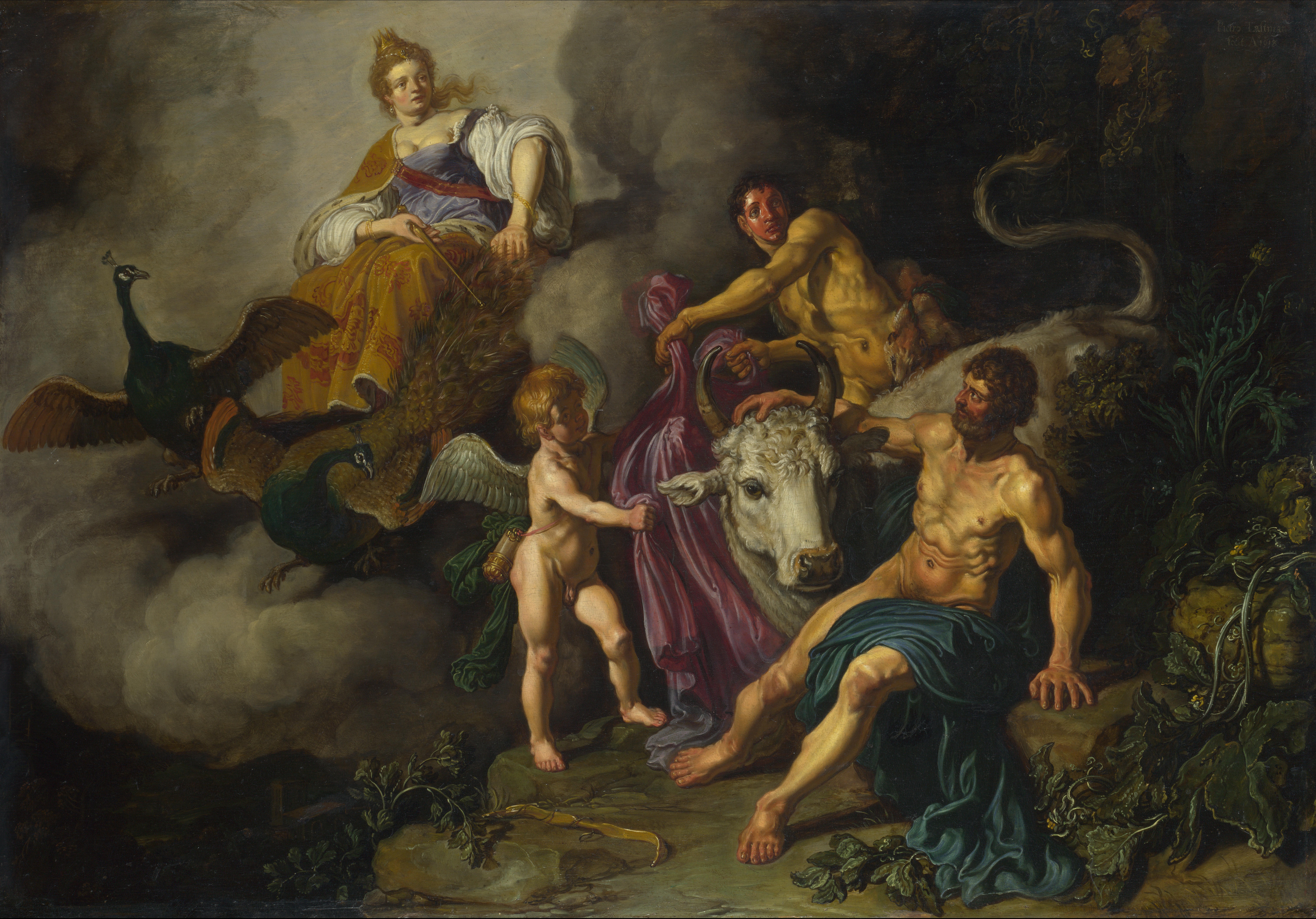
In the version of the story in which Zeus transformed Io, the deception failed, and Hera begged Zeus to give her the heifer as a present, which, having no reason to refuse, he did. Pitying the unfortunate girl, Gaia, the goddess of the earth, created the violet (), so the cow could eat, thus growing "from her from whom it has its name", based on incorrect folk etymology. The various colours of the violet (red, purple, white) changed on account of Io's life, red for the blushing maiden, purple for the cow, white for the stars. Hera then sent Argus Panoptes, a giant who had 100 eyes, to watch Io and prevent Zeus from visiting her, and so Zeus sent Hermes to distract and eventually slay Argus. According to Ovid, he did so by first lulling him to sleep by playing the panpipes and telling stories. Zeus freed Io, still in the form of a heifer. In some myths, Hera uses Argus' eyes to decorate her peacock's feathers to thank the giant for his help.
.jpg)
In order to exact her revenge, Hera sent a gadfly to sting Io continuously, driving her to wander the world without rest. Io eventually crossed the path between the Propontis and the Black Sea, which thus acquired the name Bosporus (meaning ox passage), where she met Prometheus, who had been chained on Mt. Caucasus by Zeus. Prometheus comforted Io with the information that she would be restored to human form and become the ancestress of the greatest of all heroes, Heracles (Hercules). Io escaped across the Ionian Sea to Egypt, where she was restored to human form by Zeus. There, she gave birth to Zeus's son Epaphus, and a daughter as well, Keroessa. She later married Egyptian king Telegonus. Their grandson, Danaus, eventually returned to Greece with his fifty daughters (the Danaids), as recalled in Aeschylus' play The Suppliants.
The myth of Io must have been well known to Homer, who often calls Hermes Argeiphontes, which is often translated as "Argus-slayer", though this interpretation is disputed by Robert Beekes. Walter Burkert notes that the story of Io was told in the ancient epic tradition at least four times of which we have traces: in the Danais, in the Phoronis—Phoroneus founded the cult of Hera, according to Hyginus' Fabulae 274 and 143—in a fragment of the Hesiodic Aigimios, as well as in similarly fragmentary Hesiodic Catalogue of Women. A mourning commemoration of Io was observed at the Heraion of Argos into classical times.
The ancients connected Io with the Moon, and in Aeschylus' Prometheus Bound, where Io encounters Prometheus, she refers to herself as "the horned virgin". From her relationship with Phoroneus, as sister (or descendant), Io is sometimes called Phoronis.
According to the Dictionary of Greek and Roman Biography and Mythology by William Smith, Io at some point landed at Damalis, and the Chalcedonians erected a bronze cow on the spot.
Io as Isis
Lygdus and his wife, Telethusa, were a poor couple living in Crete. When Telethusa becomes pregnant, her husband tells her that they cannot afford to have a daughter, and that they have no other option than to kill the child if it is a daughter. Eight months later Io, later in the story mentioned as Isis, comes in a vision to Telethusa telling her that she should keep her daughter when it is born and must tell her husband that it is a boy named Iphis.
Later in the story, Isis (Io) changes Iphis' sex when she is supposed to marry her fiancée, Ianthe.
Gallery
File:Antonio Allegri, called Correggio - Jupiter and Io - Google Art Project.jpg|Jupiter and Io by Antonio da Correggio File:Victor-Janssens Io-recognized-by-her-father.jpg|Io Recognised by Her Father by Victor Honoré Janssens (second half of 17th century) File:Nicolaes Pietersz. Berchem the Younger - Hera and Io, 1669.jpg|Hera and Io by Nicolaes Pieterszoon Berchem the Younger (circa 1669) File:Jupiter and Io) by John Hoppner, RA.jpg|Jupiter and Io by John Hoppner (1785) at Denver Art Museum File:Io changed into a cow, Mercury cuts of Argus's head.jpg|From Neueröffneter Musen-Tempel by Bernard Picart (1733), University of Heidelberg File:Francesco de Mura – Giunone affida Io ad Argo.tiff|Juno (Hera) commits Io to Argus Panoptes by Francesco de Mura (1740–1750) at Museum of Modern and Contemporary Art of Trento and Rovereto, Italy File:Italian School - Jupiter and Io, espied by Juno (1600-1699).jpg|Jupiter and Io, espied by Juno by Andrea Sacchi and Pier Francesco Mola (1600 - 1699) at Kedleston Hall, Derbyshire (Accredited Museum) File:Gerbrand van den Eeckhout - Juno, Jupiter and Io.jpg|Juno, Jupiter and Io by Gerbrand van den Eeckhout File:Arnold Houbraken - Jupiter, Juno and Io.jpg|Jupiter, Juno and Io by Arnold Houbraken File:Jacob Symonsz. Pynas - Jupiter and Io.jpg|Jupiter and Io by Jacob Pynas at The Fitzwilliam Museum, UK File:Jupiter and Io LACMA M.71.76.16.jpg|Jupiter and Io by Hendrik Goltzius (1589) at Los Angeles County Museum of Art, Los Angeles
Notes
References
Bibliography
- Aeschylus, Suppliants in Persians. Seven against Thebes. Suppliants. Prometheus Bound, edited and translated by Alan H. Sommerstein, Loeb Classical Library No. 145, Cambridge, Massachusetts, Harvard University Press, 2009. . Online version at Harvard University Press.
- Apollodorus, Apollodorus, The Library, with an English Translation by Sir James George Frazer, F.B.A., F.R.S. in 2 Volumes. Cambridge, Massachusetts, Harvard University Press; London, William Heinemann Ltd. 1921. . Online version at the Perseus Digital Library.
- Ovid. Metamorphoses, Volume I: Books 1-8. Translated by Frank Justus Miller. Revised by G. P. Goold. Loeb Classical Library No. 42. Cambridge, Massachusetts: Harvard University Press, 1916. Online version at Harvard University Press.
- Peck, William Thane (editor), The First and Second Books of Ovid's Metamorphoses, Ginn & Company, 1900.
- Tsagalis, Christos, Early Greek Epic Fragments I: Antiquarian and Genealogical Epic, Walter de Gruyter GmbH & Co KG, 2017.
References
- "A Latin Dictionary".
- Lemprière, John. (1809). "A Classical Dictionary". D. & G. Bruce.
- (1751). "L'Encyclopédie".
- Aeschylus, ''Prometheus Bound'', 590; [[Bibliotheca (Pseudo-Apollodorus)
- (1970). "The Oxford Classical Dictionary". Clarendon Press.
- [https://www.perseus.tufts.edu/hopper/text?doc=Perseus%3Atext%3A1999.04.0062%3Aalphabetic+letter%3DI%3Aentry+group%3D3%3Aentry%3Dinachis-harpers Harry Thurston Peck, Harpers Dictionary of Classical Antiquities (1898), Inachis]
- ''Catalogue of Women''. fr. 124
- [[Bibliotheca (Pseudo-Apollodorus)
- M.L. West, ''The Hesiodic Catalogue of Women: Its Nature, Structure, and Origins'' (Oxford, 1985) 77
- [[Pausanias (geographer). Pausanias]], ''Description of Greece'', 2.1.3; [[Gaius Julius Hyginus. Hyginus]], ''Fabulae'', 124.
- Hesychius of Alexandria s. v. {{lang. grc. Ὶὼ Καλλιθύεσσα
- Pausanias, ''Description of Greece'', [https://www.perseus.tufts.edu/hopper/text?doc=Perseus%3Atext%3A1999.01.0160%3Abook%3D2%3Achapter%3D16 2.16.1]
- [[Bibliotheca (Pseudo-Apollodorus)
- [[Scholia]] on [[Euripides]]' ''[[Orestes (play). Orestes]]'', 932
- (1993). "The Oxford Concise Companion to Classical Literature". Clarendon Press.
- ''[[Geoponica]]'' [https://archive.org/details/Geoponica02/page/n113/mode/2up?view=theater 6.22]
- Severus, ''Narrations'' 1
- Ovid, ''Metamorphoses'', I.650-730
- Burkert, ''Homo Necans'' (1974) 1983:164 note 14, giving bibliography.
- [[Eustathius of Thessalonica]] commentary on ''[[Dionysius Periegetes]]'', 92; the Byzantine encyclopedia [[Suda]] ''s.v.'' "Io", [[Ancient Macedonian language. Hesychius]], ''s.v.'' "Io".
- Tsagalis, [https://books.google.com/books?id=lL0vDwAAQBAJ&pg=PA409 p. 409], Peck, [https://books.google.com/books?id=WQhKAAAAIAAJ&pg=PA200 p. 200]; e.g. [[Ovid]], ''[[Metamorphoses]]'' [https://www.loebclassics.com/view/ovid-metamorphoses/1916/pb_LCL042.49.xml?rskey=r5Ud7G&result=1&mainRsKey=f4g7xg 1.668], [https://www.loebclassics.com/view/ovid-metamorphoses/1916/pb_LCL042.97.xml?mainRsKey=f4g7xg&result=1&rskey=r5Ud7G 2.524].
- [https://www.perseus.tufts.edu/hopper/text?doc=Perseus%3Atext%3A1999.04.0104%3Aalphabetic+letter%3DD%3Aentry+group%3D1%3Aentry%3Ddamalis-bio-1 A Dictionary of Greek and Roman biography and mythology, Damalis]
- The source wrongly quotes Symeon Mag. de Constant. Porphyr. p. 729, ed. Bonn; comp. Plb. 5.43. As a source but it is actually Plb.4.43.)
- "Ovid Metamorphoses".
This article was imported from Wikipedia and is available under the Creative Commons Attribution-ShareAlike 4.0 License. Content has been adapted to SurfDoc format. Original contributors can be found on the article history page.
Ask Mako anything about Io (mythology) — get instant answers, deeper analysis, and related topics.
Research with MakoFree with your Surf account
Create a free account to save articles, ask Mako questions, and organize your research.
Sign up freeThis content may have been generated or modified by AI. CloudSurf Software LLC is not responsible for the accuracy, completeness, or reliability of AI-generated content. Always verify important information from primary sources.
Report