From Surf Wiki (app.surf) — the open knowledge base
Invitation to tender
Business process
Business process
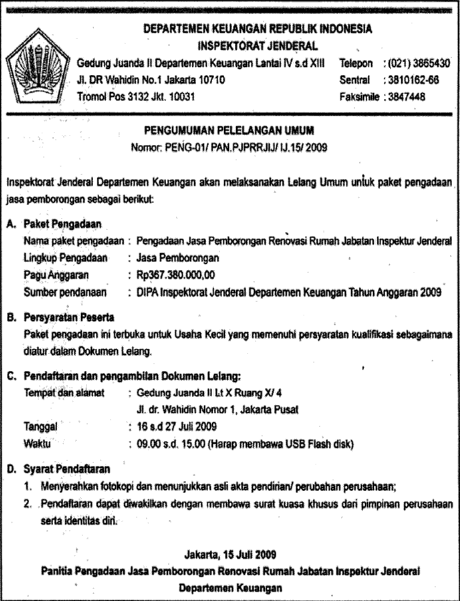
An invitation to tender (ITT, also known as a call for bids or a request for tenders) is a formal, structured procedure for generating competing offers from different potential suppliers or contractors looking to obtain an award of business activity in works, supply, or service contracts, often from companies who have been previously assessed for suitability by means of a supplier questionnaire (SQ) or pre-qualification questionnaire (PQQ).
Unlike a request for proposal (RFP), which is used when a company sources for business proposals, ITTs are used when a government or company does not require the submission of an original business proposal and is looking solely to award a contract based on the best tender submitted. As a result, whereas ITTs are often decided based on the best price offered, decisions on RFPs may also involve other considerations such as technology and innovation. Both are forms of reverse auction.
At the same time, variant bids may be requested in an ITT, which allow suppliers to offer proposals which differ in non-essential terms from the supplies or services requested. The European Commission has suggested that requesting variants is one way in which suppliers can be asked to offer more socially responsible solutions to meeting public needs, and they may provide a means of offering innovative solutions to client needs. The UK government has advised that where variant bids are invited, suppliers might also be asked to provide a compliant bid, which can be compared with other suppliers' compliant bids for evaluation purposes. The government's guidance on this matter also observes that submitting two bids in this manner "will increase suppliers' bid costs and may act as a disincentive to innovation".
Public sector organisations in many countries are legally obliged to release tenders for works and services. In the majority of cases, these are listed on their websites and traditional print media. Electronic procurement and tendering systems or e-procurement are also increasingly prevalent. The European Union states that 235,000 calls for tender are issued annually using its Tenders Electronic Daily system, including those issued by countries in the European Economic Area and beyond.
Terminology
Various terms are used globally to refer to an invitation to tender. The term "notice inviting tenders" (NIT) is often used in India. The European Union's institutions often use the terms "calls for tenders" and "calls for expressions of interest". Other terms used in the United States include "Invitation for Bid" (IFB).
Types
Open tenders (also known as open calls for tenders or advertised tenders) are open to all vendors or contractors who can guarantee performance. Restricted tenders (also known as restricted calls for tenders or invited tenders) are only open to selected pre-qualified vendors or contractors. The tender stage may form part of a two-stage process; the first stage comprises issuing an expression-of-interest (EOI) tender call, | publication-date = 2013 | access-date = 2015-12-03 Compare: | editor1-last = Shorney-Darby | editor1-first = Holly | publication-date = 2012 | access-date = 2015-12-03
Sole source tenders involve only one potential supplier being invited to submit a tender. A sole source tender may be used where there is essentially only one suitable supplier of the services or product.
Tenders have a bid preparation period available to bidders. Research has shown that the length of this period might affect the number of bids and, as a result, the level of competition among tenderers. The interval between advertising a tender or inviting tender submissions, and the close of the bid preparation period, may be subject to regulation in public sector tendering. The European Commission has issued best practice guidelines which emphasise the need to allow suppliers adequate time for bid preparation including the time which small businesses might require to find partners for joint bidding and prepare an agreed bid.
Process
Pre-qualification questionnaires
Supplier questionnaires or pre-qualification questionnaires ensure that potential suppliers are all asked the same information when assessing their suitability to be invited to tender or to have their tenders evaluated. Some organisations issue a standard pre-qualification questionnaire, for example the UK government has developed standard core PQQ questions which have been revised several times and are mandated for use across government, and has also stipulated that PQQs should not be used by central government contracting bodies when procuring goods or services valued less than the threshold values set by UK procurement legislation.
Tender box
A tender box is a mailbox used to receive the physical tender or bid documents, or a digital equivalent. The tender box is not implemented in every country around the world.
Tender validity date
A tender validity date is a date until which a tenderer commits to keeping their prices (and other tender details) open for acceptance (or otherwise) by the client. Such a date is usually included in a form of tender, either as a specified date or as the termination of a specified period from another key tender date. For example, in tendering for gym equipment in 2013, West Dunbartonshire Council required tenderers to accept that "Your tender shall remain open for acceptance for ninety (90) days from the date for return of tenders indicated above, or any subsequent date notified to you by us. Your tender may be accepted by us at any time during this period."
Tender evaluation
There are several different methods for available for tender evaluation, which are related to the proposition method asked by the procurement management:
Lowest price
This method is the simplest and oldest of all. Under this the procurement contract is awarded to the best price. Some relevant methods are these of examining the overall or in parts and in total discount in a given price list or on a given budget. One of the options available under rules applicable to government procurement in the European Union (EU).
Most economically advantageous
The term "most economically advantageous tender" ("MEAT") is applied when proposals of differing quality are evaluated within set limits. Under this the proposals are graded according to their price for value and the contract is awarded to the one with the best grade. Similar to this is the grading of the proposals according to time, making the proposals needing less time of implementation seem more valuable. This is also one of the options available under rules applicable to government procurement in the EU.
Mean value
The contract is awarded to a bid close to the mean value of the proposals received. This may apply to procurements where numerous proposals are expected and there is a need for a market-representing value.
Exclusion of the extremes
Under this method the proposals that are deviating the most from the mass of the proposals are excluded and then the procedure continues with one of the above methods.
Evaluations which do not take account of price
Some evaluations ignore prices or impose a single price which all intending contractors are expected to charge. For example in the English High Court case of Croft House Care et al. v Durham County Council (2010), the Council's commissioning manager explained that allowing bidders offering home care services for older and disabled people to charge different prices and using the lower prices as a part of the tender evaluation process risked bidders being unable to recruit staff and deliver the services they had contracted for.
There are also many variants and/or combinations of these main methods.
After evaluation
Upon completion of tender evaluation it is usual to award a contract, unless no satisfactory tenders have been received. Organisations seeking tenders may reserve in advance the option not to award a contract or to abandon the procedure.
Post-tender negotiation
Post-tender negotiation involves negotiation between an intending buyer and seller after a seller's tender has been submitted.
References
References
- Consular reports: Commerce, manufactures, etc, Issues 164-167. United States. Bureau of Foreign Commerce, United States. Dept. of Commerce and Labor G.P.O., 1894. [https://books.google.com/books?id=H5w8AQAAIAAJ&pg=Pg361 Pg 361]
- European Commission, Directorate-General for Employment, Social Affairs and Inclusion and [[Directorate-General for Internal Market, Industry, Entrepreneurship and SMEs. Directorate-General for the Internal Market and Services]], [https://op.europa.eu/en/publication-detail/-/publication/cb70c481-0e29-4040-9be2-c408cddf081f ''Buying Social: a Guide to Taking Account of Social Considerations in Public Procurement''], Publications Office, 2011, accessed 30 May 2023, pages 30-31
- [[Office of Government Commerce]], [https://web.archive.org/web/20040715080421/www.ogc.gov.uk/sdtoolkit/workbooks/procurement/8_bidevaluation.htm#6 Invite and evaluate bids], ''OGC Successful Delivery Kit'', version 4.5.1, published in March 2004, archived on 15 July 2004, accessed on 2 December 2025
- European Union, [https://ted.europa.eu/TED/main/HomePage.do TED: Tenders Electronic Daily], accessed 13 June 2020
- [[Telecommunications Consultants India Limited]], [https://www.tcil-india.com/nit.php Notice Inviting Tenders (NIT)] {{Webarchive. link. (2020-06-03 , accessed 6 March 2019)
- Council of the EU, [https://www.consilium.europa.eu/en/general-secretariat/public-procurement/ Procurement at the General Secretariat], last reviewed on 25 October 2022, accessed 9 May 2023, reproduction authorised provided that the Council of the EU is always acknowledged as the original source of the material.
- Washington DC Department of General Services, [https://dgs.dc.gov/page/dgs-contracts-and-procurement-faqs Contracts and Procurement Frequently Asked Questions], second question, accessed on 10 December 2024
- Pliatsidis, Andreas Christos. (2022-11-01). "Impact of the time limits for the receipt of tenders on the number of bidders: evidence from public procurement in Greece". Journal of Public Procurement.
- European Commission, [https://www.ecec.net/fileadmin/pdf/law/2/smecodeofbestpracticesen1.pdf European Code of Best Practices Facilitating Access by SMEs to Public Procurement Contracts], Commission Staff Working Document SEC(2008) 2193, p. 20, published 25 June 2008, accessed 21 February 2025
- Crown Commercial Service, [https://assets.publishing.service.gov.uk/government/uploads/system/uploads/attachment_data/file/62093/PPN-01-12-Use-of-PQQ.pdf Procurement Policy Note – Use of Pre-Qualification Questionnaires: Action Note 01/12 10 February 2012], accessed 5 August 2021
- [[Electronics Corporation of India Limited]], [https://etenders.ecil.co.in/web/eps/upload/resources/User_Manual_TBO_Process_v2.0.pdf User Manual - Tender Box Opening], Version 2.0, accessed 5 August 2021
- Designing Buildings Wiki, [https://www.designingbuildings.co.uk/wiki/Form_of_tender Form of tender], accessed 1 June 2020
- West Dunbartonshire Council (2013), [https://www.west-dunbarton.gov.uk/media/3792701/tender_specification_for_gym_equipment_2013.pdf INVITATION TO TENDER FOR Tender Ref: 1314-59, To Supply, Deliver, Install and Commission Gym Equipment, with Training and Marketing support provision, and 5 years Maintenance Service FOR West Dunbartonshire Leisure Trust], accessed on 8 October 2024
- [[EUR-Lex]], [http://eur-lex.europa.eu/LexUriServ/LexUriServ.do?uri=OJ:L:2004:134:0114:0240:en:PDF 2004/18/EC Article 53§1b of the Directive on the coordination of procedures for the award of public works]
- Hugh James, [https://www.hughjames.com/blog/procurement-bill-most-advantageous-tender-replaces-most-economically-advantageous-tender/ Procurement Bill – Most Advantageous Tender replaces Most Economically Advantageous Tender], published on 4 April 2023, accessed on 12 November 2025
- EUR-Lex, [http://eur-lex.europa.eu/LexUriServ/LexUriServ.do?uri=OJ:L:2004:134:0114:0240:en:PDF 2004/18/EC Article 53§1a of the Directive on the coordination of procedures for the award of public works]
- Assaf, S., Bubshait, A. and Aitah, R., [https://faculty.kfupm.edu.sa/CEM/bushait/Research/Bid-awarding-systems-An-overview.pdf Bid-awarding systems: An overview], ''Cost Engineering'', August 1998; 40, 8; ABI/INFORM Global, p. 37, accessed on 17 October 2024
- England and Wales High Court (Technology and Construction Court), [https://www.bailii.org/ew/cases/EWHC/TCC/2010/909.html Croft House Care Ltd & Ors v Durham County Council [2010] EWHC 909 (TCC)], paragraph 13, delivered on 27 April 2010, accessed on 12 November 2025
- Mills and Reeve, [https://www.procurementportal.com/procurement-law-and-guidance/procurement-act-2023-faqs/award-and-standstill-process-regulated-by-the-public-contracts-regulations-2015/ Award and standstill process regulated by The Public Contracts Regulations 2015], question headed "Can we abandon a procurement following receipt of bids?", accessed on 4 August 2025
- [[Chartered Institute of Procurement & Supply]], [https://www.cips.org/Documents/Resources/Knowledge%20Summary/Tendering%20and%20Post%20Tender%20Negotiation.pdf Tendering and Post Tender Negotiation], accessed 4 June 2018
This article was imported from Wikipedia and is available under the Creative Commons Attribution-ShareAlike 4.0 License. Content has been adapted to SurfDoc format. Original contributors can be found on the article history page.
Ask Mako anything about Invitation to tender — get instant answers, deeper analysis, and related topics.
Research with MakoFree with your Surf account
Create a free account to save articles, ask Mako questions, and organize your research.
Sign up freeThis content may have been generated or modified by AI. CloudSurf Software LLC is not responsible for the accuracy, completeness, or reliability of AI-generated content. Always verify important information from primary sources.
Report