From Surf Wiki (app.surf) — the open knowledge base
Inverted nun
Classical Hebrew glyph

Classical Hebrew glyph
| Inverted Nun | compare with brackets | compare with Nun |
|---|
| Inverted nun – text |
|---|


Inverted nun ( "isolated nun" or "inverted nun" or "" in Hebrew) is a rare glyph used in classical Hebrew. Its function in the ancient texts is disputed. It takes the form of the letter nun in mirror image, and appears in the Masoretic text of the Tanakh in nine different places:
- Numbers - twice, 10:35–36: the two verses are delineated by inverted nuns, sometimes isolated outside the passage text and sometimes embedded within words in verses 10:35 and 11:1.
- Psalms - seven times in Psalm 107 (vs 23-28, vs 40)
The images at right show three common variants of the inverted nun – vertically flipped, horizontally flipped, and Z-shaped. Other renderings exist, corresponding to alternative interpretations of the term "inverted". It may also occur with a dot above.
Occurrence and appearance
Inverted nuns are found in nine passages of the Masoretic Text of the Bible. The exact shape varies between different manuscripts and printed editions. In many manuscripts, a reversed nun is found, referred to as a "nun hafucha" by the Masoretes. In some earlier printed editions, they are shown as the standard nun upside down or rotated, presumably because the printer did not want to design a new rare character. Recent scholarly editions of the Masoretic text show the reversed nun as described by the Masoretes. In some manuscripts, however, other symbols are occasionally found instead. These are sometimes referred to in rabbinical literature as "simaniyot" (markers).
In the Torah, the inverted nuns frame the text:
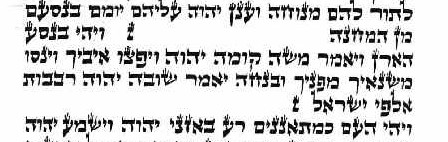
The nuns are generally positioned close to, but not touching, the first and last words of the couplet. They are supposed to be positioned between the gaps in between the paragraphs, but there is disagreement as to how this should be done. Some texts invert the existing nuns in the Torah text and don't add inverted nuns before and after it.
Rashi's commentary states that the name of the city of Haran at the end of the Torah portion Noach also occurs with an inverted nun, but this is not found in existing texts.
Rabbinic basis
The Babylonian Talmud records in the tractate Shabbath, folio 116a, that the markings surrounding Numbers 10:35–36 were thought to denote that this 85-letter text was not in its proper place. One opinion states that it would appear in another location which discusses the order of tribal column, with the position of the Ark already stated there.
The 85-letter text found between the he is also said to be denoted because it is the model for the fewest letters which constitute a 'text' which one would be required to save from fire due to its holiness. It also suggests that the inverted nuns may suggest the Hebrew word נֵר he, meaning 'a light'.
The tractate Shabbat in the Talmud says regarding the inverted nuns:
Sifrei explains these "signs":
The Talmud continues, stating that as this section is a separate book, the portions of Numbers before and after it also count as books and thus the Torah contains seven books in total: Bar Kappara is known to have considered the Torah as composed of seven volumes in the Gemara "The seven pillars with which Wisdom built her house (Prov. 9:1) are the seven Books of Moses". Genesis, Exodus and Leviticus and Deuteronomy as we know them but Numbers was really three separate volumes: Num 1:1 to Num 10:35, followed by Numbers 10:35–36, and the third text from there to the end of Numbers.
The Mishnah, in tractate Yadayim, states:
According to Midrash:
Maharshal ruled that the Talmud only mandates the usual break for a parashah section, and Torah scrolls with extra letters are he (unfit for ritual use). Rabbi Yechezkel Landau, however, defends the custom, stating that punctuation such as inverted nuns doesn't count as extra letters and thus don't invalidate the scroll.
Elsewhere
Inverted nun appears to have been used as a scribal or editorial annotation or text-critical mark.
The primary set of inverted nuns is found surrounding the text of Numbers 10:35–36. The Mishna notes that this text is 85 letters long and dotted. The demarcation of this text leads to the later use of the inverted nun markings. Saul Lieberman demonstrated that similar markings can be found in ancient Greek texts where they are also used to denote 'short texts'. Greek sources, especially Alexandrian ones, refer to the sign as reversed sigma.
Unicode
The inverted nun is not part of any word, and is never pronounced; thus it is classed as punctuation and not a letter.
| Glyph | Unicode | Name |
|---|---|---|
| U+05C6 | HEBREW PUNCTUATION NUN HAFUKHA |
References
References
- "Nun hafucha described at sofer.co.uk".
- "Universal Multiple-Octet Coded Character Set: International Organization for Standardization".
- e.g. Menahem Kasher, ''Torah Sheleima'', v. 29
- [https://web.archive.org/web/20190227183535/https://scripts.sil.org/CMS/scripts/page.php?site_id=nrsi&item_id=ReversedNun_intheBHS Reversed Nun in the BHS]
- e.g. Ganzfried, ''Keset ha-Sofer'', ch. 16 [http://www.hasoferet.com/ritual/keset/chapter16.shtml English translation] {{Webarchive. link. (2008-12-01)
- e.g. Ganzfried, ''Keset ha-Sofer'', ch. 15 [http://www.hasoferet.com/ritual/keset/chapter15.shtml English translation] {{Webarchive. link. (2008-12-01)
- [https://seforim.blogspot.com/2006/06/inverted-nuns.html The Seforim blog: Inverted Nuns]
- [http://www.chabad.org/library/bible_cdo/aid/8175/showrashi/true/jewish/Chapter-11.htm, Genesis Chapter 11 English Bible with Rashi - Chabad.org]
- [http://www.oztorah.com/2007/05/inverted-nun-bhaalotcha/ Inverted Nun – B'ha'alot'cha]
- "Iyunim – Weekly insights on the Parasha with commentaries by Nehama Leibovitz, za"l".
- [https://books.google.com/books?id=U1UfMyO-RiEC&dq=inverted+nun&pg=PA54 Textual criticism of the Hebrew Bible, pp. 54–55]
This article was imported from Wikipedia and is available under the Creative Commons Attribution-ShareAlike 4.0 License. Content has been adapted to SurfDoc format. Original contributors can be found on the article history page.
Ask Mako anything about Inverted nun — get instant answers, deeper analysis, and related topics.
Research with MakoFree with your Surf account
Create a free account to save articles, ask Mako questions, and organize your research.
Sign up freeThis content may have been generated or modified by AI. CloudSurf Software LLC is not responsible for the accuracy, completeness, or reliability of AI-generated content. Always verify important information from primary sources.
Report