From Surf Wiki (app.surf) — the open knowledge base
Interstellar travel
Hypothetical travel between stars or planetary systems

Hypothetical travel between stars or planetary systems
To travel between stars within a reasonable amount of time (decades or centuries), an interstellar spacecraft must reach a significant fraction of the speed of light, requiring enormous amounts of energy. Communication with such interstellar craft will experience years of delay due to the speed of light. Collisions with cosmic dust and gas at such speeds can be catastrophic for such spacecrafts. Crewed interstellar travel could possibly be conducted more slowly (far beyond the scale of a human lifetime) by making a generation ship. Hypothetical interstellar propulsion systems include nuclear pulse propulsion, fission-fragment rocket, fusion rocket, beamed solar sail, and antimatter rocket.
The benefits of interstellar travel include detailed surveys of habitable exoplanets and distant stars, comprehensive search for extraterrestrial intelligence and space colonization. Even though five uncrewed spacecraft have left the Solar System, they are not "interstellar craft" because they are not purposefully designed to explore other star systems. Thus, as of the 2020s, interstellar spaceflight remains a popular trope in speculative future studies and science fiction. A civilization that has mastered interstellar travel is called an interstellar species.
Challenges
Interstellar distances
Distances between the planets in the Solar System are often measured in astronomical units (AU), defined as the average distance between the Sun and Earth, some 1.5E8 km. Venus, the closest planet to Earth, is (at closest approach) 0.28 AU away. Neptune, the farthest planet from the Sun, is 29.8 AU away. As of January 20, 2023, Voyager 1, the farthest human-made object from Earth, is 163 AU away, exiting the Solar System at a speed of 17 km/s (0.006% of the speed of light).
The closest known star, Proxima Centauri, is approximately 4.243 ly away, or over 9,000 times farther away than Neptune. 1 A.U. = 149,597,870,700 meters, 1 light-year = 9,460,730,472,580,800 meters or 63241.077 AU, Venus perihelion = 0.7184 AU Neptune perihelion = 29.809946 AU Voyager 1 distance (2021/Jan) = 163 AU Proxima = 4.243 ± 0.002 light years away.
| Object | Distance | |
|---|---|---|
| (AU) | Light time | |
| Moon | 0.0026 | 1.3 seconds |
| Sun | 1 | 8 minutes |
| Venus (nearest planet) | 0.28 | 2.4 minutes |
| Neptune (farthest planet) | 29.8 | 4.1 hours |
| Voyager 2 | 136.1 | 18.9 hours |
| Voyager 1 | 163.0 | 22.6 hours |
| Proxima Centauri (nearest star and exoplanet) | 268,332 | 4.24 years |
Because of this, distances between stars are usually expressed in light-years (defined as the distance that light travels in vacuum in one Julian year) or in parsecs (one parsec is 3.26 ly, the distance at which stellar parallax is exactly one arcsecond, hence the name). Light in a vacuum travels around 300000 km per second, so 1 light-year is about km or 1 ly AU. Hence, Proxima Centauri is approximately 4.243 light-years from Earth.
Another way of understanding the vastness of interstellar distances is by scaling. One of the closest stars to the Sun, Alpha Centauri A (a Sun-like star that is one of two companions of Proxima Centauri), can be pictured by scaling down the Earth–Sun distance to 1 m. On this scale, the distance to Alpha Centauri A would be 276 km.
The fastest outward-bound spacecraft yet sent, Voyager 1, has covered 1/390 of a light-year in 46 years and is currently moving at 1/17,600 the speed of light. At this rate, a journey to Proxima Centauri would take 75,000 years.
Required energy
A significant factor contributing to the difficulty is the energy that must be supplied to obtain a reasonable travel time. A lower bound for the required energy is the kinetic energy K = \tfrac{1}{2}mv^2 where m is the final mass. If deceleration on arrival is desired and cannot be achieved by any means other than the engines of the ship, then the lower bound for the required energy is doubled to mv^2.
The velocity for a crewed round trip of a few decades to even the nearest star is several thousand times greater than those of present space vehicles. This means that due to the v^2 term in the kinetic energy formula, millions of times as much energy is required. Accelerating one ton to one-tenth of the speed of light requires at least 450 PJ (world energy consumption 2008 was 143,851 terawatt-hours), without factoring in efficiency of the propulsion mechanism. This energy has to be generated onboard from stored fuel, harvested from the interstellar medium, or projected over immense distances.
Interstellar medium
A knowledge of the properties of the interstellar gas and dust through which the vehicle must pass is essential for the design of any interstellar space mission. A major issue with traveling at extremely high speeds is that, due to the requisite high relative speeds and large kinetic energies, collisions with interstellar dust could cause considerable damage to the craft. Various shielding methods to mitigate this problem have been proposed. Larger objects (such as macroscopic dust grains) are far less common, but would be much more destructive. The risks of impacting such objects and mitigation methods have been discussed in literature, but many unknowns remain. An additional consideration is that, due to the non-homogeneous distribution of interstellar matter around the Sun, these risks would vary between different trajectories. Although a high density interstellar medium may cause difficulties for many interstellar travel concepts, interstellar ramjets, and some proposed concepts for decelerating interstellar spacecraft, would actually benefit from a denser interstellar medium.
Hazards
The crew of an interstellar ship would face several significant hazards, including the psychological effects of long-term isolation, the physiological effects of extreme acceleration, the effects of exposure to ionising radiation, and the physiological effects of weightlessness to the muscles, joints, bones, immune system, and eyes. There also exists the risk of impact by micrometeoroids and other space debris. These risks represent challenges that have yet to be overcome.
Wait calculation
The speculative fiction writer and physicist Robert L. Forward has argued that an interstellar mission that cannot be completed within 50 years should not be started at all. Instead, assuming that a civilization is still on an increasing curve of propulsion system velocity and not yet having reached the limit, the resources should be invested in designing a better propulsion system. This is because a slow spacecraft would probably be passed by another mission sent later with more advanced propulsion (the incessant obsolescence postulate). In 2006, Andrew Kennedy calculated ideal departure dates for a trip to Barnard's Star using a more precise concept of the wait calculation where for a given destination and growth rate in propulsion capacity there is a departure point that overtakes earlier launches and will not be overtaken by later ones and concluded "an interstellar journey of 6 light years can best be made in about 635 years from now if growth continues at about 1.4% per annum", or approximately 2641 AD. It may be the most significant calculation for competing cultures occupying the galaxy.Kennedy, A., "The Wait Calculation: The Broader Consequences of the minimum time from now to interstellar destinations and its significance to the space economy". JBIS, 66:96-109, 2013
Prime targets for interstellar travel
There are 59 known stellar systems within 40 light years of the Sun, containing 81 visible stars. The following could be considered prime targets for interstellar missions:
| System | Distance (ly) | Remarks |
|---|---|---|
| Alpha Centauri | Closest system. Three stars (G2, K1, M5). Component A is similar to the Sun (a G2 star). On August 24, 2016, the discovery of an Earth-size exoplanet (Proxima Centauri b) orbiting in the habitable zone of Proxima Centauri was announced. | |
| Barnard's Star | Small, low-luminosity M5 red dwarf. Second closest to Solar System. | |
| Sirius | Large, very bright A1 star with a white dwarf companion. | |
| Epsilon Eridani | Single K2 star slightly smaller and colder than the Sun. It has two asteroid belts. It is also believed to host a gas giant (AEgir), possibly another smaller planet, and may possess a Solar-System-type planetary system. | |
| Tau Ceti | Single G8 star similar to the Sun. High probability of possessing a Solar-System-type planetary system: current evidence shows four planets with potentially two in the habitable zone. | |
| Luyten's Star | M3 red dwarf with the super-Earth Luyten b orbiting in the habitable zone. | |
| Wolf 1061 | Wolf 1061 c is 1.6 times the size of Earth; it may have rocky terrain. It also sits within the 'Goldilocks' zone where it might be possible for liquid water to exist. | |
| Gliese 667C | A system of at least two planets, with a super-Earth lying in the zone around the star where liquid water could exist, making it a possible candidate for the presence of life. | |
| Vega | A very young system possibly in the process of planetary formation. | |
| TRAPPIST-1 | A system which has seven Earth-like planets, some of which may have liquid water. The discovery is a major advancement in finding a habitable planet and in finding a planet that could support life. |
Existing astronomical technology is capable of finding planetary systems around these objects, increasing their potential for exploration.
Proposed methods
Slow, uncrewed probes
Main article: Interstellar probe
"Slow" interstellar missions (still fast by other standards) based on current and near-future propulsion technologies are associated with trip times starting from about several decades to thousands of years. These missions consist of sending a robotic probe to a nearby star for exploration, similar to interplanetary probes like those used in the Voyager program. By taking along no crew, the cost and complexity of the mission is significantly reduced, as is the mass that needs to be accelerated, although technology lifetime is still a significant issue next to obtaining a reasonable speed of travel. Proposed concepts include Project Daedalus, Project Icarus, Project Dragonfly, Project Longshot, and more recently Breakthrough Starshot.
Fast, uncrewed probes
Main article: Interstellar probe
Nanoprobes

Near-lightspeed nano spacecraft might be possible within the near future built on existing microchip technology with a newly developed nanoscale thruster. Researchers at the University of Michigan are developing thrusters that use nanoparticles as propellant. Their technology is called "nanoparticle field extraction thruster", or nanoFET. These devices act like small particle accelerators shooting conductive nanoparticles out into space.
Michio Kaku, a theoretical physicist, has suggested that clouds of "smart dust" be sent to the stars, which may become possible with advances in nanotechnology. Kaku also notes that a large number of nanoprobes would need to be sent due to the vulnerability of very small probes to be easily deflected by magnetic fields, micrometeorites and other dangers to ensure the chances that at least one nanoprobe will survive the journey and reach the destination.
As a near-term solution, small, laser-propelled interstellar probes, based on current CubeSat technology were proposed in the context of Project Dragonfly.
Starseed is a similar proposed method of launching interstellar nanoprobes at one-third light speed. The proposed launcher uses a 1,000 km-long small-diameter hollow wire, with electrodes lining the hollow wire, an electrostatic accelerator tube, similar to K. Eric Drexler's ideas.
Slow, crewed missions
In crewed missions, the duration of a slow interstellar journey presents a major obstacle and existing concepts deal with this problem in different ways. They can be distinguished by the "state" in which humans are transported on-board of the spacecraft.
Generation ships
Main article: Generation ship

A generation ship (or world ship) is a type of interstellar ark in which the crew that arrives at the destination is descended from those who started the journey. Generation ships are not currently feasible because of the difficulty of constructing a ship of the enormous required scale and the great biological and sociological problems that life aboard such a ship raises.
Suspended animation
Main article: Sleeper ship
Scientists and writers have postulated various techniques for suspended animation. These include human hibernation and cryonic preservation. Although neither is currently practical, they offer the possibility of sleeper ships in which the passengers lie inert for the long duration of the voyage.
Frozen embryos
Main article: Embryo space colonization
A robotic interstellar mission carrying some number of frozen early stage human embryos is another theoretical possibility. This method of space colonization requires, among other things, the development of an artificial uterus, the prior detection of a habitable terrestrial planet, and advances in the field of fully autonomous mobile robots and educational robots that would replace human parents.
Island hopping through interstellar space
Interstellar space is not completely empty; it contains trillions of icy bodies ranging from small asteroids (Oort cloud) to possible rogue planets. There may be ways to take advantage of these resources for a good part of an interstellar trip, slowly hopping from body to body or setting up waystations along the way.
Fast, crewed missions
If a spaceship could average 10 percent of light speed (and decelerate at the destination, for human crewed missions), this would be enough to reach Proxima Centauri in forty years. Several propulsion concepts have been proposed that might be eventually developed to accomplish this (see § Propulsion below), but none of them are ready for near-term (few decades) developments at acceptable cost.
Time dilation
Main article: Time dilation
Physicists generally believe faster-than-light travel is impossible. Relativistic time dilation allows a traveler to experience time more slowly, the closer their speed is to the speed of light. This apparent slowing becomes noticeable when velocities above 80% of the speed of light are attained. Clocks aboard an interstellar ship would run slower than Earth clocks, so if a ship's engines were capable of continuously generating around 1 g of acceleration (which is comfortable for humans), the ship could reach almost anywhere in the galaxy and return to Earth within 40 years ship-time (see diagram). Upon return, there would be a difference between the time elapsed on the astronaut's ship and the time elapsed on Earth.
For example, a spaceship could travel to a star 32 light-years away, initially accelerating at a constant 1.03g (i.e. 10.1 m/s2) for 1.32 years (ship time), then stopping its engines and coasting for the next 17.3 years (ship time) at a constant speed, then decelerating again for 1.32 ship-years, and coming to a stop at the destination. After a short visit, the astronaut could return to Earth the same way. After the full round-trip, the clocks on board the ship show that 40 years have passed, but according to those on Earth, the ship comes back 76 years after launch.
From the viewpoint of the astronaut, onboard clocks seem to be running normally. The star ahead seems to be approaching at a speed of 0.87 light years per ship-year. The universe would appear contracted along the direction of travel to half the size it had when the ship was at rest; the distance between that star and the Sun would seem to be 16 light years as measured by the astronaut.
At higher speeds, the time on board will run even slower, so the astronaut could travel to the center of the Milky Way (30,000 light years from Earth) and back in 40 years ship-time. But the speed according to Earth clocks will always be less than 1 light year per Earth year, so, when back home, the astronaut will find that more than 60 thousand years will have passed on Earth.
Constant acceleration
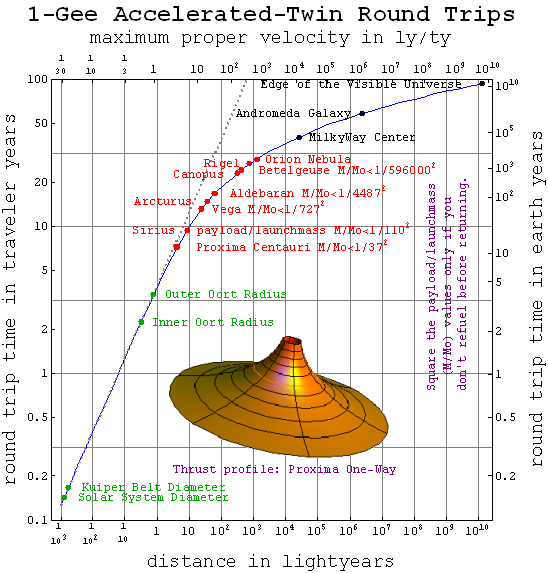
Regardless of how it is achieved, a propulsion system that could produce acceleration continuously from departure to arrival would be the fastest method of travel. A constant acceleration journey is one where the propulsion system accelerates the ship at a constant rate for the first half of the journey, and then decelerates for the second half, so that it arrives at the destination stationary relative to where it began. If this were performed with an acceleration similar to that experienced at the Earth's surface, it would have the added advantage of producing artificial "gravity" for the crew. Supplying the energy required, however, would be prohibitively expensive with current technology.
From the perspective of a planetary observer, the ship will appear to accelerate steadily at first, but then more gradually as it approaches the speed of light (which it cannot exceed). It will undergo hyperbolic motion. The ship will be close to the speed of light after about a year of accelerating and remain at that speed until it brakes for the end of the journey.
From the perspective of an onboard observer, the crew will feel a gravitational field opposite the engine's acceleration, and the universe ahead will appear to fall in that field, undergoing hyperbolic motion. As part of this, distances between objects in the direction of the ship's motion will gradually contract until the ship begins to decelerate, at which time an onboard observer's experience of the gravitational field will be reversed.
When the ship reaches its destination, if it were to exchange a message with its origin planet, it would find that less time had elapsed on board than had elapsed for the planetary observer, due to time dilation and length contraction.
The result is an impressively fast journey for the crew.
Propulsion
According to physicist Michio Kaku, although chemical rocket engines have a thrust of several thousand tons, they operate only for a few minutes, so in terms of final acceleration they are inferior, for example, to ion engines with low thrust and a lifespan of several years, but ion thruster and plasma engines are too weak for human flight to the stars. The most advanced electric rocket engines available today have a characteristic velocity ΔV of about 100 km/s, which, according to Edgar Choueiri, is too slow for travel to distant stars.
For an object to reach the nearest star in a reasonable time (approximately half a century), it must accelerate to a near-relativistic speed in a short period of time and then, if possible, decelerate again. The problem here can be illustrated by the Tsiolkovsky equation:
: \Delta v\ = v_\mathrm{e} \ln \frac {m_0} {m_1} for a launch mass ({m_0}) and a payload of {m_1}.
To achieve a large change in velocity Delta-v (\Delta v), a high effective reaction gas exhaust velocity v_\mathrm{e} (equal to the engine's specific impulse (I_\mathrm{sp}) is required. Furthermore, to obtain the required energy, a large amount of propellant must be processed (m_0/m_1). Another effect that should be accounted for is the thickening (increase of viscosity) of the fuel and of the exhaust gases at relativistic speeds.
Based on this consideration, two categories of engines can be excluded:
- Chemical engines offer high thrust, but due to the use of chemical energy, their efficiency (I_{sp}) is very low (require high fuel consumption).
- Electric engines offer high efficiency, but their thrust is quite low due to the use of electric charges and their mutual repulsion.
According to Dr. Tony Martin, controlled-fusion engines and the nuclear–electric systems have very low thrust because equipment to convert nuclear energy into electrical has a large mass which results in small acceleration, taking a century to achieve the desired speed (for example 15% of the velocity of light, thus unsuitable for interstellar flight during a single human lifetime); thermodynamic nuclear engines of the NERVA type require a great quantity of fuel. Photon rockets have to generate power at a rate of 3 W per kg of vehicle mass and require mirrors with absorptivity of less than 1 part in 106. Interstellar ramjet's problems are the tenuous interstellar medium with a density of about 1 atom/cm3, a large diameter funnel, and high power required for its electric field. Thus the only suitable propulsion method for the project Daedalus was thermonuclear pulse propulsion.
Rocket concepts
All rocket concepts are limited by the rocket equation, which sets the characteristic velocity available as a function of exhaust velocity and mass ratio, the ratio of initial (M0, including fuel) to final (M1, fuel depleted) mass.
Very high specific power, the ratio of thrust to total vehicle mass, is required to reach interstellar targets within sub-century time-frames. Some heat transfer is inevitable, resulting in an extreme thermal load.
Thus, for interstellar rocket concepts of all technologies, a key engineering problem (seldom explicitly discussed) is limiting the heat transfer from the exhaust stream back into the vehicle.
Nuclear fission powered
Fission-fragment
Fission-fragment rockets use nuclear fission to create high-speed jets of fission fragments, which are ejected at speeds of up to 12,000 km/s. With fission, the energy output is approximately 0.1% of the total mass-energy of the reactor fuel and limits the effective exhaust velocity to about 5% of the velocity of light. For maximum velocity, the reaction mass should optimally consist of fission products, the "ash" of the primary energy source, so no extra reaction mass need be bookkept in the mass ratio.
Nuclear pulse
Main article: Nuclear pulse propulsion

| access-date=7 July 2017 | archive-date=11 May 2010 | archive-url=https://web.archive.org/web/20100511090218/https://ntrs.nasa.gov/archive/nasa/casi.ntrs.nasa.gov/19760065935_1976065935.pdf | url-status=live
Project Orion team member Freeman Dyson proposed in 1968 an interstellar spacecraft using nuclear pulse propulsion that used pure deuterium fusion detonations with a very high fuel-burnup fraction. He computed an exhaust velocity of 15,000 km/s and a 100,000-tonne space vehicle able to achieve a 20,000 km/s delta-v allowing a flight-time to Alpha Centauri of 130 years.{{cite journal
In the 1970s the Nuclear Pulse Propulsion concept further was refined by Project Daedalus by use of externally triggered inertial confinement fusion, in this case producing fusion explosions via compressing fusion fuel pellets with high-powered electron beams. Since then, lasers, ion beams, neutral particle beams and hyper-kinetic projectiles have been suggested to produce nuclear pulses for propulsion purposes.
A current impediment to the development of any nuclear-explosion-powered spacecraft is the 1963 Partial Test Ban Treaty, which includes a prohibition on the detonation of any nuclear devices (even non-weapon based) in outer space. This treaty would, therefore, need to be renegotiated, although a project on the scale of an interstellar mission using currently foreseeable technology would probably require international cooperation on at least the scale of the International Space Station.
Another issue to be considered would be the g-forces imparted to a rapidly accelerated spacecraft, cargo, and passengers inside (see Inertia negation).
Nuclear fusion rockets
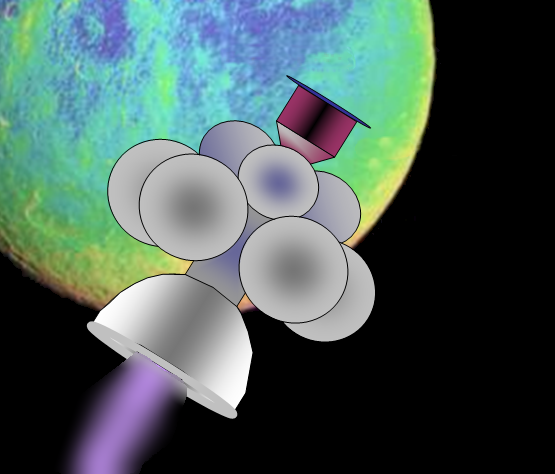
Fusion rocket starships, powered by nuclear fusion reactions, should conceivably be able to reach speeds of the order of 10% of that of light, based on energy considerations alone. In theory, a large number of stages could push a vehicle arbitrarily close to the speed of light. These would "burn" such light element fuels as deuterium, tritium, 3He, 11B, and 7Li. Because fusion yields about 0.3–0.9% of the mass of the nuclear fuel as released energy, it is energetically more favorable than fission, which releases
Antimatter rockets
Main article: Antimatter rocket
An antimatter rocket would have a far higher energy density and specific impulse than any other proposed class of rocket. If energy resources and efficient production methods are found to make antimatter in the quantities required and store it safely, it would be theoretically possible to reach speeds of several tens of percent that of light. Whether antimatter propulsion could lead to the higher speeds (90% that of light) at which relativistic time dilation would become more noticeable, thus making time pass at a slower rate for the travelers as perceived by an outside observer, is doubtful owing to the large quantity of antimatter that would be required.
Speculating that production and storage of antimatter should become feasible, two further issues need to be considered. First, in the annihilation of antimatter, much of the energy is lost as high-energy gamma radiation, and especially also as neutrinos, so that only about 40% of mc2 would actually be available if the antimatter were simply allowed to annihilate into radiations thermally. Even so, the energy available for propulsion would be substantially higher than the ~1% of mc2 yield of nuclear fusion, the next-best rival candidate.
Second, heat transfer from the exhaust to the vehicle seems likely to transfer enormous wasted energy into the ship (e.g. for 0.1g ship acceleration, approaching 0.3 trillion watts per ton of ship mass), considering the large fraction of the energy that goes into penetrating gamma rays. Even assuming shielding was provided to protect the payload (and passengers on a crewed vehicle), some of the energy would inevitably heat the vehicle, and may thereby prove a limiting factor if useful accelerations are to be achieved.
More recently, Friedwardt Winterberg proposed that a matter-antimatter GeV gamma ray laser photon rocket is possible by a relativistic proton-antiproton pinch discharge, where the recoil from the laser beam is transmitted by the Mössbauer effect to the spacecraft.
Rockets with an external energy source
Rockets deriving their power from external sources, such as a laser, could replace their internal energy source with an energy collector, potentially reducing the mass of the ship greatly and allowing much higher travel speeds. Geoffrey A. Landis proposed an interstellar probe propelled by an ion thruster powered by the energy beamed to it from a base station laser. Lenard and Andrews proposed using a base station laser to accelerate nuclear fuel pellets towards a Mini-Mag Orion spacecraft that ignites them for propulsion.
Non-rocket concepts
A problem with all traditional rocket propulsion methods is that the spacecraft would need to carry its fuel with it, thus making it very massive, in accordance with the rocket equation. Several concepts attempt to escape from this problem:
Interstellar ramjets
In 1960, Robert W. Bussard proposed the Bussard ramjet, a fusion rocket in which a huge scoop would collect the diffuse hydrogen in interstellar space, "burn" it on the fly using a proton–proton chain reaction, and expel it out of the back. Later calculations with more accurate estimates suggest that the thrust generated would be less than the drag caused by any conceivable scoop design. Yet the idea is attractive because the fuel would be collected en route (commensurate with the concept of energy harvesting), so the craft could theoretically accelerate to near the speed of light. The limitation is due to the fact that the reaction can only accelerate the propellant to 0.12c. Thus the drag of catching interstellar dust and the thrust of accelerating that same dust to 0.12c would be the same when the speed is 0.12c, preventing further acceleration.
Beamed propulsion

A light sail or magnetic sail powered by a massive laser or particle accelerator in the home star system could potentially reach even greater speeds than rocket- or pulse propulsion methods, because it would not need to carry its own reaction mass and therefore would only need to accelerate the craft's payload. Robert L. Forward proposed a means for decelerating an interstellar craft with a light sail of 100 kilometers in the destination star system without requiring a laser array to be present in that system. In this scheme, a secondary sail of 30 kilometers is deployed to the rear of the spacecraft, while the large primary sail is detached from the craft to keep moving forward on its own. Light is reflected from the large primary sail to the secondary sail, which is used to decelerate the secondary sail and the spacecraft payload. In 2002, Geoffrey A. Landis of NASA's Glen Research center also proposed a laser-powered, propulsion, sail ship that would host a diamond sail (of a few nanometers thick) powered with the use of solar energy. With this proposal, this interstellar ship would, theoretically, be able to reach 10 percent the speed of light. It has also been proposed to use beamed-powered propulsion to accelerate a spacecraft, and electromagnetic propulsion to decelerate it; thus, eliminating the problem that the Bussard ramjet has with the drag produced during acceleration.
A magnetic sail could also decelerate at its destination without depending on carried fuel or a driving beam in the destination system, by interacting with the plasma found in the solar wind of the destination star and the interstellar medium.
The following table lists some example concepts using beamed laser propulsion as proposed by the physicist Robert L. Forward:
| Journey | Mission | Laser power | ||||||||
|---|---|---|---|---|---|---|---|---|---|---|
| GW | Vehicle mass | |||||||||
| t | Acceleration | |||||||||
| g | Sail diameter | |||||||||
| km | Maximum velocity | |||||||||
| (% of the speed of light) | Total duration | Flyby – Alpha Centauri | Rendezvous – Alpha Centauri | Crewed – Epsilon Eridani | ||||||
| outbound stage | 65 | 1 | 0.036 | 3.6 | 11% @ 0.17 ly | 40 years | ||||
| outbound stage | 7,200 | 785 | 0.005 | 100 | 21% @ 4.29 ly | 41 years | ||||
| deceleration stage | 26,000 | 71 | 0.2 | 30 | 21% @ 4.29 ly | |||||
| outbound stage | 75,000,000 | 78,500 | 0.3 | 1000 | 50% @ 0.4 ly | 51 years | ||||
| (including 5 years exploring star system) | ||||||||||
| deceleration stage | 21,500,000 | 7,850 | 0.3 | 320 | 50% @ 10.4 ly | |||||
| return stage | 710,000 | 785 | 0.3 | 100 | 50% @ 10.4 ly | |||||
| deceleration stage | 60,000 | 785 | 0.3 | 100 | 50% @ 0.4 ly |
Interstellar travel catalog to use photogravitational assists for a full stop
The following table is based on work by Heller, Hippke and Kervella.
| Name | Travel time | ||
|---|---|---|---|
| (yr) | Distance | ||
| (ly) | Luminosity | ||
| (L☉) | |||
| Sirius A | 68.90 | 8.58 | 24.20 |
| α Centauri A | 101.25 | 4.36 | 1.52 |
| α Centauri B | 147.58 | 4.36 | 0.50 |
| Procyon A | 154.06 | 11.44 | 6.94 |
| Vega | 167.39 | 25.02 | 50.05 |
| Altair | 176.67 | 16.69 | 10.70 |
| Fomalhaut A | 221.33 | 25.13 | 16.67 |
| Denebola | 325.56 | 35.78 | 14.66 |
| Castor A | 341.35 | 50.98 | 49.85 |
| Epsilon Eridani | 363.35 | 10.50 | 0.50 |
- Successive assists at α Cen A and B could allow travel times to 75 yr to both stars.
- Lightsail has a nominal mass-to-surface ratio (σnom) of 8.6×10⁻⁴ gram m−2 for a nominal graphene-class sail.
- Area of the Lightsail, about 105 m2 = (316 m)2
- Velocity up to 37,300 s−1 (12.5% c)
Pre-accelerated fuel
Achieving start-stop interstellar trip times of less than a human lifetime require mass-ratios of between 1,000 and 1,000,000, even for the nearer stars. This could be achieved by multi-staged vehicles on a vast scale. Alternatively large linear accelerators could propel fuel to fission-propelled space-vehicles, avoiding the limitations of the rocket equation.
Dynamic soaring
Dynamic soaring as a way to travel across interstellar space has been proposed.
Theoretical concepts
Transmission of minds with light
Uploaded human minds or AI could be transmitted with laser or radio signals at the speed of light. This requires a receiver at the destination which would first have to be set up e.g. by humans, probes, self replicating machines (potentially along with AI or uploaded humans), or an alien civilization (which might also be in a different galaxy, perhaps a Kardashev type III civilization).
Artificial black hole
Main article: Black hole starship
A theoretical idea for enabling interstellar travel is to propel a starship by creating an artificial black hole and using a parabolic reflector to reflect its Hawking radiation. Although beyond current technological capabilities, a black hole starship offers some advantages compared to other possible methods. Getting the black hole to act as a power source and engine also requires a way to convert the Hawking radiation into energy and thrust. One potential method involves placing the hole at the focal point of a parabolic reflector attached to the ship, creating forward thrust. A slightly easier, but less efficient method would involve simply absorbing all the gamma radiation heading towards the fore of the ship to push it onwards, and let the rest shoot out the back.
RF resonant cavity thruster
A radio frequency (RF) resonant cavity thruster is a device that is claimed to be a spacecraft thruster. In 2016, the Advanced Propulsion Physics Laboratory at NASA reported observing a small apparent thrust from one such test, a result not since replicated. One of the designs is called EMDrive. In December 2002, Satellite Propulsion Research Ltd described a working prototype with an alleged total thrust of about 0.02 newtons powered by an 850 W cavity magnetron. The device could operate for only a few dozen seconds before the magnetron failed, due to overheating. The latest test on the EMDrive concluded that it does not work.
Helical engine
Proposed in 2019 by NASA scientist Dr. David Burns, the helical engine concept would use a particle accelerator to accelerate particles to near the speed of light. Since particles traveling at such speeds acquire more mass, it is believed that this mass change could create acceleration. According to Burns, the spacecraft could theoretically reach 99% the speed of light.
Faster-than-light travel
Main article: Faster-than-light
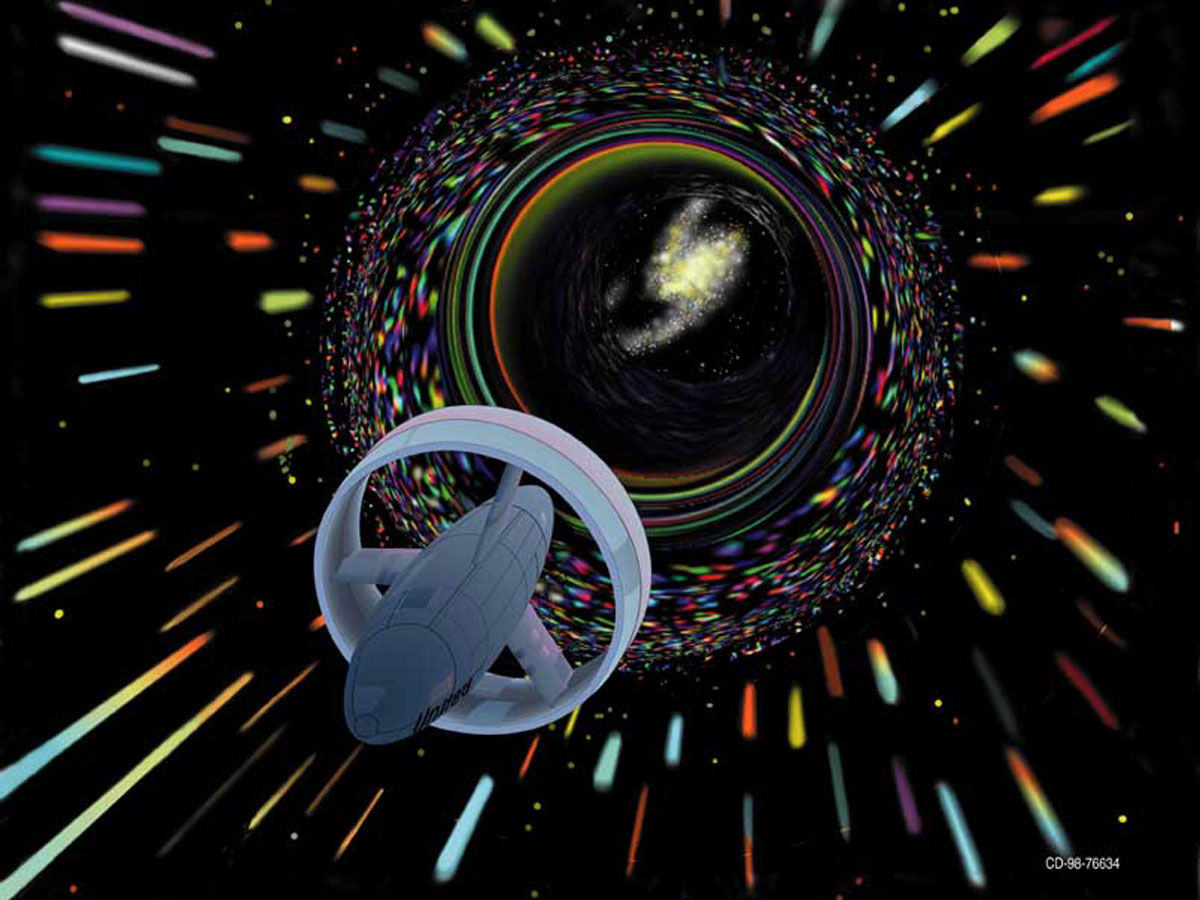
Scientists and authors have postulated a number of ways by which it might be possible to surpass the speed of light, but even the most serious-minded of these are highly speculative.
It is also debatable whether faster-than-light travel is physically possible, in part because of causality concerns: travel faster than light may, under certain conditions, permit travel backwards in time within the context of special relativity. Proposed mechanisms for faster-than-light travel within the theory of general relativity require the existence of exotic matter, and it is not known if it could be produced in sufficient quantities if at all.
Alcubierre drive
Main article: Alcubierre drive
In physics, the Alcubierre drive is based on an argument, within the framework of general relativity and without the introduction of wormholes, that it is possible to modify spacetime in a way that allows a spaceship to travel with an arbitrarily large speed by a local expansion of spacetime behind the spaceship and an opposite contraction in front of it. Alcubierre stated in an email to William Shatner that his theory was directly inspired by the term used in the show and cites the "'warp drive' of science fiction" in his 1994 article. Nevertheless, this concept would require the spaceship to incorporate a region of exotic matter, or the hypothetical concept of negative mass.
Wormholes
Wormholes are conjectural distortions in spacetime that theorists postulate could connect two arbitrary points in the universe, across an Einstein–Rosen Bridge. It is not known whether wormholes are possible in practice. Although there are solutions to the Einstein equation of general relativity that allow for wormholes, all of the currently known solutions involve some assumption, for example the existence of negative mass, which may be unphysical. However, Cramer et al. argue that such wormholes might have been created in the early universe, stabilized by cosmic strings. The general theory of wormholes is discussed by Visser in the book Lorentzian Wormholes.
Designs and studies
Project Hyperion
Main article: Project Hyperion (interstellar)
Project Hyperion has looked into various feasibility issues of crewed interstellar travel. Notable results of the project include an assessment of world ship system architectures and adequate population size. Its members continue to publish on crewed interstellar travel in collaboration with the Initiative for Interstellar Studies.
Enzmann starship
Main article: Enzmann starship
The Enzmann starship, as detailed by G. Harry Stine in the October 1973 issue of Analog, was a design for a future starship, based on the ideas of Robert Duncan-Enzmann. The spacecraft itself as proposed used a 12,000,000 ton ball of frozen deuterium to power 12–24 thermonuclear pulse propulsion units. Twice as long as the Empire State Building is tall and assembled in-orbit, the spacecraft was part of a larger project preceded by interstellar probes and telescopic observation of target star systems.
NASA research
NASA has been researching interstellar travel since its formation, translating important foreign language papers and conducting early studies on applying fusion propulsion, in the 1960s, and laser propulsion, in the 1970s, to interstellar travel.
In 1994, NASA and JPL cosponsored a "Workshop on Advanced Quantum/Relativity Theory Propulsion" to "establish and use new frames of reference for thinking about the faster-than-light (FTL) question".
The NASA Breakthrough Propulsion Physics Program (terminated in FY 2003 after a 6-year, $1.2-million study, because "No breakthroughs appear imminent.") identified some breakthroughs that are needed for interstellar travel to be possible.
Geoffrey A. Landis of NASA's Glenn Research Center states that a laser-powered interstellar sail ship could possibly be launched within 50 years, using new methods of space travel. "I think that ultimately we're going to do it, it's just a question of when and who," Landis said in an interview. Rockets are too slow to send humans on interstellar missions. Instead, he envisions interstellar craft with extensive sails, propelled by laser light to about one-tenth the speed of light. It would take such a ship about 43 years to reach Alpha Centauri if it passed through the system without stopping. Slowing down to stop at Alpha Centauri could increase the trip to 100 years, whereas a journey without slowing down raises the issue of making sufficiently accurate and useful observations and measurements during a fly-by.
100 Year Starship study
The 100 Year Starship (100YSS) study was the name of a one-year project to assess the attributes of and lay the groundwork for an organization that can carry forward the 100 Year Starship vision. 100YSS-related symposia were organized between 2011 and 2015.
Harold ("Sonny") White from NASA's Johnson Space Center is a member of Icarus Interstellar, the nonprofit foundation whose mission is to realize interstellar flight before the year 2100. At the 2012 meeting of 100YSS, he reported using a laser to try to warp spacetime by 1 part in 10 million with the aim of helping to make interstellar travel possible.
Other designs
- Project Orion, human crewed interstellar ship (1958–1968).
- Project Daedalus, uncrewed interstellar probe (1973–1978).
- Starwisp, uncrewed interstellar probe (1985).
- Project Longshot, uncrewed interstellar probe (1987–1988).
- Starseed/launcher, fleet of uncrewed interstellar probes (1996).
- Project Valkyrie, human crewed interstellar ship (2009).
- Project Icarus, uncrewed interstellar probe (2009–2014).
- Sun-diver, uncrewed interstellar probe.
- Project Dragonfly, small laser-propelled interstellar probe (2013–2015).
- Breakthrough Starshot, fleet of uncrewed interstellar probes, announced on 12 April 2016.
- Solar One, crewed spacecraft that would combine beamed-powered propulsion, electromagnetic propulsion, and nuclear propulsion (2020).
Non-profit organizations
A few organisations dedicated to interstellar propulsion research and advocacy for the case exist worldwide. These are still in their infancy, but are already backed up by a membership of a wide variety of scientists, students and professionals.
- Initiative for Interstellar Studies (UK)
- Tau Zero Foundation (USA)
- Limitless Space Institute (USA)
- Tennessee Valley Interstellar Workshop (TVIW), business name Interstellar Research Group (IRG) (USA)
Feasibility
The energy requirements make interstellar travel very difficult. It has been reported that at the 2008 Joint Propulsion Conference, multiple experts opined that it was improbable that humans would ever explore beyond the Solar System. Brice N. Cassenti, an associate professor with the Department of Engineering and Science at Rensselaer Polytechnic Institute, stated that at least 100 times the total energy output of the entire world [in a given year] would be required to send a probe to the nearest star.
Astrophysicist Sten Odenwald stated that the basic problem is that through intensive studies of thousands of detected exoplanets, most of the closest destinations within 50 light years do not yield Earth-like planets in the star's habitable zones. Given the multitrillion-dollar expense of some of the proposed technologies, travelers will have to spend up to 200 years traveling at 20% the speed of light to reach the best known destinations. Moreover, once the travelers arrive at their destination (by any means), they will not be able to travel down to the surface of the target world and set up a colony unless the atmosphere is non-lethal. The prospect of making such a journey, only to spend the rest of the colony's life inside a sealed habitat and venturing outside in a spacesuit, may eliminate many prospective targets from the list.
Moving at a speed close to the speed of light and encountering even a tiny stationary object like a grain of sand will have fatal consequences. For example, a gram of matter moving at 90% of the speed of light contains a kinetic energy corresponding to a small nuclear bomb (around 30kt TNT).
One of the major stumbling blocks is having enough Onboard Spares & Repairs facilities for such a lengthy time journey assuming all other considerations are solved, without access to all the resources available on Earth.
Interstellar missions not for human benefit
Explorative high-speed missions to Alpha Centauri, as planned for by the Breakthrough Starshot initiative, are projected to be realizable within the 21st century. It is alternatively possible to plan for uncrewed slow-cruising missions taking millennia to arrive. These probes would not be for human benefit in the sense that one can not foresee whether there would be anybody around on Earth interested in then back-transmitted science data. An example would be the Genesis mission, which aims to bring unicellular life, in the spirit of directed panspermia, to habitable but otherwise barren planets. Comparatively slow cruising Genesis probes, with a typical speed of c/300, corresponding to about 1000,\mbox{km/s}, can be decelerated using a magnetic sail. Uncrewed missions not for human benefit would hence be feasible.
Discovery of Earth-like planets
On August 24, 2016, Earth-size exoplanet Proxima Centauri b orbiting in the habitable zone of Proxima Centauri, 4.2 light-years away, was announced. This is the nearest known potentially-habitable exoplanet outside the Solar System.
In February 2017, NASA announced that its Spitzer Space Telescope had revealed seven Earth-size planets in the TRAPPIST-1 system orbiting an ultra-cool dwarf star 40 light-years away from the Solar System. Three of these planets are firmly located in the habitable zone, the area around the parent star where a rocky planet is most likely to have liquid water. The discovery sets a new record for greatest number of habitable-zone planets found around a single star outside the Solar System. All of these seven planets could have liquid water – the key to life as we know it – under the right atmospheric conditions, but the chances are highest with the three in the habitable zone.
References
References
- "Voyager - Mission Status".
- (2015-03-11). "A Look at the Scaling". NASA Glenn Research Center.
- (2013). "Simulating the Compton-Getting Effect for Hydrogen Flux Measurements: Implications for IBEX-Hi and -Lo Observations". Astrophysical Journal.
- (2018-04-28). "Outer Solar System: prospective energy and material resources". Springer.
- Westover, Shayne. (27 March 2012). "Active Radiation Shielding Utilizing High Temperature Superconductors".
- Garrett, Henry. (30 July 2012). "There and Back Again: A Layman's Guide to Ultra-Reliability for Interstellar Missions".
- (2011). "Project Icarus: A review of local interstellar medium properties of relevance for space missions to the nearest stars". Acta Astronautica.
- Gibson, Dirk C.. (2015). "Terrestrial and Extraterrestrial Space Dangers: Outer Space Perils, Rocket Risks and the Health Consequences of the Space Environment". Bentham Science Publishers.
- Kennedy, Andrew. (July 2006). "Interstellar Travel: The Wait Calculation and the Incentive Trap of Progress". Journal of the British Interplanetary Society.
- Forward, Robert L.. (1996). "Ad Astra!". Journal of the British Interplanetary Society.
- (16 December 1995). "Planet eps Eridani b".
- (16 December 1995). "Planet eps Eridani c".
- (18 December 2015). "Astronomers Have Discovered The Closest Potentially Habitable Planet".
- (October 2014). "Disentangling Planets and Stellar Activity for Gliese 667C". [[The Astrophysical Journal]].
- Croswell, Ken. (3 December 2012). "ScienceShot: Older Vega Mature Enough to Nurture Life".
- (1977). "Voyager". ERIC Clearing House.
- Gilster, Paul. (September 5, 2014). "Project Dragonfly: The case for small, laser-propelled, distributed probes". Centauri Dreams.
- Nogrady, Bianca. (4 October 2016). "The myths and reality about interstellar travel". BBC Future.
- (2016). "Project Dragonfly: A feasibility study of interstellar travel using laser-powered light sail propulsion". Acta Astronautica.
- (2019). "Project Dragonfly: Sail to the stars". Acta Astronautica.
- Wilson, Daniel H.. (July 8, 2009). "Near-lightspeed nano spacecraft might be close". NBC News.
- Kaku, Michio. (2008). "[[Physics of the Impossible]]". Anchor Books.
- "Starseed/Launcher".
- Hein, Andreas. (April 17, 2012). "How Will Humans Fly to the Stars?".
- NASA. (1977). "Space Settlements: A Design Study (1977)".
- Hein, A. M.. (2012). "World Ships: Architectures & Feasibility Revisited". Journal of the British Interplanetary Society.
- Hein, A.M.. (2020). "World Ships: Feasibility and Rationale". Acta Futura.
- Bond, A.. (1984). "World Ships – An Assessment of the Engineering Feasibility". Journal of the British Interplanetary Society.
- Frisbee, R.H.. (2009). "Limits of Interstellar Flight Technology in Frontiers of Propulsion Science". Progress in Astronautics and Aeronautics.
- Hein, Andreas M.. "Project Hyperion: The Hollow Asteroid Starship – Dissemination of an Idea".
- (2006). "Various articles on hibernation". Journal of the British Interplanetary Society.
- Crowl, A.. (2012). "Embryo Space Colonisation to Overcome the Interstellar Time Distance Bottleneck". Journal of the British Interplanetary Society.
- Gilster, Paul. (12 February 2012). "'Island-Hopping' to the Stars". Centauri Dreams.
- (1990). "Interstellar Travel: A Review for Astronomers". Quarterly Journal of the Royal Astronomical Society.
- (2014). "18.2.2.1Time Dilation". American Institute of Aeronautics and Astronautics.
- (1966). "Clock paradox III". W.H. Freeman, San Francisco.
- Crowell, Benjamin. (2010). "Light and Matter". Benjamin Crowell.
- (2008). "Invariant Manifolds And Control Of Hyperbolic Trajectories On Infinite- Or Finite-Time Intervals". Dynamical Systems.
- [https://www.google.ru/books/edition/Physics_of_the_Impossible/zmmQMPAVkxgC?hl=ru&gbpv=1&dq=Physics+of+the+Impossible&printsec=frontcover Michio Kaku. Physics of the Impossible. 9. Starships]
- Choueiri, Edgar Y. (2009)[https://www.researchgate.net/publication/23970847_New_Dawn_for_Electric_Rockets New dawn of electric rocket] ''[[Scientific American]]'' 300, 58—65 {{doi. 10.1038/scientificamerican0209-58
- (November 2024). "Relativistic theory of the viscosity of fluids across the entire energy spectrum". Physical Review E.
- Alessio Zaccone. (2024-11-07). "Fluids thicken at the speed of light: A new theory extends Einstein's relativity to real fluids".
- Ronald Koster. (2002-05-30). "Rocket Dynamics – Space Travel with Rockets".
- Choueiri, Edgar Y. (2009) [https://www.researchgate.net/publication/23970847_New_Dawn_for_Electric_Rockets New dawn of electric rocket] ''[[Scientific American]]'' 300, 58—65 {{doi. 10.1038/scientificamerican0209-58
- "Project Daedalus: The Propulsion System Part 1; Theoretical considerations and calculations. 2. Review of Advanced Propulsion Systems".
- (January 1, 1978). "Project Daedalus". Journal of the British Interplanetary Society Supplement.
- "Project Daedalus – Origins".
- Orth, C. D.. (16 May 2003). "VISTA – A Vehicle for Interplanetary Space Transport Application Powered by Inertial Confinement Fusion". Lawrence Livermore National Laboratory.
- Clarke, Arthur C.. (1951). "The Exploration of Space". Harper.
- Cosmos by Carl Sagan
- (June 2007). "Use of Mini-Mag Orion and superconducting coils for near-term interstellar transportation". Acta Astronautica.
- Winterberg. (2010). "The Release of Thermonuclear Energy by Inertial Confinement". World Scientific.
- [https://web.archive.org/web/20110610051632/http://gltrs.grc.nasa.gov/reports/2005/TM-2005-213559.pdf PDF] C. R. Williams et al., 'Realizing "2001: A Space Odyssey": Piloted Spherical Torus Nuclear Fusion Propulsion', 2001, 52 pages, NASA Glenn Research Center
- "Storing antimatter - CERN".
- (5 June 2011). "ALPHA Stores Antimatter Atoms Over a Quarter of an Hour – and Still Counting - Berkeley Lab".
- Rouaud, Mathieu. (2020). "Interstellar travel and antimatter". Mathieu Rouaud.
- Winterberg, F.. (21 August 2012). "Matter–antimatter gigaelectron volt gamma ray laser rocket propulsion". [[Acta Astronautica]].
- Landis, Geoffrey A.. (29 August 1994). "Laser-powered Interstellar Probe".
- (June 2007). "Use of Mini-Mag Orion and superconducting coils for near-term interstellar transportation". Acta Astronautica.
- A. Bolonkin (2005). ''Non Rocket Space Launch and Flight''. Elsevier. {{ISBN. 978-0-08-044731-5
- Forward, R.L.. (1984). "Roundtrip Interstellar Travel Using Laser-Pushed Lightsails". J Spacecraft.
- "Alpha Centauri: Our First Target for Interstellar Probes".
- Delbert, Caroline. (2020-12-09). "The Radical Spacecraft That Could Send Humans to a Habitable Exoplanet".
- (1990). "Magnetic Sails and Interstellar Travel". Journal of the British Interplanetary Society.
- (1999-08-11). "NIAC Study of the Magnetic Sail".
- Landis, Geoffrey A.. (2003). "Interstellar Travel and Multi-Generation Space Ships". Apogee Books.
- (2017). "Optimized trajectories to the nearest stars using lightweight high-velocity photon sails". The Astronomical Journal.
- (1963). "Feasibility of Interstellar Travel". Astronautica Acta.
- (2000). "Interstellar rendezvous missions employing fission propulsion systems". [[AIP Conference Proceedings]].
- Mcrae, Mike. (6 December 2022). "'Dynamic Soaring' Trick Could Speed Spacecraft Across Interstellar Space". [[ScienceAlert]].
- (28 November 2022). "Dynamic soaring as a means to exceed the solar wind speed". Frontiers in Space Technologies.
- (2 March 2018). "Michio Kaku foretells humanity's extraordinary future".
- (2009). "Are Black Hole Starships Possible".
- Chown, Marcus. (25 November 2009). "Dark power: Grand designs for interstellar travel". New Scientist.
- Barribeau, Tim. (November 4, 2009). "A Black Hole Engine That Could Power Spaceships". io9.
- (2016-11-21). "NASA Team Claims 'Impossible' Space Engine Works—Get the Facts".
- "Roger SHAWYER -- EM Space Drive -- Articles & Patent".
- McRae, Mike. (24 May 2018). "The Latest Test on The 'Impossible' EM Drive Concludes It Doesn't Work".
- Starr, Michelle. (15 October 2019). "NASA Engineer Claims 'Helical Engine' Concept Could Reach 99% The Speed of Light Without Propellant".
- (1995). "Some thoughts on the implications of faster-than-light interstellar space travel". Quarterly Journal of the Royal Astronomical Society.
- (1967). "Possibility of faster-than-light particles". Physical Review.
- Alcubierre, Miguel. (1994). "The warp drive: hyper-fast travel within general relativity". Classical and Quantum Gravity.
- (11 March 2015). "Ideas Based On What We'd Like To Achieve: Worm Hole transportation". NASA Glenn Research Center.
- John G. Cramer. (15 March 1995). "Natural Wormholes as Gravitational Lenses". Physical Review D.
- Visser, M.. (1995). "Lorentzian Wormholes: from Einstein to Hawking". AIP Press, Woodbury NY.
- "Icarus Interstellar – Project Hyperion".
- Hein, Andreas. (January 2012). "World Ships – Architectures & Feasibility Revisited".
- (2014). "Estimation of a genetically viable population for multigenerational interstellar voyaging: Review and data for project Hyperion". Acta Astronautica.
- (2012). "World ships—architectures & feasibility revisited". Journal of the British Interplanetary Society.
- (2014). "Estimation of a genetically viable population for multigenerational interstellar voyaging: Review and data for project Hyperion". Acta Astronautica.
- (2 April 2014). "How Many People Does It Take to Colonize Another Star System?".
- (28 July 2014). "Want to Colonize an Alien Planet? Send 40,000 People".
- Gilster, Paul. (April 1, 2007). "A Note on the Enzmann Starship". Centauri Dreams.
- (10 July 1995). "Report on the NASA/JPL Workshop on advanced quantum/relativity theory propulsion". American Institute of Aeronautics and Astronautics.
- [https://web.archive.org/web/19991002003540/http://www.grc.nasa.gov/WWW/bpp "Breakthrough Propulsion Physics"] project at NASA Glenn Research Center, Nov 19, 2008
- (January 26, 2009). "Warp Drive, When?". NASA Breakthrough Technologies.
- "Sailing to the Stars: Sex and Society Aboard the First Starships".
- "Dr. Harold "Sonny" White – Icarus Interstellar". icarusinterstellar.org.
- "Icarus Interstellar – A nonprofit foundation dedicated to achieving interstellar flight by 2100.". icarusinterstellar.org.
- Moskowitz, Clara. (17 September 2012). "Warp Drive May Be More Feasible Than Thought, Scientists Say".
- Forward, R. L.. (May–June 1985). "Starwisp – An ultra-light interstellar probe". Journal of Spacecraft and Rockets.
- Benford, James. (2003). "Near-Term Beamed Sail Propulsion Missions: Cosmos-1 and Sun-Diver". Department of Physics, University of California, Irvine.
- (12 April 2016). "Breakthrough Starshot". Breakthrough Initiatives.
- [http://breakthroughinitiatives.org/Concept/3 Starshot – Concept] {{Webarchive. link. (3 September 2016 .)
- "Breakthrough Initiatives".
- (2020-05-22). "Solar One – a concept for interstellar travel".
- Webpole Bt.. "Initiative For Interstellar Studies". i4is.org.
- "Pioneering Interstellar Flight - Tau Zero Foundation".
- "Limitless Space Institute".
- "Interstellar Research Group".
- Odenwald, Sten. (April 2, 2015). "Interstellar travel: Where should we go?". Huffington Post Blog.
- Regis, Ed. (October 3, 2015). "Interstellar Travel as Delusional Fantasy [Excerpt]".
- (2017). "Relativistic Spacecraft Propelled by Directed Energy". The Astronomical Journal.
- (5 September 2016). "Developing ecospheres on transiently habitable planets: the genesis project". Astrophysics and Space Science.
- Andersen, Ross. (August 25, 2016). "How to Jumpstart Life Elsewhere in Our Galaxy". [[The Atlantic]].
- Romero, James. (13 November 2017). "Should we seed life through the cosmos using laser-driven ships?". [[New Scientist]].
- (22 February 2017). "Release 17-015: NASA Telescope Reveals Largest Batch of Earth-Size, Habitable-Zone Planets Around Single Star".
This article was imported from Wikipedia and is available under the Creative Commons Attribution-ShareAlike 4.0 License. Content has been adapted to SurfDoc format. Original contributors can be found on the article history page.
Ask Mako anything about Interstellar travel — get instant answers, deeper analysis, and related topics.
Research with MakoFree with your Surf account
Create a free account to save articles, ask Mako questions, and organize your research.
Sign up freeThis content may have been generated or modified by AI. CloudSurf Software LLC is not responsible for the accuracy, completeness, or reliability of AI-generated content. Always verify important information from primary sources.
Report