From Surf Wiki (app.surf) — the open knowledge base
Interstate 96
Interstate Highway in Michigan, United States

Interstate Highway in Michigan, United States
| Field | Value | |||||||
|---|---|---|---|---|---|---|---|---|
| state | MI | |||||||
| type | I | |||||||
| route | 96 | |||||||
| map | ||||||||
| map_custom | yes | |||||||
| map_notes | I-96 highlighted in red | |||||||
| map_alt | I-96 runs west-northwest to east-southeast across the Lower Peninsula of Michigan | |||||||
| established | 1959 | |||||||
| history | Completed November 21, 1977 | |||||||
| length_mi | 192.032 | |||||||
| length_ref | ||||||||
| direction_a | West | |||||||
| terminus_a | in Norton Shores | |||||||
| junction | ||||||||
| *{{Jct | state | MI | US | 131}} in Walker | ||||
| *{{Jct | country | USA | I | 196}} in Grand Rapids | ||||
| *{{Jct | state | MI | I | 69}} near Lansing | ||||
| *{{Jct | state | MI | I | 496 | US | 127}} in Lansing | ||
| *{{Jct | state | MI | US | 23}} in Brighton | ||||
| *{{Jct | state | MI | I | 275 | I | 696 | M | 5}} in Farmington Hills |
| *{{Jct | state | MI | I | 275 | M | 14}} near Livonia | ||
| *{{Jct | state | MI | US | 24}} in Redford | ||||
| *{{Jct | state | MI | I | 94}} in Detroit | ||||
| direction_b | East | |||||||
| terminus_b | in Detroit | |||||||
| counties | Muskegon, Ottawa, Kent, Ionia, Clinton, Eaton, Ingham, Livingston, Oakland, Wayne | |||||||
| previous_type | M | |||||||
| previous_route | 95 | |||||||
| next_type | BL | |||||||
| next_route | 96 |
- in Walker
- in Grand Rapids
- near Lansing
- in Lansing
- in Brighton
- in Farmington Hills
- near Livonia
- in Redford
- in Detroit
Interstate 96 (I-96) is an east–west Interstate Highway that runs for approximately 192 mi entirely within the Lower Peninsula of the US state of Michigan. The western terminus is at an interchange with US Highway 31 (US 31) and Business US 31 (Bus. US 31) on the eastern boundary of Norton Shores southeast of Muskegon, and the eastern terminus is at I-75 near the Ambassador Bridge in Detroit. From Grand Rapids through Lansing to Detroit, the freeway parallels Grand River Avenue, never straying more than a few miles from the decommissioned US 16. The Wayne County section of I-96 is named the Jeffries Freeway from its eastern terminus to the junction with I-275 and M-14. Though maps still refer to the freeway as the Jeffries, the portion within the city of Detroit was renamed by the state legislature as the Rosa Parks Memorial Highway in December 2005 in honor of the late civil rights pioneer. There are four auxiliary Interstates as well as two current and four former business routes associated with I-96.
Grand River Avenue originated as an Indian trail before Michigan statehood. It later was used as a wagon road across the state. The roadway was included in the State Trunkline Highway System in 1919 as M-16 and later the United States Numbered Highway System as US 16. Construction of a freeway along the length of the corridor was proposed in the 1940s, and included as part of the Interstate Highway System in the mid-1950s. This construction was started in 1956 and initially completed across the state to Detroit in 1962. The proposed route for the Jeffries Freeway in Detroit was moved in the 1960s; it was built in the 1970s. I-96 was completed on November 21, 1977, in the Detroit area, closing the last gap along the route. Since then, additional interchanges and lanes have been added in places to accommodate traffic needs.
Route description
I-96 is maintained by the Michigan Department of Transportation (MDOT) as a segment of the larger State Trunkline Highway System. In 2011, the department's traffic surveys showed that on average, 201,200 vehicles used the highway daily between 6 and 7 Mile roads in Livonia. Near Norton Shores, 20,638 vehicles did so each day between Airline and Fruitport roads. These are the highest and lowest counts along the highway, respectively. As an Interstate Highway, all of I-96 is included in the National Highway System, a network of roads important to the country's economy, defense, and mobility. In addition, the highway in Detroit has been named the Rosa Parks Memorial Highway by the Michigan Legislature to honor the civil rights pioneer Rosa Parks. The segment from Livonia west to I-275 is the Jeffries Freeway, named for a former mayor of Detroit, Edward Jeffries.
Norton Shores to Grand Rapids
I-96 begins at a three-quarter cloverleaf interchange with US 31 northeast of the Muskegon County Airport in Norton Shores, near Muskegon. At the starting terminus, the highway has a grassy median and two lanes in each direction as it travels southeasterly through rural Muskegon County. The freeway is paralleled by Airline Highway in an area with a mix of fields and residences as far as Fruitport. I-96 bypasses that village to the north and east before crossing into Ottawa County at Fruitport Road. After a distance of about 5 mi in the county, the trunkline reaches Nunica. The highway crosses the Crockery Creek and turns eastward toward Coopersville. The freeway runs parallel to the Grand River, about 2.5 mi to the north. Near Ironwood Drive, I-96 turns southeasterly again and goes through Marne.
Beyond Marne, I-96 passes the western end of M-11 and crosses into Kent County, curving around a rest area for the eastbound lanes. The freeway runs eastward through a light industrial area of the suburb of Walker as it enters the Grand Rapids metropolitan area. At the interchange with Alpine Avenue, M-37 merges onto the freeway and the two run concurrently past the studios for WZZM-TV Adjacent to the studios are the ramps from eastbound I-96 to southbound US 131 and from northbound US 131 to westbound I-96. These ramps mark the northern end of I-296, an unsigned auxiliary Interstate Highway designation applied to them and the US 131 freeway south to downtown Grand Rapids. I-96 turns northeasterly past a commercial area to a three-quarter cloverleaf interchange that provides all of the other connections with US 131 next to a crossing of the Grand River.
East of the river, I-96 and M-37 pass through the northern suburb of Comstock Park, intersecting Connector M-44 (Conn. M-44, Plainfield Avenue) near Lamberton Lake. Past that interchange, the freeway angles southeasterly and then southward, bypassing Grand Rapids to the northeast. East of downtown, I-96/M-37 meets I-196 (Gerald R. Ford Freeway) at a partial interchange; traffic headed eastbound on I-196 must enter I-96 eastbound and only westbound I-96 traffic may enter I-196. Immediately east of the interchange is another for M-44 (East Beltline Avenue) where M-37 separates from the freeway to turn southward. Through this series of interchanges, I-96 curves to the east and then turns back southward after passing through them. There are two more interchanges for M-21 (Fulton Street) and Cascade Road before I-96 meets the eastern end of M-11 at 28th Street. The next interchange for 36th Street provides access to the Gerald R. Ford International Airport. The freeway continues to the east of the airport and then intersects the eastern end of M-6 (Paul B. Henry Freeway, South Beltline Freeway) at an interchange over the Thornapple River.
Grand Rapids to Howell
The freeway exits the edges of the Grand Rapids urban area past the interchange with M-6, turning due east and paralleling the northern edge of Cascade Road. I-96 curves to the south of Pratt Lake near the county line, crossing into Ionia County. Grand River Avenue is the frontage road as the freeway heads east through farm fields. South of Ionia, I-96 intersects M-66. Near Portland, the trunkline turns to the southeast to cross the Grand River again. On the east side of town, the freeway crosses Grand River Avenue, its former business spur into town. I-96 continues southeasterly, crossing into Clinton County and passes the community of Eagle. Entering the western reaches of the Lansing metropolitan area, I-96 merges with I-69 and turns southward at an interchange in the southwestern corner of the county; this interchange also provides access to Business Loop I-96 (BL I-96, Grand River Avenue).

These two Interstates run southward together for about 6.5 mi on the west side of the metropolitan area, picking up a third lane in each direction. The exit numbers and mileposts along the concurrency reflect those of I-96, which is considered the dominant designation of the pair. South of that interchange, the freeway crosses into Eaton County and over the Grand River. The trunkline passes near residential subdivisions, and next to the interchange for BL I-69/M-43 (Saginaw Highway), there is a large retail development. Farther south, I-496 (Olds Freeway) branches off to run into downtown Lansing before the split between I-96 and I-69. I-69 turns southward while I-96 turns southeasterly, dropping back to four lanes in total. After the Lansing Road interchange, the freeway crosses the Grand River one last time and runs due east to bypass Lansing.

I-96 crosses into Ingham County and continues along the southern edges of the Lansing metro area. It passes through areas with residential subdivisions and commercial developments, coming to a pair of interchanges including one for the eastern end of BL I-96 (Cedar Street). Near the crossing of the Red Cedar River, I-96 goes through the interchange for I-496/US 127. East of that interchange, the freeway begins to exit the metro area as the landscape transitions back to farm fields. I-96 continues eastward, bypassing Williamston and Webberville to the south. Near the latter, the freeway turns more southeasterly and crosses into Livingston County. In Livingston County, I-96 passes to the south of Fowlerville and then enters the far northwestern edge of Metro Detroit, passing south of Howell. From this point, the freeway expands to six lanes and runs parallel to Grand River Avenue on the southern side of town.
Metro Detroit
.png)
Near the Livingston County Spencer J. Hardy Airport on the western edge of Howell, I-96 meets M-59, which runs to Pontiac and carries the Howell business loop easterly to Grand River Avenue. The business loop reconnects near Lake Chemung on the east side of town, and I-96 turns further to the southeast. On the northeast side of Brighton, I-96 crosses over Grand River Avenue and the landscape transitions to include residential subdivisions. I-96 proceeds to cross US 23.
I-96 passes through an area with several lakes as it crosses into Oakland County. This area includes the Island Lake State Recreation Area to the south and the Kensington Metropark to the north of the freeway in an area where it crosses the Huron River. The Interstate runs through Wixom into Novi, where it passes to the south of the Twelve Oaks Mall. Southeast of the mall, I-96 enters a complex interchange on the border between Novi and Farmington Hills that connects it to M-5 (Haggerty Connector), I-275 and I-696 (Reuther Freeway). The trunkline drops a lane in each direction as it enters the interchange and turns southward. The freeway then merges into I-275 and increases to four lanes in each direction running south in Farmington Hills.
According to the Federal Highway Administration, I-275 ends at the junction with I-96 and M-14 along the boundary between Livonia and Plymouth Township and not at the interchange in Novi and Farmington Hills. MDOT considers I-275 to extend northward concurrently with I-96 to the Novi and Farmington Hills,
I-96/I-275 runs southward for about 2 mi before crossing into Wayne County at the interchange with 8 Mile Road near the Meadowbrook Country Club. The freeway curves to the east around Schoolcraft College; then, south of 5 Mile Road, I-96 meets the interchange with M-14 and I-275 where it turns to the east along the Jeffries Freeway. To the north and south sides of I-96 are a pair of service drives named Schoolcraft Road To the north of the Jeffries are residential neighborhoods, and to the south are commercial or industrial areas. At Inkster Road, the freeway crosses into Redford Township where it intersects US 24 (Telegraph Road) near Eliza Howell Park. East of the park, I-96 enters Detroit.
Past the Outer Drive interchange, I-96 splits into a local-express lanes configuration. There are two carriageways in each direction, and the central ones have three lanes that bypass almost all of the exits while the outer ones have two lanes that have access to each exit. The Jeffries turns southeasterly and separates from Schoolcraft Road shifting 1/2 mi to the south. The interchange with M-39 (Southfield Freeway) features slip ramps so that traffic can pass between the local and express lanes. Further east, I-96 turns northeasterly to cross M-5 (Grand River Avenue). I-96 curves over to the interchange with M-8 (Davison Avenue) and the local-express configuration ends as the freeway turns back to the south to cross over Grand River Avenue.

From the crossing south of Davison, I-96 runs parallel to Grand River Avenue southeasterly with eight lanes total. The two run together as far as the interchange with I-94 (Edsel Ford Freeway) near Bishop Park. I-96 turns more south-southeasterly there through residential neighborhoods on Detroit's southeastern side. I-96 terminates at an interchange that connects it to I-75 (Fisher Freeway) and to the Ambassador Bridge.
History
Interstate 96 was mostly constructed in sections that opened from 1957 to 1962, but it was not completed in the Detroit area until 1977. Even before the National Interstate and Defense Highways Act was signed in 1956, the route was being planned as a replacement of the old US 16, which was decommissioned in the state in 1962.
Beginnings
The Muskegon–Grand Rapids–Lansing–Detroit corridor was initially named the Grand River Road, an Indian trail that was designated as a military highway in 1825. The roadway was included as a branch of "Division 2" of the State Trunkline Highway System when that was created in May 1913. When the system was signposted in 1919, the highway was assigned the M-16 designation. Grand River Avenue was the first paved highway across the state when paving was completed in 1926. The entire highway was designated as part of US 16 later that year.
.jpg)
East of Grand Rapids, the highway was a major artery of national importance, and was added to the proposed "Interregional Highway System" as part of a northern route between Chicago and Detroit by the 1940s. A branch from Grand Rapids to Muskegon was added later that decade, and in 1957 the Chicago–Detroit route was labeled as part of I-94, with I-94N on the spur to Muskegon. Michigan, believing that this would "cause considerable confusion to the public", requested a change in April 1958, which would move I-94 to the shorter Kalamazoo route (which was planned as I-92), make the Muskegon–Detroit route I-96, and assign I-67 to the connection from I-94 to I-96 at Grand Rapids, but this was initially rejected by the American Association of State Highway Officials (AASHO). By mid-1959, Michigan's plan had been approved, with one change: I-96 would take the south leg from I-94 at Benton Harbor to Grand Rapids, and the north leg to Muskegon would be I-196.
Construction of the Brighton–Farmington Expressway piece of the US 16 upgrade began in 1956, and, when a 4 mi piece opened on August 1, 1957, it was the first section of funded Interstate to open in Michigan. The entire 23 mi freeway from east of Brighton to a bypass of Farmington was completed in December of that year. By early 1959, when signs for I-96 and I-196 were posted, 59 mi of the "Detroit–Muskegon Freeway" had been completed and marked as US 16. With the opening of 51 mi from west of Lansing to east of Howell, the entire route, except in the Detroit area, opened for travel on December 12, 1962. US 16 was decommissioned in the state at that time; the portions into Muskegon and Detroit, beyond the ends of the freeway, became separate related highways named Business Spur I-196 (BS I-196) for Muskegon and BS I-96 for Detroit.
In 1963, the Michigan State Highway Department petitioned AASHO to again make the change it had requested back in 1958, moving I-96 over I-196 to end at Muskegon and renumbering I-96 west of Grand Rapids to I-67. The state cited problems with destination signing and numerous complaints from the public about confusion caused by the numbering. At their October 21, 1963, meeting, AASHO approved the relocation of I-96, but rejected I-67, stating that the number should be kept for a more major route in case the system is expanded, and instead assigned I-196 to the not-yet-complete Benton Harbor–Grand Rapids highway. The signage was switched in January 1964. With the scheduled completion of the Lodge Freeway on October 29, 1964, a full freeway route was available from I-96 into downtown Detroit via I-696 and the Lodge, but it would be some time before I-96 was finished into the city.
Construction of the Jeffries Freeway
The Detroit Expressway and Transit System plan, prepared in 1945 for the city of Detroit, included a Grand River Expressway, which was to parallel Grand River Avenue into downtown and relieve congestion on that artery. A rail line would be built in the median of the freeway west of West Chicago Street, where streetcars would exit onto the existing surface tracks on Grand River Avenue into downtown. The plan called for a future conversion to rapid transit with a grade-separated route to downtown. The Department of Street Railways determined in 1947 that the operation would cost $6 million per year (equivalent to $/yr in ), and the planned transit line was dropped from the plans. By 1961, the proposed highway was renamed the Jeffries Freeway, after Edward Jeffries, who served as Detroit mayor from 1940 to 1948.

Originally, the route of I-96 from the east end of the existing freeway in Farmington through Detroit, named the Jeffries Freeway (commonly referred to as simply "the Jeffries"), was to closely parallel Grand River Avenue (formerly US 16). However, by 1963, several freeway revolts were taking place in urban locations throughout the country, including Detroit. Several of Detroit's planned freeways were modified, scaled back, or outright cancelled. To minimize the impact to existing communities and businesses, it was decided that the Jeffries Freeway would no longer utilize the Grand River Avenue corridor. Instead, the new I-96 freeway corridor would partially use right-of-way from the C&O Railroad through the city of Livonia (ultimately being built over Schoolcraft Road), and utilize the planned I-275 freeway bypassing Detroit to the west to connect back to the existing freeway.
The first piece of the Jeffries Freeway connected the Fisher Freeway (I-75) with the Edsel Ford Freeway (I-94) in 1970. It was extended northwest to Livernois Avenue (exit 188A) in July 1971, and then to Grand River Avenue at Schaefer Highway (exit 185) in 1973. In 1976, the freeway was extended west to the Southfield Freeway (exit 183), and the entire I-275 concurrent section was opened. The final piece was completed on November 21, 1977, connecting the Detroit section to I-275.
Subsequent history
Since the completion of I-96 in 1977, several changes to the freeway have taken place. Beginning in 1984, an extension of the US 27 freeway (later to become I-69) bypassing Lansing opened; US 27 was then cosigned with I-96 along the western side of Lansing. Three years later, the I-69 designation was applied to this new bypass, resulting in a triple concurrency (I-96/I-69/US 27) that existed until 2002, when US 27 was decommissioned in Michigan.
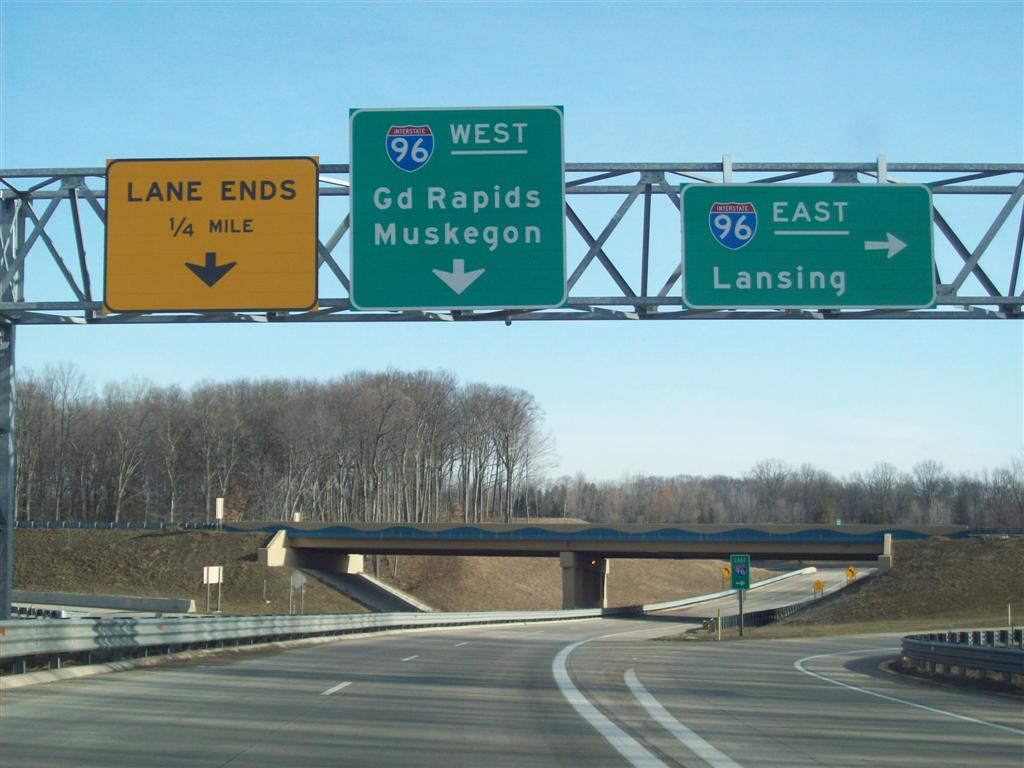
From 2003 to 2005, the Beck Road interchange (exit 160) in Novi was reconstructed as a single point urban interchange (SPUI), the first in the metropolitan Detroit area and the first on I-96. An interchange between 36th Street and I-96 was built starting in 2005 and was completed in 2006. The project aimed to improve access to the Gerald R. Ford International Airport southeast of Grand Rapids. The reconstruction of the Wixom Road interchange near Novi as a SPUI was completed in late fall of 2008. Another interchange at Latson Road in Howell was approved for construction on July 19, 2012. This interchange was designed to bring improved access to the eastern Howell area, which prior to construction of the Latson Road exit was only accessible from westbound I-96. The project was completed on December 2, 2013.
On April 5, 2014, MDOT closed I-96 between Newburgh Road and US 24 (Telegraph Road). The project was estimated to cost $148 million (equivalent to $ in ), and would rebuild the 7 mi of roadway, replace two bridges, and repair 32 other bridges. The department also planned to install new drainage and replace the signs along I-96. The project was expected to be completed in October 2014. Instead, it was finished ahead of schedule, and that segment of I-96 was re-opened on September 21, 2014.
Also in 2015, work began on bypassing the 1960s interchange with US 23 near Brighton. A new set of through lanes was built on I-96 between the previous eastbound and westbound lanes with three new bridges over northbound and southbound US 23, and Old US 23. The existing lanes of I-96 were changed to be collector-distributor lanes for ramp traffic. This project was completed in November 2016.
MDOT started work to add a flex route on I-96 between Kent Lake Road and the I-275/I-696/M-5 interchange in Novi on March 21, 2022. Under this plan, the shoulders of the highway will be available as extra lanes during peak traffic periods, and indicated with overhead light systems. In addition, ramp meters will be installed at ramps onto the freeway. The construction was completed in October 2024, but the flex route was not operational until March 19, 2025.
Gateway Project
Beginning on February 25, 2008, MDOT and the Detroit International Bridge Company initiated the Ambassador Gateway Project at the eastern end of I-96. The adjacent section of I-75 closed completely to traffic in both directions to start the complete reconstruction of the road to better connect I-75 and I-96 to the Ambassador Bridge, and the plans included the reconstruction of a mile (1.6 km) of I-96. That segment of I-96 closed on July 14, 2008, and it was scheduled to reopen a month early the following September. The overall project to realign ramps and connect the bridge to the freeways was mired in lawsuits between MDOT and the private company that owns the bridge. The company's owner was jailed for contempt of court during court proceedings in early 2012. MDOT was later ordered to assume responsibility for construction, and the department completed the project on September 21, 2012.
Incidents
On January 12, 2005, a large multiple-vehicle collision consisting of over 200 motor vehicles occurred on both directions of I-96 near Williamston in Ingham County. Two people were killed in the incident. It was one of the largest collisions in US history and was blamed on heavy fog.
In October 2012, reports of a sniper shooting cars along I-96 in four counties led to a federal investigation and a multi-jurisdictional task force of 100 law enforcement officials. As of October 30, 2012, 25 shootings had been linked to one suspect. The Federal Bureau of Investigation, the Bureau of Alcohol, Tobacco, Firearms and Explosives, and Crime Stoppers offered a $102,000 (equivalent to $ in ) reward for information leading to the arrest of the perpetrator. The suspect, Raulie Casteel of Wixom, was arrested on November 5, 2012, and ordered to stand trial in 2013 in Oakland County for 60 charges in one case, with a second trial on terrorism and murder charges to be brought by the Michigan Attorney General. On October 30, 2013, the suspect pleaded no contest, but mentally ill, in the Oakland County case, and he was sentenced to serve anywhere from six years and eight months to 10 years in prison on multiple assault charges (as well as two concurrent years on weapons charges) for that case on February 4, 2014. The trial for the Livingston County case began on January 14, 2014, and after being convicted on the terrorism charge, Casteel was sentenced to 16 to 40 years in state prison.
Exit list
M L King Jr. Boulevard
Notes
References
References
- Bureau of Transportation Planning. (2008). "Traffic Monitoring Information System". Michigan Department of Transportation.
- Michigan Department of Transportation. (April 23, 2006). "National Highway System, Michigan". Michigan Department of Transportation.
- (September 26, 2012). "What is the National Highway System?". [[Federal Highway Administration]].
- [[Michigan Legislature]]. (2001). "Rosa Parks Memorial Highway". State of Michigan.
- Staff Writer. (August 15, 2011). "The Story of the 13 Weatherball". [[WZZM-TV]].
- {{cite MDOT map. (2012)
- "Overview Map of Interstate 96".
- (2012)
- Adderly, Kevin. (May 23, 2017). "Table 2: Auxiliary Routes of the Dwight D. Eisenhower National System of Interstate and Defense Highways as of December 31, 2016". Federal Highway Administration.
- [[Rand McNally]]. (2013). "The Road Atlas". Rand McNally.
- Woodard, Sadie G.. (1966). "Grand River Road: A Traveler's View of a Historic Route that Traversed Early Michigan". Plane Tree Press.
- [[Wayne County Department of Public Services]]. "Part I: An Indian Trail". Wayne County Department of Public Services.
- Wayne County Department of Public Services. "Part II: A Military Road". Wayne County Department of Public Services.
- Michigan Legislature. (1915). "The Compiled Laws of the State of Michigan". Wynkoop, Hallenbeck, Crawford.
- (September 20, 1919). "Michigan May Do Well Following Wisconsin's Road Marking System". [[The Grand Rapids Press]].
- {{cite MDOT map. (1919-07-01L)
- Barnett, LeRoy. (2004). "A Drive Down Memory Lane: The Named State and Federal Highways of Michigan". Priscilla Press.
- (November 11, 1926). "United States System of Highways Adopted for Uniform Marking by the American Association of State Highway Officials". [[United States Geological Survey]].
- [[Public Roads Administration]]. (c. 1943). "Routes of the Recommended Interregional Highway System". Public Roads Administration.
- Public Roads Administration. (August 2, 1947). "National System of Interstate Highways". Public Roads Administration.
- [[American Association of State Highway Officials]]. (August 14, 1957). "Official Route Numbering for the National System of Interstate and Defense Highways". American Association of State Highway Officials.
- Michigan State Highway Department. (April 25, 1958). "Recommended Numbering: Interstate Highways in Michigan". Michigan State Highway Department.
- American Association of State Highway Officials. (June 27, 1958). "Official Route Numbering for the National System of Interstate and Defense Highways". American Association of State Highway Officials.
- (January 8, 1959). "Spring to Bring Debut for Interstate Road Numbering". [[The Herald-Palladium.
- (June 30, 1956). "Road Plans Revised". The Holland Evening Sentinel.
- Kelley, Frank E.. (June 29, 2006). "Meeting Minutes". [[Michigan State Transportation Commission]].
- (December 6, 1957). "Expressway to Be Opened by Dec. 13". [[Ironwood Daily Globe]].
- (February 25, 1959). "New Highway Signs". [[Holland Sentinel.
- (December 13, 1962). ["Michigan Freeway Hits 1,000th Mile ). [[The Milwaukee Sentinel]].
- (April 14, 1962). "Drop US 16 Designation". The Holland Evening Sentinel.
- {{cite MDOT map. (1964)
- (August 24, 1963). "Muskegon Freeway Link Number Change Sought". The Holland Evening Sentinel.
- (October 23, 1963). "New Numbers Seen for Road". The Holland Evening Sentinel.
- (December 12, 1963). "Route Number Changes Slated". [[Lansing State Journal]].
- (October 28, 1964). "Lodge Road to be Opened". The Holland Evening Sentinel.
- (1980). "Making Michigan Move: A History of Michigan Highways and the Michigan Department of Transportation". Michigan Department of Transportation.
- Andrews, W. Earle.. (1945). "Detroit Expressway and Transit System". Detroit Transportation Board.
- (January 18, 1999). "Detroit Will Stay Accessible During I-75 Shutdown". [[The Detroit News]].
- Malo, Alger F.. (January 1961). "The Relation of Mass Transportation to Total Transportation in Detroit". [[Eno Foundation.
- Bureau of Public Roads. (September 1955). "General Location of National System of Interstate Highways Including All Additional Routes at Urban Areas Designated in September 1955". US Government Printing Office.
- Michigan State Highway Department. (1964). "I-96 Freeway Planning and Route Location Study, City of Detroit". Michigan State Highway Department.
- {{cite MDOT map. (1970)
- {{cite MDOT map. (1971)
- Barnett, LeRoy. (2004). "A Drive Down Memory Lane: The Named State and Federal Highways of Michigan". Priscilla Press.
- {{cite MDOT map. (1973)
- {{cite MDOT map. (1974)
- Milliken, William. (1975). "Economic Report of the Governor". [[Governor of Michigan.
- The I-96 designation was assigned along the I-275 freeway south to the Jeffries Freeway, and eastward along the new freeway to the M-39 interchange; the remaining stub of I-96 around Farmington was redesignated as an extension of [[M-102 (Michigan highway). M-102]] (now [[M-5 (Michigan highway). (1977)
- {{cite MDOT map. (1978)
- {{cite MDOT map. (1984)
- {{cite MDOT map. (1985)
- {{cite MDOT map. (1986)
- {{cite MDOT map. (1987)
- (January 14, 2002). "US 27 Designation Soon to Be Deleted from Michigan Highways". Michigan Department of Transportation.
- Kalousdian, Aram. (August 7, 2004). "Single Point Interchange Under Construction". Reed Business Information.
- Bloemendaal, Dirk C.. (September 2, 2006). "Interchange Improves Traffic Flow". Reed Business Information.
- Kalousdian, Aram. (November 3, 2008). "Wixom/I-96 Interchange Reconstructed". Reed Business Information.
- Greenwood, Tom. (July 19, 2012). "$32M Interchange Project OK'd for I-96 in Livingston County". The Detroit News.
- (October 30, 2015). "M-231 Is Now Open for Traffic". [[WXMI-TV]].
- Abdel-Razzaq, Lauren. (April 5, 2014). "The Driving Challenge Begins with I-96 Closure". The Detroit News.
- Walker, Marlon A.. (September 21, 2014). "Yay! I-96 Is Back in the Traffic Business". Detroit Free Press.
- Peal, Wayne. (February 25, 2015). "I-96/US 23 Interchange Work Set to Begin". Detroit Free Press.
- Knake, Lindsay. (November 4, 2016). "I-96, US 23 Interchange Project Complete After Two Years". Booth Newspapers.
- Michigan Department of Transportation. (August 30, 2021). "I-96 Flex Route Flex Lane". Michigan Department of Transportation.
- (October 31, 2024). "I-96 Flex Route: How it works and when it opens". MLive.
- Marshall, Ryan. (March 19, 2025). "Flex Route System Takes Effect Today on I-96 in Oakland County". [[WXYZ-TV]].
- (February 26, 2008). "Motorists Maneuver Through Gateway Project Maze". The Detroit News.
- (July 14, 2008). "I-96 Closes from I-94 to Rosa Parks". The Detroit News.
- Greenwood, Tom. (September 6, 2008). "Closed Stretch of I-96 near Ambassador Bridge Reopens Early". The Detroit News.
- (January 12, 2012). "Mich. Billionaire, 84, Jailed over Bridge Dispute". [[USA Today]].
- Wattrick, Jeff T.. (March 16, 2012). "MDOT Launches 'Getting Gateway to the Finish Line' Social Campaign". Booth Newspapers.
- Muller, David. (September 20, 2012). "Detroit Neighborhoods to See Less Truck Traffic as $230 million Gateway Plaza Opens". Booth Newspapers.
- Phillips, Lauren. (January 20, 2005). "Police Continue Investigation of Massive I-96 Accident". The State News.
- Dolan, Matthew. (October 30, 2012). "Drivers Fear Sniper May Prowl Michigan Highway". [[The Wall Street Journal]].
- Web Staff. (October 29, 2012). "$102,000 Reward for Information Leading to I-96 Area Shooter". [[WXYZ-TV]].
- Dougovito, Lori. (November 6, 2012). "Task Force Confirms Suspect Arrested in Highway Shootings". [[WJRT-TV]].
- Turk, John. (May 30, 2013). "Jury Trial for Accused I-96 Corridor Shooter Postponed 5 Months". [[The Oakland Press]].
- (May 31, 2013). "I-96 Shooter Suspect's Trial Is in Nov.". [[WOOD-TV]].
- AlHajal, Khalil. (October 30, 2013). "Suspect in I-96 Shooting Spree Pleads No Contest to Some Charges, Still Faces Terrorism Trial". The Grand Rapids Press.
- Williams, Corey. (February 4, 2013). "Mich. Highway Shooter Gets More than 6½ Years". MSN News.
- (March 3, 2014). "Convicted I-96 Shooter Raulie Casteel Sentenced to 16 to 40 years in Prison for Terrorism". WXYZ-TV.
- {{cite MDOT PRFA
- Anderson, Michelle D.. (November 15, 2013). "M-231 Project Update: MDOT Opens Nearly All Lanes and Ramps at New I-96 Interchange". [[Booth Newspapers]].
- Behnan, Christopher. (December 2, 2013). "Long-Awaited Latson Road Interchange Ready to Roll". [[Livingston County Daily Press & Argus]].
- {{cite MDOT map. (1985)
- Michigan Department of Transportation. (October 31, 2007). "Contract Number 103107". Michigan Department of Transportation.
- (2019T)


This article was imported from Wikipedia and is available under the Creative Commons Attribution-ShareAlike 4.0 License. Content has been adapted to SurfDoc format. Original contributors can be found on the article history page.
Ask Mako anything about Interstate 96 — get instant answers, deeper analysis, and related topics.
Research with MakoFree with your Surf account
Create a free account to save articles, ask Mako questions, and organize your research.
Sign up freeThis content may have been generated or modified by AI. CloudSurf Software LLC is not responsible for the accuracy, completeness, or reliability of AI-generated content. Always verify important information from primary sources.
Report