From Surf Wiki (app.surf) — the open knowledge base
International trade
Exchange across international borders

Exchange across international borders
International trade is the exchange of capital, goods, and services across international borders or territories because there is a need or want of goods or services.
In most countries, such trade represents a significant share of gross domestic product (GDP). While international trade has existed throughout history (for example Uttarapatha, Silk Road, Amber Road, salt roads), its economic, social, and political importance has been on the rise in recent centuries.
Carrying out trade at an international level is a complex process when compared to domestic trade. When trade takes place between two or more states, factors like currency, government policies, economy, judicial system, laws, and markets influence trade.
To ease and justify the process of trade between countries of different economic standing in the modern era, some international economic organizations were formed, such as the World Trade Organization. These organizations work towards the facilitation and growth of international trade. Statistical services of intergovernmental and supranational organizations and governmental statistical agencies publish official statistics on international trade.
Characteristics of global trade
A product that is transferred or sold from a party in one country to a party in another country is an export from the originating country, and an import to the country receiving that product. Imports and exports are accounted for in a country's current account in the balance of payments.
Trading globally may give consumers and countries the opportunity to be exposed to new markets and products. Almost every kind of product can be found in the international market, for example: food, clothes, spare parts, oil, jewellery, wine, stocks, currencies, and water. Services are also traded, such as in tourism, banking, consulting, and transportation.
Advanced technology (including transportation), globalization, industrialization, outsourcing and multinational corporations have major impacts on the international trade systems.
Differences from domestic trade
_with_view_to_Newark_Bay_-_panoramio.jpg)
International trade is, in principle, not different from domestic trade as the motivation and the behavior of parties involved in a trade do not change fundamentally regardless of whether trade is across a border or not.
However, in practical terms, carrying out trade at an international level is typically a more complex process than domestic trade. The main difference is that international trade is typically more costly than domestic trade. This is due to the fact that cross-border trade typically incurs additional costs such as explicit tariffs as well as explicit or implicit non-tariff barriers such as time costs (due to border delays), language and cultural differences, product safety, the legal system, and so on.
Another difference between domestic and international trade is that factors of production such as capital and labor are often more mobile within a country than across countries. Thus, international trade is mostly restricted to trade in goods and services, and only to a lesser extent to trade in capital, labour, or other factors of production. Trade in goods and services can serve as a substitute for trade in factors of production. Instead of importing a factor of production, a country can import goods that make intensive use of that factor of production and thus embody it. An example of this is the import of labor-intensive goods by the United States from China. Instead of importing Chinese labor, the United States imports goods that were produced with Chinese labor. One report in 2010, suggested that international trade was increased when a country hosted a network of immigrants, but the trade effect was weakened when the immigrants became assimilated into their new country.{{cite news
History
Main article: Timeline of international trade
The history of international trade chronicles notable events that have affected trading among various economies.
Theories and models
Main article: International trade theory
There are several models that seek to explain the factors behind international trade, the welfare consequences of trade and the pattern of trade.
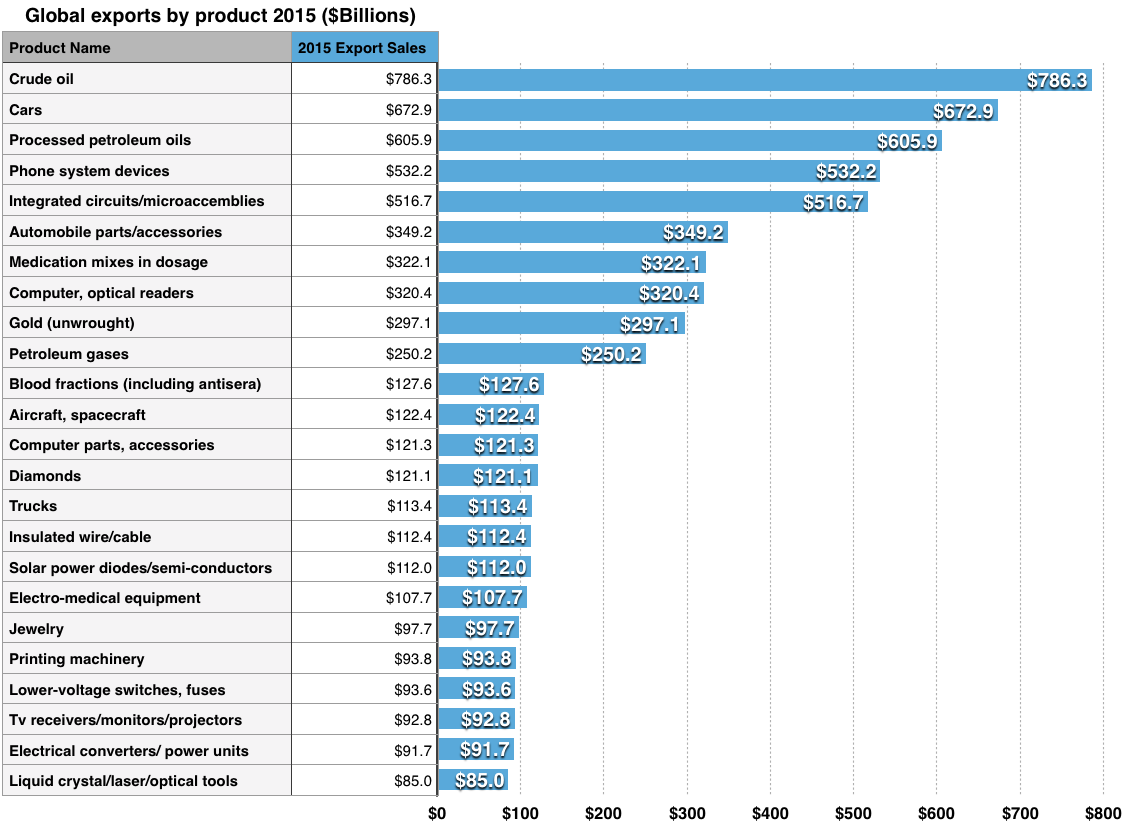
Most traded export products
Largest countries or regions by total international trade
Main article: List of countries by exports, List of countries by imports

The following table is a list of the 30 largest trading states according to the World Trade Organization in 2024.
| Rank | State | Goods | Services | Goods and |
|---|---|---|---|---|
| services | ||||
| – | *World* | 49,177,769 | 16,930,782 | 66,108,551 |
| – | European Union | 5,429,683 | 3,156,243 | 8,585,926 |
| 1 | United States | 5,424,499 | 1,993,624 | 7,418,123 |
| 2 | China | 6,163,999 | 1,056,457 | 7,220,456 |
| 3 | Germany | 3,107,433 | 1,023,755 | 4,131,188 |
| 4 | United Kingdom | 1,328,813 | 1,050,548 | 2,379,361 |
| 5 | Netherlands | 1,732,989 | 640,644 | 2,373,633 |
| 6 | France | 1,390,477 | 740,560 | 2,131,037 |
| 7 | Japan | 1,449,636 | 474,705 | 1,924,341 |
| 8 | India | 1,144,196 | 644,197 | 1,788,393 |
| 9 | Singapore | 964,344 | 746,688 | 1,711,032 |
| 10 | South Korea | 1,315,376 | 301,607 | 1,616,983 |
| 11 | Italy | 1,289,671 | 318,022 | 1,607,693 |
| 12 | Hong Kong | 1,349,678 | 199,642 | 1,549,320 |
| 13 | Canada | 1,141,276 | 319,173 | 1,460,449 |
| 14 | United Arab Emirates | 1,142,066 | 283,962 | 1,426,028 |
| 15 | Mexico | 1,261,074 | 125,087 | 1,386,161 |
| 16 | Ireland | 383,054 | 986,640 | 1,369,694 |
| 17 | Belgium | 1,048,406 | 307,233 | 1,355,639 |
| 18 | Spain | 896,146 | 331,898 | 1,228,044 |
| 19 | Switzerland | 816,072 | 394,410 | 1,210,482 |
| 20 | Taiwan | 875,482 | 129,912 | 1,005,394 |
| 21 | Poland | 759,378 | 193,934 | 953,312 |
| 22 | Vietnam | 782,268 | 60,044 | 842,312 |
| 23 | Russia | 711,706 | 121,512 | 833,218 |
| 24 | Australia | 637,759 | 192,015 | 829,744 |
| 25 | Turkey | 605,875 | 168,506 | 774,381 |
| 26 | Brazil | 615,000 | 151,513 | 766,513 |
| 27 | Thailand | 607,339 | 145,786 | 753,125 |
| 28 | Malaysia | 630,781 | 109,773 | 740,554 |
| 29 | Saudi Arabia | 537,338 | 156,942 | 694,280 |
| 30 | Sweden | 382,556 | 241,841 | 624,397 |
Top traded commodities by value (exports)
| Rank | Commodity | Value in US$ | |
|---|---|---|---|
| (millions) | Date of | ||
| information | |||
| 1 | Mineral fuels, oils, distillation products | 3,988,389 | 2022 |
| 2 | Electrical, electronic equipment | 3,493,553 | 2022 |
| 3 | Machinery, nuclear reactors, boilers, etc. | 2,573,572 | 2022 |
| 4 | Vehicles (excluding railway) | 1,621,658 | 2022 |
| 5 | Pharmaceutical products | 875,345 | 2022 |
| 6 | Pearls, precious stones, metals, coins, etc. | 866,839 | 2022 |
| 7 | Plastics and articles thereof | 815,554 | 2022 |
| 8 | Optical, photo, technical, medical, etc. apparatus | 669,128 | 2022 |
| 9 | Iron and steel | 564,547 | 2022 |
| 10 | Organic chemicals | 537,854 | 2022 |
Source: International Trade Centre
Observances
In the US, starting in 1935, the various U.S. presidents have held "World Trade Week" observances to promote large and small companies to be more involved with the export and import of goods and services. This tradition was preceded by a local observance of "Foreign Trade Week" by the Los Angeles Area Chamber of Commerce that originated in 1927 as an expansion of United States National Maritime Day.
Every year the President declares the third week of May to be World Trade Week.
- President George W. Bush observed World Trade Week on May 18, 2001 and May 17, 2002.
- On May 13, 2016, President Barack Obama proclaimed May 15–21, 2016 as World Trade Week.
- On May 19, 2017, President Donald Trump proclaimed May 21–27, 2017 as World Trade Week.
International trade vs local production
Food security
Main article: Food security
The trade-offs between local food production and distant food production are controversial, with limited studies comparing environmental impact and scientists cautioning that regionally specific environmental impacts should be considered. A 2020 study indicated that local food crop production alone cannot meet the demand for most food crops with "current production and consumption patterns" and the locations of food production at the time of the study for 72–89% of the global population and 100 km radiuses as of early 2020. Studies found that food miles are a relatively minor factor for carbon emissions, albeit increased food localization may also enable additional, more significant, environmental benefits such as recycling of energy, water, and nutrients. For specific foods regional differences in harvest seasons may make it more environmentally friendly to import from distant regions than more local production and storage or local production in greenhouses.
Qualitative differences and economic aspects
Qualitative differences between substitutive products of different production regions may exist due to different legal requirements and quality standards or different levels of controllability by local production- and governance-systems which may have aspects of security beyond resource security, environmental protection, product quality and product design and health. The process of transforming supply as well as labor rights may differ as well.
Local production has been reported to increase local employment in many cases. A 2018 study claimed that international trade can increase local employment. A 2016 study found that local employment and total labor income in both manufacturing and nonmanufacturing were negatively affected by rising exposure to imports.
Local production in high-income countries, rather than distant regions may require higher wages for workers. Higher wages incentivize automation which could allow for automated workers' time to be reallocated by society and its economic mechanisms or be converted into leisure-like time.
Specialization, production efficiency and regional differences
Local production may require knowledge transfer, technology transfer and may not be able to compete in efficiency initially with specialized, established industries and businesses, or in consumer demand without policy measures such as eco-tariffs. Regional differences may cause specific regions to be more suitable for a specific production, thereby increasing the advantages of specific trade over specific local production. Forms of local products that are highly localized may not be able to meet the efficiency of more large-scale, highly consolidated production in terms of efficiency, including environmental impact.
Resource security
A systematic, and possibly first large-scale, cross-sectoral analysis of water, energy and land in security in 189 countries that links total and sectorial consumption to sources showed that countries and sectors are highly exposed to over-exploited, insecure, and degraded such resources with economic globalization having decreased security of global supply chains. The 2020 study finds that most countries exhibit greater exposure to resource risks via international trade – mainly from remote production sources – and that diversifying trading partners is unlikely to help countries and sectors to reduce these or to improve their resource self-sufficiency.
Illicit trade
Illegal gold trade
A number of people in Africa, including children, were using informal or "artisanal" methods to produce gold. While millions were making a livelihood through this small-scale mining, governments of Ghana, Tanzania and Zambia complained about the increase in illegal production and gold smuggling. Sometimes the procedure involved criminal operations and even human and environmental cost. Investigative reports based on Africa's export data revealed that gold in large quantities is smuggled out of the country through the United Arab Emirates, without any taxes being paid to the producing states. Analysis also reflected discrepancies in the amount exported from Africa and the total gold imported into the UAE.
In July 2020, a report by Swissaid highlighted that the Dubai-based precious metal refining firms, including Kaloti Jewellery International Group and Trust One Financial Services (T1FS), received most of their gold from poor African states like Sudan. The gold mines in Sudan were seldom under the militias involved in war crimes and human rights abuses. The Swissaid report also highlighted that the illicit gold coming into Dubai from Africa is imported in large quantities by the world's largest refinery in Switzerland, Valcambi.
Another report in March 2022 revealed the contradiction between the lucrative gold trade of West African countries and the illicit dealings. Like Sudan, Democratic Republic of Congo (DRC), Ghana and other states, discrepancies were recorded between the gold production in Mali and its trade with Dubai, UAE. The third largest gold exporter in Africa, Mali imposed taxes only on the first 50 kg of gold exports per month, which allowed several small-scale miners to enjoy tax exemptions and smuggle gold worth millions. In 2014, Mali's gold production was 45.8 tonnes, while the UAE's gold imports were 59.9 tonnes.
Statistics
- List of countries by imports
- List of countries by exports
- List of countries by merchandise exports
- List of countries by service exports and imports
- List of top exporting countries by product category
- List of countries by exports per capita
- List of countries by leading trade partners
- List of countries by net goods exports (Balance of trade)
- List of sovereign states by current account balance
- List of countries by tariff rate
References
Sources
References
- "Trade – Define Trade at Dictionary.com". Dictionary.com.
- "International Trade and Finance by ICC Academy".
- (2003-11-25). "Balance Of Payments (BOP)". Investopedia.
- "WTO Stats". World Trade Organization.
- "WTO Stats". World Trade Organization.
- "List of exporters for the selected product in 2022".
- "Import Export Data".
- "World Trade Week New York".
- (May 22, 2001). "World Trade Week, 2001". [[Federal Government of the United States]].
- (May 22, 2002). "World Trade Week, 2002". [[Federal Government of the United States]].
- (May 13, 2016). "Presidential Proclamation -- World Trade Week, 2016". [[whitehouse.gov]].
- (May 19, 2017). "President Donald J. Trump Proclaims May 21 through May 27, 2017, as World Trade Week". [[White House]].
- . (May 20, 2017). ["President Donald J. Trump Proclaims May 21 through May 27, 2017, as World Trade Week"](https://article.wn.com/view/2017/05/20/President_Donald_J_Trump_Proclaims_May_21_through_May_27_201_z/). *World News Inc.*.
- (15 February 2016). "Environmental performance of local food: trade-offs and implications for climate resilience in a developed city". Journal of Cleaner Production.
- (28 April 2020). "Majority of the world's population depends on imported food". European Scientist.
- "Relying on 'local food' is a distant dream for most of the world". phys.org.
- (April 2020). "Local food crop production can fulfil demand for less than one-third of the population". Nature Food.
- (1 March 2017). "Improving attributional life cycle assessment for decision support: The case of local food in sustainable design". Journal of Cleaner Production.
- (2010). "Does eating local food reduce the environmental impact of food production and enhance consumer health?". Proceedings of the Nutrition Society.
- (13 August 2018). "Re-examining the Effects of Trading with China on Local Labor Markets: A Supply Chain Perspective". National Bureau of Economic Research.
- (2017). "The Impact of Chinese Import Competition on the Local Structure of Employment and Wages: Evidence from France". Journal of Regional Science.
- (2 December 2020). "How Artificial Intelligence Could Widen the Gap Between Rich and Poor Nations".
- (26 October 2020). "Global trade linked to resource insecurity". Cosmos Magazine.
- (20 November 2020). "Is globalisation compatible with sustainable and resilient supply chains?". European Scientist.
- "Globalized economy making water, energy and land insecurity worse: study".
- (28 October 2020). "Water, energy and land insecurity in global supply chains". Global Environmental Change.
- (April 24, 2019). "Gold worth billions smuggled out of Africa".
- (16 July 2020). "L'or douteux de Dubaï est prisé en Suisse".
- (July 2020). "GOLDEN DETOUR: The hidden face of the gold trade between the United Arab Emirates and Switzerland".
- (11 March 2022). "Mali: West Africa's hub for illegal gold trade with Dubai".
- (3 August 2022). "Mali to Dubai: artery for West Africa's booming illegal gold trade".
This article was imported from Wikipedia and is available under the Creative Commons Attribution-ShareAlike 4.0 License. Content has been adapted to SurfDoc format. Original contributors can be found on the article history page.
Ask Mako anything about International trade — get instant answers, deeper analysis, and related topics.
Research with MakoFree with your Surf account
Create a free account to save articles, ask Mako questions, and organize your research.
Sign up freeThis content may have been generated or modified by AI. CloudSurf Software LLC is not responsible for the accuracy, completeness, or reliability of AI-generated content. Always verify important information from primary sources.
Report