From Surf Wiki (app.surf) — the open knowledge base
International Federation of Library Associations and Institutions
Organization of libraries
Organization of libraries
| Field | Value |
|---|---|
| name | International Federation of Library Associations and Institutions (IFLA) |
| image | IFLA org logo.svg |
| established | |
| leader_title | President |
| leader_name | Leslie Weir |
| leader_title2 | Secretary General |
| leader_name2 | Sharon Memis |
| location | Prins Willem-Alexanderhof 5, The Hague, Netherlands |
| type | International nongovernmental organization |
| website |
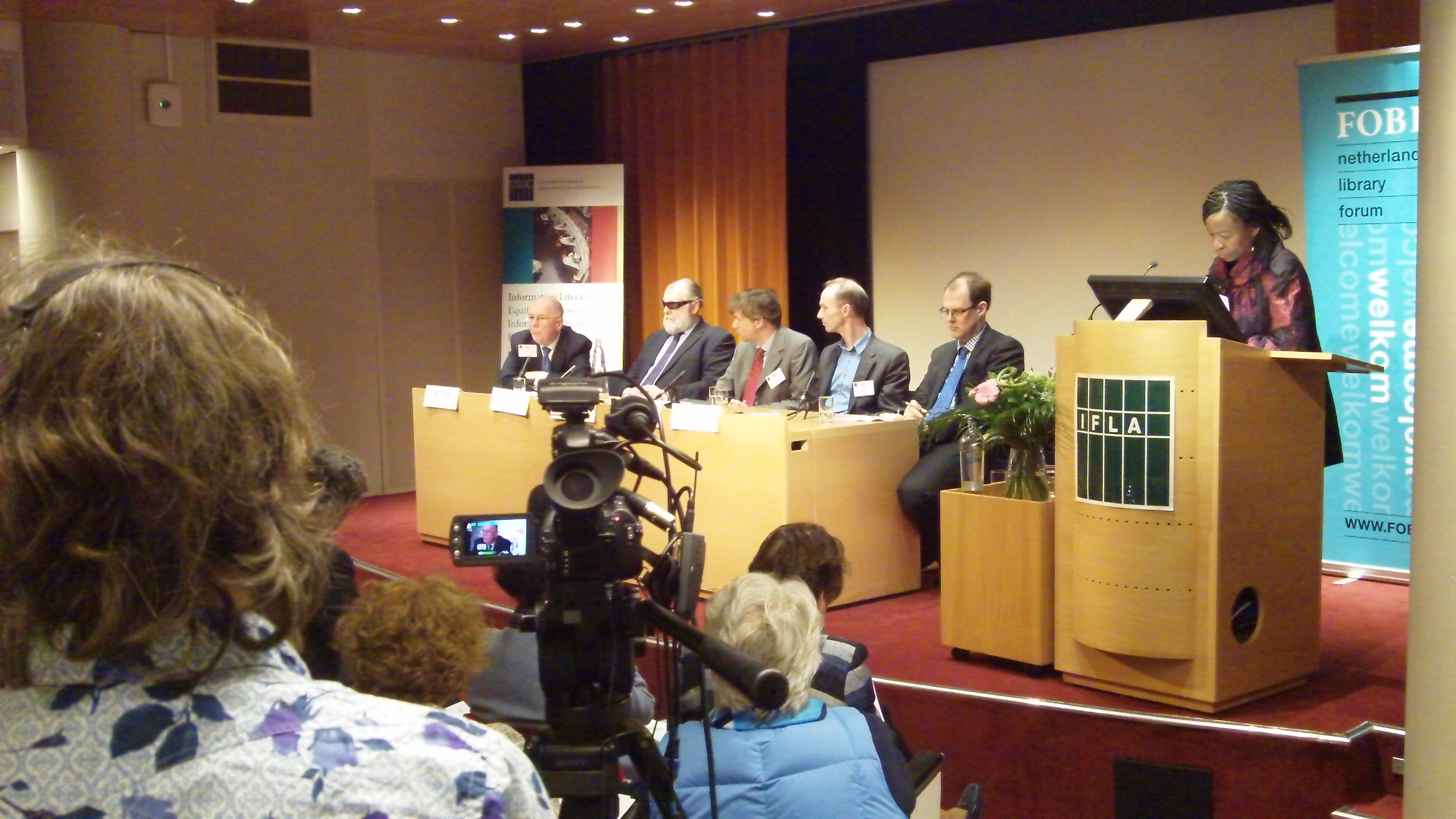
The International Federation of Library Associations and Institutions (IFLA) is an international body that represents the interests of library users and information professionals. Founded in Scotland in 1927, IFLA operates as a non-governmental, not-for-profit organization with its headquarters located at the National Library of the Netherlands in The Hague.
IFLA sponsors the annual IFLA World Library and Information Congress, an event dedicated to promoting access to information, ideas, and works of imagination. This initiative is centered on the tenets of social, educational, cultural, democratic, and economic empowerment. IFLA also produces several publications, including the peer-reviewed IFLA Journal, which disseminates research and best practices in the field of library and information science.
IFLA partners with UNESCO, resulting in several jointly produced manifestos. IFLA is also a founding member of Blue Shield, which works to protect the world's cultural heritage when threatened by wars and natural disasters.
History
IFLA was founded in Edinburgh, Scotland, on 30 September 1927, when library associations from 14 European countries and the United States signed a resolution at the celebration of the 50th anniversary of the Library Association of the United Kingdom. Isak Collijn, head of the National Library of Sweden, was elected the first president. The first constitution was approved in Rome in 1929 during the World Congress of Librarianship and Bibliography.
During the 1930s the first library associations from outside Europe and the US joined: China, India, Japan, Mexico and the Philippines. By 1958 membership had grown to 64 associations from 42 countries. A permanent secretariat was established in 1962. By 1970 there were 250 members from 52 countries. The secretariat was moved to The Hague in 1971. By 1974 IFLA membership stood at 600 members in 100 countries.
Membership criteria were expanded beyond library associations in 1976 to include institutions, i.e. libraries, library schools and bibliographic institutes. At this time, the word Institutions was added to the organisation's name. Since then further new categories of membership have been created, including personal affiliates.
IFLA has now grown to over 1,700 members in approximately 155 countries. It is headquartered in the Koninklijke Bibliotheek, the National Library of the Netherlands, in The Hague.
In 2021 for the first time, IFLA held World Library and Information Congress (WLIC) online because of the continuing global pandemic.
IFLA's objectives are:
- To represent librarianship in matters of international interest
- To promote the continuing education of library personnel
- To develop, maintain and promote guidelines for library services
IFLA Secretaries General
| Name | Tenure |
|---|---|
| Sharon Memis | 2023–present |
| Helen Mandl | 2021–2023 (Acting) |
| Gerald Leitner | 2016–2021 |
| Jennefer Nicholson | 2008–2016 |
| Peter Lor | 2005–2008 |
| Rasu Ramachandran | 2004–2005 |
| Ross Shimmon | 1999–2004 |
| Leo Voogt | 1992–1998 |
| Paul Nauta | 1987–1992 |
| Margreet Wijnstroom | 1971–1987 |
| Anthony Thompson | 1962–1970 |
| Maria Razumovsky | 1962 (Interim) |
| Joachim Wieder | 1958–1962 |
| Tietse Pieter Sevensma | 1929–1958 |
| Heinrich Uhlendahl | 1928–1929 |
Divisions
More than 60 sections, strategic programmes, and special interest groups are organized in five divisions to carry out a variety of IFLA's activities and programs.
These divisions are:
- Library Types (Division I) - includes sections focused on academic, research, public, special, and school libraries; a strategic programme for Committee on Standards; and special interest groups, including Evidence for Global and Disaster Health (E4GDH) group.
- Library Collections (Division II) - includes sections on acquisitions and collection development, rare books and special collections, and news media; strategic programmes on Preservation and Conservation (PAC) and the Committee on Standards; and special interest groups on LGBTQ users and on library publishing.
- Library Services (Division III) - includes sections on Bibliography, Cataloguing, and Indigenous Matters; strategic programmes on UNIMARC and the Committee on Standards; and special interest groups on big data and Digital Humanities.
- Support of the Profession (Division IV) - includes sections on library buildings and equipment, theory and research, and statistics and evaluation; strategic programmes for the Committee on Freedom of Access to Information and Freedom of Expression (FAIFE), Committee on Copyright and other Legal Matters (CLM), and the Committee on Standards; and special interest groups including Women, Information and Libraries Special Interest Group and LIS Education in Developing Countries.
- Regions (Division V) - includes sections on Africa, Asia and Oceania, Latin America and the Caribbean; strategic programmes for the Library Development Programme (LDP) and the Committee on Standards; and special interest group for Access to Information Network – Africa (ATINA).
Strategic programmes
IFLA operates six strategic programmes:
- Committee on Standards
- Copyright and other Legal Matters (CLM) Advisory Committee
- Freedom of Access to Information and Freedom of Expression (FAIFE) Advisory Committee
- Library Development Programme (LDP)
- Strategic Programme on Preservation and Conservation (PAC)
- UNIMARC Strategic Programme.
Committee on Copyright and other Legal Matters (CLM)
Copyright and intellectual property issues and laws have long been recognized important to the library profession. A volunteer-driven committee, the CLM was created to advise and represent IFLA on matters of international copyright law.
The CLM produces legal briefs and is the representative for IFLA at meetings of the World Intellectual Property Organization (WIPO). The CLM's activities for the WIPO involve:
- Copyright limitations and exceptions for libraries and archives
- Copyright limitations and exceptions for visually impaired persons
- Relations with WIPO Secretariat
- Opposition to the Broadcast Treaty at WIPO
- Development Agenda at WIPO
- Preservation of Traditional Knowledge at WIPO
Committee on Free Access to Information and Freedom of Expression (FAIFE)
A core activity of IFLA is the Committee on Free Access to Information and Freedom of Expression, which monitors the state of intellectual freedom within the library community worldwide, supports IFLA policy development and co-operation with other international human rights organisations, and responds to violations of free access to information and freedom of expression. FAIFE provides guidance and leadership on issues of intellectual freedom around the world through the publication of annual reports, guidelines, manifestos, special reports, and statements.
In 2022, the 25th anniversary of the establishment of IFLA's Committee on Free Access to Information and Freedom of Expression, the landmark IFLA Statement on Libraries and Intellectual Freedom was the focus of a special issue of the IFLA Journal
IFLA/FAIFE is a member of the International Freedom of Expression Exchange, a global network of non-governmental organisations that monitors freedom of expression worldwide. It is also a member of the Tunisia Monitoring Group, a coalition of 16 free expression organisations that lobbies the Tunisian government to improve its human rights record.
Library Development Program (LDP)
Launched in 1984 and initially known as Advancement of Librarianship in the Third World, the programme has supported capacity building through a series of small grants and projects in developing and transition countries and advocacy for access to information. This program focuses predominantly on three main programs:
- Building Strong Library Associations Programme
- International Advocacy Programme (IAP), focusing on advocacy for the role of access to information and libraries in the UN 2030 Agenda for Sustainable Development
- International Leader's Programme.
Strategic Programme on Preservation and Conservation (PAC)
Established in 1984, The Strategic Programme on Preservation and Conservation (PAC) was established in 1984. It focuses on efforts to preserve library and archive materials, in any form, around the world. Unlike other IFLA Strategic Programmes, PAC features a decentralised approach, with global strategies implemented by a Focal Point and activities managed by Regional Centres.
PAC aims to ensure that both published and unpublished library and archive materials are preserved in an accessible form. In doing so, the programme follows three main guiding principles:
- preservation is essential to the survival and development of culture and scholarship;
- international cooperation is a key principle;
- each country must accept responsibility for the preservation of its own publications.
IFLA Trend Report
The first IFLA Trend Report, "Caught in the waves or caught in the tide? Insights from the IFLA Trend Report", was launched at the World Library and Information Congress in Singapore on 19 August 2013. The IFLA Trend Report resulted in the identification of emerging high-level societal trends which may affect the global information environment. The Trend Report consists of a number of documents—including an overview, annotated bibliography and research papers—and is also intended as a web platform for ongoing consultation. In the first stage of the review from November 2012 through 2013, "social scientists, economists, business leaders, education specialists, legal experts and technologists"—mainly from outside the library field—were consulted. One of the key focal points of the report was the inundation of the archives with a tidal wave of information. By 2010 this represented more than 1 zettabytes of data or 1.8 trillion gigabytes.
The report listed five key trends predicted to impact how societies and individuals "access, use, and benefit from information in an increasingly hyper-connected world":
- new technologies that "will both expand and limit who has access to information"
- online education that "will democratise and disrupt global learning"
- redefinition of the boundaries of privacy and data protection
- hyper-connected societies that "will listen to and empower new voices and groups:
- transformation of the global information economy through new technologies
The IFLA Trend Report continues to publish annual updates on these five key trends, as well as compiling and creating further resources.
Manifestos
IFLA has endorsed and collaborated on several manifestos that cover a wide range of issues related to libraries. These manifestos include:
- IFLA/UNESCO Public Library Manifesto 1994 (1994)
- IFLA/UNESCO School Library Manifesto 1999 (1999)
- Alexandria Manifesto on Libraries, the Information Society in Action (2005)
- IFLA Manifesto on Transparency, Good Governance and Freedom from Corruption (2008)
- IFLA/UNESCO Multicultural Library Manifesto (2009)
- IFLA Library Statistics Manifesto (2010)
- IFLA/UNESCO Manifesto for Digital Libraries (2010)
- IFLA Manifesto for libraries serving persons with a print disability (2012)
- Internet Manifesto 2014 (2014)
- A Library Manifesto for Europe (2019)
- IFLA School Library Manifesto (2021)—forthcoming
- IFLA-UNESCO Public Library Manifesto (2022)
- IFLA Internet Manifesto (2024)
Manifesto for Libraries Serving Persons with a Print Disability (LPD)
Endorsed by IFLA's Governing Board in April 2012, the first draft of the Manifesto for Libraries Serving Persons with a Print Disability was intended to support the Marrakesh VIP Treaty. After further drafts, the LPD Manifesto was passed in November 2013 at the 37th UNESCO General Conference in Paris. The LPD Manifesto encourages libraries to provide more accessible library and information services for blind and visually impaired patrons. According to the IFLA, lack of access to information is the biggest barrier for persons with a print disability to fully and effectively participate in all aspects of society.
The six statements of the LPD Manifesto are as follows:
- IFLA recommends that all library and information providers, as part of their core services, put in place services, collections, equipment and facilities, which will assist individual users with a print disability to access and use resources that meet their particular needs for information.
- IFLA encourages library and information service providers to consult individuals with a disability, and groups representing them, in the planning, development and ongoing delivery of services.
- IFLA acknowledges that the best services are provided by professionals who are aware of the needs of, and service options for, people with a print disability. Therefore, IFLA encourages all library and information services to ensure that staff are adequately trained and available to work with users with a print disability, and supports career-long professional development and formal library and information studies programs, which will facilitate the strengthening of equitable library and information services to people with a print disability.
- IFLA supports efforts to improve access to resources by people with a print disability through service agreements, referrals and sharing of resources between library and information services; and between these and other organisations specialising in services targeted for people with a print disability. Therefore, IFLA encourages the establishment and development of an international network of libraries of accessible materials.
- IFLA supports efforts to ensure that copyright legislation enables equal access by people with a print disability to information from all libraries and information providers.
- In addition to meeting legislative requirements, IFLA encourages the observation of universal design principles, guidelines and standards to ensure that library and information services, collections, technologies, equipment and facilities meet the identified needs of users with a print disability.
Jay Jordan IFLA/OCLC Early Career Development Fellowship Program
The Jay Jordan IFLA/OCLC Early Career Development Fellowship Program Sponsored by IFLA and OCLC, "provides early career development and continuing education for library and information science professionals from countries with developing economies." Each year, the four-week program provides up to five individuals with the opportunity to interact with important information practitioners in the field. Fellows deliver presentations that address libraries' challenges and formulate development plans that benefit their personal career growth.
IFLA/OCLC Fellows by Year
| Year | Fellows |
|---|---|
| 2019 | John Oluwaseye Adebayo, Chrisland University, Nigeria |
| 2018 | Alehegn Adane Kinde, University of Gondar, Ethiopia |
| 2017 | Patience Ngizi-Hara, The Copperbelt University, Zambia |
| 2016 | Idowu Adegbilero-Iwari, Nigeria |
| 2015 | Stanislava Gardaševic, Serbia |
| 2014 | Olufunmilayo Fati, Nigeria |
| 2013 | Dwaymian Brissette, Jamaica |
| 2012 | Efua Ayiah, Ghana |
| 2011 | Khumo Dibeela, Botswana |
| 2010 | Sasekea Harris, Jamaica |
| 2009 | John Kiyaga, Uganda |
| 2008 | Hanan Erhif, Morocco |
| 2007 | Kodjo Atiso, Ghana |
| 2006 | Maria Cherrie, Trinidad & Tobago |
| 2005 | Thomas Bello, Malawi |
| 2004 | Nayana Wijayasundara, Sri Lanka |
| 2003 | Anjali Gulati, India |
| 2002 | Ferry Iranian, Indonesia |
| 2001 | Andy Igonor, South Africa |
President
The current president of IFLA is Vicki McDonald.

| Name | Country | Tenure | |
|---|---|---|---|
| Isak Collijn | Sweden | 1927–1931 | |
| William Warner Bishop | United States | 1931–1936 | |
| Marcel Godet | Switzerland | 1936–1947 | |
| Wilhelm Munthe | Norway | 1947–1951 | |
| Pierre Bourgeois | Switzerland | 1951–1958 | |
| Gustav Hofmann | West Germany | 1958–1963 | |
| Sir Frank Francis | United Kingdom | 1963–1969 | |
| Herman Liebaers | Belgium | 1969–1974 | |
| Preben Kirkegaard | Denmark | 1974–1979 | |
| Else Granheim | Norway | 1979–1985 | |
| Hans-Peter Geh | West Germany | 1985–1991 | |
| Robert Wedgeworth | United States | 1991–1997 | |
| Christine Deschamps | France | 1997–2003 | |
| Kay Raseroka | Botswana | 2003–2005 | |
| Alex Byrne | Australia | 2005–2007 | |
| Claudia Lux | Germany | 2007–2009 | |
| Ellen Tise | South Africa | 2009–2011 | |
| Ingrid Parent | Canada | 2011–2013 | |
| Sinikka Sipilä | Finland | 2013–2015 | |
| Donna Scheeder | United States | 2015–2017 | |
| Gloria Pérez-Salmerón | Spain | 2017–2019 | |
| Christine Mackenzie | Australia | 2019–2021 | |
| Barbara Lison | Germany | 2021–2023 | |
| Vicki McDonald | Australia | 2023–2025 | |
| Leslie Weir | Canada | 2025–2027 |
Publications
- IFLA Journal is an academic journal in the fields of libraries, library and information science, and freedom of information published quarterly by SAGE Publication on behalf of IFLA
References
References
- "IFLA President".
- "Letter from the President: Welcoming IFLA's new Secretary General, Sharon Memis".
- (2024). "International Federation of Library Associations and Institutions (IFLA)". [[Union of International Associations]].
- Lor, P. J. (2024). "Published sources and themes for the historiography of IFLA." ''IFLA Journal,'' 0(0). https://doi.org/10.1177/03400352241236731
- "IFLA Journal".
- "IFLA: The International Federation of Libraries". Goethe.de.
- "History".
- Henry, Carol. "International Federation of Library Associations and Institutions", ''World Encyclopedia of Library and Information Services'' ed. Wedgeworth, Robert. 3rd ed. 1993. Pages 378–382. {{ISBN. 0-8389-0609-5, {{ISBN. 978-0-8389-0609-5.
- Wilhite, Jeffrey M. 2012. ''85 Years IFLA: A History and Chronology of Sessions, 1927-2012.'' IFLA Publications 155. Berlin: De Gruyter Saur. This volume is in two major parts - Part One: Introductory History and Part Two: Chronology of Sessions, 1927-2012. These are followed by a Bibliography, Appendixes, a Name Index, and About the Author.
- "World Library and Information Congress".
- "Past IFLA Secretaries General".
- "IFLA -- Activities and Groups".
- "IFLA -- Evidence for Global and Disaster Health (E4GDH) Special Interest Group".
- "IFLA -- Division of Library Types".
- "IFLA -- Division of Library Collections".
- "IFLA -- Division of Library Services".
- "IFLA -- Division of Support of the Profession".
- "IFLA -- Division of Regions".
- Rubin, Richard. (2010). "Foundations of Library and Information Science". Neal-Schuman.
- "Committee on Copyright and other Legal Matters (CLM)". International Federation of Library Associations and Institutions.
- (24 March 2014). "Activities".
- [http://www.ifla.org/faife FAIFE website]
- "About FAIFE". International Federation of Library Associations and Institutions.
- "Publications from FAIFE". International Federation of Library Associations and Institutions.
- Byrne, A. (2022). "A declaration for all seasons: The IFLA Statement on Libraries and Intellectual Freedom." ''IFLA Journal'', 48(3), 373–382.
- [http://www.ifex.org/our_network/ IFEX website]
- "Action for Development through Libraries Programme".
- "IFLA -- Building Strong Library Associations".
- "IFLA -- The International Advocacy Programme (IAP)".
- "IFLA -- Libraries, Development and the United Nations 2030 Agenda".
- "IFLA -- IFLA International Leaders Programme".
- "About the Preservation and Conservation Strategic Programme". International Federation of Library Associations and Institutions.
- (22 September 2014). "About the Preservation and Conservation Strategic Programme".
- (19 August 2013). "Riding the Waves or Caught in the Tide? Insights from the IFLA Trend Report". International Federation of Library Associations and Institutions.
- (June 2011). "The Digital Universe Study: Extracting Value from Chaos". International Data Corporation.
- "IFLA Trend Report".
- "IFLA -- IFLA/UNESCO Public Library Manifesto 1994".
- "IFLA -- IFLA/UNESCO School Library Manifesto 1999".
- "IFLA -- Alexandria Manifesto on Libraries, the Information Society in Action".
- "IFLA -- IFLA Manifesto on Transparency, Good Governance and Freedom from Corruption".
- "IFLA -- IFLA/UNESCO Multicultural Library Manifesto".
- "IFLA -- IFLA Library Statistics Manifesto".
- "IFLA -- IFLA/UNESCO Manifesto for Digital Libraries".
- "IFLA -- IFLA Manifesto for libraries serving persons with a print disability".
- "IFLA -- Internet Manifesto 2014".
- "A Library Manifesto for Europe".
- "IFLA -- IFLA School Library Manifesto (2021) open for comments".
- "IFLA -- IFLA-UNESCO Public Library Manifesto (2022)".
- "IFLA -- IFLA Internet Manifesto (3rd update) (2024)".
- Marlin, Mike. (November–December 2014). "Promoting Access for Blind and Visually Impaired Patrons". American Library Association.
- (2014-05-07). "IFLA Manifesto for libraries serving persons with a print disability".
- "Jordan IFLA/OCLC Fellowship Program".
- (2021-03-26). "The Jay Jordan IFLA/OCLC Early Career Development Fellowship Program".
- (3 March 2020). "Gender gap, Wikipedia and libraries (in Spanish: Brecha de género, Wikipedia y bibliotecas)".
- "IFLA Presidents".
- "IFLA President".
This article was imported from Wikipedia and is available under the Creative Commons Attribution-ShareAlike 4.0 License. Content has been adapted to SurfDoc format. Original contributors can be found on the article history page.
Ask Mako anything about International Federation of Library Associations and Institutions — get instant answers, deeper analysis, and related topics.
Research with MakoFree with your Surf account
Create a free account to save articles, ask Mako questions, and organize your research.
Sign up freeThis content may have been generated or modified by AI. CloudSurf Software LLC is not responsible for the accuracy, completeness, or reliability of AI-generated content. Always verify important information from primary sources.
Report