From Surf Wiki (app.surf) — the open knowledge base
International Chemistry Olympiad
Annual academic competition for high schoolers

Annual academic competition for high schoolers
The International Chemistry Olympiad (IChO) is an annual academic competition for high school students. It is one of the International Science Olympiads. The first IChO was held in Prague, Czechoslovakia, in 1968. The event has been held every year since then, with the exception of 1971. The delegations that attended the first events were mostly countries of the former Eastern bloc and it was not until 1980, the 12th annual International Chemistry Olympiad, that the event was held outside of the bloc in Austria.
Up to 4 students for each national team compete around July in both a theoretical and an experimental sections, with about half of the participants being awarded medals.
About
The International Chemistry Olympiad (IChO) is an annual competition for the world’s most talented chemistry students at the secondary school level. Nations around the world send a team of four students who are tested on their chemistry knowledge and skills in a five-hour laboratory practical exam and a five-hour written theoretical examination that are held on separate days with the practical examination usually being before the theoretical examination. Countries who wish to participate in the IChO must send observers to two consecutive Olympiads before their students can participate in the event. Presently, around 80 countries participate in the International Chemistry Olympiad.
All participants are ranked based on their individual scores and no official team scores are given. Gold medals are awarded to the top 12% of students, silver medals are awarded to the next 22% of students, and bronze medals are awarded to the next 32% of students. Honorable mentions are awarded to the top 10% of non medalist participants. One special award is given to the student that achieves the highest score overall. Two separate special awards are given to the students who get the best score in the theoretical and practical examinations. Preparation for the International Chemistry Olympiad demands a high level of understanding and interest in chemistry and an outstanding ability to relate chemical subjects with one another as well as with the practical world.
Structure and rules
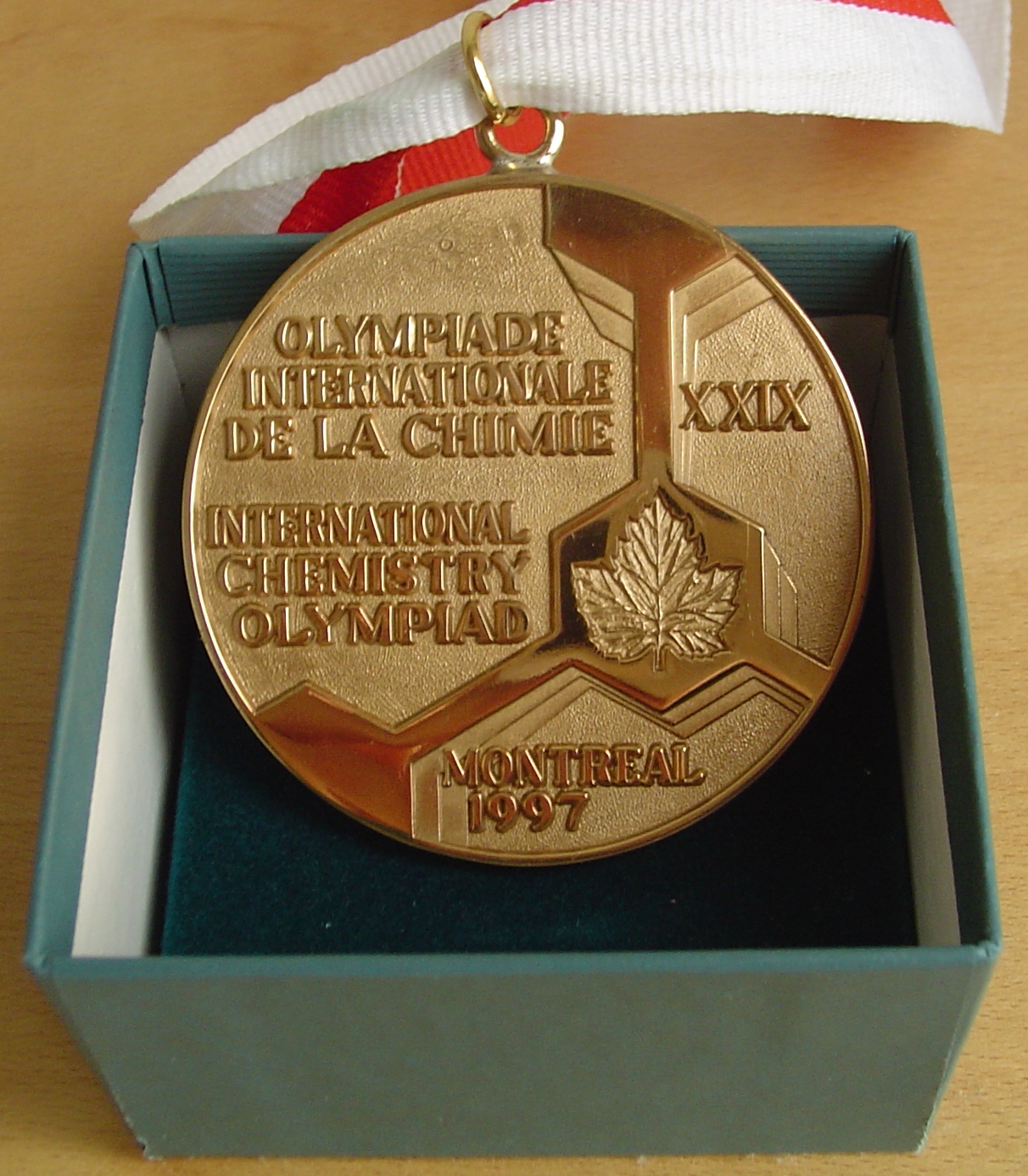
Each delegation consists of up to four students and two mentors (one of them is designated as the head of the delegation or "head mentor"). A delegation may also include a handful of guests and scientific observers. Students must be under the age of 20 and must not be enrolled as regular students in any post-secondary education institution. The International Information Center of the International Chemistry Olympiad is based in Bratislava, Slovakia.
Countries who wish to participate in the IChO must send observers to two consecutive olympiads before their students can participate in the event. A total of 68 countries took part in the 38th IChO in 2006: 67 as participants and 1 as an observer. In 2017 more than 90 countries are expected to send students.
The competition consists of two examinations, a theoretical examination and a practical examination. Both have durations of up to 5 hours, and are held on separate days with the practical examination usually being before the theoretical examination. The theoretical examination has a value of 60 points and the practical examination has a value of 40 points. Each examination is evaluated independently from the other and the sum of the results of the examinations determines a participant's overall result. A scientific jury, which is installed by the host country, suggests the tasks. The international jury, which consists of the 2 mentors from each of the participating countries, discusses the competition tasks and translates them into the language of their students' preference.
Students receive the examinations translated into their languages of preference. It is the duty of the mentors to translate the examinations from English before they are given to the participants. After the examinations are held and evaluated by a committee appointed by the host country and before awards are presented, mentors discuss the evaluation of the exams with judges of the committee to assure fairness in their evaluation. Because the mentors review the examinations before they are given to participants, any communication between the mentors and the students is strictly forbidden prior to the completion of both exams, and the students are required to surrender any mobile phones and laptop computers to the organizer.
The syllabus of the competition contains subjects from several areas of chemistry, including organic chemistry, inorganic chemistry, physical chemistry, analytical chemistry, biochemistry, and spectroscopy. Though some of these subjects are included in most secondary school chemistry programs, for the most part, they are evaluated at a much deeper level and many may require a level of knowledge and understanding comparable to that of post-secondary education. In addition, the host country of each IChO issues a set of preparatory problems well in advance of the competition every year. These preparatory problems cover specific topics in considerable more depth than typical post-secondary education. Preparation for the International Chemistry Olympiad demands a high level of understanding and interest in chemistry and an outstanding ability to relate chemical subjects with one another as well as with the practical world.

Preparation
Each country is free to choose its team by whatever means it seems appropriate, the selection involves holding regional and national olympiad competitions. Many countries hold "training camps" for its top students, where mentors from the country give the students accelerated college-level courses in chemistry with an emphasis on the topics covered in that year's preparatory problems as well as practical training. It is agreed that such training programs must not exceed a total duration of two weeks but there are allegations every year that some countries exceed this limit by months or even years. Another concern is that some countries tend to bring the same students to the competition year after year, which helps them win better medals. Although some believe that this is against the spirit of the olympiad, many nations find it hard to justify leaving their best students at home.
History
The idea of the International Chemistry Olympiad was developed in the former Czechoslovakia in 1968.
The first International Chemistry Olympiad took place in Prague between 18 and 21 June 1968. Each of the three participating countries sent a team of six students, and four theoretical tasks were to be solved. Guidelines for the next competitions were already suggested. The second chemistry Olympiad took place in 1969 in Poland, and Bulgaria also participated, with USSR and GDR only sending observers. Each team consisted of five pupils, and an experimental competition was added. The decision was made to invite more socialist countries to future competitions and to limit the number of pupils to four. The third Olympiad in 1970 was organized in Hungary with the GDR, Romania and the Soviet Union as new countries. In this competition, more than three prizes were distributed for the first time.
There was no Olympiad held in 1971, as at the end of the competition in 1970, an organizer and host for the next event could not be agreed on. This was solved for the next three years by diplomatically agreeing on the Soviet Union to host 1972, Bulgaria in 1973, and Romania in 1974, starting the tradition to decide the host years in advance. 1972 was the first time where preparation tasks for the International Chemistry Olympiad were created. Also, at a jury session, it was suggested that invitations should be sent to Vietnam, Mongolia, and Cuba. However, these invitations were not sent, leaving seven to compete in 1973.
In 1974, Romania invited Sweden and Yugoslavia to the Olympiad in Bucharest, while Germany and Austria sent observers. The Federal Republic of Germany was the first NATO-country with an observer present and this was only able to occur because the Brandt government had contracts in the East. Thus, in 1975, West Germany, Austria, and Belgium also participated in the International Chemistry Olympiad.
The first Olympiad in a non-socialist country took place 1980 in Linz in Austria, although the Soviet Union did not participate. Since then the number of the participating countries has increased steadily. In 1980, only 13 nations took part but this number increased to 21 by the 1984 Olympiad in Frankfurt/Main. With the fall of the Iron Curtain and the break-up of the Soviet Union into independent states in the early 1990s, the number of participants increased again. In addition, the increasing interest of Asian and Latin American countries became apparent with the numbers of participants. Altogether 47 delegations participated in 1998. Presently, 88 countries are invited to the International Chemistry Olympiads.
Summary
| bottom; | No. | bottom; | Year | bottom; | City | Country | Date | Website | Teams | New teams |
|---|---|---|---|---|---|---|---|---|---|---|
| 1 | 1968 | Prague | June 18–21 | 3 | Czechoslovakia, Poland, Hungary | |||||
| 2 | 1969 | Katowice | June 16–20 | 4 | Bulgaria | |||||
| 3 | 1970 | Budapest | July 1–5 | 7 | GDR, Romania, Soviet Union | |||||
| — | 1971 | not held | ||||||||
| 4 | 1972 | Moscow | July 1–10 | 7 | — | |||||
| 5 | 1973 | Sofia | July 1–10 | 7 | — | |||||
| 6 | 1974 | Bucharest | July 1–10 | 9 | Sweden, Yugoslavia | |||||
| 7 | 1975 | Veszprém | July 1–10 | 12 | Austria, FRG, Belgium | |||||
| 8 | 1976 | Halle | July 10–19 | 12 | — | |||||
| 9 | 1977 | Bratislava | July 4–14 | 12 | (observers from UNESCO) | |||||
| 10 | 1978 | Toruń | July 3–13 | 12 | — | |||||
| 11 | 1979 | Leningrad | July 2–11 | 11 | — | |||||
| 12 | 1980 | Linz | July 13–23 | 13 | Netherlands, Italy | |||||
| 13 | 1981 | Burgas | July 13–23 | 14 | France | |||||
| 14 | 1982 | Stockholm | July 3–12 | 17 | Yugoslavia, Denmark, Norway | |||||
| 15 | 1983 | Timișoara | July 2–11 | 18 | United Kingdom | |||||
| 16 | 1984 | Frankfurt | July 1–10 | 21 | Greece, Kuwait, USA | |||||
| 17 | 1985 | Bratislava | July 1–8 | 22 | Cuba | |||||
| 18 | 1986 | Leiden | July 6–15 | 23 | Canada | |||||
| 19 | 1987 | Veszprém | July 6–15 | 26 | Switzerland, China | |||||
| 20 | 1988 | Espoo | July 2–9 | 26 | Australia, Singapore | |||||
| 21 | 1989 | Halle | July 2–10 | 26 | — | |||||
| 22 | 1990 | Paris | July 8–17 | 28 | Cyprus, Thailand | |||||
| 23 | 1991 | Łódź | July 7–15 | 30 | Latvia, Lithuania, Slovenia | |||||
| 24 | 1992 | Pittsburgh and | ||||||||
| Washington, D.C. | July 11–22 | 33 | New Zealand, Mexico | |||||||
| 25 | 1993 | Perugia | July 11–22 | 38 | Iran, Slovakia, Czech Republic, | |||||
| Venezuela, Taiwan, Korea | ||||||||||
| 26 | 1994 | Oslo | July 3–11 | 39 | Estonia, Turkey, Ukraine | |||||
| 27 | 1995 | Beijing | July 13–20 | 42 | ||||||
| 28 | 1996 | Moscow | July 14–23 | 45 | Belarus | |||||
| 29 | 1997 | Montreal | July 13–22 | 47 | ||||||
| 30 | 1998 | Melbourne | July 5–14 | 47 | ||||||
| 31 | 1999 | Bangkok | July 4–11 | 52 | India | |||||
| 32 | 2000 | Copenhagen | July 2–11 | url=http://www.icho39.chem.msu.ru/html/english/IChO/PreviousIChOs.htm | title=39th INTERNATIONAL CHEMISTRY OLYMPIAD | publisher=Icho39.chem.msu.ru | access-date=2018-04-28}} | |||
| 33 | 2001 | Mumbai | July 6–15 | 54 | ||||||
| 34 | 2002 | Groningen | July 5–14 | 57 | ||||||
| 35 | 2003 | Athens | July 5–14 | 60 | ||||||
| 36 | 2004 | Kiel | July 18–27 | 61 | ||||||
| 37 | 2005 | Taipei | July 16–25 | 59 | ||||||
| 38 | 2006 | Gyeongsan | July 1–11 | 66 | Saudi Arabia, Israel | |||||
| 39 | 2007 | Moscow | July 15–24 | 68 | ||||||
| 40 | 2008 | Budapest | July 12–21 | |||||||
| 41 | 2009 | Cambridge | July 18–27 | |||||||
| 42 | 2010 | Tokyo | July 19–28 | |||||||
| 43 | 2011 | Ankara | July 9–18 | |||||||
| 44 | 2012 | Washington, D.C. | July 21–30 | |||||||
| 45 | 2013 | Moscow | July 15–24 | 74 | ||||||
| 46 | 2014 | Hanoi | July 20–29 | |||||||
| 47 | 2015 | Baku | July 20–29 | |||||||
| 48 | 2016 | Tbilisi | Georgia | July 23 – August 1 | ||||||
| 49 | 2017 | Nakhon Pathom | July 6–15 | 76 | ||||||
| 50 | 2018 | Bratislava | ||||||||
| Prague | ||||||||||
| July 19–29 | url=https://www.ichosc.org/ | title=IChO | website=www.ichosc.org}} | 76 | ||||||
| 51 | 2019 | Paris | July 21–30 | 80 | ||||||
| 52 | 2020 | Istanbul (online) | July 23–30 | 60 | ||||||
| 53 | 2021 | Osaka (online) | July 24 – August 2 | 79 | ||||||
| 54 | 2022 | Tianjin (online) | July 10–18 | 84 | ||||||
| 55 | 2023 | Zürich | July 16–25 | 89 | ||||||
| 56 | 2024 | Riyadh | July 21–30 | 84 | ||||||
| 57 | 2025 | Dubai | July 5–14 | |||||||
| 58 | 2026 | Tashkent | July 10–19 | |||||||
| 59 | 2027 |
One of the usual way to get in touch with former and current participants are currently in place. One popular form is through a Facebook Group: Group for the International Chemistry Olympiad --
Remote IChO
Due to the COVID-19 pandemic, IChO 2020, 2021 and 2022 were organized remotely without a laboratory exam in order to keep the Olympic spirit of collaboration and peace even in harsh times.
Distribution of medals
The current list of countries with the best results for last decade by Golds are as follows as of July 2025 (Consolidated from following sources: ):
| Rank | Country | Gold in Last 10 contests (2016-2025) |
|---|---|---|
| 1 | China | 37 (4+3+4+3+3+4+4+4+4+4) |
| 2 | Vietnam | 29 (2+3+1+2+4+3+4+3+3+4) |
| 3 | USA | 28 (1+4+4+3+4+2+1+2+3+4) |
| 4 | Taiwan | 27 (3+4+1+2+2+3+4+3+2+3) |
| 5 | Singapore | 21 (2+2+2+2+3+2+2+4+1+1) |
| 6 | South Korea | 20 (3+2+3+4+2+1+2+1+1+1) |
| 7 | Russia | 16 (3+2+2+4+1+4+x+x+x+x) |
| 8 | Iran | 15 (2+3+0+1+1+2+2+3+1+0) |
| 9 | Japan | 14 (1+1+1+2+0+0+4+2+2+1) |
| 10 | India | 13 (2+1+2+2+x+2+0+1+1+2) |
| 10 | Romania | 13 (3+2+0+1+x+3+2+1+0+1) |
| 12 | Czech Republic | 9 (0+0+3+1+1+1+1+0+1+1) |
| 12 | United Kingdom | 9 (0+0+3+1+1+2+0+1+0+1) |
| 14 | Bulgaria | 8 (0+1+1+1+0+0+1+2+1+1) |
| 14 | Thailand | 8 (2+2+1+1+0+0+0+1+0+1) |
| 14 | Turkey | 8 (x+1+1+0+2+2+1+1+0+0) |
| 17 | Kazakhstan | 7 (0+1+0+0+0+0+1+1+2+2) |
| 18 | Poland | 6 (1+0+0+0+0+0+1+1+2+1) |
| 18 | Uzbekistan | 6 (0+0+0+0+0+1+0+2+1+2) |
| 20 | Israel | 5 (0+0+0+0+1+1+1+0+x+2) |
| 21 | Ukraine | 4 (0+0+1+1+x+0+0+0+0+2) |
| 22 | Brazil | 3(0+0+2+0+0+0+0+0+1+0) |
| 22 | Slovakia | 3 (0+0+0+2+0+0+0+0+1+0) |
| 24 | Denmark | 2 (0+0+0+1+0+0+0+0+0+1) |
| 24 | Germany | 2 (0+0+0+0+0+0+0+1+0+1) |
| 24 | Hungary | 2(0+0+1+0+0+0+0+1+0+0) |
| 24 | Indonesia | 2 (0+1+1+0+0+0+0+0+0+0) |
| 24 | Lithuania | 2 (0+1+0+0+0+0+0+0+1+0) |
| 29 | Belarus | 1 (1+0+0+0+x+0+x+x+x+x) |
| 29 | Armenia | 1(0+0+0+0+0+0+0+1+0+0) |
| 29 | Australia | 1 (0+0+0+0+1+0+0+0+0+0) |
| 29 | Argentina | 1 (0+0+0+1+x+x+0+0+0+0) |
| 29 | Austria | 1 (x+0+0+0+0+0+0+0+1+0) |
| 29 | Azerbaijan | 1 (0+1+0+0+0+0+0+0+0+0) |
| 29 | Canada | 1 (x+0+0+0+0+0+0+0+1+0) |
| 29 | France | 1 (0+0+1+0+0+0+0+0+0+0) |
| 29 | Italy | 1 (0+0+0+1+x+x+x+0+0+0) |
| 29 | Latvia | 1 (0+0+0+1+0+0+0+0+0+0) |
| 29 | Peru | 1 (0+1+0+0+x+x+0+0+0+0) |
| 29 | Serbia | 1 (0+0+0+0+0+0+0+0+1+0) |
| 29 | Turkmenistan | 1 (0+0+0+0+x+0+1+0+0) |
0 denotes participated and yet did not get any gold, whilst x denotes the country did not participate at that year
References
References
- (February 13, 2018). "Celebrating the Golden Jubilee of the International Chemistry Olympiad: Back to Where It All Began". Journal of Chemical Education.
- (August 1, 2023). "IChO - Regulations".
- "39th INTERNATIONAL CHEMISTRY OLYMPIAD". Icho39.chem.msu.ru.
- "International Chemistry Olympiad - ICHO".
- Glavin, Chris. (2018-09-27). "History of International Chemistry Olympiad {{!}} K12 Academics".
- "The 26th International Chemistry Olympiad".
- "Markku's IChO Home Page".
- "The 28th International Chemical Olympiad (Moscow, 1996)".
- "International Chemistry Olympiad".
- "International Chemistry Olympiad".
- Kanda Nivesanond. "International Chemistry Olympiad 31st".
- "The year 2000 International Chemistry Olympiad in Denmark.".
- "39th INTERNATIONAL CHEMISTRY OLYMPIAD". Icho39.chem.msu.ru.
- "ICHO 2001 — Homi Bhabha Centre For Science Education, TIFR".
- (2018-04-10). "Results — Homi Bhabha Centre For Science Education, TIFR". Hbcse.tifr.res.in.
- "34th International Chemistry Olympiad, Groningen".
- (2004-06-21). "34th International Chemistry Olympiad".
- "35 ICHO - English Page".
- "Results of the 35th International Chemistry Olympiad".
- "IPN - Internationale ChemieOlympiade".
- "IChO-Ergebnisse nach Ländern.xls".
- "Home".
- "Participation".
- "Official site of the 38th IChO, 2006".
- "IChO2006".
- "Official site of the 39th IChO, 2007". Icho39.chem.msu.ru.
- "Official site of the 40th IChO, 2008". Eötvös Loránd University.
- "International Chemistry Olympiad 2009".
- "42nd International Chemistry Olympiad".
- "wwwicho's blog – Just another METU Blog Service site".
- "44th International Chemistry Olympiad".
- "45th IChO website".
- "Results by country".
- "46 th International Chemistry Olympiad".
- "IChO 2015".
- "IChO 2016".
- "IChO 2017 official site". Icho2017.sc.mahidol.ac.th.
- "Participating countries : ICHO 2017". Icho2017.sc.mahidol.ac.th.
- "IChO".
- "Participating countries | IChO 2018".
- "IChO 2019 official site".
- "IChO 2020 official site".
- "IChO 2021 official site".
- "IChO 2022 official site".
- "IChO 2023 official site".
- "IChO 2024 official site".
- "IChO 2025 official site".
- "IChO 2026 official site".
- "International Chemistry Olympiad - IChO".
- "46 th International Chemistry Olympiad".
- "IChO 2015".
- "IChO 2016".
- "IChO 2017 official site". Icho2017.sc.mahidol.ac.th.
- "Participating countries | IChO 2018".
- "IChO 2019 official site".
- "IChO 2020 official site".
- "IChO 2021 official site".
- "IChO 2022 official site".
- "IChO 2023 official site".
- "IChO 2024 official site".
- "IChO Results".
- students from Russia and Belarus participate as individual participants since 2022
- students from Russia and Belarus participate as individual participants since 2022
This article was imported from Wikipedia and is available under the Creative Commons Attribution-ShareAlike 4.0 License. Content has been adapted to SurfDoc format. Original contributors can be found on the article history page.
Ask Mako anything about International Chemistry Olympiad — get instant answers, deeper analysis, and related topics.
Research with MakoFree with your Surf account
Create a free account to save articles, ask Mako questions, and organize your research.
Sign up freeThis content may have been generated or modified by AI. CloudSurf Software LLC is not responsible for the accuracy, completeness, or reliability of AI-generated content. Always verify important information from primary sources.
Report