From Surf Wiki (app.surf) — the open knowledge base
Institute of Astronomy, Cambridge
Astronomy department of the university of Cambridge
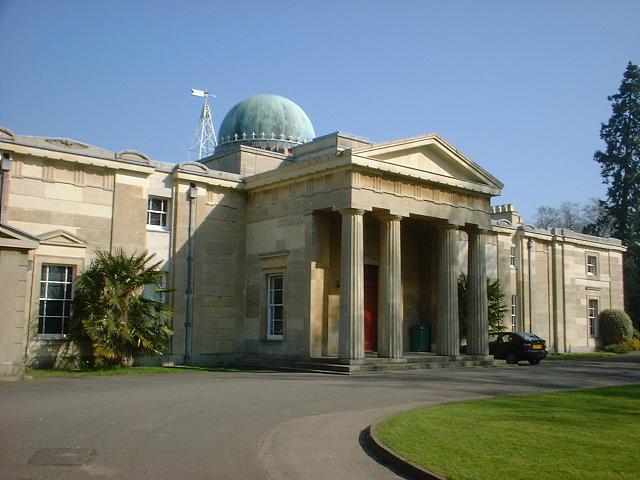
Astronomy department of the university of Cambridge
| Field | Value |
|---|---|
| name | Institute of Astronomy |
| image | Logo of the Institute of Astronomy, Cambridge.png |
| established | 1972 |
| faculty | School of Physical Sciences, University of Cambridge |
| head_label | Director |
| head | Cathie Clarke and Mark Wyatt |
| staff | 177 |
| location | Cambridge, Cambridgeshire, United Kingdom |
| address | Madingley Road |
| website | www.ast.cam.ac.uk |
The Institute of Astronomy (IoA) is the largest of the three astronomy departments in the University of Cambridge, and one of the largest astronomy sites in the United Kingdom. Around 180 academics, postdocs, visitors and assistant staff work at the department.
Research at the department is made in a number of scientific areas, including exoplanets, stars, star clusters, cosmology, gravitational-wave astronomy, the high-redshift universe, AGN, galaxies and galaxy clusters. This is a mixture of observational astronomy, over the entire electromagnetic spectrum, computational theoretical astronomy, and analytic theoretical research.
The Kavli Institute for Cosmology is also located on the department site. This institute has an emphasis on The Universe at High Redshifts. The Cavendish Astrophysics Group are based in the Battcock Centre, a building in the same grounds.
History

The institute was formed in 1972 from the amalgamation of earlier institutions:
- The University Observatory, founded in 1823. Its Cambridge Observatory building now houses offices and the department library.
- The Solar Physics Observatory, which started in Cambridge in 1912. The building was partly demolished in 2008 to make way for the Kavli Institute for Cosmology.
- The Institute of Theoretical Astronomy, which was created by Fred Hoyle in 1967. Its building is the main departmental site (the Hoyle Building), with a lecture theatre added in 1999, and a second two-storey wing built in 2002.
From 1990 to 1998, the Royal Greenwich Observatory was based in Cambridge, where it occupied Greenwich House on a site adjacent to the Institute of Astronomy.
Teaching
The department teaches about thirty 3rd and 4th year undergraduates as part of the Natural Sciences Tripos or Mathematical Tripos. Courses include General Relativity, Cosmology, Black Holes, Extrasolar Planets, Astrophysical Fluid Dynamics, Structure and Evolution of Stars & Formation of Galaxies, and students also complete a research project. In addition, there are around 12 to 18 graduate PhD students at the department each year, mainly funded by the STFC. The graduate programme is particularly unusual in the UK as the students are free to choose their own PhD supervisor or adviser from the staff at the department, and this choice is often made as late as the end of their first term.
Notable current staff
An incomplete list of notable current members of the department.
- Cathie Clarke
- Carolin Crawford
- George Efstathiou
- Andrew Fabian
- Paul Hewett
- Mike Irwin
- Gerry Gilmore
- Douglas Gough
- Nikku Madhusudhan
- Richard McMahon
- Hiranya Peiris
- Max Pettini
- James E. Pringle
- Martin Rees
- Christopher Tout
- Anna Zytkow
Notable past members and students
Here are some notable members of the department and its former institutes.
- Sverre_Aarseth
- Suzanne Aigrain
- George Airy
- Robert Stawell Ball
- James Challis
- Donald Clayton
- John Couch Adams
- Arthur Eddington
- Richard Ellis
- Roger Griffin
- Stephen Hawking
- Cyril Hazard
- Fred Hoyle
- Ofer Lahav
- Mike Irwin
- Jamal Nazrul Islam
- Harold Jeffreys
- Robert Kennicutt
- Donald Lynden-Bell
- Jayant Narlikar
- Jeremiah Ostriker
- Christopher S. Reynolds
- Robert Woodhouse
Telescopes

The Institute houses several telescopes on its site. Although some scientific work is done with the telescopes, they are mostly used for public observing and astronomical societies. The poor weather and light-pollution in Cambridge makes most modern astronomy difficult. The telescopes on the site include:
- The Northumberland Telescope donated by the Duke of Northumberland in 1833. This is a 12 in diameter refractor on an English mount.
- The smaller Thorrowgood Telescope, on extended loan from the Royal Astronomical Society. The telescope is an 8 in refractor.
- The 36-inch Telescope, built in 1951.
- The Three-Mirror Telescope, which is a prototype telescope with a unique design to have wide field of view, sharp images and all-reflection optics.
The institute's former 24" Schmidt Camera was donated to the Spaceguard Centre in Knighton, Powys in Wales in June 2009.
The Cambridge University Astronomical Society (CUAS) and Cambridge Astronomical Association (CAA) both regularly observe. The Institute holds public observing evenings on Wednesdays from October to March.
Public activities

The department holds a number of events involving the general public in astronomy. These include or have included:
- Open evenings on Wednesdays during the winter, with a talk given by a member of the institute followed by observing in clear weather
- Hosting the Astroblast conference
- Annual sculpture exhibition showing work of Anglia Ruskin University
- Annual open day during the Cambridge Science Festival
- A monthly podcast, the 'Astropod', aimed at the general public (the Astropod originally ran from 2009 to 2011, and was relaunched in 2020)
- Extra observing nights for special events such as IYA Moonwatch and BBC stargazing live
Library
The institute library is housed in the old Cambridge Observatory building. It is a specialist library concentrating on the subjects of astronomy, astrophysics and cosmology. The collection has approximately 17,000 books and subscribes to about 80 current journals. The library also has a collection of rare astronomical books, many of which belonged to John Couch Adams.
Achievements
Among the significant contributions to astronomy made by the institute, the now decommissioned Automatic Plate Measuring (APM) machine was used to create a major catalogue of astronomical objects in the northern sky.
References
References
- "People at the Institute | Institute of Astronomy".
- [http://www.ast.cam.ac.uk/about/ The Institute of Astronomy: About the Institute]
- [http://www.ast.cam.ac.uk/history/ The Institute of Astronomy: Past and Present] {{webarchive. link. (2007-10-22)
- [http://www.ast.cam.ac.uk/research The Institute of Astronomy: Research]
- [http://www.ast.cam.ac.uk/kavli/ The Institute of Astronomy: Kavli Institute for Cosmology, Cambridge] {{webarchive. link. (2007-09-25)
- (6 September 2023). "Part III Lecture Courses - 2020-21 {{!}} Institute of Astronomy".
- [http://www.ast.cam.ac.uk/about/northumberland.telescope Northumberland Telescope] {{Webarchive. link. (17 November 2017)
- [http://www.ast.cam.ac.uk/about/thorrowgood.telescope Thorrowgood Telescope]
- [http://www.ast.cam.ac.uk/about/36-inch.telescope 36-inch Telescope]
- [http://www.ast.cam.ac.uk/about/three-mirror.telescope Three-Mirror Telescope] {{Webarchive. link. (19 December 2018)
- [http://www.srcf.ucam.org/astronomy/ Cambridge University Astronomical Society]
- [http://www.caa-cya.org/ CAA Home]
- "Institute of Astronomy - Public".
- [http://www.astronomylog.co.uk/2008/05/19/introduction-to-astronomy-week-4/ Introduction to Astronomy – Week 4]
- [http://www.ast.cam.ac.uk/public/public_observing/ Institute of Astronomy » Public Activities]
- [http://www.astroblast.org.uk/ Astroblast] {{webarchive. link. (2007-10-16)
- [http://www.ast.cam.ac.uk/public/past/sculpture2010/ Institute of Astronomy » Public Activities]
- [http://www.ast.cam.ac.uk/astropod/ The Astropod - Institute of Astronomy Podcast]
- Hurn, M. "An English Astronomical Library: the case of the Cambridge Observatory" [http://adsabs.harvard.edu/abs/2004Obs...124...37H The Observatory, Vol. 124, No. 1178, pp. 37-46 (2004)]
- Irwin, Mike. "Overview of the APM Facility". Cambridge University.
This article was imported from Wikipedia and is available under the Creative Commons Attribution-ShareAlike 4.0 License. Content has been adapted to SurfDoc format. Original contributors can be found on the article history page.
Ask Mako anything about Institute of Astronomy, Cambridge — get instant answers, deeper analysis, and related topics.
Research with MakoFree with your Surf account
Create a free account to save articles, ask Mako questions, and organize your research.
Sign up freeThis content may have been generated or modified by AI. CloudSurf Software LLC is not responsible for the accuracy, completeness, or reliability of AI-generated content. Always verify important information from primary sources.
Report