From Surf Wiki (app.surf) — the open knowledge base
Instant-runoff voting
Single-winner ranked-choice electoral system

Single-winner ranked-choice electoral system
Instant-runoff voting (IRV; US: ranked-choice voting (RCV), AU: preferential voting, UK/NZ: alternative vote) is a single-winner ranked voting election system where one or more eliminations are used to simulate multiple runoff elections. In each round, the candidate with the fewest first-preference votes (among the remaining candidates) is eliminated. This continues until only one candidate is left. Instant runoff falls under the plurality-with-elimination family of voting methods, and is thus closely related to methods like the two-round runoff system and party primary systems.
Instant-runoff voting has found some use in national elections in several countries, predominantly in the Anglosphere. It is used to elect members of the Australian House of Representatives and the National Parliament of Papua New Guinea, and to elect the head of state in India, Ireland, and Sri Lanka.
The system was first discussed by the Marquis de Condorcet, who showed the rule could eliminate the majority-preferred candidate (Condorcet winner). Since then, instant-runoff voting has been criticized for other mathematical pathologies, including its ability to eliminate candidates for having too much support or too many votes. Like first-past-the-post voting (FPTP), instant-runoff is vulnerable to a kind of spoiler effect called a center squeeze, which causes it to favor uncompromising alternatives over more-moderate ones, encouraging polarization.
Advocates of instant-runoff voting often argue these properties are positive, as voting methods should encourage candidates to appeal to their core support or political base rather than a broad coalition. They also note that in countries like the UK without primaries or runoffs, instant-runoff voting can prevent spoiler effects by eliminating minor-party candidates, because it avoids some kinds of vote-splitting by nearly identical (clone) candidates. IRV has also been described as a natural extension of the two-round system or primary elections that avoids multiple rounds of voting.
Election procedure
In instant-runoff voting, as with other ranked voting methods, each voter orders candidates from first to last. The counting procedure is then as follows:
- If there is more than one candidate left, eliminate the one with the fewest voters ranking them first.
- Reassign votes held by the eliminated candidates to the next-highest preference on each ballot paper (setting aside any with no remaining preferences). Return to step 1.
This procedure is often described as stopping when a candidate reaches a majority, but there is no guarantee that any candidate will reach more than half the votes. In practice, most candidates who do not have a majority in the first round never achieve a majority under IRV; i.e., most competitive elections do not end with a candidate reaching majority support but instead elect the candidate who had enough votes to avoid being eliminated.
Properties and pathologies
Center squeeze
Wasted votes and Condorcet winners
Compared to a plurality voting system that rewards only the top vote-getter using non-transferable votes, instant-runoff voting mitigates the problem of wasted votes. However, it does not ensure the election of a Condorcet winner, which is the candidate who would win a direct election against any other candidate in the race.
Some advocates of instant-runoff voting argue that the failure to elect a Condorcet winner is positive, as it enables instant-runoff voting to pass later-no-help and later-no-harm, which together render the method immune to burying strategy. FairVote, in particular, has stated that they "believe [later-no-harm] is necessary in the context of high-stakes, competitive elections".
Resistance to strategy
Instant-runoff voting has notably high resistance to tactical voting but less to strategic nomination.
Party strategizing and strategic nomination
In Australia, preference deals (where one party's voters agree to place another party's voters second, in return for their doing the same) between parties are common. Parties and candidates often encourage their supporters to participate in these preference deals using How-to-vote cards explaining how to use their lower rankings to maximize the chances of their ballot helping to elect someone in the preference deal before it may exhaust.
Instant runoff may be manipulable via strategic candidate entry and exit, reducing similar candidates' chances of winning. Such manipulation does not need to be intentional, instead acting to deter candidates from running in the first place. Spatial model simulations indicate that instant runoff rewards strategic withdrawal by candidates.
Tactical voting
Gibbard's theorem demonstrates that no (deterministic, non-dictatorial) voting method can be entirely immune from tactical voting. This implies that instant-runoff voting is susceptible to tactical voting in some circumstances. In particular, when there exists a Condorcet winner who instant-runoff voting fails to elect, voters who prefer the Condorcet winner to the instant-runoff voting winner have an incentive to use the compromising strategy. instant-runoff voting is also sometimes vulnerable to a paradoxical strategy of ranking a candidate higher to make them lose, due to instant-runoff voting failing the monotonicity criterion.
Research suggests that instant-runoff voting is highly resistant to strategic voting. In a test of multiple methods, instant runoff was found to be the second-most-resistant to tactical voting, after a class of instant runoff-Condorcet hybrids. Instant-runoff voting is also completely immune to the burying strategy: ranking a strong opposition candidate lower can't get one's preferred candidate elected.
Tactical voting in instant-runoff voting seeks to alter the order of eliminations in early rounds, to ensure that the original winner is challenged by a stronger opponent in the final round. For example, in a three-party election where voters for both the left and right prefer the centrist candidate to stop the opposing candidate from winning, those voters who care more about defeating the opposition than electing their own candidate may cast a tactical first-preference vote for the centrist candidate.
Spoiler effect
Main article: Spoiler effect
Proponents of instant-runoff voting claim that instant-runoff voting eliminates the spoiler effect, since instant-runoff voting makes it safe to vote honestly for marginal parties. Under a plurality method, voters who sympathize most strongly with a marginal candidate are strongly encouraged to instead vote for a more popular candidate who shares some of the same principles, since that candidate has a much greater chance of being elected, and a vote for the marginal candidate will not result in the marginal candidate's election. Instant-runoff voting reduces this problem, since the voter can rank the marginal candidate first and the mainstream candidate second; in the likely event that the fringe candidate is eliminated, the vote is not wasted but is transferred to the second preference.
However, when the third-party candidate is more competitive, they can still act as a spoiler under instant-runoff voting, by taking away first-choice votes from the more mainstream candidate until that candidate is eliminated, and then that candidate's second-choice votes helping a more-disliked candidate to win. In these scenarios, it would have been better for the third party voters if their candidate had not run at all (spoiler effect), or if they had voted dishonestly, ranking their second-favorite first and their favorite second, rather than first (favorite betrayal). This is the same bracketing effect exploited by Robinette and Tideman in their research on strategic campaigning, where a candidate alters their campaign to cause a change in voter honest choice, resulting in the elimination of a candidate who nevertheless remains more preferred by voters. This occurred in the 2022 Alaska's at-large congressional district special election. If Republican Sarah Palin, who lost in the end, had not run, the more centrist Republican candidate, Nick Begich, was expected to have defeated the winning Democratic candidate, Mary Peltola, because the expectation was that the votes for the two Republican candidates would have been combined behind Begich and would have exceeded those of Peltola. This did not happen in the IRV election due to the way 15,000 Begich supporters marked their back-up preferences across party lines.
This may be observed when a candidate leads in the first count but is in the end unsuccessful. For example, in the 2009 Burlington, Vermont, mayoral election, if Kurt Wright, the Republican candidate who lost in the end, had not run, the Democratic candidate, Andy Montroll, was expected to have defeated the winning Progressive candidate, Bob Kiss. In that sense, the Republican candidate was a spoiler—albeit for an opposing Democrat, rather than some political ally—even though he led in first-choice support.
Failed criteria
Condorcet winner criterion
The Condorcet winner criterion states that "if a candidate would win a head-to-head competition against every other candidate, then that candidate must win the overall election". It is incompatible with the later-no-harm criterion, so instant-runoff voting does not meet this criterion.
Instant-runoff voting is more likely to elect the Condorcet winner than plurality voting and traditional runoff elections. The California cities of Oakland, San Francisco and San Leandro in 2010 provide an example; there were a total of four elections in which the plurality-voting leader in first-choice rankings was defeated, and in each case the instant-runoff voting winner was the Condorcet winner, including a San Francisco election in which the instant-runoff voting winner was in third place in first choice rankings.
A particularly notable Condorcet failure occurred in the 2009 Burlington mayoral election.
Independence of irrelevant alternatives
The independence of irrelevant alternatives criterion states that "the election outcome remains the same even if a candidate who cannot win decides to run." Instant-runoff voting violates this. In the general case, instant-runoff voting can be susceptible to strategic nomination: whether or not a candidate decides to run at all can affect the result even if the new candidate cannot themselves win. This is less likely to happen than under plurality, but much more likely than under the Minimax Condorcet method.
Monotonicity criterion
The monotonicity criterion says that a voter ranking a candidate higher on their ballot should not cause that candidate to lose and conversely, that a voter ranking a candidate lower on their ballot should not help that candidate win. The exact probability of a monotonicity failure depends on the circumstances, but with 3 major candidates, the probabilities range from 15 percent under the impartial culture model to 8.5 percent in the case of a strict left–right spectrum.
Participation criterion
The participation criterion says that candidates should not lose as a result of having "too many voters"—a set of ballots that all rank AB should not switch the election winner from A to B. Instant-runoff voting fails this criterion. In his 1984 study, mathematician Depankar Ray found that in elections where instant-runoff voting elects a different candidate from plurality, that there was an estimated 50 percent probability that some voters would have received a more preferable outcome if they had not participated.
Reversal symmetry criterion
The reversal symmetry criterion states that the first- and last-place candidates should switch places if every ballot is reversed. In other words, it should not matter whether voters rank candidates from best-to-worst and select the best candidate, or whether they rank them worst-to-best and then select the least-bad candidate.
Instant-runoff voting fails this criterion: it is possible to construct an election where reversing the order of every ballot does not alter the final winner; that is, the first- and last-place finishers, according to instant-runoff voting, are the same candidate.
Criticism
The system has had a mixed reception among political scientists and social choice theorists. Some have suggested that the system does not do much to decrease the impact of wasted votes relative to plurality. Research has found instant-runoff voting causes lower confidence in elections and does not substantially affect minority representation, voter turnout, or long-run electoral competition. Opponents have also noted a high rate of repeals for the system.
Similarity to plurality
Often instant-runoff voting elections are won by the candidate who leads in first-count vote tallies so they choose the same winner as first-past-the-post voting would have. Such similarity between the two systems means the disproportionality of IRV is about same as results under first-past-the-post.
Of the Australia federal elections, the 1972 election had the largest number of winners who would not have won under first-past-the-post, but still only 14 out of 125 seats filled were not won by the first-count leader. In the Australian federal election in September 2013, 135 out of the 150 House of Representatives seats (or 90 percent) were won by the candidate who led on first preferences. The other 15 seats (10 percent) were won by the candidate who placed second on first preferences.
Participation
The effect of instant-runoff voting on voter turnout is difficult to assess. In a 2021 report, researchers at New America, a think tank based in Washington, D.C., said it may increase turnout by attracting more and more diverse candidates, but the impact would be realized most significantly by eliminating the need for primaries. The overall impact on diversity of candidates is difficult to detect.
Invalid, incomplete and exhausted ballots{{Anchor|Exhausted ballots}}
All forms of ranked-choice voting reduce to plurality when all ballots rank only one candidate. By extension, ballots for which all candidates ranked are eliminated are equivalent to votes for any non-winner in plurality, and considered exhausted ballots.
Some political scientists have found the IRV system contributes to higher rates of spoiled votes, partly because the ballot marking is more complex. Most jurisdictions with instant-runoff voting do not require complete rankings and may use columns to indicate preference instead of numbers. In American elections with instant-runoff voting, more than 99 percent of voters typically cast a valid ballot.
A 2015 study of four local US elections that used instant-runoff voting found that inactive ballots occurred often enough in each of them that the winner of each election did not receive a majority of votes cast in the first round. The rate of inactive ballots in each election ranged from a low of 9.6 percent to a high of 27.1 percent.
Terminology
While instant run-off voting is distinguished from its multiple winner equivalent, the single transferable vote, most English-speaking discussion of electoral systems does not differentiate them. In Ireland, one of the few countries to use these systems in all elections, no distinction between the two is made, either by the general population or in legal texts. The Constitution of Ireland describes the electoral system as "proportional representation by means of the single transferable vote", as do all other statutory authorities, when referring to either single-winner or multiple-winner elections. The acronym "PR-STV" is in general use to describe both types of elections. Examples of single-winner elections in Ireland which are described officially as "proportional representation by means of the single transferable vote" are the election of the President and the election of the Ceann Comhairle (chairperson of Dáil Éireann). The lack of distinction between the systems in Ireland reflects that there is no difference in the mechanics of the process from election to election, only the number of candidates to be elected by that process. This is not always the case when discussing the systems in the abstract, as there are many variations in how such elections could be run.
Instant-runoff voting derives its name from the way the ballot count simulates a series of runoffs, similar to an exhaustive ballot system, except that voters do not need to turn out several times to vote. It is also known as the alternative vote, transferable vote, ranked-choice voting (RCV), single-seat ranked-choice voting, or preferential voting (but use of some of those terms may lead to misunderstanding as they also apply to single transferable vote.)
Britons and New Zealanders generally call instant-runoff voting the "alternative vote" (AV). Australians, who use instant-runoff voting for most single winner elections, call instant-runoff voting "preferential voting". While this term is widely used by Australians, it is somewhat of a misnomer. Depending on how "preferential" is defined, the term would include all voting systems, apply to any system that uses ranked ballots (thus both instant-runoff voting and single transferable vote), or would exclude instant-runoff voting (instant-runoff voting fails positive responsiveness because ballot markings are not interpreted as "preferences" in the traditional sense. Under instant-runoff voting (and single transferable vote), secondary preferences are used as back-up preferences/contingency votes).
Jurisdictions in the United States such as San Francisco, Minneapolis, Maine, and Alaska have tended to use the term "ranked-choice voting" in their laws that apply to instant-runoff voting contests. The San Francisco Department of Elections claimed the word "instant" in the term "instant-runoff voting" could confuse voters into expecting results to be immediately available. As a result of American influence, the term ranked-choice voting is often used in Canada as well. When discussing his promise of electoral reform, Canadian Prime Minister Justin Trudeau used the term "preferential ballot".
American NGO FairVote has promoted the terminology "ranked-choice voting" to refer to instant-runoff voting, a choice that has caused controversy and accusations that the organization is attempting to obscure the existence of other ranked-choice methods that are competing or could compete with instant-runoff voting.
Instant-runoff voting is occasionally referred to as Hare's method (after Thomas Hare) to differentiate it from other ranked-choice voting methods such as majority-choice voting, Borda, and Bucklin, which use weighted preferences or methods that allow voter's lower preference to be used against voter's most-preferred choice.
When the single transferable vote (STV) method is applied to a single-winner election, it becomes instant-runoff voting; the government of Ireland has called instant-runoff voting "proportional representation" based on the fact that the same ballot form is used to elect its president by instant-runoff voting and parliamentary seats by proportional representation (single transferable vote), but instant-runoff voting is a non-proportional single-winner election method, while single transferable vote elects multiple winners and produces minority representation, as well as majority representation, in almost all cases.
State law in South Carolina and Arkansas use "instant runoff" to describe the practice of having certain categories of absentee voters cast ranked-choice ballots before the first round of an election and counting those ballots in any subsequent runoff elections.
History and use
Main article: History and use of instant-runoff voting
History
According to mathematician Edward J. Nanson, the method was first described by the Marquis de Condorcet in 1788, "but only to be condemned". It was later independently reinvented by Thomas Hare (of England) and Carl Andrae (of Denmark) in the form of the single transferable vote, while Henry Richmond Droop and William R. Ware were the first to apply it to single-winner races.
Adoption
Instant-runoff voting has found some use in national elections in several countries, predominantly in the Anglosphere. It is used to elect members of the Australian House of Representatives and the National Parliament of Papua New Guinea, and to elect the head of state in India, Ireland, and Sri Lanka.
In Alaska, it is used for general elections, after a top-four nonpartisan primary, while in Maine it is used for both general elections and for primary elections (held separately by each party), excluding those for president.
''Robert's Rules of Order''
In the United States, the sequential elimination method used by instant-runoff voting is described in Robert's Rules of Order Newly Revised as an example of ranked-choice voting that can be used to elect officers. Robert's Rules note that ranked-choice systems (including instant-runoff voting) are an improvement on simple plurality but recommend against runoff-based methods because they often prevent the emergence of a consensus candidate with broad support. The book instead recommends repeated balloting until some candidate manages to win a majority of votes. Two other books on American parliamentary procedure, The Standard Code of Parliamentary Procedure and Riddick's Rules of Procedure, take a similar stance.
Examples
Tennessee capital example
It takes three rounds to determine a winner in this election.
Round 1 – In the first round no city receives a majority:
| Votes in round/ | 1st |
|---|---|
| Memphis | 42% |
| Nashville | 26% |
| Knoxville | 17% |
| Chattanooga | 15% |
If one of the cities had achieved a majority vote (more than half), the election would end there. If this were a first-past-the-post election, Memphis would win because it received the most votes. But instant-runoff voting does not allow a candidate to win on the first round without having an absolute majority of the active votes. Since no city has won yet, the city with the least first-place support (Chattanooga) is eliminated from consideration. The ballots that listed Chattanooga as first choice are added to the totals of the second-choice selection on each ballot.

Round 2 – In the second round of tabulation, Chattanooga's 15% of the total votes have been added to the second choices selected by the voters for whom that city was first-choice (in this example Knoxville):
| Votes in round/ | 1st | 2nd |
|---|---|---|
| Memphis | 42% | 42% |
| Nashville | 26% | 26% |
| Knoxville | 17% | 32% |
| Chattanooga | 15% |
In the first round, Memphis was first, Nashville was second and Knoxville was third. With Chattanooga eliminated and its votes redistributed, the second round finds Memphis still in first place, followed by Knoxville in second and Nashville has moved down to third place. No city yet has secured a majority of votes, so the now last placed Nashville is eliminated and the ballots currently counting for Nashville are added to the totals of Memphis or Knoxville based on which city is ranked next on that ballot.
Round 3

As Memphis and Knoxville are the only two cities remaining in the contest, this round will be the final round. In this example the second-choice of the Nashville voters is Chattanooga, which is already eliminated. Therefore, the votes are added to their third-choice: Knoxville. The third round of tabulation yields the following result:
| Votes in round/ | 1st | 2nd | 3rd |
|---|---|---|---|
| Memphis | 42% | 42% | 42% |
| Nashville | 26% | 26% | |
| Knoxville | 17% | 32% | 58% |
| Chattanooga | 15% |
Result: Knoxville, which was running third in the first tabulation, has moved up from behind to take first place in the third and final round. The winner of the election is Knoxville. However, if 6% of voters in Memphis were to put Nashville first, the winner would be Nashville, a preferable outcome for voters in Memphis. This is an example of potential tactical voting, though one that would be difficult for voters to carry out in practice. Also, if 17% of voters in Memphis were to stay away from voting, the winner would be Nashville. This is an example of instant-runoff voting failing the participation criterion.
For comparison, note that traditional first-past-the-post voting would elect Memphis, even though most citizens consider it the worst choice, because 42% is larger than any other single city. As Nashville is a Condorcet winner, Condorcet methods would elect Nashville. A two-round method would have a runoff between Memphis and Nashville where Nashville would win, too.
1990 Irish presidential election
The 1990 Irish presidential election provides a simple example of how instant-runoff voting can produce a different result from first-preference plurality and prevent some kinds of vote-splitting. The three major candidates were Brian Lenihan of Fianna Fáil, Austin Currie of Fine Gael, and Mary Robinson of the Labour Party. In the first round, Lenihan had the largest share of first-choice rankings but not a majority. Currie had the fewest votes and was eliminated. After this, Robinson received 82 percent of Currie's votes. This was enough for her vote tally to pass that of Lenihan.
| Candidate | Round 1 | Round 2 | Mary Robinson | Brian Lenihan | Austin Currie | Exhausted ballots | Total |
|---|---|---|---|---|---|---|---|
| 612,265 | 38.7% | 817,830 | 51.6% | ||||
| 694,484 | 43.8% | 731,273 | 46.2% | ||||
| 267,902 | 16.9% | Eliminated | |||||
| 9,444 | 0.6% | 34,992 | 2.2% | ||||
| 1,584,095 | 100% | 1,584,095 | 100% |
2014 Prahran election (Victoria)
Another real-life example of instant-runoff voting producing results different from first-past-the-post can be seen in the 2014 Victorian general election in Prahran. In this rare instance, the candidate who initially placed third, (Greens candidate Sam Hibbins), won the seat. In the 7th and final round, Hibbins narrowly defeated Liberal candidate Clem Newton-Brown by a margin of 277 votes, having eliminated Neil Pharaoh by the even narrower margin of 31 votes in the previous round.
| Candidate | 1st | 2nd | 3rd | 4th | 5th | 6th | 7th | Total |
|---|---|---|---|---|---|---|---|---|
| Clem Newton-Brown (LIB) | 44.8% | 16,582 | 16,592 | 16,644 | 16,726 | 16,843 | 17,076 | 18,363 |
| Neil Pharaoh (ALP) | 25.9% | 9,586 | 9,593 | 9,639 | 9,690 | 9,758 | 9,948 | Eliminated |
| Sam Hibbins (GRN) | 24.8% | 9,160 | 9,171 | 9,218 | 9,310 | 9,403 | 9,979 | 18,640 |
| Eleonora Gullone (AJP) | 2.3% | 837 | 860 | 891 | 928 | 999 | Eliminated | |
| Alan Walker (FFP) | 0.8% | 282 | 283 | 295 | Eliminated | |||
| Jason Goldsmith (IND) | 0.7% | 247 | 263 | 316 | 349 | Eliminated | ||
| Steve Stefanopoulos (IND) | 0.6% | 227 | 241 | Eliminated | ||||
| Alan Menadue (IND) | 0.2% | 82 | Eliminated | |||||
| 100% | 37,003 |
2009 Burlington mayoral election
| Candidates | 1st round | 2nd round | 3rd round | Candidate | Party | Votes | ± | Votes | ± | Votes | ± | Others | Exhausted |
|---|---|---|---|---|---|---|---|---|---|---|---|---|---|
| Bob Kiss | Progressive | 2585 | +2585 | 2981 | +396 | 4313 | +1332 | ||||||
| Kurt Wright | Republican | 2951 | +2951 | 3294 | +343 | 4061 | +767 | ||||||
| Andy Montroll | Democrat | 2063 | +2063 | 2554 | +491 | Eliminated | |||||||
| Dan Smith | Independent | 1306 | +1306 | Eliminated | |||||||||
| 71 | +71 | Eliminated | |||||||||||
| 4 | +4 | 151 | +147 | 606 | +455 |
Burlington, Vermont's second IRV election in 2009 resulted in Bob Kiss defeating the majority-preferred candidate, Andy Montroll. Although 54 percent of voters ranked Montroll above Kiss, Montroll was defeated as a result of a first-round spoiler effect, violating the principle of majority rule.
FairVote touted the 2009 election as one of its major success stories, claiming it helped the city save on costs of a traditional runoff and prevented a spoiler effect, although later analysis showed that without Wright in the election, Montroll would have defeated Kiss in a one-on-one race.
Mathematicians and voting theorists criticized the election results as revealing several pathologies associated with instant-runoff voting, noting Kiss only won because of 750 votes cast against his candidacy (ranking Kiss in last place). Lint
Similar methods
Runoff voting
The term instant-runoff voting is derived from the name of a class of voting methods called runoff voting. In runoff voting voters do not rank candidates on the ballot - each voter marks only one preference. When no candidate receives a majority of voters in the first round, voters cast votes in two or more subsequent rounds of voting as the field of candidates is reduced. Multi-round runoff voting methods allow voters to change their preferences in each round, incorporating the results of the prior round to influence their decision, which is not possible in instant-runoff voting.
The runoff method closest to instant-runoff voting is the exhaustive ballot. In this method—familiar to fans of the television show American Idol—one candidate is eliminated in each round, and many rounds of voting may be necessary. Because holding many rounds of voting on separate days is generally expensive, the exhaustive ballot is not used for large-scale, public elections.
A more practical form of runoff voting is the two-round system. If no candidate receives a majority of votes in the first round, all but the top-two candidates are excluded after the first round, and just one more round of voting determines the winner. Eliminations can occur with or without allowing and applying preference votes to choose the final two candidates. This method is used in Mali and France, and in Finnish and Slovenian presidential elections.
Contingent vote
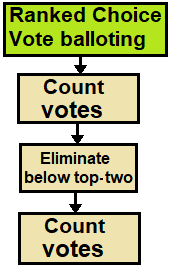
The contingent vote, also known as "top-two instant-runoff voting" ("top-two IRV"), is the same as instant-runoff voting, except that if no candidate achieves a majority in the first round of counting, all but the two candidates with the most votes are eliminated, and the second preferences for those ballots are counted. As in instant-runoff voting, there is only one round of voting. Unlike instant-runoff voting, the vote count process entails only two rounds of counting, while instant-runoff voting can entail many rounds.
Under a variant of contingent voting used in Sri Lanka, and formerly for the elections for Mayor of London in the United Kingdom, voters rank a specified maximum number of candidates. In London, the supplementary vote allowed voters to express first and second preferences only. Sri Lankan voters rank up to three candidates to elect the president of Sri Lanka.
While similar to "sequential-elimination" instant-runoff voting, top-two can produce different results. Excluding more than one candidate after the first count might eliminate a candidate who would have won under sequential elimination instant-runoff voting. Restricting voters to a maximum number of preferences is more likely to exhaust ballots if voters do not anticipate which candidates will finish in the top two. This can encourage voters to vote more tactically, by ranking at least one candidate they think is likely to win.
Conversely, a practical benefit of 'contingent voting' is expediency and confidence in the result with only two rounds.
Larger runoff process
Instant-runoff voting may also be part of a larger runoff process:
- Some jurisdictions that hold runoff elections allow absentee (only) voters to submit ranked ballots, because the interval between rounds of balloting is too short for a second round of absentee voting. Ranked ballots enable absentee votes to count in the second (general) election round if their first choice does not make the second round runoff. Arkansas, South Carolina and Springfield, Illinois adopt this approach. Louisiana uses it only for members of the United States Service or who reside overseas.
- Under some exhaustive ballot runoff systems, instant-runoff voting may be used to quickly eliminate some weak candidates in early rounds, using rules to leave a desired number of candidates for further balloting.
- Instant-runoff voting elections that require a majority of cast ballots but not that voters rank all candidates may require more than a single instant-runoff voting contest due to exhausted ballots. (Most IRV systems require a winner to have only a majority of votes still in play, not a majority of votes cast.)
- Robert's Rules recommends preferential voting for elections by mail and requiring a majority of votes to elect a winner. For in-person elections, they recommend repeated balloting until one candidate receives a majority of votes; if candidates drop out when it becomes clear they will not win, this procedure will always elect a Condorcet winner. The use of repeated balloting allows voters to resolve Condorcet cycles by discussion and compromise, or by electing a consensus candidate who might have polled poorly in the initial election.
Variations

A number of instant-runoff voting methods, varying as to ballot design and as to whether or not voters are obliged to rank all the candidates, are in use in different countries and local governments.
In an optional preferential voting system, voters can give a preference to as many candidates as they wish. They may make only a single choice, known as "bullet voting", and some jurisdictions accept a single box marked with an "X" (as opposed to a numeral "1") as valid for the first preference. Bullet voting may result in exhausted ballots, where all of a voter's preferences are eliminated before a candidate is elected, such that the "majority" in the final round may constitute only a minority of all ballots cast. Optional preferential voting is used for elections for the President of Ireland as well as some elections in New South Wales and Queensland.
In a full-preferential voting method, voters are required to mark a preference for every candidate standing. Ballots that do not contain a ranking of all candidates are in some jurisdictions considered spoilt or invalid, even if there are only two candidates standing. The full-preferential voting method can become burdensome in elections with many candidates and can lead to "donkey voting", in which some voters simply choose candidates at random or in top-to-bottom order, or a voter may order his or her preferred candidates and then fill in the remainder on a donkey basis. Full preferential voting is used for elections to the Australian federal parliament and for most state parliaments.
Other methods only allow marking preferences for a maximum of the voter's top three favorites, a form of partial preferential voting. Such a system produces exhausted votes even when the voter would have been willing to rank more candidates.
A version of instant-runoff voting applying to the ranking of parties was first proposed for elections in Germany in 2013 as spare vote.
Notes
References
References
- Nurmi, Hannu. (June 2005). "Aggregation problems in policy evaluation: an overview". European Journal of Political Economy.
- (July 2024). "A simulation-based study of proximity between voting rules".
- (2024-09-01). "A majority rule philosophy for instant runoff voting". Constitutional Political Economy.
- Condorcet, Jean-Antoine-Nicolas de Caritat. (1788). "Complete Works of Condorcet".
- Nanson, E. J.. (1882). "Methods of election: Ware's Method". Transactions and Proceedings of the Royal Society of Victoria.
- (2000). "A simple characterization of majority rule". [[Economic Theory (journal).
- (2002). "How an Ideologically Concentrated Minority Can Trump a Dispersed Majority: Nonmedian Voter Results for Plurality, Run-off, and Sequential Elimination Elections". American Journal of Political Science.
- (1977). "Single Transferrable Vote: An Example of a Perverse Social Choice Function". American Journal of Political Science.
- Nurmi, Hannu. (December 1996). "It's not just the lack of monotonicity1". Representation.
- (2022-10-30). "The flaw in ranked-choice voting: rewarding extremists".
- (2002). "How an Ideologically Concentrated Minority Can Trump a Dispersed Majority: Nonmedian Voter Results for Plurality, Run-off, and Sequential Elimination Elections". American Journal of Political Science.
- Merrill, Samuel. (1985). "A statistical model for Condorcet efficiency based on simulation under spatial model assumptions". Public Choice.
- Merrill, Samuel. (1984). "A Comparison of Efficiency of Multicandidate Electoral Systems". American Journal of Political Science.
- Robinette, Robbie. (2023-09-01). "Implications of strategic position choices by candidates". Constitutional Political Economy.
- (2024). "Robust Electoral Competition: Rethinking Electoral Systems to Encourage Representative Outcomes". Elsevier BV.
- (September 2024). "A Majority Rule Philosophy for Instant Runoff Voting". Constitutional Political Economy.
- Nanson, E. J.. (1882). "Methods of election: Ware's Method". Transactions and Proceedings of the Royal Society of Victoria.
- (2023-03-06). "An Examination of Ranked Choice Voting in the United States, 2004-2022".
- Dopp, Kathy Anne. (2011). "Realities Mar Instant Runoff Voting Flaws and Benefits of IRV".
- (1978). "Toward Applicable Social Choice Theory: A Comparison of Social Choice Functions under Spatial Model Assumptions". Cambridge University Press (CUP).
- (2018-10-23). "How is RCV better than Approval, Score or Condorcet voting methods?".
- (20 May 2022). "Explained: What are 'preference deals' and how do they influence my vote?".
- Robinette, Robbie. (2023-02-02). "Implications of strategic position choices by candidates". Springer Science and Business Media LLC.
- Green-Armytage, James. (2014). "Strategic voting and nomination". Springer.
- "Monotonicity and instant-runoff voting – Why the Monotonicity Criterion is of Little Import".
- Green-Armytage, James. (2011). "Four Condorcet-Hare Hybrid Methods for Single-Winner Elections". [[Voting matters]].
- Borgers, Christoph. (2010). "Mathematics of Social Choice: Voting, Compensation, and Division". SIAM.
- Poundstone, William. (2009). "Gaming the Vote: Why Elections Aren't Fair (and What We Can Do About It)". Farrar, Straus and Giroux.
- Bristow-Johnson, R.. (2023). "The failure of Instant Runoff to accomplish the purpose for which it was adopted: a case study from Burlington Vermont". Const Polit Econ.
- O'Neill, Jeffrey C.. (2006). "Everything That Can be Counted Does Not Necessarily Count: The Right to Vote and the Choice of a Voting System".
- (2022). "A Mathematical Analysis of the 2022 Alaska Special Election for US House".
- Miller, Nicholas R.. (2012). "Monotonicity failure in IRV elections with three candidates".
- (1996). "The likelihood of monotonicity paradoxes in run-off elections". Mathematical Social Sciences.
- Ray, Depankar. (1986). "On the practical possibility of a 'no show paradox' under the single transferable vote". Mathematical Social Sciences.
- Felsenthal, Dan S.. (2012). "Electoral Systems". Springer Berlin Heidelberg.
- (10 November 2021). "What We Know About Ranked-Choice Voting". New America.
- Drutman, Lee. (2023-09-18). "How I updated my views on ranked choice voting".
- (10 April 2017). "Understanding the Limited Preferential Voting system – EMTV Online".
- (2023). "Ballot Marking Errors in Ranked-Choice Voting".
- (2014-03-01). "Making wasted votes count: Turnout, transfers, and preferential voting in practice". Electoral Studies.
- "The Effect of Ranked-Choice Voting in Maine {{!}} MIT Election Lab".
- (August 2023). "Come-from-behind victories under ranked-choice voting and runoff: The impact on voter satisfaction". Politics & Policy.
- Nielson, Lindsay. (August 2017). "Ranked Choice Voting and Attitudes toward Democracy in the United States: Results from a Survey Experiment". Politics & Policy.
- "The Short-Term Impact of Ranked-Choice Voting on Candidate Entry and Descriptive Representation".
- Green, Antony. (11 May 2010). "Preferential Voting in Australia".
- Green, Antony. (2015-09-08). "Preferences, Donkey Votes and the Canning By-Election". Australian Broadcasting Corporation.
- "What We Know About Ranked-Choice Voting".
- (1 August 2008). "Instant Runoff Voting and Its Impact on Racial Minorities". New America Foundation.
- (March 2015). "Ballot (and voter) 'exhaustion' under Instant Runoff Voting: An examination of four ranked-choice elections". Electoral Studies.
- (January 2020). "Constitution of Ireland (English)". Office of the Attourney General.
- (15 February 2001). "Second Report: Election of a Speaker". House of Commons Select Committee on Procedure.
- Cary, David. (1 January 2011). "Estimating the Margin of Victory for Instant-runoff Voting". Proceedings of the 2011 Conference on Electronic Voting Technology/Workshop on Trustworthy Elections.
- (8 February 2012). "BBC News – Alternative vote". British Broadcasting Corporation.
- (30 September 2017). "Opinion: OUSA Needs the Alternative Vote". Otago University Students' Association.
- (11 December 2020). "Liberal plan to change federal voting laws may have crossbench support". The Guardian.
- Appendix D, Instant Runoff Voting, San Francisco Charter § 13.102 https://sfgov.org/ccsfgsa/sites/default/files/Voting%20Systems%20Task%20Force/AppendixD__.pdf.
- Arntz, John. (2 February 2005). "Ranked-Choice Voting: A Guide for Candidates". Department of Elections: City and County of San Francisco.
- "What is Ranked Choice Voting?".
- (2017-02-13). "Analysis {{!}} Trudeau and allies pledged 1,813 times to reform Canada's elections. Now it won't happen.". The Washington Post.
- (17 August 2019). "How RCV Works".
- Pacuit, Eric. (24 June 2019). "Voting Methods".
- "Proportional Representation". Citizens Information Board.
- "South Carolina General Assembly : 116th Session, 2005–2006".
- "Bill Information".
- Nanson, E. J.. (1882). "Methods of election: Ware's Method". Transactions and Proceedings of the Royal Society of Victoria.
- Condorcet, Jean-Antoine-Nicolas de Caritat. (1788). "Complete Works of Condorcet".
- Droop, H. R.. (1881). "On Methods of Electing Representatives". [Royal Statistical Society, Oxford University Press].
- "The History of IRV".
- (10 November 2016). "Maine became the first state in the country Tuesday to pass ranked-choice voting".
- Russell, Eric. (12 June 2018). "Mainers vote to keep ranked-choice voting, with supporters holding commanding lead". Portland Press Herald.
- "Alaska Ballot Measure 2, Top-Four Ranked-Choice Voting and Campaign Finance Laws Initiative (2020)".
- "Ranked Choice Voting {{!}} Maine Voters Rank Candidates".
- Robert, Henry. (2011). "Robert's Rules of Order Newly Revised". Da Capo Press.
- "TSC".
- (1985). "RID".
- "Presidential Election November 1990". ElectionsIreland.org.
- "State Election 2014: Prahran District (Distribution of preference votes)". Victorian Electoral Commission.
- (2023). "The failure of Instant Runoff to accomplish the purpose for which it was adopted: a case study from Burlington Vermont". Constitutional Political Economy.
- Ellenberg, Jordan. (29 May 2014). "How Not to Be Wrong: The Power of Mathematical Thinking". Penguin.
- Stensholt, Eivind. (7 October 2015). "What Happened in Burlington?".
- Dopp, Kathy. (10 June 2009). "IRV much worse than old runoffs". The Aspen Times.
- Etnier, Carl. (6 March 2009). "Instant runoff was success". Rutland Herald }}{{Dead link.
- Totten, Shay. "Burlington Residents Seek Repeal of Instant Runoff Voting". Seven Days.
- Bouricius, Terry. (17 March 2009). "Response to Faulty Analysis of Burlington IRV Election".
- Lewyn, Michael. (2012). "Two Cheers for Instant Runoff Voting". Phoenix L. Rev..
- (2014). "Interacting double monotonicity failure with direction of impact under five voting methods". Mathematical Social Sciences.
- (1 October 2014). "Frequency of monotonicity failure under Instant Runoff Voting: estimates based on a spatial model of elections". Public Choice.
- "Initiatives – Pew Center on the States".
- "IRV for Louisiana's Overseas Voters". FairVote IRV America.
- (28 January 2020). "Voting system". Electoral Commission of Queensland.
- (27 January 2015). "Are Queenslanders in danger of 'wasting' their votes?".
- "Electoral Systems". Electoral Council of Australia.
- "Ranked-Choice Voting".
- (November 2013). "Anhörung zum Entwurf eines Gesetzes zur Abschaffung der Fünf-Prozent-Sperrklausel bei Landtagswahlen in Schleswig-Holstein". Piratenfraktion im Schleswig-Holsteinischen Landtag.
This article was imported from Wikipedia and is available under the Creative Commons Attribution-ShareAlike 4.0 License. Content has been adapted to SurfDoc format. Original contributors can be found on the article history page.
Ask Mako anything about Instant-runoff voting — get instant answers, deeper analysis, and related topics.
Research with MakoFree with your Surf account
Create a free account to save articles, ask Mako questions, and organize your research.
Sign up freeThis content may have been generated or modified by AI. CloudSurf Software LLC is not responsible for the accuracy, completeness, or reliability of AI-generated content. Always verify important information from primary sources.
Report