From Surf Wiki (app.surf) — the open knowledge base
INS Vikrant (1961)
Majestic-class aircraft carrier of the Indian Navy

Majestic-class aircraft carrier of the Indian Navy
| Field | Value | ||||
|---|---|---|---|---|---|
| section1 | {{Infobox ship/image | ||||
| image | INS Vikrant circa 1984 carrying a unique complement of Sea Harriers, Sea Hawks, Allouette & Sea King helicopters and Alize ASW.jpg | ||||
| image_alt | A color photograph of an aircraft carrier at sea with multiple aircraft onboard | ||||
| image_caption | INS Vikrant in 1984 | ||||
| section2 | {{Infobox ship/career | ||||
| country | United Kingdom | ||||
| flag | |||||
| name | Hercules | ||||
| builder | *Vickers-Armstrongs, High Walker | ||||
| laid_down | 14 October 1943 | ||||
| launched | 22 September 1945 | ||||
| commissioned | Never commissioned | ||||
| identification | Pennant number: R49 | ||||
| fate | Laid up, 1947; Sold to India, 1957 | ||||
| section3 | {{Infobox ship/career | ||||
| hide_header | title | ||||
| country | India | ||||
| flag | |||||
| name | Vikrant | ||||
| acquired | 1957 | ||||
| commissioned | 4 March 1961 | ||||
| decommissioned | 31 January 1997 | ||||
| homeport | Bombay | ||||
| identification | Pennant number: R11 | ||||
| motto | Sanskrit: Jayema Sam Yudhi Sprdhah* | ||||
| fate | Scrapped, 2014 | ||||
| section4 | {{Infobox ship/characteristics | ||||
| class | light carrier | ||||
| displacement | *16,000 t (standard) | ||||
| * {{convert | 19,500 | t | LT | abbr | on}} (deep load) |
| length | 700 ft (o/a) | ||||
| beam | 128 ft | ||||
| draught | 24 ft | ||||
| power | *40,000 ihp | ||||
| propulsion | 2 shafts; 2 Parsons geared steam turbines | ||||
| speed | 25 kn | ||||
| range | *12,000 nmi at 14 kn | ||||
| * {{convert | 6,200 | nmi | abbr | on}} at 23 kn | |
| complement | 1,110 | ||||
| sensors | *1 × LW-05 air-search radar | ||||
| armament | 16 × 40 mm Bofors anti-aircraft guns (later reduced to 8) | ||||
| aircraft | 21–23 | ||||
| aircraft_facilities | * 1961: |
-
Harland & Wolff
-
English: I completely defeat those who dare to fight with me
-
19,500 t (deep load)
-
4 Admiralty three-drum boilers
-
6,200 nmi at 23 kn
-
1 × ZW-06 surface-search radar
-
1 × LW-10 tactical radar
-
1 × Type 963 aircraft-landing radar
-
Catapult Assisted Take-Off
-
1989:
-
9.75 degree ski jump
INS Vikrant (from Sanskrit vikrānta, "courageous") was a of the Indian Navy. The ship was laid down as '*HMS Hercules''' for the British Royal Navy during World War II, but was put on hold when the war ended. India purchased the incomplete carrier in 1957, and construction was completed in 1961. *Vikrant'' was commissioned as the first aircraft carrier of the Indian Navy and played a key role in enforcing the naval blockade of East Pakistan during the Indo-Pakistani War of 1971.
In its later years, the ship underwent major refits to embark modern aircraft, before being decommissioned in January 1997. She was preserved as a museum ship in the Naval Docks in Mumbai until 2012. In January 2014, the ship was sold through an online auction and scrapped in November 2014 after final clearance from the Supreme Court.
History and construction
In 1943 the Royal Navy commissioned six light aircraft carriers in an effort to counter the German and Japanese navies. The 1942 Design Light Fleet Carrier, commonly referred to as the British Light Fleet Carrier, was the result. Serving with eight navies between 1944 and 2001, these ships were designed and constructed by civilian shipyards as an intermediate step between the full-sized fleet aircraft carriers and the less expensive but limited-capability escort carriers. Sixteen light fleet carriers were ordered, and all of them were laid down as what became the Colossus class in 1942 and 1943. The final six ships were modified during construction to handle larger and faster aircraft, and were re-designated as the Majestic class. The improvements from the Colossus class to the Majestic class included heavier displacement, armament, catapult, aircraft lifts and aircraft capacity. Construction on the ships was suspended at the end of World War II, as the ships were more than the Royal Navy's peacetime requirements. Instead, the carriers were modernized and sold to several Commonwealth nations. The ships were similar, but each varied depending on the requirements of the country the ship was sold to.
HMS Hercules, the fifth ship in the Majestic class, was ordered on 7 August 1942 and laid down on 14 October 1943 by Vickers-Armstrongs at High Walker on the River Tyne. After World War II ended with Japan's surrender on 2 September 1945, she was launched on 22 September and her construction was suspended in May 1946. At the time of suspension, she was 75 per cent complete. Her hull was preserved, and in May 1947 she was laid up in Gareloch off the Clyde. In January 1957, she was purchased by India and was towed to Belfast to complete her construction and modifications by Harland & Wolff. Several improvements to the original design were ordered by the Indian Navy, including an angled deck, steam catapults and a modified island.
Design and description
Vikrant displaced 16,000 t at standard load and 19,500 t at deep load. She had an overall length of 700 ft, a beam of 128 ft and a mean deep draught of 24 ft. She was powered by a pair of Parsons geared steam turbines, driving two propeller shafts, using steam provided by four Admiralty three-drum boilers. The turbines produced a total of 40,000 ihp which gave a maximum speed of 25 kn. Vikrant carried about 3175 t of fuel oil that gave her a range of 12000 nmi at 14 kn; and 6200 mi at 23 kn. The air and ship crew consisted of 1,110 officers and men.
The ship was armed with sixteen 40 mm Bofors anti-aircraft guns, but these were later reduced to eight. At various times, its aircraft consisted of Hawker Sea Hawk and STOVL BAe Sea Harrier jet fighters, Sea King Mk 42B and HAL Chetak helicopters, and Breguet Br.1050 Alizé anti-submarine aircraft. The carrier fielded between 21 and 23 aircraft of all types. Vikrants flight decks were designed to handle aircraft weighing up to 24,000 lb, but 20,000 lb remained the heaviest landing weight of an aircraft. Larger 54 by lifts were installed later. The ship was equipped with one LW-05 air-search radar, one ZW-06 surface-search radar, one LW-10 tactical radar and one Type 963 aircraft landing radar with other communication systems.
Service
The Indian Navy's first aircraft carrier was commissioned as INS Vikrant on 4 March 1961 in Belfast by Vijaya Lakshmi Pandit, the Indian High Commissioner to the United Kingdom. The name Vikrant was derived from the Sanskrit word vikrānta meaning "stepping beyond", "courageous" or "bold". Captain Pritam Singh Mahindroo was the first commanding officer of the ship. Two squadrons were to be embarked on the ship - INAS 300 commanded by Lieutenant Commander B. R. Acharya which had British Hawker Sea Hawk fighter-bombers; and INAS 310 commanded by Lieutenant Commander Mihir K. Roy which had French Alizé anti-submarine aircraft. On 18 May 1961, the first jet landed on her deck. It was piloted by Lieutenant Radhakrishna Hariram Tahiliani, who later served as admiral and Chief of the Naval Staff of India from 1984 to 1987. Vikrant formally joined the Indian Navy's fleet in Bombay (now Mumbai) on 3 November 1961, when she was received at Ballard Pier by then Prime Minister Jawaharlal Nehru. That December, the ship was deployed for Operation Vijay (the code name for the annexation of Goa) off the coast of Goa with two destroyers, and . Vikrant did not see action and patrolled along the coast to deter foreign interference. During the Indo-Pakistani War of 1965, Vikrant was in dry dock refitting, and did not see any action.
In June 1970, Vikrant was docked at the Naval Dockyard, Bombay, due to many internal fatigue cracks and fissures in the water drums of her boilers that could not be repaired by welding. As replacement drums were not available locally, four new ones were ordered from Britain, and Naval Headquarters issued orders to not use the boilers until further notice. On 26 February 1971 the ship was moved from Ballard Pier Extension to the anchorage without replacement drums. The main objective behind this move was to light up the boilers at reduced pressure, and work up the main and flight deck machinery that had been idle for almost seven months. On 1 March, the boilers were ignited, and basin trials up to 40 revolutions per minute (RPM) were conducted. Catapult trials were conducted on the same day.
The ship began preliminary sea trials on 18 March and returned two days later. Trials were again conducted on 26–27 April. The navy decided to limit the boilers to a pressure of 400 psi and the propeller revolutions to 120 RPM ahead and 80 RPM astern, reducing the ship's speed to 14 kn. With the growing expectations of a war with Pakistan in the near future, the navy started to transfer its ships to strategically advantageous locations in Indian waters. The primary concern of Naval Headquarters about the operation was the serviceability of Vikrant. When asked his opinion regarding the involvement of Vikrant in the war, Fleet Operations Officer Captain Gulab Mohanlal Hiranandani told the Chief of the Naval Staff Admiral Sardarilal Mathradas Nanda:
Nanda and Hiranandani proved to be instrumental in taking Vikrant to war. There were objections that the ship might have severe operational difficulties that would expose the carrier to increased danger on operations. In addition, the three s acquired by the Pakistan Navy posed a significant risk to the carrier. In June, extensive deep sea trials were carried out, with steel safety harnesses around the three boilers still operational. Observation windows were fitted as a precautionary measure to detect any steam leaks. By the end of June, the trials were complete and Vikrant was cleared to participate on operations, with its speed restricted to 14 knots.
Indo-Pakistani War of 1971
Main article: Indo-Pakistani War of 1971
As part of preparations for the war, Vikrant was assigned to Eastern Naval Command, then to the Eastern Fleet. This fleet consisted of INS Vikrant, the two s and , the two Petya III-class corvettes and , and one submarine, . The main reason behind strengthening the Eastern Fleet was to counter the Pakistani maritime forces deployed in support of military operations in East Bengal. A surveillance area of 18,000 sqmi, confined by a triangle with a base of 270 mi and sides of 165 and, was set up in the Bay of Bengal. Any ship in this area was to be challenged and checked. If found to be neutral, it would be escorted to the nearest Indian port, otherwise, it would be captured and taken as a war prize.
In the meantime, intelligence reports confirmed Pakistan was going to deploy the US-built . Ghazi was considered a serious threat to Vikrant by the Indian Navy, as Vikrants approximate position would be known by the Pakistanis once she started operating aircraft. Of the four available surface ships, INS Kavaratti had no sonar, which meant the other three ships had to remain in close vicinity, around 5 – close to Vikrant, without which the carrier would be completely vulnerable to attacks by Ghazi.
On 23 July, Vikrant sailed off to Cochin in company with the Western Fleet. En route, before reaching Cochin on 26 July, Sea King landing trials were carried out. After completion of the radar and communication trials on 28 July, she departed for Madras, escorted by Brahmaputra and Beas. The next major problem was operating aircraft from the carrier. The commanding officer of the ship, Captain (later Vice Admiral) Swaraj Prakash, was seriously concerned about flight operations. He was concerned aircrew morale would be adversely affected if flight operations were not undertaken, which could be disastrous. Naval Headquarters remained stubborn on the speed restrictions, and sought confirmation from Prakash whether it was possible to embark an Alizé without compromising the speed restrictions. The speed restrictions imposed by the headquarters meant Alizé aircraft would have to land at close to stalling speed. Eventually the aircraft weight was reduced, which allowed several of the aircraft to embark along with a Seahawk squadron.
_launches_an_Alize_aircraft_during_Indo-Pakistani_War_of_1971.jpg)
By the end of September, Vikrant and her escorts had reached Port Blair. En route to Visakhapatnam, tactical exercises were conducted in the presence of the Flag Officer Commanding-in-Chief of Eastern Naval Command. From Vishakhapatnam, Vikrant set out for Madras for maintenance. Rear Admiral S. H. Sarma was appointed Flag Officer Commanding Eastern Fleet and arrived at Vishakhapatnam on 14 October. After receiving reports that Pakistan might launch preemptive strikes, maintenance was stopped for another tactical exercise, which was completed during the night of 26–27 October at Vishakhapatnam. Vikrant then returned to Madras to resume maintenance. On 1 November, the Eastern Fleet was formally constituted, and on 13 November, all the ships set out for the Andaman and Nicobar Islands. To avoid misadventures, the plan was to sail Vikrant to a remote anchorage, isolating it from combat. Simultaneously, deception signals would give the impression of Vikrant operating somewhere between Madras and Vishakhapatnam.
On 23 November, an emergency was declared in Pakistan after a clash of Indian and Pakistani troops in East Pakistan two days earlier. On 2 December, the Eastern Fleet proceeded to its patrol area in anticipation of an attack by Pakistan. The Pakistan Navy had deployed Ghazi on 14 November with the explicit goal of targeting and sinking Vikrant, and Ghazi reached a location near Madras by the 23rd. In an attempt to deceive the Pakistan Navy and Ghazi, India's Naval Headquarters deployed Rajput as a decoy—the ship sailed 160 mi off the coast of Vishakhapatnam and broadcast a significant amount of radio traffic, making her appear to be Vikrant. Ghazi, meanwhile, sank off the Visakhapatnam coast under mysterious circumstances. On the night of 3–4 December, a muffled underwater explosion was detected by a coastal battery. The next morning, a local fisherman observed flotsam near the coast, causing Indian naval officials to suspect a vessel had sunk off the coast. The next day, a clearance diving team was sent to search the area, and they confirmed Ghazi had sunk in shallow waters.
The reason for Ghazis fate is unclear. The Indian Navy's official historian G. M. Hiranandani suggests three possibilities after analysinh the position of the rudder and extent of the damage suffered. The first was that Ghazi had come up to periscope depth to identify her position and may have seen an anti-submarine vessel that caused her to crash dive, which in turn may have led her to bury her bow in the bottom. The second possibility is closely related to the first: on the night of the explosion, Rajput was on patrol off Visakhapatnam and observed a severe disturbance in the water. Suspecting that it was a submarine, the ship dropped two depth charges on the spot, on a position that was very close to the wreckage. The third possibility is that there was a mishap when Ghazi was laying mines on the day before hostilities broke out.
Vikrant was redeployed towards Chittagong at the outbreak of hostilities. On 4 December, the ship's Sea Hawks struck shipping in the Chittagong and Cox's Bazar harbours, sinking or incapacitating most of the ships present. Later strikes targeted Khulna and the Port of Mongla, which continued until 10 December, while other operations were flown to support a naval blockade of East Pakistan. On 14 December, the Sea Hawks attacked the cantonment area in Chittagong, destroying several Pakistani army barracks. Medium anti-aircraft fire was encountered during this strike. Simultaneous attacks by Alizés continued on Cox's Bazar. After this, Vikrants fuel levels dropped to less than 25 per cent and the aircraft carrier sailed to Paradip for refueling. The crew of Vikrant earned two Maha Vir Chakras and twelve Vir Chakra gallantry medals for their role in the war.
Later years
_with_a_Sea_King_helicopter_during_Indo-Pakistani_war_of_1971.jpg)
Vikrant did not see much service after the war, and was given two major modernisation refits—the first one from 1979 to 1981 and the second one from 1987 to 1989. In the first phase, her boilers, radars, communication systems and anti-aircraft guns were modernised, and facilities to operate Sea Harriers were installed. In the second phase, facilities to operate the new Sea Harrier Vertical/Short Take Off and Land (V/STOL) fighter aircraft and the new Sea King Mk 42B Anti-Submarine Warfare (ASW) helicopters were introduced. A 9.75-degree ski-jump ramp was fitted. The steam catapult was removed during this phase. in 1991, Vikrant again underwent a six-month refit, followed by another fourteen-month refit in 1992–94. She remained operational thereafter, flying Sea Harriers, Sea Kings and Chetaks until her final sea outing on 23 November 1994. In the same year, a fire was also recorded aboard. In January 1995, the navy decided to keep Vikrant in "safe to float" state. She was laid up and formally decommissioned on 31 January 1997.
Squadrons embarked
During her service, INS Vikrant embarked four squadrons of the Naval Air Arm of the Indian Navy:
| Squadron | Name | Insignia | Aircraft | Notes |
|---|---|---|---|---|
| INAS 300 | White Tigers | Hawker Sea Hawk | Operated during the 1971 war, and phased out in 1978. | |
| BAE Sea Harrier | Introduced in 1983, with the first Harrier landing on the ship's deck on 20 December 1983, operated until the ship was decommissioned in late 1997. | |||
| INAS 310 | Cobras | Breguet Alizé | Operated during the 1971 war, and phased out in 1987, with the last Alizé flown off on 2 April 1987. | |
| INAS 321 | Angels | Alouette III/ | ||
| HAL Chetak | The Alouettes/Chetaks were first embarked in 1960s, and operated until the ship was decommissioned in 1997. | |||
| INAS 330 | Harpoons | Westland Sea King | Introduced into the Indian Navy in 1974, the Sea Kings operated on Vikrant from 1991, and remained until the ship was decommissioned in 1997. |
Commanding officers
| S.No | Name | Assumed office | Left office | Notes |
|---|---|---|---|---|
| 1 | Captain P. S. Mahindroo | 16 February 1961 | 16 April 1963 | Commissioning CO. Later Chief of Materiel. |
| 2 | Captain Nilakanta Krishnan | 17 April 1963 | 16 November 1964 | Flag Officer Commanding-in-Chief Eastern Naval Command during the Indo-Pakistani War of 1971. |
| 3 | Captain V. A. Kamath | 16 November 1964 | 4 November 1966 | Flag Officer Commanding Southern Naval Area during the Indo-Pakistani War of 1971. Founding Director General of Indian Coast Guard. |
| 4 | Captain Jal Cursetji | 4 November 1966 | 8 December 1967 | Later Chief of the Naval Staff. |
| 5 | Captain E. C. Kuruvila | 8 December 1967 | 5 December 1969 | Flag Officer Commanding Western Fleet during the Indo-Pakistani War of 1971. Later Flag Officer Commanding Southern Naval Area. |
| 6 | Captain Kirpal Singh | 5 December 1969 | 15 January 1971 | Later Flag Officer Commanding Western Fleet. |
| 7 | Captain S. L. Sethi | 15 January 1971 | 30 June 1971 | Later Vice Chief of the Naval Staff. |
| 8 | Captain Swaraj Parkash | 1 July 1971 | 24 January 1973 | Later Vice Chief of the Naval Staff and Director General of Indian Coast Guard. |
| 9 | Captain M. K. Roy | 3 January 1974 | 8 February 1976 | Later Flag Officer Commanding-in-Chief Eastern Naval Command. |
| 10 | Captain R. H. Tahiliani | 8 February 1976 | 26 December 1977 | Later Chief of the Naval Staff. |
| 11 | Captain J. C. Puri | 26 December 1977 | 5 March 1979 | |
| 12 | Captain R. D. Dhir | 5 March 1979 | 15 June 1979 | |
| 13 | Captain S. Bose | 15 June 1979 | 2 April 1981 | |
| 14 | Captain Arindam Ghosh | 2 April 1981 | 27 August 1982 | Later Fortress Commander, Andaman and Nicobar Islands. |
| 15 | Captain KASZ Raju | 27 August 1982 | 19 November 1984 | Later Flag Officer Commanding-in-Chief Western Naval Command. |
| 16 | Captain S. K. Gupta | 19 November 1984 | 17 March 1986 | |
| 17 | Captain P. A. Debrass | 17 March 1986 | 8 August 1988 | Later Flag Officer Commanding Maharashtra Naval Area. |
| 18 | Captain B. S. Karpe | 11 October 1988 | 22 October 1989 | |
| 19 | Captain R. N. Ganesh | 22 October 1989 | 3 January 1991 | Later Fortress Commander, Andaman and Nicobar Islands and Flag Officer Commanding-in-Chief Southern Naval Command. |
| 20 | Captain Raman Puri | 3 January 1991 | 25 June 1992 | Later Chief of Integrated Defence Staff. |
| 21 | Captain R. C. Kochchar | 25 June 1992 | 7 September 1994 | Later Flag Officer Commanding Maharashtra Naval Area. |
| 22 | Captain K. Mohanan | 7 September 1994 | 7 August 1995 | |
| 23 | Commander H. S. Rawat | 20 July 1996 | 31 January 1997 | Last Commanding Officer. |
Museum ship


Following decommissioning in 1997, Vikrant was earmarked for preservation as a museum ship in Mumbai. Lack of funding prevented progress on the ship's conversion to a museum and it was speculated Vikrant would be converted into a training ship. In 2001, the ship was opened to the public by the Indian Navy, but the Government of Maharashtra was unable to find a partner to operate the museum on a permanent, long-term basis and the museum was closed after it was deemed unsafe for the public in 2012.
Scrapping
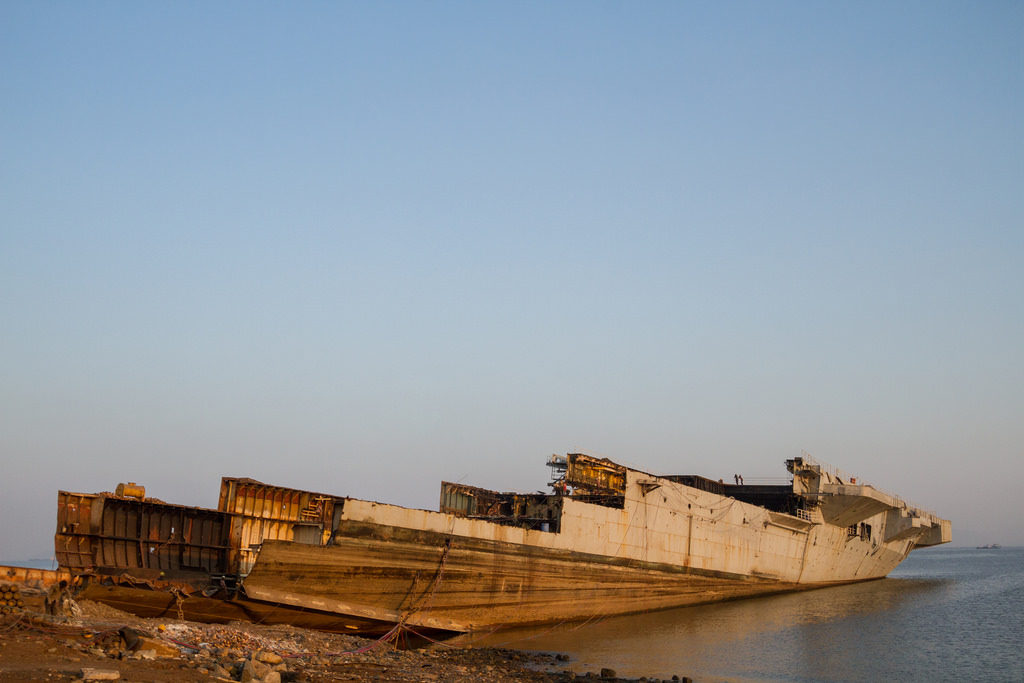
In August 2013, Vice Admiral Shekhar Sinha, Commander-in-Chief of Western Naval Command, said the Ministry of Defence would scrap the ship as she had become very difficult to maintain and no private bidders had offered to fund the museum's operations. On 3 December 2013, the Indian government decided to auction the ship. The Bombay High Court dismissed a public-interest lawsuit filed by Kiran Paigankar to stop the auction, stating the vessel's dilapidated condition did not warrant her preservation, nor were the necessary funds or government support available. In January 2014, the ship was sold through an online auction to a Darukhana ship-breaker for . The Supreme Court of India dismissed another lawsuit challenging the ship's sale and scrapping on 14 August 2014. Vikrant remained beached off Darukhana in Mumbai Port while awaiting the final clearances of the Mumbai Port Trust. On 12 November 2014, the Supreme Court gave its final approval for the carrier to be scrapped, which commenced on 22 November 2014.
On 7 April 2022, an FIR against an ex-MP Kirit Somaiya, his son Neil and others was registered, on charges of alleged cheating and criminal breach of trust linked to the collection of funds up to Rs. 57 crore for restoring the decommissioned aircraft carrier INS Vikrant. The Trombay Police booked them under Section 420 (cheating and dishonesty including delivery of property), Section 406 (punishment for criminal breach of trust) and Section 34 (common intentions) of the Indian Penal Code. According to the complaint, the father and son duo collected the money in 2013–14 in the name of restoring Vikrant, but the funds collected were spent on personal use. Somaiya was leading the front of attacking the government's intent of commercializing the decommissioned ship by handing it to private players.
Legacy
In memory of Vikrant, the Vikrant Memorial was unveiled by Vice Admiral Surinder Pal Singh Cheema, Flag Officer Commanding-in-Chief of the Western Naval Command at K Subash Marg at the Naval Dockyard of Mumbai on 25 January 2016. The memorial is made from metal recovered from the ship. In February 2016, the Indian automobile manufacturer Bajaj unveiled a new motorbike made with metal from Vikrants scrap and named it Bajaj V in honour of Vikrant.
The navy has named its first home-built carrier INS Vikrant in honour of INS Vikrant (R11). The new carrier is built by Cochin Shipyard Limited, and will displace 40000 t. The keel was laid down in February 2009 and she was launched in August 2013 under the premiership of then PM Dr. Manmohan Singh. The ship was commissioned on 2 September 2022 by PM Narendra Modi.
In popular culture
The decommissioned ship featured prominently in the film ABCD 2 as a backdrop while it was moored near Darukhana in Mumbai.
After the decommissioning of INS Vikrant, Mumbai-based artist Arzan Khambatta was approached by veterans who had served on the warship to create a sculpture in its memory. Using actual metal from the ship, Khambatta crafted a tribute that now stands at Lion Gate, a historic naval entrance in Mumbai.
Footnotes
References
Bibliography
References
- "HMS Hercules". Fleet Air Arm Archive.
- "INS Vikrant R11".
- "INS Vikrant (R11) – History, Specs and Pictures".
- "Indian Naval Aviation – Air Arm & its Carriers".
- Sanjai, P R. (14 March 2006). "INS Vikrant will now be made training school". [[Business Standard]].
- Sunavala, Nargish. (4 February 2006). "Not museum but scrapyard for INS Vikrant". [[The Times of India]].
- (30 January 2014). "Warship INS Vikrant heads for Alang death". Times of India.
- Naik, Yogesh. (10 August 2013). "Vikrant museum to be scrapped as Navy readies new carrier". [[Mumbai Mirror]].
- (4 December 2013). "Govt to auction decommissioned aircraft carrier INS Vikrant". First Post India.
- Sunavala, Nargish. (3 February 2014). "Not museum but scrapyard for INS Vikrant". Times of India.
- (24 February 2014). "Crushing museum dreams, court says INS Vikrant must be scrapped". Mumbai Mirror.
- (21 November 2014). "Dismantling Vikrant begins". [[Indian Express]].
- (22 November 2014). "India's first aircraft carrier slips into history | India News - Times of India".
- (3 February 2014). "Not museum but scrapyard for warship Vikrant". Times of India.
- (14 August 2014). "Activists move Supreme Court over Sale of INS Vikrant to Ship Breaker". Bihar Prabha.
- (22 November 2014). "India's first aircraft carrier slips into history". Times of India.
- Shaikh, Zeeshan. (8 April 2022). "Explained: The cheating case related to INS ''Vikrant'' in which BJP's Kirit Somaiya, son have been booked".
- "Vikrant Memorial at traffic Island near Lion Gate".
- (26 January 2016). "Bajaj V – A bike made of INS Vikrant's metal – Launching on February 1". [[The Financial Express (India).
- (2 February 2015). "Bajaj V: A Bike Made with INS Vikrant's Scrap unveiled". eHot News.
- (25 August 2013). "Comparison of Chinese Aircraft Carrier Liaoning and Indian INS Vikrant".
- Bhattacharjee, Sumit. (4 December 2020). "INS Vikrant may be inducted by 2022-23, says ENC Chief". The Hindu.
- "Varun poses before INS Vikrant". Bollywood Bazaar.
- arZan. (2016-01-25). "Arzan Khambatta Creates Memorial to Indian Naval Ship Vikrant".
This article was imported from Wikipedia and is available under the Creative Commons Attribution-ShareAlike 4.0 License. Content has been adapted to SurfDoc format. Original contributors can be found on the article history page.
Ask Mako anything about INS Vikrant (1961) — get instant answers, deeper analysis, and related topics.
Research with MakoFree with your Surf account
Create a free account to save articles, ask Mako questions, and organize your research.
Sign up freeThis content may have been generated or modified by AI. CloudSurf Software LLC is not responsible for the accuracy, completeness, or reliability of AI-generated content. Always verify important information from primary sources.
Report