From Surf Wiki (app.surf) — the open knowledge base
Inns of Court
Professional associations for barristers in England and Wales
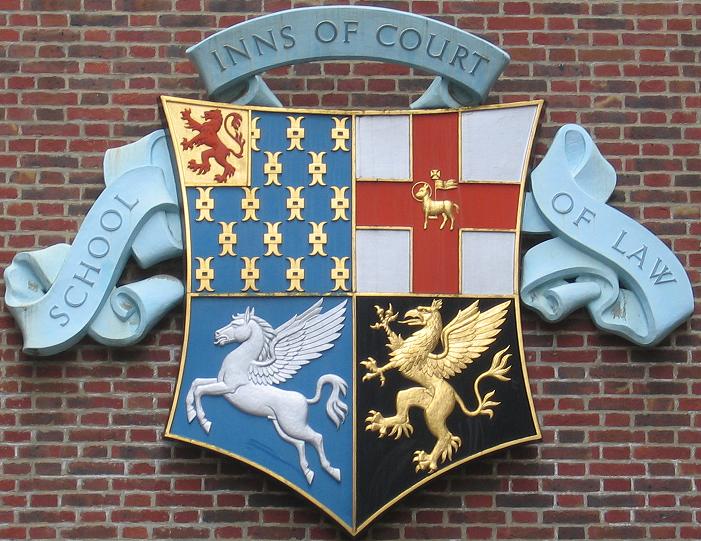
Professional associations for barristers in England and Wales
the London-based bodies
The Inns of Court in London are the professional associations for barristers in England and Wales. There are four Inns of Court: Gray's Inn, Lincoln's Inn, Inner Temple, and Middle Temple.
All barristers must belong to one of them. They have supervisory and disciplinary functions over their members, and provide libraries, dining facilities and professional accommodation. Each also has a church or chapel attached to it, and is a self-contained precinct where barristers traditionally train and practise. However, growth in the legal profession, together with a desire to practise from more modern and lower-rent accommodation, caused many barristers' chambers to move outside the precincts of the Inns of Court in the late 20th century.
History
During the 12th and early 13th centuries, law was taught in the City of London, primarily by the clergy. In 1219 Pope Honorius III promulgated Super Specula, prohibiting the clergy from studying secular law as opposed to canon law. As a result, English common law began to be practised and taught by laymen instead of clerics. To protect their schools from competition, first Henry II () and later Henry III () issued proclamations prohibiting the teaching of civil law within the City of London. The common-law lawyers worked in guilds of law, modelled on trade guilds, which in time became the Inns of Court.
In the earliest centuries of their existence, beginning with the 14th century, the Inns were any of a sizeable number of buildings or precincts where lawyers traditionally lodged, trained and carried on their profession. Over the centuries, the four Inns of Court became where barristers were trained, while the more numerous Inns of Chancery – which were initially affiliated to the Inns of Court – became associated with the training of solicitors in the Elizabethan era. |access-date = 21 April 2023
The four Inns of Court are:
- The Honourable Society of Lincoln's Inn
- The Honourable Society of the Inner Temple
- The Honourable Society of the Middle Temple
- The Honourable Society of Gray's Inn
Lawyers have lived and worked in the Temple since 1320. In 1337 the premises were divided into the Inner Temple, where the lawyers resided, and Middle Temple, which was also occupied by lawyers by 1346. Lincoln's Inn, the largest, is able to trace its official records to 1422. The records of Gray's Inn begin in 1569, but teaching is thought to have begun there in the late-fourteenth century. In 1620 a meeting of senior judges decided that all four Inns would be equal in order of precedence.
Until the 16th century students or apprentices learned their craft primarily by attending court sessions and by sharing both accommodation and education during the legal terms. Prior to the outbreak of the English Civil War in 1642, this training lasted at least seven years; subsequently, the Inns focused their residency requirements on dining together in the company of experienced barristers, to enable learning through contact and networking with experts. In the mid-18th century the common law was first recognised as a subject for study in the universities, and by 1872 bar examinations became compulsory for entry into the profession of law.
Importance in English Renaissance theatre
Main article: Revels (Inns of Court)
The Inns played an important role in the history of the English Renaissance theatre. Notable literary figures and playwrights who resided in the Inns of Court included John Donne (1572-1631), Francis Beaumont (1584-1616), John Marston (1576-1634), Thomas Lodge (-1625), Thomas Campion (1567-1620), Abraham Fraunce ( 1559- 1593), Sir Philip Sidney (1554-1586), Sir Thomas More (1478-1535), Sir Francis Bacon (1561-1626), and George Gascoigne (-1577). Plays written and performed in the Inns of Court include Gorboduc, Gismund of Salerne (1561), and The Misfortunes of Arthur (1588). An example of a famous masque put on by the Inns was James Shirley's The Triumph of Peace (1634). Shakespeare's The Comedy of Errors () and Twelfth Night () were also performed at the Inns, although written for commercial theatre.
Military tradition
Since at least 1584, members of the Inns of Court have taken arms to defend the realm during times of crisis. That tradition continues to the present, in that 10 Stone Buildings in Lincoln's Inn has been the permanent home of the Inns of Court & City Yeomanry since the building was freed up by the abolition of the Clerks of Chancery in 1842.
Membership and governance
Each of the four Inns of Court has three ordinary grades of membership: students, barristers, and more senior masters of the bench or "benchers", who constitute the governing body for each Inn and appoint new members from among existing barrister members. According to the rules any barrister member of the inn is eligible for appointment; in practice, appointments are made of senior members of the Bar, usually KCs, or High Court judges or those who carry out work on behalf of the Inn on committees or through the training of students and other junior members.
The senior bencher of each Inn is the Treasurer, a position which is held for one year only. Each Inn usually also has at least one royal bencher. Inns may also appoint honorary benchers, from academics, the world of politics and overseas judiciary.
The Inns of Court no longer provide all the education and training needed by prospective barristers, who must now pass the Bar Professional Training Course, but do provide supplementary education during the 'Bar School' year, pupillage and the early years of practice. All prospective Bar School students must be members of one of the four Inns, and must attend ten (formerly twelve) 'qualifying sessions' before being eligible to qualify as a barrister. Qualifying sessions traditionally comprise formal dinners followed by law-related talks, but increasingly the inns offer training weekends that may count for several sessions' worth of attendance. The Inns still retain the sole right to call qualified students to the bar, which is associated with a graduation ceremony ('Call Day').
Prospective students may choose which Inn to apply to for membership, but can only apply to one Inn for scholarships. It makes no long-term difference which Inn a barrister joins; an applicant might, for example, choose a particular inn because they know someone already a member, or it has a student association at their university.
The inns' disciplinary functions are carried out by a joint Council of the Inns of Court, which administers the disciplinary tribunals. When necessary barristers are prosecuted by the Bar Standards Board.
Location
Location and layout
The four inns are located near one another in central London, near the western boundary of the City of London. Nearby are the Royal Courts of Justice, which were moved for convenience from Westminster Hall to the legal quarter of London in 1882.
Middle Temple and Inner Temple are "liberties" of the City of London; although within the boundaries of the City they are not subject to its jurisdiction, and operate as their own local authorities. These two Inns neighbour each other and occupy the core of the Temple area. The closest Tube station is Temple.
Gray's Inn and Lincoln's Inn are in the London Borough of Camden (formerly in the Borough of Holborn) near the boundary with the City of London. They do not have the status of a local authority. The nearest Tube station is Chancery Lane.
Each Inn is a substantial complex with a great hall, chapel, libraries, sets of chambers for many hundreds of barristers, and gardens, and covers several acres. The layout is similar to that of an Oxbridge college. The chambers were originally used as residences as well as business premises by many of the barristers, but today they serve as offices with only a small number of residential apartments.
American Inns of Court
Main article: American Inns of Court
From the late 1970s, U.S. Chief Justice Warren Burger led a movement to create Inns of Court in the United States, loosely modelled after the traditional English Inns. In 1985, he and others established the American Inns of Court Foundation to promote and formally charter local Inns of Court across the United States. Each local Inn is devoted to promoting professionalism, civility, ethics, and legal skills amongst the American bench and bar, in a collegial setting, through continuing education and mentoring. Major American cities have more than one Inn of Court; for example, one Inn may be affiliated with a local law school, and another may be associated with a specific field of legal practice. American Inns of Court do not possess any real property. They are groups of judges, practising attorneys, law professors and students who meet regularly, usually monthly, to discuss and debate issues relating to legal ethics and professionalism. American Inn of Court meetings typically consist of a shared meal and a programme presented by one of the Inn's pupillage teams.
The U.S. does not require attorneys—not divided into barristers and solicitors—to be members of an Inn of Court, and many of the equivalent functions are performed by state bar associations. Some states require attorneys to belong to the official bar association, e.g., the State Bar of Michigan, while other states, such as Illinois, do not make membership of an official bar association a compulsory condition of licensure. Neither voluntary professional associations (including the American Inns of Court) nor mandatory bar associations typically have any role in training or licensing of law students that would be comparable to that function of the four English Inns of Court in selection and training of new barristers.
While the American Inns of Court share a collegial relationship with the English Inns, there is no formal or legal relationship. A Declaration of Friendship was signed by the English and American Inns of Court, establishing visitation procedures under which American Inn members can acquire a letter of introduction that will officially introduce them to the Inns in England and Ireland, with reciprocal procedures available for English and Irish barristers. An annual six-week exchange program, known as the Pegasus Scholarships, was created to provide for young English barristers to travel to the United States, and young American Inn of Court members to travel to London, to learn about the legal system of the other jurisdiction.
References
Notes
References
- {{cite EB1911. James C.. Webster
- Bellot, Hugh H.L.. (1902). "The Inner and Middle Temple: Legal, Literary and Historical Associations". Methuen & Co.
- {{cite EB1911. James C.. Webster
- {{cite EB1911. James C.. Webster
- [https://www.middletemple.org.uk/education-training/education-and-qualification-rules "Education and Qualification Rules"] at the Middle Temple website. (Retrieved 9 October 2020.)
- "The Inns of Court compared - Chambers Student Guide".
- Bellot, Hugh H.L.. (1902). "The Inner and Middle Temple: Legal, Literary and Historical Associations". Methuen & Co.
- (6 June 2014). "History".
- (2010). "Actors and Acting in Shakespeare's Time: The Art of Stage Playing". Cambridge Univ. Press.
- Cunningham, Karen J.. (2007). "Solon and Thespis: Law and Theater in the English Renaissance". University of Notre Dame Press.
- "Legal Services Act of 2007, Interpretation: Section 207". The National Archives.
- "Education and Training".
- Roberts, Chris. (2004). "Heavy Words Lightly Thrown: The Reason Behind the Rhyme". Granta Books.
- "History of the Inn: Origins". The Honourable Society of Lincoln's Inn.
- (2014). "English and Irish Inn Visits". American Inns of Court.
- (2014). "Pegasus Scholarships". American Inns of Court.
- Murphy, H.H. Judge Peter. (March–April 2014). "Inns Old and New: A Historic Yet Thoroughly Modern Connection". The Bencher.
- (2014). "Message from our President". American Inns of Court.
- (2014). "Frequently Asked Questions". American Inns of Court.
- "Call to the Bar".
- "COIC Group Final Report".
This article was imported from Wikipedia and is available under the Creative Commons Attribution-ShareAlike 4.0 License. Content has been adapted to SurfDoc format. Original contributors can be found on the article history page.
Ask Mako anything about Inns of Court — get instant answers, deeper analysis, and related topics.
Research with MakoFree with your Surf account
Create a free account to save articles, ask Mako questions, and organize your research.
Sign up freeThis content may have been generated or modified by AI. CloudSurf Software LLC is not responsible for the accuracy, completeness, or reliability of AI-generated content. Always verify important information from primary sources.
Report