From Surf Wiki (app.surf) — the open knowledge base
Influenza A virus subtype H7N9
Subtype of the influenza A virus

Subtype of the influenza A virus
Influenza A virus subtype H7N9 (A/H7N9) is a subtype of the influenza A virus, which causes influenza (flu), predominantly in birds. It is enzootic (maintained in the population) in many bird populations. The virus can spread rapidly through poultry flocks and among wild birds; it can also infect humans that have been exposed to infected birds.
A/H7N9 virus is shed in the saliva, mucus, and feces of infected birds; other infected animals may shed bird flu viruses in respiratory secretions and other body fluids.
Symptoms of A/H7N9 influenza vary according to both the strain of virus underlying the infection and on the species of bird or mammal affected. Classification as either Low Pathogenic Avian Influenza (LPAI) or High Pathogenic Avian Influenza (HPAI) is based on the severity of symptoms in domestic chickens and does not predict the severity of symptoms in humans. Chickens infected with LPAI A/H7N9 virus display mild symptoms or are asymptomatic, whereas HPAI A/H7N9 causes serious breathing difficulties, a significant drop in egg production, and sudden death.
In mammals, including humans, A/H7N9 influenza (whether LPAI or HPAI) is rare; it can usually be traced to close contact with infected poultry or contaminated material such as feces. Symptoms of infection vary from mild to severe, including fever, diarrhoea, and cough; the disease can often be fatal.
The A/H7N9 virus is considered to be enzootic (continually present) in wild aquatic birds, which may carry the virus over large distances during their migration. The first known case of A/H7N9 influenza infecting humans was reported in March 2013, in China. Cases continued to be recorded in poultry and humans in China over the course of the next 5 years. Between February 2013 and February 2019 there were 1,568 confirmed human cases and 616 deaths associated with the outbreak in China. Initially the virus was low pathogenic to poultry, however around 2017 a highly pathogenic strain developed which became dominant. The outbreak in China has been partially contained by a program of poultry vaccination which commenced in 2017.
Bird-adapted A/H7N9 transmits relatively easily from poultry to humans, although human to human transmission is rare. Its ability to cross the species barrier renders it a potential pandemic threat, especially if it should acquire genetic material from a human-adapted strain.
Virology
Main article: Influenza A virus
H7N9 is a subtype of Influenza A virus. Like all subtypes it is an enveloped negative-sense RNA virus, with a segmented genome. Influenza viruses have a relatively high mutation rate that is characteristic of RNA viruses. The segmentation of its genome facilitates genetic recombination by reassortment in hosts infected with two different strains of influenza viruses at the same time.
Figure 1 shows a diagramatic representation of the genetic relatedness of Asian H5N1 hemagglutinin genes from various isolates of the virus Through a combination of mutation and genetic reassortment the virus can evolve to acquire new characteristics, enabling it to evade host immunity and occasionally to jump from one species of host to another.
Highly pathogenic avian influenza
Epidemiology
Some species of wild aquatic birds act as natural asymptomatic carriers of a large variety of influenza A viruses, which they can spread over large distances in their annual migration. Symptoms of avian influenza vary according to both the strain of virus underlying the infection, and on the species of bird affected. Symptoms of influenza in birds may include swollen head, watery eyes, unresponsiveness, lack of coordination, respiratory distress such as sneezing or gurgling.
Humans and other mammals can only become infected with avian influenza, including A/H7N9, after prolonged close contact with infected birds or contaminated environments. In mammals including humans, infection with avian influenza (whether LPAI or HPAI) is rare. Symptoms of infection vary from mild to severe, including fever, diarrhoea, and cough.
As of February, 2024 there have been very few instances of human-to-human transmission, and each outbreak has been limited to a few people. All subtypes of avian Influenza A have potential to cross the species barrier into humans, with H5N1 and H7N9 considered the biggest threats.
History
Outbreak in China, 2013-2019
Prior to 2013, A/H7N9 had previously been isolated only in birds, with outbreaks reported in the Netherlands, Japan, and the United States. Until the 2013 outbreak in China, no human infections with A/H7N9 had been reported.
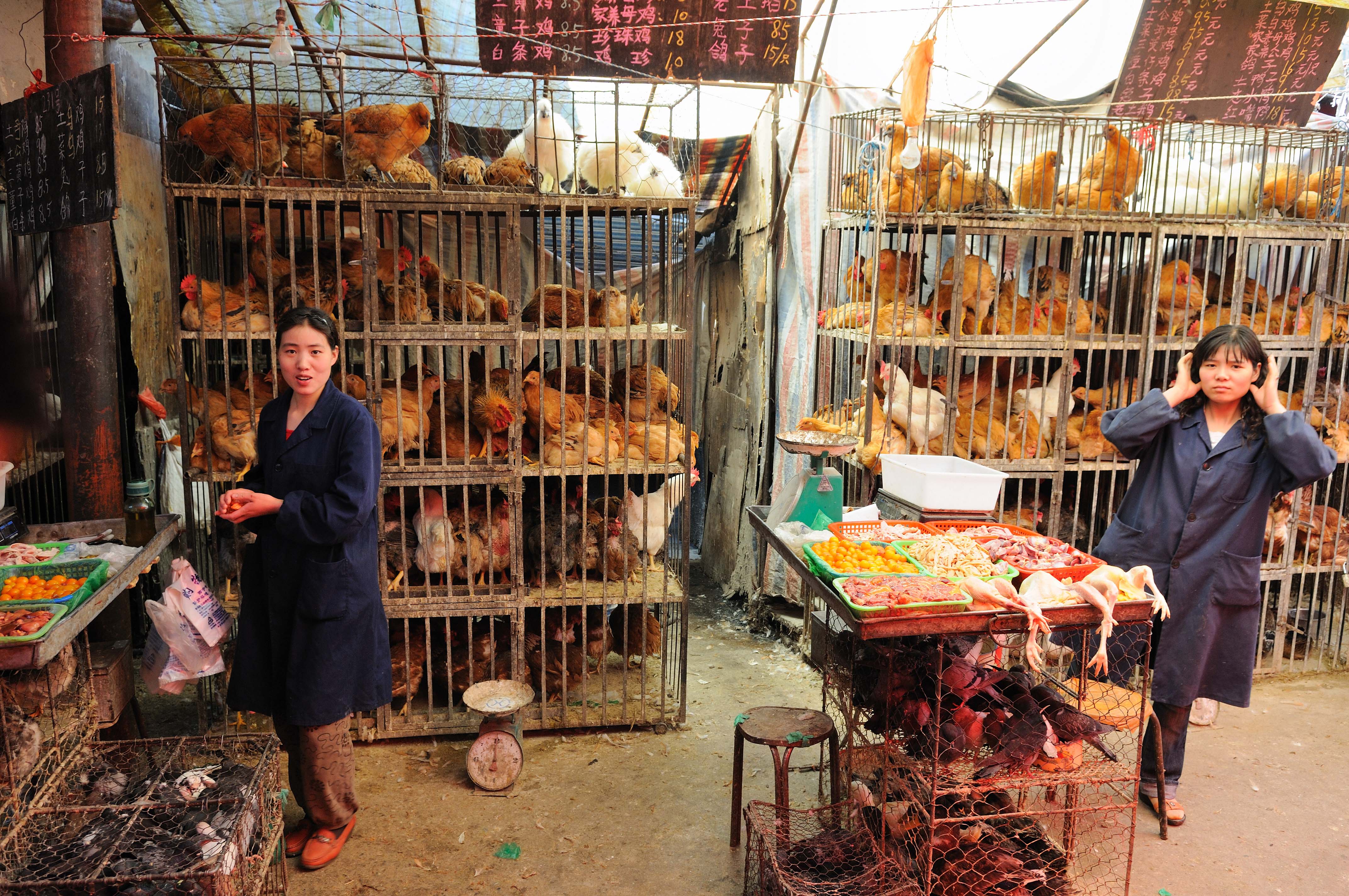
A significant outbreak of Influenza A virus subtype H7N9 (A/H7N9) started in March 2013 when severe influenza affected 18 humans in China; six subsequently died. It was discovered that a low pathogenic strain of A/H7N9 was circulating among chickens, and that all the affected people had been exposed in poultry markets. Further cases among humans and poultry in mainland China continued to be identified sporadically throughout the year, followed by a peak around the festival season of Chinese New Year (January and February) in early 2014 which was attributed to the seasonal surge in poultry production.
Infections among humans and poultry continued during the next few years, again with peaks around the new year. In 2016 a virus strain emerged which was highly pathogenic to chickens. In order to contain the HPAI outbreak, the Chinese authorities in 2017 initiated a large scale vaccination campaign against avian influenza in poultry. Since then, the number of outbreaks in poultry, as well as the number of human cases, dropped significantly. In humans, symptoms and mortality for both LPAI and HPAI strains have been similar. Although no human H7N9 infections have been reported since February 2019, the virus is still circulating in poultry, particularly in laying hens. It has demonstrated antigenic drift to evade vaccines, and remains a potential threat to the poultry industry and public health.
As of May 2022, a total of 1568 confirmed A(H7N9) human infections with 616 deaths have been reported, with a case fatality ratio (CFR) of 39%.
Genetic characterisation of the "Asian lineage" strain of avian influenza A/H7N9 shows that it was not related to A/H7N9 strains previously identified in Europe and North America. This new strain resulted from the recombination of genes between several parent viruses noted in poultry and wild birds in Asia. The H7 gene is most closely related to sequences found in samples from ducks in Zhejiang province in 2011.The N9 gene was closely related to isolated wild ducks in South Korea in 2011. Other genes resembled samples collected in Beijing and Shanghai in 2012. The genes would have been carried along the East Asian flyway by wild birds during their annual migration.
The genetic characteristics of Asian lineage A/H7N9 virus are of particular concern because of their pandemic potential. The virus is able to infect humans relatively easily, but does not sustain human-to-human transmission. If the virus were to acquire the ability to transmit easily between humans (either through mutation or genetic reassortment) there is potential for a severe epidemic or pandemic.
Other occurrences
During early 2017, outbreaks of avian influenza A(H7N9) occurred in poultry in the USA. The strain in these outbreaks was of North American origin and is unrelated to the Asian lineage H7N9 which is associated with human infections in China.
In May 2024, an HPAI A/H7N9 was detected on a poultry farm with 151,894 birds in Terang, Australia. There were 14,000 clinically affected birds. It is presumed that wild birds were the source of the outbreak.
An H7N9 outbreak in the US was confirmed on March 13, 2025, on a commercial broiler breeder chicken farm in Noxubee, Mississippi, housing 47,654 chickens. All 47,654 chickens were euthanized as a precautionary measure to prevent further spread of the virus.
Vaccine
The continuing evolution and antigenic drift of the A/H7N9 virus makes further development difficult as any significant outbreak could involve a completely new strain. A number of human vaccines targeting A/H7N9 have been trialled in relatively small groups of subjects; in the event of any outbreak, a candidate vaccine virus would be distributed to manufacturers
References
References
- (3 October 2023). "Influenza (Avian and other zoonotic)". [[World Health Organization]].
- (2024-04-19). "Prevention and Antiviral Treatment of Bird Flu Viruses in People {{!}} Avian Influenza (Flu)". [[Centers for Disease Control]].
- "Bird flu (avian influenza)". Department of Health & Human Services.
- (2021-11-18). "Avian influenza: guidance, data and analysis".
- (2022-06-14). "Avian Influenza in Birds". U.S. Centers for Disease Control and Prevention (CDC).
- (2022-12-13). "Bird flu (avian influenza): how to spot and report it in poultry or other captive birds". Department for Environment, Food & Rural Affairs and Animal and Plant Health Agency.
- (5 April 2013). "Frequently Asked Questions on human infection with influenza A(H7N9) virus, China". World Health Organization.
- (1 June 2022). "Avian Influenza A(H7N9) virus".
- (2021-11-18). "Avian influenza: guidance, data and analysis".
- (January 2017). "The ecology and adaptive evolution of influenza A interspecies transmission". Influenza and Other Respiratory Viruses.
- (April 2013). "The fight against bird flu". Nature.
- (2024-06-03). "2010-2019 Highlights in the History of Avian Influenza (Bird Flu) Timeline". U.S. Centers for Disease Control and Prevention (CDC).
- (8 January 2020). "Risk assessment of avian influenza A(H7N9) – eighth update".
- (December 2015). "The pandemic potential of avian influenza A(H7N9) virus: a review". Epidemiology and Infection.
- (2024-05-13). "Influenza A Subtypes and the Species Affected {{!}} Seasonal Influenza (Flu) {{!}} CDC". U.S. Centers for Disease Control and Prevention (CDC).
- (December 2023). "Antiviral resistance in influenza viruses". Cellular and Molecular Biology.
- (December 2005). "New genotype of avian influenza H5N1 viruses isolated from tree sparrows in China". Journal of Virology.
- (August 2017). "Evolution of Influenza A Virus by Mutation and Re-Assortment". International Journal of Molecular Sciences.
- (January 2015). "At the centre: influenza A virus ribonucleoproteins". Nature Reviews. Microbiology.
- (2022-12-13). "Bird flu (avian influenza): how to spot and report it in poultry or other captive birds".
- "Avian flu".
- (2024-02-01). "Influenza Type A Viruses". U.S. Centers for Disease Control and Prevention (CDC).
- (2021-11-18). "Avian influenza: guidance, data and analysis".
- (2024-02-01). "Reported Human Infections with Avian Influenza A Viruses {{!}} Avian Influenza (Flu)". U.S. Centers for Disease Control and Prevention (CDC).
- "Zoonotic influenza".
- "The next pandemic: H5N1 and H7N9 influenza?".
- (April 1, 2013). "China reports three H7N9 infections, two fatal". CIDRAP News.
- (2017-06-15). "Factsheet on A(H7N9)".
- (April 30, 2013). "OIE expert mission finds live bird markets play a key role in poultry and human infections with influenza A(H7N9)". [[World Organisation for Animal Health]].
- (June 2024). "Evolution and Antigenic Differentiation of Avian Influenza A(H7N9) Virus, China". Emerging Infectious Diseases.
- (November 2022). "Influenza A(H7N9) Pandemic Preparedness: Assessment of the Breadth of Heterologous Antibody Responses to Emerging Viruses from Multiple Pre-Pandemic Vaccines and Population Immunity". Vaccines.
- (May 2, 2013). "H7N9 gene tree study yields new clues on mixing, timing". CIDRAP News.
- (June 2013). "Origin and diversity of novel avian influenza A H7N9 viruses causing human infection: phylogenetic, structural, and coalescent analyses". Lancet.
- (June 2013). "Avian influenza A H7N9 in Zhejiang, China". Lancet.
- (8 January 2020). "Risk assessment of avian influenza A(H7N9) – eighth update".
- (25 November 2024). "Australia - High pathogenicity avian influenza viruses (poultry) (Inf. with) - Follow up report 21 [FINAL]".
- de La Hamalde, Sybille. (17 March 2025). "US reports first outbreak of deadly H7N9 bird flu since 2017".
- (November 2022). "Influenza A(H7N9) Pandemic Preparedness: Assessment of the Breadth of Heterologous Antibody Responses to Emerging Viruses from Multiple Pre-Pandemic Vaccines and Population Immunity". Vaccines.
- (23 February 2024). "Summary of status of development and availability of avian influenza A(H7N9) candidate vaccine viruses and potency testing reagents".
- (2024-03-12). "Selecting Viruses for the Seasonal Flu Vaccine". U.S. Centers for Disease Control and Prevention (CDC).
This article was imported from Wikipedia and is available under the Creative Commons Attribution-ShareAlike 4.0 License. Content has been adapted to SurfDoc format. Original contributors can be found on the article history page.
Ask Mako anything about Influenza A virus subtype H7N9 — get instant answers, deeper analysis, and related topics.
Research with MakoFree with your Surf account
Create a free account to save articles, ask Mako questions, and organize your research.
Sign up freeThis content may have been generated or modified by AI. CloudSurf Software LLC is not responsible for the accuracy, completeness, or reliability of AI-generated content. Always verify important information from primary sources.
Report