From Surf Wiki (app.surf) — the open knowledge base
Inflatable space habitat
Structure that can support life whose volume can be increased in outer space

Structure that can support life whose volume can be increased in outer space
Main article: Space habitat (facility)
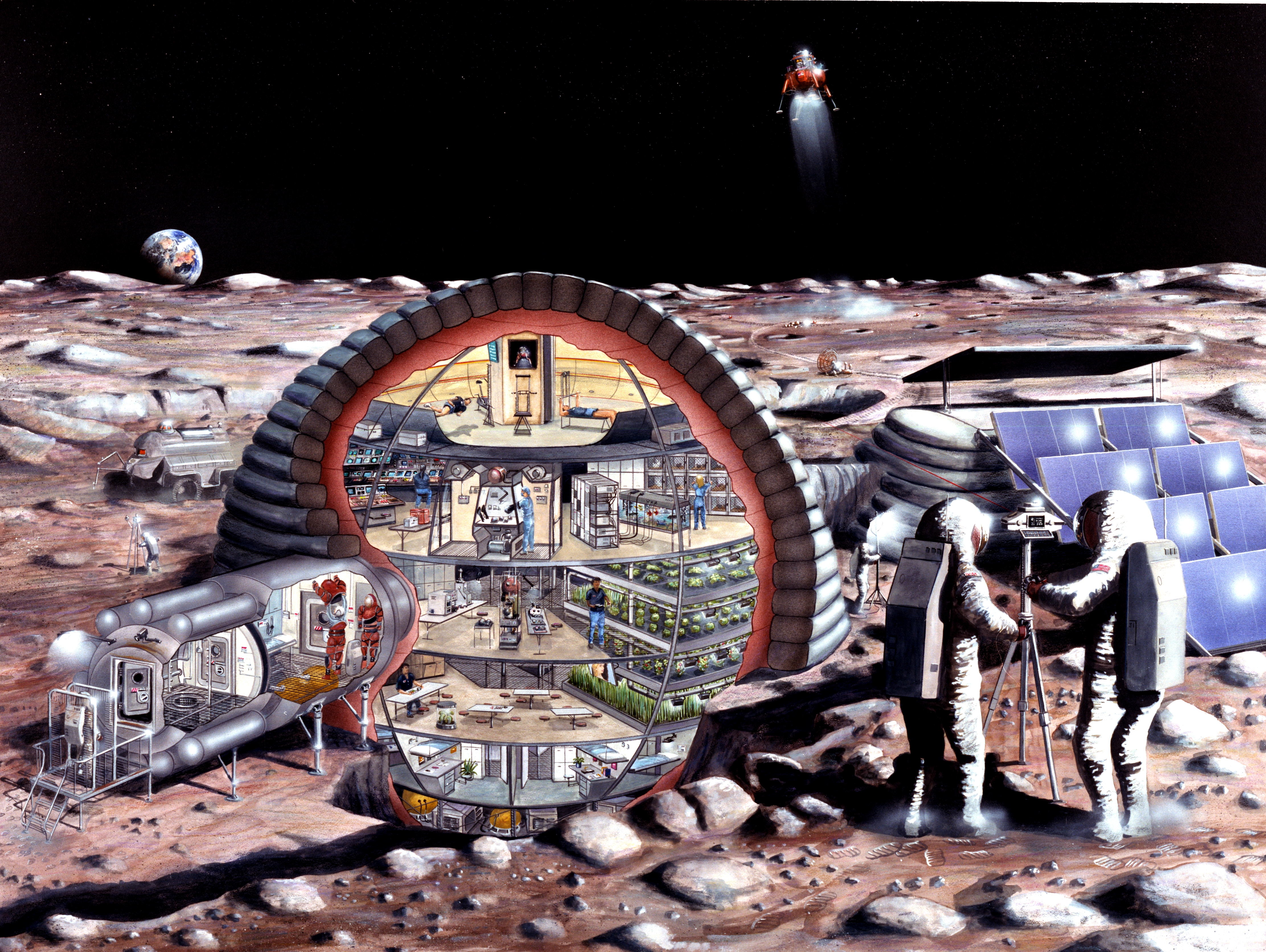
Inflatable habitats or expandable habitats are pressurized tent-like structures capable of supporting life in outer space whose internal volume increases after launch. They have frequently been proposed for use in space applications to provide a greater volume of living space for a given mass.
The first formal design and manufacture of an inflatable space habitat was in 1961 with a space station design produced by Goodyear (although this design was never flown). A proposal released in 1989 by Johnson Space Center's Man Systems Division outlined a 16 m diameter spherical habitat lunar outpost which was partially buried in the lunar surface.
An inflatable module called TransHab (a portmanteau of Transit Habitat) was proposed for the International Space Station, and later the private company Bigelow Aerospace revived the design for use in a number of potential civil and commercial applications.
Construction
The construction of an inflatable space habitat is determined by its design objectives. However common elements include interwoven layers of highly durable materials such as Kevlar and mylar around a flexible air bladder which is used to retain an atmosphere. The shape of the module is maintained by the pressure difference between the internal atmosphere and the outside vacuum. The inflatable Bigelow Aerospace modules have an internal core which provides structural support during its launch into orbit.


Ongoing research
Currently the main areas of research are being undertaken by Sierra Space and NASA. NASA is currently studying inflatable lunar bases with the planetary surface habitat and airlock unit which is in an early prototype phase, and has conceptual proposals for utilizing expandable-technology space structures in cislunar and interplanetary crewed exploration spacecraft.
Bigelow Aerospace development work
From its founding in 1998 until its closing in 2020, Bigelow Aerospace performed pioneering research and development work in coordination with NASA on inflatable space habitats. In 2021 Sierra Space was founded, which continued the development of inflatable space habitats in partnership with NASA.
Bigelow- Expandable Activity Module
Main article: Bigelow Expandable Activity Module
The Bigelow Expandable Activity Module (BEAM) was an experimental expandable space station module developed by the now defunct Bigelow Aerospace, under contract to NASA, for testing as a temporary module on the International Space Station (ISS) from 2016 to at least 2020. It arrived at the ISS on April 10, 2016, was berthed to the station on April 16, and was expanded and pressurized on May 28, 2016.
Bigelow- Commercial Space Station
The Bigelow Next-Generation Commercial Space Station, composed of two types of expandable space habitat modules, was announced in mid-2010. Bigelow Aerospace — Next-Generation Commercial Space Stations: Orbital Complex Construction , Bigelow Aerospace, accessed 2010-07-15. The initial build-out of the station was announced for 2014/2015, and would have consisted of two Sundancer modules and one B330 module. Bigelow has publicly shown space station design configurations with up to nine B330 modules containing 100000 cuft of habitable space Bigelow Aerospace Shows Off Bigger, Badder Space Real Estate, Popular Mechanics, 2010-10-28, accessed 2010-10-30. In 2011 the B330 was in final design with construction getting underway. Bigelow began to publicly refer to the initial configuration—two Sundancer modules and one B330 module—as "Space Complex Alpha" in October 2010. Bigelow still thinks big, The Space Review, 2010-11-01, accessed 2010-11-02.
In March 2020, Bigelow laid off all 88 of its employees. the company remains dormant and is currently considered defunct. In April 2021 Sierra Space was founded, which continued to develop inflatable space habitats as its predecessor Bigelow Aerospace had done previously.
NASA Multi-Mission Space Exploration Vehicle
Main article: Nautilus-X
In early 2011, NASA put forward a conceptual proposal for a long-duration crewed space transport vehicle which includes an artificial gravity space habitat intended to promote crew-health for a crew of up to six persons on missions of up to two years duration. Called the Multi-Mission Space Exploration Vehicle (MMSEV), the partial-G torus-ring centrifuge would utilize both standard metal-frame and inflatable spacecraft structures and would provide 0.11 to 0.69 G ({{#expr: 9.81 * 0.11 round 1}} -). NASA NAUTILUS-X: multi-mission exploration vehicle includes centrifuge, which would be tested at ISS , RLV and Space Transport News, 2011-01-28, accessed 2011-01-31.
Related to MMSEV is the ISS Centrifuge Demo, proposed in 2011 as a demonstration project preparatory to the final design of the larger torus centrifuge space habitat for the Multi-Mission Space Exploration Vehicle. The structure would have an outside diameter of 30 ft with a 30 in ring interior cross-section diameter and would provide 0.08 to 0.51 G ({{#expr: 9.81 * 0.08 round 1}} -). This test and evaluation centrifuge would have the capability to become a sleep module for ISS crew.
Sierra Space- LIFE Habitat
Main article: Large Integrated Flexible Environment
.jpg)
LIFE (Large Integrated Flexible Environment or Large Inflatable Fabric Environment) is an inflatable space habitat currently being developed by Sierra Space. The proposed Orbital Reef commercial space station includes multiple LIFE habitats in its design.
Lunar Surface Habitat
.jpg)
Lunar Surface Habitat is an inflatable habitat proposed by NASA for Artemis program.
Lockheed Martin inflatable habitat
Lockheed Martin is developing an inflatable habitat,{{Cite web|lang=en|author=Jim Vinoski
Max Space inflatable habitat
Max Space, a startup, is developing an inflatable habitat.
Chinese module
China is developing an inflatable module. A small module was launched with Shijian 19 on 27 September 2024.
Advantages
- All other factors being equal, the aerodynamic load any vehicle is subjected to as it travels through an atmosphere increases with the square of its diameter. Therefore, a launch vehicle's diameter must be kept to a minimum to ensure a reasonably safe and fuel-efficient ascent through the lower atmosphere. In contrast, a vehicle designed to travel in a vacuum can be engineered without regard for aerodynamics. Because the diameter of the habitat is not strictly constrained by the diameter of the launch (and, if desired, re-entry) vehicle(s), inflatables can have a greater volume of living space for a given mass.
- Some designs offer higher resistance to space debris. For example, the B330 provides ballistic protection superior to traditional aluminum shell designs. Bigelow Aerospace — Next-Generation Commercial Space Stations: BA 330 , Bigelow Aerospace, 2010, accessed 11 Jan 2011.
- Some designs provide higher levels of shielding against radiation. For example, the B330 provides radiation protection equivalent to or better than the International Space Station, "and substantially reduces the dangerous impact of secondary radiation."
Flight experience
The 1965 Voskhod 2 mission employed an inflatable airlock for the first ever EVA.
As of 2019, the only designs that have flown in space have been the Genesis I, Genesis II, and Bigelow Expandable Activity Module from Bigelow Aerospace.
References
References
- "GPN-2003-00106 - Inflatable Station Concept".
- Kim Dismukes (curator). (2003-06-27). "TransHab Concept". NASA.gov.
- [https://www.newscientist.com/news/news.jsp?id=ns99996347 Holidays in space are on the horizon], [[New Scientist]] article (September 4, 2004)
- [https://web.archive.org/web/20100724045042/http://www.bbc.co.uk/blogs/thereporters/jonathanamos/2010/07/boeing-flags-its-intentions-in.shtml], [[BBC]] article (July 23, 2010)
- "NASA - Camping on the Moon Will Be One Far Out Experience".
- Pearlman, Robert. (April 10, 2016). "SpaceX Dragon Arrives at Space Station, Delivers Inflatable Room Prototype". Space.com.
- (May 2024)
- Foust, Jeff. (March 23, 2020). "Bigelow Aerospace lays off entire workforce". [[SpaceNews]].
- [https://arstechnica.com/space/2023/08/trans-atlantic-joint-venture-aims-to-build-new-international-space-station/3/ Trans-Atlantic joint venture aims to build new “international” space station] ARSTechnica. By Stephen Clark. August 3, 2023. Accessed January 27, 2024
- [http://spirit.as.utexas.edu/~fiso/telecon/Holderman-Henderson_1-26-11/Holderman_1-26-11.ppt NAUTILUS - X: Multi-Mission Space Exploration Vehicle] {{Webarchive. link. (2011-03-04 , Mark L. Holderman, ''Future in Space Operations (FISO) Colloquium'', 2011-01-26, accessed 2011-01-31.)
- "LIFE Habitat (Large Integrated Flexible Environment) | Space Station | Sierra Space".
- [https://www.americaspace.com/2020/08/13/sierra-nevada-makes-progress-on-life-inflatable-habitat-for-lunar-mars-missions/ Sierra Nevada Makes Progress on LIFE Inflatable Habitat for Lunar, Mars Missions]
- Josh Dinner. (July 10, 2023). "Boom! Watch an inflatable space habitat explode during testing (video)".
- Jeff Foust. (April 9, 2024). "Max Space announces plans for inflatable space station modules".
- Devin Coldewey. (July 27, 2024). "Max Space reinvents expandable habitats with a 17th-century twist, launching in 2026".
- Andrew Jones. (November 22, 2024). "China quietly tested its first inflatable space module in orbit".
This article was imported from Wikipedia and is available under the Creative Commons Attribution-ShareAlike 4.0 License. Content has been adapted to SurfDoc format. Original contributors can be found on the article history page.
Ask Mako anything about Inflatable space habitat — get instant answers, deeper analysis, and related topics.
Research with MakoFree with your Surf account
Create a free account to save articles, ask Mako questions, and organize your research.
Sign up freeThis content may have been generated or modified by AI. CloudSurf Software LLC is not responsible for the accuracy, completeness, or reliability of AI-generated content. Always verify important information from primary sources.
Report