From Surf Wiki (app.surf) — the open knowledge base
Infinite dihedral group
Type of mathematical group

Type of mathematical group
| p1m1, (*∞∞) | p2, (22∞) | p2mg, (2*∞) | ||||||
|---|---|---|---|---|---|---|---|---|
| [[File:Frieze group m1.png | 120px]] | [[File:Frieze group 12.png | 120px]] | [[File:Frieze group mg.png | 120px]] | |||
| [[File:Frieze example p1m1.png | 120px]][[File:Frieze sidle.png | 120px]] | [[File:Frieze example p2.png | 120px]][[File:Frieze spinning hop.png | 120px]] | [[File:Frieze example p2mg.png | 120px]][[File:Frieze spinning sidle.png | 120px]] |
| In 2-dimensions three frieze groups p1m1, p2, and p2mg are isomorphic to the Dih∞ group. They all have 2 generators. The first has two parallel reflection lines, the second two 2-fold gyrations, and the last has one mirror and one 2-fold gyration. |
In mathematics, the infinite dihedral group Dih∞ is an infinite group with properties analogous to those of the finite dihedral groups.
In two-dimensional geometry, the infinite dihedral group represents the frieze group symmetry, p1m1, seen as an infinite set of parallel reflections along an axis.
Definition
Every dihedral group is generated by a rotation r and a reflection s; if the rotation is a rational multiple of a full rotation, then there is some integer n such that rn is the identity, and we have a finite dihedral group of order 2n. If the rotation is not a rational multiple of a full rotation, then there is no such n and the resulting group has infinitely many elements and is called Dih∞. It has presentations
:\langle r, s \mid s^2 = 1, srs = r^{-1} \rangle ,! :\langle x, y \mid x^2 = y^2 = 1 \rangle ,!
and is isomorphic to a semidirect product of Z and Z/2, and to the free product Z/2 * Z/2. It is the automorphism group of the graph consisting of a path infinite to both sides. Correspondingly, it is the isometry group of Z (see also symmetry groups in one dimension), the group of permutations α: Z → Z satisfying |i − j| = |α(i) − α(j)|, for all i, j in Z.
The infinite dihedral group can also be defined as the holomorph of the infinite cyclic group.
Aliasing
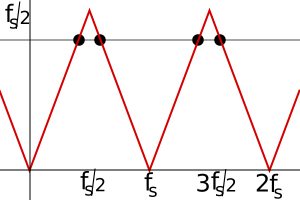
An example of infinite dihedral symmetry is in aliasing of real-valued signals.
When sampling a function at frequency f (intervals 1/f), the following functions yield identical sets of samples: }. Thus, the detected value of frequency f is periodic, which gives the translation element . The functions and their frequencies are said to be aliases of each other. Noting the trigonometric identity:
: \sin(2\pi (f+Nf_s)t + \varphi) = \begin{cases} +\sin(2\pi (f+Nf_s)t + \varphi), & f+Nf_s \ge 0, \[4pt] -\sin(2\pi |f+Nf_s|t - \varphi), & f+Nf_s \end{cases}
we can write all the alias frequencies as positive values: |f+Nf_s|. This gives the reflection (f) element, namely f ↦ −f. For example, with and , reflects to 0.4f, resulting in the two left-most black dots in the figure.In signal processing, the symmetry about axis f/2 is known as folding, and the axis is known as the folding frequency. The other two dots correspond to and . As the figure depicts, there are reflection symmetries, at 0.5f, f, 1.5f, etc. Formally, the quotient under aliasing is the orbifold [0, 0.5f], with a Z/2 action at the endpoints (the orbifold points), corresponding to reflection.
Notes
References
References
- (August 2004). "The surgery obstruction groups of the infinite dihedral group". Geometry & Topology.
- Meenaxi Bhattacharjee, Dugald Macpherson, Rögnvaldur G. Möller, Peter M. Neumann. Notes on Infinite Permutation Groups, Issue 1689. Springer, 1998. [{{Google books. 978-3-540-64965-6
This article was imported from Wikipedia and is available under the Creative Commons Attribution-ShareAlike 4.0 License. Content has been adapted to SurfDoc format. Original contributors can be found on the article history page.
Ask Mako anything about Infinite dihedral group — get instant answers, deeper analysis, and related topics.
Research with MakoFree with your Surf account
Create a free account to save articles, ask Mako questions, and organize your research.
Sign up freeThis content may have been generated or modified by AI. CloudSurf Software LLC is not responsible for the accuracy, completeness, or reliability of AI-generated content. Always verify important information from primary sources.
Report