From Surf Wiki (app.surf) — the open knowledge base
Inejirō Asanuma
Japanese socialist politician (1898–1960)
Japanese socialist politician (1898–1960)
| Field | Value |
|---|---|
| name | Inejirō Asanuma |
| native_name | 浅沼 稲次郎 |
| native_name_lang | ja |
| image | Inejiro Asanuma Salvaged (cropped).jpg |
| caption | Asanuma in 1952 |
| office1 | Chairman of the Japan Socialist Party |
| term_start1 | 23 March 1960 |
| term_end1 | 12 October 1960 |
| predecessor1 | Suzuki Mosaburō |
| successor1 | Saburo Eda (acting) |
| Jōtarō Kawakami | |
| office2 | General Secretary of the Japan Socialist Party |
| term_start2 | 13 October 1955 |
| term_end2 | 23 March 1960 |
| predecessor2 | Position established |
| successor2 | Saburo Eda |
| office3 | Member of the House of Representatives |
| constituency3 | Tokyo 1st (1946–1947) |
| Tokyo 1st (1947–1960) | |
| term_start3 | 11 April 1946 |
| term_end3 | 12 October 1960 |
| predecessor3 | Constituency established |
| successor3 | Kyōko Asanuma |
| constituency4 | Tokyo 4th (1936–1937) |
| Tokyo 3rd (1937–1942) | |
| term_start4 | 21 February 1936 |
| term_end4 | 30 April 1942 |
| predecessor4 | Park Choon-Geum |
| successor4 | Zenjuro Watanabe |
| office5 | Member of the Tokyo Metropolitan Assembly |
| constituency5 | Fukagawa Ward |
| term_start5 | 13 September 1943 |
| term_end5 | 10 April 1946 |
| birth_date | |
| birth_place | Miyake-jima, Tokyo, Japan |
| death_date | |
| death_place | Chiyoda, Tokyo, Japan |
| death_cause | Assassination (stab wound) |
| resting_place | Tama Cemetery, Tokyo |
| spouse | |
| alma_mater | Waseda University |
| party | Socialist |
| (1945–1951; 1955–1960) | |
| otherparty | FLP (1925) |
| JLFP (1926–1928) | |
| SMP (1932–1940) | |
| IRAA (1940–1942) | |
| Independent (1942–1945) | |
| RSP (1951–1955) |
Jōtarō Kawakami Tokyo 1st (1947–1960) Tokyo 3rd (1937–1942) (1945–1951; 1955–1960) JLFP (1926–1928) SMP (1932–1940) IRAA (1940–1942) Independent (1942–1945) RSP (1951–1955)
Inejiro Asanuma was a Japanese politician and leader of the Japan Socialist Party. During World War II, Asanuma was aligned with the Imperial Rule Assistance Association and advocated for war in Asia. Asanuma later became a forceful advocate of socialism in post-war Japan. He was noted for his support of the newly established People's Republic of China (PRC) as well as the criticism of United States–Japanese relations, making him a polarizing figure.
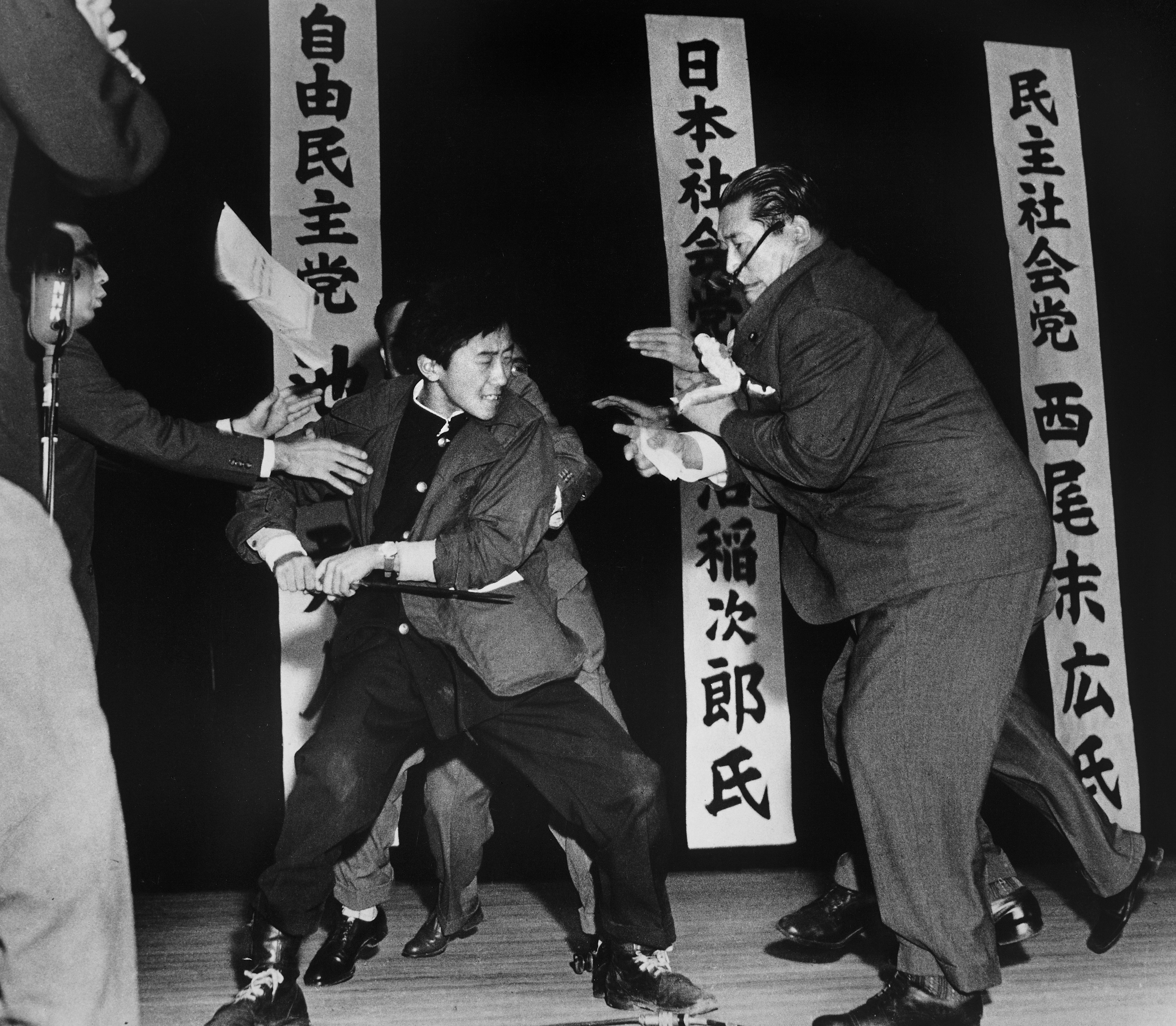
Asanuma was assassinated with a wakizashi, a traditional short sword, by 17-year-old far-right ultranationalist Otoya Yamaguchi while speaking in a televised political debate in Tokyo. His violent death was seen in graphic detail on national television by millions of Japanese, causing widespread public shock and outrage.
Early life and education
Asanuma was born on the island of Miyake-jima, a remote volcanic island that is administratively part of Tokyo, on 27 December 1898. His mother died in childbirth. He was consequently raised by his father, who later died of cancer, leaving Asanuma an orphan. After completing high school, Asanuma entered Waseda University, graduating in 1923. While still in college, Asanuma joined the newly formed Farmer-Labor Party and took part in various forms of leftist activism. Among other activities, he founded the "Builders League," which studied the works of English socialists, worked for Russian famine relief, and protested against military-related research being conducted at Waseda. In 1924, Asanuma left the Farmer-Labor Party after the party became divided into three different factions, and became involved in tenant organizing and the Labor-Farmer movement.
Political career
In 1926, Asanuma was one of the main founders of the Japan Labour-Farmer Party, as part of his efforts to link urban labor movements with rural peasant's movements. In 1929, Asanuma began running for Tokyo City Council, representing Fukagawa ward. He was elected in 1933. In 1936, Asanuma was elected to the National Diet of Japan for the first time, as a member of the newly-formed Social Masses Party, which merged into the Imperial Rule Assistance Association in 1940. Asanuma would serve in the Diet for a total of 20 years.
As a member of the Diet, Asanuma pivoted from his earlier anti-imperialist views and became a vocal supporter of Japan's "holy war" in East Asia, claiming that it was necessary to "liberate" Asia from the forces of western imperialism. He even led the drive to censure Saitō Takao and expel him from the Social Masses Party following the latter's anti-war speech on the floor of the Diet in 1940. Asanuma decided not to run for reelection in 1942, due to suffering a mental breakdown, despite securing a "recommendation" from the government.
In the immediate aftermath of Japan's defeat in World War II, Asanuma was one of the founders of the Japan Socialist Party (JSP). He rose to become its secretary-general (1955–1960) and eventually, party chairman (1960). As a politician, Asanuma cultivated an "everyman" image. He lived modestly in public housing his entire life, and was particularly popular among ordinary laborers, small shopkeepers, and other members of the working class.
In contrast to his pro-war stance during World War II, in the postwar period, Asanuma spearheaded the JSP's staunch opposition to revising Article 9 of Japan's postwar constitution and remilitarizing Japan. However, historian Andrew Gordon argues that Asanuma was consistent in his antipathy to western imperialism and a desire for Asia to chart its own course in world affairs.
In 1959, Asanuma was widely criticized for an incident in which he visited the People's Republic of China and called the United States "the shared enemy of China and Japan" during a speech in front of the Chinese Communist Party in Beijing. When he returned from this trip, he wore a Mao suit while disembarking from a plane in Japan, sparking criticism even from Socialist leaders. At this time, Japan, its ally the United States, and many other countries recognized the Republic of China as the legitimate government of China. Under Asanuma's leadership, the JSP played a leading role in the massive Anpo protests against revision of the U.S.–Japan Security Treaty in 1960, which led to the resignation of prime minister Nobusuke Kishi, angering rightists and ultranationalists who supported the treaty.
Assassination
Main article: Assassination of Inejirō Asanuma
On 12 October 1960, Asanuma was assassinated by 17-year-old Otoya Yamaguchi, a right-wing ultranationalist, during a televised political debate ahead of upcoming elections for the House of Representatives. While Asanuma spoke from the lectern at Tokyo's Hibiya Hall, Yamaguchi rushed onstage and ran his yoroi-dōshi, a traditional samurai short sword, through Asanuma's ribs on the left side, fatally wounding him. Japanese public broadcaster NHK was videorecording the debate for later transmission and the tape of Asanuma's assassination was shown many times to millions of viewers. The photograph of Asanuma's assassination won its photographer Yasushi Nagao both the Pulitzer Prize and World Press Photo of the Year.
Yamaguchi was captured at the scene of the crime, and a few weeks afterwards committed suicide by hanging himself while in police custody.
Commemoration
Asanuma's assassination shocked Japan's political establishment. Shortly after his death, conservative prime minister and erstwhile electoral rival Hayato Ikeda captured the mood of his fellow lawmakers when he gave a heartfelt eulogy for Asanuma on the floor of the Diet. Commemorating Asanuma as a "speech-giving everyman", Ikeda declared:
|You made service to the people the core of your political principles. Literally running from east to west, you were constantly appealing directly to the people with unrivaled eloquence and unmatched passion.
:’Numa truly is a speech-giving everyman :With his soiled clothes and tattered briefcase; :Today in this public hall, :Tomorrow at a roadside temple in Kyoto.
This is what Asanuma’s comrades used to sing about him back in the 1920s, when they were founding the Japan Labour-Farmer Party. Even after he became Chairman [of the JSP], this “speech-making everyman” spirit never showed the least sign of flagging. Even now, we all still have vivid recollections of you giving all those speeches in every corner of this nation.
According to reportage at the time, Ikeda's short speech was met with thunderous applause and left many lawmakers in tears.
Legacy
The Japan Socialist Party had been a union between left socialists, centrist socialists, and right socialists, who had been forced together in order to oppose the consolidation of conservative parties into the Liberal Democratic Party in 1955. Asanuma had been able to hold many of these mutually antagonistic factions together, and under Asanuma's leadership, the party had won an increasing amount of seats in the Diet in every election over the latter half of the 1950s and seemed to be gathering momentum.
Asanuma's death deprived the party of his leadership, and thrust Saburō Eda into the leadership role instead. A centrist, Eda rapidly took the party in a more centrist direction, far faster than the left socialists were ready to accept. This led to growing infighting within the party, and damaged its ability to present a cohesive message to the public. Over the rest of the 1960s and going forward, the number of seats the Socialists held in the Diet continued to decline until the party's extinction in 1996.
References
Works cited
References
- Tsurusaki, Tomokame. (1998). "浅沼稲次郎小伝". Taimatsu Shinsho.
- "私の履歴書 (浅沼 稲次郎 日本経済新聞社 )".
- "资讯_凤凰网".
- Kao, Michael Y.M.. (1988). "Taiwan in a Time of Transition". Paragon House.
- Chun, Jayson Makoto. (2006). "A Nation of a Hundred Million Idiots?: A Social History of Japanese Television, 1953–1973". Routledge.
- Langdon, Frank. (1973). "Japan's Foreign Policy". [[University of British Columbia Press]].
This article was imported from Wikipedia and is available under the Creative Commons Attribution-ShareAlike 4.0 License. Content has been adapted to SurfDoc format. Original contributors can be found on the article history page.
Ask Mako anything about Inejirō Asanuma — get instant answers, deeper analysis, and related topics.
Research with MakoFree with your Surf account
Create a free account to save articles, ask Mako questions, and organize your research.
Sign up freeThis content may have been generated or modified by AI. CloudSurf Software LLC is not responsible for the accuracy, completeness, or reliability of AI-generated content. Always verify important information from primary sources.
Report