From Surf Wiki (app.surf) — the open knowledge base
Indiana State Fair
Annual fair held in Indianapolis, Indiana, US

Annual fair held in Indianapolis, Indiana, US
| Field | Value |
|---|---|
| name | Indiana State Fair |
| logo | Indiana State Fair Logo.png |
| image | COLISEUMedited.jpg |
| caption | Main Street during the 2015 Indiana State Fair |
| status | Active |
| genre | State fair |
| date | |
| begins | |
| ends | |
| frequency | Annually |
| venue | Indiana State Fairgrounds & Event Center |
| location | Indianapolis, Indiana |
| coordinates | |
| country | U.S. |
| years_active | 1852–1860; 1865–1916; 1919–1941; 1945–2019; 2021– |
| first | |
| founder_name | |
| prev | August 1–August 17, 2025 |
| next | August 7–August 23, 2026 |
| attendance | 854,977 (2025) |
| leader_name | Cynthia Hoye (executive director) |
| organized | Indiana State Fair Commission |
| sponsor | |
| website |
The Indiana State Fair is an annual state fair that spans 15 days in August in Indianapolis, Indiana, U.S. The Indiana State Fair debuted in 1852 at Military Park in Indianapolis and is the sixth oldest state fair in the U.S. It is the largest event in the state, drawing between 730,000 and 980,000 visitors annually since 2010. In 2015, readers of USA Today ranked the Indiana State Fair among the ten best state fairs in the country.
The Indiana State Fairgrounds & Event Center has been the host site of the fair since 1892. Located about 4 mi north of downtown Indianapolis, it encompasses 214 acre, 72 buildings, a 6,000-seat grandstand, and a 1 mi racetrack. The complex is home to year-round tenants and is used throughout the year for a variety of other gatherings, including trade shows, sporting events, and concerts.
History
19th century
In February 1851, at the urging of Governor Joseph Wright, the Indiana General Assembly passed an act intended "to encourage agriculture" growth in the state, which also included the formation of a State Board of Agriculture. A primary goal of the board was to organize an Indiana State Fair. Indiana was the sixth state to begin holding an annual statewide agricultural fair. On October 20–22, 1852, Indiana's first state fair was held on the grounds of what is now Military Park, west of downtown Indianapolis. In 1860 a new location for the fairgrounds was established on approximately 38 acre along Alabama Street, north of the city.
During the American Civil War, the county fairgrounds was converted into Camp Morton, a prison camp for captured Confederate soldiers. In 1864, a sanitary fair was held as part of the larger state fair. In 1865, the fair was held in Fort Wayne. The gates opened at the Indiana State Fairgrounds on East 38th Street for the first time on September 19, 1892. Since then, the fair has continually been held in Indianapolis.
The Indiana State Fair has been held in Indianapolis for the majority of its existence. Other Indiana cities hosted the event during the 19th century, including Lafayette (1853); Madison (1854); New Albany (1859); Fort Wayne (1865); and Terre Haute (1867).
20th century

There was no fair held in 1917 and 1918 because of World War I nor from 1942 to 1944 because of World War II.
On October 31, 1963, a propane tank exploded in the Indiana State Fair Coliseum, killing 54 at the scene; another 27 died due to their injuries, with a total of 81 people killed. Around another 400 were injured. It is the deadliest disaster in Indianapolis history.
21st century
Historically, the fair lasted 12 days; however, it was expanded to 17 days (2009–2019), and then to 18 days (2021–2023). Starting in 2024, the event has been condensed down to 15 days.
On August 13, 2011, high winds from an approaching thunderstorm collapsed the roof over the grandstand stage just before Sugarland was about to perform, killing seven people and injuring 58. Concerts were moved indoors to the Fairgrounds Coliseum, and, during that building's renovation in 2013, events were moved to Bankers Life Fieldhouse and Lucas Oil Stadium. The coliseum reopened in 2014.
The COVID-19 pandemic caused the cancellation of the 2020 fair. The fair resumed in 2021 with some social distancing measures, but masks were not required.
Competitions
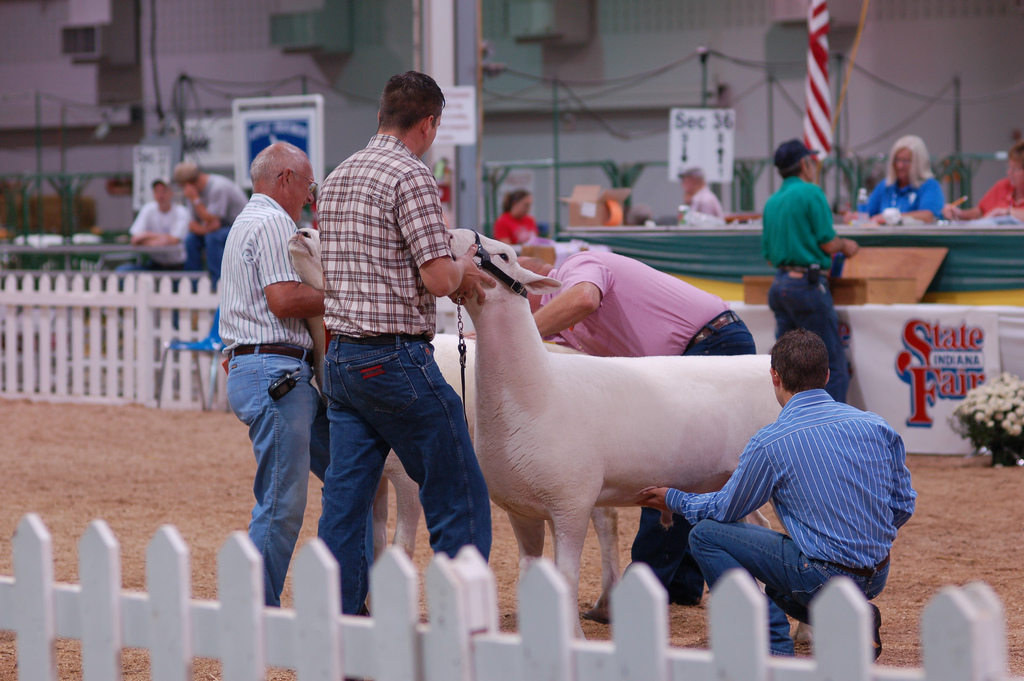
During each annual run of the Indiana State Fair, several competitions take place. The 4-H has a large participation in the fair and competitions are held in numerous areas for 4-H youth members. 4-H winners at county fairs can progress to the state fair with their livestock, crafts, gardening, or other exhibits. The winner at the state fair can, in some cases, advance to a national competition. The winners receive scholarships and other awards.
Other competitions also occur including art contests, a hot air balloon race, and a high school marching band contest, the Indiana State Fair Band Day on "Band Day". Adult competitions also occur in various farm-related categories.
The Indiana State Fairgrounds' mile-long oval track has hosted auto races for over a century. The AAA National Championship and USAC National Championship hosted car races in 1946 and from 1953 to 1970, traditionally under the name Hoosier Hundred. The USAC Silver Crown Series sanctioned the event since 1971. However, the track will be converted to a harness racing facility with an all-weather surface of crushed limestone. The half-mile dirt track in the infield will also be eliminated to allow more parking for the State Fair and other events. The conversion was originally scheduled to occur after the 2019 race, but the conversion was delayed until 2021; the 2021 race was originally scheduled to still be run at the Fairgrounds, but was moved to the Terre Haute Action Track.
Entertainment
Midway

The Midway is the area of amusement park rides and games. Fairgoers can either buy single-ride tickets or unlimited ride wristbands. Midway rides operate from noon until 10 or 11 pm depending on the day.
Performances
Numerous nationally known entertainers have performed at the Indiana State Fair.
On September 3, 1964, The Beatles performed two sold-out shows to a total audience of nearly 30,000 and, in 1989, New Kids on the Block set a Grandstand attendance record with 18,509 audience members.
The fair also presents Latino/Hispanic entertainment for Indiana's Hispanic population.
Presidential visits
In 1919, President Woodrow Wilson gave a speech to a crowd of 40,000 on a day known as "Big Thursday." Over the years, Presidents George W. Bush, Bill Clinton, John F. Kennedy, Franklin D. Roosevelt, Barack Obama, and Donald Trump have all made appearances at the fairgrounds.
Attendance

| Year | Attendance | Year | Attendance | Year | Attendance | Year | Attendance |
|---|---|---|---|---|---|---|---|
| 1988 | 571,230 | 1998 | 728,724 | 2008 | 859,600 | 2018 | 860,131 |
| 1989 | 593,676 | 1999 | 748,204 | 2009 | 973,902 | 2019 | 878,857 |
| 1990 | 639,335 | 2000 | 754,410 | 2010 | 950,000 | 2020 | canceled |
| 1991 | 676,693 | 2001 | 731,592 | 2011 | 872,312 | 2021 | 830,390 |
| 1992 | 722,218 | 2002 | 796,431 | 2012 | 853,941 | 2022 | 837,568 |
| 1993 | 689,924 | 2003 | 878,114 | 2013 | 978,296 | 2023 | 840,414 |
| 1994 | 672,872 | 2004 | 900,365 | 2014 | 954,884 | 2024 | 854,236 |
| 1995 | 591,680 | 2005 | 820,248 | 2015 | 907,000 | 2025 | 854,977 |
| 1996 | 701,021 | 2006 | 870,052 | 2016 | 731,543 | ||
| 1997 | 673,167 | 2007 | 746,421 | 2017 | 906,732 |
References
References
- Adams, Matt. (August 26, 2025). "Here's how Indiana State Fair attendance compared to last year". [[WXIN]].
- (June 19, 2024). "Indiana State Fair Commission 2023 Annual Report". Indiana State Fair Commission.
- Mason King. (August 23, 2024). "Indiana State Fair attendance rises slightly despite three fewer days". IBJ Media.
- (2021). "Indiana State Fair and Fairgrounds". Indianapolis Public Library.
- (June 19, 2024). "Indiana State Fair Commission 2023 Annual Report". Indiana State Fair Commission.
- (2015). "Best State Fairs: 2015 10 Best Readers' Choice Travel Awards".
- "Indiana State Fairgrounds and Event Center Collection {{!}} University Library".
- Ignatius Brown. (1994). ["Logan's History of Indianapolis from 1818"](https://archive.org/details/loganshistoryofi00brow}}; and {{cite book). Indiana University Press.
- "Indiana State Fair History". FunCityFinder.com.
- (4 Oct 1864). "Indiana State and Sanitary Fairs".
- "2011 Indiana State Fair". in.gov.
- Drabek, Thomas E.. (June 1996). "What Disaster Response Management Can Learn from Chaos Theory". [[California Research Bureau]].
- ''Wall Street Journal''. Jack Nicas, "[https://www.wsj.com/articles/SB10001424052702304356604577339923897959492 Faulty Planning, Stage Cited in Fair Collapse]". April 12, 2012.
- (January 13, 2012). "Indiana fair concerts going to expanded coliseum". The Herald Bulletin.
- (April 25, 2014). "Open house shows off newly renovated State Fairgrounds Coliseum". [[WTHR]].
- "COVID-19 Safety - Indiana State Fair".
- (31 July 2021). "Few masks at Indiana State Fair, but even people with higher COVID risks can't stay away". WISH-TV {{!}} Indianapolis News {{!}} Indiana Weather {{!}} Indiana Traffic.
- "Introduction". Indiana State Fair Board.
- Brown, Alex. "'Hoosier Hundred' to Leave State Fair After Track Conversion".
- Richie, Murray. (2021-04-20). "Sumar Classic Replaces Hoosier Hundred".
- (2024). "Midway Rides & Attractions".
- "Midway". Indiana State Fairgrounds & Event Center.
- (July 31, 2014). "1964: Hoosiers recall Beatles at Indiana State Fair". USA Today.
- Lindquist, David. "10 times Indy lost it because of a hot music act".
This article was imported from Wikipedia and is available under the Creative Commons Attribution-ShareAlike 4.0 License. Content has been adapted to SurfDoc format. Original contributors can be found on the article history page.
Ask Mako anything about Indiana State Fair — get instant answers, deeper analysis, and related topics.
Research with MakoFree with your Surf account
Create a free account to save articles, ask Mako questions, and organize your research.
Sign up freeThis content may have been generated or modified by AI. CloudSurf Software LLC is not responsible for the accuracy, completeness, or reliability of AI-generated content. Always verify important information from primary sources.
Report