From Surf Wiki (app.surf) — the open knowledge base
Indian Military Academy
Military academy in Dehradun, India
.jpg)
Military academy in Dehradun, India
| Field | Value |
|---|---|
| name | Indian Military Academy |
| native_name | भारतीय सैन्य अकादमी |
| native_name_lang | hi |
| former_name | Armed Forces Academy |
| image | Indian Military Academy.png |
| image_size | 200px |
| caption | Insignia of IMA |
| motto | वीरता और विवेक |
| (Veerta aur Vivek) | |
| motto_lang | Hindi |
| mottoeng | Valour and Wisdom |
| established | |
| type | Military Academy |
| officer_in_charge | Lt. Gen. Nagendra Singh |
| head_label | Commandant |
| head | Lt. Gen. Nagendra Singh |
| city | Dehradun |
| state | Uttarakhand |
| country | India |
| students | 1,650 |
| coordinates | |
| campus | Suburban |
| campus_size | 1400 acre |
| colours | Blood red and steel grey |
(Veerta aur Vivek)
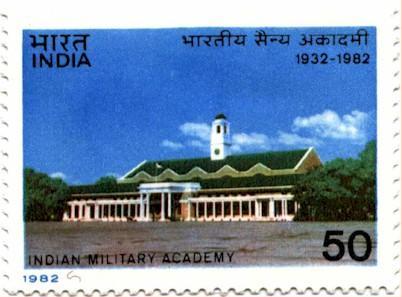
The Indian Military Academy (IMA) is one of the oldest military academies in India, and trains officers for the Indian Army. Located in Dehradun, Uttarakhand, it was established in 1932 following a recommendation by a military committee set up under the chairmanship of General (later Field Marshal) Sir Philip Chetwode. From a class of 40 male cadets in 1932, IMA now has a sanctioned capacity of 1,650. Cadets undergo a training course varying between 3 and 16 months depending on entry criteria. On completion of the course at IMA cadets are permanently commissioned into the army as Lieutenants.
The academy, spread over 1400 acre, houses the Chetwode Hall, Khetarpal Auditorium, Somnath Stadium, Salaria Aquatic Centre, Hoshiar Singh Gymnasium and other facilities that facilitate the training of cadets. Cadets in IMA are organized into a regiment with four battalions of four companies each. The academy's mission, to train future military leaders of the Indian Army, goes hand in hand with the character building enshrined in the IMA honour code, warrior code and motto. Cadets take part in a variety of sports, adventure activities, physical training, drills, weapons training and leadership development activities. Cadets have to learn and understand the philosophy of military assessment and selection following by three words Mansa, Vacha, and Karma - derived from Sanskrit indicates the cadet capabilities as a Psychologist, Interviewing Officer, and GTO – Group Testing Officer, respectively.
The academy's alumni include six recipients of India's highest military decoration, the Param Vir Chakra. Other achievements by alumni include 73 Military Crosses, 17 Ashoka Chakras, 84 Maha Vir Chakras and 41 Kirti Chakras. In 2017, Lieutenant Ummer Fayaz Parray was the 847th name to be engraved on the IMA War Memorial, which honours alumni of the academy who have fallen in the course of action.
Up to 1 October 2019, the 87th Raising Day, over 61,000 gentleman cadets had graduated and over 3,000 foreign cadets from over 30 other states, including Afghanistan, Singapore, Zambia, and Malaysia, had attended IMA for pre-commission training. Alumni have gone on to become Chief and Vice-Chief of Army Staff, Olympians and politicians. Foreign alumni have also done well in their countries, going on to becomes chiefs of their respective militaries, prime ministers, presidents and politicians.
History
Demands for an Indian military training academy
During the Indian independence movement, Indian leaders recognised the need for a local military institution to meet the needs of an armed force loyal to sovereign India. The Indianisation of the officer cadre of the army began in 1901, but it was only for the elite, and after training they were not allowed into the regular army. The British Raj was reluctant to commission Indian officers or permit local officer training. In 1905, natives could officer only Indian troops and by rank were not equal to commissioned British officers. Up to the outbreak of the First World War, the highest rank to which a native soldier of India could rise was Subedar, a rank lower than the lowermost officer rank of Subaltern.
But following the Indian military performance in the First World War, the Montagu–Chelmsford Reforms facilitated the officer training of 10 Indian commissioned officers at the Royal Military College, Sandhurst. In 1922, the Prince of Wales Royal Indian Military College (now known as the Rashtriya Indian Military College or just RIMC) was set up in Dehradun to prepare young Indians for admission to Sandhurst. The Indianisation of the Army started with the commissioning of 31 Indian officers. Among this first batch of officers to be commissioned was Sam Hormusji Framji Jamshedji Manekshaw, who became the Chief of Army Staff of the Indian Army in 1969 and later the first Indian Field Marshal. Despite demands from the Indian officers, the British resisted expansion of the Indian officer cadre. Indian leaders pressed the issue at the first Round Table Conference in 1930. The establishment of an Indian officer training college was one of the few concessions made at the conference. The Indian Military College Committee, set up under the chairmanship of General Sir Philip Chetwode, in 1931 recommended the establishment of an Indian Military Academy in Dehradun to produce forty commissioned officers twice a year following two and a half years of training.[[File:General Sir Philip Chetwode (LOC).jpg|thumb|Then [[General (United Kingdom)|General]] [[Philip Chetwode, 1st Baron Chetwode|Sir Philip Chetwode]]. He was promoted [[Field Marshal (United Kingdom)|Field Marshal]] in February 1933.|alt=|246x246px|left]]
Inauguration to Independence
The Government of India transferred the former property of the Railway Staff College of the Indian Railways, with its 206-acre campus and associated infrastructure, to the Indian Military Academy. Brigadier L.P. Collins was appointed the first Commandant and the first batch of 40 gentleman cadets (GC), as IMA trainees are known, began their training on 1 October 1932. The institute was inaugurated on 10 December 1932 by General Sir Philip Chetwode, 7th Bt. Chetwode was promoted to being a Field Marshal the following year, in February 1933. In 1934, before the first batch had passed out, Viceroy Lord Willingdon presented the first colours to the academy on behalf of King George V. The first batch of cadets to graduate the academy, graduating in December 1934, now known as the Pioneers, included Field Marshal Sam Manekshaw, General Muhammad Musa and General Smith Dun, who became the Army Chiefs of India, Pakistan, and Burma, respectively. General Dun graduated at the top of his class at IMA and also commanded the passing out parade for the first course. The second, third, fourth and fifth batches were called, respectively, Immortals, Invincible, Stalwarts and Bahadurs.{{Quote box (Maj Gen. A. S. Naravane (Retd) joined IMA on 29 January 1936)
Post-Independence
Following the Independence of India in August 1947 and the subsequent partition creating Pakistan, a number of British officers who were trainers in the academy left for Britain, while Pakistani cadets left for Pakistan. A total of 110 Pakistani cadets then continued their training at Pakistan Military Academy, Kakul. Brigadier Thakur Mahadeo Singh, DSO, was appointed the first Indian Commandant of the academy. The 189 GCs who graduated on 20 December 1947 were the first class from IMA to be commissioned into a free India.
In late 1947, the Chiefs of Staff of the Indian Armed Forces, following the recommendation of a 1946 committee headed by Field Marshal Sir Claude Auchinleck, decided to initiate an action plan to commission a new Joint Services training academy. In the interim, they decided to conduct Joint Services training at IMA. The academy was renamed the Armed Forces Academy and a new Joint Services Wing (JSW) was commissioned on 1 January 1949, while training of Army officers continued in the Military Wing. The academy was renamed as the National Defence Academy (NDA) on 1 January 1950, ahead of India becoming a Republic. In December 1954, when the new Joint Services training academy was established in Khadakwasla, near Pune, the NDA name along with the Joint Services Wing was transferred to Khadakwasla. The academy in Dehradun was then rechristened as the Military College. Brigadier M.M. Khanna, MVC was the first IMA alumni to be appointed Commandant of IMA at the end of 1956. In 1960, the founding name, Indian Military Academy, was reinstated. On 10 December 1962, on the 30th anniversary of the academy's inauguration, the second President of India, Dr. Sarvapalli Radhakrishnan, presented new colours to the academy.
After the Sino-Indian War of 1962, special measures were introduced. From 1963 until August 1964, the duration of regular classes was truncated, emergency courses were initiated, and new living quarters for cadets were added. However, unlike previous wars, the Indo-Pakistan War of 1965 and that of 1971 did not disrupt Academy training or graduation schedules. On 11 February 1971, William G Westmoreland, Chief of Staff, United States Army, visited the academy.
In 1976, the four battalions of the academy were renamed after Field Marshal Kodandera Madappa Cariappa, General Kodandera Subayya Thimayya, Field Marshal Sam Manekshaw and Lieutenant General Premindra Singh Bhagat, with two companies each. On 15 December 1976, then President Fakhruddin Ali Ahmed presented new colours to the academy. In the 1970s, the Army Cadet College (ACC) was shifted from Pune to Dehradun, becoming a wing of IMA. In 2006, the ACC was merged into IMA as the fifth battalion, the Siachen Battalion.
By 1 October 2019, the 87th Raising Day, the number of GCs to have graduated from IMA stood at 61,762, including foreign alumni from 33 friendly countries. Foreign countries included Angola, Afghanistan, Bhutan, Myanmar, Ghana, Iraq, Jamaica, Kazakhstan, Kyrgyzstan, Malaysia, Nepal, Nigeria, Palestine, Philippines, Singapore, Sri Lanka, Tajikistan, Tanzania, Tonga, Uganda, Yemen and Zambia.
Campus

The academy is in the Doon Valley (Dronacharya Ashram), Uttarakhand. National Highway 72, the Dehradun–Chakrata Road, separates the North and South Campus. The campus of the academy covers an area of 1400 acre. The Chetwode Hall on the drill square, built in 1930, houses the administrative headquarters of IMA and is also the hub of academic training. It has lecture halls, computer labs and a cafe. On the opposite side of the drill square is the Khetarpal Auditorium. Opened in 1982, it has a seating capacity of over 1,500. A newer wing of the Chetwode building, added in 1938, houses the central library. It has over 100,000 volumes and subscriptions to hundreds of periodicals from across the world, in addition to multimedia sections. In addition, there are two branch libraries closer to the cadet barracks across the campus.
The IMA museum on the campus displays artifacts of historic importance such as the pistol of Lieutenant General Amir Abdullah Khan Niazi of the Pakistan Army, given upon his surrender to Lt. Gen Jagjit Singh Aurora after signing the instrument of surrender to end the Bangladesh liberation war of 1971. A captured Pakistan Army Patton tank is also on the grounds.
Athletic facilities
The South Campus of IMA includes facilities such as the Somnath Stadium, with a seating capacity of 3,000, the Salaria Aquatic Centre, consisting of an Olympic sized swimming pool, and the Hoshiar Singh Gymnasium. The North Campus includes the polo ground along the Tons River. Tons Valley to the northwest of the campus is used for para-dropping, para-gliding, skydiving and battle training. Other facilities include stables with a stud farm, a small arms shooting range, and épée fencing from the modern pentathlon.
War memorial

The IMA War Memorial commemorates the alumni of the academy who died in action. At the sanctum sanctorum of the memorial is a bronze statue of a gentleman cadet with a sword presenting arms. The memorial was inaugurated by Field Marshal Manekshaw on 17 November 1999, shortly after the conclusion of the Kargil War. IMA officers led and fought in the war, with some of them becoming household names in India for their gallantry. Among their ranks were two Param Vir Chakra recipients and eight Maha Vir Chakra recipients. In 2017, Lieutenant Ummer Fayaz Parray was the 847th name to be engraved on the War Memorial.
Gentleman cadet life
There are various modes of entry into IMA, which include: on graduation from National Defence Academy, on graduation from Army Cadet College (a wing of IMA itself), direct entry through the Combined Defence Services Examination followed by SSB exams, and technical entry under university and college schemes. While those who gain entry into IMA go on to become permanently commissioned officers, those who go to the other officer training academies such as Officer Training Academy, Chennai are trained for short service commission. Depending on entry criteria married or unmarried male candidates are allowed to voluntarily apply for the course. Lady Cadets are not inducted into the Indian Army through IMA, though there has been talk of the same. IMA has a sanctioned capacity of 1,650.
A trainee on admission to IMA is referred to as a gentleman cadet (GC). One reason for this is that the academy expects its graduates to uphold the highest moral and ethical values. Inscribed in the oak paneling at the eastern entrance of the Chetwode Hall is the academy's credo, excerpted from the speech of Field Marshal Chetwode at the inauguration of the academy in 1932:
The freshman GCs hail from diverse backgrounds from all parts of India. The training is action-filled, intense, diverse, and fast. Significant emphasis is placed on self discipline. The official website of the Indian Army describes the training as "a test of one's mettle and capabilities, and in psychological terms a foretaste of what the trainees would face in the battlefield". On passing out GCs are permanently commissioned into the Army as Lieutenants.

Organization
IMA cadets are organized as a regiment with four training battalions, of four companies each. There were sixteen companies in 2013. Battalions are named after generals of the Indian Army (except for Siachen Battalion), while companies are named after battles in which the Army has participated.
- Cariappa Battalion: Kohima Company, Naushera Company, Poonch Company
- Thimayya Battalion: Alamein Company, Meiktila Company, Sangro Company
- Manekshaw Battalion: Imphal Company, Zojila Company, Jessore Company
- Bhagat Battalion: Sinhgarh Company, Keren Company, Cassino Company
- Siachen Battalion: Erstwhile Army Cadet College
Training
Technical graduates, ex-NDA, ex-ACC and university entry cadets undergo training at IMA for one year. Direct entry cadets train for one and a half years. A gentleman cadet gets a stipend of per month for the duration of the course (as per the 7th pay commission).
IMA's mission is to train future military leaders of the Indian Army. Physical training, drills, weapons training and leadership development form the focus of the training. Character building is embedded in the honour code of IMA "I shall not lie, steal or cheat, nor tolerate those who do so". From the honour code came the adoption of "The Gentleman Cadet's Resolve" and in turn the Credo, Honour Code and Resolve became the academy Trishul for conduct of cadets. The "Warrior Code" of IMA which has been adopted from the "Bhagwat Gita", the punch line of it being "I am a Warrior, fighting is my dharma;" also talks of compassion.
Training is broadly categorised into character building, service subjects and academic subjects. Service subjects give basic military knowledge up to the standard required for an infantry platoon commander. Academic subjects provide the cadet with a general education so as to enable a basic knowledge in professional subjects as well as enable cadets to clearly express themselves both verbally and in writing. In the early 1970s the service subjects to academic subjects ratio was 16:9 (64% service to 36% academic); this ratio was enhanced for technical graduates to a ratio of 83% service subjects and 27% academic subjects. Over time this ratio varied as per regular course entry or technical entry, and changed as terms were increased or decreased.[[File:Physical endurance training for GCs.jpg|thumb|Physical endurance training for GCs]] Weapon training includes the close quarter battle range, the location of miss and hit target system, jungle lane shooting and the team battle shooting range.
Games and sports include cross country, hockey, basketball, polo, athletics, football, aquatics, volleyball and boxing. There is also an annual sports meet with other military academies in India. Adventure activities undertaken at the academy include trekking, cycling, and rock climbing. In 2007 a cadet died in a grenade blast. In 2009 a cadet died by drowning. Between 2017 and 2019, three cadets died during training. Two cadets died of exhaustion during a 10 km run, while a third died after slipping into a gorge during a night navigation exercise. The academy requires that cadets get insurance against death and disability during training.
Passing out parade
One of the most well known traditions in the IMA is the passing out parade (POP). Before the cadets begin the POP, the band plays an aarti, allowing the cadets to pray to their respective gods. Traditionally, the adjutant leads the parade. In 2019, the reviewing officer for the 136th parade was Lt. Gen. Cherish Mathson. IMA has adopted a song penned by Javed Akhtar for its POPs — Bharat mata teri kasam, tere rakshak rahenge hum ().
During the POP, a civilian dignitary may also make a speech, as was the case during the passing out parade in 1962 when the President Dr. Sarvepalli. Radhakrishnan addressed the cadets, and in 2007 when the Prime Minister Manmohan Singh did so. In 1982, during the golden jubilee, Prime Minister Indira Gandhi inspected the POP while in 1992, the President R. Venkataraman reviewed the diamond jubilee POP (winter term). In 2006, President APJ Abdul Kalam was the reviewing officer at the POP.
The finale is the antim pag (final step), where cadets take the last step into Chetwode Hall. However the POP on 11 June 1961 was called off without the final step due to weather, the only instance where this has happened for a passing out batch. The tradition of cap-flinging during the passing out parade has a long past but it was replaced by the cadets doing celebratory pushups. The passing out also consists of traditions such as presentation of a "Sword of Honour" to the best GC. Notable recipients of the Sword of Honour include the first Chief of Defence Staff Bipin Rawat (in 1978) and the Olympian and union minister Col. Rajyavardhan Singh Rathore (in 1990).
Notable Gallantry Awardees
File:Major Somnath Sharma.jpg|Somnath Sharma File:Captain Gurbachan Singh Salaria.jpg|Gurbachan Singh Salaria File:Major Hoshiar Singh.jpg|Hoshiar Singh Dahiya File:Second Lieutenant Arun Khetarpal statue at Param Yodha Sthal Delhi.jpg|Arun Khetarpal File:Manoj Kumar Pandey.jpg|Manoj Kumar Pandey File:Captain Vikram Batra Portrait.jpg|Vikram Batra File:Arun Singh Jasrotia.jpg|Arun Singh Jasrotia File:Sudhir Kumar Walia.jpg|Sudhir Kumar Walia File:Triveni Singh.jpg|Triveni Singh File:Maj. Mohit Sharma (1 Para SF).jpg|Mohit Sharma
Param Vir Chakra Awardees
-
Maj Somnath Sharma
-
Capt Gurbachan Singh Salaria
-
Col Hoshiar Singh Dahiya
-
2/Lt Arun Khetarpal
-
Capt Manoj Kumar Pandey
-
Capt Vikram Batra
Ashok Chakra Awardees
- 2/Lt Pollur Mutthuswamy Raman
- Capt Ummed Singh Mahra
- Lt Ram Prakash Roperia
- Maj Bhukant Mishra
- 2/Lt Rakesh Singh Malhan
- Col Neelakantan Jayachandran Nair, KC
- Capt Sandeep Sankhla
- Maj Rajiv Kumar Joon, SC
- Capt Arun Singh Jasrotia, SM
- 2/Lt Puneet Nath Datt
- Lt Col Shanti Swaroop Rana
- Maj Sudhir Kumar Walia, SM**
- Lt Triveni Singh
- Capt Harshan R Nair
- Col Vasanth Venugopal
- Maj Dinesh Raghu Raman
- Maj Sandeep Unnikrishnan
- Maj Mohit Sharma, SM
Sports Achivements
- Col Rajyavardhan Singh Rathore AVSM - Won a Silver medal at the 2004 Summer Olympics
- Col Balbir Singh Kullar - Captain of the Indian hockey team in the 1971 Hockey Worldcup
- Maj Gen Mohammed Amin Naik - Arjuna Award in Rowing
- Maj DP Singh - India's first Blade Runner
Alumni from British Indian Army assigned to Bangladesh, Myanmar, Pakistan Armies
- Air Marshal Asghar Khan – 1st native Commander-in-Chief of the Pakistan Air Force
- General M. A. G. Osmani – Commander-in-Chief of the Bangladesh Mukti Bahini
- Lt. General Khwaja Wasiuddin – General in Pakistan Army and Bangladesh Army, member of Nawab of Dhaka family
- General Yahya Khan – 5th Commander-in-Chief of Pakistan Army and third President of Pakistan
- General Tikka Khan – 1st Chief of Army Staff (Pakistan)
- General Gul Hassan Khan – 6th Commander-in-Chief of Pakistan Army
- General Zia-ul-Haq – 2nd Chief of Army Staff (Pakistan) and sixth President of Pakistan
- Lt. General. Sahabzada Yaqub Khan – Pakistan Ambassador to the United States and later the Foreign Minister
- Brigadier Aslam Khan – Captured Kennedy Peak (Myanmar) in World War II and served as Chief of War Plans CENTO
- General Musa Khan – 4th Commander-in-Chief of Pakistan Army
- Lt. General Habibullah Khan Khattak – 6th Chief of General Staff (Pakistan)
- Captain Raja Muhammad Sarwar – Recipient of Nishan-i-Haider, Pakistan Army
- Major Tufail Mohammad – Recipient of Nishan-i-Haider, Pakistan Army
- Major General Muhammad Anwar Khan – Engineer In Chief, Pakistan Army
- Maj. General Smith Dun – Chief of Army Staff Myanmar Army, Sword of Honour IMA
International alumni
Some of IMA's International alumni include:
- General Ibrahim Ismail – Chief of Staff of the Malaysian Armed Forces
- General Ibrahim Babangida – former military president of Nigeria
- Captain Tunku Ismail Sultan Ibrahim – Crown prince of Johor state, Malaysia
- Sher Mohammad Abbas Stanikzai – an Afghan Taliban politician
- Sultan Sallehuddin — Sultan of Kedah State, Malaysia
In popular culture
The 2004 Bollywood film Lakshya is partly shot in IMA as well as the Tamil film Vaaranam Aayiram. In 2015 Tanushree Podder penned a novel called On The Double: Drills, Drama, and Dare-Devilry at the Indian Military Academy, a fictional portrayal of a gentleman cadet's life. Making of a Warrior, a documentary by Dipti Bhalla and Kunal Verma, provides an inside look at IMA's culture, traditions and training regime. The 2023 Indian biopic film Sam Bahadur also featured IMA.
References
- (2025-02-08). "What is SSB Services Selection Board - History, Preparation".
- (1997). "Where Gallantry is Tradition: Saga of Rashtriya Indian Military College : Plantinum Jubilee Volume, 1997". Allied Publishers.
- "About Us".
- Chopra, Jaskiran. (30 July 2018). ""Notes from Dehra Dun, July 30, 1931": How The Pioneer reported about the beginnings of the IMA".
- Chetwode, Philip. (Spring 2012). "Address by Field Marshal Sir Philip Chetwode". [[Centre for Land Warfare Studies]].
- Chopra, Jaskiran. (22 September 2017). "How IMA became functional in September, 85 long years ago!".
- Dun, Gen Smith. "Memoirs of the Four Foot Colonel". [[Cornell University]] Southeast Asia Program.
- (21 April 2008). "Careers in the Army: How you can sign up".
- "Beginning to Independence".
- ''[https://web.archive.org/web/20190925094219/https://indianarmy.nic.in/writereaddata/documents/Heritage120516.pdf IMA Heritage]''. Indian Army. Retrieved from the [https://indianarmy.nic.in/writereaddata/documents/Heritage120516.pdf original] on 25 September 2019.
- "IMA History – Beginning to Independence".
- (2017-08-25). "Culture, Conflict and the Military in Colonial South Asia". Routledge India.
- ANI. (2017-12-21). "IMA first batch celebrates Platinum Jubilee in Delhi". Business Standard India.
- "Independence to Silver Jubilee".
- Deka, Kaushik. (21 August 2017). "National Defence Academy: Steel in our spine".
- "NDA History".
- Khanduri, Chandra B.. (1969). "Thimayya:An Amazing Life". Centre for Armed Historical Research, United Service Institution of India, New Delhi through Knowledge World.
- "History Of NDA".
- Indian Military Academy. [https://web.archive.org/web/20180516231722/http://joinindianarmy.nic.in/writereaddata/Portal/Images/pdf/IMA_144_TGC_JOINING_INSTRS_20_JUN17.pdf Joining Instructions for Gentleman Cadets Indian Army]. Archived from the [http://joinindianarmy.nic.in/writereaddata/Portal/Images/pdf/IMA_144_TGC_JOINING_INSTRS_20_JUN17.pdf original] on 5 August 2019.
- Varma, Ashali. (2014-06-27). "The Victoria Cross: A Love Story: The life of Lt Gen P S Bhagat PVSM, VC: World War II Hero and author of the Henderson Brooks/Bhagat Report on the India-China War". Ashali Varma.
- "ACC Wing A Glimpse".
- "Siachin Bn (ACC Wing)".
- (2 October 2019). "87th raising day of IMA celebrated".
- "Foreign Cadets".
- (8 December 2009). "Rajnath announces two underpasses at IMA".
- Rawat, Rachna Bisht. (2017-10-15). "Shoot, Dive, Fly: Stories of Grit and Adventure from The Indian Army". Penguin Random House India Private Limited.
- "IMA Campus and Landmarks".
- (6 December 2018). "Important Landmarks and Institutions of the IMA Campus".
- Alexander, Deepa. (2016-03-18). "A town called Dehra". The Hindu.
- Masih, Archana. (4 June 2016). "7 States. 6 Days. 2,148 km and a journey of a lifetime".
- (25 August 2018). "IMA's Chushul Company wins prestigious Colonel Hoshiar Singh, PVC Trophy".
- link. (4 August 2019 on 4 August 2019.)
- Sujlana, Lt Gen R. Singh. (16 May 2017). "Making of a warrior & the ultimate sacrifice". The Tribune.
- Ministry of Defence. [https://mod.gov.in/sites/default/files/AR1516.pdf ''Annual Report 2015-16''] {{Webarchive. link. (25 September 2019 . Government of India. pg 129. Retrieved on 25 September 2019.)
- "Permanent Commission: Indian Military Academy, Dehradun".
- "Recruitment and Training". Ministry of Defence, Government of India.
- (21 January 2020). "IMA ready to welcome women". Business Standard.
- (17 February 2020). "SC verdict on permanent commission to women officers". The Hindu.
- Dutta, Amrita Nayak. (2019-12-10). "Army proposal to disband Officers Training Academy in Gaya gets defence ministry nod".
- Chopra, Jaskiran. (8 June 2018). "Down Memory lane: Vignettes of the Indian Military Academy".
- "Life of a GC".
- Recruiting Directorate Website (Jul 2020). [https://joinindianarmy.nic.in/writereaddata/Portal/NotificationPDF/TGC_131.pdf Join Indian Army: 131st Technical Graduate Course (TGC-131)]. Retrieved on 20 March 2020. [https://web.archive.org/web/20191102081641/https://joinindianarmy.nic.in/writereaddata/Portal/NotificationPDF/TGC_131.pdf Archived] on 2 November 2019.
- Pote, Amol Ramdas. (2019-03-20). "Antim Pag: Life begins here!". Notion Press.
- "IMA Training".
- (2013-08-11). "Pay And Allowances Of Gentleman Cadet At IMA, Dehradun".
- "Location of Miss and Hit (LOMAH) RTLP-MCX Range Design Guide". U.S. Army Corps of Engineers.
- (2014). "Prepared and Armed: Team Shooting Tactics for Home Defense". Penguin.
- (13 June 2016). "Wah ustad! A look at the unsung heroes of IMA".
- Chopra, Jaskiran. (10 March 2007). "IMA cadet killed after grenade blows up in training".
- (10 August 2009). "IMA cadet's body sent home in 'rotting' state".
- Kumar, Yogesh. (15 May 2019). "Why IMA cadets are dying during training?".
- Budhwar, Yeshika. (22 August 2017). "Indian Military Academy: 'Routine run' kills second IMA cadet in 2 days; 5 in hospital".
- (2018-07-11). "Two IMA cadets died despite best treatment: Army". The Economic Times.
- (2019-05-07). "IMA cadet dies during navigation exercise". The Economic Times.
- Tikku, Aloke. (24 August 2017). "Court Of Inquiry Ordered Into Death Of 2 Cadets At Indian Military Academy".
- Tuli, Manoj. (21 August 2017). "Demise of Gentleman Cadets at Indian Military Academy".
- Jha, Prashant. (8 June 2019). "IMA POP: A few beliefs and traditions".
- Jha, Prashant. (31 May 2019). "Lt Gen Cherish Mathson to be reviewing officer of POP".
- Kazmi, S M A. (2 October 2007). "IMA adopts Javed Akhtar's song for passing out parade".
- (10 December 2007). "PM's address at the Indian Military Academy Passing Out Prade : Speeches : Prime Minister of India – Dr. Manmohan Singh".
- (2017-12-09). "UP tops list as 487 officers graduate from Indian Military Academy".
- Oberoi, Vijay. (12 June 2017). "Down Memory Lane: A Parade to Savour".
- (11 December 2010). "No caps tossed this time".
- Basu, Indranil. (9 December 2012). "IMA's cap-flinging tradition bites dust".
- Budhwar, Yeshika. (11 December 2016). "Sword of Honour: Odisha boy gets Sword of Honour".
- ''[https://web.archive.org/web/20181009052813/https://indianarmy.nic.in/writereaddata/images/ima_images/Sword-of-Honour.pdf List of Sword of Honour Recipients]''. Indian Army. Archived from the [https://indianarmy.nic.in/writereaddata/images/ima_images/Sword-of-Honour.pdf original] on 9 October 2018. Retrieved on 17 October 2019.
- (2019-04-04). "Lok Sabha elections 2019: After successful debut, MP Rajyavardhan Rathore seeks second innings".
- Khan, Asghar. (2008). "My Political Struggle". Oxford University Press.
- (31 August 2018). "Lest We Forget, The Legacy Of MAG Osmani".
- "Wasiuddin, Lt General Khwaja".
- (26 October 2013). "General Yahya Khan | Former Army Chief of Pakistan enforcing Martial Law in 1969".
- (12 November 2013). "NOTHING BUT!". Partridge Publishing.
- "Muhammad Zia-ul-Haq.".
- (27 January 2016). "Pakistan's prince soldier, diplomat, statesman". Express Tribune.
- Singh, K. Brahma. (1990). "History of Jammu and Kashmir Rifles, 1820-1956: The State Force Background". Lancer International.
- (1959). "Cahiers de l'Orient contemporain". G.P. Maisonneuve.
- [https://www.pakistantoday.com.pk/2016/07/27/capt-sarwar-shaheed-pakistans-first-ever-nishan-e-haider-recipient-remembered/ Captain Sarwar Shaheed, Pakistan's first ever Nishan-e-Haider award recipient remembered] Pakistan Today (newspaper), Published 27 July 2016, Retrieved 4 November 2018
- (2000). "Globe: Major Tufail Mohammad". A. Mahmood.
- April 1940 Indian Army List
- . (26 January 2011). ["Tun Ibrahim Ismail"](https://www.telegraph.co.uk/news/obituaries/military-obituaries/special-forces-obituaries/8284728/Tun-Ibrahim-Ismail.html). *[[The Daily Telegraph]]*.
- (2012). "Ibrahim Babangida". Adonis & Abbey Publishers Ltd.
- [https://web.archive.org/web/20070930192158/http://www.bernama.com/bernama/v3/news_lite.php?id=190803 Johor Ruler's Grandson Appointed Raja Muda]. [[Bernama]]. 8 April 2006.
- (28 June 2013). "'IMA Talib' a key figure in Doha talks with US".
- (2 June 2015). "Ashraf Ghani slams Pakistan for waging 'undeclared war'".
- Alexander, Deepa. (2015-11-16). "When the bugle calls". The Hindu.
- (24 June 2015). "Watch Official Indian Military Academy Documentary".
- (23 September 2016). "Making of a Warrior – IMA, Dehradun (Dipti Bhalla & Shiv Kunal Verma)".
This article was imported from Wikipedia and is available under the Creative Commons Attribution-ShareAlike 4.0 License. Content has been adapted to SurfDoc format. Original contributors can be found on the article history page.
Ask Mako anything about Indian Military Academy — get instant answers, deeper analysis, and related topics.
Research with MakoFree with your Surf account
Create a free account to save articles, ask Mako questions, and organize your research.
Sign up freeThis content may have been generated or modified by AI. CloudSurf Software LLC is not responsible for the accuracy, completeness, or reliability of AI-generated content. Always verify important information from primary sources.
Report