From Surf Wiki (app.surf) — the open knowledge base
Index card
Standard sized card for recording data
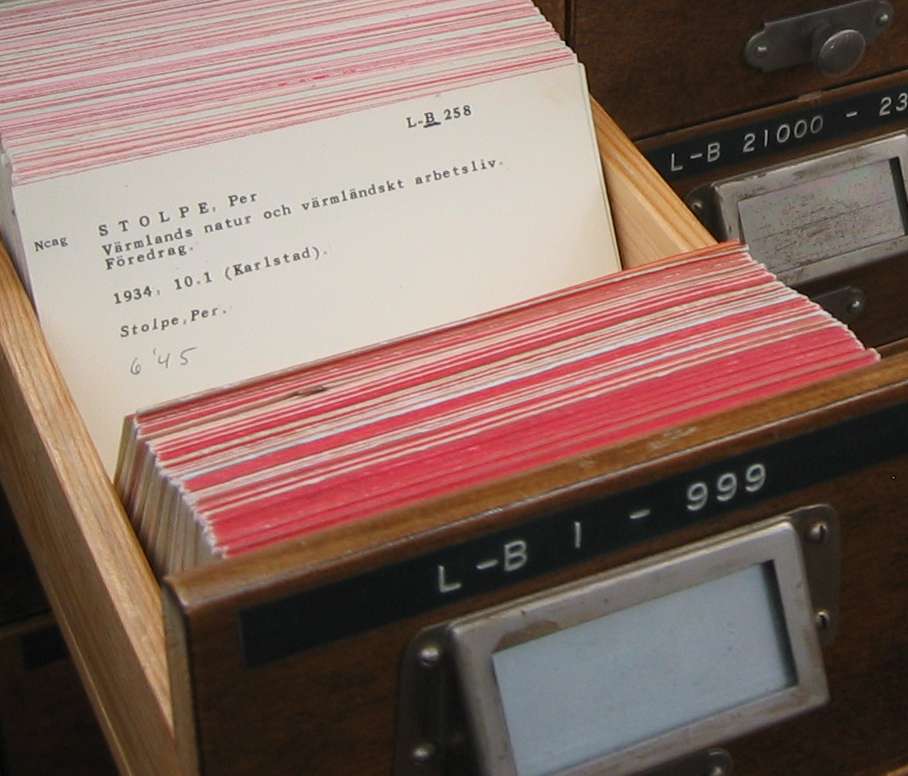
Standard sized card for recording data


An index card (record card in British English and system card in Australian English) consists of card stock (heavy paper) cut to a standard size, used for recording and storing small amounts of discrete data. A collection of such cards either serves as, or aids the creation of, an index for expedited lookup of information (such as a library catalog or a back-of-the-book index). This system is said to have been invented by Carl Linnaeus, around 1760.
Format
The most common size for index card in North America and the UK is 3 by, hence the common name 3-by-5 card. Other sizes widely available include 4 by, 5 by and ISO-size A7 (74 by). Cards are available in blank, ruled and grid styles in a variety of colors. Special divider cards with protruding tabs and a variety of cases and trays to hold the cards are also sold by stationers and office product companies. They are part of standard stationery and office supplies all around the globe.
Uses
Index cards are used for a wide range of applications and environments: in the home to record and store recipes, shopping lists, contact information and other organizational data; in business to record presentation notes, project research and notes, and contact information; in schools as flash cards or other visual aids; and in academic research to hold data such as bibliographical citations or notes in a card file. Professional book indexers used index cards in the creation of book indexes until they were replaced by indexing software in the 1980s and 1990s.
An often suggested organization method for bibliographical citations and notes in a card file is to use the smaller 3-inch by 5-inch cards to record the title and citation information of works cited, while using larger cards for recording quotes or other data, but some people have also given the opposite advice to put everything on one size of card.
Index cards are used for many events and are helpful for planning.
History

The first early modern card cabinet was designed by 17th-century English inventor Thomas Harrison ( 1640s). Harrison's manuscript on the "ark of studies" (Arca studiorum) describes a small cabinet that allows users to excerpt books and file their notes in a specific order by attaching pieces of paper to metal hooks labeled by subject headings. Harrison's system was edited and improved by Vincent Placcius in his well-known handbook on excerpting methods (De arte excerpendi, 1689).
Carl Linnaeus, an 18th-century naturalist who formalized binomial nomenclature, is said to have "invented the index card" in order to help deal with the information overload facing early scientists that occurred from overseas discoveries, though there is room for dispute about whether he alone was the index card's inventor. Linnaeus had to deal with a conflict between needing to bring information into a fixed order for purposes of later retrieval, and needing to integrate new information into that order permanently. His solution was to keep information on particular subjects on separate sheets, which could be complemented and reshuffled. In the mid 1760s Linnaeus refined this into what are now called index cards. Index cards could be selected and moved around at will to update and compare information at any time.
In the late 1890s, edge-notched cards were invented, which allowed for easy sorting of data by means of a needle-like tool. These edge-notched cards were phased out in the 1980s in favor of computer databases, and they are no longer sold.
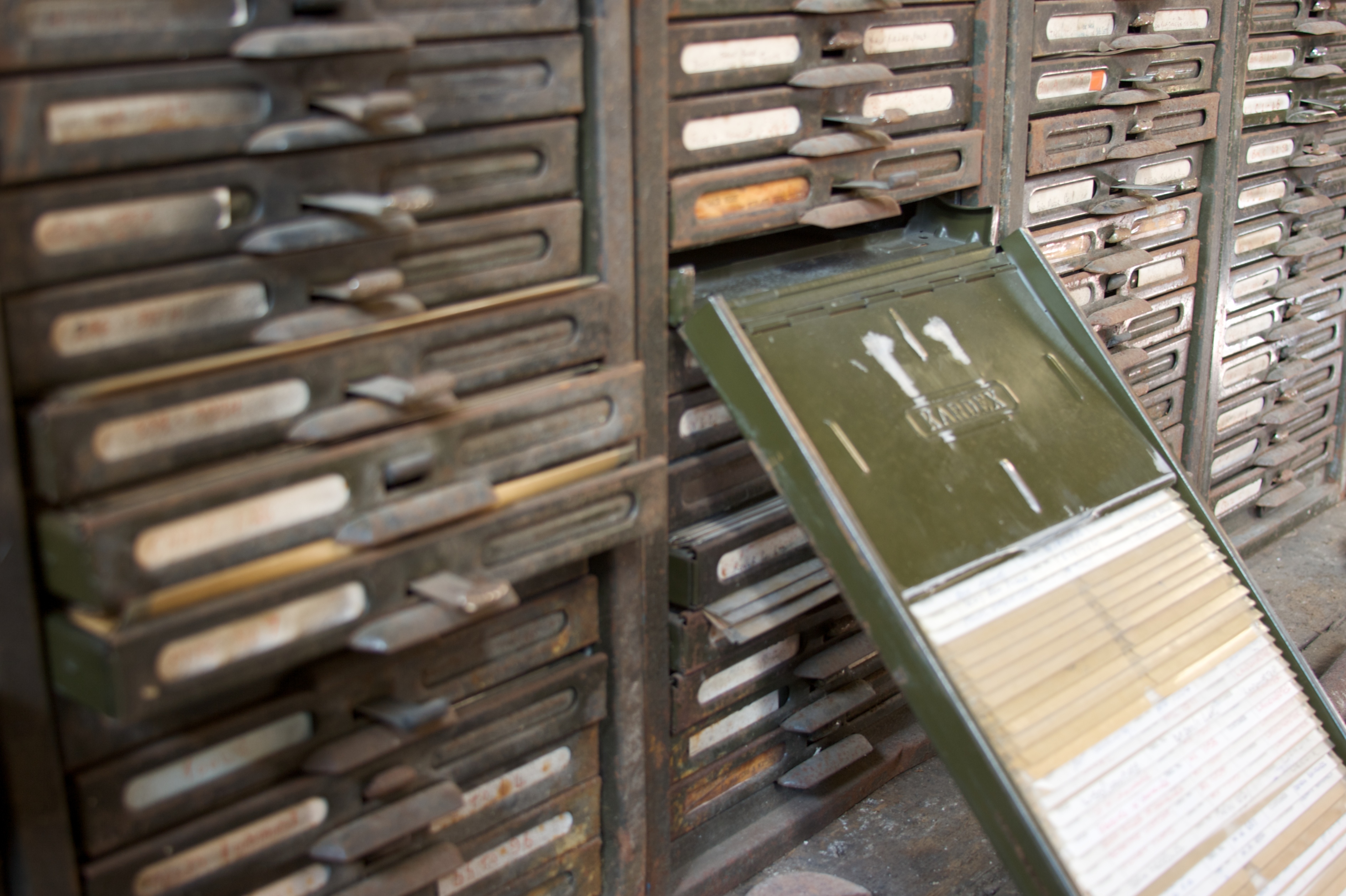
James Rand, Sr.'s Rand Ledger Company (founded 1898) with its Visible Ledger system, and his son James Rand, Jr.'s American Kardex dominated sales of index card filing systems worldwide through much of the 20th century. "Kardex" became a common noun, especially in the medical records field where "filing a kardex" came to mean filling out a patient record on an index card.
Library card catalogs as currently known arose in the 19th century, and Melvil Dewey standardized the index cards used in library card catalogs in the 1870s. Until the digitization of library catalogs, which began in the 1980s, the primary tool used to locate books was the card catalog, in which every book was described on three cards, filed alphabetically under its title, author, and subject (if non-fiction). Similar catalogs were used by law firms and other entities to organize large quantities of stored documents. However, the adoption of standard cataloging protocols throughout nations with international agreements, along with the rise of the Internet and the conversion of cataloging systems to digital storage and retrieval, has made obsolescent the widespread use of index cards for cataloging.
Many authors have used index cards for the writing of books. Vladimir Nabokov wrote his works on index cards, a practice mentioned in his work Pale Fire.
References
References
- (January 2009). "Indexing Nature: Carl Linnaeus (1707–1778) and his Fact-Gathering Strategies". Centre for Medical History, [[University of Exeter]].
- (2016). "Information Overload". Distillations.
- "Index card sizes compared".
- "Business card sizes".
- Williams, Cecil B.. (1963). "A Research Manual for College Studies and Papers". Harper & Row.
- (1967). "How to Study History". [[Crowell Publishing]].
- Hockett, Homer Carey. (1948). "Introduction to Research in American History". Macmillan.
- (1958). "How to Locate Educational Information and Data: An Aid to Quick Utilization of the Literature of Education". Teachers College, Columbia University.
- (2004). "The Modern Researcher". [[Thomson/Wadsworth]].
- (1999). "The Facilitator's Fieldbook: Step-by-Step Procedures, Checklists and Guidelines, Samples and Templates". [[AMACOM]].
- Harrison, Thomas. (2017). "The Ark of Studies". [[Brepols]].
- (2017-12-01). "How the Index Card Cataloged the World".
- Placcius, Vincent. (1689). "De arte excerpendi vom gelehrten Buchhalten liber singularis, quo genera & praecepta excerpendi, ab aliis hucusq[ue]; tradita omnia, novis accessionibus aucta, ordinata methodo exhibentur, et suis quaeque materiis applicantur ...". Apud Gottfried Liebezeit, bibliop. literisq[ue] Spiringianis.
- Malcolm, Noel. (September 2004). "Thomas Harrison and his 'ark of studies': an episode in the history of the organization of knowledge". [[The Seventeenth Century (journal).
- (2007). "Taxonomy: what's in a name? Doesn't a rose by any other name smell as sweet?". Croatian Medical Journal.
- (March 2012). "Natural history and information overload: the case of Linnaeus". Studies in History and Philosophy of Biological and Biomedical Sciences.
- (April 2014). "Carl Linnaeus's botanical paper slips (1767–1773)". Intellectual History Review.
- (16 June 2009). "Carl Linnaeus Invented The Index Card".
- (2008). "Kardex".
- Krajewski, Markus. (2011). "Paper Machines: About Cards & Catalogs, 1548–1929". [[The MIT Press]].
- Gold, Herbert. (1967). "Vladimir Nabokov, The Art of Fiction No. 40". The Paris Review.
This article was imported from Wikipedia and is available under the Creative Commons Attribution-ShareAlike 4.0 License. Content has been adapted to SurfDoc format. Original contributors can be found on the article history page.
Ask Mako anything about Index card — get instant answers, deeper analysis, and related topics.
Research with MakoFree with your Surf account
Create a free account to save articles, ask Mako questions, and organize your research.
Sign up freeThis content may have been generated or modified by AI. CloudSurf Software LLC is not responsible for the accuracy, completeness, or reliability of AI-generated content. Always verify important information from primary sources.
Report